Category Archives: Reviews

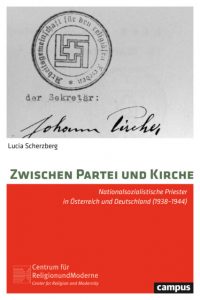
Review of Lucia Scherzberg, Zwischen Partei und Kirche: Nationalsozialistische Priester in Österreich und Deutschland (1938-1944)

Contemporary Church History Quarterly

Volume 26, Number 3 (September 2020)

Review of Lucia Scherzberg, Zwischen Partei und Kirche: Nationalsozialistische Priester in Österreich und Deutschland (1938-1944), Schriftreihe “Religion und Moderne” Band 20 (Frankfurt am Main: Campus Verlag, 2020). 645 pages, 49,00,- €, (44,99,- € E-Book), ISBN: 9783593444185.

By Kevin P. Spicer, Stonehill College

This review was originally published in theologie.geschichte and is reproduced here with the kind permission of the publisher. The original review is available here: http://universaar.uni-saarland.de/journals/index.php/tg/article/view/1154/1211.

In Zwischen Partei und Kirche, Lucia Scherzberg, professor of systematic theology at Saarland University and co-editor of Theologie.Geschichte, studies a relatively small group of Catholic priests and select laity from Germany and Austria who actively promoted a positive relationship between the National Socialist state and the Catholic Church. In the book’s introduction, among many questions, she asks, “Were they a few crazy fanatics? Were the members isolated or did they find their support in the rest of the clergy?” and “How much did the priests differ in their convictions and actions from the rest of the leadership of the Catholic Church?” (14). Scherzberg finds that though they were fanatical in their support for National Socialism, these Catholic clerics and laity were far from deranged. Rather, they were intelligent, intensely calculating, and fully cognizant of their actions in support of Hitler and the Nazi government and party. Yet, as Scherzberg reveals, at times, their outlook was not always exceptional when compared with some of their fellow clergymen. Still, they made the ill-advised mistake of imperiously bucking the Church’s hierarchical system by assuming roles and tasks traditionally reserved for the Church’s episcopate, and thereby became persona non grata in their dioceses.

As I have shown in Hitler’s Priests: Catholic Clergy and National Socialism, there were approximately one-hundred-fifty “brown priests” who publicly supported and aligned themselves with National Socialism.[1] In my more broadly based work, I devoted a chapter to examining the National Socialist Priests’ Group (NS-Priests) studied by Scherzberg. By contrast, Scherzberg spent years researching the NS-Priests’ personalities, tracking down minute details, and uncovering extensive networks between and among them. Her research deepens our knowledge of the complexity of church-state relations under National Socialism and builds upon previous works such as Hitler’s Priests. Additionally, the pioneering studies of the late contemporary witness Franz Loidl, professor of church history at the Catholic-Theological Faculty of the University of Vienna, provided Scherzberg with a basic introduction to the NS-Priests that included vital primary documents, though the study was limited in scope and often apologetic in analysis.[2] Josef Lettl’s brief but impressive Diplomarbeit (Master’s Thesis), Arbeitsgemeinschaft für den religösion Frieden 1938 (Association for Religious Peace 1938), offered a general introduction to the initial but short-lived public organization of the NS-Priests.[3] More recently, in Hitlers Jünger und Gottes Hirten (Hitler’s Disciples and God’s Shepherds), Eva Maria Kaiser examined a few of the leading NS-Priests in her study of the Austrian bishops’ post-war advocacy for former National Socialists.[4] In the end, Scherzberg’s study is authoritative and will become a standard work.
Scherzberg uses the 1938 Anschluss to divide her work into two parts that contain headings but without chapter numbers. In the first part, Scherzberg identifies the original members of the Arbeitsgemeinschaft für den religiösen Frieden (AGF), the initial rendering of the NS-Priests that became public after the March 1938 Anschluss. The AGF consisted of both lay and ordained Catholics, primarily under the leadership of three individuals: Johann Pircher, a former religious of the Deutsch-Orden who had incardinated into the Vienna archdiocese in 1921 and joined the NSDAP in 1933; Wilhelm van den Bergh, a former Capuchin friar from the Netherlands who like Pircher had incardinated into the Vienna archdiocese in 1929; and Karl Pischtiak, a lay Catholic, National Socialist, and SA-Sturmbannführer who had ties with Josef Bürckel, Reichskommissar für die Wiedervereinigung Österreichs mit dem Reich (Reich Commissioner for the Reunification of Austria with the Reich;1938-1939) and Reichsstatthalter and Gauleiter of Vienna (Reich Governor and NSDAP District Leader; 1939-1940). According to Scherzberg, the AGF developed from the remnants of several Catholic pro-Anschluss groups. The same individuals had also been entangled in more politically aligned extreme right-wing associations such as the Katholisch-Nationalen (Catholic Nationals), the Deutsche Klub (German Club), and the Deutsche Gemeinschaft (German Community). Many of these same individuals had likewise been involved in the post-war Catholic youth movement, which had been heavily influenced by the writings of theologian Michael Pfliegler. Pfliegler criticized political Catholicism and emphasized the importance of the Church’s pastoral mission, especially to promote peace between church and state. Youth associations such as Reichsbund Jungösterreich, Bund Neuland, and Quickborn rejected the Peace Treaty of St. Germain-en-Laye (1919), supported a Greater-Deutschland, and embraced various forms of antisemitism, though generally not racial. Many of their members also rejected the Austrian Corporative State, especially the close alignment between the Austrian Catholic Church and the Dollfuß and Schuschnigg governments. Catholic priests from Styria, whose borders had been affected by the 1919 treaty, particularly rejected the situation of post-war Austria. Scherzberg provides a comprehensive overview of Austria’s pre-Anschluss history to contextualize the AGF’s foundation.

Before the 10 April 1938 National Referendum on the Anschluss, the Austrian bishops issued a solemn declaration that expressed their goodwill towards National Socialism. The Holy See, however, was not pleased by the stance of the Austrian episcopate, especially after the encyclical Mit brennender Sorge (With Deep Anxiety), that criticized the German state’s encroachment on the rights of the Catholic Church. On 8 April 1938, Schmerzensfreitag (Friday of Sorrows), many of the individuals who were predisposed to form the AGF, issued a letter directed to Cardinal Theodor Innitzer, archbishop of Vienna, in support of the Anschluss and critical of the Vatican. Eight days later, on 17 April, Pircher, van den Bergh, and two other priests in the name of the AGF issued a public appeal to the Catholic clergy to support the political developments between Austria and the German Reich. Newspapers covered it and reported that the appeal allegedly resonated with the clergy. Immediately, Jakob Weinbacher, Innitzer’s secretary, made it known that he did not approve. As early as May 1938, the Vienna Diözesanblatt (Diocesan Gazette) reminded clergy that they were not to be involved in politics and should limit their realm of activity to the pastoral sphere. On 30 September 1930, Cardinal Innitzer ordered diocesan newspapers to announce a ban against the AGF. Pircher and van den Bergh were never personally informed beforehand. In October 1938, Pircher issued a statement carried by Austrian newspapers that announced the disbandment of the AGF.

Scherzberg’s argument reveals that the prohibition was not due solely to a question of tactics or a difference of opinion about applying them that led to the AGF’s ban. Instead, one could attribute it more to the nature and function of the diocesan hierarchical structure, whereby only a bishop or his delegate speaks in the name of the Church. The ban also took place during a period of tense church-state conflict as the two sides negotiated for power in annexed Austria. With pressure on his back from the Holy See to assert the rights of the Church and to critique National Socialism, Innitzer could not allow a renegade group of priests to speak for his diocese. Pircher and van den Bergh were not alone. Pircher claimed that 525 priests were members, and an additional 1844 expressed their support (out of 8,000 priests in Austria). Scherzberg finds that these numbers may not be entirely overstated. Through meticulous research, she identifies at least 150 priests who joined the AGF and offers convincing arguments about the missing individuals not accounted for.

Around the time of the AGF’s prohibition, a power struggle ensued between Pircher and Pischtiak. Scherzberg speculates that Pischtiak used his connections with Bürckel to have the Gestapo confiscate the AGF’s membership index from its headquarters in Pircher’s home. At this point, it might have been helpful if Scherzberg had also analyzed the contemporary lay-cleric dynamics in this power struggle. Nevertheless, in the end, Scherzberg reveals that Pircher proved more skillful at power-play, apparently enjoying a more significant share of Bürckel’s trust. Pitschtiak then separated himself from the AGF and disappeared from the historical record.

Even though the AGF had formally disbanded, Pircher refused to let go of his dream to create a mass organization for priests within the NSDAP structure. Moving underground, Pircher maintained his contacts with like-minded priests. In a November 1938 letter to a former AGF member, he declared that the NS-Priests needed to retain, “‘reconciling, mediating, and state-affirming ideas [until] a modus vivendi can be achieved in religious terms’” (228). He was not alone. Pfarrer, Richard Hermann Bühler, a retired priest of the Limburg diocese, suggested that they establish an NS Religionsdiener-Verband (National Socialist Religious Servants Association) that would educate the clergy in a National Socialist spirit. Yet, in the disbanded AGF world, these efforts had little practical impact as the actual group of priests dwindled over time to a select few.

Amid this post-AGF climate, in December 1938, Pircher travelled to Cologne to meet for the first time Richard Kleine, a priest of the Hildesheim diocese and religion teacher at the Duderstadt Gymnasium. Though the specific origins of their initial contact are unknown, Kleine would become a leading figure among the NS-Priests as well as its primary theorist. Kleine’s entry along with others would also broaden the group’s geographic scope, enlarging it from its primarily Austrian locale to a broader demographic reach that would encompass the Greater German Reich.

Scherzberg’s research reveals a great deal more about Kleine than previous studies uncovered. To avoid scandal over Kleine’s illegitimate birth, he had to be ordained for Hildesheim instead of his home diocese of Cologne. Likewise, he was rejected as a Feldgeistlicher (military chaplain) in the First World War. While not overemphasizing these points, Scherzberg speculates that they had an impact on his self-perception and world outlook. Still, Kleine had further influences. His professor, Arnold Rademacher, a specialist in fundamental theology at the University of Bonn, advocated for both church reform and the reunification in faith among the Christian denominations. In the same vein, at University of Tübingen, Wilhelm Koch, professor of dogmatics and apologetics and a progressive intellectual, provided Kleine with a religious worldview that contrasted with the dominant neo-scholastic approach of his era. Accused of the heresy of modernism, Koch ended up leaving teaching and returned to full-time pastoral ministry. The impact of Rademacher and Koch on Kleine would especially be felt when Kleine raised issues that preoccupied him and shared them with members of the NS-Priests.

In addition to Pircher, Kleine, van den Bergh, and Bühler, other prominent members included Alois Nikolussi, a priest of the Trient diocese who in 1919 became a Chorherr of St. Augustine at Stift Sankt Florian; Simon Pirchegger, a priest of the Graz-Seckau diocese, a Dozent of Slavic Studies at University of Bonn, and an NSDAP member; Joseph Mayer, an Augsburg priest and professor of moral theology at Theologische Fakultät Paderborn; and Adolf Herte, a Paderborn priest and a professor of church history and patristics also at Paderborn. As Scherzberg’s previous works have also shown, Karl Adam, professor of systematic theology at the University of Tübingen, later joined this group.[5] A few Catholic laymen were also involved, including Josef Bagus, editor of the Kolpingsblatt, and Alois Brücker, an editor and NSDAP member living in Cologne. For each of these individuals, Scherzberg provides extensive background information to contextualize their support of National Socialism and initial contact with Pircher and Kleine. Additionally, she concludes the first part of her study by discussing the theological positioning of the group. The individual egos of the group’s members, along with the intermittent commitment of each, did not easily lead to consensus on religious questions. Pircher, for example, remained obsessed and convinced of the group’s ability to influence the outlook of high-ranking National Socialists on the Church. Kleine became fixated on an antisemitic interpretation of Christ’s Sermon on the Mount, interpreting it as a declaration of war on Judaism. Finally, Mayer and Herte appeared reluctant in their involvement, having to be nudged along by Pircher.

Part two of the work focuses on the activities of the NS-Priests, who never agreed on an official name for the group. The outbreak of war for Germany, with its decisive initial victories and subsequent harsh defeats, created a radicalization in the group’s outlook. Scherzberg’s systematic theological expertise is evident throughout her writing, especially in part two, as she analyzes the publications and presentations of the group’s members. Most chilling is the parallel she draws between the NS-Priests’ antisemitism, which led members to advocate the removal of references to Jews in Catholic sacramental rites, and the dormant antisemitism among members of a subcommittee dealing with liturgical reform in the Fulda Bishops’ Conference who discussed and similarly advocated for the removal of Jewish names from the marriage rite. Though the German bishops never agreed upon a revised rite for the sacraments under National Socialism, one did appear in 1948, with the Jewish names discussed above removed.

The ideas of the NS-Priests appeared in Kameradschaftlicher Gedankenaustausch (Comradely Exchange of Ideas; KG), a newsletter that ran inconsistently for twenty-seven issues from September 1939 to January 1945. With the help of a Catholic laywoman, Pircher edited and distributed each issue that typically was four pages in length. Pircher published most articles with pseudonyms. Nevertheless, Scherzberg spends significant time and does crucial detective work identifying the authors of the contributions. The KG’s language was overtly nationalistic and repeatedly implored its readers to serve their fatherland faithfully, especially in wartime. Increasingly in each issue, the KG’s language also became more militant and antisemitic. Alongside the KG, on his own initiative, from 1938-1940, Pircher wrote Information zur kulturpolitischen Lage (Information on the Church-Political Situation), mirroring the SD’s Meldungen aus dem Reich (Reports from the Reich), in which he reported on church issues that he believed would be of interest to the state. He shared the reports with Gauleiter Bürckel, who, it appears, for a brief time financially supported Pircher’s efforts. Despite their actions and National Socialist worldview, Pircher and Kleine had little sympathy for priests who proposed a more radical course for the Church’s clergy, such as abandoning clerical celibacy. Likewise, Pircher revealed his allegiance to Catholicism by including criticisms of the state’s treatment of the Catholic Church in his reports. He confided to Kleine that he might end up in Dachau for his more critical comments. Two separate party proceedings to remove Pircher from the NSDAP were eventually introduced, but neither succeeded.

The efforts of the NS-Priests brought them in contact with like-minded clergy and laity from other Christian denominations, and even in contact with representatives of völkisch non-Christian groups. Kleine pursued unification efforts with the Nationalkirchliche Bewegung Deutsche Christen (National Church Movement of German Christians; DC), and with the Völkisch-Religious Gemeinschaft (Ethnonationalist-Religious Community) nurtured by Ernst Graf von Reventlow from Postdam. Though Kleine at first was taken aback by the involvement of a few former Catholic clergymen in the DC, he soon adjusted and began to work with them. The dialogue that ensued led to a series of meetings where the participants attempted to work out the significant obstacles that existed between them. Scherzberg painstakingly analyses the discussion at these meetings and the individuals involved. Due to numerous factors, nothing of note resulted in the end. However, Kleine did receive an invitation from the Protestant biblical studies professor, Walter Grundmann, to join his Institut für Erforschung und Beseitgung des jüdischen Einflusses auf das deutsche kirchliche Leben (Institute for the Study and Eradication of Jewish Influence on German Church Life), which he accepted. As a result, Kleine’s antisemitism became more radical and even at one point promoted an ecclesiastical solution parallel to the Final Solution of the Jewish Question.

Kleine’s work with the DC led him into contact with the Mecklenburg Landesbishof (state bishop) Walther Schultz, who was sympathetic to Klein’s ecumenical efforts. Kleine also sought a similar collaborator from the Catholic side and believed he had found one in the newly appointed archbishop of Paderborn, Lorenz Jaeger, a former Wehrmachtspfarrer (army chaplain). While a previous biography has been sympathetic to Jaeger’s choices under National Socialism[6], Scherzberg’s findings reveal that while Jaeger was staunchly nationalist and open to listening, in the end, he rejected Kleine’s efforts at a joint Protestant-Catholic Pastoral Letter and refused to sanction Kleine’s understanding of church and ecumenism. Yet, Kleine did succeed in bringing together Schultz and Jaeger to a meeting with him to discuss the pastoral letter. A research commission focusing on Jaeger is ongoing in the Paderborn archdiocese.

As the war turned for the worse for Germany, the NS-Priests became more embittered, and their antisemitism proportionally increased. In their voluminous correspondence, they condemned the 1943 Decalogue Letter, which was critical of the state and adopted by the plenary assembly of the Fulda Bishops’ Conference. Scherzberg concludes that the worsening of the war situation and the party’s dwindling attention and notice given to the NS-Priests led to this escalation. One might also perceive that the radical antisemitism was always present, and that the apocalyptic situation at the end of the war provided the impetus for the priests to express their views more openly and, in turn, attempt to prove their allegiance even more. After the war, most of the known members of the NS-Priests, centered around Pircher and Kleine went through some form of denazification and lost their positions. The lay members, less so. Yet, Scherzberg reveals that none dropped their racist National Socialist views, but instead, merely suppressed them.

In her introduction, Scherzberg offered a theoretical framework that included the sociological theories of (de)-differentiation, (de)-secularization, and (re)-sacralization, to understand and evaluate how the priests interacted with the church and state. She returned to this framework in her conclusion. For Scherzberg, the priests she studied lived in a differentiated and often secularized society, operating within their own independent sub-system. She continued, “They demanded freedom of religion, freedom of the church and freedom of conscience. In their understanding state and church were responsible for separate areas the state for the welfare of the people, the church for the salvation of souls. Consequently, the members of the group consistantly rejected attacks by the state or the party on the church and the practice of religion” (599-600). Yet, in their own way and according to their values, the priests were traditional, upholding priestly celibacy and religious education. Often, they wanted the best of both worlds, rejecting political Catholicism while still hoping to influence political and social processes. At the same time, they were willing to accept the state’s oversight in areas such as the training of clergy.

Scherzberg also considered how the polycratic nature of the NS-State, especially evident in the leadership of Vienna’s Reichsstatthalter und Gauleiter Josef Bürckel and Baldur von Schirach, affected the NS-Priester. Like many Germans, the NS-Priester did not blame Hitler for the persecution of the Church. Instead, they relegated the responsibility to lower-level National Socialists or more likely than not to clergy themselves for not supporting the party and state. While not identifying state leadership style as polycracy, the NS-Priests attempted to benefit from the regionally differentiated leadership approaches at-large by courting Bürckel and Schirach with varying levels of success. Finally, Scherzberg considered the role that masculinity and comradeship played in the relational milieu that NS-Priests fostered. Most of the NS-Priests, for example, bought into the overtly militaristic language of the time, with some taunting or jeering the hesitancy of fellow priests to act, accusing the latter of a breach in masculinity. The comradely address shared between them and displayed boldly on their newsletter, however, ultimately had little weight as conflict and doubt arose among them. In the end, according to Scherzberg, they appear to be lone agents out for themselves and only brought together by a prevailing ideology. Each seemed willing to sell out the other, if necessary, to become more recognized by National Socialist leadership.

Lucia Scherzberg has produced an excellent study that should be widely read. It significantly helps the reader to understand the dangers of extreme nationalism and the temptation to misshape religion for personal and political gain.

Notes:

[1] Kevin P. Spicer, Hitler’s Priests: Catholic Clergy and National Socialism, DeKalb, IL, 2008; vgl. „Gespaltene Loyalität. ‚Braune Priester‘ im Dritten Reich am Beispiel der Diözese Berlin“, übersetz. Ilse Andrews, Historisches Jahrbuch 122 (2002), S. 287-320.

[2] z.B. Franz Loidl, Religionslehrer Johann Pircher. Sekretär und aktivster Mitarbeiter in der ‚Arbeitgemeinschaft für den religiösen Frieden‘ 1938 (Vienna 1972); ders., Hg., Arbeitgemeinschaft für den religiösen Frieden 1938/1939. Dokumentation, 1. Teil (Vienna 1973); ders., Hg., Arbeitgemeinschaft für den religiösen Frieden 1938/1939. Ergänzungs-Dokumentation, 2. Teil (Vienna 1973).

[3] Lettl was a former student of Rudolf Zinnhobler, professor of church history at the katholische Privatuniversität Linz. Josef Lettl, Die Arbeitsgemeinschaft für den religiösen Frieden 1938, Diplomarbeit (Linz 1981).

[4] Eva Maria Kaiser, Hitlers Jünger und Gottes Hirten: Der Einsatz der katholischen Bischöfe Österreichs für ehemalige Nationalsozialisten nach 1945 (Wien/Köln/Weimar 2017).

[5] Lucia Scherzberg, Kirchenreform mit Hilfe des Nationalsozialismus. Karl Adam als kontextueller Theologe. (Darmstadt 2001) and ders., Karl Adam und der Nationalsozialismus (Saarbrücken 2011; theologie.geschichte, Beiheft 3).

[6] Heribert Gruß, Erzbischof Lorenz Jaeger als Kirchenführer im Dritten Reich. Tatsachen-Dokumente-Entwicklungen-Kontext-Probleme (Paderborn 1995).

Share

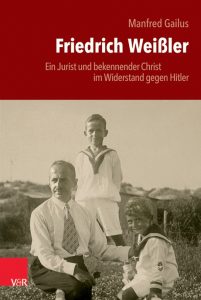
Review of Manfred Gailus, Friedrich Weißler. Ein Jurist und bekennender Christ im Widerstand gegen Hitler

Contemporary Church History Quarterly

Volume 26, Number 3 (September 2020)

Review of Manfred Gailus, Friedrich Weißler. Ein Jurist und bekennender Christ im Widerstand gegen Hitler (Göttingen: Vandenhoeck & Rupprecht, 2017). 316 pages, with illustrations and an appendix with documentation. ISBN 978-3-525-30109-8.

By Victoria J. Barnett, United States Holocaust Memorial Museum (Retired)

Manfred Gailus (who is one of the editors of this quarterly review) has published several studies of little-known and under-examined individuals in the German Protestant churches under National Socialism, including Helmut Hesse, Elisabeth Schmitz, and other Protestant women who resisted Nazi racial policy. These books are not only detailed studies of what dignity and heroism in Nazi Germany looked like. They reveal how marginalized such people were in their own times and all too often in the historiography.[1]

Friedrich Weißler is another such figure. A legal advisor to the Confessing Church, he is usually mentioned (if at all) in his connection to the 1936 Confessing Church memorandum (Denkschrift) to Adolf Hitler. Tortured and beaten to death in Sachsenhausen in February 1937, Weißler was the only person to be killed as a result of the memorandum. Not coincidentally, he was also the only “Volljude” involved. This 2017 book by Manfred Gailus is a gripping biography of a courageous man and a well-documented account of the genesis and aftermath of the memorandum. (Gailus is the first author to examine the papers that were in the family possession.)

Weißler was raised in a secular and patriotic Jewish home. His father was a lawyer who was such a conservative nationalist that he committed suicide in the wake of the Versailles Treaty. Weißler studied and began to practice law during the 1920s, married a Protestant pastor’s daughter, and had two sons. Although he certainly encountered antisemitism in this first decade of his career, the Weimar years were generally happy ones professionally and personally. He moved steadily ahead in his career and became director of a legal journal; he also published books and articles on various aspects of the law. In 1932 he was appointed director of the regional court in Magdeburg. The Weißler family moved there in January 1933.

Within days of the Nazi ascent to power his life changed dramatically. Weißler issued a fine against a young SA man accused of violence who had appeared in court in uniform. The local Nazi press immediately targeted the “Jewish” judge. In an ugly incident local SA and Stahlhelm members pushed their way into the court building and hung a swastika flag from the balcony facing the town square. They then dragged Weißler to the balcony and forced him to salute the swastika flag. A few days later Weißler was suspended from his position, and in July he lost his position under the new civil service laws. Under Nazi racial laws he was a “Volljude.” In September the family, including Weißler’s elderly mother, moved to Berlin.

Weißler was 42 years of age. He had a very small pension and the family’s assets were modest. Having joined the Protestant church during the 1920s, in 1934 he became a member of the Confessing Church and developed close ties to the most radical circles in Dahlem. His legal expertise now became useful to the Confessing Church leadership as they navigated the realities of Reich church politics and Nazi law.

As in his other books, Gailus documents the antisemitism that was all too present in Confessing Church circles. It was something that Weißler encountered repeatedly and personally. The portrait that emerges is of a man who was characteristically reserved but outspoken and unafraid to confront antisemitism. After Pastor Walter Thieme of the Stadtmission defended Adolf Stoecker’s warnings against the “influence of the Jewish spirit on the life of our Volk,” Weißler wrote Thieme that he could “summon no understanding for your behavior.” He also critiqued members of the Deutsche Christen—a courageous risk for someone in his position.

All this took its toll. There are poignant examples of friends and colleagues who abandoned or turned against the Weißler family. Having received an antisemitic letter from one such “friend” Weißler noted that he was replying “only in consideration that you like so many others have succumbed to the general psychosis of this era, and given that which we previously shared.”

This general antisemitism is an important context for Gailus’s account of the 1936 memorandum to Hitler. Like all Confessing Church protests, it was a mixed bag. A small group within the Confessing Church had been urging the leadership to issue a clear public protest against the regime’s antisemitic measures; in the wake of the September 1935 Nuremberg laws these efforts gained new momentum. Although most Confessing Christians were focused primarily on church members (so-called “Christian non-Aryans”) there were others (notably Elisabeth Schmitz) who wanted the church leadership to speak decisively about the persecution of all German Jews.

These efforts led to the Confessing Church leadership’s decision to issue a memorandum and send it directly to Adolf Hitler. The decision coincided with growing divisions within the church opposition between more radical voices like Martin Niemöller and Dietrich Bonhoeffer and the church’s more compromising leaders. The memorandum was the work of a committee and like many such documents it had been considerably watered down by the time it was completed. The result was primarily an expression of the Confessing Church’s concerns about the Nazi regime’s pressures on the churches and the “dechristianization” of German society. It opened, for example, with a conciliatory expression of gratitude to Führer for defeating the threat of “bolshevism.”

The most notable section of the memorandum however condemned antisemitism in the most explicit wording that would ever be issued by the Confessing Church. It criticized the growing Nazi incitement of anti-Jewish hatred, particularly propaganda aimed at younger Germans, as “anti-Christian.” It went further, condemning the extrajudicial nature of Gestapo measures and the concentration camps, and warning against the “deification” of the Führer.

The memorandum was intended for Hitler’s eyes only and those involved were sworn to secrecy. Supposedly there were only three copies: a document personally delivered to the Reichskanzlei on June 4, 1936, by Pastor Walter Jannasch; a separate copy given to Birger Forell, pastor of the Swedish Church in Berlin; and another copy placed in the safe of the church chancellery in Berlin. It is not known whether Hitler ever even saw the memorandum; the Chancellor’s Office forwarded it to the Reich Church Ministry.

On July 15—two weeks before the opening of the Berlin Olympics—the New York Herald reported on the memorandum, and on July 23 the Basler Nachrichten published the entire document as an example of Protestant opposition to the Nazi regime. The story was also picked up by leading papers like the New York Times and the London Times.

Alarmed, the Confessing Church leadership immediately tried to find out who had leaked the memorandum. They focused on individuals with foreign press contacts, including Friedrich Weißler, who had advised throughout the planning of the memorandum. The others were Werner Koch, a seminarian who had studied with Dietrich Bonhoeffer in Finkenwalde, and Ernst Tillich, who had studied under Bonhoeffer in Berlin before abandoning his theological studies. Weißler admitted to the church leadership that he had given a copy of the memorandum to Tillich (who knew Koch and had ties to the foreign press).

Gailus methodically reconstructs the subsequent events. Weißler, Koch, and Tillich were arrested in October 1936, as was Dr. Heinrich Schmidt, a lawyer who worked for the Confessing Church. Schmidt was released after a short time, but the other three were interrogated throughout the fall of 1936. In the meantime the Confessing Church leadership distanced itself from the group and the memorandum. In a late October meeting it was Martin Niemöller who argued that the church had to distance itself completely from Weißler: “We owe it to the Confessing Church.”

In a damning letter to Heinrich Himmler in early February 1937 the Confessing Church leadership emphasized that Weißler had never held an official position in the Confessing Church and had served only in an informal capacity. Five days later the three men were transferred from the Gestapo prison in Berlin to Sachsenhausen. Koch and Tillich were imprisoned in a block doing forced labor and released after several months. On the orders of Sachsenhausen commandant Karl Koch, Weißler was placed in solitary confinement a different block of the camp. Six days later his wife received word that he was dead. Accompanied by Heinrich Schmidt, she went to the camp and was able to see that her husband’s face was swollen and badly bruised.

Even by Nazi standards, Weißler’s death was considered extrajudicial, and at the end of 1938 three Sachsenhausen guards were tried in the killing. It became clear from the court proceedings that Weißler had been badly beaten over the six days of his imprisonment before dying of his injuries, and equally clear, as Gailus notes, that the sole motive was “blind hatred” against Jews. Only one of the guards was sentenced, to one year in prison.

Gailus’ account acknowledges those members of the Confessing Church who did stand by Weißler throughout this ordeal—notably Hans Böhm and Fritz Müller. Franz Hildebrandt, a Confessing vicar affected by the racial laws who would soon flee himself to England, was also outspoken in Weißler’s defense. In the aftermath of his death, Hildebrandt and Heinrich Schmidt continued to help Weißler’s widow and family. Weißler’s eldest son Ulrich was able to emigrate to England in 1939 on the Kindertransport. His widow and other son remained in Germany, assisted financially by friends. Weißler’s elderly mother, who lived with the family, was deported to Theresienstadt in 1943 and died there shortly thereafter. Ironically, when Martin Niemöller was sent to Sachsenhausen in March 1938 as a “special prisoner” of the Führer, he was imprisoned in the same block in which Weißler had been murdered.

Gailus concludes this fine book with a reflective chapter on the continuing importance of these individual histories, even decades after the end of National Socialism. Readers of this journal will not need to be convinced of that, but I wish this book could be translated into English. The story of Friedrich Weißler is a crucial corrective for the all too frequent superficial understandings of the Confessing Church. I will add that reading this book in light of our current events in the United States, including the murders of Black men by the police and the rise in right-wing hatred and violence, was especially sobering.

Notes:

[1] I should note that the oral histories I conducted in Germany during the 1980s included interviews with Werner Koch and Heinrich Schmidt, both of whom were involved in the memorandum. Excerpts from both interviews, giving detailed accounts of the memorandum and Weißler’s death, were published in For the Soul of the People. Both interviews are now available to scholars in the collections of the United States Holocaust Memorial Museum (the transcript of the Schmidt interview, which was not taped, is being added): https://collections.ushmm.org/search/catalog/irn707864.

Share

Review of A Hidden Life, written and directed by Terrence Malick

Contemporary Church History Quarterly

Volume 26, Number 3 (September 2020)

Review of A Hidden Life, written and directed by Terrence Malick (Fox Searchlight 2019)

By Lauren Faulkner Rossi

The Extraordinary Stance of an Ordinary Man

Scholarship tells us that the German military authorities executed tens of thousands of men and jailed hundreds of thousands more during the Second World War for the crime of Wehrkraftzersetzung, or the undermining of military morale.[1] Such a category encompassed a broad spectrum of treasonous behaviour, from deliberate sabotage to desertion of one’s post to conscientious objection. Franz Jägerstätter is one of the more well-known examples of the last category. Gordon Zahn’s 1964 English-language biography, In Solitary Witness, brought him renown beyond his immediate community and did much to illuminate the historical and moral circumstances of Jägerstätter’s life and especially his execution. Numerous articles, books, and screen treatments of him followed over several decades, leading to the 1998 formal abrogation of his sentence and his 2007 beatification by Pope Benedict XVI, who also recognized him as a martyr.[2] Terrence Malick’s exploration, therefore, does not necessarily break new ground, but the strength of the film, as it retreads established paths, is the director’s attention to the emotional toll of Jägerstätter’s conviction on himself and his family, and the director of photography’s breathtakingly beautiful shots of the South Tyrol alpine countryside.[3]

Malick is an atypical American director: he has protected his private life to the point of reclusiveness; his projects routinely consume several years; while he has made several critically-acclaimed films (his first film, Badlands; The Thin Red Line, about the Vietnam War; The Tree of Life, about immortality), he is both lauded and criticized for favouring themes and visual aesthetics over plot and narrative (see The Tree of Life). In fact, A Hidden Life delivers a more linear narrative than many of his films, with an identifiable beginning, middle, and end. It opens with Leni Riefenstahl’s Triumph des Willens, the famous aerial shot of clouds and a city gradually coalescing through the mist. Lasting only the first couple of minutes, and including splices from elsewhere in that famous 1934 documentary, such as the stunning panorama of the Nazi Party’s rally grounds, this is all Malick gives to the audience of Hitler’s climb to power and takeover of Austria and Czechoslovakia before plunging directly into the fall of 1939. Franz Jägerstätter (August Diehl) is married to Franziscka (“Fani”, Valerie Pachner), and has two small blonde-haired, blue-eyed daughters. They live in the Upper Austrian village of Sankt Radegund, not far from the German border (Bavaria). We watch them pause in their labour as unseen planes fly overhead, our only clue that the war has begun.
Their life as farmers (some scholars call them peasants) can be backbreakingly hard, a fact that Malick and Jörg Widmer, the director of photography, take great care to emphasize continuously, so one cannot charge the film with romanticizing rural workers. Their existence is dominated by the seasons, and harvests, and very dependent on the cooperation of the entire community: cutting and milling wheat, ploughing fields without advanced machinery, tending sheep and other farm animals, pulling dirt and mud out of a dried-up well by hand. But there is also an authenticity in their labour and a simplicity to their daily routine: planting potatoes, picking fruit from trees, their daughters underfoot or at their sides, the frequent daytime breaks for quiet moments together or to play games, window frames and sills decorated with fresh wildflowers. The mountains are quasi-protagonists themselves, looming in and out of view in the wide-angled shots that Malick favours in many of his features, emphasizing the grandiosity and majesty of nature and the relative insignificance of humans.

Malick ensures that this visually arresting scenery is firmly implanted in his audience as he continues towards the middle of his narrative. Franz – well liked, an upstanding member of his community, a family man – undertakes compulsory military training in 1940 (around which time a third daughter arrives), at first with benign acceptance but then with increasing doubt. Documentary footage from the battlefield, shown as part of training, leaves a deep and obviously negative impression on him, and he returns home full of doubt about his willingness and ability to serve. (The film does not make this clear, but he received an exemption as a farmer and would not be called up until 1943.) His doubts are rooted in the unjustness of the war and the conduct of the German Wehrmacht, though Malick seems less interested in historical context and more in the emotional, almost visceral angst of Franz. The real-life Jägerstätter’s objections were more than mere hostility to the war effort, had a much longer brewing period – he was the only person in his village to vote against the Anschluss in 1938 – and had as much to do with the nature of the Nazi regime as the war itself. He condemned the Nazi T4 “euthanasia” program when he learned of it and followed with dismay the repeated and open attacks by the Nazis on the Catholic Church in both Germany and Austria, which further estranged him from the idea of military service.

His struggle is conducted internally and externally; in the film, in addition to countless wordless scenes of long gazes and conflicted expressions, there is almost no one that Franz does not eventually seek out for counsel. He speaks with his wife and his mother, Rosalia. (He was her only son, and she did not initially support his decision.) He speaks with his local priest in the church where he works as sacristan (and where he became a member of the Third Order of Saint Francis, a fact not mentioned in the film), who nervously tells him, “Your sacrifice would benefit no one”, but nonetheless arranges for him to meet with Josef Fließer, bishop of Linz. The bishop tells him, “You have a duty to the Fatherland – the Church tells you so.” (Franz confides to his wife that he felt the bishop treated him as a potential spy and feared to speak openly.) He defends himself to the mayor, once a friend, and to the former mayor, and to the miller, and to a painter working on the church frescoes, and to others who would listen. The earlier emphasis on community now reveals itself for its significance: if that community should turn against you, the bleakness of life tending a farm in such remote conditions is acute. Franz finds no true like minds and almost no supporters, and his family is actively ostracized and jeered at for his “act of madness, [his] sin against family and village.” His wife and her sister, Resie, must endure bullying and fits of shouting; his children are picked on. The mayor calls him a traitor to his face. The few people that show an understanding continue their friendships discreetly, from a distance. For his part, Franz is not swayed from his conviction: he knows he will not take the oath to Hitler – “the anti-Christ,” as one of the very few sympathetic villagers refers to him, in a soft tone – that is required of all soldiers; he refuses to give donations to veterans’ associations, whose brown-shirted members are canvassing for money; he refuses the Hitler greeting, clinging obstinately to the regional “Grüß Gott” that one still encounters there today. He and Fani hope that the war will be over before he is called up, and talk about possibly running away, maybe hiding in the forest. (Fani eventually encounters a bedraggled, dirt-crusted man, a stranger and, one assumes, a Jew, in the forest near the village, but he flees before she can approach. There are no Jews in the movie and no mention of the word Jew itself, only vague allusions to unwanted foreigners during one of the mayor’s drunken monologues shrieked before a blazing outdoor fire.) Franz does not seem to have seriously considered this. In any case, his fate cannot be delayed long.

Franz is called up in March 1943, in the aftermath of the disastrous German defeat at Stalingrad (Malick does not mention this context). In short order, Franz refuses the oath and is tossed into jail, first at Enns where he underwent training, and then later at Tegel, in Berlin. Here is where Malick comes closest to showcasing the violence and sadism of Nazism, in the form of Franz’s military guards who subject him to endless beatings, torture, and other cruelties. The windows of the cells he is moved through grow gradually smaller until he is held in a space scarcely larger than a closet with a tiny window he cannot reach. Such claustrophobic confinement is contrasted with his memories of home, the sweeping meadows, the trees with low-hanging fruit, and even more dramatically by Malick’s insertion of colourized documentary footage of Hitler at his mountain retreat in Berchtesgaden, entertaining the Nazi elite and their children, or sitting contemplatively in a chair with the mountains looming behind him.

Both Franz and Fani are subjected to temptations: the suave lawyers who try to persuade Franz to change his mind, and Resie, who insists to Fani that Franz’s behaviour is prideful and selfish. Where Fani’s faith comes across as childlike, perhaps even naïve – “No evil can happen to a good man,” she tells herself as she waits to hear the outcome of her husband’s arrest – Franz’s is presented as more complex, and, not surprisingly, more tortured. Any comparison of suffering is mostly an unhelpful exercise, because without doubt both of them suffered, if in different ways: beyond the endless waiting and uncertainty, Fani has only Resie for help through one springtime since no one from the village would work for them, and eventually was loathe even to go to church, where she had to endure the unwelcoming stares of her neighbours. As for Franz, his mental state begins to deteriorate rapidly, salvaged only briefly by the reappearance of Waldlan, a friend from basic training who also ended up in Tegel. (Not much by way of explanation is given: “What are you here for?” “Treason.”) Waldlan’s childlike demeanour and goofy smile leads to one of the film’s more tender, introspective moments as he stares out of his jail cell window, speaking to Franz of being free, planting vines to make wine (a white wine for summer, a red wine for winter), and sometimes going to church, and sometimes staying home.

The denouement is a foregone conclusion, even if the audience is not familiar with Franz’s story: he appears before a military tribunal, having declined numerous times to volunteer for service in a medical unit as a way to save himself. (In fact, the real Franz Jägerstätter was willing to serve in a non-arms-bearing capacity, but this was evidently ignored at his trial.[4]) He is screamed at by a junior official, and taken to the senior judge’s private chambers during a recess and gently questioned there about his position. The conversation between Franz and the judge, played by the indomitable Bruno Ganz (famous among North American audiences for playing Hitler in Der Untergang, here in one of his final roles), is almost as affecting as Widmer’s mountain shots: Ganz as the judge lets sober contemplation and discomfort play across his face and, after Franz is returned to the courtroom, he sits down in the chair he had occupied, hands on knees, silent, as if trying to imagine himself in Franz’s place. Ultimately, he is not moved enough to challenge the inevitable: Franz is sentenced to death, and executed by guillotine on 9 August 1943.

Cinematically, this is the most beautiful film I have seen this year, and maybe for several years. Malick and Widmer are famous for such productions. Even if one expects a visual spectacle based on their reputation, to experience the camera following closely behind Franz’s motorcycle on the sun-soaked mountain path, skimming through rolling fields, past simple shrines and straw-hatted labourers packing hay, is breathtaking. Fani’s search for firewood in the winter of 1940/41, while Franz is undergoing training, is similarly arresting, as she trudges alone over streams and up hills through waist-high snow. The pacing is even and unrushed, and while there is very little action (in the American sense), the three hours was not arduous. The two lead actors are convincing in both their love for and dedication to each other as well as the anguish that Franz’s position causes. Malick is hardly a stranger in confronting the deeply spiritual and philosophical conundrums of our time and exploring the repercussions of an individual’s difficult decision, particularly on loved ones. His camera lingers on Franz’s face, anxious to catch any evidence of doubt or regret (one senses it but never quite sees it), and exposes us to Fani’s breakdown, her hands ripping into the earth in vain, her fists and feet pummeling the unyielding wood of the pasture fence before climbing over it and running into the distance. The impressive supporting cast adds heft to the drama: in addition to Ganz, appearances are made by Matthias Schoenaerts as one of Franz’s lawyers, Jürgen Prochnow as the former mayor, Michael Nyqvist as Bishop Fließer, Karl Markovics as the mayor, and Franz Rogowski as Waldlan. Malick deftly uses language to convey various moods as well: the movie is in English with un-subtitled German threaded into specific scenes, including the trial and community gatherings. But this is not Hollywood’s take on the shrieking Nazi, the German rendered villainous and almost unintelligible; there is that too, as the villagers holler at Fani and Resie in guttural, spit-flecked Austrian dialect, but Malick also uses it for Franz’s whispered prayers and Bible recitations, and Fani’s own musings, prayers and half-thoughts, both sprinkled throughout the movie.

The critical eye of the historian will be less generous in her assessment of the film, though clearly Malick made decisions as the writer and director without feeling obliged to honour the deeper historical context. Franz and Fani are presented as partners, but his decision to refuse the oath is his own. Historically Franziska Jägerstätter endured much controversy and was depicted in her community both at the time and for many years after the war as a co-conspirator, maybe even an arch-influencer, in Franz’s decision; the fact that she supported him, even encouraged him to stand his ground (relayed in the film as her swearing, in the wrenching final meeting between them sometime before his trial, that she would love him no matter what he chose to do) was read by many as having fueled Franz to commit himself to his conscientious objection. She was the more religious of the two when they married; he became more serious about his faith after they wed. This gives a deeper meaning to one of the only exchanges with words between Fani and Rosalia, when she asks her mother-in-law if she blames her for her son’s actions; Rosalia responds cryptically, “He was different, before he met you,” and then the scene cuts away. He was also significantly affected by the example of Franz Reinisch, a fellow Austrian conscientious objector and the only Catholic priest to be executed during the Third Reich, in August 1942, for refusing to swear the Hitler oath; Franz found great affirmation in the fact that he was following the example of a priest. Reinisch plays no role in the movie. Nor does Rupert Mayr, another member of the Third Order of Saint Francis and fellow conscientious objector, who Franz met during his training; the two grew very close through a voluminous correspondence. Rather, Malick presents Franz as something of a lone wolf in his principled stance.

The film is clearly the story of Franz and, to a slightly lesser extent, Fani, and their emotions. Thus Malick spends little time delving into the motivation behind Franz’s decision, beyond his disgust with the war and rejection of Hitler. Their deep religiosity is evident, as is Franz’s desire to be guided by authorities in his church and his belief that what he is doing is right. But the true cause of his refusal to swear the oath – his conviction that, as a Catholic he could not in good conscience swear loyalty to a man like Hitler and the regime he represented, both of which were antithetical to all that a faithful Catholic held as central – is not as deeply interrogated as his emotional journey to stay faithful to that refusal. We do not really learn how he came to feel this way. We know nothing of Franz before 1939 other than brief flashbacks centred on Fani, and we are left to assume what exactly his objections are to Nazism. There is no evidence in the film that Franz wrote extensively, but he did, both about his faith (including, evidently, a catechism for his children, in fearful anticipation that they would not receive a proper Catholic education; his parish priest burnt it in 1945[5]) as well as his opposition to Nazism. Malick’s Franz holds a pencil only to write a few last lines, presumably to Fani, on a clipboard that a guard thrusts at him as he stands waiting for his sentence to be carried out. Even less time is spent on the Church authorities that Franz trusted and who forsook him: the bishop in Linz and the parish priest in Sankt Radegund both come across as typical clergy for the time, careful not to speak openly against the regime, content to stress one’s duty to nation, community and family. Why they failed to share Franz’s conviction that one could not compromise with Nazism without endangering one’s soul is a question still debated today, with few satisfying answers: why did he resist, but not these others? Why was accommodation to Nazism far more common than resistance?

But A Hidden Life, while based on true events and largely accurate to those events as documents tell us, does not pretend to be a rigid historical rendering. Malick is intent on sketching a portrait of Franz and the depth and breadth of his humanity. Each scene was prepared to show the extraordinary goodness of an ordinary man in exceptional circumstances, who was killed for refusing to compromise his deepest beliefs. (An epigraph featuring a George Eliot quotation, unidentified as from Middlemarch, clarifies the meaning of the title.) For this reason the film may well be one of Malick’s masterpieces, bringing the story of Franz Jägerstätter to a more popular audience, and giving to a more informed, scholarly audience a nuanced, reverent treatment of one of the era’s few genuine heroes.

Notes:

[1] See Norbert Haase and Gerhard Paul, Die andere Soldaten : Wehrkraftzersetzung, Gehorsamsverweigerung, und Fahnenflucht im Zweiten Weltkrieg (Fischer Taschenbuch Verlag, 1995).

[2] A concise but detailed analysis of the abrogation is delivered by Manfred Messerschmidt, « Die Aufhebung des Todesurteils gegen Franz Jägerstätter » in Kritische Justiz 31/1 (1998), 99-105.

[3] Because of the amount of literature on Franz Jägerstätter, some of which is academic and much of which is hagiographic, I will analyze the film for the most part on its own terms, with some critical discussion of its attention to historical context, rather than within the framework of the Jägerstätter historiography.

[4] Erna Putz, Franz Jägerstätter – Martyrer : Leuchtendes Beispiel in dunkler Zeit (Bischöfliches Ordinariat der Diözese Linz, 2007), 84-85.

[5] Putz, pg. 68.

Share

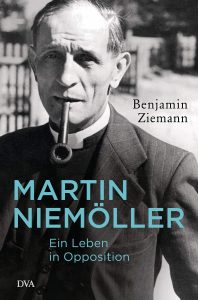
Review of Benjamin Ziemann, Martin Niemöller. Ein Leben in Opposition

Contemporary Church History Quarterly

Volume 26, Number 1/2 (June 2020)

Review of Benjamin Ziemann, Martin Niemöller. Ein Leben in Opposition (Munich: DVA, 2019). 640 pages. ISBN: 978-3-421-04712-0.

By Hansjörg Buss, Georg-August-Universität Göttingen; translated by Kyle Jantzen, Ambrose University

At Christmas 1940, Martin Niemöller appeared on the front page of Time Magazine as the “Martyr of 1940.” Since that same autumn, the film Pastor Hall, inspired by a drama by the playwright Ernst Toller, had been showing in American cinemas. It captured the story of the “Church Struggle” in Germany on celluloid, with little attempt to conceal Niemöller’s biographical details. Since his arrest in the summer of 1937 and subsequent transfer to Sachsenhausen concentration camp on the personal orders of Adolf Hitler, Niemöller had become a worldwide symbol of church resistance to the National Socialist dictatorship. Interest in his person continued even after his liberation at the beginning of May 1945. Despite the irritation that Niemöller provoked by making nationalistic statements in his first public postwar interview, he and his wife travelled to the United States for several months in 1946 and 1947, where he gave over 200 public lectures in 22 states.

To this day, Martin Niemöller remains one of the most famous German churchmen of the twentieth century. He is regarded as an upright resistance fighter against Hitler, who testified to his stance with seven years of incarceration in concentration camps, as a preacher who admonished German “guilt” and as someone who had transformed from an imperial submarine commander of the First World War into a pacifist, who during the 1950s eloquently and powerfully opposed the Federal Republic of Germany’s Western alliance, its remilitarization, and nuclear weapons. Now, 35 years after Niemöller’s death in 1984, Benjamin Ziemann, Professor of Modern German History at the University of Sheffield and Fellow of the Royal Historical Society, cuts through the thicket of legend concerning Niemöller’s story and uncovers important strands of his life.
Born in 1892, Niemöller came from the home of a Westphalian pastor and chose the career of naval officer. Caught up in the national Protestantism of his time, he experienced the German defeat in the First World War as nothing less than a catastrophe. Only then did he decide to study theology, which he successfully completed in Münster. The book chapter on the völkisch and German national “student politician” is one of the most striking. Niemöller belonged to various far-right parties and associations such as the antisemitic German Nationalist Protection and Defiance Federation (Deutschvölkischen Schutz- und Trutzbund) and the National Association of German Officers (Nationalverband Deutscher Offiziere) and counted himself among the enemies of Weimar democracy. He also personally held, as Ziemann comprehensively proves for the first time, an aggressive attitude of racial antisemitism. As a father of several children and with his entry into civilian professional life, Niemöller became more moderate in the second half of the 1930s, but initially his political stance did not change. In 1931, after seven years as the organizer of the Westphalian Inner Mission, he moved to Dahlem, a well-to-do parish in Berlin’s southwest. Like many German nationalist pastors of his generation, Niemöller welcomed Hitler’s chancellorship, the “Third Reich,” and the emergence of a “people’s community” (Volksgemeinschaft) founded on Christianity.

Those disputes, which are treated today under the term “church struggle,” were crucial tests. As head of the Pastors’ Emergency League, founded in mid-September 1933, Niemöller became one of its most important protagonists in the second half of 1933 and gained importance throughout the Reich. Ziemann expertly describes the activities of Niemöller in the conflicts of the “church struggle,” accompanied by ecclesiastical, political, and personal tensions and breaks, and ascribes to him a key role in the debates of the Confessing Church concerning the inevitable consequences of Barmen Theological Declaration of the end of May 1934. He experienced the February 1936 division of the Confessing Church into a Dahlemite wing led by Councils of Brethren and a Lutheran wing led by regional bishops not only as a loss, but also as an opportunity for the (Confessing) Church.

His involvement, which led him to become increasingly opposed to the Nazi state and the growing state pressure on the church, ended abruptly on July 1, 1937, with his arrest. After a comparatively mild judgment by the Special Court at the regional court level, which would actually have resulted in his release, he was transferred directly to the Sachsenhausen Concentration Camp. In the detailed description of his concentration camp imprisonment in the almost fifty-page chapter on Niemöller’s time of suffering as the “personal prisoner of the Führer,” two themes stand out. One was the almost-two-year deliberation about conversion to the Catholic Church, which he only finally decided against at the urging of his wife, in February 1941, a few months before his transfer to Dachau. The other was the “empathy for communists and other victims of Nazi terror,” which Ziemann exposes as a subsequent self-stylization of the postwar period. Rather, he demonstrates an ongoing anti-Bolshevik and nationalist stance: “Even at the moment of liberation from the concentration camp, he interpreted the defeat of the German nation as the fall of the West” (p. 356).

Up to the 1970s, Niemöller remained a public figure and a noticeable and by no means uncontroversial voice in the social debates of the early Federal Republic. Ziemann goes into great detail about Niemöller’s disappointment at the development of the postwar Protestant Church, which he accused of episcopal and confessional tendencies and of supporting Konrad Adenauer’s policies, which he characterized as restorationist. Rooted in his understanding of a “prophetic guardian role” for the church, this went hand in hand with his keen criticism of the founding of the Federal Republic (“conceived in Rome and born in Washington”), the decision to ally with the West, and West German rearmament. Biographically, Niemöller’s sharpest break occurred at the end of the 1950s over the question of war and peace. Under the impact of the destructive force of hydrogen bombs, the former naval officer—who, despite his pacifist criticism of politics and the West German military, felt committed to the ethos of an officer throughout his life—became the most outspoken leader of the West German peace movement, in the campaign “Fight Against Nuclear Death” (“Kampf dem Atomtod”) and after 1957 as president the German Peace Society (Deutsche Friedensgesellschaft). Only then did Niemöller’s Protestant nationalist guiding principles wear off, which in the immediate postwar period were still expressed in nationalist speeches and manifest in his participation in the mythology of German victimhood. Ziemann’s portrait of the post-war Niemöller is extremely multifaceted, describing how Niemöller, increasingly shaped by international and ecumenical concerns, dramatically shifted his stance toward the church and underwent a political transformation.. Ziemann, however, does not lose sight of the continuities: Niemoller’s persistent unease (which he never completely abandoned) with representative party democracy and media diversity , his latent anti-Catholicism and anti-Americanism, as well as his persistent culturally and socially fueled antisemitic resentment.

Anyone interested in Martin Niemoeller’s eventful life cannot ignore Ziemann’s extremely rich, brilliantly written, critical, yet balanced account. In the controversial and polarizing person of Niemoller—the “volcano” Niemöller, as the Bishop of Württemberg Theophil Wurm once put it—he also depicts the fundamental conflicts that marked the four political systems of the late empire, the unpopular and defeated Weimar Republic, the National Socialist ideological dictatorship, and the Federal Republic, which was in search of new ways forward. Using the example of the “belated” pastor, the “church fighter” (“Kirchenkämpfer”), the church president of the postwar Hesse-Nassau Regional Church, and the internationally-recognized ecumenist, Ziemann also reflects the fundamental upheavals of twentieth-century religious life.

The strength of his biography is also a result of the fact that he does not stop at the public Martin Niemöller. Without committing any indiscretions, Ziemann writes about the strict “patriarch” and family man; the restless, often overwhelmed and driven worker; the impatient, polemical, and self-opinionated disputant who also offended those who were on his side; and, last but not least, the one who was challenged, who repeatedly suffered severe personal crises. And he writes about Else Niemöller, his wife who died in a car accident in 1961 and with whom Martin had been married for almost forty years. One of Ziemann’s great achievements in his publication is that he acknowledges her role as a discussion partner and advisor, editor of his sermons, emotional support during his term in prison, and, last but not least, as the one who took care of the family during Niemöller’s extremely time-consuming activities as an organizer of the Inner Mission, as a pastor, and as a church politician. Benjamin Ziemann’s Niemöller biography is already a standard work.


Share

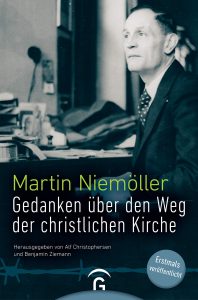
Review of Martin Niemöller, Gedanken über den Weg der christlichen Kirche

Contemporary Church History Quarterly

Volume 26, Number 1/2 (June 2020)

Review of Martin Niemöller, Gedanken über den Weg der christlichen Kirche, eds. Alf Christophersen and Benjamin Ziemann (Gütersloh: Gütersloher Verlagshaus, 2019). 268 pages. ISBN: 9783579085449.

Reviewed by Robert P. Ericksen, Pacific Lutheran University (Retired)

In the first week of February 1941, while Martin Niemöller languished in the Nazi concentration camp at Sachsenhausen, the London Times was one of several international newspapers to announce his conversion to Catholicism. The New York Times headlined this story more circumspectly: “Niemöller’s Friends Deny His Conversion: Say Imprisoned Pastor Is Only Studying Catholic Doctrine” (New York Times, 5 Feb. 1941). Neither version was quite on target. Niemöller had not converted to the Catholic Church; however, his study of Catholic doctrine hardly represented mere curiosity. It involved a serious consideration on his part to convert. This brief moment in Martin Niemöller’s life has received relatively little attention, though it does get mentioned by some, including Matthew Hockenos in his recent Then They Came for Me: Martin Niemöller, the Pastor who Defied the Nazis (reviewed in CCHQ, 25/1, March 2019).

This book, edited by Alf Christophersen and Benjamin Ziemann, has given a surprising moment in Niemöller’s life its most thorough explication. It also offers readers an edited version of the handwritten manuscript Niemöller produced within a period of less than three months during his four years of solitary confinement in Sachsenhausen. His assessment of Catholicism versus Protestantism, a document which numbers over 200 pages in Niemöller’s hand, now comprises 150 printed pages in this book.
Many or most readers of this CCHQ online journal will know at least the main features of Martin Niemöller’s life. He is one of the most famous and most important participants in the German Protestant Kirchenkampf (Church Struggle) alongside important friends and colleagues such as Dietrich Bonhoeffer and Karl Barth. He founded the Pastors’ Emergency League in the fall of 1933. He participated in the creation of the Barmen Declaration in 1934, and he played a leading role in the first three years of the Confessing Church. Niemöller was arrested on 1 July 1937 and spent the next eight months in prison in Berlin, awaiting the outcome of his case. Then, having completed the necessary prison time required by the court, he was not released but designated a “personal prisoner” of Adolf Hitler. Instead of going home to Dahlem, a suburb of Berlin, he was hurried off to solitary confinement at the nearby concentration camp of Sachsenhausen, where he stayed from March 1938 until July 1941. At that point he was transferred to Dachau, near Munich, where he remained incarcerated until the collapse of the Nazi regime in May 1945. Niemöller emerged from Dachau a famous figure and he quickly became a leader in the postwar German Protestant Church. His international stature also was high, resulting among other things in a stint as President of the World Council of Churches from 1961-68. After a postwar life traveling the world as a famous advocate for various causes, he died in 1984 at the age of ninety-two. (Personal note: I caught up with Martin Niemöller in 1973 and sought his friendly advice, but only via telephone.)

Martin Niemöller was not a theologian, though he knew theologians. Martin Niemöller also had a first career that gave him a portion of public recognition. Born in 1892 to a Lutheran pastor, he chose life as a naval officer. When World War I began, he commanded a submarine which supported the German cause by sinking British ships. His first burst of fame in Germany came from these activities, especially with his war memoir, From U-Boat to Pulpit (1934), in which he described his wartime exploits as well as his postwar turn toward the church. By 1933, when Niemöller began developing what became his high profile in the Confessing Church, he was already forty-one years old, a pastor in the Dahlem suburb of Berlin, a husband, and a father to seven children.

It is clear from Christophersen and Ziemann’s careful work that Niemöller pursued the possibility of conversion to the Catholic Church with great seriousness. By the summer of 1938 he was using a Catholic prayer book for his daily devotions while sequestered in Sachsenhausen. By August he wrote to his wife that he was “astonished by the richness of prayers and biblical readings” (“erstaunt über den Reichtum an Gebeten und biblischen Lektionen”) in the Catholic tradition (p. 9). By the spring of 1939 he was angered by the attempt of church authorities in Berlin to remove him from his pastorate in Dahlem, a form of discipline intended for the most active opponents of Reich Bishop Müller and the Deutsche Christen (“German Christian”) leadership in the Protestant Church. By July 1939, he wrote, “the Protestant State Church has never been a Christian church” (“Die Evangelische Landeskirche [ist] niemals christliche Kirche gewesen”), but merely a bureaucracy (p. 11, quoting from Martin Niemöller, Brief aus der Gefangenschaft, 61). Soon he was asking Elsa, his wife, to send him books by or about converts to Catholicism, people such as John Henry Newman. This mid-nineteenth-century professor at Oxford University was ordained a priest in the Church of England in 1825, famously converted to Catholicism in 1845, was ordained a Catholic priest in 1847, and was created a cardinal in 1879. (Newman eventually achieved sainthood in the Catholic tradition in 2019).

From late August to the beginning of November in 1939, Niemöller began and finished the manuscript now described and printed in this book. Christopherson and Ziemann have had access to many sources. These include the document itself, plus letters Martin and Elsa Niemöller were allowed to send every two weeks, and records of the twice-per-month visits Elsa was allowed to make to Niemöller in Sachsenhausen, especially as recorded in notes Niemöller made after those meetings. All of these handwritten materials are available to us based on two pieces of good fortune. First, Niemöller was able on short notice to pack papers into his luggage when transferred from Sachsenhausen to Dachau. Then on 5 April 1945, when the Catholic priest, Michael Höck, was suddenly released from Dachau, he agreed to carry Niemöller’s “things” (“Sachen”) to safety (p. 39).

As Niemöller leaned toward the Catholic Church, it was based partly on his attraction to certain forms of piety in the Catholic faith. His primary concern, however, involved the role of authority. Niemöller was no fan of the tremendous variety of beliefs and emphases within the Protestant tradition, nor was he entirely comfortable with the fruits of modern biblical scholarship. Rather, he valued straightforward teachings of the biblical text. Writing to Elsa, Niemöller regretted about Luther “that in practical terms he abolished the teaching office of the church” (“dass er das Lehramt der Kirche praktisch abgeschaft hat”) (p. 43). He also envied the “apostolic succession” Catholics claimed on the basis of biblical authority, especially the text in which Jesus elevated Peter to a position of special authority.

It is clear that these pages in which Niemöller compared Catholic and Protestant teachings represented for him not just a personal inclination–plus his aversion to the wildly pro-Nazi theological claims of Deutsche Christen in the Kirchenkampf, of course. It also was his one effort to join the ranks of his theologian friends. He did so with some trepidation, not least because so many of his friends were such important theologians. Hans Asmussen, a prolific scholar and a close friend in the Confessing Church, stayed close to Elsa Niemöller as advisor and friend during Martin’s incarceration. Martin asked Elsa to seek Asmussen’s assistance and council and welcomed the chance to use Asmussen’s help. In May 1939, however, he also showed some recognition of his role as a beginner. As he wrote to Elsa, “Certainly Asmussen in my situation already would have written a thick book, or several” (“Asmussen hätte in meiner Lage sicher schon ein dickes Buch oder mehrere geschrieben”) (p. 29).

In fact, Elsa secretly worked together with Asmussen, Helmut Gollwitzer (another close friend and an assistant pastor in Dahlem), and Martin’s clergyman brother Wilhelm Niemöller to try to steer Martin away from his plan to convert. In all cases, they gave assistance and advice to Martin, but usually with small warnings or a nudge against Martin’s intended path. For Elsa, of course, the implications were the most pressing. She worried about financial considerations if Martin gave up his position and his career: “Then you can become a scavenger; and where are we left with the children? In that case we could not feed [or perhaps “support”, RPE] more than three” (“Dann kannst du Strassenkehrer werden; und wo bleiben wir mit den Kindern? Mehr als 3 können wir dann nicht ernähren”) (p. 12). During these months there were tears. There were requests that Martin promise not to make a hasty decision, or not to make a final decision without talking to her beforehand. After nearly two years of contemplation and indecision from July 1939 to the spring of 1941, Niemöller finally gave up on the idea of conversion. Christophersen and Ziemann describe various important reasons for this outcome, but conclude, “The real reason was the tenacity of his wife” (“Der wahre Grund war die Hartnäckigkeit seiner Frau”) (p. 22).

Share

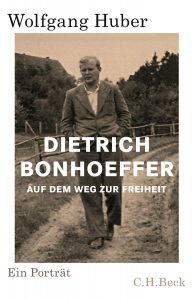
Review of Wolfgang Huber, Dietrich Bonhoeffer: Auf dem Weg zur Freiheit

Contemporary Church History Quarterly

Volume 26, Number 1/2 (June 2020)

Review of Wolfgang Huber, Dietrich Bonhoeffer: Auf dem Weg zur Freiheit (Munich: C.H. Beck, 2019). 336 pages + 25 illustrations. ISBN 978-3-406-73137-2.

By Andrew Chandler, University of Chichester

Wolfgang Huber is a distinguished voice in the German theological world, both academic and ecclesiastical, and a sustained treatment of the life and work of Dietrich Bonhoeffer by such a figure at once demands attention. His book is in many ways an introductory survey which seeks to unite the ‘fragments’ of Bonhoeffer’s life and thought in a single coherent picture, for, as Huber remarks, at every turn in Bonhoeffer’s short life, ‘belief and life, theology and resistance closely interrelated’ (p. 9). The fertile phrases which Bonhoeffer cast upon the waters of the theological world are all here and considered in turn with authority and insight. Altogether, Huber views his primary material with poise and it may be said that every kind of source – theses and books, letters and poems –  is justly represented. As befits such a portrait the acknowledgement of other secondary studies is kept to a minimum: here they sharpen perspectives and come and go at important junctures without crowding the picture. Sometimes there is an acknowledgement of later debates which have come to define Bonhoeffer scholarship in the world at large, not least the guilt of the Christian Church, the campaign to claim Bonhoeffer as a ‘Righteous Gentile’, the two worlds of East and West Germany, and the controversies which emerged in the churches of South Africa under Apartheid. Huber clearly knows this broad ground very thoroughly indeed but here his attention is primarily claimed by Bonhoeffer himself and his voice is very much his own.

The structure of the book is not unduly distinctive, but it sets out clearly the overall argument and method. Huber’s Bonhoeffer is certainly a big and complex figure. He is also one full of contrasts and the author delights in framing and exploring them. An introductory section evokes the figure of Bonhoeffer as we might first encounter him in a variety of places, not least over the Great West Door of Westminster Abbey. There follows a section on Bonhoeffer’s background and early formation and then another three on his early work in the contexts of university and church life, the first situating him firmly in the landscapes of German thought, the second examining a theology of grace which was deeply rooted in the precepts of Lutheranism, and the third discussing the place of the Bible in a world of maturing historical criticism. Each of these sections present dualities which already defined so much in Bonhoeffer’s work (‘Individual spirituality or Society’; ‘The Church of the World or the Church of the Word’; ‘Acting justly and waiting for God’s own time’; ‘The Historical Jesus or the Jesus of Today’). The young Bonhoeffer is certainly very much at home in the intellectual landscapes of German Lutheranism but the emerging vision is an open one and there is no knowing where it will lead.

Huber acknowledges how extraordinary was Bonhoeffer’s achievement in maintaining sustained theological study under the many pressures and dangers to which his life exposed him. An extended discussion of the development and ‘actuality’ of Bonhoeffer’s pacifism precedes an examination of his place in the history of the German resistance against Hitler and his significance there as a ‘theologian of resistance’. Here Huber acknowledges frankly that to account for the motives which lay behind the actions of any figure of resistance, whether they became fundamental to events or peripheral, must be ‘difficult, even impossible’ (p. 172). At all events, with this decisive turning comes an intensification of the discussion of Bonhoeffer’s ethical writings and a deepening emphasis on the themes of guilt and responsibility. It is in these contexts of resistance that Huber is most of all struck by Bonhoeffer’s singular, even ‘astonishing’, new steps, and even if they only reach us as fragments the sense of a coherent picture remains. Indeed, it is in ‘the extreme loneliness of a prison cell’ that Bonhoeffer finds a ‘wonderful security’ in the achievement of a unity of faith, teaching and life (p. 34). A further section, stoutly entitled ‘No end to Religion’, again shows the importance of situating Bonhoeffer’s thought securely in the intellectual contexts with which he was familiar. A final, and rewarding, section on the ‘Polyphony of life’ maintains a fascination with dualities (‘Bach or Beethoven’; ‘Music or Theology’) and offers a particularly attractive discussion of Bonhoeffer and Gregorian plainsong (provoked by the famous remark to Eberhard Bethge). An epilogue reflects at length on ‘what remains’, searching through the subsequent publication of Bonhoeffer’s writings and the accumulating studies of his many interpreters, and observing, rather nicely, the creative achievement of a ‘polycentric internationalism’. A gentle parting note occurs with a reflection on Bonhoeffer’s late poem ‘The Powers of Good’, in which Huber finds a final place of rest in a vast, unsentimental and moving trust in God (p. 298).

It could be said that of the making of books about Dietrich Bonhoeffer there is no end. In such a field many new authors labour to produce some distinctive insight or bold (even tenuous) claim, perhaps to justify the writing of another book or to address a particular audience or time. Over the years particular aspects of Bonhoeffer’s thought have certainly been placed under many microscopes. It is natural at first to wonder if a new, introductory portrait by an established scholar might turn out to be something of an academic tour of duty. We may expect a good deal of craft and even a dose of wisdom. But Huber’s book is something better than this: the encounter of author and subject is duly rigorous but it is also fresh, alert and warmly responsive. Nothing here is taken for granted; often Huber acknowledges that he finds a particular idea, or development, ‘astonishing’ and one senses that he really does. Indeed, he serves his subject and his audience very well. Such a book would make an excellent place for German readers make a start. One might well hope for an English edition too.

Share

Review of Rebecca Scherf, Evangelische Kirche und Konzentrationslager

Contemporary Church History Quarterly

Volume 26, Number 1/2 (June 2020)

Review of Rebecca Scherf, Evangelische Kirche und Konzentrationslager (1933 bis 1945) (Göttingen: Vandenhoeck & Ruprecht, 2019). 296 pages. ISBN 978-3-525-57057-9.

By Victoria J. Barnett, United States Holocaust Memorial Museum (Retired)

Most of the literature on the intersections between the German churches and the Nazi concentration camp system has concerned the imprisonment of Christian clergy. In addition to studies of the Dachau “clergy barracks” (where most of these clergy were held, including more than 1700 Polish priests) there are studies of prominent figures, such as Martin Niemoeller (who was imprisoned in Sachsenhausen and then Dachau) and Dietrich Bonhoeffer (who was in Buchenwald before being sent to Flossenbürg to be executed). Several studies of the Confessing Church (including my own work) have documented instances in which clergy were arrested and sent to camps or prisons, even briefly.

In other words, the subject has been framed largely in terms of clerical resistance and the persecution of the churches. Yet, the growing scholarship on the camp system, with its detailed portrayal of its scope and visibility, raises important questions about whether and how German Protestant and Catholic churches addressed these larger issues during the 1930s. The United States Holocaust Memorial Museum’s ongoing research project, the Encyclopedia of Camps and Ghettos, has documented more than 44,000 camps, prisons, and ghettoes throughout Nazi-occupied Europe. Within Nazi Germany, between 1933 and 1939, there were hundreds of small camps and sub-camps (in addition to Gestapo prisons), beginning with the establishment of Dachau in 1933. Those sent to these early camps included members of opposition political parties and other opponents of the regime, pacifists, Jehovah’s Witnesses, homosexuals, and others.

Rebecca Scherf’s study of the German Evangelical Church’s (GEC) responses to the concentration camps is a significant new contribution to the scholarship. While her main focus concerns Protestant clergy who were sent to concentration camps (she confined her study to concentration camps, so it does not include pastors who were in prisons), she has broadened her analysis to address three points of intersection between the GEC and the concentration camp system. The first concerns the relationship between regional churches and the Protestant chaplains who served in the early camps. The second examines the official church responses when clergy were sent to camps. The third looks at the experiences of those who were imprisoned in camps by drawing on contemporary documentation and subsequent memoirs. There are several appendixes with helpful graphs illustrating the number of clergy arrests by year (1935—when there were mass arrests of Confessing pastors due to a pulpit protest—was the peak), by camp, and by regional church. While most clergy who were sent to camps were held only briefly (indicating that the Nazi state intended such arrests as a form of intimidation), the number of arrests during the war grew and fewer were released. There is also a chronologically and geographically organized list of the Protestant clergy who were imprisoned.
The study begins with a brief synopsis of the rise of National Socialism and the responses within the GEC, particularly with respect to the German Church Struggle and the sharp divisions between the “German Christian” movement and the Confessing Church between 1933 and 1935. Although the Church Struggle thwarted a complete alliance between the GEC and the Nazi state, it was focused on internal church matters, not political opposition. By 1935 the Confessing Church clergy and leadership were marginalized in most regional churches; the official church leadership was either openly “German Christian” or had made its peace with the regime. This, in turn, shaped church policy toward the camp system, including how regional church leaders reacted when their clergy were arrested and imprisoned.

The earliest issue that arose concerned the question of Protestant chaplains in the camps. In July 1933 Hermann Stöhr—a pacifist who would be executed in 1940 for his conscientious objection to military service—wrote GEC leaders in Berlin to ask whether there were Protestant chaplains in the camps. By that date, there were concentration camps in sixteen of the twenty-eight regional churches (some of these early camps were in existence for a relatively short time), and around 18,000 people were imprisoned in these camps. Stöhr also raised more directly political questions, noting that local pastors were not being informed when camps were set up in their districts, nor were they able to obtain family contact information for those who were imprisoned. The GEC church leadership in Berlin replied several months later that such arrangements had not yet been made.

In the meantime, however, some of the affected regional churches began to assign pastors to serve as chaplains in the camps. Most of the chaplains were “German Christians” and understood their pastoral duties accordingly. In many early camps, there was an emphasis on the “re-education” of political prisoners, and Scherf quotes one chaplain who stressed how essential Protestant chaplaincy was for prisoners’ rehabilitation “into the great German Volksgemeinschaft of the Third Reich.” In another instance, Scherf discovered a camp chaplain who tried unsuccessfully to report and stop the mistreatment of prisoners. In some camps, chaplains held regular worship service and were able to counsel prisoners; in others, their duties were strictly limited—in Dachau, for example, the chaplain was permitted only to hold the service and was forbidden to have any other contact, including conversation, with the prisoners. With the gradual consolidation of the camp system under central SS oversight, the state tightened its restrictions on even “German Christian” chaplains, and Scherf found a growing number of cases in which chaplains were banned. In 1937 Heinrich Himmler banned the chaplaincy in the concentration camps; no protest came from the official church leadership.

The second section of Scherf’s study focuses on the Protestant clergy imprisoned in the camps (virtually all of these clergy had ties to the Confessing Church). Relatively few Protestant clergy were actually sent to concentration camps—she documents only 71 in this book —although there were many more who were arrested and imprisoned in Gestapo prisons. In March 1935, for example, some 700 Prussian pastors were imprisoned briefly after reading from the pulpit a Confessing Church protest against the Nazi view of religion, but only 26 of them were sent to camps. In many cases, the decisive criterion seems to have been the extent to which the regional church leadership was overtly “brown.”  Most of the clergy sent to camps were released the same year of their arrest.

For her case studies, Scherf focuses on the two camps with the highest number of Protestant clergy, Dachau and Sachsenburg (which was in Saxony). Dachau had the highest number of imprisoned clergy (over 2700) and they came from a number of different countries; most of them were Polish Catholic priests, but there were also clergy from the different Orthodox churches, Old Catholics, and other Protestant groups, as well as two Muslims. In contrast, most of the clergy imprisoned in Sachsenburg were from Saxony, the region in which the camp was located, and most had been arrested in conjunction with the March 1935 pulpit proclamation. The Bishop of Saxony was Friedrich Coch, one of the leading “German Christians.” Scherf offers a detailed and fascinating case study of the ways in which the camp experience provoked political protest and a different theological response among those in the camp, leading them to send a protest letter to the Saxony church leadership for its lack of solidarity. Even after the war ended several of those who had been together in Sachsenburg continued to work through their experience theologically.

The experiences of Confessing clergy who had been imprisoned fostered the post-1945 portrayal of the Confessing Church as a resistance group that had been persecuted for its opposition to Nazism—but it also deepened the postwar divide within the Evangelical Church itself, for some of those who had been imprisoned blamed the official church leadership for its failure to speak out. Nonetheless, the history of clergy who were sent to camps, including accounts by Catholic priests who had been in Dachau, became an important element in the postwar narratives about the “martyrdom” of both churches.

In her conclusion, Scherf discusses the ways in which history touches on the larger issue of how the German Evangelical Church responded to Nazi crimes before and after 1945. This study of the church responses to the concentration camps, particularly during the 1930s, offers some significant new insights into the relationship between the Protestant churches and the Nazi state.

Share

Review of Gerhard Ringshausen and Andrew Chandler, eds., The George Bell-Gerhard Leibholz Correspondence: In the Long Shadow of the Third Reich, 1938-1958

Contemporary Church History Quarterly

Volume 26, Number 1 (March 2020)

Review of Gerhard Ringshausen and Andrew Chandler, eds., The George Bell-Gerhard Leibholz Correspondence: In the Long Shadow of the Third Reich, 1938-1958 (London: Bloomsbury Academic, 2019). 476 pages. ISBN 978-1-4742-5766-4.

By Victoria J. Barnett, United States Holocaust Memorial Museum (Retired)

Gerhard Leibholz was a German attorney and professor of state law, married to Dietrich Bonhoeffer’s twin sister Sabine. George Bell was a British Anglican priest, the bishop of Chichester and an active leader in the international Protestant ecumenical movement who became one of Bonhoeffer’s closest allies. These two very different figures would be brought together by the accidents of history, but this fascinating volume shows that they found common ground on a number of issues. Starting on the eve of the Second World War and extending into the 1950s, the Bell-Leibholz correspondence gives a vivid portrait of the challenges they faced as well as their reflections on the nature of democracy and totalitarianism, and on Christianity’s future in a transformed postwar political order.

A baptized Protestant, Leibholz came from a secular Jewish family and was categorized as a Volljude under the Nazi racial law. After the passage of the Law for the Restoration of the Civil Service in April 1933, Leibholz’s father lost his position, dying only five days later (there is speculation that his death was a suicide). One of his brothers, Peter, lost his position at the same time. A professor in Göttingen, Gerhard Leibholz managed to keep his position until early 1935. He and his family remained in Nazi Germany until spring 1938, when his brother-in-law Hans von Dohnanyi warned them of the regime’s plans to require all those affected by the racial laws to have a “J” in their passport. Bonhoeffer and Eberhard Bethge drove the Leibholzes to the Swiss border; from there they made their way to England where they were joined later by their two daughters.

The volume opens with Bell’s September 1938 letter to Bonhoeffer assuring him of his willingness to help the Leibholzes. George Bell had been actively involved since 1933 in assisting refugees from Nazi Germany, including members of the Confessing Church who were affected by the Nazi laws. The early correspondence offers a detailed picture of the difficulties refugees faced even after they reached a safe country. They could not assume, of course, that they would remain in safety; Leibholz’s brother Hans and his wife managed to reach Holland, but committed suicide in 1940 after the German invasion. Added to this anxiety were financial concerns (Germany froze Leibholz’s assets when he fled, so they arrived in England with nothing), worries about the family they had left behind, existential concerns about employment and the future, and dealing with anti-German prejudice in England once the war began. In May 1940 Leibholz was interned as an “enemy alien” on the Isle of Man, along with a number of Confessing Church pastors and their wives. Bell managed to obtain his release in August 1940, after which the two men pursued the possibility that the Leibholzes might immigrate to the United States. With the assistance of Dietrich Bonhoeffer’s contacts in New York, Leibholz was offered and accepted an invitation to Union Theological Seminary in 1941, but by then the door had closed due to new U.S. restrictions on immigration.
Bell succeeded in cobbling together various stipends and opportunities by which Leibholz could support his family in England. A moving aspect of this book is Bell’s often heroic support and advocacy for the German refugees, particularly as popular British sentiment against them intensified.  The bishop also came under growing fire for his opposition to total war and his arguments on behalf of the “other Germany,” positions that probably cost him an appointment as Archbishop of Canterbury.

The book’s greatest significance, however, may be its documentation of the developing conversations between the two about Christianity, democracy, human rights, and their visions for the postwar European order. Their correspondence was part of a larger international conversation at the time that included diplomats, intellectuals, Catholics, Protestant ecumenists, and others. The detailed discussion of these issues in this volume could be an important resource for the scholarship today about the shaping of post-1945 Europe, particularly the differing conceptions of human rights that emerged after 1945.

Leibholz viewed these social and political questions from the standpoint of someone who had studied law; his doctorate had focused on issues of legitimacy in parliamentary law. (As an aside: in 2000 I interviewed Gerhard Riegner, who directed the World Jewish Congress during the war years. Riegner told me that he had studied law in Berlin during the 1920s with Leibholz and spoke of their early common commitment to human rights.) Leibholz shared Bell’s view that the major battle of their times was the defense of liberal democracy and its values against the threat of totalitarianism. Their understanding of those ideals was very much the product of the era, culture, and class from which they came. Leibholz, for example, viewed the “totalitarian” form of nationalism in National Socialism as something completely different from Prussian nationalism.

It is difficult to know how much previous Bonhoeffer family discussions had influenced Leibholz before he arrived in England, but the extent to which he began to focus in England on the centrality of Christian teaching and doctrine for Western ideals is striking. He was naturally interested in the German church struggle in which his brother-in-law was so engaged, and his first published article in Britain was a 1939 report about the situation confronting German churches. By 1940 he was already influenced by Bell’s book Christianity and World Order (Leibholz’s review of the book is included in an appendix to this volume). In 1942 Leibholz gave a series of lectures on “Christianity, Politics, and Power,” that was subsequently published in the widely read Christian News-Letter.

Leibholz intently followed British reports and commentary on the implications of the European situation. His letters to Bell are filled with analysis and commentary, particularly his sense of how Germans would react to British public policy and statements. Bell clearly valued Leibholz’s opinion and feedback. One of this volume’s many revelations is the extent to which Leibholz shaped Bell’s view of the German resistance. Bell sometimes sent Leibholz drafts of public statements in advance for his opinion, as in late 1942 with a question he planned to raise in the House of Lords: “I want to ask you whether the form in which the Question if put could and would be twisted by Goebbels so as to make it appear that I or the Church of England had turned Communist….” (115) Bell frequently shared Leibholz’s observations with other church and political officials, but with time Leibholz developed his own connections and sometimes wrote these figures directly. In a letter of 19 June 1942 to J. H. Oldham, for example, he commented on the Anglo-Russian treaty and the need for more discussion in Britain of what form of German government “the Anglo-Saxon countries would be prepared to accept after a collapse of ‘Hittlerite Germany’”(94). Another interesting development that was new to me was Leibholz’s growing belief that Catholic teachings on natural law were fundamental for modern liberal democracy, and his emphasis on the need for the “re-Christianization” of Germany after the defeat of National Socialism.

As the war progressed the personal strains on the Leibholzes intensified. They naturally focused on the German resistance and the fates of their family members. They learned of the April 1943 arrests of Dietrich Bonhoeffer and Hans von Dohnanyi only four months later, in August. Two months after the failed coup attempt of July 1944, Leibholz compiled a list of people whom he believed had been executed and sent it to Bell with a comment about the loss this would mean for a postwar Germany. In the spring of 1945, they received conflicting information about the executions of Dietrich and Klaus Bonhoeffer (the Leibholzes initially believed that Dietrich Bonhoeffer had survived). They only received confirmation of Dietrich Bonhoeffer’s death on 31 May from Adolf Freudenberg in Geneva; confirmation of the deaths of Rüdiger Schleicher and Hans von Dohnanyi didn’t arrive until late July. Bell immediately began to write about the German resistance, and much of the correspondence during Leibholz’s remaining time in Britain concerned the reconstruction of what had happened to his brothers-in-law.

In 1947 the Leibholzes returned to Germany. Gerhard Leibholz became a federal judge in Karlsruhe in 1951 (he continued, however, to teach in Göttingen) and remained there until his retirement in 1971. After his return Leibholz sent letters reporting on denazification and the political reconstruction of Germany, but over time their exchanges grew infrequent. The friendship continued until Bell’s death in 1958. The final document in the volume is the Leibholzes’ condolence letter to Bell’s widow in October 1958, in which they wrote that they had “lost the most faithful and best friend we have had in the English speaking world.”

This book includes an excellent introduction by Ringshausen and Chandler giving the general historical context for the correspondence. The letters are grouped by year, with a short chronology for each year, and there are helpful footnotes throughout that identify the people mentioned and give more background for the issues being described. This volume will certainly be of interest to Bonhoeffer scholars and those interested in ecumenical and British church history. I hope that it will find a wider audience, because these extensive and often revealing conversations between a German refugee lawyer and a British Anglican bishop provide a close-up view of the larger historical conversations about war, democracy, human rights, and the construction of civil society at a critical juncture in twentieth-century history.

Share

Review of Dietz Bering, Luther im Fronteinsatz. Propagandastrategien im Ersten Weltkrieg

Contemporary Church History Quarterly

Volume 25, Number 4 (December 2019)

Review of Dietz Bering, Luther im Fronteinsatz. Propagandastrategien im Ersten Weltkrieg (Göttingen: Wallstein, 2018). Pp. 229.

By Doris L. Bergen, University of Toronto

Sometime in the late 1980s, when I was a PhD student researching the “German Christian” movement, someone told me about Dietz Bering’s Der Name als Stigma. Antisemitismus im deutschen Alltag 1812-1933 (1987; published in English in 1992 as The Stigma of Names). The book was a revelation, highly original and insightful, and reading it felt like a special secret, a feeling I would also get with Michel-Rolph Trouillot’s Silencing the Past: Power and the Production of History (1995) and Annette Wieviorka’s The Era of the Witness (1998), though I subsequently learned that all of these books were widely known and admired.

More than thirty years later, Bering is an acknowledged public intellectual whose 2010 book, Die Epoche der Intellektuellen, attracted significant attention. This newest book, about the uses and abuses of Martin Luther in World War I, does not have the cachet of a surprise discovery, but it shares with The Stigma of Names the author’s detailed attention to language – he is a linguist by training – his patience for quantitative and qualitative analyses, and a knack for moving from carefully presented evidence to bold conclusions. In this case, Bering examines a body of World War I writing in which Martin Luther features, literally counting the number of times certain words and phrases appear – “hammer”, “hero”, “manliness”, and many more – and layers his findings onto a sketch of the war as experienced by Germans. The result is an insightful elucidation of the transformation, or more aptly, weaponization, of the defiant monk and reformer into a nationalist propaganda, morale-boosting tool. As Bering shows, that process unfolded in one world war and left the Protestant reformer and his avatar primed for deployment in another.
Luther im Fronteinsatz is a tightly structured, amply documented essay on the origins of an ideology rather than a sustained historical investigation. Readers familiar with recent works by Christopher Probst, Hartmut Lehmann, Manfred Gailus, and Lyndal Roper, or the older scholarship by Martin Greschat, Gottfried Maron, and others are unlikely to learn anything new about Luther or his legacies in the twentieth century. Nor does the book re-interpret the social history of the Great War and its fall-out in Central Europe, as illuminated by Belinda Davis, Roger Chickering, Maureen Healy, Deborah Cohen, Annelise Thimme, and many others in a massive historiography in English and German. (Of the authors named in this paragraph, only Roper and Maron appear in Bering’s bibliography.)

Yet Bering’s book is still valuable for its compelling articulation of a process that injected Luther into the “idea of 1914,” metonymized as the “hammer” and lauded as the original “German personality” and the embodiment of “German loyalty.” Confronted with the setbacks and defeats of 1917-18, Bering shows, this set of images ossified in a new propaganda initiative, “instruction for the Fatherland” – Vaterländischer Unterricht. Bering devotes most attention to the leaders and shapers of a dynamic discourse: Ernst Troeltsch, Heinrich von Treitschke, Adolf von Harnack, and other prominent men. But he also examines opinion multipliers including military periodicals such as the Feldpressestelle, Deutsche Kriegswochenschau, Karnisch-Julische Kriegszeitung, and the Kriegszeitungen of the 4th, 7th, and 10th armies, as well as grassroots popularizers, notably local pastors. Throughout his analysis, Bering weaves in a dialectical component. As he shows, enemy propaganda fueled a feedback loop: for example, accusations that German soldiers were unthinking automatons sparked an insistent emphasis on the concept of “freedom,” in particular “German freedom,” in contrast to the supposed shallow and individualistic freedoms of the French with their violent revolutions and British with their fixation on “Gold und Geld”.

Bering makes a convincing case, and the book is a lively read, especially the crisp opening chapter, “Deutschland auf der Suche nach sich selbst”. Still he raises many questions that remain unaddressed or are discussed only briefly. One involves Catholics. Given the many Catholics in Germany and the much more pronounced Catholic presence in the Austro-Hungarian military, they merit further attention. Bering does make some effort to show how the Luther-myth was adapted for a German Catholic audience, but it is not commensurate with the magnitude of the challenge. Patrick Houlihan’s study of Catholicism and the Great War: Religion and Everyday Life in Germany and Austria-Hungary, 1914-1922 (2017) would have been a useful conversation partner.

Another underexamined issue is antisemitism. In The Stigma of Names, Bering revealed a deep and nuanced understanding of how anti-Jewish assumptions, messages, and provocations were built into Christian signs, symbols, and names. This book includes some astute observations about how anti-Black and anti-Turkish racisms functioned in the weaponized Luther system but has surprisingly little to say about antisemitism. Yet antisemitism hovers just outside the frame in many of the quotations analyzed, from the stereotype of the materialist British (and their shadowy Jewish cousins) obsessed with “money and gold,” to the emphatic addition of German to modify the nouns “courage”, “character”, “loyalty”, and “faith”, and to exclude Jews and others constructed as the non- or anti-Germans. Luther’s 1543 screed, On the Jews and Their Lies, is not mentioned in the book, which made me wonder whether German World War I propagandists deliberately avoided that text or Bering chose not to address it.

A third underexplored topic involves reception. How did soldiers, their families and friends receive this instrumentalized version of the familiar figure of Luther? Bering observes that class divisions and failing morale were the reasons German opinion leaders adopted aggressive mythmaking in the first place. Censors found letters between home and fighting fronts to be rife with bitter complaints from people who felt hungry, used, and disregarded by the warmakers. Did the men and women who wrote such letters buy into the weaponized Luther? Did they ridicule and lampoon it, which must have been tempting given the heavy-handedness of its promoters? Observers were certainly aware of the religious elements in German chauvinism, as depictions of “Prussians” in Jaroslav Hašek’s 1921 novel, The Good Soldier Švejk, make hilariously clear.

John Conway, the founder of this journal, always insisted it was the discrediting of organized Christianity in Germany during World War I, with the jingoistic insistence that “God is on our side,” that opened the way for the ravages of National Socialism. This claim and Bering’s interpretation open a series of question central to any critique of populism. Were ordinary Germans and ordinary Christians victims or dupes? Were they silenced, manipulated, or won over so that they themselves become proponents of the nationalist bile? As an academic, I have been conditioned to believe that diagnosing a problem, unpacking a discourse to reveal its construction, takes away its power. But does that claim still hold if an audience prefers the discourse, lies and all, to its informed analysis?


Share

Review of Sabine Arend and Insa Eschebach, eds., Ravensbrück: Christliche Frauen im Konzentrationslager 1939-1945

Contemporary Church History Quarterly

Volume 25, Number 4 (December 2019)

Review of Sabine Arend and Insa Eschebach, eds., Ravensbrück: Christliche Frauen im Konzentrationslager 1939-1945 (Berlin: Metropol, 2018). Pp. 294. ISBN: 9783863313821.

By Christina Matzen, University of Toronto

Ravensbrück: Christliche Frauen im Konzentrationslager 1939-1945 is an unconventional and significant tribute to the Christian women who were interned in the Ravensbrück women’s concentration camp during World War II. Editors Sabine Arend and Insa Eschebach curated this volume as an accompaniment to the Ravensbrück Memorial’s 2017 exhibit on Christian prisoners, which was part of a German Evangelical Church Kirchentag event in Berlin. In the context of this exhibition, the term “Christian” is a category of self-description and encompasses women from Eastern and Western Europe. Indeed, this inclusive approach lies at the heart of the book’s strength. Through the contributors’ attention to women and their religious lives before and during their incarceration, women victims of Christian faith are rightly made more visible in the history of Nazi Germany, Christianity, gender, and memory.

Resistance is a central theme of the book. Christian women in Ravensbrück tended to be involved in opposition within charitable associations and in education but have long been regarded as “apolitical, inconspicuous, and therefore irrelevant,” helping to explain the marginal attention paid to this persecuted group in historical scholarship (21). Most forms of resistance from Christian women entailed critical statements against the German government and expressions of solidarity with people attacked by the Nazi regime. As Manfred Gailus writes in his contribution on Protestant resistors, many religious women found themselves in a dual position of opposition: they criticized both Nazism and sexist religious conventions (206).
Dr. Katharina Staritz is just one compelling woman chronicled in the book. Born in Breslau in 1903, Staritz became a member of the Confessing Church in 1934 and by 1938 was blessed as a vicar. Shortly after the November Pogrom, Staritz took over leadership of the Breslau branch of Protestant theologian Heinrich’s Grüber’s “auxiliary body for non-Aryan Christians,” a welfare agency to help Jews who had converted to Christianity emigrate safely in order to escape deportations. Although Staritz was forbidden as a female vicar to perform baptisms, she nonetheless baptized Jewish women. In September 1941 she wrote a circular to the Breslau clergy asking them not to exclude parishioners marked with a yellow star. The Gestapo confiscated the circular, labeled her as “Jewish friendly and objectionable,” and arrested her the following winter (25-26). Staritz wrote after the war that while she was interned in Ravensbrück, she worshiped the Bible every Sunday and preached to a small group of women as they walked up and down the camp road (155). With Claudia Koonz’s seminal work in mind on how women could be both victimized by the regime and complicit in the regime’s murderous policies, one might wonder to what extent Staritz—an oft-cited figure throughout the book—is representative of Christian women who served time in Ravensbrück. Her story is profound and important, but readers who approach this volume without some familiarity of the complex roles of both women and religious institutions in Nazi Germany may be left with an incomplete impression of the scope of Christian women’s actions in the Reich.

The book is organized in three parts and is largely based on survivor accounts and judicial and police records. Eschebach provides an introduction on the social and religious contexts of Christians in the Ravensbrück. The second (and largest) section of the book explores religious practices in concentration camps and chronicles the lives of thirteen women who, inspired by their religious views, opposed the Nazi regime and were consequently arrested and incarcerated in Ravensbrück. The final section comprises six essays that cover topics such as the experiences of women in various Christian sects that were represented in the Ravensbrück inmate population (namely Catholic, Protestant, and Jehovah’s Witness, but other groups are referenced as well), religious life in Fürstenberg and Ravensbrück during the Third Reich, and the role of church remembrance and memorial work.

Analytical contributions of the book are strongest in regard to Christian social life in Ravensbrück. The authors argue that ecumenical efforts in the camp had a limited impact, and Christian convictions seldom resulted in prisoners overcoming confessional differences, national origins, educational milieus, and politically and religiously motivated concepts of community and resistance. Language skills and class distinctions tended to inhibit communication among Christian women in Ravensbrück, and multinational and pan-Christian discussions were predominantly initiated by individuals. All prisoners lacked holy texts and liturgical objects, and although Ravensbrück camp regulations did not explicitly prohibit religious practice, large group meetings outside the barracks were prohibited, limiting the possibility of collective services. Women resorted to creative responses and generated booklets with Bible verses and psalms from stolen office papers. Women also used plastic and aluminum to fashion miniature crucifixes and pendants with depictions of saints. However, these common struggles did little to unify observant women who hailed from other countries and engaged in dissimilar Christian practices.

An innovative and empathetic blend of public history and traditional scholarship, this book’s discussion of women’s struggles within their religions, within Nazi-dominated Europe, and within the Ravensbrück concentration camp is commendable. Additional information and especially archival citations for the thirteen biographies would have strengthened the volume since this book will certainly be indispensable for those seeking a deeper knowledge of the particular denominations and individuals highlighted in the book. Ravensbrück: Christliche Frauen im Konzentrationslager 1939-1945 nevertheless is a forceful and insightful overview that will be of great interest to a wide readership.


Share

Review of Michael P. DeJonge, Bonhoeffer on Resistance: The Word against the Wheel

Contemporary Church History Quarterly

Volume 25, Number 4 (December 2019)

Review of Michael P. DeJonge, Bonhoeffer on Resistance: The Word against the Wheel (Oxford: Oxford University Press, 2018). 170 Pp. ISBN: 9780198824176.

By Kyle Jantzen, Ambrose University

Michael P. DeJonge’s book on Dietrich Bonhoeffer’s theo-political vision of resistance is a concise response to recent conflicting invocations of a “Bonhoeffer moment” by both conservative and liberal Christians in the United States. Concerned about the lack of clarity concerning the legacy of Bonhoeffer’s political resistance and the narrow focus at present on Bonhoeffer’s involvement in the conspiracy to commit tyrannicide, DeJonge argues that “to associate his legacy exclusively with this conspiracy dramatically truncates his witness.” Indeed, “his participation in a conspiracy that intended violence was the endgame of a long resistance process, the final stop through an elaborate flowchart of resistance activity” (5). The author wants us to turn to Bonhoeffer for more than just inspiration for contemporary political activism. To that end, he seeks to go beyond narrating what Bonhoeffer did in order to ask what Bonhoeffer actually thought about political resistance, and to locate that within Bonhoeffer’s theology of church, politics, and resistance. In doing this, DeJonge seeks to fill a gap in the scholarly literature—the lack of a “comprehensive and accessible account of Bonhoeffer’s resistance thinking” (7).

In fourteen short chapters, DeJonge guides his readers through Bonhoeffer’s theology of resistance, identifying no less than six types of resistance in the German theologian’s writings. The author begins with basic theological foundations—creation, fall, and redemption—then adds the Lutheran accents of the law and gospel, explaining them in terms of the categories of preservation and redemption. He then outlines Bonhoeffer’s belief in politics as a component of God’s preserving activity, complete with Bonhoeffer’s criticisms of politics as an order of creation (with linkages to Natural Law, an aberration he associates with Roman Catholics and with “pseudo-Lutherans” who see the Volk as an order of creation) or as an order of redemption (with links to the Kingdom of God, which he associates with the Reformed tradition and the “mistake” of treating the gospel as a blueprint for society) (31-34). Rather, as DeJonge argues, Bonhoeffer uses the Lutheran theological mainstays of the two kingdoms and the orders as a way to define and hold down a middle position in which state and church (along with the household) work together in the task of preserving and redeeming humankind (38).
Important to DeJonge’s account is Bonhoeffer’s insistence that the law and gospel, the orders, and the work of church and state needed to be reconnected in his time—brought back into cooperative harmony—having drifted apart into two entirely different sets of norms and values in the modern era. Drawing on Bonhoeffer’s 1932 lecture “The Nature of the Church,” DeJonge explains Bonhoeffer’s thinking about church and state as orders working together—the state to preserve external righteousness and create space for the service of Christ, which is the church’s specialized role. (45, 54). The church, for Bonhoeffer, is where Christ is truly present and where Christ is proclaimed through the preaching of the Word. Because Christ is lord over the whole world—including both church and state—and because the God’s Word (meaning both Christ’s presence and Christ preached) is of utmost importance, the church must be on guard to protect its role: “Obedience to the state exists only when the state does not threaten the word. The battle about the boundary must then be fought out!” (45). This idea is so central to DeJonge’s account of Bonhoeffer’s theology of resistance that it is worth quoting him at length here:

This remarkable understanding of the church’s proclamation is the anchor of Bonhoeffer’s resistance thinking. For him, the most powerful form of political resistance is not any action in the ordinary sense of that word, whether that action comes in the mild form of nonviolent civil disobedience or in the drastic form of violent governmental overthrow. Rather, the most powerful form of political resistance is words, although these are words in a special sense, words that are themselves, paradoxically, the most fundamental kind of action. This is, specifically, the divine word entrusted to the church. This word is the centre of Bonhoeffer’s resistance thinking and activity. When Bonhoeffer advocated or himself undertook any other form of resistance, it was in the service of this ultimate form of resistance. Because the word is the highest form of resistance, the church is the most important agent of resistance (48).

Chapters 5 through 14 analyze Bonhoeffer’s resistance thinking in a series of key texts written between 1932 and 1943, during the time of the Nazi dictatorship and the German Church Struggle: “The Church and the Jewish Question” (1933), “What is Church?” (1933), “The Führer and the Individual in the Younger Generation” (1933), “On the Theological Foundation of the Work of the World Alliance” (1932), “False Teaching in the Confessing Church?” (1935-1936), “The Church and the Peoples of the World” (1934), Discipleship (1937), Ethics (1940-1943), “Protestantism without Reformation” (1939), “State and Church” (1940s), “’Personal’ and ‘Objective’ Ethics” (c. 1942), “State and Church” (c. 1941), “After Ten Years” (1943), “History and Good” (1940s), “The Concrete Commandment and the Divine Mandates” (1943), and “What Does It Mean to Tell the Truth?” (1943). Along the way, he identifies three phases of Bonhoeffer’s resistance activity and six forms of resistance in Bonhoeffer’s writing (9-10, 59). In the first phase, from 1932-1935, in which Bonhoeffer engaged in “resistance through the proclamation of the ecumenical church” (9), four types of resistance stand out: 1.) individual and humanitarian resistance to state injustice, 2.) the church’s diaconal service to the victims of state injustice, 3.) the church’s “indirectly political word” to the state, and 4.) the church’s “directly political word” against an unjust state (10). In the second phase, from 1935-1939, Bonhoeffer returned to Germany, entered the “second battle” of the church struggle, and engaged in a new form of resistance: 5.) resistance through discipleship in the church. Finally, in the third phase of his resistance, from 1939-1945, Bonhoeffer entered the conspiracy to overthrow Hitler, and a final type of resistance: 6.) resistance through the responsible action of the individual (9-10).

As he works his way through these writings, phases, and types of resistance, DeJonge argues that Bonhoeffer was remarkably consistent in his understanding of resistance. He suggests that some of the confusion over seemingly contradictory statements made by Bonhoeffer—especially in “The Church and the Jewish Question”—can be reconciled through a proper grounding of the German theologian’s resistance thinking in his theology of the two kingdoms, the orders, and the relationship between church and state. The main problem, according to DeJonge, is that readers of Bonhoeffer (scholars included) have failed to attend to Bonhoeffer’s distinction between individual and humanitarian resistance on the one hand and churchly resistance on the other (59-68, passim).

Individual and humanitarian resistance are manifest in the first and sixth types of resistance identified by DeJonge. In the first type, as “The Church and the Jewish Question” makes clear, individuals and humanitarian groups (but not the church) can point out the specific injustices of state policies, “to make the state aware of the moral aspect of the measures it takes … to accuse the state of offenses against morality” (63-64).

The church, however, does not critique the state based on morality but based on the gospel. The church preaches and hears the gospel, and is defined by the presence of Christ (in conjunction with the proclamation of Christ, the message of the gospel) (62). But the church has both a preaching office and a diaconal office, and thus the second type of resistance (and the first offered by the church) is the diaconal “service to the victims of the state’s actions”—the work to “bind up the wounds of the victims beneath the wheel” (66). This is accompanied by two other types of resistance (numbers 3 and 4 in DeJonge’s typology) arising from the preaching office of the church: the “indirectly political word of the church,” which flows from Bonhoeffer’s notion of the church “questioning the state as to the legitimate state character of its actions, that is, making the state responsible for what it does” (69); and the “directly political word of the church,” which is rooted in Bonhoeffer’s belief that in extreme circumstances the church might act “not just to bind up the wounds of the victims beneath the wheel but to seize the wheel itself” (79). These are not about challenging the state directly concerning the morality of specific policies or actions, but about working to define the boundary of state authority and calling the state to fulfill its God-given mandate to preserve external righteousness. Even in the extreme case (the status confessionis, or state of confession), the church is not usurping the role of the state, but offering a “concrete commandment” in a specific situation in which the state has overstepped its bounds (82-87). The goal of type 3 and 4 resistance is, to quote Bonhoeffer, to “protect the state from itself and preserve it.” As DeJonge puts it, “The goal of the concrete commandment is to reestablish ordinary times in which the state and church fulfill their respective mandates” (87). It is essential to note that DeJonge returns time and again to the importance of the two kingdoms and the orders, or divine mandates, as Bonhoeffer comes to call them, for judging both the actions and the legitimacy of the state, and for defining the responses of the church.

To continue with DeJonge’s schema, type 5 resistance is the last of the churchly forms of resistance. It is the resistance that dominated the period in which Bonhoeffer directed the illegal Confessing Church seminary at Finkenwalde, where he engaged in what he called the second battle of the church struggle, the battle to see the church enter into genuine discipleship to Jesus. This radical discipleship would in turn provide it with the spiritual foundation from which to speak the indirect and direct words of the church to the state (109-119). It is the idea of discipleship as resistance, an entrance into the suffering of Christ and into suffering for Christ. For Bonhoeffer, only the community radically devoted to Christ belongs to the body of Christ. Indeed, Bonhoeffer even argued that membership in the Confessing Church—the only true church—was a requirement for salvation (124).

Finally, with phase 3 and type 6 of Bonhoeffer’s resistance, DeJonge argues that Bonhoeffer leaves behind churchly resistance and returns to the resistance of individuals or groups. This last resistance is the resistance of individuals willing to take “free responsible action” in the world (142-143), to enter into extreme situations in which normal standards of guilt and innocence do not apply, because the ordinary relationship of the two kingdoms or the orders/mandates of church and state have been thrown into confusion (152-154). Such resistance accepts the fact that “it is impossible to avoid guilt and complicity” (154). Again, as in the church’s resistance, this free responsible action of the individual is directed to one aim: to re-establish the conditions of life—to return to the place where the two kingdoms and divine mandates are once again working in harmony (155).

As DeJonge identifies these types of resistance in Bonhoeffer’s life and writing, one of the thorny problems he tries to solve is Bonhoeffer’s seemingly contradictory statements about Jews. Chapter 9 is devoted to this specific issue—to understanding how Bonhoeffer can argue that the church has an “unconditional obligation toward the victims of any societal order, even if they do not belong to the Christian community,” but continue on to state that:

The church of Christ has never lost sight of the thought that the “chosen people,” which hung the Redeemer of the world on the cross, must endure the curse of its action in long-drawn-out suffering. “The Jews are the most miserable people on earth. They are plagued everywhere, and scattered about all countries, having no certain resting place” (Luther, Table Talk). But the history of suffering of this people that God loved and punished will end in the final homecoming of the people of Israel to its God. And this homecoming will take place in Israel’s conversion to Christ. (100-101)

DeJonge rejects the notion that this is a case of an inconsistent, early version of Bonhoeffer “working out his thinking about Jews and resistance on the fly” (101). Rather, DeJonge argues that “the relationship between the mistreatment of the Jews and resistance to the state is not immediate but rather mediated by other concerns. Specifically, these concerns are the two kingdoms (as illustrated in the first part of “The Church and the Jewish Question”) and justification (as illustrated in the second part)” (101-102). Within the context of these concepts, Jewish persecution is, then, first and foremost an issue of the state failing in its divinely-ordained mandate, and in two ways: first, in failing to provide enough order to protect the rights of its people (and to which the church must respond unconditionally, on behalf of Jews), and second, in overreaching its authority and encroaching on the church’s freedom to proclaim the gospel (for the salvation of all, including the Jews) (105-108).

In his conclusion, DeJonge attempts to clarify Bonhoeffer’s thinking about rights (“inviolable rights are not fundamental”), the state (state authority is grounded not in popular sovereignty but in God’s mandate), and the church (the church’s political voice focuses on the state’s mandate and does not follow the “ethical-political logic” of individuals or humanitarian groups) (158-159). He reminds us that, for Bonhoeffer, the most fundamental action is not found in “our own deeds” but in “God’s word” (159). His hope is that his readers will understand that, for Bonhoeffer, the church is at the heart of his resistance thinking, and that “seizing the wheel” is not about civil disobedience or overthrow.

DeJonge has engaged in a thorough analysis of Bonhoeffer’s resistance thinking. Those of us who work on the historical side of the German church struggle would do well to incorporate his and other theologians’ insights into our work, to enrich our interpretations and aid us in the cultivation of an undistorted and unpoliticized interpretation of Bonhoeffer’s life and work.


Share

Review of Paul Hanebrink, A Specter Haunting Europe: The Myth of Judeo-Bolshevism

Contemporary Church History Quarterly

Volume 25, Number 3 (September 2019)

Review of Paul Hanebrink, A Specter Haunting Europe: The Myth of Judeo-Bolshevism (Cambridge, MA: The Belknap Press of Harvard University Press, 2018). 284 Pp. ISBN: 9780674047686.

By Beth A. Griech-Polelle, Pacific Lutheran University

The Jobbik Party of Hungary. Greece’s Golden Dawn. The Neo-Confederate movement in the United States and countless other nationalist extremist movements. What unites all of them on a certain level is their adoption of the rhetoric chiefly associated in many people’s minds with Adolf Hitler and the Third Reich: that of a worldwide Judeo-Bolshevik conspiracy out to destroy traditional Christian morality and age-old civilizations. Paul Hanebrink’s examination into the origins and power of the Judeo-Bolshevik myth offers readers the opportunity to think – not about how true the Judeo-Bolshevik myth is, but rather, “to understand why it has been and remains so powerful” (5).

Hanebrink’s work has been influenced by the approach taken by Israeli historian Shulamit Volkov whose work on nineteenth-century Germany explained the rise of antisemitic language as part of a response to the many unsettling experiences caused by the late unification of Germany. No matter how quickly economic modernization, rapid urbanization, and cultural changes were dislocating people in Germany, Volkov argued that the use of antisemitic rhetoric and tropes about Jews were part of a “cultural code.” By addressing the “Jewish Question” an individual could then respond with solutions to the so-called problem. This often allowed many people to believe that the problems they were experiencing in their daily lives could be explained by one, all-powerful disruptor: the Jew. Hanebrink explores the use of the “Judeo-Bolshevik myth” over the course of different time periods and across various countries in Europe and the United States, allowing the reader to track how this destructive myth about Jews varied over the course of the twentieth century and to ponder why the myth continues to persist so powerfully into the twenty-first.

Following the unsettling and devastating impact of the First World War and the outbreak of the Russian Revolution, much of Europe seemed to be in a state of revolutionary flux. Much like the work of Robert Gerwarth,[1] Hanebrink opens his work with the reality that, for so many Europeans, the First World War did not really end in November 1918. War and revolution continued on in many places, particularly in Central and Eastern Europe, so that the experience of many people was not one of peace and stability but simply a continuation of the violence of 1914-1918. With so many revolutions breaking out in such a time of instability and dislocation, the search was on for the root cause of such upheavals. The answer that presented itself to so many people was a simple one: Jews were the face of revolution and revolutions seemed to be breaking out everywhere. From Munich, Germany, to Hungary, Romania, Poland, Russia, left-wing attempts to take over governments and countries led to an atmosphere of the total upheaval of societal norms. The one element that so many could agree upon was the role that Jews played in leftist activity. Hanebrink does not deny the involvement of some Jews in each of these movements, but he works hard to refute the notion that Jews created Bolshevism, supported the radical movement, and therefore all Jews were to be held responsible for the crimes of Bolshevism (14). The idea of the “Judeo-Bolshevik myth” was linked to the centuries-old language of hatred directed towards and about Jews: the figure of the Jew was linked to being the creator of disorder, disruption, and fanaticism, and there were just enough men and women who could be identified as being Jewish in each revolutionary movement that the myth seemed to embody a core kernel of truth.

How did this myth impact actual Jewish lives? Hanebrink exams the pogroms that repeatedly broke out in various parts of Central and Eastern Europe. In Ukraine, for example, Symon Petliura argued that by fighting against the “Judeo-Bolsheviks,” Ukrainians would be able to unify into a National Republic. Others in Ukraine attacked Jews, not to form a new Republic, but to restore an older state. In either case, Jews suffered directly because of the belief that they were behind the forces of disorder and chaos in Ukraine. Judeo-Bolshevism as an international threat played a prominent role in the political calculations of various faction leaders not only in Ukraine but also in Poland, Hungary, and Romania in the interwar years. Adding to this fear was the imagined idea that all Jews were by nature conspiratorial and therefore untrustworthy as potential allies. Works by Timothy Snyder and Omer Bartov[2] underscore Hanebrink’s analysis: some Jews in the borderland regions were caught in a crossfire of competing armies. The one element that each army could agree on was that the Jews were a true obstacle to achieving their objectives. As a result, more and more Jews lost their property if not their very lives. In such a tumultuous atmosphere, Jews were perceived my many as posing both an internal as well as an external threat to a country’s gentile population. The fears that Jews could potentially contribute to revolution, threatening the national security of a newly-formed nation fueled and rationalized the violence perpetrated against local Jewish populations.

While violence and pogroms continued in Eastern European territories, the Judeo-Bolshevik myth took on its perhaps most destructive power under the influence of Hitler and the Nazi regime. Hanebrink rightly points out that it is perhaps no coincidence that the early Nazi party had its beginnings in Munich – a city that had been rocked by left-wing revolution in 1919. Hitler took the pre-existing imagery of the Judeo-Bolshevik and used it to animate his followers. He told them they were fighting to defend traditional German Christian society which Jewish-Bolsheviks threatened to overturn. In Hitler’s mind, fighting the power of a Jewish-Bolsheviks was a matter of life or death for Germans. In this way, the Judeo-Bolshevik myth took on it perhaps most lethal form yet. If Germans were to live, then Jewish-Bolshevik supporters had to die.[3] Lending support to the “reality” of a Judeo-Bolshevik plot to destroy all of Christian Europe was the outbreak of the Spanish Civil War. Here Hitler saw an opportunity to elevate the existential threat that Jews posed to Germans – now he could point to Catholic Spain and argue that all of Europe would succumb to Judeo-Bolshevism unless there was a mighty crusade (led by him) to destroy it.[4] Once again, the mere presence of some Jews in the Spanish Civil War lent an air of truth to the idea of a vast “Judeo-Bolshevik” conspiracy. From the 1930s onward, the fight against Jewish Bolshevism would be tied to Nazi Germany, reaching its most destructive peak with the invasion of the Soviet Union in 1941.

It was in that event that Nazi propagandists could unleash the full force of their anti-Jewish-Bolshevik imagery. Layered upon Judeo-Bolshevik images was the portrait of Russia as an Asiatic, barbaric, foreign place that had been perverted by Jewish domination for decades. Jews were set in the role of saboteurs, conspirators, partisans, and the supreme proponents of Communism. Therefore, they were seen as the ultimate security threat. This helped the Nazis and many of their Eastern European allies participate in mass violence against Jewish populations, ultimately labeled as the Holocaust. Hanebrink also tracks the evolution that occurs – from the period of Nazi victories inside of the Soviet Union to the periods of Nazi defeat – and he provides examples of how Nazi propaganda would leave a long-lasting mark, particularly as the Soviet Red Army advanced further westward. The successful blending of images of Red Army soldiers as representative of Jewish vengeance, along with the notion that the Red Army was composed of “Asiatic barbarians” come to overturn all of European Christian civilization would have a long-lasting impact on areas that found themselves living in a post-WWII Communist-dominated territory.

In places such as Poland, Romania, and Hungary, the success of the Red Army meant one, ultimate thing: “Soviet occupation had brought Jews to power” (168). Jews who had survived the Holocaust emerged from hiding and many who had believed that Jews had been eradicated in the war now feared Jews would seek revenge for their suffering. This was coupled with the belief that Communist systems were led by Jews. There was even a tendency among post-war countries such as in the case of Poland, where leaders argued that Jews had supported Communism and they, therefore, had no one but themselves to blame for any hatred directed against them by the public. This line of argumentation was particularly useful when, in 1946, a charge of blood libel was made against Jews which resulted in the murder of at least 42 Jewish people. In yet another cruel twist of irony, local Communists also exploited anti-Jewish sentiments, particularly in Hungary where the economy was floundering and accusations of war profiteering were utilized to stir up crowds against “capitalist exploiters” whose images looked suspiciously like stereotypes of Jews. In these types of cases, Jews were associated with capitalism, exploitation, speculation, and the like. In the post-war environment, Communist leaders sought to shake free of the association of Jewishness with Communism.

For the post-WWII Western nations, the question that emerged was how to continue to fight against the growing spread of Communism without associating the fight with Nazism? Hanebrink explores the shifting of terminology in the West, going from fighting against “Judeo-Bolshevism” to embracing “Judeo-Christian civilization.” Now, instead of Hitler leading the crusade against Communism, the United States would be the lead fighter for Western Civilization. Intellectuals could still maintain that the Soviets and Communism, in general, represented “Asiatic barbarity” but they de-coupled the language of “Judeo-Bolshevism” from this fight. In the aftermath of the devastation of the war, many Christians in Europe and in the U.S. argued that Christianity could lead Europe out of the darkness it had fallen into under Nazi domination. Now the fight could be reframed as a battle against “atheistic Communism” with Christians and Jews working together, sharing a common biblical tradition that provided the seedbed for moral renewal. The concept of Judeo-Christianity was one that allowed Jews to align themselves in the battle of the Cold War against the forces of atheism. In this new way of thinking, Jews could become Cold Warriors. The idea of shared moral values between Christians and Jews connected with the idea of creating a more liberal, more tolerant society. This also impacted the way in which the memory of the Holocaust was addressed in public discourse.

In some instances, voices emerged in post-Communist societies that argued that the crimes committed under Communist regimes were ignored, while undo attention was given to specifically Jewish suffering during the Holocaust. In countries such as Poland, heated debates rose to the surface, asking why so much attention was given to Jewish victimhood at the hands of the Nazis while the victimization of gentile Poles at the hands of the Communist leaders was downplayed or ignored altogether? This line of argumentation brought back the specter that has haunted Europe for much of the twentieth and now part of the twenty-first centuries: that of the Judeo-Bolshevik. Right-wing and populist leaders demand an acknowledgement that Jews supported Communism, that Communism created categories of its own victims, and in this way, Hanebrink argues, “The Judeo-Bolshevik myth was reborn in post-Communist Europe as a tool for challenging the premises on which transnational memory of the Holocaust rested- and with those premises, the liberal civic ideals of multicultural toleration, human rights, and European integration that Holocaust memory culture had come to symbolize so powerfully” (273).

Hanebrink’s book is a valuable contribution to the intellectual history of the idea of Judeo-Bolshevism. The book could benefit from the addition of several items including maps of the areas he is discussing, some pictures of propaganda imagery, and, most importantly, the book needs a comprehensive bibliography. The work would be useful in classes of graduate students who have studied some of the history of antisemitism, intellectual history, and histories of the twentieth century.

[1] Robert Gerwarth, The Vanquished. Why the First World War Failed to End (NY, NY: Farrar, Straus and Giroux, 2017).

[2] See Timothy Snyder, Bloodlands: Europe Between Hitler and Stalin (NY, NY: Basic Books, 2010) and Omer Bartov, Anatomy of a Genocide: The Life and Death of a Town Called Buczacz (NY, NY: Simon and Schuster, 2018).

[3] See especially the work of Michael Wildt, Hitler’s Volksgemeinschaft and the Dynamics of Racial Exclusion. Violence Against Jews in Provinicial Germany, 1919-1939 (NY, NY: Berghahn Books, 2012) and also Thomas Kühne, Belonging and Genocide Hitler’s Community, 1918-1945 (New Haven, CT: Yale University Press, 2010). These works explore the dynamic of “us vs. them” in Nazi ideology.

[4] See, for example, Beth A. Griech-Polelle, “The Impact of the Spanish Civil War upon Roman Catholic Clergy in Nazi Germany,” in Kevin P. Spicer, ed., Antisemitism, Chrisitian Ambivalence, and the Holocaust (Bloomington, IN: Indiana University Press, 2007), 121-135 and Beth A. Griech-Polelle, “Crusade. The Impact of the Spanish Civil War and the Invasion of the Soviet Union on the Roman Catholic Church under the Nazi Regime,” in Glaube- Freiheit-Diktatur in Europa und den USA. Festschrift für Gerhard Besier zum 60. Geburtstag, eds. Katarzyna Stoklosa and Andrea Strübund (Göttingen: Vandenhoeck & Ruprecht, 2007), 715-726.

Share

Review of Karl-Joseph Hummel and Michael Kißener, eds., Catholics and Third Reich: Controversies and Debates

Contemporary Church History Quarterly

Volume 25, Number 3 (September 2019)

Review of Karl-Joseph Hummel and Michael Kißener, eds., Catholics and Third Reich: Controversies and Debates, translated by Christof Morrisey (Paderborn: Ferdinand Schöningh, 2018), 315 Pp., ISBN: 9783506787866.

By Kevin P. Spicer, Stonehill College

In the “Preface to English Edition,” the editors inform the reader that Catholics and Third Reich is a translation of the 2009 (paperback reprint 2010) Die Katholiken und das Dritte Reich: Kontroversen und Debatten, with minor corrections and additions of only essential bibliographical citations. The editors’ intention in the original German volume was to offer an update of the classic, Die Katholiken und das Dritte Reich, edited by Klaus Gotto and Konrad Repgen (both of whom passed in 2017), published initially in 1980 and revised for a third and final time in 1990. Hummel and Kißener dedicated their volume to Repgen, to commemorate his eighty-fifth birthday. The editors of both collections endeavored to historiographically contextualize the current themes and debates about the Catholic Church under Nationalism Socialism through chapters that are “easy-to-read yet still academically sound…for a broad reading public” (8). Evidently, German academics have a different understanding of the term “easy-to-read” than their English-speaking counterparts. For example, a translated sentence from Christoph Kösters’ contribution, “Catholics in the Third Reich: An Introduction to the Scholarship and Research History,” reads: “While the during the 1950s and early 1960s the participant generation’s view of history still predominated, at least on the surface, behind the scenes the institutionalization and networking of an emerging community of contemporary historians was taking place, wherein Catholicism studies would establish itself as a branch” (41). Of course, it is the role of a translator to produce a text that is clear and readable. Sadly, it is missing here. In several chapters, Christof Morrisey, the translator, followed – evidently too closely – the grammatical structure of the original’s dense academic German that results in awkwardly phrased English. In turn, this affects the text’s clarity and naturally the overall presentation of the authors’ arguments. Even the title is strangely framed, Catholics and Third Reich, neglecting the determiner “the.” “Preface to English edition” again forgets “the.” Such stylistic errors are minor but nevertheless make the reading of the volume challenging. To be fair, the latter chapters flow more evenly. More importantly, too, is the choice of Ferdinand Schöningh to have this volume translated into English in the first place, without requesting significant revisions from the contributors to reflect the historiographical developments in the field. The essays in Hummel and Kißener’s volume, for example, are often contentious and dominated by older interpretive debates. A better choice to fulfill the editors’ goal would have been the more accessible 2011 (revised second edition, 2018) volume, Die katholische Kirche im Dritten Reich: Eine Einführung (The Catholic Church in the Third Reich: An Introduction), edited by Christoph Kösters and Mark Edward Ruff and published by Herder, a competitor of Ferdinand Schöningh. In any case, the volume before us is the text under review.

Hummel and Kißener have divided their volume into four sections: Overview, Controversies and Debates, Images of History, and Bibliography, the latter including insightful maps of the voting behavior of the German Catholic population in Germany during the crucial years of 1932 and 1933. In the Overview section, Michael Kißener, University Professor for Contemporary History at the Johannes Gutenberg-University in Mainz, introduces the volume by providing a historical chronological summary of German Catholics in Nazi Germany. According to Ki­ßener, two approaches may be taken to evaluate the choices of Catholics and the Catholic Church under Hitler. The first approach proposes making a judgment about the moral conduct or “guilt” of the Church under National Socialism, which he recognizes as legitimate, but ultimately not historically sound. Instead, Kißener favors an approach that focuses on “understanding” by analyzing the “causal factors” and establishing “theories of developmental process.” The latter, he believes, allows us “to understand the time…on its own terms, rather than to ‘condemn’” (14). Kißener points out that in 1933, Catholics in Germany represented only one-third of the population. The influence of their tradition ended in a “grey zone” of intersection between religion and politics in which the Church was overly cautious to intervene. As other contributors to this volume emphasize, Catholicism “did not require its believers to choose martyrdom” and therefore should not be compared to religious bodies such as the Jehovah Witnesses (15). At the same time, despite the hierarchical nature of Catholicism, the Catholic Church in Germany faced numerous obstacles preventing it from forming a unified approach toward the Nazi state. For example, the Freising and Fulda Bishops’ Conferences were only consolidated into one joint conference in 1933 and, as a result, had not yet perfected its operational rules. Resolutions made by the united conference were “not yet binding for individual bishops” (16). Kißener places significant responsibility for the lack of a more aggressive stance toward National Socialism on Adolf Bertram, Cardinal Archbishop of Breslau and leader of the Fulda Bishops’ Conference, who, he admits, too swiftly accommodated the National Socialists. Kißener describes Bertam’s Eingabenpolitik (policy of petition) as “legitimate,” but ultimately “anachronistic and futile” as the Nazis solidified their power over the government (23). Regarding the persecution of German Jews, especially during Reichskristallnacht, Kißener asks, “Did [the bishops] fear that standing up for the Jews in the existing situation would provoke more violence against them? Or did they believe they were unable to help because it was assumed that, after the Jews, the Catholics would be the next target of Nazi attacks?” (26) Kißener finds the bishops’ reaction or lack thereof “difficult to explain” but assures the reader that it was “not the product of any racially based anti-Semitism adapted by the Church” (27). Throughout his essay, Kißener has adopted a tone that is protective of the Church and its shortcomings in the years of Hitler’s rule. Regarding resistance, he quotes a historian equally defensive, Hans Maier, who wrote, “‘one has to look at it soberly: that a church as a whole would join the resistance is not very realistic’” (34).

In the second overview essay, Christoph Kösters, a research fellow at the Kommission für Zeitgeschichte in Bonn, tackles the monumental job of offering a summary of the decades of scholarship procured on the Catholic Church in Nazi Germany. More recently, Mark Edward Ruff dedicated an entire book to this topic in his authoritative study, The Battle for the Catholic Past in Germany 1945-1960 (Cambridge, 2017), which Kösters does cite. Meanwhile, the editors have afforded Kösters just a little more than twenty pages to address the same topic. While Kösters provides a fair sketch of the topic, he primarily directs his critical comments toward four authors: Ernst-Wolfgang Böckenförde, a German jurist, Gordon Zahn, an American sociologist and pacifist, Guenter Lewy, an American political scientist, and Olaf Blaschke, a German historian. Ironically, Kösters feels the need to point out that Lewy is “Jewish,” “born in Germany,” and later “emigrated to Palestine” (47). While Kösters presents a reasonable assessment of Lewy’s thesis, not all contributors follow suit.

The editors have assigned the next nine essays to the category, Controversies and Debates. In a rather mistitled essay, “Racist Ideology and Völkisch Religiosity,” Wolfgang Altgeld, professor emeritus of Modern History at the Julius-Maximilian University in Würzburg, rehearses the arguments he made in his earlier study, Katholizismus, Protestantismus, Judentum: Über religiös begründete Gegensätze und nationalreligiöse Ideen in der Geschichte des deutschen Nationalismus (Catholicism, Protestantism, Judaism: On Religiously-Based Contrasts and National-Religious Ideas in the History of German Nationalism; Mainz: Matthias-Grünewald, 1992). Altgeld finds the reaction of German Catholicism to National Socialism deeply rooted in the centuries-long denominational tensions in Germany between Protestants and Catholics. The overwhelming support of National Socialism by Protestants led Catholics to see Nazism virtually as a “Protestant milieu Party.” This outlook thus enabled Catholic clergy and laity to perceive themselves as living amid a “second Kulturkampf” (81).

Matthias Stickler, director of the Institute for the Study of Higher Education (Institüt für Hochschule) of the Julius-Maximilian University in Würzburg, also develops the idea of Kulturkampf in his contribution, “Collaboration or Ideological Distance? Catholic Church and Nazi State.” According to him, the “traumatic memory of the Kulturkampf” fueled Catholics’ response to Nazism in 1933. In return and to protect the Church, the German Catholic hierarchy supported a Concordat with the Nazi government. Stickler refutes historian Klaus Scholder’s theories regarding the Reich Concordat’s connection with the disbandment of the Center Party and the German bishops 28 March 1933 pronouncement by citing six historical examples. In part, these points highlight the violence against members of Catholic associations and the extensive debate over the political issues behind Concordat articles 31 and 32. For Stickler, the time spent discussing such issues reveals the “precondition of the existence of Catholic political parties” (92). Alongside these arguments, Stickler emphasizes the essential role of the Concordat in permitting the Catholic Church to function in National Socialist Germany. To support his argument, he notes the extensive limitations and persecution the Austrian Catholic Church bore after the Reich Chancery declared the Austrian Concordat of May 1934 defunct.

In “The German Bishops: Pastoral Care and Politics,” Karl-Joseph Hummel, a retired director of the Kommission für Zeitgeschichte in Bonn, discusses the problems that arise when attempting to interpret the Church’s response to National Socialism. Chief among these issues is the failure both to contextualize primary sources correctly and to credit the Church for the “resistance of individuals against the Nazi regime” while, at the same time, hold the Church “accountable for the failures of individual bishops” (104). Building upon Michael Kißener’s insights on the organizational weaknesses of the Fulda Bishops’ Conference, Hummel relates how the united Conference met only fourteen times during Hitler’s rule. Outside of these limited meetings, all business had to be coordinated by the “time-consuming” process of postal mail (105). Hummel admits that although pastoral care was of the utmost concern for the bishops, any notion of selfish “milieu egotism,” the caring of one’s milieu alone, should be rejected. To support his claim, he cites the willingness of bishops Petrus Legge of Meißen and Johannes B. Sproll of Rottenburg to suffer at the hands of the state over issues larger than those that were directly linked to Catholicism. The state, for example, found Legge guilty of breaking foreign currency transfer rules and fined him significantly. Sproll refused to support the Anschluss plebiscite and corresponding Reichstag election in April 1938 and had to flee his diocese in fear of persecution. While the example of Sproll possibly supports Hummel’s argument, that of Legge does not. Hummel adds that despite the lack of direct persecution against other German bishops, a significant number of Catholic priests from Germany ended up imprisoned in Dachau, often as “proxies” for their bishops (106). In addition, a few Catholics bishops from occupied countries were not spared internment in Dachau nor were numerous members of their clergy shown mercy. What Hummel does not mention is the ethnonationalistic tensions that existed in Dachau between German Catholic clergy and clergy of other countries, especially from occupied Eastern Europe (on this point, see Adam Kozłowiecki, SJ. Not und Bedrängnis: Als Jesuit in Auschwitz und Dachau. Lagertagebuch, edited by Manfred Deselaers and Bernhard Sill, translated by Herbert Ulrich, Regensburg: Friedrich Pustet, 2016). Hummel’s larger point is that the bishops did not possess a mandate “for the moral order of society at large or for advocacy of the persecuted” (110). Here he quotes Heinz Hürten, who, before his recent passing, was the doyen of modern German Catholic Church history. In this vein, Hummel speculated, “When there was no involvement, as on 1 April 1933, there may have been other reasons besides ‘silence’, ‘passivity’, ‘naivety’, or ‘egotism’. For example, in early 1933 Faulhaber appeared so convinced that the boycott of Jewish businesses was un-Christian that, in his view, not the official Church but rather every individual Christian should protest against it of his own volition. In Faulhaber’s view, there were far more important contemporary issues for the Church’s leading authorities, such as the schools, the preservation of Catholic associations, or the question of sterilization” (109-110). Ultimately, such argumentation significantly grants the benefit of the doubt to the choices the bishops made under National Socialism

Thomas Brechenmacher, professor of modern history at the University of Potsdam, takes up the broader issue of the Catholic Church and Jews under National Socialism. He rejects what he views as common points of departure for historians covering this topic: the Church “failed morally…by not speaking out and not acting” and, in turn, “violated its own duty to ‘Christian’ love; it failed politically by becoming “blinded by anti-Bolshevism” and viewing “Nazism as a natural ally in the struggle against Soviet communism; the Church was only concerned with itself and therefore could be charged with “milieu egotism”; and lastly, the Church was antisemitic and therefore refused to respond to the plight of Jews (127-128). Reviving the eternal debate among historians about the nature of hatred toward Jews, Brechenmacher rejects any argument that does not make a clear distinction between anti-Judaism, which he describes as “older” and “religiously motivated,” and antisemitism, which he defines as “newer, socioeconomic or racially based” (128). Despite this distinction, he readily admits, “Undoubtedly, there are connections and even a flowing interchange between an older Christian tradition of religiously motivated hostility toward Jews – in other words, anti-Judaism – and the new ‘anti-Semitism’, with its economic and racist argumentation” (130-131). Nevertheless, he ultimately concludes that theologically, anti-Judaism “could have never led to [the] genocide of the Jews. Nor could it have inspired devout Christians to deduce that the Jewish people must be exterminated through murder” (131). Instead, Brechenmacher reasons, only the “older, religious anti-Judaism” helps to explain “the ‘ambivalence’ with which many Catholics…occasionally responded to the Nazis’ persecution of the Jews” (131). He cites, for example, the reaction of Bertram and Faulhaber to the 1 April 1933 boycott as an example of the latter. While Brechnmacher’s essay is one of the stronger ones in the volume, overall, he and his colleagues seem surprisingly out of touch with the impact of Holocaust Studies on the writing of the history of church and state under National Socialism. In addition, the citations throughout this volume testify to the narrowness of the contributors’ secondary source material, especially in relation to more recent studies in English on the Church, National Socialism, and the Holocaust.

In “The Catholic Milieu and Nazism,” Christoph Kösters examines the ever-changing milieu of German Catholicism. As reflected in more recent English-language studies, Kösters portrays the milieu as “dynamic” and “not a stagnant system” nor a sealed off “Catholic ghetto” as it is often portrayed (152-153). Though it might appear as anti-democratic and “hostile to secularization,” Kösters argues that it merely “braced itself against the developments of modern society” (153). In the same vein, Kösters rejects secularization theories that portray Catholic conflicts with the Nazi regime as arising from “traditional anti-modernization reflexes and ‘secularization conflicts’ within the Catholic milieu” (153-154). For him, the Church should not be viewed as “a moral authority and institution that focused only on its own survival [and] failed to recognize the ‘signs of the times’, in contrast to the politically resistant socialist milieu.” (155). Instead, Kösters insists that the main conflict was over the “idea of race as a core component of the Nazi worldview” (156). He continues, the Nazis ultimately wanted to “eliminate Christianity and its organizational carrier, which opposed the core idea of race” (157). Truly, this would be amazing if the Church had taken such a stance, but unfortunately extant primary documents do not consistently support such a definitive conclusion in relation to the Church’s conflict with National Socialism.

In “Is ‘Resistance’ not ‘the Right Word’?,” Michael Kißener takes aim at Georg Denzler, emeritus professor of church history at the University of Bamberg, and his work, Widerstand ist nicht das richtige Wort: Katholische Theologen und Priester im Dritten Reich (Resistance is not the Correct Word: Catholics Theologians and Priests in the Third Reich, Zurich: Pendo, 2003). Focusing on the cases of Konrad von Preysing, bishop of Berlin, and Willi Graf, a student and member of the White Rose resistance movement, he concludes, “‘resistance from within the church environment can only be grasped in individual cases” (175). Confirming this stance, he repeats the statement by Hans Maier, which he quoted in his introductory essay to the volume, namely that the Church “as a whole” would not realistically “enter the resistance” (175).

In his second contribution, Thomas Brechenmacher examines Pius XII and World War II. For him, Pope Pius XII engaged in the principle of Inter Arma Caritas or “Christian charity between the weapons” as a departure point for the Vatican’s response to the war. In September 1939, the pope also set up an “Office of Information” whose purpose was to offer “concrete assistance, visits to prisons and concentration camps, deliveries of food, clothing, and medicine” (182). Though taking a public position of neutrality, Pius XII likewise engaged in behind the scenes activities that were far from impartial. Such endeavors included overtures to President Roosevelt in 1938 around the time of the Munich agreement; establishing contact in early 1940 between the resistance in the German military and the British government; and in May 1940, sending telegrams to members of the royalty in the Netherlands, Belgium, and Luxembourg, which denounced invasions by the German army. Though such actions were unknown to most of the world, Brechenmacher does not find Pius XII silent in face of the horrible atrocities of the World War II period. Rather, Brechenmacher argues that Pius XII never deviated from his basic message: “damning the war, urging peace, calling for a new order for state and society based on Christian values, condemning modern pagan totalitarianism, demanding the observance of divine and human rights, entreating and prayer for innocent victims” (196). An important insight, yet, Brechenmacher neglects to admit that Pius XII, despite his Christmas 1942 message, never directly and specifically condemned the persecution and murder of European Jews.

In her contribution, Annette Mertens, a research fellow at the German Federal Archives in Koblenz, examines the choices of German Catholics during the Second World War. At the outset, she states that no book has ever been produced on this subject. However, since this volume’s publication, Oxford University Press has published Thomas Brodie’s study, German Catholicism at War, 1939-1945, which I reviewed in the last issue of CCHQ. Mertens informs the reader that “650 military chaplains” along with 20,000 clerics, monastics, and prospective priests were serving at the front, mostly as military medics” (199). She makes a clear distinction between serving the fatherland – the German nation – and serving the Nazi regime, then assures the reader that the emphasis of the Church hierarchy was on the former. Unfortunately, the bishops were not privy to any outlook that enabled them to approach the war differently than in the past. The Peace League of German Catholics (Friedensbund Deutscher Katholiken) had only been founded in 1917 and banned in 1933 and, according to her, had not yet made enough impact to alter traditional thinking toward war. She concludes, that for the Catholic Church “as a national church, a general summons to martyrdom would have been unthinkable” (204).

In the final essay of the second section, Karl-Joseph Hummel examines how the German Catholic Church dealt with its past under National Socialism. He stresses that the German Catholic bishops were the first group to issue a post-war confession of guilt in August 1945. Yet, he fails to point out that their statement made no reference to the murder of European Jews. For him, doubt over the Church’s role in World War II “came under suspicion” seriously in the 1960s, primarily because it was an institution (237). This is an important insight, but it lacks any contextualization in the tumultuous events of the 1960s that upended many traditional institutions and modes of thinking.

The third section of the book, “Images of History,” contains but one essay, once again by Karl-Joseph Hummel. Entitled, “The Church in Pictures: Historical Photos as a Means of Deception,” the chapter describes the history behind several images that have appeared in more recent books about the Catholic Church under National Socialism. Among these photos is one that the editors at Northern Illinois University Press used for the cover of my book, Hitler’s Priests: Catholic Clergy and National Socialism (2008). The photo features Abbott Alban Schachleiter, OSB, a Benedictine and emeritus abbot of Emmaus Monastery in Prague, giving the Hitler salute to SA men. Hummel not only criticizes the use of this historical photo but also misrepresents the book’s content.

Overall, the contributors to the volume do endeavor to fulfill the goal of the collection’s title by offering an overview of the state of debates and controversies regarding research on the German Catholic Church under National Socialism. Generally, the contributors’ arguments and interpretations are favorable to the Church and the choices of its leaders during this tumultuous time period. A more critical eye would have strengthened the collection. Nevertheless, as with any edited collection, one needs to consider that the chapters are, at times, brief, unnuanced summaries of more detailed arguments. The editors could have also taken steps to strengthen the English language edition by deemphasizing controversies that are long past and by revising chapters to include the depth and breadth of the current historiography (in both German and English) on the Catholic Church in the Third Reich. In addition, as I pointed out above, the translation lacks style and fluency in English, the target language, which makes the volume, at times, challenging to read and not advantageous for use in the classroom. Finally, and more practically, the book, a paperback at that, is priced at over $70.00. In recommending the book, such imperfections cannot be shaken off too easily, if at all.


Share

Review of Anita Rasi May, Patriot Priests: French Catholic Clergy and National Identity in World War I

Contemporary Church History Quarterly

Volume 25, Number 3 (September 2019)

Review of Anita Rasi May, Patriot Priests: French Catholic Clergy and National Identity in World War I (Norman, OK: University of Oklahoma Press, 2018), X + 162 Pp., ISBN: 9780806159089.

By Heath Spencer, Seattle University

More than 33,000 French priests and members of religious orders served in the First World War. Although many of them were government-appointed or volunteer chaplains, the majority were involved in other ways—as stretcher-bearers, nurses, and combatants. Anita Rasi May draws on the memoirs, letters and biographies of thirty-three of these individuals in order to shed light on their subjective experiences. She begins with a survey of anticlerical policies during the prewar Third Republic, a “culture war” situation in which the French Catholic Church saw its status and privileges significantly curtailed. She follows up with analysis of the responses of French priests to the outbreak of war, the variety of ways in which they participated, and their perceptions of the war’s meaning for France and the church. As she assesses the consequences of the war on church-state relations, she concludes that “in the postwar period there emerged a new relationship between the priests and the people due in large part to the memory of the priests’ wartime service and to their key role in memorializing their many fallen comrades. This newly won respect provided the atmosphere in which both the government and church leaders worked out compromises in their ongoing relationship” (10).

The anticlerical policies of the prewar era provide an important backdrop for understanding the mentalities and motivations of French priests, bishops and members of religious orders during the war itself. From the 1870s forward, French political leaders feared that Catholic clergy and institutions “did not form patriots but rather encouraged loyalty to monarchical government and to an international organization, the Catholic Church, based in Rome” (16). They responded by dissolving the Jesuits and other religious orders, abolishing the military chaplaincy, and ending priests’ exemption from military service. The Catholic Church’s dubious role in the Dreyfus Affair provided the pretext for further anticlerical measures, including the abolition of church schools and the formal separation of church and state. The government’s open hostility to the Catholic Church was accompanied by a long, steady decline in religious observance, especially among people of the working class, and among men of all classes.

In light of such troubling developments, French clergy saw the Great War as an opportunity to demonstrate their patriotism and prove their worth to national community. Like their counterparts in other belligerent countries, French priests believed their nation’s cause was just, but an equally powerful motivation for supporting the war was the prospect of restoring the Catholic Church to its former prominence and reversing the secularization of state and society. May cites the example of a Franciscan seminarian who believed that the war would lead to a rebirth of “the France of years past, that is to say, the true Christian France” (50). As ordinary people flocked to religious ceremonies and cheered for priests who volunteered for war service, many clergy believed they were witnessing a revitalization of religious life and an end to anticlerical hostility. These hopes and expectations help explain why so many priests volunteered for combat and non-combat roles, why French bishops gave their assent, and why so few French clergy opposed the war and the phenomenon of the soldier priest.

May’s research gives us a glimpse into the inner world of those clergy who spent time at the front. For example, Jesuit Pierre Teilhard de Chardin, who went on to become one of the twentieth century’s most prominent philosophers, was a stretcher-bearer with the 8th Regiment of Moroccan Riflemen. He saw the war as a “baptism into reality” (52) and hoped his position would give him influence among the men with whom he served. A Franciscan chaplain named Édouard de Massat described the war itself as “a missionary whose voice is more eloquent than our own” and expressed the hope that France would emerge from the struggle “with a new soul” (56). As time went on, priests grew more realistic about the prospects of mass conversion and religious renewal, and their efforts at evangelizing gave way to an emphasis on pastoral care and service to their comrades in arms. This was as true of soldier priests and medical personnel as it was of chaplains.

May notes that most priests adjusted well to military life and found it easy to combine patriotic fervor and military service with their Catholic faith. This was also true of those who experienced combat. May provides numerous examples of priests who were promoted to officer status, led assaults on enemy positions, and participated actively and sometimes enthusiastically in killing. Although none of May’s thirty-three priests were pacifists, all were aware of the horrors of war (especially the damage it inflicted on their own countrymen) and occasionally struggled over the ethics of killing. Although May asserts that “in these memoirs, journals, autobiographies and biographies…there is no love of war for itself” (78), she also quotes a chaplain named Jean Lagardère who said of the front: “I am happy here: the friendship of the men, the rattling of arms, the noise of the cannon, the whistling of bullets, the view of the trenches, their infected mud delights me, thrills me, makes me quiver. I am only at home there, I only breathe there, I only do good there. I only feel myself a man there” (78). They knew the horrors of war, and some loved it anyway.

Priests’ reactions to the war were complicated and contradictory on a variety of levels. For example, they expressed contempt for men who refused to fight or mutilated themselves to avoid military service, yet some of them intervened on behalf of soldiers condemned to death for breaches of discipline. Some regretted killing the enemy, or regretted enjoying it, but few gave much thought to the humanity of the enemy. Most preferred to focus on the French soldier’s self-sacrifice rather than his role as a perpetrator of violence, and they made frequent comparisons with Christ’s sacrifice on the cross. A war sermon by chaplain Louis Lenoir was one of the more eloquent and revealing expressions of this blend of faith, war, and nationalist euphoria: “Like that of Christ, this ‘beautiful blood of France’ was today, as it has always been in history, ‘liberating blood’…spread across Europe and to the extremities of the earth to defend nations against injustice and support religious and social freedom…search all the corners of the world where violated liberty has called for help, everywhere you will find traces of French blood” (85).

Whether they were chaplains, medical personnel, or soldiers, French priests took their apostolic work seriously. They administered the sacraments, counseled individual soldiers, mailed or hand delivered letters, procured books and personal items, established social spaces where soldiers could relax, visited soldiers’ families when on leave, and conveyed gifts from those families to soldiers with whom they served at the front. They heard confessions, granted absolution, and gave communion before attacks, and in the aftermath, they performed last rites for the dying, presided over burials and masses for the dead, and helped with the mapping of cemeteries. Not surprisingly, the pastoral ministry of priests at the front seems to have been the role that was most widely appreciated and accepted, even among persons who had left the church and had no interest in returning.

In terms of long-term impact, the priests’ expectations only partly coincided with reality. When the war began, many of them believed they would have the opportunity “to evangelize men who were not the usual churchgoers in early twentieth-century France” (64). They also hoped to demonstrate that they were just as manly and patriotic—and as much a part of the national community—as other French men. Although the mass conversions did not occur, priests did develop “bonds of brotherhood” with many soldiers, “based more on mutual respect than on shared faith. They also found in themselves a capacity for violence and for being swept up into the exaltation of battle, which strengthened their feelings of brotherhood and empathy for their fellows” (109). As an institution, the French Catholic Church enjoyed a slight improvement of its status in the postwar era. The state and the education system remained secularized, but members of religious orders who had returned from exile to fight for France were allowed to remain there when the war had ended. The French government also restored diplomatic relations with the Vatican, and though anticlerical laws remained on the books, they were not always rigorously enforced. In fact, when the government of Édouard Herriot attempted to do so in 1926, veteran priests played an important role in the protests that forced the state to back down. May credits these successes to the fact that priests enjoyed a new level of respect and status due to their wartime service.

May’s book offers a fascinating glimpse into the fears, frustrations and hopes of Catholic clergy during the First World War. The priests themselves are a stark example of the “self-mobilization” that was so prevalent in the “war cultures” of Europe during this period.[1] At the same time, the book suffers from a number of shortcomings in terms of framing as well as the selection and interpretation of sources.

First, it relies too much on priests’ own perceptions of their impact without considering other kinds of data. For example, it would be helpful to see information on baptisms, confirmations and other indicators of religious observance before, during and after the war. To what extent did the war service of priests and the rapprochement between church and state disrupt or mitigate the long, steady decline in public, corporate worship? May also refers to wartime rumors and disinformation in “anticlerical newspapers and speeches” (116) but does not comment on the intensity of anticlerical discourses at different points in time. Tracking changes and continuities in the anticlerical press would be another way of assessing whether the priests’ war service had an impact on popular opinion (i.e. whether they achieved the respect and recognition they longed for or merely imagined it).

A second shortcoming is the fact that May engages the question of clerical violence on only the most superficial level. She notes that soldier priests killed and sometimes expressed regret for killing (or for enjoying it) and follows up with the claim that these experiences made it easier for priests to identify with and minister to other men who had been in combat. May does not explore the long tradition of Catholic theological reflection on violence, nor does she acknowledge that there were many other possible areas of shared experience (visiting brothels, for example) from which priests were expected to abstain. What made military violence different?

May’s temporal framework is also problematic. Her story ends in 1926 at what appears to be a comeback moment for Catholics in France’s culture wars—a happy ending of sorts. Extending the study to 1940 or 1945 would complicate things, as May would have to grapple with those segments of the Catholic Church that supported far right movements, cast their lot with the Vichy regime and celebrated the demise of the Third Republic.

Finally, May’s study adopts an exclusively national perspective with only the briefest references to other European states and the wider world. Comparative analysis across European cultural and religious landscapes would make it more difficult to affirm the validity of bargains in which clergy supported questionable regimes and policies in exchange for acceptance and influence. The response of many German clergy to their country’s “national renewal” in 1933 should serve as a cautionary tale. Likewise, May fails to incorporate insights from a large body of recent research on the global dimensions of the war. Though she notes the existence of colonial troops, she offers no meaningful discussion of their religious and cultural identities or their wartime experiences. Several of May’s priests (including Teilhard and Lenoir) embraced their role as missionaries and affirmed France’s “civilizing mission” throughout the world, but May does not indicate the context in which those efforts and assumptions played out. For example, the majority of France’s colonial soldiers were forcibly recruited through processes that did great violence to them, their families, and their communities. After arriving in Europe, they were deployed as shock troops in an effort to lower the death toll among white French soldiers.[2] We cannot understand the ideas and actions of priests like Teilhard and Lenoir apart from these realities. By neglecting them, May’s book remains confined to the same limited horizons as the priests’ own accounts of the war and its meaning.


[1] See John Horne, “Public Opinion and Politics,” in A Companion to World War I, ed. John Horne (Hoboken, NJ: Wiley, 2004), 280-281.

[2] See Joe Lunn, Memoirs of the Maelstrom: A Senegalese Oral History of the First World War (Portsmouth, NH: Heinemann, 1999).

Share

Review of James Enns. Saving Germany: North American Protestants and Christian Mission to West Germany, 1945-1974

Contemporary Church History Quarterly

Volume 25, Number 3 (September 2019)

Review of James Enns. Saving Germany: North American Protestants and Christian Mission to West Germany, 1945-1974 (Montreal: McGill-Queen’s University Press, 2017). 328 Pp. ISBN:  9780773549135.

By Rebecca Carter-Chand, United States Holocaust Memorial Museum*

From the perspective of North American Protestants in 1945, Germans needed “saving” on a number of fronts: from the lingering effects of Nazism, from the potential allure of communism, from the seemingly inevitable pull of secularism, and perhaps most urgently, from the vast material destruction and deprivation in the wake of Germany’s defeat in World War II. James Enns’ 2017 book, Saving Germany: North American Protestants and Christian Mission to West Germany, 1945-1974, analyzes the role of North American Protestant ecumenical and mission agencies that participated in the reconstruction and spiritual rehabilitation of West Germany in the first three decades after World War II.

Enns examines a range of Protestant missionary responses to postwar Germany and divides his subjects into three broad categories. Ecumenical missionaries were mainline Protestants who worked primarily through the Religious Affairs Section of the American Military Government in Germany, the World Council of Churches (WCC), and the Church World Service. They were invested primarily in relief and reconstruction, particularly helping to rebuild the Evangelische Kirche Deutschland (the main Protestant church) as a pillar of German society. Denominational missionaries represent the second approach, and here Enns focuses on the Baptists and Mennonites. These denominations used pre-existing ties to their German counterparts and sought to build up these communities and their standing in German society. The third category is conservative evangelical missionaries who worked through independent mission organizations of a mid-century fundamentalist bent. The impact of organizations like Youth for Christ and Janz Team Ministries is not well known and the author does a good job integrating these organizations in the larger narrative.

Although he uses the terms “missionaries” and “missionary activity,” Enns is careful to distinguish the growing rift about the missionary endeavor within American Protestantism. By this period, mainline Protestants who supported the ecumenical movement had moved away from traditional practices of evangelizing and civilizing toward a model of humanitarian self-help (9). At the other end of the spectrum, conservative evangelical and fundamentalist Protestants remained committed to converting the “unsaved” and promoting an individualized personal faith.

What all these approaches had in common, especially in the first postwar decade, was the goal of promoting democracy. In Enns’ assessment, the Cold War context hovered over all of these various relief and mission endeavors – the motivation to bulwark Germany against communism was much stronger than the desire to help Germans come to terms with their Nazi past. Each group understood the role of Christianity in different ways: ecumenical Protestants were committed to the WCC’s Christian internationalism; Baptists and Mennonites believed their congregational models of church governance best promoted democracy and religious freedom; and conservative evangelicals believed that “inviting Christ into your life” fostered the personal freedoms of democracy (104).

I applaud the author’s integration of Germany’s Freikirchen (independent churches) into the broader narrative of German Protestantism and his ability to juggle several denominations, ecumenical bodies, and ministries in a coherent narrative. The book draws out the powerful transnational influences of individuals like Billy Graham to the growth of a German Evangeliker identity (a neologism that connotes “evangelical” in the North American sense of the term, as opposed to evangelisch, which has always referred to the main Protestant church in Germany).

The analysis is less strong when it relies on the denominational mission agencies’ own articulation of what they were accomplishing in Germany. Regarding the North American Baptists’ efforts to restore Baptist church buildings, he writes that “[t]hey were helping German Baptists claim a legitimate place in the religious life of the communities in which they were resident and thus be agents of spiritual renewal to their own people” (84). The historical actors involved may well have believed the German Baptists to be agents of spiritual renewal, but such a claim should be analyzed in a broader context of German complicity. Ten pages later the author does address the German Baptists’ involvement in Nazi society, but prefaces the discussion with the erroneous claim that German Mennonites were not “compromised by Nazi ideology” (94). A plethora of new research on Mennonites and the Holocaust suggests that Mennonites were indeed compromised by Nazism in many ways.

These criticisms notwithstanding, Saving Germany makes an important contribution to our understanding of transnational religious history in postwar Germany and does so by taking seriously the full diversity of the German religious landscape.


* The views expressed are those of the author and do not necessarily represent those of the United States Holocaust Memorial Museum.

Share