Letter from the Editors (Spring 2026)

Contemporary Church History Quarterly

Volume 32, Number 1 (Spring 2026)

Letter from the Editors (Spring 2026)

By Lauren Faulkner Rossi, Simon Fraser University

Dear Friends,

I will begin with warm Easter and Pesach greetings to those of you still in the throes of the high holidays of the many religious communities for whom this is a special, sacred time of year. Our March issue is posting, once again, several weeks later than it should, but it permits me to extend wishes for peace and moments of quiet tranquility for each of you as our world continues to spin quite a bit more erratically than it used to.

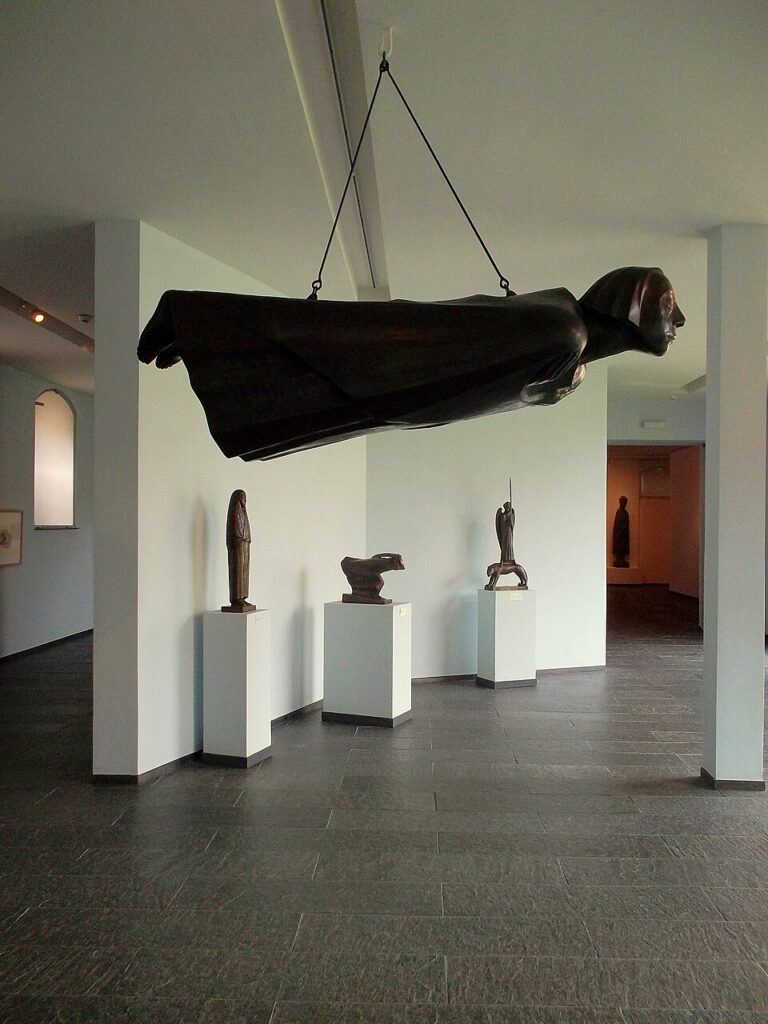
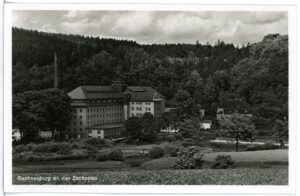
By ClemensAugust1700 – Own work, CC BY-SA 3.0, https://commons.wikimedia.org/w/index.php?curid=20898734

I am excited to begin our first issue of the 2026 calendar year with a full complement of reviews, and anticipate that all of our 2026 issues will follow with similar full-to-the-brim content. For this issue, Continue reading

Share

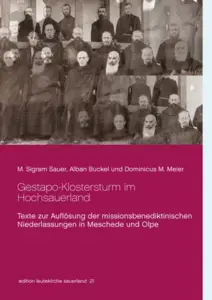
Review of Bauer, M. Sigram, Alban Buckel, Dominicus M. Maier et. al. Gestapo-Klostersturm im Hochsauerland

Contemporary Church History Quarterly

Volume 32, Number 1 (Spring 2026)

Review of Bauer, M. Sigram, Alban Buckel, Dominicus M. Maier et. al. Gestapo-Klostersturm im Hochsauerland. Texte zur Auflösung der missionsbeneditinischen Niederlassungen in Meschede und Olpe. Norderstedt: BoD, 2020.

By Martina Cucchiara, Bluffton University

This volume is the third in a projected four-part series on the Klostersturm (storming of the cloisters) in the archdiocese of Paderborn in Nazi Germany. Upon completion, the series will document in detail eight Catholic cloisters in the archdiocese that were closed and confiscated by the Gestapo between 1939 and 1941. The third and most recent volume focuses on the dissolution of the missionary Benedictine communities in the Sauerland: the Benediktinerkloster Königsmünster in Meschede and the Missions-Benediktinerinnen von Tutzing in Olpe. Divided into two parts, the book opens with Peter Bürger’s analysis and overview of the histories of the two religious communities. It is followed by a documentary section that brings together primary sources, personal testimonies, and previously published studies on the Benedictines in Meschede and Olpe as well as on the Klostersturm more broadly. Seeking to provide foundational material to scholars, the volume and series will mainly be of interest to scholars specializing in the history of the Catholic Church under Nazism.

Researchers and readers new to the topic will appreciate Bürger’s two introductory chapters, in which he situates the volume within the regime’s broader campaign against religious institutions. Repressive measures included the currency and morality trials, the closure of schools and novitiates, and the compulsory use of church properties during World War II. Continue reading
Share

Review of Stefan Alkier, Martin Keßler, and Stefan Rhein (eds.), Evangelische Kirchen und Politik in Deutschland. Konstellationen im 20. Jahrhundert

Contemporary Church History Quarterly

Volume 32, Number 1 (Spring 2026)

Review of Stefan Alkier, Martin Keßler, and Stefan Rhein (eds.), Evangelische Kirchen und Politik in Deutschland. Konstellationen im 20. Jahrhundert (Christianity in the Modern World 5), Tübingen 2023, 498 pp., €84.00.

By Manfred Gailus, Technische Universität Berlin; Translated from the German by Lauren Faulkner Rossi, with the assistance of DEEPL

This anthology of twenty-one contributions is based on a conference that was originally planned for November 2020 in Wittenberg with this central theme: “the question of the constellations of action and reaction of Protestant churches, their representatives, and their members in the political sphere” (introduction, v) in Germany in the 20th century. The Covid-19 pandemic threw a spanner in the works: the conference had to be postponed twice before it could finally happen in August 2021, on a considerably reduced scale. Although interdisciplinary in nature, theology and church history dominate the general thrust of this book by far. Unfortunately, the three editors’ all-too-brief introduction (v-vii) does not explain in detail what is meant by the guiding principle of “constellation research” and how this concept can be fruitfully applied to the analysis of twentieth-century German Protestantism.

Co-editor Martin Keßler provides more detail on the concept in his individual contribution. Following Karl Mannheim, Max Weber, and most recently Dieter Henrich, the term “constellation” is to be understood as Continue reading
Share

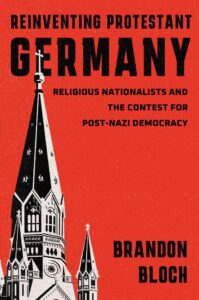
Review of Bloch, Brandon. Reinventing Protestant Germany: Religious Nationalists and the Contest for Post-Nazi Democracy

Contemporary Church History Quarterly

Volume 32, Number 1 (Spring 2026)

Review of Bloch, Brandon. Reinventing Protestant Germany: Religious Nationalists and the Contest for Post-Nazi Democracy (Harvard University Press, 2025), pp. 384, ISBN: 978-0-674-29543-8.

By Björn Krondorfer, Northern Arizona University

Over the last decades, an extensive body of scholarly work and other writings have addressed the role of the German churches and German clergy during the Nazi regime as well as their efforts to reform and rebuild themselves in the decades following Germany’s defeat in 1945. As a matter of fact, Protestant Germans issued introspective, apologetic, self-exculpating and, at times, defiant public declarations and statements immediately after the war, producing a large oeuvre of historical, theological, and political writings by those who lived through the twelve-year dictatorship. These initial proclamations were followed by analytical, historical, critical, and ethical assessments by succeeding generations of scholars as well as lay people, clergy, and theologians. So much ink has been spilled on these issues that one would expect new scholarship to emerge only in areas of more limited regional interest (i.e. local networks or personal biographies) or in specialized cross-disciplinary case studies (i.e. questions of gender or comparative studies on religion and nationalism in other Nazi-occupied countries). But we might not have expected in the twenty-first century a publication to offer a fresh panoptic view on German Protestantism during and after Nazi Germany.

This, however, is exactly what Brandon Bloch presents in his book on Protestant Germany, a sweeping project that is part political, theological, and intellectual history and part social analysis that reassesses Protestant viewpoints and influences in postwar Germany, interspersed with occasional biographical materials on Protestant clergy and theologians as well as Protestant intellectuals and politicians. Bloch traces the wave of religious nationalism that swept up German Protestant during Hitler’s dictatorship and how the defeat of Nazi Germany required a reorientation among German Protestants which, as he convincingly argues, was both a break with the past as well as a continuation of previous Protestant mentalities. Continue reading
Share

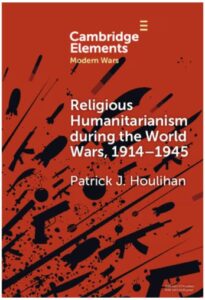
Review of Patrick J. Houlihan, Religious Humanitarianism during the World Wars, 1914-1945

Contemporary Church History Quarterly

Volume 32, Number 1 (Spring 2026)

Review of Patrick J. Houlihan, Religious Humanitarianism during the World Wars, 1914-1945. Cambridge Elements: Elements in Modern Wars. (Cambridge, 2024).

By Blake McKinney, Texas Baptist College at Southwestern Seminary

Wars do not consist entirely of death and destruction, but sometimes it may appear that histories written about wars do. Patrick Houlihan provides an unexpected contribution to the Cambridge Elements’ series of modern war studies which emphasizes humanitarian action rather than the era’s immense violence. Houlihan serves as Associate Professor of History at Trinity College Dublin. He is likely familiar to most CCHQ readers because of his 2015 book Catholicism and the Great War: Religion and Everyday Life in Germany and Austria-Hungary, 1914-1922 (Cambridge, 2015). His latest work, Religious Humanitarianism during the World Wars, 1914-1945, explores the reconstructive side of the human experience of war. This book is concerned with the preservation of lives and the rebuilding of societies rather than the destruction of modern warfare. Houlihan engages with the growing scholarship on humanitarianism, human rights, and transnational aid organizations. He challenges sweeping claims of twentieth-century secularization with an emphasis on the religious impulses of twentieth-century humanitarianism.

This book – or booklet – is the third of five publications thus far in Cambridge’s series “Elements in Modern War.”  These Cambridge Elements volumes may be unfamiliar to some readers. Cambridge describes the Elements line as a combination of “the best features of books and journals to create a quick, concise publishing solution for researchers and readers in the fields of academic publishing and scholarly communication.” Houlihan’s contribution to the Elements in Modern War stands out as the volume that most explicitly deals with the religious aspects of the world wars era (although Jay Winter’s The Cultural History of War in the Twentieth Century and After engages aspects of religious life as well). Works in this series are intentionally short with a goal to “provide comprehensive coverage of the key topics” in various subfields. This book most certainly accomplishes this goal. Houlihan introduces his readers to religious humanitarianism during the era of the two world wars with an impressive engagement of the historical literature. Continue reading
Share

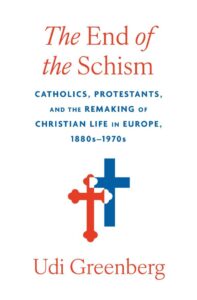
Review of Udi Greenberg, The End of Schism: Catholics, Protestants, and the Remaking of Christian Life in Europe, 1880s-1970s

Contemporary Church History Quarterly

Volume 32, Number 1 (Spring 2026)

Review of Udi Greenberg, The End of Schism: Catholics, Protestants, and the Remaking of Christian Life in Europe, 1880s-1970s. Cambridge, MA and London: Harvard University Press, 2025.

By Michael E. O’Sullivan, Marist University

This thorough academic study traces the gradual decline of the antagonism between Roman Catholics and Protestants in much of modern Europe. Udi Greenberg deftly examines an array of published works by Christian theologians, economists, social theorists, sex commentators, and missionary writers from over a century of transformative change. His narrative about how interconfessionalism gradually took hold and altered European politics, culture, and law is captivating. This book contributes much to the historiography due to its engagement with so many intellectuals from several western and central European nation-states, including Germany, Austria, France, Switzerland, Belgium, and the Netherlands. Furthermore, the extended time frame of the study, its transnational focus, and the attention paid to gender, sexuality, and colonialism all add to its originality.

This monograph advances several well-articulated claims. Its primary focus is to show that “even though Christian writers portrayed their engagement with each other as an egalitarian process, ecumenism was also deeply rooted in efforts to preserve hierarchies” (4). This study sheds light not only on the degree of interconfessional conflict and cooperation, but also on how opposition to class equality, feminism, and independence of African and Asian colonies prompted increasing ecumenical outreach. An additional thesis is that the rise of Nazism catalyzed change in confessional outlooks and caused an earlier shift toward cooperation between Catholics and Protestants than some previous histories of the subject suggest. Continue reading
Share

Article Note: David I. Kertzer, “Eugenio Pacelli and the Vatican’s Irish Plan to Save Baptized Jews (1938–1939)”

Contemporary Church History Quarterly

Volume 32, Number 1 (Spring 2026)

Article Note: David I. Kertzer, “Eugenio Pacelli and the Vatican’s Irish Plan to Save Baptized Jews (1938–1939),” Irish Theological Quarterly 91 (2026): 3–16, doi: 10.1177/00211400251404116.

Dirk Schuster, University of Vienna

David I. Kertzer, professor at Brown University and Pulitzer Prize winner, has recently published several studies on Pope Pius XI (1857–1939) and Pope Pius XII (1876–1958) and their relationship to fascist Italy under Benito Mussolini (1883–1945) and the National Socialist Third Reich. In his latest article, published in February 2026 in the Irish Theological Quarterly, Kertzer examines for the first time Ireland’s role in accepting Jews and Jews who had converted to Catholicism from Italy and Germany in 1938 and 1939. This short period was a decisive one for Jews and converts, especially in Italy. Continue reading

Share

Letter from the Editors (Winter 2025)

Contemporary Church History Quarterly

Volume 31, Number 4 (Winter 2025)

Letter from the Editors (Winter 2025)

By Lauren Faulkner Rossi, Simon Fraser University

Dear Friends,

Warmest Christmas greetings to our editors and readers. It has been a remarkable, productive, and very busy year for Contemporary Church History Quarterly, and I am pleased that we can once again finish on a strong note, with this final, somewhat tardy issue of the year stocked with varied contributions from several of our editors. Looking forward to 2026, I know that our journal will continue to be active and productive and, no doubt, relevant in ways both anticipated and unexpected.

Sachsenburg Concentration Camp (1933). By Brück & Sohn Kunstverlag Meißen – Own work, CC BY-SA 3.0, https://commons.wikimedia.org/w/index.php?curid=52763635

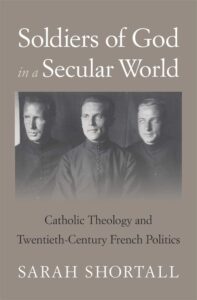
Maria Mitchell examines Sarah Shorthall’s recent monograph about the impact of French Catholic theology on French politics in the twentieth century. She notes that Soldiers of God in a Secular World is wonderfully interdisciplinary and carefully researched, and constitutes a clear guide to complicated questions that have historical contexts but that continue to resonate, particularly about the relationship between religion and philosophy, and religious and secular thought.

Continue reading

Share

Review of Sarah Shorthall, Soldiers of God in a Secular World: Catholic Theology and Twentieth-Century French Politics

Contemporary Church History Quarterly

Volume 31, Number 4 (Winter 2025)

Review of Sarah Shorthall, Soldiers of God in a Secular World: Catholic Theology and Twentieth-Century French Politics. (Cambridge: Harvard University Press, 2021). pp. 338.

By Maria D. Mitchell, Franklin & Marshall College

Sarah Shorthall has written a sweeping, multidimensional account of the influence of French theology on twentieth- and twenty-first century European and global Catholic and policy, philosophy, and politics.  In lucid, accessible prose, Shorthall traces seemingly esoteric debates among Catholic thinkers with real-world consequences for the anti-fascist resistance, Christian Democracy, existentialism, Liberation Theology, Negritude, the Second Vatican Council, and post-structuralism.  By demonstrating religion’s ongoing significance to a dechurched Europe, this rich history punctures the false dichotomy of a secularized public sphere and religious private sphere to interrogate contemporary meanings of secularism.

Version 1.0.0

Catholicism’s fundamental challenge in the twentieth century – to define the Church’s role in a secularized public sphere – serves as a touchstone for French religious thought.  In imagining an “authentically Catholic modernity” (5), theologians, like nationalists and socialists, excavated centuries of tradition to design new forms of public Catholicism that would defy “the logic of secular political taxonomies” (134).  It was no coincidence that French theologians exercised outsized influence on European Catholicism; ironically, France’s expulsion of religious orders – the Jesuits in 1880 and Dominicans in 1903 – and the radical separation of Church and State in 1905 fostered the very conditions for theological renewal.  Providing refuge for priests from across France and abroad, the Dominican exile at Le Saulchoir in Belgium and especially the Jesuit seminary on the Channel Island Jersey offered isolation, an extensive library, and protection for young theologians from Vatican control.  Shaped by wartime “affective” bonds that facilitated intellectual daring, these seminarians-in-exile would lead a Catholic theological renewal known as the nouvelle théologie.  That they ultimately helped engineer Vatican II and inspire Popes John Paul II, Benedict XVI, and Francis more than justifies Shorthall’s detailed treatment of their writings.

Continue reading

Share

Review of Felix Dümcke and Anna Schüller, eds., Geistliche im Konzentrationslager Sachsenburg

Contemporary Church History Quarterly

Volume 31, Number 4 (Winter 2025)

Review of Felix Dümcke and Anna Schüller, eds., Geistliche im Konzentrationslager Sachsenburg. Berlin, and Leipzig: Hentrich & Hentrich, 2023.

Dirk Schuster, University of Vienna

Hardly anything has had such a lasting impact on (theological) church historiography on the churches in the Third Reich as the narratives of imprisoned clergymen. Over decades, these narratives about them have emphasized resistance, victimization, and the trope of the apologetic martyr. As is well known, clergymen were imprisoned in concentration camps for various reasons in the early years of Nazi Germany. One of these early concentration camps was the KZ Sachsenburg, in what is now the German federal state of Saxony. However, these early concentration camps differed greatly in structure and size from the later systematically planned concentration camps such as Sachsenhausen, Buchenwald and Auschwitz.

Against the backdrop of rampant right-wing extremism in Saxony, it is all the more surprising that the government of Saxony does not wanted to provide any money to renovate the remaining buildings of the Sachsenburg concentration camp for an on-site memorial.[1] Apparently, the Saxon government no longer saw the need to draw attention to the horrors of National Socialism in the early years as situated in an authentic site. Or perhaps they were simply too cowardly to face up to the anticipated outraged reactions of the far-right AfD Party (which are sure to follow) if they were to make funds available for the creation of an appropriate memorial. After all, it can’t be down to the cost amount; we are talking about just over one million missing Euros out of an estimated five million for the construction measures. Fortunately, at the end of June this year, the Saxon state government decided at the last minute to provide the missing funds after all.

Continue reading

Share

Review of Jan H. Wille, Das Reichskonkordat: Ein Staatskirchenvertrag zwischen Diktatur und Demokratie, 1933-1957

Contemporary Church History Quarterly

Volume 31, Number 4 (Winter 2025)

Review of Jan H. Wille, Das Reichskonkordat: Ein Staatskirchenvertrag zwischen Diktatur und Demokratie, 1933-1957. (Paderborn: Brill-Schöningh, 2024). Pp. 481.

By Martin Menke, Rivier University

This volume, the latest in the blaue Reihe published by the Kommission für Zeitgeschichte, is a useful reference work for those seeking to understand the long-term effects of the concordat between the German state and the Holy See, concluded in 1933 and still in effect today. That said, the volume’s five parts vary in their scholarly richness. The author, Jan H. Wille, currently serves as an associate at the Helmut Schmidt University of the Armed Forces in Hamburg.

The work under review is his revised dissertation, which the late Thomas Großbölting supervised before his untimely death. Like most German dissertations, it begins with a lengthy discussion of existing literature and investigatory approaches. The author asserts that the concordat of 1933 was one of a series of treaties negotiated between churches and the German state in the twentieth century. Generally, the concordat is not considered a Staatskirchenvertrag, as those concluded by the German government and the Protestant churches are. Most historians of the concordat consider it a diplomatic agreement between two sovereign entities.

Continue reading

Share

Article Note: García-Fernández, Mónica. “From National Catholicism to Romantic Love: The Politics of Love and Divorce in Franco’s Spain.”

Contemporary Church History Quarterly

Volume 31, Number 4 (Winter 2025)

Article Note: García-Fernández, Mónica. “From National Catholicism to Romantic Love: The Politics of Love and Divorce in Franco’s Spain.” Contemporary European History 31, no. 2 (2022): 2–14.

By Martina Cucchiara, Bluffton University

In this prize-winning article, Mónica García-Fernández examines the changing emotional regime of romantic love in marriage in the final phase of Franco’s dictatorship (1939–75). She argues that a shifting discourse on love and marriage that prized happiness and fulfillment had repercussions far beyond the private sphere. Rather, she writes, “the defense of romantic love and divorce went hand-in-hand with a demand for religious freedom, individual rights, the separation of church and state and, ultimately, democracy” (p. 2). This new discourse was so consequential because Continue reading

Share

Article Note: Ilari Taskinen, Risto Turunen, Lauri Uusitalo, and Ville Kivimäki, “Religion, Patriotism and War Experience in Digitized Wartime Letters in Finland, 1939–44”

Contemporary Church History Quarterly

Volume 31, Number 4 (Winter 2025)

Article Note: Ilari Taskinen, Risto Turunen, Lauri Uusitalo, and Ville Kivimäki, “Religion, Patriotism and War Experience in Digitized Wartime Letters in Finland, 1939–44,” Journal of Contemporary History 57 (2022): 577–96, doi: 10.1177/00220094211066006.

By Dirk Schuster, University of Vienna

In 2022, four Finnish scholars, Ilari Taskinen, Risto Turunen, Lauri Uusitalo, and Ville Kivimäki, published a truly fascinating and a forward-looking paper featuring a particularly pioneering methodological approach to analyzing historical sources in the Journal of Contemporary History 57. For their contribution, they analyzed letters written by Finnish soldiers during Finland’s three wars between 1939 and 1944, which at first glance may not sound spectacular or particularly innovative. The question of “religion, patriotism, and war experience” is equally unspectacular, to be honest. The study of religious elements in letters from and to soldiers during wartime is a common theme in academic work. Nevertheless, Taskinen and his colleagues have produced a truly promising and, above all, forward-looking contribution.

Continue reading

Share

Review of Escape from Germany

Contemporary Church History Quarterly

Volume 31, Number 4 (Winter 2025)

Review of Escape from Germany, Directed by T.C. Christiansen, Remember Films, 2024.

By Martin Menke, Rivier University

“Escape from Germany” tells the story of how U.S. missionaries of the Church of Latter-Day Saints (LDS) or Mormons, fled Germany in 1939, just before the German invasion of Poland. There are many good films about National Socialism and religion. This is not one of them. It fails as cinema and, even more, as history.

The cinematic weaknesses are many. Continue reading

Share

Letter from the Editors (Fall 2025)

Contemporary Church History Quarterly

Volume 31, Number 3 (Fall 2025)

Letter from the Editors (Fall 2025)

By Mark Ruff, Saint Louis University

Dear Friends,

This issue represents a departure from Contemporary Church History Quarterly’s norm. Instead of providing our usual smorgasbord of scholarly reviews and conference reports, we are providing six reflections on a single theme.

This issue is inspired by the relevance of our journal’s staple to contemporary politics. It offers trenchant commentaries on how the histories of German and European religious institutions in the 1930s and 1940s – what for decades were somewhat misleadingly called the “church struggles” – are being appropriated, used, and abused in ongoing political strife and culture wars around the world, not least in the United States.

Continue reading

Share