Contemporary Church History Quarterly
Volume 27, Number 1 (March 2021)
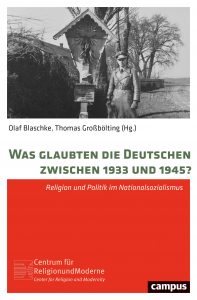
Review of Olaf Blaschke and Thomas Großbölting, eds., Was glaubten die Deutschen zwischen 1933 and 1945? Religion und Politik im Nationalsozialismus (Frankfurt am Main: Campus Verlag, 2020). 540 pages. ISBN 978-3-593-51077-4 (paperback); 978-3-593-44223-5 (eBook).
By Kevin P. Spicer, C.S.C., Stonehill College
In December 2018, at their home institution, the Westphalian Wilhelm University in Münster, Olaf Blaschke, a professor of nineteenth-century European history, and Thomas Großbölting, a professor of modern and contemporary European history, convened a diverse group of scholars to examine “What did the Germans believe 1933-1945, a New Perspective on the Relationship between Religion and Politics under National Socialism.” The conference resulted in the publication of the present volume, What did the Germans Believe 1933-1945? Religion and Politics under National Socialism, consisting of twenty unnumbered chapters divided into three parts. Blaschke’s and Großbölting’s collection follows an approach initially begun by Manfred Gailus and Armon Nolzen in their influential 2011 edited volume, Estranged ‘Ethnonationalist Community’: Faith, Denomination, and Religion under National Socialism (Zerstritten ‘Volksgemeisnchaft’ Glaube, Konfession und Religion im Nationalsozialismus; Vandenhoeck & Ruprecht). The essays in the Gailus and Nolzen collection examined the implications of the data that more than ninety-five percent of the German population belonged to either the Catholic or Protestant Church until National Socialism’s collapse in 1945, while, at the same time, at least two-thirds of these individuals also belonged to at least one National Socialist organization. The essays explored the intersection of these stark realities as Germans negotiated what it meant to be Christian and likewise members of the Volksgemeinschaft in the National Socialist state.
 The essays in Blaschke and Großbölting’s volume continue this investigation in a similar vein by widening and deepening it. They ask: Where did the churches and National Socialism interact with each other? In what ways did they stand in each other’s way? How did they compete for members or prominence? And how did they promote each other’s particular concerns? For the editors, an apologetic and mistaken emphasis on resistance – “cross versus sword” narrative – has dominated the interpretative framework of studies on Christianity in Germany under National Socialism. By contrast, however, they view the period fluidly, recognizing that few Germans rejected Nazism entirely. They claim a closer tie between the two than previously articulated in the Gaius and Nolzen collection as well as by others. If one concludes that religion was a significant factor in German society in the 1920s and 30s, they raise the following questions: did National Socialism arise despite Christianity, as many historians have suggested, or did Nazism develop and establish itself precisely because of society’s Christian character? The essays of this volume primarily support the latter by exposing the interplay of National Socialism and Christianity in a variety of historical situations.
The approach is not driven by examining the hierarchy of the churches nor by scrutinizing the nature of the institutions themselves. Instead, the chapters seek to uncover individual voices and actions of ordinary Christians both inside and outside traditional church settings. As with any volume, the results are mixed. Some are thoroughly convincing, while others offer the reader only a preview of an undeveloped argument. At the same time, the essays are not as original or groundbreaking in their field as the editors suggest. Although, since the turn of the century, apologetic and simplistic works have appeared, many studies on the churches under National Socialism have parted from the “cross versus sword” narrative to uncover elements of Christian complicity that lent support to the National Socialist state and abetted its crimes. Likewise, the authors have generally ignored the role of theology as a motivational factor and neglected the legacy of the Kulturkampf on Catholics. Still, this present volume advances our knowledge of the continuity of “brownness” among Christians prior, during, and after National Socialism officially existed in Germany.
The editors title the first section of their work as “Protagonists and their Practices.” Here the essays seek to reveal the interconnectedness and “entanglement” of National Socialism and Christianity in the different “social strata and milieus” in which Christians went about their daily existence (19-20). Unfortunately, the essay by Detlef Scheichen-Ackermann, which begins this section, rambles on, as it were, as he first attempts to elucidate alternate theories to explain the attraction of Germans toward the Volksgemeinschaft before presenting five concrete reasons for political reorientation to arise among them in the first place. These events include the failed experiment in councils coupled with the 1918-1919 civil upheaval that led to a “primal fear” of Bolshevism, the disgrace of Versailles, the loss of the talents and mediating influence of Gustav Stresemann upon his untimely death in 1929, fluctuating economic crisis, and, finally, the failure of Heinrich Brüning amid the bankruptcy of political Catholicism (50). In the following chapter, Jürgen W. Falter revisits his impressive, earlier 1991 research on the voting behavior of Catholics and Protestants that led to Hitler’s ascension to power and recalls his previous hypothesis, “if there had only been Catholics, there would probably never have been a National Socialist takeover, because then the NSDAP would not have easily managed to move beyond the status of a minority party” (61). While support for the NSDAP was always significantly higher among Protestants, Falter also concludes that in the last months of the Weimar Republic, the “relatively considerable resistance of the Catholic population to National Socialism diminished” (61).
Markus Raasch, in his contribution, attempts unsuccessfully to reveal how the relatively small city of Eichstätt and its surrounding communities evolved from a clerical-inspired “black” characterization of a staunchly Catholic community to a National Socialist “brown.” He argues that a “real resilient opposition between Catholicism and National Socialism never existed” (90). In his analysis, he gives almost no consideration to the impact of Konrad von Preysing (bishop, 1932 to 1935) on Eichstätt’s interaction with National Socialism. Likewise, he interprets the appropriation of National Socialist terminology by Catholics as a “Catholicization of National Socialism based on the Nazification of Catholicism” (94). Other authors, including myself, have interpreted the Catholic leaders’ adoption of such Nazi idiom in a different light, especially when faced with the repressive tactics against such use by Prussian Minister-President Hermann Göring in 1935. Raasch’s use of evidence is also selective, ignoring relevant studies and seemingly drawing from others without citation.
Sarah Thieme’s insightful chapter examines the metamorphosis of Advent and Christmas celebrations in the south Westphalian city of Bochum as they increasingly departed from their Christian roots. Before January 1933, an influential Protestant pastor, Philipp Klose, embraced the National Socialist “struggle” rhetoric and portrayed Christ as a militant soldier. Both Protestant and Catholic laywomen, for example, intertwined their roles in church associations, charity work, and, as individual members, in the National Socialist Women’s Organization. Such interaction resulted in cooperation between these groups in charity efforts such as the Winter Relief Program of the National Socialist Peoples’ Welfare (NSV). Church, state, and party organizations in Bochum, Thieme notes, also maintained traditional manners of celebrating Advent and Christmas, including nativity plays. In 1938, apparent national trends led the National Socialist Women’s Organization local leader to push for a reorientation of the celebrations. Ostensively, in an effort to avoid any denominational tensions, festivals of “light and joy” and adoration of a Nazified sacralized ideal for German mothers replaced Advent rites and “veneration of the blessed mother.” The war, however, brought an end to most public celebrations of the holiday season, Thieme concludes, as such events were relegated to the churches and private spheres.
Thomas Brodie’s essay on Catholic Faith during the Second World War summarizes his recent work, German Catholicism at War, 1939-1945 (Oxford, 2018), which I reviewed in CCHQ (25:2, June 2019). In that study, he sought to understand what religion meant to the German Catholic faithful during the war. For Brodie, a central contention is that Catholicism’s legitimization of the war outside of National Socialist ideology enabled Germans to support the battle on the homefront. This, of course, is not a new insight as Gordon Zahn and Heinrich Missilla came to a similar conclusion many years back. Next, Armin Nolzen contemplates the understanding of religion within the League of German Girls (BDM). He points out that there has been little investigation of this topic in the studies of this period. Although, for example, in December 1933, Reich Bishop Ludwig Müller enabled Protestant youth groups to merge with the Hitler Youth and, four years later, in 1937, the state forbade dual membership in denominational youth groups and the Hitler Youth (under which the BDM falls), there were still, by November 1939, thirty Protestant and twenty-five Catholic youth groups in existence. While Nolzen does not entirely succeed in uncovering the role of religion in the BDM, he does raise important questions for researchers to pursue.
In chapter seven, Christiane Schröder studies Protestant women’s religious communities in the Lower Saxony former regions of Calenberg and Lüneburg under National Socialism. Schröder explains that these communities have seldom been the topic of study and admits that they consisted of only 240 women. Remnants of pre-Reformation Catholic religious life, these communities required that women be Lutheran, unmarried, and at least fifty-five years old. Most came from the Hanoverian lower nobility and bourgeoisie classes. Overseen by the Klosterkammer in Hannover, which fell under the jurisdiction of the Reich and Prussian Ministry of Science, Education, and Culture, the communities were not entirely free of state supervision. Members of these communities no longer had to partake in a traditional monastic routine, but nevertheless were required to participate in a Sunday service, evening meals in common, and select prayer services while receiving rent-free apartments and a monthly allowance. For many women, these communities raised their social prestige and freed them from living with parents or relatives. Schröder freely admits that her research is in its initial stages directed toward her dissertation-in-progress. Thus far, her research has uncovered approximately twenty-six women who were members of the NSDAP, with a handful who were “old fighters.” By 1936, the state ordered the denomination requirement for entrance to be dropped, and, in its place, merely proof of Aryan ancestry. The institutions’ chronicles, Schröder’s central source, reveal the women’s collective gratitude and appreciation for Hitler, especially for destroying Bolshevism in Germany and for his initial gains in foreign policy. Support for the war, however, was mized among the women, with the chronicle authors heralding victories, but also expressing concern for the well-being and safety of German soldiers.
Martina Steber introduces the story of Augsburg’s second, possibly third-ranked composer Arthur Piechler, whose mother’s heritage was from a Jewish family that had converted to Catholicism. Steber’s interpretation is multilayered. Obtaining civil servant status in 1934 while being of mixed racial background, Piechler was an anomaly to the norm experienced by so many other Germans of similar heritage. Though persecuted on the national level by expulsion from the Reich Chamber of Music and forced labor under Organization Todt, Piechler became a pawn in the power struggle among the Reich Ministry of Propaganda and Gau (NSDAP district) and city officials. Steber views the defense of Piechler as partially ideological – his work embodied the “ideological disposition” of Gau Schwaben, which enabled the Catholic cultural conservative traits of “nationalism, anti-liberalism, anti-Bolshevism, and anti-modernism” to connect forces with National Socialism (212). Augsburg officials and bourgeoise citizens embraced Piechler’s music as representative of German art, arguing that his Ayran roots superceded his Jewish heritage. Piechler survived the war and was soon promoted by the allied occupiers to the director of Augsburg’s conservatory. He remained a “star” in Augsburg, but never gained national recognition as critics deemed his musical composition style outdated.
Finishing out the first section is Olaf Blaschke’s impressive chapter on the faith of Claus Schenk Graf von Stauffenberg. Although Stauffenberg has been the subject of numerous studies, according to Blaschke, none have convincingly examined his religious motivations. Likewise, no historian has provided a “single motif for his affinity to National Socialism” (255). Blaschke concludes that if faith is credited for his resolute choices after 1943, then his faith must also be seen as active in his decisions before this point. He finds no “direct evidence” against such a conclusion, especially when one acknowledges the anti-liberalism of both National Socialism and Catholicism as a point of convergence.
The editors designate the essays in section two, “Ideological and Religious Motives,” though, in many ways, they continue themes present in the first part. Klaus Große Kracht, for example, investigates five large gatherings of Catholics in Berlin in 1933. In my 2004 study, Resisting the Third Reich: Catholic Clergy in Hitler’s Berlin (DeKalb, IL: Northern Illinois University Press), I covered the same ground and reached similar conclusions. During these events, Catholics appropriated Nazi language and imagery, expressing nationalistic language and a desire to serve the German Reich. Große Kracht argues that this is the period before anticlericalism dominated the politics of the National Socialist state. He also highlights the nationalistic rhetoric of Father Marianus Vetter, a Dominican religious and celebrated preacher, who, I too, covered, making similar points, in Hitler’s Priests: Catholic Clergy and National Socialism (DeKalb, IL: Northern Illinois University Press, 2008). As previous studies have shown, once the bishops lifted their prohibition against membership in the National Socialist Party, many Catholics worked for a positive relationship between the state and church. Große Kracht’s essay affirms these earlier findings.
Miloslav Szabó’s essay reaches beyond the borders of the German Reich to Slovakia to examine priests’ affinity for National Socialism. He is fond of Roger Griffin’s 2007 term “clerical fascism” that distinguishes between those priests who defended “fascist ideology” and those clergymen who only succumbed to the “temptations of ‘national rebirth’” to combat Bolshevism and liberalism. Szabó takes significant issue with my use of the term “brown priest” and the discussion thereof by Thomas Forster in Priests in the Era of Radical Change: Identity and Life of Catholic Parish Clergy in Upper Bavaria 1918 to 1945 (Priester in Zeiten des Umbruchs: Identität und Lebenswelt des katholischen Pfarrklerus in Oberbazern 1918 bis 1945, Göttingen: Vandenhoeck & Ruprecht, 2014). Evidently, Szabó did not read Hitler’s Priests theoretical first chapter that covers analogous ground or Forster’s insightful contextual discussion of the term. Szabó divides “brown priests” into two categories: “clerical National Socialists” who, in their support of National Socialism, turn against the Church and eventually replace doctrine with ideology and “clerical fascists” who agitate for National Socialism but remain loyal to Catholicism and their ordinaries. To illustrate his use of the terms, Szabó presents three case studies. He identifies the first two priests of his study, Fathers František Boháč and Viliam Ries, as “clerical National Socialists” who worked tirelessly to implement National Socialist ideology radically. Szabó’s third cleric, Father Josef Steinhübl, is labeled a “clerical fascist” who endeavored to reconcile Catholicism with National Socialism, especially as a prominent agitator for the Carpathian German Party that represented the German minority in Slovakia. Szabó’s essay is informative and well-researched, though, I believe, he could have been more aware in his analysis of the geographical and situational uniqueness of the clerics that he studies. His categorization of Monsignor Jozek Tiso as a “clerical fascist minimum” (clerical-faschistisches Minimum) is also somewhat perplexing and not entirely helpful.
In chapter twelve, Holger Arning invites the reader to ponder the difference between trust (vertrauen) and faith (glauben) in the year 1934, specifically as it appears in the articles in Unser Kirchenblatt, the Münster diocese’s newspaper. He informs us that the term trust can “inspire true confidence” both in the Church and the leader (322). By 1934, the relationship between Church and state, however, had radically altered following the murder of Erich Klausener during the Röhm Purge – a turning point on which Arning and I agree. While the word Führer (leader) repeatedly appears in the pages of the newspaper, affirming the validity of the National Socialist leadership principle (Führerprinzip), authors of the newspaper articles use it more often in a Catholic context, reinforcing the Church’s authoritarian ideal and hierarchical system and aligning it with the kingship of Christ. (In 1925, Pope Pius XI had established the feast of Christ the King in response to anti-clericalism, secularism, and nationalism). Arning interprets this as the “adaptation of the editors to the new political circumstances” without specifically approving National Socialist ideology (326). In its rhetoric about Hitler, the newspaper was positive, but more often than not, referred to him by his official title as Chancellor. Arning concludes that in 1934 in the articles in Unser Kirchenblatt, Catholic trust “in Hitler and National Socialism was unstable,” and any confidence expressed in National Socialism was self-serving (343).
In a chapter on religious rites under National Socialism, Hans-Ulrich Thamer offers an insightful point about the nature of worship and ritual. For those who withdrew membership in their respective Christian denominations and legally became “believers in God” (Gottgläubigen), they did not immediately forfeit public expressions of their ingrained religious traditions. They brought these with them and, in turn, consciously or unconsciously influenced the structure of newly created National Socialist rites. Ample photos illustrate Thamer’s captivating argument. The second section ends with Christopher Picker’s ambitious essay on the belief and convictions of Palantine Protestants from 1933-1945. Focusing on the March 1934 Resolution of Palatine Protestants that proclaimed support for Reich Bishop Ludwig Müller as well as for the German Christians and placed the Palatine regional church “entirely at the disposal of the National Socialist state and its aid organizations,” the essay uncovers the overwhelming support of Protestant Christians in this region for National Socialism and the Nazi state (371). Picker devotes much of the article to National Socialism’s initial years of rule with little emphasis on the later years. Perhaps a more balanced focus would yield a more nuanced portrait of Palentine Protestantism under National Socialism.
The third part of the book focuses on “Interpretive Discourse,” as each essay connects themes and underlying patterns in the belief of Christians under National Socialism. Uwe Puscher examines the role of völkisch (ethnonationalist) religion in Nazi Germany. According to him, there were at most five thousand individuals who adhered to some form of völkisch religion under Hitler. Puscher chooses specifically not to focus on völkisch religion itself, but on Oskar Stillich, an economist, sociologist, and pacifist who dedicated a part of his career to studying völkisch thought and religious ideology, uncovering its racist and nationalistic aims. Removed in 1933 from his position at Humbolt University in Berlin, Stillich went into inner emigration, as it were, though he continued to research and write. He died on January 1, 1945. Though the chapter is informative on Stillich, it does not connect particularly well to the overall themes of the volume. Likewise, in an ambitious and wildly focused essay, Christoph Auffarth writes about contradictions in the theological interpretations he found among various professors at the University of Marburg under National Socialism. Despite the presence of National Socialist supporter Ernst Benz on its faculty, Marburg University’s faculty of theology maintained its allegiance to the Confessing Church, the branch of German Protestantism that sought freedom from Nazi state oversight and interference. In the next chapter, Manfred Gailus offers reflections on Christians in Nazi Germany by emphasizing both the impact of the 1933 Reich Concordat on Catholics and the high percent of Protestant clergy embracing National Socialism. For him, there should be “no talk of a block of ‘Christian resistance’ or Catholic resistance” (449). At the same time, there was “no clear strategy of religious policy on the part of the NSDAP or the Nazi state.” Instead, both entities approached religion with a “trial and error” mentality (455). Gailus is also one of the few authors who directly addresses the link between Christian and racial antisemitism. Then he concludes, “faith, denomination, and religion were hotly debated topics since 1933, and they occupied most Germans during this epoch more than before and more than afterward in the twentieth century” (461).
Lucia Scherzberg’s essay continues her ongoing study of the National Socialist Priests’ Circle that was the focus of her recent book, Between Party and Church: National Socialist Priests in Austria and Germany 1938-1944 (Zwischen Partei und Kirche: Nationalsozialistische Priester in Österreich und Deutschland 1938-1944, Frankfurt am Main: Campus Verlag, 2020), which I reviewed in the last issue of CCHQ (26:3, September 2020). In her chapter, she focuses on Father Franz Sales Seidl, a priest of the Passau diocese and one of a few Catholic priests involved in the Eisenach based Institute to Research and Eradicate the Jewish Influence on German Church Life. An active and enthusiastic member, Seidl contributed a three-part study, “Ethnonationalist Elements in the Roman Liturgy,” in which he proposed how to purify the Catholic liturgy of Jewish elements and to recover its so-called Germanic and Nordic roots. Despite the antisemitic and radical nature of his ideas, Seidl and his fellow National Socialist-inclined priests remained traditionally clerical, entirely opposed to any changes in the priesthood.
Mark Edward Ruff offers a thought-provoking essay by comparing the similarities between the “political and religious landscapes of the present with that of National Socialism” to uncover the hybridism of religious belief (493). He asks, “If a 66-year old evangelical Christian spends two hours a week in his church and twenty hours watching Fox News, the question arises which institution has the decisive influence on him. To draw a parallel with the National Socialist era, the following example may be given: If a 28-year old Protestant…in the Nazi era attended church once a month and was politically active for ten hours a week, one wonders what influence had the greatest impact on him” (508). To this end, he concludes, “in many cases, it is much more the political actors who not only draw the line between the religious and the secular but also determine and change the context of faith and its forms” (510).
Finally, Isabel Heinemann offers an overview of the volume by providing a summary of the arguments. She points out five areas of connection: First, although Germany was overwhelmingly Protestant, Catholicism dominated the subjects of the collection’s essays. In part, she believes this fact rests on the need for historians to challenge and dismantle interpretations that emphasize the fundamental resistance of the Catholic Church and Catholics to National Socialism. Second, the connection between faith and racism enabled Christians to integrate racist ideology into the practice of their faith easily. Third, during wartime, most Christians had “no problem with violence against Jews or Bolsheviks” (521). Fourth, the interplay between faith and gender appeared conspicuously, especially the relationship between Christian men and women during the war. Fifth, the interaction of religion and politics highlights the fact that the regime used “sacred symbolism and religious ritual to legitimize its rule and to exalt its own worldviews” (526). Upon pointing out these five areas of connection, Heinemann proposes topics for further study, which include moving beyond Germany to the occupied regions; expanding the time-period of focus (beyond 1933-1945); studying the relationship between faith and war as they tie to the question of annihilative ideology; and investigating the ties between Christian antisemitism and racism, empirically. Lastly, Heinemann recommends exploring the relationship of ethnonationalism to religion, the topic that Rebbeca Carter-Chand and I explore in our upcoming edited volume on ethnonationalism, antisemitism, and Christianity in the era of the two world wars.
Overall, this worthwhile volume provokes more questions than it answers. Still, this posture of inquiry is important as it will advance our understanding of Christian belief under National Socialism. Likewise, as we ponder the convergence of politics and faith in the essays of this volume, Mark Edward Ruff’s chapter, in particular, make for essential reading during this polarized election season.
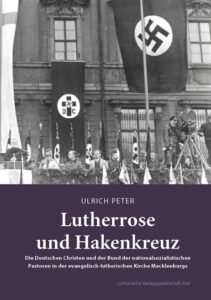 Above all, the work on the Thuringian German Christians, the dominant German-Christian movement in the “Third Reich” up to 1945 (Clemens Vollnhals), clearly shows how a large number of evangelical pastors–also far beyond Thuringia–dealt with National Socialism, perceiving it as connected to or at least instrumental in helping to build a “new Germany.” It is particularly striking, however, how many pastors–here again, beyond the Thuringian German Christians–welcomed the anti-Semitism of the National Socialists and even justified it theologically.
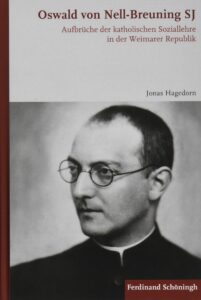 The introduction lasts the first seventy pages, and not until almost halfway through the volume does the discussion focus on Nell-Breuning. The previous pages explained the state of Christian solidarity in the 1920’s, describing Nell-Breuning’s definition of the term as post-liberal corporatist solidarity, but not fascist or reactionary. Hagedorn explains in detail the distinctions between the more romanticist-idealist Catholic thinkers in Vienna and the northern German approach to Catholic solidarity, which better reflected the economic realities of the 1920’s. Nell-Breuning was more comfortable with the “Kölner Richtlinien” of 1926, which explicitly accepted Catholic trade unions and much else in Catholic social teaching that would integrate Catholics in the broader economic and labor concerns of the times. For example, the Austrians denied any compatibility between capitalism and Christianity. At the same time, the commission established by Cardinal Schulte, Archbishop of Cologne, sought to find a way for Catholics, employers, employees, and others to function in the Weimar Republic’s economic conditions. Nell-Breuning also advocated ecclesiastical recognition of Christian trade unions and not just Catholic workers’ associations (katholische Arbeitervereine) led by priests.
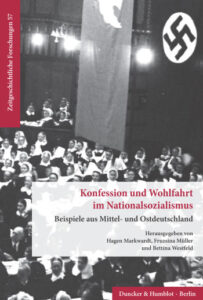 The focus on the regions of Central and Eastern Germany is a response to the current dearth of research on that region. Because denominational institutions were relatively autonomous at that time, such a regional delimitation makes perfect sense. Due to the denominational character of the region, then, most of the contributions deal with institutions and actors from the Protestant (evangelisch) spectrum, which is understandable. This will allow comparisons to be drawn between the various actors and institutions in different regions of Germany at a later point in time. It is regrettable that the editors did not succeed in soliciting contributions on the Thuringian region. They have focused on Silesia, however, which has also been rarely examined by research so far. A positive point to be emphasized here is the approach of the editors, acknowledging that the “relationship between the Christian-denominational institutions and the Nazi rule [are] not to [be understood] from the outset as dichotomous” (p. 11). Even if this approach should be a matter of course from this reviewer’s point of view, recent works show again and again that an ideological opposition between Christians and National Socialists is frequently assumed from the outset. Therefore, as self-evident as it may be, the editors’ basic attitude as it is formulated and implemented in the book is to be appreciated.
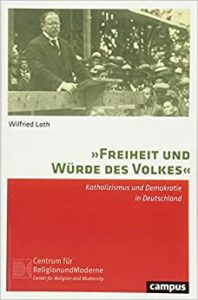 Loth argues that much relevant scholarship has rested on Rainer Lepsius’ theory of a closed Catholic milieu, largely dominated by ultramontane clergy.
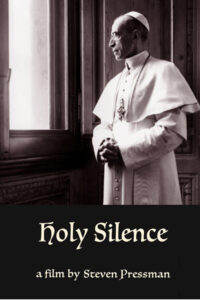 The film features several academics familiar to CCHQ readers, including members of the editorial team Kevin Spicer and Suzanne Brown-Fleming. Interviews with Robert Ventresca, Susan Zuccotti, Michael Phayer, Maria Mazzenga, and many others are interspersed with historic footage, and occasional re-enactment to explore the actions of popes Pius XI and XII and some of the innerworkings of the Vatican. Pressman offers a range of voices, including a few outliers like Norbert Hofmann, Secretary of the Holy See’s Commission for Jewish Relations, who views Pius XII in a sympathetic light. We also hear contrasting viewpoints from Sister Maria Pascalizi of the Roman Convent of Santa Maria dei Sette Dolori and Micaela Pavoncello, a local Jew, about the Vatican’s role in sanctioning or encouraging the hiding of Jews in churches.
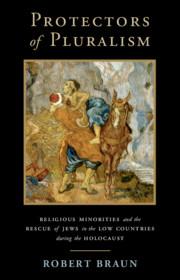 Because this is a work of social science, it employs a methodology very different from how historians approach research and thus warrants some explanation. Braun begins with a hypothesis that religious minorities are more likely to assist or rescue persecuted groups from mass violence or genocide. In this framing, religious minorities could hold minority status on a national level because of their small size (e.g., Quakers) or they could be a minority in a given region—Catholics in a majority Protestant region and vice versa. This minority theory is based on the idea that religious minorities recognize a shared vulnerability with other minorities, which triggers empathy. Braun posits that all religious communities seek security and self-preservation. When they cannot achieve this through religious dominance, then pluralism is the next safest option to ensure survival. So, a commitment to pluralism accounts for the willingness factor but minority status also enables capacity. Minority communities are able to engage in clandestine collective action while reducing exposure because of their members’ commitment and their relative isolation (more on isolation below). (40)
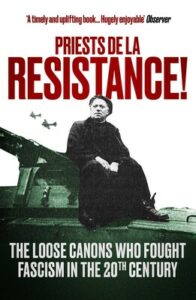 The book is divided into five sections, beginning in occupied France, with stories of “resistance par excellence” focusing on the lives of Canon Felix Kir (of blanc de cassis aka “Kir” fame) and Abbe Pierre (born Henri Marie Joseph Groues). Both of these individuals engaged in acts of sabotage, rescue work (especially of persecuted Jews), and generally served as thorns in the sides of the Nazis and their French collaborators.
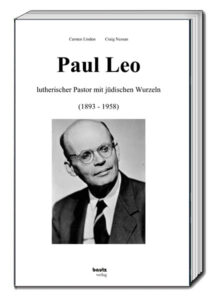 Based on extensive archival source material, Linden describes Paul Leo’s early professional career. When the National Socialists came to power, Leo faced increasing difficulties due to his Jewish ancestors. Why Linden then adopts the racial biological interpretations of the National Socialists in this regard and describes Paul Leo as the “Jewish pastor of the regional church” (p. 19) is disturbing, however. Unfortunately, Linden also makes significant mistakes in terms of content: The Confessing Church did not form due to alleged state and National Socialist (where should a dividing line be drawn here?) interventions in church affairs (p. 18). This apologetic church historiography of the 1950s has been refuted many times in recent years, which should be taken into account when dealing with such a topic.
 In his foreword to the book, Mark Lindsay welcomes Moses warmly into the realm of contemporary theological angst, affirming the proper place of a historian in all such things. This may seem all too obvious, but then the authority of the historical craft, and of historical knowledge altogether, has for some years now become increasingly obscure to those who oversee the life and work of most of our Protestant churches. When a moment of vital significance turns up historians are seldom to be found in the counsels of authority. If anything, they are likely to be deliberately excluded from them, though they might now and then be recruited to write introductory paragraphs. Evidently, we are all expected to return to a vigorous state of primitive Christianity as though nothing of significance has occurred across the intervening centuries. But there may be other reasons to maintain this state of ignorance. The historian of the modern church is not quite a tame creature. The churches prefer a show of loyalty, while those in charge of them care not at all to be criticised. Historians tend to do this rather freely, particularly when provoked. The historian of the Reformation may unhelpfully point out doctrinal contradictions or emphasize acts of violence. The historian of secularization will certainly prove to be bad for morale. As for the historians of the Third Reich, it is much safer to leave them in their university departments than to invite them to observe patterns and parallels. And why should there be any, after all?
 Many studies on the existence of churches under National Socialism point to the Warthegau as a blueprint of the Nazi state’s plans of actions for the future of all churches in Germany. Generally, however, historians have drawn such conclusions prematurely, basing them on select archival documents without examining the broader context of Nazi policies for the Warthegau and for Poland as a whole. By setting right these ill-considered assumptions, Huener situates his analysis of the church’s plight in the Warthegau clearly in the Nazi state’s Kirchenpolitik and Volkstumskampf or ethno-racial struggle. Dominating this regional policy was Arthur Greiser, a native of the region and the Warthegau’s long-serving (1939-1945) Gauleiter (district leader) and Reichsstatthalter (Reich governor), and his deputy, August Jäger, whom historian Klaus Scholder had previously identified as instrumental in intensifying state involvement in Protestant Church affairs in the initial years of Nazi rule. Huener mentions but does not explore this connection. Greiser and Jäger did not act alone. From Munich, Martin Bormann, chief of staff in the Office of the Deputy Führer and, after May 1941, head of the party chancellery, and from Berlin, Heinrich Himmler, SS Leader and Reich Commissioner for the Consolidation of German Nationhood, influenced Warthegau church policy while also allowing Greiser freedom to craft and implement it locally. The result revealed competing concerns between the ethno-racial struggle against Poles and an existing distrust of Catholicism. What historians have traditionally interpreted as attacks on Christianity by limiting or prohibiting Masses, Huener explains, were primarily security measures implemented by the occupiers to “prevent Poles from congregating and fomenting dissent or resistance” while they continued their policy of “undermin[ing] Poles’ sense of national identity and community” (6). Amid such motivations, strong anti-church sentiments also existed.
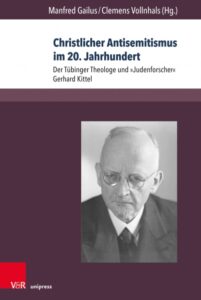 In a wide-ranging introduction, the editors skillfully contextualize the issues surrounding Protestant anti-Judaism and antisemitism during the Third Reich. Gailus and Vollnhals use the national reactions to the commemoration of the 500th anniversary of the German Protestant Reformation as a jumping off point. These 2017 commemorations included – for the first time in a Luther jubilee year – critical analysis of the reformer’s “Judenschriften,” of which the deeply anti-Judaic and antisemitic Von den Juden und ihren Lügen (On the Jews and Their Lies) stands out. Very soon after these commemorations ended, a group of historians, church historians, theologians, and religion scholars met in Dresden to assess Kittel’s biography, work, and legacy (7), which occasioned the present volume. Though Luther and Kittel lived and worked in vastly different historical contexts, their oeuvres stir similar debates about animus toward Jews and Judaism in Protestant theology and their real-world effects (8). Despite some overlap and repetition, the essays that follow address these issues in a comprehensive and satisfying fashion.
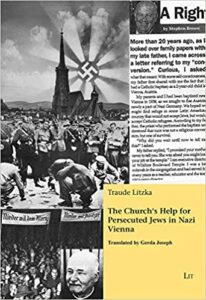 Despite the challenges of locating survivors and documents which would testify to the actions of the brave Catholic men and women engaged in rescue work, Litzka has assembled quite a roster of both individuals as well as orders of religious who decided that, despite the threat of arrest, interrogation, and imprisonment (or worse), their consciences would not allow them to remain inactive in the face of overwhelming discrimination and hardships. One such man who figures prominently throughout the book is the Jesuit priest, Ludger Born (born in Duisburg in 1897). Born was appointed as head of the “Aid Office for Non-Aryan Catholics” by Cardinal Theodor Innitzer in 1940 and for the next five years, Father Born worked assiduously to aid all those who needed help. He inherited his position from another priest, Father Georg Bichlmair, who had established the office and had staffed it primarily with dedicated women. Some of these women’s stories were later documented after the war by Father Born, providing some insight into both their identity and motivations. Out of the twenty-three employees, Father Born’s documentation focused on only five of the female workers. He attributed their dedication to their profound religiosity.
 Readers eager to expand their knowledge of World War II will appreciate details that are rarely addressed in standard histories. Reynolds, who served with the 120th Light Anti-Aircraft Regiment, describes how he experienced the elaborate preparations for the Normandy landings, including three days on board LST (Landing Ships Tank) 319. He also provides a fascinating glimpse into British interactions with locals in northern France and Belgium in the months after the breakout. For example, through a funeral he conducted for a Protestant civilian, Reynolds met and befriended a French woman, Mlle Perremond, who spoke excellent English. He subsequently learned that she and two other French women, one young, the other elderly, had helped seven downed RAF pilots escape to England.