Contemporary Church History Quarterly
Volume 32, Number 1 (Spring 2026)
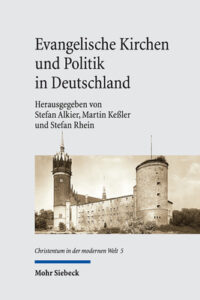
Review of Stefan Alkier, Martin Keßler, and Stefan Rhein (eds.), Evangelische Kirchen und Politik in Deutschland. Konstellationen im 20. Jahrhundert (Christianity in the Modern World 5), Tübingen 2023, 498 pp., €84.00.
By Manfred Gailus, Technische Universität Berlin; Translated from the German by Lauren Faulkner Rossi, with the assistance of DEEPL
This anthology of twenty-one contributions is based on a conference that was originally planned for November 2020 in Wittenberg with this central theme: “the question of the constellations of action and reaction of Protestant churches, their representatives, and their members in the political sphere” (introduction, v) in Germany in the 20th century. The Covid-19 pandemic threw a spanner in the works: the conference had to be postponed twice before it could finally happen in August 2021, on a considerably reduced scale. Although interdisciplinary in nature, theology and church history dominate the general thrust of this book by far. Unfortunately, the three editors’ all-too-brief introduction (v-vii) does not explain in detail what is meant by the guiding principle of “constellation research” and how this concept can be fruitfully applied to the analysis of twentieth-century German Protestantism.
 Co-editor Martin Keßler provides more detail on the concept in his individual contribution. Following Karl Mannheim, Max Weber, and most recently Dieter Henrich, the term “constellation” is to be understood as a heuristic instrument that seeks to illuminate individual elements in their broader contexts through a perspective of openness. A constellation is an assignment of comparable variables that is initially perceived as striking and then interpreted as significant. What Weber and Mannheim referred to as ‘factors’ is understood here as a structural element open to comparability. The perception of a constellation is descriptive in nature; its analysis adds further elements to which interpretative links are established. Within the general framework of historical research, the question of these relationships lies between a description of the specific individual cases and tentative explanatory models of the situational particularities. (46)
I will return in my conclusion to the question of whether this very abstract concept of ‘constellation research’ proves illuminating for the present book on the history of German Protestantism.
The twenty-one contributions are roughly divided into three sections: individual voices; institutional statements; and staged events. In the first section, Göttingen theologian Dietz Lange knowledgeably presents Nathan Söderblom’s ecumenical activities during the interwar period, culminating in the great Stockholm Church Conference of 1925. The Swedish theologian Söderblom, who had worked in Germany for a long time before the war, returned to Sweden immediately when war broke out in 1914. In a style reminiscent of Old Testament prophecy, according to Lange, the preacher subsequently condemned “the worship of the German god of blood and iron, the French god of the ‘grande nation,’ and the English god of imperialism as idolatry” during a service in Uppsala. (7) His criticism of the German god was most pronounced. This god, he said, had nothing to do with the Christian God, but belonged “in Valhalla.” Jürgen von Ungern-Sternberg (Basel) examines the proportion of theologians in the October 1914 appeal “To the Cultural World!” and their more general role during the First World War, specifically the attitudes of the prominent Berlin professors Adolf von Harnack, Adolf Deißmann, and Reinhold Seeberg. In terms of the history of theology, the break of the young Swiss theologian Karl Barth with the German theological traditions of the nineteenth and early twentieth centuries, prompted by the excesses of Protestant nationalist war theology, appears to be particularly significant due to this war constellation.
Co-editor Martin Keßler (Bonn) discusses the two-volume publication by Gotha publisher Leopold Klotz, published in 1932, that contains personal statements by German theologians on National Socialism. These statements from the summer of 1932, which Leonore Siegele-Wenschkewitz first examined in 1974, represent a cross-sectional survey of over forty theologians and are an important source for analyzing Protestant positions six months before Hitler came to power. Unfortunately only one voice (Paul Fiebig) is examined in detail here. A more in-depth examination of Siegele-Wenschkewitz’s analysis, which is now more than fifty years old, would have been desirable, but unfortunately this does not take place. Under the title “The Protestant Council Idea in the 20th Century,” the Kiel church historian Tim Lorentzen devotes himself to examining innovatively a memorial stone on the Danish holiday island of Fanø, which is dedicated to the ecumenical conference of August 1934 and especially to its participant Dietrich Bonhoeffer. Bonhoeffer took part in the parallel youth conference as a representative of the Confessing Church and, on this occasion, delivered a sermon on August 28, 1934, in which he proclaimed a biblically-grounded pacifism. Not least because of this engaging “peace speech,” the older idea of an ecumenical peace council was revived, which, as is well known, never came to fruition during the Third Reich. In this context, the author focuses particularly on the pioneering role of the pacifist Berlin theologian Friedrich Siegmund-Schultze, who decades earlier had been instrumental in initiating a peace conference that was to take place in Konstanz in August 1914 but had to be abandoned prematurely due to the outbreak of war.
Contributions by Helmut Kiesel (Heidelberg) on Jochen Klepper and by co-editor and New Testament scholar Stefan Alkier (Bonn) on “biblical confidence” and the “loss of trust in Protestant churches” in the Federal Republic conclude this first section. It is refreshing to read that literary scholar Kiesel—despite his empathy for the terrible fate of the Klepper family—ultimately takes a critical look at the behavior of the Christian-conservative writer. In view of Klepper’s “madness of faith” and its consequences, should we not ask, along with Sigmund Freud, “whether this faith was an illusion resulting from a combination of infantilism and fantasies of omnipotence, unworthy of the reason and sense of reality of an adult human being of the twentieth century?” (98) That may sound harsh, but in the Klepper case it seems to me to be well worth discussing.
Stefan Alkier’s unusual contribution is provocative: in places, it presents quite candid, critical assessments of the current state of the Protestant churches, enriched with biographical references. I read it with sympathy. The fundamental problem for the denomination is a “loss of trust” that “results largely from the gap between the prophetic, socially critical claims of biblical texts and the theological and ecclesiastical treatment of them, which is adapted to social power relations.” Instead of standing up for the socially marginalized, the churches have largely succumbed to the “market logic of capitalism.” In the style of a socially-committed, compassionate preacher of repentance and revival, theologian Alkier calls on the church to reflect on the essence of the biblical message: it is not acceptable to stay out of conflicts. The actions to which “the Scriptures” motivate us are carried by the hope of overcoming precarious conditions and suffering, which is promised to all. For the most part, this text is more of a sermon on repentance addressed to the current churches and their leaders and less a scientific contribution.
Only partial and summary references can be made here to the eleven contributions in the extensive second section “Institutional Statements.” Among others, the volume describes the “long road” from the Stuttgart Confession of Guilt in 1945 to the Rhineland Synod’s decision in 1980 on a renewed relationship between Christians and Jews (Wolfgang Hüllstrung); Claudia Lepp (Munich)’s examination of the church’s handling of the “Radikalenerlass” (Radicals Decree), which was highly controversial in the German public sphere of the 1970s and aimed to keep prospective teachers with communist leanings or party membership out of public service; the analysis of theologian Christian Polke (Göttingen) of the programmatic speeches by EKD Council chairpersons after 1945; and finally, the attention of systematic theologian Günter Thomas (Bochum), in a highly theological contribution, to the paths taken by the German postwar churches and Protestantism in general toward becoming a “moral agency” or a purely values-based agency. Several articles deal with specific topics related to an increasingly isolated and independent Protestantism in East Germany, including, for example, Christoph Kähler in his essay on the origins and uses of the then-common phrase “the church under socialism” as it repositioned itself.
In the third section, “Staged Events,” Eckart Reinmuth, a New Testament scholar from Rostock, reports on the 1937 removal of Ernst Barlach’s ‘Der Schwebende’ (“The Floating One”, 1927) from Güstrow Cathedral in a cloak-and-dagger operation by the National Socialists, and Karl-Wilhelm Niebuhr (Jena) reports on the now well-researched “Entjudungsinstitut” (De-Judaization Institute) in Eisenach and Walter Grundmann, the protagonist of this antisemitic research center in the Thuringian regional church. In particular, there is new information about Grundmann’s post-war church career in the GDR and his work as an informant for the Stasi.
Finally, we turn to the contribution of co-editor and classical philologist Stefan Rhein, who was chairman and director of the Luther Memorials Foundation in the state of Saxony-Anhalt from 1998 to 2023, and who played a leading role in preparing for the 2017 Reformation anniversary. He titled his review of the anniversary – quoting a critic of the large-scale church-state enterprise (with a question mark added) – “Protestant party at the state’s expense?” As a key protagonist of the project, the author naturally believes that the large-scale commemorative event was more than just a big church party at the state’s expense. But there is no doubt in and around Wittenberg, the commemorative year 2017 and the long period of preparation leading up to it, the atmosphere was very pro-government and politically consensual: Chancellor Angela Merkel, Federal Minister Wolfgang Schäuble, and Federal President Joachim Gauck spoke of the event in glowing terms and always very sympathetically. However, Rhein has little sympathy for the critical voices of renowned historians and church historians such as Hartmut Lehmann, Heinz Schilling, and Thomas Kaufmann. Here he echoes the defensive stance of Thies Gundlach, who as vice president of the EKD at the time was instrumental in the conception and implementation of the anniversary celebrations. Gundlach dismissed the criticism of the concept of the commemoration by a number of academics as “grumbling and nit-picking” and “know-it-all ignorance” towards the common causes of the federal government, the states, and civil society. What is striking about this summary article is that it makes virtually no mention of the undoubtedly influential initiatives provided by Council President Wolfgang Huber, who announced the Reformation and Luther Decade back in 2008 and clearly had high missionary hopes for it. It is also striking that there is no assessment of the long-term cost-benefit ratio of this huge state-funded missionary effort. After all, approximately €50 million of public money was spent. Has there been any turnaround, any noticeable resurgence of Christianity in terms of churchgoing or the public appreciation of Luther in the extremely unchurched heartland of the German Reformation and beyond in the “godless East”?
In sum, this compact 500-page anthology has the odium of a “general store.” As such, it represents a collection of texts on the history of German Protestantism in the twentieth century, some of which are more interesting than others. This potpourri of texts does not provide an overall impression of what the Protestant movement actually looked like in the century of the “German catastrophe” (Friedrich Meinecke). The underlying concept of ‘constellation research’ proves to be far too abstract to address the subject at hand. Not all of the contributions refer to the concept of ‘constellation’ as a guiding principle. More concrete or more subject-related terms or concepts would have been preferable here, as they would have allowed for a more appropriate examination of the history of German Protestantism. I will mention a few keywords and phrases: social and cultural trends toward secularization and the church’s resistance to them in the form of a conservative, militant anti-secularism; nationalism and völkisch thinking in theologically and ecclesiastically related forms of national Protestantism; Protestant Christian attitudes and positions on politics in general and, more specifically, on democracy, parliamentarianism, and party pluralism; Christian anti-Judaism and antisemitism as a mentality that had a massive influence on the dominant Christian denomination throughout the entire century. These are just a few of the long-standing issues that could be examined in detail and at the same time evaluated historically in relation to manifestations of German Protestantism in the fateful twentieth century. Unfortunately, we learn too little about these in the book with the promising title “Protestant Churches and Politics in Germany: Constellations in the 20th Century.” It is no coincidence that the editors provide no summary of any kind, either in the far-too-brief introduction or at the end of the book, that would do justice to the high aspirations of the book’s title.
