Contemporary Church History Quarterly
Volume 32, Number 1 (Spring 2026)
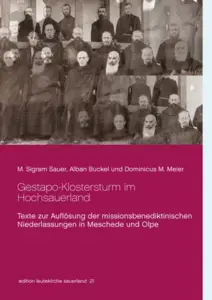
Review of Bauer, M. Sigram, Alban Buckel, Dominicus M. Maier et. al. Gestapo-Klostersturm im Hochsauerland. Texte zur Auflösung der missionsbeneditinischen Niederlassungen in Meschede und Olpe. Norderstedt: BoD, 2020.
By Martina Cucchiara, Bluffton University
This volume is the third in a projected four-part series on the Klostersturm (storming of the cloisters) in the archdiocese of Paderborn in Nazi Germany. Upon completion, the series will document in detail eight Catholic cloisters in the archdiocese that were closed and confiscated by the Gestapo between 1939 and 1941. The third and most recent volume focuses on the dissolution of the missionary Benedictine communities in the Sauerland: the Benediktinerkloster Königsmünster in Meschede and the Missions-Benediktinerinnen von Tutzing in Olpe. Divided into two parts, the book opens with Peter Bürger’s analysis and overview of the histories of the two religious communities. It is followed by a documentary section that brings together primary sources, personal testimonies, and previously published studies on the Benedictines in Meschede and Olpe as well as on the Klostersturm more broadly. Seeking to provide foundational material to scholars, the volume and series will mainly be of interest to scholars specializing in the history of the Catholic Church under Nazism.
 Researchers and readers new to the topic will appreciate Bürger’s two introductory chapters, in which he situates the volume within the regime’s broader campaign against religious institutions. Repressive measures included the currency and morality trials, the closure of schools and novitiates, and the compulsory use of church properties during World War II. He also offers an exacting critique of Catholic historiography which, he reiterates, all too often has functioned as apologetic theology rather than critical scholarship. Insisting on truthfulness (Wahrhaftigkeit) as a central theological virtue, he calls on church historians to pursue critical, source-based scholarship, which must entail discussions of complicity, collaboration, and failures within the Church. In this spirit, Bürger touches on the colonial legacy of the Benedictines, whose missionary work was intertwined with racist colonial ideologies, nationalism, and cultural paternalism. He raises these issues in part “to preempt the misunderstanding that the main purpose of our documentary series was to add heroic narratives of a narcissistic church culture” (17).
In subsequent chapters, Bürger situates the Klostersturm in Meschede and Olpe within the broader histories of both houses and the church struggle. He identifies the dissolution of the monastery Königsmünster in Meschede on March 19, 1941 as the beginning of the second phase of attacks against religious orders in Paderborn. Tracing the founding, development, and eventual dissolution of Königsmünster, the author probes the moral and theological limits of Catholic accommodation to the Nazi state. He offers a brief summary of the Benedictine school (Gymnasium) in Meschede based on the research of Dominicus M. Meier, OSB, whose work on the topic, first published in 1995, is reprinted in full in the second part of the book. Scholars of the school struggle will find this addition of interest. The chapter also raises unresolved questions about the principal, P. Hermann Weggartner, OSB, who is portrayed in vague and conflicting accounts as close to or even part of the Nazi movement (sources indicate he appeared in an SA uniform and left the Nazi Party in 1937) whilst also protecting Jews during the November pogrom in 1938. Bürger does not resolve these contradictions but calls for further research.
The chapter culminates in a detailed chronology of the Gestapo’s suppression of the cloister in 1941—the house searches, seizures, and arrests and the regime’ feeble legal maneuvers to justify the confiscation. Bürger writes that “like in all of the Gestapo’s raids of cloisters (Klosterraubzügen), here too, one is reminded of Kafka’s The Trial: The Meschede Benedictines are classified as ‘enemies of the state and the people’ but a concrete offense that justifies the confiscation is nowhere to be found” (62). The primary and secondary documents reprinted in the book supplement the chapter.
Here and elsewhere in the book, the author notes the ineffective and often feeble response of the Church hierarchy, highlighting instead what he sees as the courageous intervention of the laity. Once such intervention occurred in June 1941, when the Gestapo confiscated the cloister of the Benedictines in Olpe and expelled the nuns. According to the report compiled by Sr. M. Sigram Bauer, OSB, the Gestapo took the women to the small town of Eslohe, where “inhabitants gathered and adopted a ‘threatening posture’ toward Gestapo officials” (102). But the evidence of lay resistance as presented remains anecdotal and requires further, systematic research. The short chapter on the Benedictine nuns in Olpe offers a brief history of the cloister under Nazism, which is based on the report compiled in 2003 by Bauer titled “Missions-Benedictinerinnen von Tutzing in Schwerer Zeit.” The report is reprinted in full in the second part of the book. In contrast to the critical analysis of the Meschede Benedictine monks, the treatment of the nuns is mostly descriptive, emphasizing mainly their victimization and economic exploitation. This asymmetry points to the need for sustained research on women religious under National Socialism that illuminates histories no less complex than those of their male counterparts.
Overall, the volume offers a solid foundation for future scholarship on the Klostersturm in the Archdiocese of Paderborn. While it will mainly appeal to scholars of Catholicism, its insistence on source-based inquiry and its willingness to confront unresolved questions within Catholic history make it a worthwhile contribution to the broader field.
