Contemporary Church History Quarterly
Volume 32, Number 1 (Spring 2026)
Review of Bloch, Brandon. Reinventing Protestant Germany: Religious Nationalists and the Contest for Post-Nazi Democracy (Harvard University Press, 2025), pp. 384, ISBN: 978-0-674-29543-8.
By Björn Krondorfer, Northern Arizona University
Over the last decades, an extensive body of scholarly work and other writings have addressed the role of the German churches and German clergy during the Nazi regime as well as their efforts to reform and rebuild themselves in the decades following Germany’s defeat in 1945. As a matter of fact, Protestant Germans issued introspective, apologetic, self-exculpating and, at times, defiant public declarations and statements immediately after the war, producing a large oeuvre of historical, theological, and political writings by those who lived through the twelve-year dictatorship. These initial proclamations were followed by analytical, historical, critical, and ethical assessments by succeeding generations of scholars as well as lay people, clergy, and theologians. So much ink has been spilled on these issues that one would expect new scholarship to emerge only in areas of more limited regional interest (i.e. local networks or personal biographies) or in specialized cross-disciplinary case studies (i.e. questions of gender or comparative studies on religion and nationalism in other Nazi-occupied countries). But we might not have expected in the twenty-first century a publication to offer a fresh panoptic view on German Protestantism during and after Nazi Germany.
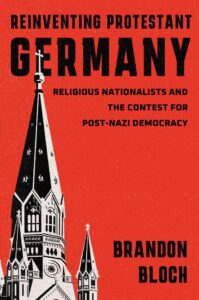 This, however, is exactly what Brandon Bloch presents in his book on Protestant Germany, a sweeping project that is part political, theological, and intellectual history and part social analysis that reassesses Protestant viewpoints and influences in postwar Germany, interspersed with occasional biographical materials on Protestant clergy and theologians as well as Protestant intellectuals and politicians. Bloch traces the wave of religious nationalism that swept up German Protestant during Hitler’s dictatorship and how the defeat of Nazi Germany required a reorientation among German Protestants which, as he convincingly argues, was both a break with the past as well as a continuation of previous Protestant mentalities.
In the Introduction and the opening two chapters, Bloch presents the contours of his project. In about sixty pages (Chapters 1 and 2), he summarizes how Germany’s national crises (1917-1930s) were understood by the different factions among German theologians and how subsequently German Protestant theologians, clergy, and intellectuals were, by and large, swept up in the national(ist) project of Hitler’s Germany. The few pockets of resistance often concerned themselves with issues of church autonomy rather than the impending war and the genocidal persecution of German Jews (and, later, the destruction of Jews in Nazi-occupied Europe). For readers and scholars familiar with this history, those chapters serve as a reminder of what is already known, though Bloch presents the main players, factions, theological positions, and contested issues with lucidity. These pages set the tone for his study. From the very start, Bloch introduces and focuses on individuals: on page 2, for example, Helmut Gollwitzer and Helmut Thielicke are highlighted. These two West German theologians had lived through Nazi Germany as young men (variously accommodating with and resisting the totalitarian state), but after 1945 represented very different political responses to the tumultuous events in the 1960s in West Germany. Thielicke compared the rebellious 1960s students to the Nazi movement, while Gollwitzer defended those students and denounced unsupportive Protestant congregations as “unchristian.” Throughout his book, as in this instance, Bloch intersperses his political analysis with the words and positions of particular personalities, a group of people he generally calls “Protestant intellectuals”: influential theologians, politicians, jurists, and lay intellectuals. To analyze “German Protestant politics after 1945” (13)—the core objective of his study—Bloch suggests looking at three venues of “personal and intellectual encounters: between Allies and Germans; between competing factions within German Protestantism; and between theologians and lay intellectuals” (13). [1]
Chapter 2, “From the Total State to the Limits of Obedience,” traces the trajectories of different Protestant men as they tried to arrange themselves with a totalitarian state. Keeping a close eye on individual clergy—and in doing so reminding the reader of how many pastors initially voted for and supported Hitler’s ascent to power, including such well-known role models as Martin Niemöller who cast his vote for Hitler on March 5, 1933—he counters hagiographic narratives of the postwar Confessing Church resistance in line with the critical scholarship that has emerged since the 1980s in German “contemporary church history.” [2] The chapter introduces the various factions within the German Protestant church, occasionally detailing theological arguments (especially with respect to Karl Barth’s theology), and it explains which narratives about that time came to dominate in Germany’s immediate postwar years. One of these enduring narratives declared Christianity incompatible with Nazim—although such a view, as we know today, was retrospectively created and not based on the factual realities in the years 1933-1945. Those postwar narratives “omitted marginalized figures” such as Protestant “laywomen and Christians of Jewish heritage” (80). “Whitewashed accounts of the Nazi era” (80), Bloch concludes, would prevail during the Allied occupation of Germany after its surrender in 1945, often in service of resisting the Allied denazification programs.
Following these introductory chapters, Bloch gets to the core of his study: to present, analyze, and understand how Protestant discourse shaped political decisions in (mostly) West Germany under Allied control, and how differences between conservative and liberal Protestants (with roots in the 1933-1945 internal “church struggle”) came to dominate contemporary political and legal debates. Bloch traces five of the better-known controversial political debates between the end of the war and the 1960s, and he devotes a full chapter to each of them. In Chapter 3, he introduces the political debates around the Allied approaches to post-Nazi justice, with the majority of Protestant clergy and theologians across the theological-political spectrum (from the Confessing church to those who accommodated or supported Nazism) protesting Allied policies. They opposed denazification procedures and war crime trials. Here, Bloch sees a clear continuation of Protestant nationalism. “The German Protestant campaign against war crimes trials embodied the antisemitic and anti-liberal ideologies that were paramount of prewar Protestant nationalism” (83). Bloch reveals how the language of human rights was invoked by Protestant intellectuals to oppose the Allied war crime trials, and how former perpetrators joined Protestant networks to benefit from the “EKD’s [Evangelical Church of Germany] postwar apologetics” (112). Those networks included the Protestant Academies in Germany which, founded after 1945, were supported by the US military government. [3]
Chapter 4 addresses legal issues that regulated family life and schools in postwar Germany, a debate that revealed a deep-seated confessional difference between German Catholics and Protestants. While Germany had been a majority Protestant country prior to 1945, with the loss of majority-Protestant provinces to East Germany under Soviet control, the balance shifted. Postwar West Germany was governed for many years by Chancellor Konrad Adenauer, a Catholic. Chapter 5 addresses the controversy over Germany’s military rearmament in the 1950s, an issue that pitted conservatives in both denominations (Adenauer and conservative Lutherans) against progressives in the Protestant Confessing Church and Catholic peace groups. Progressive Protestants who insisted on keeping Germany demilitarized as a lesson to be learned from Nazi Germany clashed with Cold War politics. A new democratic Germany, they argued, had to be committed to peace and reconciliation; in the end, the real politic of the Cold War prevailed.
In Chapter 6, Bloch addresses the issue of Germany’s loss of territories in the East. In 1965, the German Protestant Church (EKD) released its pathbreaking “Eastern Memorandum” which argued that Germany needed to accept the territorial losses, now mostly in Poland under Soviet control, for the sake of reconciliation. Protestant intellectuals and theologians argued for the acceptance of these new borders; they took a stance against a large German consensus that equated the loss of these territories as part of the “mass crimes perpetrated against Germany” after 1945 (197). No other major institution in Germany had dared to take this position as proposed in the Memorandum. Protestant opinions were, of course, not unanimous, with differences voiced along familiar lines: conservatives, like theologian Künneth, argued against the Memorandum, while progressives supported it, like Iwand, Niemöller, and Gollwitzer. The Memorandum, Bloch writes, was perhaps the Protestants’ most successful political postwar intervention. It was the engine that would, five years later, lead to the ratification of the 1970 Treaty of Moscow, which confirmed Germany’s recognition of the new borders. It was a moment that celebrated “the role of the Protestant churches in Germany’s moral renewal” (232), a role that, from that point on, steadily declined given the increasing secularization of West Germany and the aging of the generation of Protestant intellectuals who had experienced the Nazi regime and who had determined much of Germany’s postwar discourse.
The last chapter (Chapter 7) brings to the reader’s attention the controversy over the 1968 “emergency laws,” a proposed constitutional amendment to “expand executive power and limit basic rights during state-declared emergencies” (234). As to be expected, this issue too led to fissures across the Protestant spectrum. There was the old guard of progressive Protestants who had lived through the Nazi era who now aligned themselves with the new 1960s West German Left to oppose—or at least amend—these emergency laws; they argued that these laws echoed Hitler’s 1933 Enabling Act. The other side included both conservative and liberal-leaning Protestants, who supported the “emergency laws,” arguing that they were needed to defend and protect constitutional democracy. With a majority coalescing “around the narrative of their confession’s recent history that took hold after 1945,” (236) Bloch writes, new Protestant leaders came to embrace the idea of protecting the new German Rechtsstaat which they perceived as preserving and encoding Protestant religious values. Bloch ends this chapter with a few pages on the 1968 student rebellion that unsettled German society and out of which a radicalized new generation emerged: the militant Red Army Faction. Among the leading figures of the RAF were Ulrike Meinhof from a Protestant family and Gudrun Ensslin, the daughter of a Confessing Church pastor.
Helmuth Gollwitzer and Helmut Thielicke, with whom Bloch opened his book, reappear in this final chapter, reminding us of their opposing positions vis-à-vis the rebellious 1968 student movement. Thus, Bloch’s book comes full circle. With the 1968 society upheavals, the narratives of Protestant theologians and intellectuals that emerged from their experiences of the Nazi regime began to lose persuasive force. Though the early hopes of postwar Protestant intellectuals to re-Christianize Germany after 1945 never materialized, they nevertheless contributed significantly to the shaping of West Germany’s democracy. In an increasingly secularized Germany, new generations born after 1945 identified to lesser degrees with Protestantism. They shifted their attention to topics related to Nazi Germany’s past that hitherto had been neglected. Issues of antisemitism and Jewish-Christian dialogue moved to the foreground, and stories of Protestant women resisters were unearthed. By the 1970s, Bloch writes in his Conclusion, “a new generation of Protestant theologians, pastors, and lay intellectuals, who had not participated in the Nazi-era church conflict, took over the leadership of the Protestant public sphere” (275). They faced new issues, such as the integration of a Muslim minority population into Germany’s social fabric. Faultlines between different political-religious positions continued, with people invoking, at times, the lessons to be learned from Nazi Germany and the Holocaust.
Bloch’s comprehensive work is remarkable in terms of detailed attention to people, positions, and policies and in terms of conceptualizing complicated societal and religious dynamics in post-1945 Germany. The comments and short summations of each chapter presented in this review do not do justice to the countless details and insights that a reader will encounter in this book, with each section introducing a new set of issues and personalities, which Bloch masterfully negotiates and explains.
Notes:
[1] Bloch is aware of the potential limitations when focusing on key Protestant intellectuals, since Protestants in postwar Germany were a highly diverse group of “over 26 million people in 1950” (15). He justifies his focus by pointing out that his study is not a sociological assessment of regional and religious diversity but an analysis of postwar Protestant discourse that shaped German national identity and politics after 1945.
[2] “[T]his book joins a wave of studies,” Bloch notes, “that have transformed the writing of twentieth-century European history by underscoring the ongoing political salience of religion after 1945” (18). Among the works on religion and nationalism that Bloch relies on, with a focus on critical reassessments of 20th century German church history, are such scholars as Doris Bergen, Jeremy Best, Olaf Blaschke, Thomas Groβbölting, Manfred Gailus, Mirjam Loos, Wolfgang Gerlach, Victoria Barnett, Matthew Hockenos, Susannah Heschel, Benjamin Ziemann, and Clemens Vollnhals, to name a few.
[3] To learn that “the Protestant Academies pursued a conservative vision of re-Christianization” (90) when they were first established after 1945 and that they were involved in attempts at exonerating German perpetrators is of particular disappointment for this reviewer. I experienced the Evangelische Akademien in Germany in the 1980s as safe spaces for social innovation and theological education outside restrictive-normative church rules and academic theology.
