Category Archives: Reviews

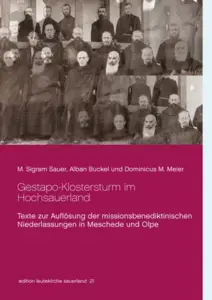
Review of Bauer, M. Sigram, Alban Buckel, Dominicus M. Maier et. al. Gestapo-Klostersturm im Hochsauerland

Contemporary Church History Quarterly

Volume 32, Number 1 (Spring 2026)

Review of Bauer, M. Sigram, Alban Buckel, Dominicus M. Maier et. al. Gestapo-Klostersturm im Hochsauerland. Texte zur Auflösung der missionsbeneditinischen Niederlassungen in Meschede und Olpe. Norderstedt: BoD, 2020.

By Martina Cucchiara, Bluffton University

This volume is the third in a projected four-part series on the Klostersturm (storming of the cloisters) in the archdiocese of Paderborn in Nazi Germany. Upon completion, the series will document in detail eight Catholic cloisters in the archdiocese that were closed and confiscated by the Gestapo between 1939 and 1941. The third and most recent volume focuses on the dissolution of the missionary Benedictine communities in the Sauerland: the Benediktinerkloster Königsmünster in Meschede and the Missions-Benediktinerinnen von Tutzing in Olpe. Divided into two parts, the book opens with Peter Bürger’s analysis and overview of the histories of the two religious communities. It is followed by a documentary section that brings together primary sources, personal testimonies, and previously published studies on the Benedictines in Meschede and Olpe as well as on the Klostersturm more broadly. Seeking to provide foundational material to scholars, the volume and series will mainly be of interest to scholars specializing in the history of the Catholic Church under Nazism.

Researchers and readers new to the topic will appreciate Bürger’s two introductory chapters, in which he situates the volume within the regime’s broader campaign against religious institutions. Repressive measures included the currency and morality trials, the closure of schools and novitiates, and the compulsory use of church properties during World War II. Continue reading

Share

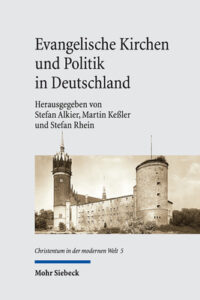
Review of Stefan Alkier, Martin Keßler, and Stefan Rhein (eds.), Evangelische Kirchen und Politik in Deutschland. Konstellationen im 20. Jahrhundert

Contemporary Church History Quarterly

Volume 32, Number 1 (Spring 2026)

Review of Stefan Alkier, Martin Keßler, and Stefan Rhein (eds.), Evangelische Kirchen und Politik in Deutschland. Konstellationen im 20. Jahrhundert (Christianity in the Modern World 5), Tübingen 2023, 498 pp., €84.00.

By Manfred Gailus, Technische Universität Berlin; Translated from the German by Lauren Faulkner Rossi, with the assistance of DEEPL

This anthology of twenty-one contributions is based on a conference that was originally planned for November 2020 in Wittenberg with this central theme: “the question of the constellations of action and reaction of Protestant churches, their representatives, and their members in the political sphere” (introduction, v) in Germany in the 20th century. The Covid-19 pandemic threw a spanner in the works: the conference had to be postponed twice before it could finally happen in August 2021, on a considerably reduced scale. Although interdisciplinary in nature, theology and church history dominate the general thrust of this book by far. Unfortunately, the three editors’ all-too-brief introduction (v-vii) does not explain in detail what is meant by the guiding principle of “constellation research” and how this concept can be fruitfully applied to the analysis of twentieth-century German Protestantism.

Co-editor Martin Keßler provides more detail on the concept in his individual contribution. Following Karl Mannheim, Max Weber, and most recently Dieter Henrich, the term “constellation” is to be understood as Continue reading

Share

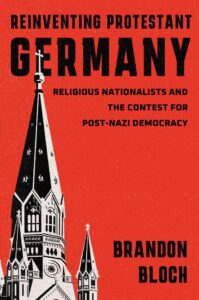
Review of Bloch, Brandon. Reinventing Protestant Germany: Religious Nationalists and the Contest for Post-Nazi Democracy

Contemporary Church History Quarterly

Volume 32, Number 1 (Spring 2026)

Review of Bloch, Brandon. Reinventing Protestant Germany: Religious Nationalists and the Contest for Post-Nazi Democracy (Harvard University Press, 2025), pp. 384, ISBN: 978-0-674-29543-8.

By Björn Krondorfer, Northern Arizona University

Over the last decades, an extensive body of scholarly work and other writings have addressed the role of the German churches and German clergy during the Nazi regime as well as their efforts to reform and rebuild themselves in the decades following Germany’s defeat in 1945. As a matter of fact, Protestant Germans issued introspective, apologetic, self-exculpating and, at times, defiant public declarations and statements immediately after the war, producing a large oeuvre of historical, theological, and political writings by those who lived through the twelve-year dictatorship. These initial proclamations were followed by analytical, historical, critical, and ethical assessments by succeeding generations of scholars as well as lay people, clergy, and theologians. So much ink has been spilled on these issues that one would expect new scholarship to emerge only in areas of more limited regional interest (i.e. local networks or personal biographies) or in specialized cross-disciplinary case studies (i.e. questions of gender or comparative studies on religion and nationalism in other Nazi-occupied countries). But we might not have expected in the twenty-first century a publication to offer a fresh panoptic view on German Protestantism during and after Nazi Germany.

This, however, is exactly what Brandon Bloch presents in his book on Protestant Germany, a sweeping project that is part political, theological, and intellectual history and part social analysis that reassesses Protestant viewpoints and influences in postwar Germany, interspersed with occasional biographical materials on Protestant clergy and theologians as well as Protestant intellectuals and politicians. Bloch traces the wave of religious nationalism that swept up German Protestant during Hitler’s dictatorship and how the defeat of Nazi Germany required a reorientation among German Protestants which, as he convincingly argues, was both a break with the past as well as a continuation of previous Protestant mentalities. Continue reading

Share

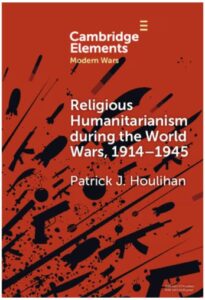
Review of Patrick J. Houlihan, Religious Humanitarianism during the World Wars, 1914-1945

Contemporary Church History Quarterly

Volume 32, Number 1 (Spring 2026)

Review of Patrick J. Houlihan, Religious Humanitarianism during the World Wars, 1914-1945. Cambridge Elements: Elements in Modern Wars. (Cambridge, 2024).

By Blake McKinney, Texas Baptist College at Southwestern Seminary

Wars do not consist entirely of death and destruction, but sometimes it may appear that histories written about wars do. Patrick Houlihan provides an unexpected contribution to the Cambridge Elements’ series of modern war studies which emphasizes humanitarian action rather than the era’s immense violence. Houlihan serves as Associate Professor of History at Trinity College Dublin. He is likely familiar to most CCHQ readers because of his 2015 book Catholicism and the Great War: Religion and Everyday Life in Germany and Austria-Hungary, 1914-1922 (Cambridge, 2015). His latest work, Religious Humanitarianism during the World Wars, 1914-1945, explores the reconstructive side of the human experience of war. This book is concerned with the preservation of lives and the rebuilding of societies rather than the destruction of modern warfare. Houlihan engages with the growing scholarship on humanitarianism, human rights, and transnational aid organizations. He challenges sweeping claims of twentieth-century secularization with an emphasis on the religious impulses of twentieth-century humanitarianism.

This book – or booklet – is the third of five publications thus far in Cambridge’s series “Elements in Modern War.”  These Cambridge Elements volumes may be unfamiliar to some readers. Cambridge describes the Elements line as a combination of “the best features of books and journals to create a quick, concise publishing solution for researchers and readers in the fields of academic publishing and scholarly communication.” Houlihan’s contribution to the Elements in Modern War stands out as the volume that most explicitly deals with the religious aspects of the world wars era (although Jay Winter’s The Cultural History of War in the Twentieth Century and After engages aspects of religious life as well). Works in this series are intentionally short with a goal to “provide comprehensive coverage of the key topics” in various subfields. This book most certainly accomplishes this goal. Houlihan introduces his readers to religious humanitarianism during the era of the two world wars with an impressive engagement of the historical literature. Continue reading

Share

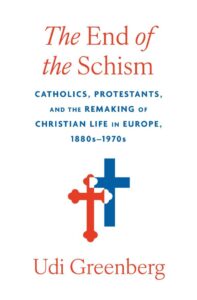
Review of Udi Greenberg, The End of Schism: Catholics, Protestants, and the Remaking of Christian Life in Europe, 1880s-1970s

Contemporary Church History Quarterly

Volume 32, Number 1 (Spring 2026)

Review of Udi Greenberg, The End of Schism: Catholics, Protestants, and the Remaking of Christian Life in Europe, 1880s-1970s. Cambridge, MA and London: Harvard University Press, 2025.

By Michael E. O’Sullivan, Marist University

This thorough academic study traces the gradual decline of the antagonism between Roman Catholics and Protestants in much of modern Europe. Udi Greenberg deftly examines an array of published works by Christian theologians, economists, social theorists, sex commentators, and missionary writers from over a century of transformative change. His narrative about how interconfessionalism gradually took hold and altered European politics, culture, and law is captivating. This book contributes much to the historiography due to its engagement with so many intellectuals from several western and central European nation-states, including Germany, Austria, France, Switzerland, Belgium, and the Netherlands. Furthermore, the extended time frame of the study, its transnational focus, and the attention paid to gender, sexuality, and colonialism all add to its originality.

This monograph advances several well-articulated claims. Its primary focus is to show that “even though Christian writers portrayed their engagement with each other as an egalitarian process, ecumenism was also deeply rooted in efforts to preserve hierarchies” (4). This study sheds light not only on the degree of interconfessional conflict and cooperation, but also on how opposition to class equality, feminism, and independence of African and Asian colonies prompted increasing ecumenical outreach. An additional thesis is that the rise of Nazism catalyzed change in confessional outlooks and caused an earlier shift toward cooperation between Catholics and Protestants than some previous histories of the subject suggest. Continue reading

Share

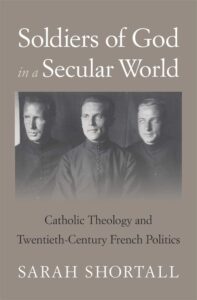
Review of Sarah Shorthall, Soldiers of God in a Secular World: Catholic Theology and Twentieth-Century French Politics

Contemporary Church History Quarterly

Volume 31, Number 4 (Winter 2025)

Review of Sarah Shorthall, Soldiers of God in a Secular World: Catholic Theology and Twentieth-Century French Politics. (Cambridge: Harvard University Press, 2021). pp. 338.

By Maria D. Mitchell, Franklin & Marshall College

Sarah Shorthall has written a sweeping, multidimensional account of the influence of French theology on twentieth- and twenty-first century European and global Catholic and policy, philosophy, and politics.  In lucid, accessible prose, Shorthall traces seemingly esoteric debates among Catholic thinkers with real-world consequences for the anti-fascist resistance, Christian Democracy, existentialism, Liberation Theology, Negritude, the Second Vatican Council, and post-structuralism.  By demonstrating religion’s ongoing significance to a dechurched Europe, this rich history punctures the false dichotomy of a secularized public sphere and religious private sphere to interrogate contemporary meanings of secularism.

Version 1.0.0

Catholicism’s fundamental challenge in the twentieth century – to define the Church’s role in a secularized public sphere – serves as a touchstone for French religious thought.  In imagining an “authentically Catholic modernity” (5), theologians, like nationalists and socialists, excavated centuries of tradition to design new forms of public Catholicism that would defy “the logic of secular political taxonomies” (134).  It was no coincidence that French theologians exercised outsized influence on European Catholicism; ironically, France’s expulsion of religious orders – the Jesuits in 1880 and Dominicans in 1903 – and the radical separation of Church and State in 1905 fostered the very conditions for theological renewal.  Providing refuge for priests from across France and abroad, the Dominican exile at Le Saulchoir in Belgium and especially the Jesuit seminary on the Channel Island Jersey offered isolation, an extensive library, and protection for young theologians from Vatican control.  Shaped by wartime “affective” bonds that facilitated intellectual daring, these seminarians-in-exile would lead a Catholic theological renewal known as the nouvelle théologie.  That they ultimately helped engineer Vatican II and inspire Popes John Paul II, Benedict XVI, and Francis more than justifies Shorthall’s detailed treatment of their writings.

Continue reading

Share

Review of Felix Dümcke and Anna Schüller, eds., Geistliche im Konzentrationslager Sachsenburg

Contemporary Church History Quarterly

Volume 31, Number 4 (Winter 2025)

Review of Felix Dümcke and Anna Schüller, eds., Geistliche im Konzentrationslager Sachsenburg. Berlin, and Leipzig: Hentrich & Hentrich, 2023.

Dirk Schuster, University of Vienna

Hardly anything has had such a lasting impact on (theological) church historiography on the churches in the Third Reich as the narratives of imprisoned clergymen. Over decades, these narratives about them have emphasized resistance, victimization, and the trope of the apologetic martyr. As is well known, clergymen were imprisoned in concentration camps for various reasons in the early years of Nazi Germany. One of these early concentration camps was the KZ Sachsenburg, in what is now the German federal state of Saxony. However, these early concentration camps differed greatly in structure and size from the later systematically planned concentration camps such as Sachsenhausen, Buchenwald and Auschwitz.

Against the backdrop of rampant right-wing extremism in Saxony, it is all the more surprising that the government of Saxony does not wanted to provide any money to renovate the remaining buildings of the Sachsenburg concentration camp for an on-site memorial.[1] Apparently, the Saxon government no longer saw the need to draw attention to the horrors of National Socialism in the early years as situated in an authentic site. Or perhaps they were simply too cowardly to face up to the anticipated outraged reactions of the far-right AfD Party (which are sure to follow) if they were to make funds available for the creation of an appropriate memorial. After all, it can’t be down to the cost amount; we are talking about just over one million missing Euros out of an estimated five million for the construction measures. Fortunately, at the end of June this year, the Saxon state government decided at the last minute to provide the missing funds after all.

Continue reading

Share

Review of Jan H. Wille, Das Reichskonkordat: Ein Staatskirchenvertrag zwischen Diktatur und Demokratie, 1933-1957

Contemporary Church History Quarterly

Volume 31, Number 4 (Winter 2025)

Review of Jan H. Wille, Das Reichskonkordat: Ein Staatskirchenvertrag zwischen Diktatur und Demokratie, 1933-1957. (Paderborn: Brill-Schöningh, 2024). Pp. 481.

By Martin Menke, Rivier University

This volume, the latest in the blaue Reihe published by the Kommission für Zeitgeschichte, is a useful reference work for those seeking to understand the long-term effects of the concordat between the German state and the Holy See, concluded in 1933 and still in effect today. That said, the volume’s five parts vary in their scholarly richness. The author, Jan H. Wille, currently serves as an associate at the Helmut Schmidt University of the Armed Forces in Hamburg.

The work under review is his revised dissertation, which the late Thomas Großbölting supervised before his untimely death. Like most German dissertations, it begins with a lengthy discussion of existing literature and investigatory approaches. The author asserts that the concordat of 1933 was one of a series of treaties negotiated between churches and the German state in the twentieth century. Generally, the concordat is not considered a Staatskirchenvertrag, as those concluded by the German government and the Protestant churches are. Most historians of the concordat consider it a diplomatic agreement between two sovereign entities.

Continue reading

Share

Review of Mary Fulbrook. Bystander Society: Conformity and Complicity in Nazi Germany and the Holocaust

Contemporary Church History Quarterly

Volume 31, Number 2 (Summer 2025)

Review of Mary Fulbrook. Bystander Society: Conformity and Complicity in Nazi Germany and the Holocaust. (Oxford: Oxford University Press, 2023), pp. 488

By Blake McKinney, Texas Baptist College

Raul Hilberg famously employed a tripartite schema in his Perpetrators Victims Bystanders: The Jewish Catastrophe, 1933-1945. Subsequent works have often divided German society in the Third Reich along these lines. Some have lumped most of the population in the perpetrator category. Others have portrayed German society as a neat bell curve in which perpetrators and victims make up the extremes and the vast majority fit within the bell as bystanders. While categorizations have heuristic value, simple categorical divisions fail to adequately describe the complexity of human activity and change over time. In Bystander Society: Conformity and Complicity in Nazi Germany and the Holocaust, Mary Fulbrook probes the complexity of the concept of “bystanders”— a group she describes as “the muddled middle.”

Mary Fulbrook is Professor of German History at University College London. She is a familiar and respected contributor to scholarship on Nazi Germany and the Holocaust. In this work she avoids teleological interpretations of events and rejects simplistic categorizations. She endeavors to tell the story of German bystanders “from the inside out” through “selected accounts of personal experiences” (16). She tells the stories of individuals. In so doing, she humanizes history. Victims and bystanders had names. They had stories. They were not a grouping of data points on a chart. Fulbrook’s subjects are profoundly human, and their complex stories challenge facile characterizations of society in Nazi Germany. Fulbrook’s primary sources for Part I are autobiographical essays from 1939 written on the theme “My life in Germany before and after January 30, 1933.” These essays give a broad range of everyday experiences before such memories were shaped by knowledge of the horrors of the Holocaust. Likewise, in Part II she employs a variety of firsthand accounts and memoirs to tell stories from the ground level. Fulbrook argues well for the value and limitations of her source base in her introduction.

Fulbrook divides her analysis into two parts. Part I, “The Slippery Slope: Social Segregation in Nazi Germany,” analyzes German society from the First World War until the beginning of Hitler’s territorial expansions. Periodization matters in historical argumentation, and Fulbrook tells a fuller story of German society by beginning her narrative well before Hitler’s rise to the chancellorship. She gives a rich account of German society and the experience of German Jews before the racialization of the Nazi period. She demonstrates the shift from pre-1933, when “social class, gender, regional, family, or individual issues had been far more significant than religious affiliation or Jewish ancestry”, to the enforcement of (and voluntary conformity with) the dichotomy of “Aryan”/”non-Aryan” divisions in the first years of the Third Reich (27).

Three out of the five chapters in Part I detail societal changes before the Nuremberg Race Laws of 1935. Fulbrook demonstrates that, well before the Nuremberg Laws, “Germans were already learning and practising distinctions between ‘Aryans’ and ‘non-Aryans’ in everyday life, and with far-reaching consequences” (91). She asserts, “widespread acceptance and more or less willing enactment… was key to the broader impact of Nazi racism over time” (103). In account after account, Fulbrook illustrates the complexities of conformity and concern. Many victims of National Socialist racial policies recorded moments of kindness from their “Aryan” compatriots, but these were nearly always marked by fear and considerations of self-preservation. Fulbrook contends that this mixture of public conformity and private misgivings allowed non-Jewish Germans to enjoy “both the benefits of public conformity and the moral glow of private dissidence,” but “in the process, this pre-emptively conformist behaviour only served further to define and deepen the rifts that Nazi ideology introduced” (118). The implementation of the Nuremberg Race Laws in 1935 further solidified broad conformity with mandated racial discrimination. Part I demonstrates the shift from voluntary conformity to compulsory conformity to Nazi racial policies within Germany.

Part II – “The Expansion of Violence at Home and Abroad” – traces the broader and devastating reach of Nazi racial policies as the Nazi regime began to dominate its neighbors. Chapter six examines the spread of Nazi racial ideology among the German-speaking populations throughout Europe with particular attention on the Baltic states and Austria. Regarding Austria, Fulbrook concludes “the progression from conformity through compliance to complicity was massively accelerated” compared to the early years of Nazi Germany (193). Chapter seven highlights Kristallnacht as a definitive turning point for the “bystander society” in Germany. If non-Jewish Germans feared the potential violent response if they protested mistreatment of “non-Aryans” from 1933-1934, the unrestrained violence of November 9-10, 1938 demonstrated the danger of not conforming with state definitions of the Volksgemeinschaft. Fulbrook asserts, “In November 1938, it was neither ignorance nor indifference that shaped the polarization of popular responses, but perceptions of the relative risks versus potential benefits of different forms of action” (232). Simply put: Kristallnacht changed the math for those calculating the reasonableness of aiding their “non-Aryan” neighbors, diminishing the already small minority of those willing to not conform.

The next two chapters detail the horrific escalation of violence resulting in genocide. Chapters ten and eleven examine the category of “bystander” for Germans from 1941-1945. Chapter ten, “Inner Emigration and the Fiction of Ignorance,” demonstrates the widespread awareness of extreme violence against Jews committed in the East. Auschwitz often functions as a metonym for the Holocaust. Fulbrook explores how German “bystanders” employed this practice to claim ignorance: “The popular refrain ‘we knew nothing about it’ generally restricted the ‘it’ to a very narrow focus, such as the chambers of Auschwitz-Birkenau. The focus on ‘Auschwitz,’ or ‘gas chambers,’ effectively excluded the discrimination and persecution of the peacetime years, with which the majority of people had been forced to comply, in which many had more actively participated, and from which many had also benefitted” (311). Fulbrook covers a wide array of personal cases where non-Jewish Germans learned of the murderous atrocities against Jews. At this point in the regime’s power (and usage of violence), she acknowledges the great difficulty facing citizens who ran the risk of becoming victims of extreme violence if they expressed dissent, “yet remaining silent meant in effect condoning brutality and murder, even if this strategy was a form of ‘muddling through’ in existentially threatening times” (339).

Fulbrook concludes with an indictment of both German elites and the wider society, but with elites bearing the greater burden. She faults elites for not standing against Hitler at an early stage, which left members of the wider society in “an arena of repression and violence, in which it was easier to conform” (341). Fulbrook identifies gradual societal change rather than a driving ideology as the crucial feature of the creation of a “bystander society” that acquiesced to (and often benefitted from) the persecution of Jews. She argues that the greatest lesson is to “explore how very small changes in everyday life that seem anodyne or justifiable at the time can have catastrophic consequences within a matter of just a few years” (374). The pre-war Nazi years are more than the “Seizure of Power,” the Nuremberg Laws, and Kristallnacht. Fulbrook’s careful narration of everyday shifts and accommodations to Nazi racial policy in German society show the complexity of human agency and possible choices in the face of growing violence.

Mary Fulbrook’s account of German bystanders reflects both sympathy for the difficulty of choices made under the shadow of violence as well as grief that courage was the exception and not the rule. She reflects upon the emergence of a “bystander society” — “a society in which social relations and political conditions are such that most people would either not want or not dare to intervene on behalf of victims, and in which most people learned to look away” (381). With hindsight, one can see that the early years of the Nazi regime were the years in which dissidence would have proven most effective, yet in those early months and years when so many Germans expected National Socialism to be a passing fad, many opportunities were missed as people just muddled through. Fulbrook closes her book with a final charge that the best way to enact the cry of “never again” is to be aware enough to enact “earlier or more effective intervention. It is, then, vital that we extend our understanding of the historically contingent conditions for the production of a bystander society” (399). Mary Fulbrook’s Bystander Society enriches the scholarship on German society in the Third Reich and serves as a helpful reminder of the gradual developments that lead to nightmarish catastrophes.

While not directly addressing the scholarship of the modern German churches, this book will help inform future studies addressing the everyday experience of otherwise anonymous members of German society in the Nazi era. Scholars of the German churches will recognize the growth of state power in the mid-1930s that made dissidence far less probable or effective than it was in 1933. Fulbrook’s concept of the “muddled middle” may find particular resonance in studies of German Protestantism, which have often focused on the Confessing Church and Deutsche Christen minorities to the neglect of the majority.


Share

Review of Anna von der Goltz, The Other ‘68ers: Student Protest and Christian Democracy in West Germany

Contemporary Church History Quarterly

Volume 31, Number 2 (Summer 2025)

Review of Anna von der Goltz, The Other ‘68ers: Student Protest and Christian Democracy in West Germany. (Oxford: Oxford University Press, 2021), pp. 330.

By Michael O’Sullivan, Marist University

This impactful monograph traces the role of politically right-of-center students in West Germany during the youthful protests of the late 1960s and the left-wing political violence during the 1970s. Anna von der Goltz deserves praise for a source base that includes extensive oral history interviews, pamphlets, posters, speeches, newspaper reports, and correspondence as well as a fluidly written narrative that captures the reader from start to finish. She reframes how the protest activities of the 1968 generation should be researched and taught. This book not only expands the historical narrative by including right-leaning activists, it also convincingly complicates how generation can be used as a concept for historical analysis.

The primary argument of the book is that conservative student activists, and especially leaders of the Ring Christlich-Demokratischer Studenten (Association of Christian Democratic Students or RCDS), were not only present during the 68er generation’s protests but were meaningful actors that shaped many of the era’s signature events. The photographs and opening anecdotes to each chapter alone convincingly prove this point. The cover photo shows a famous debate in Freiburg between the older liberal academic Ralf Dahrendorf and young Sozialistischer Deutscher Studentbund (SDS) figurehead Rudi Dutschke. Lurking in the margins of the photo are young Christian Democrats, Meinhard Ade and Ignaz Bender, who helped organize the event and participated in the debate. Von der Goltz emphasizes how these two students are rarely recognized and sometimes even cropped out of this famous photo to illustrate how the primary subjects of her inquiry have been overlooked. The presence of Ade and Bender at the debate is nonetheless significant. On the one hand, they positioned themselves against their generational spokesperson, Dutschke, and spoke out against left-wing radicalism. On the other hand, their willingness to dialogue with left-wing students and their embrace of the liberal Dahrendorf distinguished them from the older generations of Christian Democrats. Another chapter opens by revealing that the RCDS had organized the visit of the South Vietnamese ambassador in 1966, which Rudi Dutschke and the SDS interrupted, to intentionally draw national attention to the New Left’s unpopular protest tactics. Additionally, the fifth chapter opens with a description of when RCDS chair Gerd Langguth held his ground, condemning the constitutional threat posed by the Marxist Student Association Spartakus while being pelted by cheese curds in 1972. Such examples highlight the often-forgotten role of the right in these moments of protest and illustrates how young Christan Democrats initiated dialogue about reform in the 1960s, imitated many of the theatrical tactics of their left-wing adversaries, and eventually condemned the far-left’s militant turn in the 1970s.

This book does more than re-introduce Christian Democrats to the history of the student protest movement; it also deconstructs the very notion of examining this era through the lens of generation. The Other ‘68ers uses the members of the RCDS to affirm how other scholars have questioned the stereotypes present in so many commemorations of the protests. By highlighting how the “other 68ers” were both similar to and different from the left-wing 68ers, von der Goltz critiques narratives about generational conflict over the Nazi past that motivated student protest. She also questions the period as one of unfettered left-wing hegemony; undermines notions that socio-economic conditions made protest inevitable; and downplays claims that the protests led to a liberalization of West German politics and culture.

Perhaps the most useful analytical frame of the book is its use of “generational unit” as a tool for looking at this small but influential group of center-right activists. Von der Goltz explores how the RCDS related to the more famous generational unit on the left. Students on the left and the right had a surprising amount in common. Initially both units agreed on the need for reform of the university system as well as a political renewal of the republic itself. Both left and right differed from their elders in how they approached the birth control pill, pre-marital sex, fashion, hairstyles, and flamboyant political tactics. Yet they also engaged in intergenerational conflict that would shape West Germany’s future. They disagreed on cultural norms, including communal living, drugs, music, and the extent to which sexual promiscuity that should be the norm. They diverged politically over whether West Germany was in danger of becoming authoritarian, support for left-wing anti-colonial movements abroad, and the use of political violence within West Germany. Such tensions re-emerged in how both left and right remembered their activist years during the 1990s, culminating in a critical discourse about Joschka Fischer and other members of the Red-Green coalition that had been part of left-wing protests. This emphasis on the era’s inter-generational relationships rather than its generational conflict makes this book compelling.

Most useful for the readers of this publication are the book’s contributions to the history of Christian Democracy. This age cohort began its youthful activities at odds with their elders within the Christian Democratic Union/Christian Social Union (CDU/CSU) due to their attraction to the less formal political rhetoric of the time and their calls for reform within the party and the country. By the 1970s, activists within the RCDS became aligned with the mainstream of the party as they formed a united front against the RAF and other left-wing groups associated with political terrorism. This positioned the men within this group to become influential when the CDU/CSU returned to power under the leadership of Helmut Kohl. While the older Christian Democratic generation called the shots under Kohl, the “other ‘68ers” modernized the messaging of the party and shaped foreign policy. Known as “Kohl’s Kissinger,” Horst Teltschik pushed Kohl to maintain the elements of the foreign policy of the Social Democratic 1970s and prevented a freeze on relations with the GDR. He also led foreign policy efforts with the United States and encouraged Kohl’s aggressive drive for German unification in 1989. Von der Goltz argues that figures from the 1968 generation, such as Teltschik, Wulf Schönbohm, and Peter Radunski, played a leading role in preventing the Kohl government from shifting too far to the right in the 1980s and maintaining a centrist course.

Many scholars of Christianity will be disappointed that this monograph does not devote more attention to the role of religion in the ideological outlook of these Christian Democratic politicians and activists. Von der Goltz often mentions the largely Catholic backgrounds of her historical subjects. She also addresses the secularization of West Germany that accelerated in the late 1950s and differentiated this generation from their elders. The book’s coverage of the support that center-right students articulated for pre-marital sex, the pill, and the abolition of paragraph 175 illustrate how they were culturally similar to their own age cohort and thought little of Christian moral teaching in many aspects of their lives. They even became involved in making birth control more broadly available to women, and would eventually lead the CDU/CSU effort to reach out to women as voters in the 1980s. However, a book that emphasizes the “mental map” of these CDU/CSU members misses an opportunity to complicate postwar secularization. Just as this book problematizes the history of generational conflict and liberalization, it could have also developed a more complex and non-linear approach to secularization. Recent research illustrates the overlapping influence of Catholicism and new social movements of the left; there should also be space to show how both Catholicism and Protestantism remained relevant to Christian Democracy even as formal religious practice waned.[1] In addition the book could have added more context about the unrest within the Catholic Church in West Germany and the mass dissent over the encyclical Humane Vitae in 1968 that affirmed the condemnation of the birth control pill. This book already achieves so much that this shortcoming is likely only pronounced for those who specialize in religious history; perhaps its decision not to probe the entanglement between the secular and the sacred in the 1960s leaves opportunities open for future scholars.

The history of Christian Democratic women from the 1960s to the 1980s is another area where researchers can build on the findings on this monograph. Von der Goltz includes interviews with the women of the RCDS, such as Ingrid Reichart-Dreyer, Maria-Theresia van Schewick, and Ursula Männle. She demonstrates how these women, despite being sidelined by patriarchal men, often criticized not only sexism but also the ways that women’s bodies were portrayed in the political pamphlets of the era. Von der Goltz also shows how women of the right concurred with the left on the desire to legalize abortion but disagreed on how to rally publicly on behalf on repealing paragraph 218. The inclusion of these oral histories demonstrates that Catholic and Protestant women engaged in the student protests of the era; more granular work remains to analyze fully how they pursued power in a movement dominated by men. The recent scholarship of Maria Mitchell on a woman of an earlier age cohort, Maria Meyer-Sevenich, could be a model for a deeper future analysis of the agency of women such as Männle.[2]

This book is essential for all historians of modern Europe. It reorients the history the 1968 generation through its focus on young Christian Democrats. It engages readers with its call for less teleological narratives on liberalization and its problematizing of how 1968 is often commemorated by both left and right. It also illustrates the importance of the student activists to the history of Christian democracy and the era of Helmut Kohl. Beyond its scholarly importance, the book is an engaging narrative filled with original research.


Notes:

[1] Sandra Frühauf, Maria Schubert, and Florian Bock, “Catholic Narratives and Practices and the West German New Social Movements during the 1970s and 1980s,” in Dimiter Daphinoff an Franziska Metzger (eds.), Appropriation as Practice of Memory: Inventions, Uses, and Transformations of Religious Memory (Cologne: Böhlau), 345-376.

[2] Maria Mitchell, “Maria Meyer-Sevenich and the Politics of Emotions, Gender, and Religion in Postwar Germany,” in Lisa Fetheringill Zwicker and Martina Cucchiara (eds.), Women, Religion, and Emotions in Modern Germany and Beyond (Rochester, NY: Camden House, 2025), 57-84.

Share

Review of Mirjam Loos, Gefährliche Metaphern: Auseinandersetzungen deutscher Protestanten mit Kommunismus und Bolschewismus (1919 bis 1955)

Contemporary Church History Quarterly

Volume 31, Number 2 (Summer 2025)

Review of Mirjam Loos, Gefährliche Metaphern: Auseinandersetzungen deutscher Protestanten mit Kommunismus und Bolschewismus (1919 bis 1955). (Göttingen: Verlag Vandenhoeck & Ruprecht, 2020), pp. 266

By Björn Krondorfer, Northern Arizona University

There are many studies about the role of Protestant churches and theology during the Nazi regime and the Holocaust, including examinations of the Kirchenkampf, the so-called Judenfrage, antisemitism, or complicity with or resistance to National Socialist ideology. So far, however, no systematic assessment has been written about anti-communist and anti-Bolshevist sentiments in German Protestantism during the Weimar Republic and the Third Reich. “In the historiography of Protestantism,” Mirjam Loos writes, “a detailed analysis of the anti-Bolshevist rhetoric [Sprach- und Denkmuster]” is still missing (17). Her book, Dangerous Metaphors, is filling this gap.

Based on her 2017 dissertation in Protestant theology at the Ludwig-Maximilians-University, Loos presents a meticulously researched, insightful, and densely written work on German Protestant attitudes toward communism in general (ideas, ideologies, organizations) and Soviet communist-Bolshevism in particular. Occasionally referencing pre-World War I events, her focus is Germany’s political transition through the Weimar Republic into the Third Reich, tracing the intensification of anti-communist rhetoric on the eve of World War II and the eventual military assault on the Soviet Union in 1941. While the opening chapter points to a few academic-theological debates at the turn of the century on possible family resemblances between the ideals of early Christian and communist communities, the last chapter briefly outlines post-war developments in the Protestant churches until the mid-1950s, with anti-communist stances, though more restrained, remaining largely intact.

Her study might be best described as a historical as well as discourse-critical approach to analyzing how metaphors calling out the evils of communism and Bolshevism operated within a Protestant milieu. Her sources are not limited to academic writings by German theologians or public statements by the Landeskirchen (regional churches). Rather, as Loos puts it, it is a study of processes in the “evangelische Kommunikationsraum,” perhaps best translated as ‘general communication patterns in the German Protestant milieu.’ This Kommunikationsraum includes specific social spaces, organizations, official actors, media, and mechanisms of distribution. Her study thus examines a variety of sources, including sermons, theological journals, educational materials, encyclopedias, official church statements, travel diaries, testimonies, and surveys to stitch together a rich tapestry of the steadily intensifying anti-communist/anti-Bolshevist and, at times, “Bolshevist-Jewish” conspiratorial rhetoric in Protestant milieus. This rhetoric, increasingly divorced from any political reality and analysis, functioned more like a device to first conjure and then combat demonic forces—to a point, as Loos states, that “can only be described as psychotic” (208). The trope in particular of Kulturbolschewismus—an ill-defined, all-encompassing term to assert that Bolshevist ideology has infiltrated every part of German culture and society—eventually established a common ground between German Protestants and Nazi ideology.

The revolutionary events of November 1918 and spring 1919 are the actual starting point of the book’s loosely chronological approach to analyzing Protestant reactions to the threat of communism. Loos focuses on the upheavals during the short-lived “Münchener Räterepublik” and also on violent events in the Latvian capital of Riga. In the latter case, Bolshevist forces murdered Baltic German pastors who, in Christian discourse, were swiftly turned into martyrs. In response to the perceived communist threat, religious leaders (including Baltic German pastors returning from the Gulag) sounded the alarm with first-person accounts, pamphlets, and articles, while paramilitary forces, like the Free Corps (which included pastors and students of theology), fought mercilessly against rebellious workers (Revolutionäre Arbeiterräte). Those events launched the rhetorical patterns of fear that persisted for the coming decades: Bolshevism came to stand in as a general cipher for an attack on religion, Christianity, Germany, and civilization. While at the turn of the century, according to Loos, Protestants mainly took a skeptical stance toward what they called the utopia of communist social ideals, following the violent 1918/1919 events, the ambivalence of German Protestants toward the Weimar Republic increased, blaming Moscow for instigating discord in Germany (like Munich’s Räterepublik) and accusing it for violently repressing Christians in the Soviet Union.

In the following two chapters, Loos examines Protestant responses in the years 1930 to 1932, before Hitler seized power. She mentions the continuing multiplicity of voices in Protestant milieus during those years. On the one hand, there were efforts of solidarity with the persecuted brethren in Russia and protests against the treatment of Christians in the Soviet Union (exemplified by an analysis of official statements coming out of the 1930 Deutsche Evangelische Kirchentag in Nuremberg); on the other hand, German pastors such as the group of “religious socialists,” to which Paul Tillich belonged, were still able to openly identify with socialism and the “proletariat.” Clergy and theologians could still associate with the Social Democratic Party, and special clerical positions were created for a “Proletarierpfarrer” (pastoral care for the working class). Discussions were still nuanced. For example, official church statements condemned religious persecution in the Soviet Union but refrained from demonizing the Soviet social experiment in general. And there were intense internal as well as public debates on the communist memberships of German pastor Erwin Eckert and theologian Fritz Lieb. In the end both were removed from their positions, in the church and at the university respectively. All the while, other voices, today mostly forgotten, pushed a strong anti-Soviet agenda into Protestant Kommunikationsräume. For example, the Baltic German pastor Oskar Schabert condemned with apocalyptic and sexist imagery the anti-church and anti-Christian agenda of Bolshevism: “Satan herrschte, und sein willigstes Werkzeug waren die entmenschten ‚Flintenweiber’, meist junge Dirnen, denen Morden Wollust [war]” (94).* There are also the polemic publications of Iwan Iljin, who had been expelled from Moscow and whose anti-Soviet publications, such as “Gift, Geist und Wesen des Bolschewismus” (Poison, Spirit, and Essence of Bolshevism), reached a wide readership in Protestant milieus. Loos also looks at the travel reports of the few Protestants who had dared to journey to the Soviet Union during those years, like Rudolf Mirbt, who afterward concluded that the Protestant church had to play a decisive role in the final battle (Entscheidungskampf) against Bolshevism.

In chapter 5, Loos examines how the anti-Bolshevist attitudes, which had become a cohesive, identity-building force within Protestantism, enabled the churches to find common ground with Nazism and its anti-Soviet propaganda. The chapter starts with tracing the neologism of Kulturbolschewismus (cultural infiltration of Bolshevism) in 1931 and moves forward to the German invasion of the Soviet Union in 1941. It is a historically and conceptually rich chapter, and any short summary here will not do it justice. But let me say this: important to note is the author’s analysis of the ill-defined yet all-encompassing term Kulturbolschewismus, which became a “cipher for everything ‘evil,’ completely detached from any political ascriptions” (145). At times, this term morphed into the antisemitic trope of “Judeo-Bolshevism.” Loos seems to suggest that the idea of Judeo-Bolshevism, though not absent in Protestant publications, was far more prevalent in Nazi ideology than in Protestant rhetoric. And yet, it is always appalling to realize how leaders of the various regional churches succumbed and conformed to Hitler’s war. For example, when Nazi Germany invaded the Soviet Union in 1941, church leaders, including bishop August Marahrens (Hannover), sent a telegram to Adolf Hitler pledging their support and solidarity: “You have, my Führer, contained the Bolshevist danger in our country and now call on our Volk [people] and all the people in Europe to go into a decisive battle against the mortal enemy of all Ordnung [discipline/rule-based/divinely-willed order] and of the whole occidental-Christian culture” (167). The chapter ends with an apt summary: “In view of the 1936 Spanish Civil War and the attack of the Soviet Union in 1941, various church committees confirmed their loyalty to Hitler and the National-Socialist state” (179).

In the concluding chapter, Loos returns to a conceptual discussion of the role of metaphors regarding anti-Bolshevist rhetoric in Protestant spaces, and how the imagery of nature, meteorology, war, and victimhood morphed into suggestions of a final apocalyptic battle between Christianity and Bolshevism, in which the Soviet Union stood for chaos and darkness and Nazi Germany for light and order. Moving into the post-war period, Loos indicates that anti-Bolshevist sentiments remained intact in Protestant church circles after 1945, especially in West Germany, now under U.S. military administration. Yet, she writes, divergent opinions began to emerge in the 1950s in West German Protestant circles regarding the assessment of danger emanating from the Soviet Union, especially when the question of German rearmament was widely and controversially debated at the onset of the Cold War.

The book ends with a quote from theologian Helmut Gollwitzer, who had been a prisoner of war in the Soviet Union. After the war, Gollwitzer argued for a more differentiated view of communism, suggesting that communism is not “satanic,” though it might be a flawed idea. Coming full circle, Loos writes, we need to know that Gollwitzer had once been a student of Fritz Lieb, the socialist-leaning theologian who had been removed from his university position in 1933.


Notes:

* “Satan ruled, and his most willing tools were the dehumanized ‘gun-toting women’, mostly young prostitutes for whom murder was a source of pleasure.” (Editor’s translation)
Share

Review of Mikael Nilsson, Christianity in Hitler’s Ideology. The Role of Jesus in National Socialism

Contemporary Church History Quarterly

Volume 31, Number 2 (Summer 2025)

Review of Mikael Nilsson, Christianity in Hitler’s Ideology. The Role of Jesus in National Socialism. (Cambridge/New York: Cambridge University Press, 2024). ISBN: 978-1-009-31497-8.

By Kevin P. Spicer, C.S.C., Stonehill College

In 2021, Routledge published Mikael Nilsson’s Hitler Redux: The Incredible History of Hitler’s So-Called Table Talks, a critical deconstruction of several post-war books that purported to record Hitler’s verbatim conversations on various topics. In this investigative work, Nilsson, an independent historian who earned his doctorate from Stockholm’s Royal Institute of Technology, demonstrated an uncanny ability to make connections between historical texts, uncovering misunderstandings, misinterpretations, and falsifications in the process. Nilsson pursues a similar approach in his newest study, Christianity in Hitler’s Ideology: The Role of Jesus in National Socialism, while also advancing arguments initially made by Richard Steigmann-Gall in The Holy Reich: Nazi Conceptions of Christianity, 1919-1945 (Cambridge, 2003), who endorsed Nilsson’s book. Steigmann-Gall asked if National Socialism was Christian. Nilsson investigates Jesus’s place within Hitler’s and National Socialism’s ideology. Rejecting interpretations of Hitler and National Socialism as anti-Christian, Nilsson posits that both were fundamentally Christian, though defined radically different than the norm. Hitler saw Jesus as an Aryan warrior sent by God to rid the world of Jews and their influence on it. He and his followers sought to “reestablish the original teachings of Jesus, which they thought had been lost over the centuries due to the manipulations of the apostle Paul and then the Catholic Church” (3). While many scholars have written extensively about the Aryan portrayal of Jesus under National Socialism, Nilsson offers further insight and depth by largely fulfilling his introductory promise to examine anew National Socialism’s foundational texts.

Version 1.0.0

Nilsson is convinced that one must take religion seriously to understand Hitler and National Socialism entirely. He writes, “…we must understand the National Socialist movement and its revolution not as ‘quasi-religious,’ as [Joachim] Fest and others have put it, but as an ideology that was religious to its core” (29). For him, many historians cannot begin to ascertain this assumption, either by ignoring religion or refusing “to ascribe to religious beliefs any responsibility for this extremely violent and negative part of modern European history” (19).

In his sprawling first chapter, Nilsson emphasizes the importance of understanding National Socialism’s ideology, particularly in comprehending its perspective on Christianity. He is adamant in explaining in detail that Hitler did not create it in a vacuum. Instead, it developed from various strains of nineteenth-century right-wing social-Christian enmeshed thought. Nilsson focuses explicitly on the journalist and publisher Theodor Fritsch and the Protestant pastor and politician Friedrich Naumann, illustrating Fritsch’s extreme antisemitism and Naumann’s gradual adoption of Social Darwinism and racial struggle. Naumann initially presented Jesus as a social reformer but soon abandoned this emphasis entirely, focusing less on him. Fritsch openly posited that Jesus had been an Aryan of Galilean descent who dedicated his life to combating Jews. In early 1920, Franz Schränghamer-Heimdal, in a series of articles published in Völkischer Beobachter, advanced the Galilean-Aryan Jesus argument. Others, including Hitler, followed suit, elaborating on such ideas. In a July 1923 speech at Augsburg, Hitler declared, “…true Christianity did not turn the other cheek like a coward, but instead chose to combat injustice and fight for what was right” (62). In his writing, Alfred Rosenberg, the chief party ideologist, similarly argued, “the Pauline churches are thus essentially not Christian, but rather a product of the Jewish-Syrian Apostle activity, such as it was begun by the Jerusalemitic author of the Gospel of Matthew and, independently of him, completed by Paul” (62). Nilsson concludes that Rosenberg wrote here as a “theologian just as much as a National Socialist ideologue….he thought of himself and the NSDAP as the harbingers of real Christianity” (63).

The second Chapter, “Hitler’s Religious Teachers: Dietrich Eckart and Houston Stewart Chamberlain,” examines the influence these individuals had on Hitler, both of whom he knew. Chamberlain’s Christ was a strongman who shunned weakness. Less emphasis was given to compassion for human weakness, as evidenced by the rejection of Jesus’ teaching about turning the other cheek. Nilsson recounts that in 1923, Hitler proclaimed that Jesus did not mean for anyone “to cowardly offer the other cheek, but to be a warrior for righteousness and a combater of every injustice” (90). Nilsson includes further examples from Chamberlain’s writings and links them to excerpts from Hitler’s speeches. The two diverged, however, over their interpretation of the apostle Paul. Chamberlain viewed him as a heathen who had brought Hellenistic influences into Christianity, while Hitler saw him as the Jewish corrupter of Jesus’ teachings.

Dietrich Eckart, a Catholic and rabid antisemite, had even more significant influence over Hitler and instilled in him a fierce hatred of Jews. However, Nilsson cautions how we use Eckart’s writings to determine Hitler’s own thinking. He accepts Margarete Plewnia’s conclusion that the conversation discussing religion, among other topics, between Eckart and Hitler in Der Bolschewismus von Moses bis Lenin is fictional and cannot be definitively quoted. Likewise, Nilsson agrees with her assessment that Eckart’s interaction with Hitler in the early 1920s affected how Hitler spoke about Jews. Eckart’s outlook on Catholicism also influenced Hitler, who, at least initially, viewed it as “very important…. In Mein Kampf, he expressed a profound admiration for the Catholic Church as a bureaucratic organization, as an institution with a strong ideology and core message, and as a propaganda outlet” (117). Nilsson laments scholars’ dismissive attitude toward Eckart’s Catholic beliefs and his role as Hitler’s religious mentor.

Chapter three focuses on whether Hitler believed Jesus was divine. He rejects historian Michael Burleigh’s conclusion that Hitler “talked a lot about God, rarely about the Saviour” (17). Nilsson finds that Hitler considered Jesus to be divine. In a 1920 speech in Rosenheim, Hitler characterized Jews as unproductive and work-shy money changers “whom our teacher of religion, the carpenter son from Nazareth, drove out of his father’s temple with his whip” (136). Likewise, in a December 1928 speech, Hitler referred to Jesus as “Christ, our Lord” (147). According to Nilsson, Hitler prayed to God, citing several speeches. Nilsson’s evidence becomes less convincing when he discusses if there was proof that Hitler was a Christian, hypothesizing that Hitler came close to mirroring an early sect, the Ebionites, who did not believe that Jesus was divine but an ordinary man whom God adopted. He also cites a 1921 letter in which Rudolf Hess describes Hitler as a good Catholic. Hess recalls accompanying Hitler to a Catholic Mass (Nilsson refers to it as a service), in which Father Achtleitner presided and delivered a sermon. The original document is most likely referring to Abbot Alban Schachleiter, O.S.B., a devoted follower of Hitler, whose history Nilsson may not be aware of. There is no “Achtleitner” among the German clergy in the General Schematismus at that time.

Nilsson’s book takes an almost bizarre turn in Chapter Four when he examines how Hitler modeled his political conversion narrative in Mein Kampf on the Apostle Paul’s religious conversion in Acts 9. Nilsson reminds us that scholars, including Thomas Weber, claim that Hitler used biblical stories as staging motifs. He argues that Hitler had a “good knowledge of the Bible” (160). Most importantly, Nilsson compares Paul’s conversion narrative, including his temporary blindness,” with Hitler’s own experience of blindness in World War I. Perhaps this is the case, though one must wonder if Hitler hated Paul so much, why would he appropriate the apostle’s narrative as his own?

In the fifth and final chapter, Nilsson seeks to understand if Jesus was an ideological inspiration for Hitler and the NSDAP. He answers in the affirmative and encourages us to take Hitler’s words at face value in our attempts to explain his actions. We should not attempt to dismiss or deconstruct passages, such as the infamous one in Mein Kampf, “Today I hence believe that I am acting in accordance with the Almighty Creator’s intention: When I defend myself against the Jews, I am fighting for the Lord’s work” (181). Nilsson argues Hitler used such religious language sparingly, reinforcing its importance as belief, not propaganda. If so, he argues, Hitler would have frequently employed them. How Hitler read Jesus’ words is debatable, though as pointed out above, Nilsson emphasizes that Hitler was knowledgeable about the Bible. Hitler’s library also contained Houston Stewart Chamberlain’s Worte Christi, which consists of 160 sayings attributed to Jesus. As Hitler marked up his copy, Nilsson surmises that Hitler may have drawn inspiration from this text.

In his last chapter’s final section, Nilsson asks if Hitler planned the Holocaust from the outset and, in turn, if Jesus was the inspiration for this ultimate evil. At face value, the question is offensive; however, if you accept Nilsson’s understanding of how Hitler understood Christianity and Jesus, it makes more sense. Hitler saw Christ as God’s warrior sent to eradicate Jews. Nilsson agrees with Thomas Weber that “Hitler and Eckart shared a genocidal rhetoric concerning the Jews from very early on” (223). He reasons that it is “not completely unrealistic to assume that Hitler already in 1924 had arrived at the conclusion that the Jews had to be physically exterminated if Germany was to be saved” (225). Nilsson later adds that Hitler saw  Jesus as “the greatest Aryan warrior, that Jesus had fought against the Jews and was killed by them before he had time to finish his work, that is, the physical destruction of the Jewish people, and that the NSDAP was going to pick up where he left off and this time his work would be brought to completion” (232).

Nilsson presents us with a thought-provoking book. It is filled with numerous examples from primary sources and, at times, overwhelms the reader with digressive arguments. Too many of the examples are from the 1920s and Nilsson does not consider this discrepancy in significant depth. He does importantly admit that while Hitler “did not slavishly adopt ideas wholesale from any source, he was not an original thinker or intellectual either. He used what he found in others to create a blend that suited him” (126). One wonders then if Nilsson has read too much into his brief excerpts from Hitler’s speeches and writings, attributing to them too much weight. Nowhere does he ask if Hitler’s Austrian-Catholic childhood and adolescence impacted his religious view. Despite these reservations, Nilsson offers the reader much to ponder about Hitler’s religiosity.


Share

Reviews on the History of German Catholic Women

Contemporary Church History Quarterly

Volume 31, Number 2 (Summer 2025)

Jörg Seiler, ed. Literatur – Gender – Konfession: Katholische Schriftstellerinnen, Vol. 1. Forschungsperspektiven. Regensburg: Verlag Friedrich Pustet, 2018, pp. 216.

Antonia Leugers, Literatur – Gender – Konfession: Katholische Schriftstellerinnen .Vol. 2. Analysen und Ergebnisse. Regensburg: Verlag Friedrich Pustet, 2020, pp. 288.

Dominik Schindler, “Michael von Faulhaber und die katholische Frauenbewegung (1903-1917). Zeitgemäße Seelsorge eines modernen Bischofs.” In Katharina Krips, Stephan Mokry, Klaus Unterburger, eds. Aufbruch in der Zeit: Kirchenreform und europäischer Katholizismus. Stuttgart: W. Kohlhammer, 2020, pp. 207-220.

By Martin Menke, Rivier University

In the ever-widening definition of church history, the role of women of faith remains an open field. The three contributions under review here demonstrate not only the extent of research that remains to be done but also the significant contribution that Christian women’s history makes to a greater understanding of Christian life in general, especially in the twentieth century. The first two volumes under consideration are the result of a multi-year grant-funded study on Catholic women authors from 1900 to the Second Vatican Council (1962-1965), while the single chapter throws new light on the support of Michael von Faulhaber, before his appointment as archbishop of Munich, for Catholic women’s groups as well as his views of the woman’s role in church and society.

The study on Catholic women authors was funded by the Deutsche Forschungsgemeinschaft and based at the University of Erfurt. Antonia Leugers, Jörg Seiler, and Lucia Scherzberg, well-known historians of German Catholicism, as well as other church historians and several literature scholars and experts in database-supported research, collaborated on this study. Establishing a database of 160 Catholic women authors, as many as the grant permitted, the participants welcome future scholars to append additional writers, especially from earlier and later periods, to the historical record.

Based on theoretical concepts such as Pierre Bourdieu’s notion of “symbolic power” and Kimberlé Crenshaw’s theory of intersectionality, the researchers inquired how these women fared as women authors and whether the authors met contemporary ideals concerning Catholic women. Did they dedicate their careers to upholding these ideals? Did identifiable subgroups exist? Which works caused scandal, which were forbidden, either by the Reichsschrifttumskammer or the Allied powers? Which authors went into exile? How did that experience change their views? While the volumes answer these questions, they lack effective summaries that conclude “indicators of processes by which these authors emancipated themselves from church norms by analyzing their fictitious characters” (vol. II, Leugers, p. 10) The authors of this volume analyze the degree to which Catholic women authors, in their personal lives and their fiction, adhere to the Catholic image of womanhood promoted by both the church and secular society, especially by the National Socialist regime. Many authors in their lives and their works differ from both Church and social expectations in matters of marriage, chastity, parenthood, and gender.

Instead, the volumes offer a wealth of case studies. Some of the authors, such as Gertrud von le Fort and Hedwig Dransfeld, were well-known, while others published only a few works. Each of the authors has their history. The Leugers volume includes a primarily quantitative summary of the women’s experiences, how many got divorced, converted to Catholicism, left the church, lived in same-sex relationships, had children out of wedlock, attempted suicide, chose cremation, were childless, etc. Leugers admits, however, that such personal information is sometimes difficult to obtain and that, given the limited sample, the data are more “symptomatic” than representative. This detailed qualitative analysis, however, lacks explanatory power. The more important questions raised in the project remain unanswered. The authors offer no conclusions about Catholic women’s emancipation, their understanding of gender, chastity, and parenthood. While some suggest disapproval of modernity, most suggest ways of accommodating it while maintaining a life of faith. In all cases, Catholic faith triumphs. Beyond this, however, this rich body of evidence cries for additional meaningful analysis. One wonders if these volumes report results from which results can be drawn.

Determining a work’s effect, i.e., its reception history, remains difficult. The project includes contemporary critiques of the authors’ works, mostly by Catholic publications. Many of the works were considered trivial. Those authors who adhered most closely to Catholic moral standards tended to fare well in the reviews. Those who problematized Catholic teaching or offered differentiated explanations of human behavior were often condemned by church authorities and Catholic publications. For the period 1933-1945, the detailed records of the Reichsschriftumskammer, which evaluated the publications for ideological conformity or at least compatibility, offer insights into the works. One of the regime’s objections was the Catholic praise for virginity and chastity. The regime denigrated women who chose not to bear children. A final measure of a work’s popularity was the number of volumes printed. In some cases, new editions were published well after the war, while other works sold only a few hundred copies.

While the research summary volume by Leugers, the second in the trilogy, focuses on the various types of Catholic women authors, the contributors to the Seiler volume, the first in the series (these two volumes are reviewed here; the third volume, also edited by Seiler, discusses the literary conflict between Carl Muth and more conservative, orthodox groups), offer insights useful for future scholars. Lucia Scherzberg, for example, analyzes the gendering of God throughout history and how Protestantism is often defined as male, while Catholicism is usually described as female. She asks how the authors constructed gender and what role religious affiliation plays in constructing gender. In general, she inquires about the role that gender plays in the thinking and works of these authors. Scherzberg provides no answers and poses these questions to future scholars.

In an apparent rebuke to Leugers, Scherzberg also questions “whether or not social scientific theory can capture the contingency of historical processes.” Social scientific theories often cannot provide micro-historical explanations.

Günter Häntzschel discusses Catholic lyric poetry. Interesting is his summary of the conflict between Carl Muth, who founded Hochland, the premier intellectual Catholic journal of the period before World War II, and who sought to establish Catholic literature independent of Catholic teaching, and Richard Gralik, who founded the Gral as a conservative Catholic magazine. Muth became the driving force behind an independent non-ecclesiastical Catholic intellectual life in Germany. Maria Cristina Giacomin addresses Muth’s concern about inferior Catholic literature more directly. Muth feared that Catholic literature, directed primarily at women and older girls, had been feminized. The first novel by a woman that Muth published in Hochland was a complex account of an anti-Catholic man and the Catholic woman who denounces him as a Lutheran for blasphemous desecration, but also reconciles him with the Catholic faith. Gendered religious identities, erotic undertones, and the protagonist’s refusal to bear children yielded much criticism. Giacomin argues that Catholic readers at the time were accustomed to clearly didactic novels in which the Catholic moral lesson was presented unambiguously.

Regina Heyder explains that while Catholics considered women’s chastity and virginity laudable before 1945, in the post-war era, chastity was considered a burdensome outcome of fate. Several authors explain that Catholic women authors described convent schools as places of repression and punishment, but also, more importantly, as places dominated by obscurantism and “void of intellectual and artistic nourishment” (Seiler, 166).

Martin Papenbrock analyzes book covers from the Beaux-Arts style to post-war modernity. While offering little commentary on the works’ Catholicism, he notes that publishers often commission book covers that do not accurately reflect the nuanced discussions provided in the text. They reflect more the times in which the book was published than its contents.

While both volumes lack an analytical, summative conclusion, they complicate scholars’ understanding of twentieth-century Catholicism. Women who read and could afford books, or who sought out lending libraries, were offered a differentiated and challenging image of Catholic womanhood, one that demands further analysis and explanation. These works paint a more complicated picture of Catholic womanhood, as the views of womanhood discussed in these volumes were ascribed to Catholic men of their subjects’ time, and ecclesiastical concerns about “modern” Catholic women. Most importantly, the volumes offer evidence of the significance to Catholic social, moral and cultural history of women’s agency.

Another instance in which women’s agency proved important can be found in Dominik Schindler’s discussion of the relationship between the Katholische Deutsche Frauenbund and Michael von Faulhaber, a theology professor at Strasbourg and bishop of Speyer. In a nuanced brief essay, Schindler argues that Faulhaber actively supported the formation of the Frauenbund and the Hildburgisbund, an organization supporting female university students. According to Schindler, Faulhaber largely adhered to traditional values, but insisted that Catholic values reflect the equal role many Catholic women played in securing the family’s income. He also argued publicly that Catholic theology proved no obstacle to women’s suffrage. While men remained heads of household, this did not consign women to second-class status. Faulhaber’s view of the family remained conservative. Still, he acknowledged that in an industrial society, a man’s wages might not suffice to meet the family’s expenses, and thus a woman might be forced to work. Faulhaber argued that women from the upper classes should be encouraged to participate in social and cultural life. In contrast, women in the lower classes deserved much support to earn an honorable living. He believed that women’s work was necessary to meet the needs of their children. Schindler argues that, even if Faulhaber’s views seem backward today, at the time, they were quite progressive.

The three works in question raise more questions than they answer, but there is justification for such works. While Laura Fetheringill Zwicker, Martina Cucchiara, and others, including the scholarship reviewed here, have made inroads into German Catholic women’s history, much work remains to be done, work that will enrich the record and challenge scholars to be sensitive to greater differentiation.


Share

Review of Alexander Lamprecht, Zwischen Seelsorge und Diktatur: Südtirols Kirche in der NS-Zeit

Contemporary Church History Quarterly

Volume 31, Number 1 (Spring 2025)

Review of Alexander Lamprecht, Zwischen Seelsorge und Diktatur: Südtirols Kirche in der NS-Zeit. Bozen (Bolzano): Athesia Verlag, 2019. 299 pp.

By Martin Menke, Rivier University

This volume is a revised version of the author’s Master’s thesis at the Philosophical-Theological University of Brixen (Bressanone), the seminary for the diocese of Brixen-Bozen. The work’s nature and its author’s affiliation, however, do not diminish the study’s value. It is an important work not only because it details the role of bishops and clergy during the period. It also is another well-illustrated example of the dilemmas that Christians living under fascism faced. South Tyroleans were ethnic Germans but had been living in Italy since the Treaty of Saint Germain-en-Laye in 1919 moved the Austro-Italian border to the Brenner Pass. Under the terms of the October 1939 Hitler-Mussolini Agreement, South Tyroleans were forced to opt for German or Italian citizenship. While Italy initially promised South Tyroleans respect for their German language and culture, the Italian fascist regime forcibly eliminated their language from public life. It enhanced the Italian presence in the region by building a large industrial complex in Bozen. As a result, much of South Tyrolean life, including German language instruction, went underground. As Lamprecht shows, most South Tyroleans bore little love for Italy.

Under the terms of the Hitler-Mussolini Agreement, all those South Tyroleans who retained Austrian citizenship after 1919 were now considered citizens of the Reich. They had no choice but to resettle in post-Anschluss Germany. South Tyroleans who had become Italians in 1919 were given a choice. They could opt for Germany and be resettled as German citizens in Germany, or remain and be confirmed in their Italian citizenship. Lamprecht successfully illustrates the painful decisions that South Tyroleans, lay and clergy, had to make. As a result of effective German propaganda and Italian fascist repression, more than eighty percent of South Tyroleans opted for Germany. South Tyrolean laypeople opted for Germany primarily out of resentment of Italian fascism and Italianization policies. The clergy in the parishes, however, found the decision much more difficult. Most sought to remain in their homeland.

Lamprecht explains that, after the border shifts of 1919, the Holy See had rearranged the diocesan boundaries along the new frontier but otherwise left the South Tyrolean dioceses of Brixen and Trent (Trient/Trentino) intact. In 1939, the bishops of the two dioceses responded very differently to the demand to choose between Germany or Italy. Prince Bishop Johannes Geisler of Brixen decided that, no matter the clergy’s personal preferences, the South Tyrolean parishes moving almost intact to Germany required the pastoral care of their clergy. Thus, the clergy must opt for Germany. The clergy, however, vehemently objected. As a result, a deep chasm arose between the bishop and his curia on the one side and the clergy on the other. The clergy pointed to the German government’s animosity towards the Catholic Church as a deterrent from opting for resettlement. Their bishop, however, countered that any clergy remaining in South Tyrol would have to minister in Italian, both from the pulpit as well as in more personal duties. He warned that many clergy, whose Italian was poor, might find themselves without a purpose or an income once the resettlement process was complete. Geisler himself opted for resettlement and took up residence in the Austrian parts of his (non-contiguous) diocese. He felt secure in his choice since the diocese owned forests and other resources that would financially support his position. His priests, however, enjoyed no such security. By the end of the option process, Bishop Geisler no longer enjoyed any credibility or respect among his clergy.

In the southern part of the region, the Prince-Archbishop of Trent, Celestin Endrici, vehemently opposed the option for Germany. In this, he enjoyed the support of almost all his clergy. In May 1940, Endrici sent the Holy See a twenty-eight-page memorandum describing the state of his archdiocese. He explained that his clergy initially were reluctant to involve themselves in the option question. Once they became aware of the anti-Catholic views and practices of the German government, however, they warned their faithful to opt against resettlement. As a result, the German resettlement authorities in South Tyrol intensified their campaign against the clergy, which widened the gap between parishioners, who largely opted for Germany, and their clergy. While the German authorities were pressuring those inclined to remain by pointing to the many South Tyroleans who opted for Germany, Endrici argued that the clergy had to warn their parishioners because South Tyroleans were unfamiliar with the persecution of the Catholic Church that was so prevalent in Germany. Not to warn South Tyroleans of the dangers of National Socialism would be negligent.

Endrici openly opposed the neutrality that his colleague Geisler in Brixen had imposed on his clergy. Endrici demanded that his clergy fight against resettlement everywhere except from the pulpit. He did not want his clergy accused of preaching outright propaganda, but he wanted it to oppose the pro-German option. In underground meetings, in family visits, during youth catechesis, the priests were to urge South Tyroleans to remain.  Lamprecht argues that those lay people in the Archdiocese of Trent who opted to remain did so because of the decisive influence of the clergy. In Brixen, Bishop Geisler had explicitly forbidden the clergy from discussing the option.

Lamprecht carefully differentiates his argumentation. For example, he notes that Giuseppe Mastromattei, the Italian prefect of Bozen, was worried about the double loss (and subsequent economic impact) of too many qualified workers as well as thousands of residents moving to the Reich. He wanted to encourage dissatisfied and disloyal South Tyroleans to leave, but he also wanted the majority to assimilate into Italian culture and remain. He went so far as to argue that anti-Nazi clergy would not be welcome in Germany and might better find refuge in a seminary or monastery, but in ethnically Italian provinces instead of in South Tyrol. The prefect feared for the economic stability of his province and thus sought to assuage the fears of South Tyroleans. His efforts led to German protests, so in 1940, the Italian government transferred him to another post. Also, implicitly, Lamprecht demonstrates that, until the German military occupation in 1943, Italian authorities jealously safeguarded their autonomy from German officials who were promoting and organizing the option registrations and the resettlement in Germany. Lamprecht’s explanation of the motives of different priests to decide one way or the other is also very well differentiated. Some wanted to remain as representatives of German culture in South Tyrol. Others feared for their economic security should they leave. Lamprecht, however, does not discuss the influence of the priests’ local ties on their decisions.

Less convincing is Lamprecht’s claim of an active Catholic resistance against Italian and German authorities. Lamprecht claims Catholic Action was the most effective measure against National Socialist youth workers, who were making inroads among the youth of South Tyrol. While Catholic Action worked discretely and in the shadows, it is not clear that encouraging young people to remain loyal to their faith constituted resistance. The leader of Catholic Action, Father Josef Ferrari, secretly recruited for the Andreas-Hofer-Bund, an underground organization committed to informing the faithful about the truth of National Socialism. While the German authorities sought a warrant for Father Ferrari, the Italian authorities merely admonished him to be more discrete. More explanation is needed for a convincing argument that the Andreas-Hofer-Bund was a resistance organization rather than an informal network of like-minded South-Tyroleans. Lamprecht argues that most South Tyroleans did not support the Bund and the most effective means of resistance remained Catholic Action.

The remainder of the work gives the impression of a list of topical odds and ends. For example, Lamprecht mentions that male clergy of German ethnicity and citizenship had to leave Italian territory or head into purely ethnic Italian areas, where their ability to function would be limited by a lack of Italian language skills.  Female consecrated women, however, did not have to move as long as they applied for Italian citizenship. Also, given the organization of the work into separate discussions of Brixen and Trent, the author ends up repeating discussions and analyses. The author ends the work by listing questions requiring further research, such as the Church’s role in both the postwar negotiations about autonomy as well as in South Tyrol during the war more generally, which is ironic given the work’s title.

Despite these criticisms, the work is a valuable contribution to the field. Not only does it document the effect of the option program for South Tyroleans on the Catholic faithful, priests, and bishops, but it also contributes to the more extensive discussion of the Church’s role under fascism and National Socialism. Catholic leaders had to weigh the evils of Italian fascism against those of German National Socialism. They had to consider the need to provide pastoral care with the desire to oppose oppression. One can compare the dilemma of South Tyrolean clergy with the much more drastic fate of the French worker priests sent by their bishops to accompany those pressed into forced labor in the Reich to their German work sites, disguised as simple workers in the Service du Travail Obligatoire. South Tyrolean priests seemed more reluctant to follow their flocks in this manner.

This study, grounded in scholarly literature and extensive archival research, provides another example of the profound conflicts of conscience that many suffered under the mid-twentieth-century dictatorships. Lamprecht successfully illustrates not only institutional challenges but also the personal dilemma faced by bishops, priests, and laypeople in confronting the evils of fascism.


Share

Review of Gerlinde von Westphalen, Lady Abbess. Benedicta von Spiegel—Politische Ordensfrau in der NS-Zeit

Contemporary Church History Quarterly

Volume 31, Number 1 (Spring 2025)

Review of Gerlinde von Westphalen, Lady Abbess. Benedicta von Spiegel—Politische Ordensfrau in der NS-Zeit. Münster: Aschendorff Verlag, 2022.

By Martina Cucchiara, Bluffton University

In over five hundred pages, this hefty biography traces the life and leadership of Abbess Benedicta von Spiegel, who led the Benedictine abbey of St. Walburg in Eichstätt for nearly twenty-five years, from 1926 until her death in 1950. While the title emphasizes the Nazi period, the strength of the book lies in the rich account of von Spiegel’s entire eventful life that straddled two centuries and included her troubled time in two other cloisters before ultimately settling at St. Walburg.

Born Elisabeth Agnes Wilhelmine Klementine Freiin von Spiegel in January 1874, the young noblewoman grew up in wealth and privilege alongside her eight siblings on the family’s vast estate in East Westphalia. The Catholic von Spiegel family, whose lineage dates to at least the fourteenth century, maintained a close and enduring connection to the Church. In many ways, this book is as much a history of the von Spiegel family as it is a biography of Benedicta von Spiegel. Readers interested in the German aristocracy will gain considerable insights, into not only intimate family relationships revealed through von Spiegel’s extensive personal correspondence, but also the immense influence that the nobility still wielded in twentieth-century Germany and considered their birthright.

At the age of twenty-five, von Spiegel entered the contemplative Benedictine abbey of Maredret in Belgium, where she took vows two years later and received the religious name Benedicta. In 1914, after the outbreak of war, she moved to the German abbey of St. Hildegard in Eibingen in the Rhineland before finally settling at St. Walburg in Bavaria in 1918. Unlike apostolic congregations of Catholic sisters, which focus on teaching, nursing, and social work, nuns like the Benedictines are dedicated primarily to prayer.[1] These communities typically observe more demanding monastic rules than apostolic congregations, including strict claustration. During von Spiegel’s tenure at at St. Hildegard, for example, nuns were prohibited from leaving the cloister even for necessary medical treatment.

During the eighteen years that von Spiegel spent at Maredret and St. Hildegard, she struggled profoundly with her vocation and appeared to experience several extended episodes of mental illness, though any retrospective diagnosis remains uncertain. Additionally, she seems to have faced serious conflicts with the abbess of St. Hildegard, who doubted her religious calling and described her as a burden to the community and as “severely affected” (erheblich belastet) (p. 112). The latter longed to remove her from the abbey. Despite limited documentation, von Westphalen presents a nuanced discussion of these struggles, offering readers rare insight into the inner workings of contemplative cloisters and the deeply personal challenges of an individual nun. Von Spiegel’s extensive correspondence with her spiritual advisors, including her Belgian confessor Columba Marmion, sheds light on how she and her mentors sought to address these crises within the framework of strong mystical beliefs. The letters reference “invisible beings” and, at one point, even suggest the possibility of an exorcism (pp. 78, 81). The author’s exploration of von Spiegel’s deep mystical affinities is a valuable contribution to the scholarship on modern religious women, a field that too often neglects the significance of mysticism, spirituality, and religious experience. Many readers will likely wish to learn more about practices such as the annual rite of the miraculous oil at St. Walburg (Walburgisöl) or the use of the rite of exorcism in the modern Catholic Church.

Von Spiegel’s affinity for mysticism perhaps explains her long and close friendship with the famous stigmatic Therese Neumann of Konnersreuth (1898–1962), whom von Spiegel met some years after her move to the abbey St. Walburg in 1918. There she finally found a permanent home, becoming abbess only eight years after her arrival. The abbey grew considerable under her leadership, not least because she transformed it into a thriving religious community devoted to the fine and decorative arts. Von Spiegel also interpreted the rule of claustration in a very liberal manner and frequently left the cloister to travel or visit friends in the local community. This newfound freedom enabled her to forge close friendships with a circle of Catholic intellectuals in Eichstätt, which included the journalist Fritz Gerlich, the Capuchin priest Ingert Naab, the aristocrat Erich Fürst Waldburg-Zeil, and the theology professors Franz Xaver Wutz and Joseph Lechner. Von Spiegel, an intellectual in her own right who spoke several languages, thrived in this environment.  Therese Neumann, who hailed from a modest peasant milieu and lacked a formal education, became an important member of this circle.

Neumann remains of considerable interest to scholars, and von Westphalen dedicates an entire chapter to her friendship with von Spiegel. After experiencing visions and stigmata—the spontaneous appearance of wounds resembling those of Christ—for the first time in 1926, Neumann quickly rose to fame as a Catholic mystic, drawing both admiration and skepticism. Her claim that she neither ate nor drank anything for years, except for a single consecrated host per day, invited considerably suspicion and scorn, especially since she refused to undergo a clinical observation to verify her claim. The author asserts that she has uncovered new evidence proving that Neumann’s close circle of friends and influential churchmen were aware of her fraud regarding her eating habits and even helped to cover it up. The key piece of evidence is a letter from May 1938 written by Joseph Lechner, a confidant of von Spiegel, in which he suggested subjecting Neumann to a controlled clinical observation, albeit under the condition that the results would be sealed and deposited in the Vatican. He writes that the Cardinal Secretary of State and future Pope Pius XII, Eugenio Pacelli, agreed to this arrangement. Von Westphalen notes that this “unattainable so-called proof under lock and key” in the Vatican “would have made Therese Neumann more or less untouchable” (p. 202). Although no direct evidence exists in which von Spiegel and her associates explicitly acknowledged knowing about (and abetting) Neumann’s fraud, the author infers that they actively supported it because “Therese Neumann had long since become a symbol of unwavering Catholic resistance” in Nazi Germany (p. 13).

The theme of resistance is central to von Westphalen’s narrative of von Spiegel’s conduct under Nazism. She argues that the abbess was “political and engaged in the resistance against National Socialism” (p. 9). However, this assertion is problematic, not least because of the lack of a clear definition of resistance. It is evident, however, that von Westphalen does not define resistance as total opposition to the regime that involved concrete actions to bring about its downfall. Von Spiegel’s life certainly was deeply affected by violence when her close friend Fritz Gerlich was arrested in 1933 and later executed during the Röhm Putsch in 1934 for his anti-Nazi writings in the newspaper Der Gerade Weg. However, von Spiegel herself did not take part in these journalistic efforts. Instead, her actions in Nazi Germany were entirely in line with those of Catholic Church leaders at the time who adhered to a cautious and conciliatory policy, which primarily sought to preserve Catholic institutions. From time to time, von Spiegel engaged in what Martin Broszat termed Resistenz, meaning nonconformist behavior that aimed at preserving pre-1933 values without directly confronting the Nazi regime. This was the case during the school struggle in the mid-1930s, when the Bavarian state dismissed women religious teachers from public schools and commenced the closure of Catholic secondary schools. Von Spiegel wrote lengthy (and ultimately futile) protests to Nazi officials, but this was not at all unusual or even all that political.

Moreover, the book’s broad scope makes it difficult to explore certain critical topics in sufficient depth. The foreign-exchange trials of 1935–36, which directly affected von Spiegel and St. Walburg, were pivotal moments in the regime’s campaign against religious congregations and orders. Yet the author devotes less than a page to them. Similarly, von Westphalen cites part of a 1990 local news report claiming that St. Walburg had sheltered “a person persecuted by the SS,” but offers no further context or corroboration (p. 404). Where the book truly excels is in its rich portrayal of von Spiegel’s family history. The detailed accounts of her siblings, nieces, and nephews—each following different paths in the Third Reich—provide a compelling snapshot of one aristocratic Catholic family navigating Nazi Germany. The book’s greatest strength lies in its ability to illuminate the intimate world of one woman and her family, offering a deeply personal lens on history.


Notes:

[1] Benedictine nuns follow the Rule of St. Benedict (6th century).  Their communities are typically autonomous and focus on contemplative life and liturgical prayer within a cloistered setting. Catholic sisters usually follow the rule of St. Augustine. They usually practice limited or no enclosure and are dedicated to apostolic work in their communities, including teaching, nursing, and social work.  See: Relinde Meiwes, “Arbeiterinnen des Herrn”. Katholische Frauenkingregationen im 19. Jahrhundert (Frankfurt: Campus, 2000), 52–67.

Share