Contemporary Church History Quarterly
Volume 32, Number 1 (Spring 2026)
Review of Udi Greenberg, The End of Schism: Catholics, Protestants, and the Remaking of Christian Life in Europe, 1880s-1970s. Cambridge, MA and London: Harvard University Press, 2025.
By Michael E. O’Sullivan, Marist University
This thorough academic study traces the gradual decline of the antagonism between Roman Catholics and Protestants in much of modern Europe. Udi Greenberg deftly examines an array of published works by Christian theologians, economists, social theorists, sex commentators, and missionary writers from over a century of transformative change. His narrative about how interconfessionalism gradually took hold and altered European politics, culture, and law is captivating. This book contributes much to the historiography due to its engagement with so many intellectuals from several western and central European nation-states, including Germany, Austria, France, Switzerland, Belgium, and the Netherlands. Furthermore, the extended time frame of the study, its transnational focus, and the attention paid to gender, sexuality, and colonialism all add to its originality.
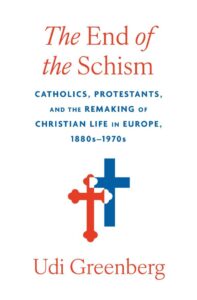 This monograph advances several well-articulated claims. Its primary focus is to show that “even though Christian writers portrayed their engagement with each other as an egalitarian process, ecumenism was also deeply rooted in efforts to preserve hierarchies” (4). This study sheds light not only on the degree of interconfessional conflict and cooperation, but also on how opposition to class equality, feminism, and independence of African and Asian colonies prompted increasing ecumenical outreach. An additional thesis is that the rise of Nazism catalyzed change in confessional outlooks and caused an earlier shift toward cooperation between Catholics and Protestants than some previous histories of the subject suggest. According to Greenberg, it was enthusiasm for and opposition to National Socialism that caused the earliest collaborations rather than the postwar rise of Christian Democracy that often draws the most attention. Finally, he stresses that Christian ecumenism included a balance of both “revolutionary tolerance and harsh exclusion” (8). While the growing affinity between the previously opposed confessions resulted in less enmity between one another, this new era of Christian friendship often resulted from anti-socialist crusades, morality campaigns, and missionary proselytization.
The opening chapter of The End of Schism effectively synthesizes past work about the nineteenth century to demonstrate the depth of confessional hostility. Both confessions blamed one another for the instability of the French Revolution. Catholics such as Joseph de Maistre viewed revolution as “the belated child of the Reformation,” blaming Luther’s anti-clericalism (29). Liberal Protestants such as Charles de Villers countered that the same Lutheran ideals founded liberalism and parliamentarianism. Such sentiments increased the hegemony of Catholic ultramontanism, caused Protestants to make anti-Catholicism central to their liberal worldview, and made Catholics targets of nationalist aggression. Confessional conflict also resulted in Protestants such as Max Weber linking capitalist innovation to the Reformation, while Catholics developed a sense of anti-materialism and charity to counter the ills of the modern economy. Furthermore, issues involving sex and gender divided them, largely because of Protestant suspicions about clerical celibacy, and the colonies became a battleground for influence between the confessions.
Greenberg argues that tensions decreased during the late nineteenth and early twentieth centuries because both sides focused on adversaries other than one another. The rising popularity of socialism caused Catholics such as Wilhelm Emmanuel von Kettler and Protestants such as Adolf Stoecker and Adolph Wagner to suggest ways to ameliorate the negative consequences of capitalism, such as calling for Sundays off and promoting employer-run welfare schemes. Yet such elites also criticized socialism as materialistic and discouraged class conflict. These similar points of emphasis continued into the realms of gender, sexuality, and the colonies. In the case of the former, Greenberg argues that Catholics and Protestants alike opposed women’s emancipation and stressed the role of Christian motherhood. Greenberg observes that Protestants followed the lead of Catholics and “reconceptualized the difference between the sexes as a form of equality, whereby the gendered division of labor granted each sex its own set of rights” (89). Furthermore, Christian commentators of both confessions led morality campaigns, culminating in the passage of laws during the 1920s that censored materials deemed to be “trash and filth.” In the colonial sphere, Catholic and Protestant missionaries also reduced rivalry, uniting in their embrace of the colonial “civilizing mission.” They both now promoted “self-discipline” in the economic sphere to help turn colonial subjects into better workers, discourage polygamy, and confront Islam.
This book’s third chapter builds on similar analyses by James Chappel, Sarah Shortall, and Brandon Bloch by showing that Nazism caused major divisions within each confession but also created self-conscious efforts by Catholics and Protestants to work together.[1] Catholics such as Robert Grosche and Protestants such as Alfred Dedo Müller not only supported National Socialism as a bulwark against communism but also sought ecumenical cooperation in the name the regime’s nationalist project. Such thinkers gravitated towards anti-Semitism, eugenics, Positive Christianity, racial pro-natalism, and a segregationist approach to the colonies. Alternatively, Dominican theologian Yves Congar and Lutheran bishop Wilhelm Stählin led ecumenical cooperation in the name of opposing authoritarianism, empowering workers, and discouraging state involvement in the economy. Furthermore, they innovated across confessional lines to promote sexual pleasure and partnership within marriage in contrast to the regime’s exclusive focus on reproduction and racial purity. In the colonies, the anti-fascist ecumenists supported placing more local authority in the hands of the indigenous population.
When analyzing the pinnacle of interconfessional cooperation during the era of Christian Democratic dominance after World War II, Greenberg emphasizes a healing of the divisions of the previous era. Formerly pro-fascist Christians agreed to democratic norms as the best method to pursue their goals of preserving stability, resisting changing sexual norms, and restraining the rise of socialism or communism. Previously anti-fascist Christians overlooked the compromised past of those who recently supported unfathomable violence in order to promote the Social Market Economy and strengthen heteronormative marital patriarchy against perceived threats of pornography and non-traditional relationships. In the realm of sex and the family, the book traces the journey of ecumenism from initially using its political power to censor speech, limit women’s liberty, and prosecute gay men to reviving past ideas that encouraged sexual pleasure and more equality within heterosexual marriage. Within the colonies, Catholics and Protestants now worked together to promote decolonization while also carving out a role for the Christian churches in Asia and Africa after the fall of European colonies by promising support for economic development.
The End of Schism’s final chapter explores the response of the Christian churches to the rise of the New Left during the 1960s and 1970s. Greenberg astutely brings to life the ideas of Johann Baptist Metz, Jürgen Moltmann, Dorothee Sölle, Catharina Halkes, Elisabeth Moltmann-Wendel, and Vincent Cosmao. In the process, he illustrates how far-left Christianity was a fully ecumenical project, albeit with a narrow impact on the institutional churches. The publications of these figures presented Christianity’s true message as one that undermined hierarchies of class, gender, and race, supported revolutionary anti-capitalism, and embraced secular ideas. Furthermore, they promoted women’s liberation, the legality of abortion, gay rights, and liberation theology.
This monograph conflicts somewhat with a recent edited volume on confessional history in Germany by Mark Edward Ruff and the late Thomas Groβbölting. Whereas Greenberg weaves a narrative about the gradual lessening of confessional conflict, the Ruff and Groβbölting anthology argues that moments of trauma during the Kulturkampf, the fall of the Hohenzollern monarchy, and the Kirchenkampf all explain why ecumenism took until after the 1960s to truly take hold. Although they too emphasize the importance of theology, Ruff and Groβbölting also include an array of contributions that considers politics, lay associational life, and everyday culture, suggesting a divide between intellectual dialogue and the lived experience of Christians in Germany.[2] Ruff’s monograph about controversies over the Catholic relationship to National Socialism also shows that enduring confessional conflict over issues such as confessional schools accompanied the process of integration in postwar West Germany.[3]
This divergence from Ruff and Groβbölting indicates how the work of numerous social and cultural historians complicates Greenberg’s narrative. For example, Jeffrey Zalar’s research indicates that, by the late nineteenth century, Catholics veered away from the consumption of religious texts, which raises questions about audience for Greenberg’s authors.[4] Additionally, the historiography of religion and gender, when viewed in its particulars, adds sophistication to one Greenberg’s main areas of emphasis. Lisa Fetheringill Zwicker finds that Catholic and Protestant students were deeply divided over how best to perform Christian masculinity at the turn of the (last) century, which challenges notions that ideas about gender politics only decreased antagonism between Catholics and Protestants during the same era.[5] Furthermore, Maria Mitchell’s analysis of female Christian Democratic Union representatives and their rhetoric against what they called the Männerstaat offers a different perspective from male authors.[6] Greenberg’s very welcome focus on the history Christian ideas about sex and the family is often divorced from the experiences of religious women throughout the first four chapters of the book. While much attention is rightfully paid to how elite men tried to limit women’s emancipation and control their sexuality, the writings of women about their own roles in the family are often overlooked. The recent volume by Lisa Fetheringill Zwicker and Martina Cucchiara about women, emotion, and religion is a good example of how to assess the spirituality of Protestant, Catholic, and Jewish women in Europe for whom emancipation was not at the forefront of their writings.[7]
The strengths of this volume are numerous. It constitutes an innovative and much-needed overview of ecumenical development. The focus on economic, gender, and racial equality frames its narrative well. The long chronological time frame and geographic breadth of the study will make it a resource for years to come, and the expert synthesis of such an overwhelming number of religious thinkers makes reading the book essential for all with an interest in modern European history, especially if read in tandem with the rich historiography covering the social and cultural history of Christianity.
Notes:
[1] James Chappel, Catholic Modern: The Challenge of Totalitarianism and the Remaking of the Church (Cambridge, MA: Harvard University Press, 2018); Sarah Shortall, Soldiers of God in a Secular World: Catholic Theology and Twentieth Century French Politics (Cambridge, MA: Harvard University Press, 2021); Brandon Bloch, Reinventing Protestant Germany: Religious Nationalists and the Contest for Post-Nazi Democracy (Cambridge, MA: Harvard University Press, 2025).
[2] Mark Edward Ruff and Thomas Groβbolting (eds.), Germany and the Confessional Divide: Tensions and Political Culture, 1871-1989 (New York: Berghahn, 2022).
[3] Mark Edward Ruff, The Battle for the Catholic Past in Germany, 1945-1980 (Cambridge: Cambridge University Press, 2017.
[4] Jeffrey Zalar, Reading and Rebellion in Catholic Germany, 1777-1914 (Cambridge: Cambridge University Press, 2019).
[5] Lisa F. Zwicker, Dueling Students: Conflict, Masculinity, and Politics in German Universities, 1890-1914 (Ann Arbor: University of Michigan Press, 2011).
[6] Maria Mitchell, “Imperfect Interconfessionalism: Women, Gender, and Sexuality in Early Christian Democracy,” in Mark Edward Ruff and Thomas Groβbolting (eds.), Germany and the Confessional Divide: Tensions and Political Culture, 1871-1989 (New York: Berghahn, 2022), 170-193.
[7] Lisa Fetheringill Zwicker and Martina Cucchiara (eds.), Women, Religion, and Emotions in Modern Germany and Beyond (Rochester: Camden House, 2025).
