Contemporary Church History Quarterly
Volume 23, Number 3 (September 2017)
Review of Benjamin W. Goossen, Chosen Nation: Mennonites and Germany in a Global Era ( Princeton: Princeton University Press, 2017), 266 + xiv Pp., ISBN: 978-0-691-17428-0.
By Kyle Jantzen, Ambrose University
From the outside, the Christian tradition of Anabaptism, of which Mennonites are the largest branch, is often known simply for its German ethnicity and its pacifist theology. In Chosen Nation: Mennonites and Germany in a Global Era, Benjamin W. Goossen employs post-structuralist history to carefully and thoroughly dismantle these notions. “If Mennonite theologians could both justify and oppose pacifism, if Mennonite nationalists could both embrace and reject Germanness, it makes little sense to think of either category as coherent, limited, or unchanging” (4). Rejecting traditional definitions of religion and nationality, Goossen depicts Mennonites as a socially constructed and historically situated collectivity forged through processes of contestation, their identities continually (re)negotiated in response to the course of modern German history. Needless to say, his differentiated portrayal of Mennonites unsettles several cherished myths: that Mennonites were thoroughly German (their Dutch roots notwithstanding), that Mennonites were marked by pacifism, or that Mennonites were apolitical. It also asks hard questions, such as whether Mennonitism was or is based on heredity or belief? The result is a thought-provoking examination of Mennonite identity centred on Mennonites’ fluid relationship with Germany from the time of nineteenth-century nationalism and political unification to the present.
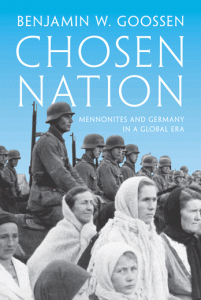 Chosen Nation argues that “Mennonitism should not be understood as a single group—or even as an amalgamation of many smaller groups.” Rather, the book seeks to uncover “what the idea of Mennonitism has meant for various observers” and “how and why interpretations have developed over time” (7). Goossen’s transnational history argues that Mennonites appropriated German nationalism when it was in their interest to do so and suppressed or abandoned it when it became problematic. Into the 1800s, Mennonites had commonly understood themselves to be a global confessional community. As the century wore on, however, they began to portray themselves as “archetypical Germans” (13). As Emil Händiges, the long-time chairman of the progressive Union of Mennonite Congregations in the German Empire (established in 1886), put it, “Do not almost all Mennonites … wherever they may live—in Russia, in Switzerland, in Alsace-Lorraine, Galicia, Pomerania, in the United States and Canada, in Mexico and Paraguay, yes even in Asiatic Siberia and Turkestan—speak the same German mother tongue? Are not the Mennonites, wherever they go, also the pioneers of German language, customs, and culture?” (13). Whether the Mennonites in these far-flung locales—or even in conservative congregations in the new German Empire—understood themselves as the promoters of German culture was another matter entirely.
For Goossen, the free-for-all of Mennonite identity-building (“collectivism”) was “constrained by the situations in which they found themselves” (16). Over the course of seven rich chapters, he guides us along the twisted road of Mennonite identity formation. Initially, around the time of the formation of the German Empire in 1871, Mennonite activists like Hinrich van der Smissen (despite his Dutch name!) developed “a common narrative based on German nationality” (19). They drew together Mennonites from three non-German regions—north German Mennonites with roots in the Netherlands, South German Mennonites with connections to coreligionists in Switzerland and Eastern France, and Prussian Mennonites living in former Polish and Lithuanian territory—who had been loosely connected by migration, commerce, marriage, and a long memory of religious persecution (fostered by the influential Martyr’s Mirror). This nascent German identity was fostered by print publications, by participation in political and military activity, and by improved communications—not least through congregational address books linking churches throughout the unified German territory (31). During these early years of Imperial Germany, there were three important developments: German replaced Dutch as the language of Mennonitism; the notion of a Mennonite diaspora was invented (further entrenching the notion of Germany as the movement’s homeland); and Mennonites became closely associated with agriculture and traditionalism (never mind the urban modernity of many of their intellectual leaders).
One key point of conflict, and the reason many Mennonites resisted this narrative of Germanness, was the notion that pacifistic Mennonites should enter military service in Imperial Germany. Whether in fighting or in noncombatant roles, military service was a means to improve Mennonite standing in the new Germany and attaining full civil liberties for their congregations. Many Mennonites rejected this political transaction, however, and emigrated. (Russian Mennonites faced a similar quandary after the passage of a draft law in 1874, and about 18,000, or one-third, emigrated to North America.)
The 1886 German Mennonite Union was slow to develop. At first, only 17 of 71 congregations joined, and most of them were progressive urban congregations in northwest Germany (71). Claiming to speak for all Mennonites, progressives portrayed conservatives who shunned the Union (and, with it, participation in modern Germany) as both nationally and religiously indifferent, and invoked fears of mixed marriages and Mennonite population decline to coerce reluctant conservatives from the South and Northeast to join the Union. In this, they achieved a measure of success. By 1914, 70 percent of Mennonites were members of the Union, and rural Mennonites even outnumbered their urban coreligionists (94).
The culmination of this Mennonite entrance into the national life of Germany came during the First World War. For Mennonites in Germany, war offered them the fullest opportunity to participate in national life, by fighting and dying for the Fatherland. Of the roughly 2,000 German Mennonites who entered military service, only one-third chose noncombatant roles. Abroad, Mennonites had little interest in supporting German war aims, but failed to convince their neighbours. Their Germanness and their refusal to fight against Germany (not out of love for Germany, but because most were pacifists) made them persecuted outsiders in Russia, the United States, and Canada. In Russia, about 6,000 Mennonite men did enter the non-combatant forestry service, while another 6,000 served in the medical corps. Many rejected any German identity, claiming that “not a drop of German blood flows in our veins” (103)!
The Bolshevik revolution of 1917 mobilized Mennonites in Europe and North America to try to rescue about 100,000 of their coreligionists from the violence of the Russian civil war (97). After 1918, Russian Mennonites subject to anti-German reprisals and marauding brigands formed self-defence militias. Suffering under persecution and famine, many sought to emigrate. To do so, they adopted the language of national self-determination and of race to present themselves both as oppressed minorities and as white agriculturalists worthy of resettlement in North and South America. Goossen describes this as the embracing of “a Zionist-like form of religious nationalism” (16). “Between 1923 and 1926, 20,000 settlers—one-fifth of all Mennonites in the Bolshevik empire—relocated to Canada” (115). About 4,000 more established a “Mennonite state” in the Chaco, in Paraguay, primarily because it afforded them cultural isolation and refuge from persecution (119). Though there was still much debate about whether Mennonites constituted a “cohesive trans-state identity,” the experience of the First World War and its aftermath “consolidated the idea of a global Mennonite community” (120).
After Hitler and his National Socialists came to power and led Germany into a racialized conquest of Eastern Europe, discourses of Mennonitism shifted once more, as pro-Nazi Mennonites formulated the notion of “a four-hundred-year-old ‘racial church’—an Aryan version of the Jewish ‘antirace’—entitled to a share of the Führer’s spoils” (16). Indeed, German scientists had begun racial research in Mennonite communities already in the Weimar era, with the consent and often support of Mennonite leaders. In the Third Reich, Mennonites proved to be “more Aryan than the average German,” according to Nazi researchers, in large part because of their cultural resistance to intermarriage. They were, in a sense, racial nationalists before the fact, and not a few tried to work their way towards the Führer by campaigning for a centralized, united, hierarchical Mennonite Union in the image of National Socialism. While many Mennonites were critical of the pro-Nazi “German Christian Movement” for attacking the Old Testament and some questioned whether one could be both a Christian and a National Socialist, most were content to enter into inner emigration, focusing on the purely spiritual activities of church services and abandoning education and youth work to the Nazis (125-126). Most Mennonite officials swore oaths, and most Mennonite men abandoned non-resistance, which they viewed as a dangerous relic of the past. Mennonites adopted racial discourse, encouraged Nazi racial research which depicted them as pure Aryans (“anti-Jews”) and even adopted aspects of antisemitism, complaining about the Judeo-Bolshevik persecution of Russian Mennonites in the Soviet Union (140). Goossen notes the ways in which Mennonite intellectuals produced their own Aryanism, striving to prove their Germanness by contrasting themselves to Russians and Jews. Hundreds of articles were written to make this point in the middle 1930s (143).
Goossen argues Mennonites were implicated in the Holocaust, in part by fashioning narratives of Aryanism that justified antisemitic laws and “implicated the confession in policies of internment, expropriation, and genocide’ (123). SS Chief Heinrich Himmler met extensively with Mennonite leader Benjamin Unruh, and established an SS Special Command R to comb the Ukrainian countryside for Mennonites to resettle in Wartheland, even as SS Einsatzgruppen were combing the Ukrainian countryside for Jews to round up and kill. As ethnic Germans, Mennonites were rewarded with social services and material goods, such as the clothes, shoes, and homes of murdered Jews. As Goossen puts it, “welfare and mass murder were two sides of the same coin” (149). In the Nazi vision for Lebensraum in Eastern Europe, pure-blood Mennonites were the ideal German settlers who could colonize (for them, resettle) Ukraine. SS leaders singled out Mennonite settlements like Chortitza and Molotschna as model German towns. Alfred Rosenberg described his visit to the former as “the most moving moment of the entire trip” he made through occupied Ukraine in 1942 (152). For these Mennonites, the war served to spark a religious and political revival, in which they gained status and power in the occupied territory. They complied with and at times participated in the Holocaust, occasionally as killers but more often as the inheritors of land expropriated from Jews among whom they lived (164).
As the war turned against Germany, Mennonites in the East were evacuated en masse. From fall 1943 to spring 1944, 200,000 German colonists (including 35,000 Mennonites) made their way on foot, horseback, wagon, and train westward into occupied Poland, swelling the German population in Wartheland. Here, too, Mennonites participated in the racial categorization underway, as the Nazis sought to identify ideal German settlers (169). Ultimately, though, as the Nazi empire collapsed, 45,000 Mennonites ended up fleeing from Ukrainian, Polish, and East Prussian territory into Germany.
After 1945, as Allied officials began sorting out the tangle of displaced persons and refugees, Mennonites faced a dilemma. If they identified as Ukrainians or Russians, they risked deportation to the USSR. If they identified as Germans, they risked the charge of collaboration and made themselves ineligible for aid. At first, some tried to identify themselves as Dutch, and a few made it to the Netherlands. Others began to claim Mennonitism as an alternative to German or Russian ethnic identity, not because of an awakening of religious nationalism but as a “temporary response to historical contingencies” (175). Though the International Refugee Organization was skeptical, about 15,000 Mennonites were nonetheless allowed to immigrate to Canada in the 1950s, mostly because they were white, Christian, anti-communist, agrarian settlers (179, 181).
In recent decades, Mennonite identity has remained fluid and contested. Mission work and the establishment of new Mennonite churches in the non-Western world has prompted questions about the relationship between Germanness and Mennonitism. Ironically, while the Mennonite migration from the collapsing Soviet Union to the newly unified Germany was predicated on Mennonite claims to German citizenship, questions remain about their Germanness.
In the end, Benjamin W. Goossen’s Chosen Nation demonstrates that, over the past two centuries, Mennonite ethnic and religious identity has been anything but stable and self-evident over the past two centuries; rather, it has been constructed, controversial, and changeable.

 Whereas a new biography of Martin Niemöller is long overdue, one might ask: do we need another on Bonhoeffer?
  Marianne Jehle-Wildberger’s biography of the Swiss Reformed pastor Adolf Keller traces the life and times of an ecumenical pioneer. Born in 1872, Adolf Keller served churches in Geneva and Zurich as well as the Protestant congregation in Cairo. During the 1920s he became active in the ecumenical movement and was elected second associate general secretary of the Universal Christian Conference on Life and Work at its founding meeting in 1925. In 1922 he founded Inter-Church Aid, an ecumenical relief agency that focused on rebuilding and assisting Protestant communities across Europe in the wake of the First World War. His work was concentrated on the plight of Protestant and Orthodox minorities in Eastern Europe, and the chapter on the interwar situation of these communities in Poland, the Baltic states, Austria, and elsewhere is fascinating. The after-effects of the war included widespread poverty, resurgent nationalisms, shifting church boundaries, and growing political and social instability that posed a vital threat to some of the Protestant minority churches. Keller ambitiously viewed his task as raising international Protestant awareness and “promoting Protestant unification,” and he became a driving force in organizing the different denominational agencies that emerged to assist their partner churches in Europe. He also became a remarkably good fundraiser, raising 1.7 million Swiss francs from U.S. and European churches for his work by 1924.
 Heinrich Rusterholz’s book on the work of the Swiss Protestant Relief Agency (Hilfswerk) for the Confessing Church covers some of the same territory (and naturally includes additional documentation on Keller’s work), but focuses on the Swiss Reformed circles and their responses to the German Church Struggle and the persecution of the Jews. Paul Vogt, the leader of many of these initiatives, is another under-examined figure in the history. Born in 1900, he began his career in 1929, focusing in his ministry on unemployment and other working class issues. He founded a social ministry center, “Sonneblick,” that became a refugee haven in the mid-1930s. From 1936-43 he was a pastor in a suburb of Zurich. He also began to work closely with Karl Barth, and the two founded the Hilfswerk in 1937 in solidarity with the German Confessing Church; one of their first actions was to organize statements of support for imprisoned Martin Niemoeller. The organization also began to offer seminars in Switzerland for lay and clergy from the Confessing Church.
 Dohnanyi had been trained as a constitutional lawyer and had held significant posts in the Ministry of Justice. But he had early on become dismayed at the illegal activities and political violence of the Nazi extremists and had in fact drawn up a dossier which documented these misdeeds in full detail.
  George Bell was born in 1883 on the south coast of England, into a “secure, comfortable middle-class clerical home” (7). He attended Westminster School beginning in 1896, then Christ Church, Oxford, in 1901. Next he enrolled in theological college in Wells, in the West of England, where he was introduced to the student ecumenical movement and to Christian Socialism. Ordained as a deacon in Ripon Cathedral in 1907 and as a priest in Leeds in 1908, Bell returned to Oxford in 1910, where he combined a growing commitment to social justice with a vibrant personal faith. As he explained, “Christianity is a life before it is a system and to lay too much stress on the system destroys the life” (12).
 The exchanges by post or telegrams recorded in these volumes are largely drawn from the Geneva archives of the World Council of Churches or from the voluminous Bell papers, now deposited in the Lambeth Palace library in London. The first volume covers the period up to 1949, and the second the final years of Bell’s life up to 1958. The editing by Gerhard Besier is very helpful, since his footnotes give the biographical details of all persons mentioned, as well as bibliographical references to the many scholarly books relating to their endeavors. (There are, however, aggravating lapses in the proof-reading and printing of the English text.) Besier’s introduction is reproduced from the chapter he contributed to The Church and Humanity: The Life and Work of George Bell, 1883-1958 (p. 169-194), edited in 2012 by Andrew Chandler.
 Much of the scholarly literature about the Jehovah’s Witnesses has been conditioned by the harassment and persecution which this sect endured during the period of Nazi rule after 1933. Most of the authors have displayed sympathy with the Witnesses’ sufferings and pay tribute to their enduring loyalty to their faith. Gerald Hacke, however, is principally interested in the actions of the state authorities, and the organization of the various methods of repression which took such a toll. Furthermore he has noted that the same kind of repression was carried out in the post-1945 years in what became known at the German Democratic Republic (GDR) under the aegis of the Communist rulers of that part of Germany for the next 40 years. His large-scale account is therefore mainly a comparison of the similarities as well as the differences in the treatment of this minority religious group by the two ideologically opposed dictatorships. In so doing he has delved in to the vast amount of state documentation left behind by both regimes, particularly in their police and judicial records and the files of the various government ministries who attempted to bring the Jehovah’s Witnesses to heel.
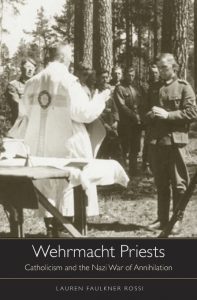 Lauren Faulkner Rossi has produced a measured and original contribution to the serious body of scholarship that has emerged over the past decade or so chronicling the varied responses and experiences of German Catholic priests under Nazism and in the Second World War. Actually, this book is about both ordained clergy and seminarians, an crucial distinction that merits a more precise articulation at the outset of this important study. We are talking here about a subject group that has received comparatively little attention from scholars to date: Catholic priests and seminarians who were conscripted into the Wehrmacht during the Second World War.
  The Protestant Union Church of the Palatinate is one of the smaller regional churches in Germany, with its headquarters in Speyer on the west bank of the Middle Rhine. The church authorities, after lengthy delays, have now published this voluminous collection of essays by more than 60 contributors, which describes the fate of the church during the years of Nazi rule. It constitutes one of the best regional studies of the Protestant church for this period, although, as the chief editor Christoph Picker acknowledges in his introduction, the results are highly sobering. In this region of Germany which was diverse in its denominational loyalties, Protestantism and National Socialism went hand in hand. Many leading Nazi functionaries saw themselves as “good Protestants,” and the collaboration between the church leadership under the “German Christian” Bishop Ludwig Diehl and the Nazi Party’s regional hierarchy was at first close and on very good terms. Above all, the desire among churchmen for stability led them to endorse the Nazi project for “national unity” (Volksgemeinschaft) in the interests of harmony. So no real Church Struggle took place in the Palatinate Church, and it is estimated that 50 percent of the pastors belonged to the German Christian faction in 1933. The limited opposition from those who supported the Confessing Church when it was organized in 1934 was successfully integrated with the dominant German Christians. More than 20 percent of the pastors took out membership in the Nazi Party.
 Pavlush focuses primarily on four events: the 1961 trial of Adolf Eichmann and the wave of antisemitism that swept Germany around the same time; the controversy about Rolf Hochhuth’s 1963 play Der Stellvertreter (The Deputy); the 1967 Six-Day War; and the 1979 national broadcast in the FRG of the U.S. television docudrama The Holocaust. In a separate chapter she examines the 1968, 1978, and 1988 anniversaries of the November 9 pogroms (“Kristallnacht”) as indicators of how East and West Germans viewed their history.
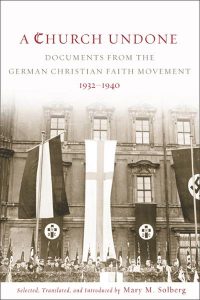 Despite the excellent contributions of such authors as James Zabel, Doris Bergen and Robert Ericksen, Solberg feels that “far too few people in or out of the academy know far too little“ about the conduct of the churches In Hitler’s Germany. But her extended introduction clearly indicates her approach to answering the questions posed by her documents: specifically what role did this German Christian Faith Movement play in the wider picture; how successful or significant were its supporters in the rise and maintenance of Nazism, at least up to 1940; and how should Christians and churches today learn from this example of a church undone? Her skillful translations of the writings of several prominent members of this movement will be of considerable value to those who do not read German, but it would have been helpful to have a biographical note or appendix outlining the careers of these authors. Her conclusion is that this was not a unique episode, that the conflation of political, racist and nationalist ideas with theological witness is a constant temptation, and therefore that the German experience in the 1930s deserves further study by both theologians and historians.