Category Archives: Reviews

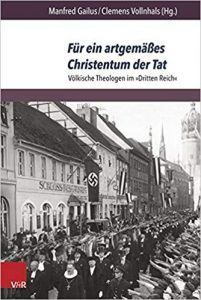
Review of Manfred Gailus and Clemens Vollnhals, eds., Für ein artgemässes Christentum der Tat: Völkische Theologen im “Dritten Reich”

Contemporary Church History Quarterly

Volume 24, Number 2 (June 2018)

Review of Manfred Gailus and Clemens Vollnhals, eds., Für ein artgemässes Christentum der Tat: Völkische Theologen im “Dritten Reich”, Vandenhoek & Ruprecht, Göttingen, 2016, 329 pp.

By Robert P. Ericksen, Pacific Lutheran University

This book, as indicated in its title, deals with what must be the most crucial flaw within German Protestant theology in the lead-up to the Nazi era, perhaps a “sickness unto death,” to borrow a phrase from Kierkegaard. This flaw involves a völkisch theology, emphasizing the tight bond between Christian belief and the German people. It involves an artgemäss theology, claiming the necessity of certain racial and cultural qualities for any Germans claiming faith in Jesus and the Christian God. And, though it does not appear in the book title, this flaw involves an “orders of creation” theology, in which certain cultural, political, and racial qualities of the German Volk, as celebrated by Adolf Hitler and National Socialism, could be seen as a binding revelation from God. After an introduction to the topic, fifteen chapters of this book deal with sixteen individuals who help us better understand the complicity of Protestant Christians in the crimes of the Nazi state.
One of the editors of this volume, Manfred Gailus (a member of the editorial board of CCHQ), is a historian known to many or most of us as a prolific author and editor of books on Protestant churches in Nazi Germany. These include his Protestantismus und Nationalsozialismus: Studien zur Nationalsozialistischen Durchdringung des Sozialmilieus Berlin (Berlin, 2001), plus books such as Mir aber zerriss es das Herz: Der stille Widerstand der Elisabeth Schmitz (Göttingen, 2010), and Friedrich Weissler: Ein Jurist und bekennender Christ im Widerstand gegen Hitler (Göttingen, 2017). He also has co-edited books with colleagues, such as Nationalprotestantische Mentalitäten in Deutschland—1870-1970 (Göttingen, 2005), co-edited with Harmut Lehmann; Zerstrittene “Volksgemeinschaft:” Glaube, Konfession und Religion im Nationalsozialismus (Göttingen, 2011), co-edited with Armin Nolzen; as well as this volume co-edited with Clemens Vollnhals.

The second editor, Vollnhals, also has a career full of important contributions to our understanding of churches in Nazi Germany, beginning with his early study on denazification, Evangelische Kirche und Entnazifizierung, 1945-1949: Die Last der nationalsozialistische Vergangenheit (Munich, 1989). He too has been prolific in co-edited projects, including Mit Herz und Verstand—Protestantische Frauen im Widerstand gegen die NS-Rassenpolitik (Munich, 2013), co-edited with Manfred Gailus; and Die völkisch-religiöse Bewegung im Nationalsozialismus: Eine Beziehungs- und Konfliktgeschichte (Göttingen, 2012), with Uwe Puschner; plus more than a dozen additional edited volumes. Taken together, the work of Gailus and Vollnhals could be the stuff of several seminars on the response of Protestants in Germany to the Nazi state, including analyses of some of the heroes, but especially with an attempt to understand those who found the Nazi state so very attractive. This volume, with its depiction of sixteen völkisch theologians, explores the attraction of Adolf Hitler and National Socialism for German Protestants. It takes us deeply into that Christian stance which, post-1945, strikes so many as so counter to an appropriate understanding of the teachings of Jesus.

All the theologians in this volume had some sort of relationship to the Deutsche Christen, of course, that group of German Protestants who welcomed and cheered the rise of Hitler, waved the Swastika, often wore brown uniforms in church, and tried to disguise or even remove all Jewish elements within the Christian tradition. Some of these stories are well known. Oliver Arnhold writes on Walter Grundmann and his “Institute for the Study and Eradication of Jewish Influence on German Church Life,” a topic also described for us in the work of Susannah Heschel, The Aryan Jesus: Christian Theologians and the Bible in Nazi Germany (Princeton, 2008). Grundmann and his so-called “Dejudaization Institute,” supported by the German Protestant Church and its notorious “Godesberg Declaration,” included a large number of seemingly reputable theologians in his project to deny the Jewish origins of Christianity, and even the Jewish origins of Jesus.

A chapter by Dirk Schuster describes Johannes Leipoldt, a professor of New Testament who, after stints at Kiel and Münster, arrived at Leipzig in 1916. Schuster emphasizes in his chapter title Leipoldt’s effort to deny Jesus’ Jewishness, including the quote, “Jesus is far removed from any sort of Jewishness” (189).[1] Leipoldt worked closely with Walter Grundmann, a former student, and became one of the most active co-workers in Grundmann’s Dejudaization Institute, especially influencing the argument—important within the Nazi world—that Jesus could not really have been of Jewish blood. Despite this antisemitic activity, Leipoldt sailed through the transition of 1945. The fact that he never actually joined the Deutsche Christen or the NSDAP allowed him to be fully exonerated by the denazification process, with no attention placed on the heavily antisemitic elements in his scholarship (197). He remained at Leipzig until his retirement in 1954 (190). With his ongoing position at Leipzig and his national and international reputation, including for translations and for work on original sources, Leipoldt’s many antisemitic stereotypes, assumptions, and arguments remained fully “citationable” into the 1980s (201).

We also get a chapter by Hansjörg Buss on Gerhard Meyer. He was a simple pastor in Lübeck, rather than a theologian with a university position; but Buss shows us how completely Meyer was able to develop a church in Lübeck, the Martin Luther Parish, into a place where Germanness counted for far more than received tradition. Catholics had no place in a German church, according to Meyer, nor did Protestants who quarreled over doctrine. Jews had no place whatsoever, whether within the Christian tradition or within Germany. This all grew out of the idea of a “Deutschkirche,” advocated by the antisemitic Bund für Deutsche Kirche (League for a German Church), founded in 1921, which had an especially strong following in Lübeck and Schleswig-Holstein. Meyer, born in Lübeck in 1907, was ordained in 1932 and received his appointment in the Martin Luther Parish in September 1933. Soon he was baptizing with these words, “The Meaning of Baptism is this: Bestowed by the mother’s womb of the world, bound with God from the beginning, this child shall stride as a man of God over German soil” (131). He celebrated a group of confirmands in March 1939, alongside Reichbishop Ludwig Müller, with a similar theology: “We believe that Germany, the land and the community of German brothers and sisters, represents the order of life to which we alone are bound by body and soul” (130). Some months later, in September, shortly before his wedding, this 31-year-old pastor and enthusiast for Hitler and the Nazi ideal, recently called up for military service, died in the invasion of Poland (131).

Stephan Linck describes another pastor from Schleswig-Holstein, Ernst Szymanowski, who quickly gravitated toward the Deutschkirche and its overtly German, racist, and antisemitic concept of Christianity. Born in 1899 and after one year of active duty during World War I, he completed his theological training, was ordained in 1924, and joined the NSDAP already in 1926. He then sought to work his way up within the church, including an attempt to be selected as bishop of Lübeck in 1934, though this effort failed (242-45). Pastor Szymanowski is now better known to us as Ernst Biberstein. This is the name he legally acquired only in 1941, as a way to jettison his Slavic name and solidify his German credentials, which he claimed extended back one thousand years (250). The name-change came after he had joined the SS in 1936, and after he withdrew from church membership in 1938 (248-49), but Biberstein is the name by which he became famous after 1945.

Among Biberstein’s activities during wartime, working under Reinhard Heydrich in the RSHA, Biberstein spent several months as leader of Einsatzkommando 6, murdering thousands of Jews. When placed on trial at Nuremberg in 1948, he explained that he joined the SS because he thought it the most idealistic Nazi organization. When asked about the killing by his Einsatzkommando 6, he said, “Due to my theological development, I found it not only extremely unpleasant, but almost unreasonable, that death sentences should be ordered and enforced under my command.” Did he offer the victims “spiritual assistance,” he was asked, as they were being murdered? No, these victims were Bolsheviks, he said, who advocated godlessness. It was not his role to try to convert them: “One should not throw pearls before swine” (252).

Amidst a great deal of press interest in this pastor/murderer, who acknowledged that at least 2000-3000 victims were shot or gassed to death under his authority, Biberstein was sentenced to death (253). As often happened, that sentence gradually got reduced to incarceration at Landsberg Prison. Working for his release from prison, by 1956 Biberstein denied his own admission at Nuremberg about the thousands of deaths under his command. He also claimed to a representative from the Protestant Church in Neumünster that, despite his having left the church in 1938, “he had always felt himself to be and handled himself as a Christian and a theologian.” Furthermore, “He said . . . simply as his own inner conviction, that it would be good if every pastor’s personal attitude in life would be as decent as his had been” (256). Linck makes clear that the interlocutor reporting on the state of Biberstein’s conscience had been a fellow member of the Nazi Party and an advocate for the Deutsche Christen back in Schleswig-Holstein in the 1930s. Biberstein failed to get his hoped-for permanent return to a clergy position; however, he did gain his release from Landsberg in 1958 and had an opportunity to live outside prison another twenty-eight years before his death in 1986. Linck then quotes Raul Hilberg on Biberstein, “For Biberstein moral boundaries were like the receding horizon. He went toward them but never reached them” (259).

The sixteen chapters in this volume contain many additional examples of völkisch Protestant theologians and clergy who followed the path of German nationalism, racism, and an increasingly aggressive attack upon the Jewish place within the Christian tradition, or even within Germany itself. Rainer Hering describes Franz Tügel, the Bishop of Hamburg, who joined the Nazi Party in 1931, after a careful reading of Nazi documents, including Mein Kampf. In 1932 he expressed hope for a “rebirth of the German nation” under Hitler’s leadership. As for the projected harsh treatment of Jews, he saw no reason for the church to criticize Nazi intentions, describing Jews as a “pestilence” and “the great danger” for Germany (141-42).

Gerhard Lindemann describes a parallel example, Martin Sasse, the Bishop of Thuringia. Born in 1890, Sasse fought in World War I from 1914-1918. Then, after the war, he joined in Freikorp battles against communists and revolutionaries. After these years in uniform, Sasse returned to his theological studies and received an appointment and ordination in 1921. In March 1930 he joined the NSDAP and that fall he accepted a pastorate in Thuringia, a very brown region with an especially strong cohort of Deutsche Christen. By January 1934 Sasse had risen to Bishop of the Thuringian Church (156). From this position he gave full support to the Nazi state and Nazi ideology. This included, for example, praise for the November 1938 Pogrom as a necessary measure and part of the “world historical struggle against the Volk-destroying spirit of the Jews” (161). He was among those bishops who signed the Godesberg Declaration of 1939, which led to the creation of Walter Frank’s Dejudaization Institute. Sasse supported the radical Thuringian Deutsche Christen, even agreeing with their claim that the Jewish Old Testament had no place in the Christian Bible (163). As for the Holocaust, by August 1941 Sasse’s office produced a public announcement describing this as the “moment in which God’s hand reaches out to destroy precisely this people” (167), apparently blaming the murder of Jews on God, rather than Germans. Sasse held his position as bishop until his death in 1942, an early demise caused by problems with his heart.

Dagmar Pöpping tells the complex story of Herman Wolfgang Beyer, born in 1898, who “grew up” serving in World War I from 1916-1918 and watching all his friends die. He returned to Germany a pacifist and idealist, with high hopes for the Weimar Republic and a peaceful future. Then began a series of lurches to the right and left. The Versailles Treaty cost him his pacifism and his support of Weimar, but, while studying theology, he first stood on the left with a group who designated themselves “readers” of Die Christliche Welt, a liberal Protestant journal. He completed his theological training, however, with Karl Holl in Berlin, the founder of a “Luther Renaissance” and teacher of many of the most völkisch of the next generation of Protestant theologians, men such as Emanuel Hirsch and Paul Althaus. Beyer befriended both men by the mid-1920s, a useful step in his career, and by the age of twenty-eight, he secured a professorship in church history at Greifswald (262-65). In 1933 he greeted the rise of Hitler with an enthusiasm as exuberant as that of his two mentors, beginning and ending every future lecture with “Heil Hitler.” As for the Protestant Kirchenkampf (Church Struggle), Beyer joined the Deutsche Christen in the spring of 1933, and also joined the SA (Nazi Stormtroopers) that fall. Surprisingly, though, Beyer became disillusioned with the harsh tactics of the DC under Reichbishop Müller in 1934 and switched his allegiance to the Confessing Church, which he maintained also when he moved to a chair at Leipzig in 1936. Throughout these changes in his church politics, he remained loyal to the Nazi state, a position not entirely uncommon among his fellow members of the Confessing Church.

When World War II broke out, Beyer volunteered to serve as a chaplain. He is interesting to us at least in part because he kept a detailed diary of his experiences on the Eastern Front. This included his personal observation of the murder of innocents, whether the shooting of 400 disabled residents of a hospital for convenience sake, or the murder of thousands and thousands of Jews. Pöpping reports on Beyer’s efforts to explain and justify these murders. Regarding the 400 disabled people dispatched by bullet, he writes, “I understand that the poor guys must be killed. One cannot simply let them run free. They would then only perish, naturally” (272). As for the mass murder of Jews, he comments, “The struggle against Jews must occur. But it has assumed a terribly hard shape…. The curse under which these people live is being fulfilled in a horrible manner” (273). Despite the horrors, Beyer taught his troops that killing Russians and Jews was necessary. He blamed the Enlightenment as a root cause, with its emphasis on equality and human rights, which finally led to Bolshevism and atheism. “We see it on the dull, staring, expiring faces of the Soviet prisoners of war who pass us by. The human being in this world has stopped being truly human” (270). True to the most hateful antisemitism of the early twentieth century, especially in its Nazi version, Beyer then made the connection to Jews, the most intensively victimized group being murdered by German forces. He explained to his troops that Jews had invented Bolshevism and, without attachment to the Christian God, both Jews and Bolsheviks had lost their souls, were no longer human. Pöpping then summarizes Beyer’s conclusion: “A human without a soul is no longer required to be treated as human” (271).

This self-description by Beyer of his work as a Protestant chaplain at the center of the Eastern Front, which was also the center of the Holocaust, could be understood simply as the rather ugly final result of völkisch theology, a theology which elevated Germany’s wounded and intense self-identity above prior Christian norms and ideals that had developed over two millennia. I appreciate Pöpping’s work on this man. I do wonder, however, whether her stance at the start of this chapter is too gentle, too understanding of the man under her gaze. She cites two historians, Doris Bergen and Felix Römer, who she accuses of describing chaplains “as ‘propagandists’ and ‘accomplices’ of the Vernichtungskrieg.”[2] In Pöpping’s view, “That would be too simple, to be content only with exposing what is morally unacceptable from today’s point of view” (261). She also cites the work of Antonia Leugers and Martin Röw for presentations of this softer approach, authors who raise the possibility of Catholics and chaplains staying moral within an immoral war.[3] These are hardly simple issues, but I am left wondering what could be seen as deficient in a “morality of today” that suggests murder and genocide are immoral. Was Beyer’s complete commitment to Adolf Hitler and the Nazi state a good decision? Should we approve of his extra effort to encourage troops not to shrink from their task? Is it wrong to connect the dots in his complicated development as a theologian and suggest that something has gone dreadfully wrong when his loyalty to Germany and to Hitler have him defending the murders perpetrated and/or viewed by troops under his spiritual guidance?

This brings me to two of the most prominent theologians dealt with in this volume, Paul Althaus and Emanuel Hirsch, theologians who befriended Hermann Wolfgang Beyer and may well have inspired his virtually complete loyalty to Hitler and the Nazi state. I am familiar with Althaus and Hirsch, since I focused on these two plus Gerhard Kittel in my Theologians under Hitler more than thirty years ago.[4] Tanja Hetzer’s chapter on Paul Althaus is based on her 2009 book him.[5] She begins with one of my favorite quotations from Althaus, at least in terms of its importance: his notable claim that Protestant churches in Germany “greeted the turning point of 1933 as a gift and miracle from God” (69). He published that statement in 1933 and it certainly guided his overall response to the rise of Hitler and National Socialism. Hetzer argues that Althaus’s völkisch nationalism, a central aspect of his theology, was heavily influenced by his experience as a wartime pastor in Lodz during World War I, as well as his marriage to Dorothea Zielke, born in Warsaw to a German family long-settled in Poland. Of course, Althaus also was influenced by his bitterness over Germany’s loss in that First World War. During the war and throughout the 1920s, Althaus preached a love for the Fatherland and a claim that the Protestant church should speak to the bond between Germans, the German Lutheran tradition, and the beleaguered German nation. Hetzer does a very nice job of showing that Althaus’s “Orders of Creation” theology and his emphasis on “Order” and “Authority”—all developed in the early years of his career—made him ready to proclaim Hitler a “gift and miracle from God” and to give mostly enthusiastic support to the regime.[6] Hetzer shows that this stance was rooted in his völkisch obsession: “With Althaus it is vital to observe how the concept of the Volk became a new ethical reference point for theology” (76).

As for Althaus’s view of Jews, Hetzer points out that he often spoke in “cultural codes” and avoided the crudest expressions of antisemitism; but she effectively shows that a harsh antagonism toward Jews lay deeply embedded within his work.[7] During Weimar he apparently had no personal connection to important figures, such as Martin Buber and Franz Rosenzweig, but he spoke of them like a “schoolmaster” and without respect (76). Hetzer effectively shows that Althaus’s “Orders of Creation” theology lays the groundwork for antisemism in its insistence that God created the various “orders” in existence, including nations and races. So it is no surprise that in the opening battles of the Church Struggle in 1933, when Deutsche Christen demanded the application of the Aryan Paragraph within the Protestant church, Paul Althaus and Werner Elert, his colleague at Erlangen, agreed that Germans had every right to include race among the requirements for clergy in the German Protestant Church (85-88). Althaus and Elert then co-authored the Ansbacher Ratschlag, an attack against the Barmen Declaration that was enthusiastically greeted by Deutsche Christen.

Hetzer concludes her chapter by pointing out that a “loyalty of the second generation” remains in place, giving Althaus a softer treatment than he deserves. This includes Walter Sparn, a systematic theologian, who claims “Althaus without doubt was never a National Socialist,” though he may have been a “political romantic” who advocated a “revolution from the right.”[8] Such a view gives little weight to Althaus’s assessment of Hitler as “a gift and miracle from God.” Hetzer also critiques the recent biographer of Althaus, Gotthard Jasper of Erlangen University.[9] The subtitle of his 2013 book, “Professor, Prediger und Patriot seiner Zeit,” certainly buries Althaus’s enthusiastic and very public support of Hitler and National Socialism with that innocuous use of “patriot,” as does Jasper’s treatment of Althaus in general. Hetzer credits Jasper with his presentation of much material, “without, however, considering problematic statements by Althaus according to his actual words or requiring of Althaus posthumous responsibility for what he actually wrote and said” (95).

I quite agree with Hetzer’s conclusion that, despite his clear political stance, “Althaus was viewed in the history of theology after 1945 not as a participant in history, but as a victim of his own ideas, above all when it involved his antisemitic undertakings” (95). I would only mention that my book from 1985 on Althaus, Hirsch and Kittel gets but one footnote in this chapter, and that is to substantiate Althaus’s “reputation as a mediator” and the fact that he is “viewed still today as a theologian with a self-chosen stance in the middle” (70). I do use the term “mediator,” and I describe him as less radical in his support of Nazi politics than either Emanuel Hirsch or Gerhard Kittel. However, this by no means hides my criticism of his very important and enthusiastic place in support of Hitler and Nazism. A large number of the quotations used by Hetzer in this chapter also appear in my book. Furthermore, Hetzer does show Althaus as a moderate of sorts, at least for his place and time. He tended to use coded and vague language. Many or most could see his attack on Jews, but he was not as outspoken or blatant as many others treated in this volume by Gailus and Vollnhals. I appreciate Hetzer’s analysis of Althaus’s work, which I think takes an important step forward in recognizing the antisemitic foundations of his scholarship. I also agree that Sparn from 1997 and Jasper from 2013 are too apologetic in their treatment of Althaus, but I remain a bit disappointed that my work in 1985 is not clearly separated from those two.

Heinrich Assel writes about Emanuel Hirsch, who was one of the main figures in his 1994 book on the Luther Renaissance from 1994.[10] This chapter also builds upon Assel’s very thorough reading of appropriate additional sources and documents to which he has gained access, even though Hirsch’s own Nachlass has been carefully restricted from public view or scholarly use. In particular, Assel has accessed a massive correspondence between Hirsch and the right-wing publicist, Wilhelm Stapel, which extended from 1931 until Stapel’s death in 1954 (47). In my view, Assel rightly places Hirsch at the very center of the völkisch theology that is at the heart of Gailus and Vollnhals’ book, and which drew Hirsch to his enthusiastic public support of Hitler by April 1932.

Hirsch became the leading theological advisor to and supporter of the Deutsche Christen and Reichbishop Ludwig Müller in 1933. He then openly designated himself a “political theologian” by 1934, taking the side of Ludwig Müller’s church government. As the Müller phase of church politics proved ineffective, Hirsch worked to support the “Gleichschaltungspolitik” of the Nazi state, privileging Hitler’s totalitarian rule over his two other loyalties, those to church and state (44). As for the Nazi stance on Jews, Hirsch moved from his earlier prejudice against Jews, which was primarily religious and cultural, to “an openly racist antisemitism.” Though others blanched at the destructiveness of the November Pogrom in 1938, he was “passionately in favor,” welcoming it as a way to push Jews toward emigration. As the murderous nature of the war in Eastern Europe and the specific annihilation of Jews developed, Hirsch was kept informed by his contacts in the Nazi Party and the SS. His response was to “give unlimited support to this politics of annihilation” (56).

Assel’s access to the Hirsch/Stapel correspondence, often comprising several letters per week and sometimes more than one letter per day, illustrates for us the overwhelming confidence placed by Hirsch and Stapel in the German Volk and the Nazi state, a convergence designed to bring Germany back to its rightful place in the world. We also learn about their harsh antisemitism. However, we do see Wilhelm Stapel losing at least some of his nerve in the last, more brutal years of the Nazi regime, while Hirsch remained firm. After the failed July 20, 1944 attempt on Hitler’s life, Stapel wrote of his sympathy for the plotters. Hirsch wrote back with ten full pages, expressing unapologetic approval of Nazi church politics, Nazi foreign policy, and also the harsh judgments of the People’s Court against the conspirators. He speculated in that letter, written in the bleak summer of 1944, on two possible outcomes of the war: a German victory, leading to a healthy nation and national church, or a German defeat and the collapse of Christianity in Germany (60-64).

In an attempt to understand the uncompromising persistence of Hirsch’s stance, Assel points out one very important factor in his life, poured out in this long letter to Stapel. That is his deep grief over his son, Peter, fallen in 1941. Assel places this in the context of a “Myth of the Fallen,” the belief that only a German victory would justify the many deaths spread over the two costly wars in Hirsch’s lifetime (63-64). In my work on Hirsch, I point to his medical deferment in August 1914 at the start of World War I. This embarrassed or even haunted him, and I speculate that it might help explain the aggressive nationalism and militarism in his work.[11] The World War II loss of his son would only have multiplied that psychological impact, of course. Even though Stapel and Hirsch each lost some of their influence during the last years of the Nazi regime, Stapel more so than Hirsch, we learn from their letters that Hirsch refused to blame Hitler or the Nazi state, even after 1945, and even after the horrors of the Nazi regime had been condemned by most of the world. In my work on Hirsch, I quoted colleagues who said he never changed his politics after 1945 or admitted that he had been mistaken.[12] I was criticized for this by some friends of Hirsch. Assel’s chance to read portions of Hirsch’s correspondence now confirm I was right on that score (49).

Before leaving Assel’s treatment of Hirsch, I will once again mention my Theologians under Hitler from 1985, which dealt extensively with Hirsch. I also wrote about Hirsch in my chapter on the Göttingen Theological Faculty, first published in Die Universität Göttingen unter dem Nationalsozialismus in 1987.[13] Neither is cited by Assel. This is obviously a minor complaint. In one instance, however, I believe that Assel’s treatment of Hirsch’s postwar circumstances would benefit from my work. In May 1945, Hirsch grabbed the chance of a medical retirement, justified by his failing eyesight, in order to avoid removal for his pro-Nazi stance. This meant he circumvented his essentially certain dismissal by the English occupiers, without pay, followed by a denazification process of uncertain outcome. Instead, besides avoiding the humiliation of being thrown out of his university, he also secured a life-long pension, even if reduced by his choice of an early medical retirement, and he secured the right to stay in his beautiful, large home on the Schiller Meadow. Assel refers to a brief postwar period when the Hirsch family did not receive funds as a “bureaucratic mistake,” which is probably true. But then he adds, “Without having to go through a denazification process, Hirsch was rehabilitated as emeritus” (57).

This version of Hirsch’s postwar transition slides past an experience that was traumatic for many university professors whose politics had been enthusiastically pro-Nazi, and especially so for Hirsch. It also ignores my extensive treatment of the actual, bitter process that ensued. His medical retirement left him without any connection to his university. At the age of fifty-seven, he was not ready to retire. As he had been nearly blind since the 1920s, he clearly hoped to reverse the convenient medical excuse used in May 1945 and resume his career. Furthermore, the eventual return of most Nazi-tinged professors to their positions would have encouraged his hopes. However, despite his own efforts and energetic attempts by a few of his friends, he never could bring himself back into the good graces of Göttingen University or its Theological Faculty. From May 1945 until his death in 1972, Hirsch was never rehabilitated. He never received emeritus status, he never received announcements of events or invitations, his name was never included in university publications, and he had no formal connection whatsoever with his former faculty.[14] (He also never received the blue plaque on his home, marking the place where very important university scholars, such as his rival, Karl Barth, had lived.) This postwar result placed Hirsch among the very few, most heavily implicated Nazis not able to return to their positions at Göttingen, part of a similar pattern at other universities as well. The only students with whom Hirsch came in contact in those postwar years met with him in his home for regular meetings of an irregular, unofficial, private seminar. Some within that informal coterie became known as the “Hirsch Circle.” This group long hoped to resurrect Hirsch’s reputation as a theologian from his loss of respect in the postwar era, but largely without success. Was the postwar denial of honor or respect appropriate? Assel’s work goes a long way toward establishing that Hirsch’s devotion to Adolf Hitler was thoroughgoing. If we do not approve of Hitler’s judgment, ideas and politics, it is difficult to approve of Hirsch’s. Furthermore, the völkisch nature of the Protestant theology at the center of Hirsch’s work made his politics far more than a side issue in his career.

In the context of the Hirsch-Stapel correspondence, I will also mention Clemens Vollnhals’ chapter on Wilhelm Stapel. During the Weimar Republic, Stapel edited and wrote prolifically in the right-wing, nationalistic journal, Deutsches Volkstum. He also rose to leadership within the Hanseatic Verlag, the publisher of Deutsches Volkstum and later the publisher of the Völkischer Beobachter and other Nazi publications. Though Stapel never had an academic career, he and Hirsch were natural allies in their commitment to a völkisch Protestant theology and a nationalistic, right-wing revolution against the Weimar Republic. In 1933 Stapel greeted the rise of Hitler with Die Kirche Christi und der Staat Hitlers (“Christ’s Church and Hitler’s State”).[15] He supported the Deutsche Christen, even after the Sports Palace Scandal of November, 1933, in which 20,000 enthusiasts applauded the removal of the Old Testament and other proposed steps into open heresy (110). All of this fit into Stapel’s understanding of a special law, a Volksnomos, given by God to every nation, and, in the German case, God’s creation of a leading nation among nations, ready to build a new European empire in the manner of ancient Rome (101-04). There was no place for Jews in this venture. Stapel praised the May 1933 burning of Jewish books. He accepted the total separation of Jews from the German nation, even before the Nuremberg Laws of 1935. In 1938 he wrote, “Jews in the German Reich are inferior. Their place in Germany is a result of the stance they have taken against us in our struggle for German honor” (113-14). Stapel also worked within Grundmann’s Dejudaization Institute. Vollnhals does show that Stapel’s stomach for harsh measures had its limits. He regretted the disorderly broken glass of November 1938. In a letter to Paul Althaus in January 1942, as deportations of Jews had begun, he admitted that what was happening to Jews was horrible. Despite the horrors, however, even in 1942 he stood by his earlier, harsh assessment of the Jewish question, “so that later it is not lost … why the symbiosis pushed for by the Jews was impossible” (114). Both Hirsch and Stapel represented the radical vision of a special place for the German Volk within God’s plan, along with a willingness to bind the resulting völkisch Protestant theology to the brutal, totalitarian regime created by Adolf Hitler.

Für ein artgemässses Christentum der Tat is a very useful book. Besides the chapters described above, it includes an excellent introductory chapter by Gailus and Vollnhals, plus additional treatments of men like Reinhold Seeberg, described by Stefan Dietzel as an important professor at Berlin in the age of Harnack, who lived into the first two years of the Nazi state and gave both eugenics and the NS racial ideology his support. Andre Postert offers us a chapter on Wolf Meyer-Erlach, the famously antisemitic and under-qualified professor who became Rektor at the University of Jena and later worked in Grundmann’s Dejudaization Institute. Ulrich Peter writes about Walter Schultz and Heinrich Schwartze, two Protestant pastors, the latter also a bishop, who negotiated complicated transitions from their support of National Socialism to their place in the postwar German Democratic Republic. Isabella Bozsa describes the career of Eugen Mattiat, a small-town pastor awarded for his political reliability with a professorship at Göttingen University. Remarkably under-qualified, he quickly lost that position under denazification, but eventually became once again a small-town pastor. Manfred Gailus gives us a final chapter, describing Walter Hoff, an enthusiastic pro-Nazi pastor in Berlin. After volunteering at nearly fifty to serve in his second World War, he returned on leave to brag about his exploits. Then, responding angrily to an “unwarlike” circular letter sent to Berlin pastors in 1943, he emphasized the need to fight against “World Jewry and its evil representatives,” uninhibited by any soft Christian ideal of “mercy.” He added that in Soviet Russia he himself had “helped liquidate” hundreds of Jews (311).

Not all stories in this volume include Protestant pastors bragging about murdering Jews! All of the stories, however, provide examples of Protestants who idolized the German Volk, gave their heart to Adolf Hitler, and both accepted and promoted the antisemitism of the Nazi state. From our present perspective, these stories give us good reason to rethink our understanding of the Christian relationship to Jews, to nation, to race, and to the compassionate side of Jesus’ ethic. Gailus and Vollnhals have assembled a useful and convincing treatment of the problems that arise when Christians think someone like Adolf Hitler is on their side.


[1] Please note that all translations are by the author of this review.

[2] Pöpping cites as representatives of this point of view, Doris Bergen, “’Germany is our Mission – Christ is our Strength!’ The Wehrmacht Chaplaincy and the ‘German Christian’ Movement,” in Church History: Studies in Christianity and Culture, 66 (1997), 522-36; and Felix Römer, Der Kommissarbefehl: Wehrmacht und NS-Verbrechen an der Ostfront 1941-42, Paderborn, 2008, 510 ff.

[3] See Antonia Leugers, “Opfer für eine grosse und heilige Sache: Katholisches Kriegserleben im nationalsozialistischen Eroberungs- und Vernichtungskrieg,” in Friedhelm Boll, ed., Volksreligiosität und Kriegserleben, Münster, 1997, 157-74; and Martin Röw, Militärseelsorge unter dem Hakenkreuz. Die Katholische Feldpastoral 1939-1945, Paderborn (2014), who, according to Pöpping, suggests (p. 448) that chaplains were “unwilling instruments” in the war of extermination.

[4] Robert P Ericksen, Theologians under Hitler: Gerhard Kittel, Paul Althaus and Emanuel Hirsch, New Haven, 1985.

[5] Tanja Hetzer, “Deutsche Stunde.” Volksgemeinschaft und Antisemitismus in der politischen Theologie bei Paul Althaus, Munich, 2009. It should be noted that most of the chapters in this book by Gailus and Vollnhals are based on book-length treatments by the authors, so that this volume becomes a useful distillation of a broad range of work.

[6] Hetzer does not mention my treatment of a possible change of heart in Althaus by 1938. His blatantly political publications cease after 1937 and family stories suggest some disillusionment. Althaus’s son Gerhard, born in 1935, told me of a family memory according to which Althaus at the dinner table denounced the November 1938 Pogrom. Gerhard himself remembered a conversation on holiday at Tegernsee in August 1943, when an officer returned from the Soviet front came back with the family from a Sunday service. As an eight-year-old boy, he overheard a story of camps at which civilians, women and children, and unarmed Soviet prisoners were shot. Afterwards, according to Gerhard, his father no longer spoke of winning the war, but of “bloodguilt,” including toward Jews. See Ericksen, 94-98.

[7] In the above-mentioned interview, Gerhard Althaus, who studied theology with his father and became a pastor, told me he questioned his father in the 1950s about the antisemitism rife in Nazi Germany. His father simply responded, “You have not experienced the Jews.” See Ericksen, 109.

[8] See Walter Sparn, “Paul Althaus,” in Wolf-Dieter Hauschild, ed., Profile des Luthertums, Gütersloh 1997, 1-26.

[9] Gotthard Jasper, Paul Althaus (1888-1996). Professor, Prediger und Patriot seiner Zeit, Göttingen, 2013.

[10] Heinrich Assel, Die Lutherrenaissance – Urspringe, Aporien und Wege: Karl Holl, Emanuel Hirsch, Rudolf Hermann (1910-1935), Göttingen, 1994.

[11] See Ericksen, 127.

[12] See Ericksen, 193.

[13] See Robert P. Ericksen, “Die Göttinger Theologische Fakultät im Dritten Reich,” in Heinrich Becker, Hans-Joachim Dahms, and Cornelia Wegeler, eds., Die Universität Göttingen unter dem Nationalsozialismus, Munich, 1987 and 1998, 75-101.

[14] See Ericksen, Theologians, 191-93. See also Ericksen, “Die Göttinger Theologische Fakultät im Dritten Reich,” 90-93.

[15] Wilhelm Stapel, Die Kirche Christi und der Staat Hitlers, Hamburg, 1933.

Share

Review of Matthias Grünzig, Für Deutschtum und Vaterland. Die Potsdamer Garnisonkirche im 20. Jahrhundert

Contemporary Church History Quarterly

Volume 24, Number 2 (June 2018)

Review of Matthias Grünzig, Für Deutschtum und Vaterland. Die Potsdamer Garnisonkirche im 20. Jahrhundert (Berlin: Metropol, 2017). Pp. 383. ISBN: 978-3-86331-296-1.

By Doris L. Bergen, University of Toronto

Für Deutschtum und Vaterland is an unusual and unusually important book. Its author, Matthias Grünzig, is a journalist, but the meticulous and resourceful research makes the book a significant contribution to historical scholarship. Its topic is the past—specifically the history of the Garrison Church in Potsdam from the end of World War I to its final demolition in Walter Ulbricht’s German Democratic Republic—but it constitutes a major intervention into recent debates over plans to rebuild the Garrison Church. As an activist effort, the book cannot be judged a success: Grünzig’s introduction is dated “March 2017,” and construction at the site officially began at the end of October 2017. But as a work of scholarship—if the goal of “scholarship” is to inform, enlighten, surprise, and inspire critical reflection—it succeeds brilliantly. Anyone who cares about the history of Christianity, the German past, church-military relations, the architecture of Potsdam, or the politics of public memory should read this book.

Grünzig’s central question is about a building. What was the place of Potsdam’s Garrison Church in twentieth-century Germany? His answer is striking and sobering. Over a fifty-year period, the Garrison Church was the site of nationalist, National Socialist, military, and militaristic activity. Members of the congregation from Imperial Germany to the last days of Hitler’s regime loudly supported those causes, and the Protestant clergy, many of them military chaplains or veterans, promoted them from the pulpit. The church building was the site of memorials, rallies, processions, and ceremonies—to commemorate the Battle of Sedan, to mourn ten years since the signing of the Treaty of Versailles, to honor the anniversary of the death of Friedrich II, and to bless the banners of the Hitler Youth. It was both a symbol of an aggressive Fatherland and itself a force in creating and empowering that version of Germany.
Grünzig’s book is organized in three main sections: the Garrison Church in the Weimar Republic, the Garrison Church in the Nazi Era, and the Garrison Church after 1945. Between the first two parts, a pivotal segment explores “The Day of Potsdam,” March 21, 1933. Each section is illuminating—every reader, whether an expert on the German churches or a novice in the field, will learn something new—and each section also brings surprises.

Among the shocks in the discussion of the Weimar Republic is the extent to which the Garrison Church was a hotbed of support not only for the DNVP (German National People’s Party) but for the NSDAP (National Socialist German Workers Party). Military chaplains, left over from World War I, stirred up trouble, and anti-democratic activists intimidated members of the congregation who did not share their views. In April 1932, even before Hitler became Chancellor, the church opened its doors, or at least its doorway, to a torchlight parade of SS, Stormtroopers, and Nazi Party members.

Anyone with even superficial knowledge of Hitler’s rise to power is familiar with the photograph of the Chancellor bowing over the hand of President Hindenburg in front of the Garrison Church. Grünzig’s presentation of the so-called Day of Potsdam shows much more. He reveals an astonishing amount of stage managing, not only by Goebbels, as one would expect, but by General Superintendent Otto Dibelius, who actively lobbied for the Garrison Church to play a key role in legitimating the new regime. No detail was too minor to merit lavish attention. The Garrison Church earned the dubious distinction of being the only Protestant church where Hitler himself spoke from the pulpit.

That inauspicious beginning set the tone for the Nazi period. After rearmament in 1935, Wehrmacht chaplains enjoyed a prominent place in the life of the church. Also notable was the appeal of the Garrison Church as a pilgrimage site both for Germans and for international visitors. Italian dignitaries were frequent visitors, and friendly luminaries also showed up from Hungary, Slovakia, and Japan, along with humbler travellers, including representatives of the League of German Girls from Romania. Grünzig provides a tantalizing list of concerts at the venue: works by Verdi, Bach, Brahms, Haydn, and others were performed there, as was Mozart’s Requiem in November 1944, all part of the ways Christianity and “culture” worked together at the church to legitimate Nazi rule and support Nazi German warfare. A Sunday service with a special performance by the Music Corps of Military District III was scheduled for April 15, 1945, but Royal Air Force bombs the evening before put an end to that.

Yet even in the form of ruins, and long after defeat and division of Germany, the Garrison Church remained a troublesome site. The final section of Grünzig’s book surveys the decades after the war, with an emphasis on the 1960s. He focuses in particular on one question: did East German leader Walter Ulbricht order the building torn down? Although widely accepted, this claim, Grünzig demonstrates, is false. He does not develop the implications of that finding, but it certainly weakens one of the arguments advanced or implied by some advocates of rebuilding: that restoring the prominent place of the historic Garrison Church, with its 90-meter steeple, to the Potsdam city-scape represents the triumph of re-Christianization after destruction of East German Communism.

The straightforward, unadorned style of Grünzig’s book is contrasted by the ostentatious website of the Wiederaufbau Garnison Kirche Potsdam (Reconstruction of the German Church in Potsdam). “We create space to remember history,” the Guiding Idea promises. Visitors can track progress of reconstruction on a webcam or make a donation to restore a building described as “national silverware.” The historian Manfred Gailus, one of the editors of this journal, has suggested calling the church something else. If it must be rebuilt, he wants it named after Friedrich Weißler. Beaten to death by a guard at Sachsenhausen in 1936, Weißler has become known as the “first martyr of the Confessing Church.” He was not killed because of his church politics, however, but because he was born Jewish. Grünzig does not address Gailus’s suggestion, nor does he directly engage the contemporary debate at all. Nevertheless, his patient, detailed, and relentless account speaks for itself: any efforts toward peace and reconciliation associated with the building, the site, or the name of the Potsdamer Garnisonkirche will carry the indelible stain of its history. Honoring Friedrich Weißler’s memory would not erase that stain but, like Grünzig’s book, it would be a meaningful acknowledgment.

Share

Review of Victoria J. Barnett, ed., “After Ten Years”: Dietrich Bonhoeffer and Our Times

Contemporary Church History Quarterly

Volume 24, Number 2 (June 2018)

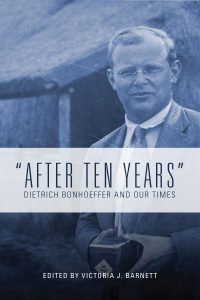
Review of Victoria J. Barnett, ed., “After Ten Years”: Dietrich Bonhoeffer and Our Times (Minneapolis: Fortress Press, 2017). Pp. 48. ISBN: 9781506433387.

By Kyle Jantzen, Ambrose University

In this slim volume, Victoria J. Barnett, general editor (2004-2014) of the celebrated Dietrich Bonhoeffer Works English Edition (DBWE), has contextualized one of Bonhoeffer’s most famous writings and applied it to our tumultuous contemporary political environment. The book is comprised of two parts: Barnett’s introduction, entitled “Reading Bonhoeffer’s ‘After Ten Years’ in Our Times,” and the English translation of Bonhoeffer’s “After Ten Years: An Account at the Turn of the Year 1942-1943” produced by Martin and Barbara Rumscheidt for the DBWE Letters and Papers from Prison, published in 2009 (to which Barnett has introduced a few slight revisions).

In her introductory chapter, Barnett begins with three italicized paragraphs in which she locates her reading of Bonhoeffer’s “After Ten Years.” On the one hand, she notes, “one must be cautious about drawing simplistic historical analogies,” especially with respect to Hitler, Nazism, and the Holocaust. “Nationalism, antisemitism, ethnocentrism, and populism have played a role in different historical periods and national contexts” (1). The grievances and resentments associated with these political movements always emerge out of specific social and cultural contexts. What is left unwritten is that the United States—indeed, the wider Western world—is currently threatened by the resurgence of just these sorts of antagonisms. Barnett continues, noting how important it is that citizens and institutions respond to such threats. Toleration of or compromise with ideologies of hatred will undermine and even destroy Western liberal political cultures. She suggests that this is a very real danger, given the fragility of ethical veneers and social conventions. Living in a time when accepted values and political norms are upended creates crises for individuals, religious bodies, and institutions of civil society, all of which struggle to adapt to or resist to these challenges. Barnett explains that these are the themes Bonhoeffer was addressing in his famous essay. As she writes, “his observations about what happens to human decency and courage when a political culture disintegrates continue to resonate around the world today” (2). This “introduction to the introduction” is very important, because it connects Bonhoeffer’s reflections about Nazi Germany to the upheaval of contemporary politics in the Age of Trump, even as it recognizes that this connection must take place in thoughtful, nuanced ways.
The balance of the introductory chapter considers the historical context of “After Ten Years,” Dietrich Bonhoeffer’s own history, and the main ideas of his important essay. Here Barnett brings her considerable expertise to bear, writing efficiently about Bonhoeffer’s family influences, his early criticisms of the Nazi regime, his experiences in England and the United States, his return to Germany in 1939 and his connection to leading members of the German Resistance. She explains how Bonhoeffer wrote “After Ten Years” to his brother-in-law, Hans Dohnanyi, his close friend Eberhard Bethge, and his military associate in the Resistance, Major General Hans Oster, as a synthesis of themes he had been thinking and talking about for some time, during a period in which the Nazi conduct of war was growing increasingly destructive and prospects for an overthrow of Hitler were becoming increasingly bleak. “After Ten Years,” Barnett notes, “was not so much an assessment of where they stood in 1942 but of how they had gotten there” (5).

She then delves more deeply into Bonhoeffer’s responses to Nazism, beginning with his February 1933 essay “The Führer and the Individual in the Younger Generation” and his April 1933 essay “The Church and the Jewish Question.” Bonhoeffer was quickly critical of the Nazi regime, not least because of its persecution of Jews. Even as Bonhoeffer urged the church to stand with persecuted Jews, however, he maintained elements of the theological anti-Judaism of his day and age. And when it came to the question of what to do about the moral and political crisis created by Nazi rule, Bonhoeffer was actually quite cautious. He participated in the Confessing Church struggle against the nazification of the churches, but did not speak out against the regime—even after the November 1938 Kristallnacht pogrom. This equivocation is captured in “After Ten Years.” As Barnett notes, “even Dietrich Bonhoeffer, Hans von Dohnanyi, and Eberhard Bethge—men of conscience who had seen through National Socialism from the beginning—could not completely extricate themselves from what was unfolding around them” (9). This is a key point that many general readers of Bonhoeffer miss: his insistence that he and his society were in various ways complicit with the Hitler regime under which they lived, not morally pure opponents completely set apart from National Socialism. The resistance that led to Bonhoeffer’s imprisonment and eventual execution emerged only after 1939.

Barnett describes “After Ten Years” as “a series of seventeen aphorisms and meditations that build upon each other” (11). She explains the way Bonhoeffer drew on his writing in Ethics to explore the extent to which “National Socialism had subverted traditional moral and ethical standards” (11). Even as he called for more individual responsibility, he explained how civil courage had declined, how National Socialism had seduced Germans, and how a widespread collective “stupidity” had taken hold. In response, he encouraged a kind of inner liberation, worried about the growth of contempt in German society, believed in the guarantee of eventual divine justice, and advocated a kind of nobility that grew out of the traditions of the Christian humanist culture in which he had been raised. He closed with a call to restore trust and sympathy among the opponents of Nazism and the recognition of the impact of suffering, the search for a responsibility towards the future, and the admission of weakness and vulnerability—even the possibility of death.

Barnett is careful to note that Bonhoeffer was not writing out of a confidence in an approaching victory of goodness or out of his own heroism. Rather, he “was reflecting on what happens to good people, what happens to the soul, the human sense of morality and responsibility, when evil has become so embedded in a political culture that it is part of the very fabric of daily life, and it becomes impossible even for good people to remain untouched by it” (14-15). All of this, she explains, arose out of his Christian faith, “characterized by personal faith and prayer, a commitment to the community of the church, and a deep responsibility toward others” (15). In this way, Bonhoeffer’s “After Ten Years” speaks to fundamental issues:

the human capacity in all ages for decency, for courage, and for an engagement in political culture that affirms these values and honors human integrity. In whatever particular historical moment we find ourselves, we are summoned to determine what our place in history will be, to think and act beyond our self-interest for the sake of a common good: not just the common good of the moment, our particular political group, or even our society, but of our times—to act, as Bonhoeffer put it, on behalf of history itself and for the sake of future generations and the kind of society we would wish for them. (16)

Rereading “After Ten Years” itself, one is struck by the power of Bonhoeffer’s analysis of his compromised position—conclusions he reached after living for a decade under Hitler’s rule. He began by noting the difficulty of the situation in which he and his friends and colleagues found themselves—decent Christians and Germans living under Nazism: “Have there ever been people in history who in their time, like us, had so little ground under their feet, people to whom every possible alternative open to them at the time appeared equally unbearable, senseless, and contrary to life?” (18). Bonhoeffer was grappling with the moral and ethical upheaval of his society—unsure where it might lead but aware of its evil and of the inability of reason, principles, conscience, freedom, or virtue to serve as a basis from which to respond to it. “Only the one who is prepared to sacrifice all of these when, in faith and in relationship to God alone, he is called to obedient and responsible action. Such a person is the responsible one, whose life is to be nothing but a response to God’s question and call” (20).

Bonhoeffer went on to describe the lack of civil courage among Germans, particularly in light of the problem they now faced: that political success had been achieved by evil means. Here the question Bonhoeffer faced was how to react to these conditions out of a sense of responsibility to future generations who would inherit these conditions. In an especially powerful section, he noted how people could easily become collectively stupid under the influence—the pressure—of an upsurge of power:

It seems that under the overwhelming impact of rising power, humans are deprived of their inner independence and, more or less consciously, give up establishing an autonomous position toward the emerging circumstances. … In conversation with [the stupid person], one virtually feels that one is dealing not at all with him as a person, but with slogans, catchwords, and the like that have taken possession of him. He is under a spell, blinded, misused, and abused in his very being. Having thus become a mindless tool, the stupid person will also be capable of any evil and at the same time incapable of seeing that it is evil. (23)

It is not hard to see how Bonhoeffer became so gripped with the importance of achieving a kind of inner liberation—an independent sense of responsibility towards the world and the future. At this point, Bonhoeffer turned to address issues like the growing contempt for humanity, the uncertainty of immanent justice, and the certainty of an eventual setting right of things, as the abiding, God-given laws of human communal life “strike dead” those who try to establish some alternative, aberrant order of society (25).

The essay then shifts, as Bonhoeffer affirms his belief “that God can and will let good come out of everything, even the greatest evil” (25). But for that to happen, God would need good people ready to live in faith and trust in God. To that end, Bonhoeffer wrote about the importance of establishing trust between people, of pursuing a genuine spirit of nobility of character, of cultivating sympathy for the suffering of others, and of embracing suffering, should it come to them. There would be no certainty about the future. “To think and to act with an eye on the coming generation and to be ready to move on without fear and worry—that is the course that has, in practice, been forced upon us. To hold it courageously is not easy but necessary” (29). Genuine optimism means working for a better future until that becomes impossible. As he considered both the uncertainty of the future and the necessity of responsible action in the world, Bonhoeffer pondered the potential of death, noting of it that “deep down we seem to feel that we are his already and that each new day is a miracle” (29).

It was here that Bonhoeffer penned his most famous question: “Are we still of any use?” (30). Could he and others around him become the kind of simple, uncomplicated, honest people living out of the inner strength which would make resistance possible? Key to this, he believed, was their experience of becoming marginalized—cast out and oppressed. Looking beyond these conditions, Bonhoeffer concluded “After Ten Years” with a call to live “out of a higher satisfaction … grounded beyond what is below and above” and thus to “do justice to life in all its dimensions and in this way to affirm it” (31).

Together, this stand-alone publication of “After Ten Years” and Barnett’s thoughtful introduction make for a powerful reminder of Bonhoeffer’s ongoing relevance as a theological and political thinker. This volume will serve well as a companion text in many university and seminary courses, and as a reading to serve as the basis for discussion among Christians and others keen to understand how to live in our contemporary political and cultural environment.

Share

Review of Joachim Krause, Im Glauben an Gott und Hitler. Die “Deutschen Christen“ aus dem Wieratal und ihr Siegeszug ins Reich von 1928 bis 1945

Contemporary Church History Quarterly

Volume 24, Number 2 (June 2018)

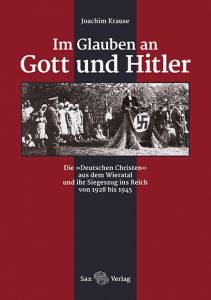
Review of Joachim Krause, Im Glauben an Gott und Hitler. Die “Deutschen Christen“ aus dem Wieratal und ihr Siegeszug ins Reich von 1928 bis 1945 (an annotated documentation / eine kommentierte Dokumentation) (Markkleeberg: Sax Verlag, 2018). Pp. 128. ISBN: 078-3-86729-212-2.

By Dirk Schuster, University of Potsdam

The retired chemist and theologian Joachim Krause just happened to come across the subject of the present book, as he writes at the outset. In referencing the well-known Institute for the Study and Elimination of Jewish Influence on German Church Life (Institut zur Erforschung und Beseitigung des jüdischen Einflusses auf das deutsche kirchliche Leben) he noted that the origins of the German Christian Church Movement (Kirchenbewegung Deutsche Christen) and their institute lay in the eastern Thuringian Wieratal, where Krause (born 1946) grew up. Since he knew nothing about the German-Christian history of the churches in his home country, he began to thoroughly investigate the German Christian Church Movement—by far the most radical and influential German-Christian organization during the period of National Socialism.

As the second subtitle reveals (“an annotated documentation”), the book is a descriptive representation of the German Christian Church Movement with a regional focus on the origins of the movement in the Wieratal near the city Altenburg. In his presentation, the author outlines the development chronologically: first of all, he describes how the two young vicars, Siegfried Leffler and Julius Leutheuser, who were inspired by National Socialism, began scouring for a small circle of like-minded people from 1927 onwards. Within a few years, this small circle was to become one of the most influential inner-church movements that controlled several Protestant churches during the time of the “Third Reich”. The theological worldview of the church movement was a symbiosis of (Protestant) Christianity and National Socialism, since they saw the direct action of God in Adolf Hitler and his movement.
The main lines of development which Krause describes, especially with respect to the sources that are quoted again and again, are not new. The early phase of the church movement is known at least in its rough historical outline through the publications of Susanne Böhm and Oliver Arnhold. This is where the uniqueness of Joachim Krause’s book comes to the fore: it is based on local sources such as the archives of the various parishes in which the German Christians began to build their national church movement. Furthermore, he can draw on personal records of inhabitants of the Wieratal from the time of National Socialism. With the help of this extraordinary material, Krause is able to retell the missionary successes of the church movement amongst the inhabitants of the Wieratal in a lively manner within the opening chapters.

In the subsequent chapters on the period of the “Third Reich”, however, Krause makes a number of content-related errors: this begins with false dates (p. 63) and leads to claims that in 1937 the NSDAP had forbidden dual membership in the party and church (p.82). To the contrary, Walter Grundmann, the scientific director of the aforementioned institute and one of the ideological leaders of the German Christian Church Movement, serves as a classic example of membership both in the NSDAP and the church organization, which was easily possibly until the end of the war.  Likewise, the secret newsletter of Martin Bormann in 1941 was not a challenge of the Nazi Party to the churches or even Christianity, but rather the attempt to achieve a consistent separation of party and church, as Armin Nolzen has impressively demonstrated.[1]

In the last chapter, Krause effectively criticizes the myth-making of an alleged ecclesiastical resistance after 1945 and points out how, on the local level, former German Christians are still fondly remembered, even today. In the chapter on the church policy of National Socialism, Krause does not maintain such a critical attitude, since he only repeats older interpretations of church historiography. By adding more recent work on the history of the churches in the “Third Reich”, such misjudgments probably could have been avoided. However, if you would like to find out more about the early years of the German Christian Church Movement, I recommend this book, which surprises with very interesting sources at various points.

[1] Armin Nolzen, “Nationalsozialismus und Christentum. Konfessionsgeschichtliche Befunde zur NSDAP,” in Manfred Gailus, Armin Nolzen (eds.), Zerstrittene »Volksgemeinschaft«. Glaube, Konfession und Religion im Nationalsozialismus (Göttingen: Vandenhoeck & Ruprecht, 2011) 151–179.

Share

Review of Come Before Winter: Dietrich Bonhoeffer and His Companions in the Dying Gasps of the Third Reich

Contemporary Church History Quarterly

Volume 24, Number 2 (June 2018)

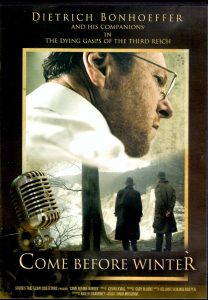
Review of Come Before Winter: Dietrich Bonhoeffer and His Companions in the Dying Gasps of the Third Reich, directed by Kevin Ekvall (Woodbury, MN: Stories That Glow Collectors, 2016).

By Kyle Jantzen, Ambrose University

This film aims to tackle two stories in one: the life and thought of German theologian Dietrich Bonhoeffer during his time in captivity leading up to his execution by the Hitler regime and the “fake news” black propaganda operation of the British journalist Sefton Delmer, assisted by Bonhoeffer family friend Otto John, Berlin-born actress Agness Bernelle, and later James Bond novelist Ian Fleming. It employs a combination of dramatic re-enactment, narration over still and moving images, and explanations from various experts, most notably sociologist Ekkehard Klausa from the Research Centre of Resistance History, ethicist Larry Rasmussen from Union Seminary, pastor John Matthews of the International Bonhoeffer Society, theologian and church official Ferdinand Schlingensiepen of the International Bonhoeffer Society, and Baptist minister and scholar Keith W. Clements, Past General Secretary of the Conference of European Churches, Geneva.

Come Before Winter begins by acknowledging the memoirs and writings of Sefton Delmer, Otto John, Sigismund Payne Best, and Dietrich Bonhoeffer as sources. It then asserts that “one of the tragedies of World War II was the refusal of President Roosevelt and Prime Minister Churchill to acknowledge the existence of a German resistance,” introducing the failed ­assassination attempt of July 20, 1944. From there viewers are introduced to Sefton Delmer, the British journalist (born and raised in Berlin) who operated several so-called black propaganda operations, broadcasting disinformation into Nazi Germany. The operation covered by the film was the German short-wave broadcast “Atlantic,” which used a powerful transmitter to broadcast jazz, invented personal announcements, and fake news throughout Germany and also to U-boats in the Atlantic during the later war years. Delmer’s goal was to demoralize German troops and to turn the German public against the Nazis. At several points in the film, broadcasts written by Delmer and Fleming (with information from Otto John) and read by Bernelle are re-enacted, in order to depict Delmer’s determined effort to use propaganda to defeat Germany. These scenes also serve as a vehicle for Otto John, a member of the July 20 assassination plot who had escaped to England, to explain the various efforts of the German Resistance to assassinate Adolf Hitler, along with Dietrich Bonhoeffer’s principled participation in the Resistance and his consequent arrest and detention in Tegel prison.
This section of the film contains interesting statements from several of the Bonhoeffer experts about the quest to kill Hitler. Schlingensiepen argues that Bonhoeffer’s extended conversation with German jurist, intelligence officer, and anti-Nazi Helmuth James von Moltke in April 1942 on the island of Rügen revolved around the theologian’s ethical justification for killing Hitler (23:40). When the head of state orders the death of thousands day by day, the only way to stop him is to kill him. Bonhoeffer believed that God left members of the Resistance free to do that, just as God left his son Jesus free to heal the sick on the Sabbath (24:44). Clements notes the difficulty of describing Bonhoeffer as either pacifist or assassin, given the complexity of his situation. Bonhoeffer deeply respected pacifism and knew the costs of war, but was it possible to preserve one’s innocence by doing nothing? (24:10).  Rather than dogmatic militarism or pacifism, Bonhoeffer argued people must face their duty to God, and that they determine that duty based on the question of what the consequences will be for other people. This was also the basis for his counsel to other members of the Resistance (25:23). Ethicist Reggie Williams of McCormick Theological Seminary adds that Bonhoeffer acted out of faith, asking what Christ calls us to do in the crisis (25:43), while religion scholar Lori Brandt Hale of Augsburg College notes that Bonhoeffer’s choice to enter the Resistance wasn’t really a choice; he knew that it was necessary and that so few others understood (26:02).

As the dramatized scenes in the film continue, Sefton Delmer and his black propaganda unit continue their work, Otto John laments the destruction of Berlin, and Bonhoeffer sits in Tegel prison. The film details his transfer to the Prinz-Albrecht-Strasse SS headquarters, then on to Buchenwald and the Schönberg schoolhouse in rural Bavaria, until his eventual final imprisonment in Flossenburg concentration camp. Along the way, we’re introduced to an eclectic mix of fellow inmates who encountered Bonhoeffer, including the British intelligence officer Sigismund Payne Best, the German mother Fey von Hassell, the Russian atheist Vassily Korokin, and the German cabaret singer Isa Vermehren. Bonhoeffer’s final sermon, preached to these prisoners before his summons to Flossenburg, included a scripture passage from Isaiah 53 on the suffering servant and a text from 1 Peter 1 on the Christian’s living hope through the resurrection of Jesus Christ. This and the singing of “A Mighty Fortress” are dramatized, along with Bonhoeffer’s famous parting words to Payne Best: “This is the end, but for me the beginning of life” (54:15).

Here Ferdinand Schlingensiepen provides a bold theological interpretation of Bonhoeffer’s execution: “Terrible as this story is, it was not without God’s commands. And Bonhoeffer knew that himself. He says, ‘Hitler cannot kill me. The hour of my death will be prescribed by the living God himself.’ And he almost escaped in Schönberg, with the others. But God allowed him to become a martyr, which made him a much more important figure for future times” (54:35).

Keith Clements explains that Bonhoeffer’s court-martial was a sham, a hasty process not meeting proper judicial standards. As the film dramatizes Bonhoeffer’s final moments, including his shaming by an SS officer and his hanging, the film shows only his feet, while cross-cutting to a typewriter tapping out the death section of Bonhoeffer’s “Stages of Freedom” poem. Clements then reflects thoughtfully on Bonhoeffer’s execution: “When the tyrant executes the martyr, the tyrant’s power ends, because he can’t do any more than that. But the power of the martyr begins, because his witness goes on forever. … [These resisters] were the people who won the battle of faith and courage and conviction and human dignity. And it’s to them that we now look today” (59:40).

The film ends with a dramatization of the memorial service for Bonhoeffer and Bishop George Bell’s sermon, including the section in which Bell makes meaning of the German theologian’s martyrdom: “He represents both the resistance of the believing soul, in the name of God, to the assault of evil, and also the moral and political revolt of the human conscience against injustice and cruelty” (1:04:10).

While the film seems to question the results of Delmer’s black propaganda (including the execution of German civilians who listened to the broadcasts and the creation of the myth of the good German soldier), it sums up Bonhoeffer by noting that, “In death, as in life, Bonhoeffer has remained on the edge of controversy. Nonetheless, his writings and life have gradually been embraced by millions and many scholars have marveled at the breadth of his theological and philosophical appeal” (1:06:36). Short descriptions of the fate of other main characters are also provided at the close of the film.

On the whole, the film does well where it dramatizes the events of Bonhoeffer’s final years using his own words or those of other key figures who knew him. The contributions of Schlingensiepen and Clements are also informative and thought-provoking. Less coherent is the story of Sefton Delmer’s black propaganda unit, which oscillates between humour and pathos. The film interprets it both as vitally important to Allied victory and as a misguided effort.

Whether these two stories—that of Delmer’s black propaganda unit and of the final stages of Bonhoeffer’s life—actually belong in the same film is probably up for debate. The person of Otto John is the link between the two, but he plays only a minor part in the film. While Come Before Winter captures something of the power of Bonhoeffer’s martyrdom, in terms of an introduction to the German Resistance, I would still recommend Hava Kohav Beller’s fine documentary The Restless Conscience: Resistance to Hitler in Nazi Germany (docurama films, 1991), and for an introduction to Dietrich Bonhoeffer and the significance of his life, thought, and death, I would turn to the Martin Doblmeier documentary Bonhoeffer: Pastor, Pacifist, Nazi Resister (First Run Features, 2003).


Share

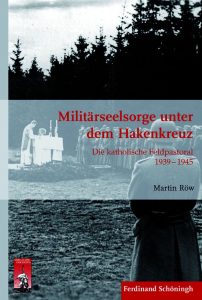
Review of Martin Röw, Militärseelsorge unter dem Hakenkreuz: die katholische Feldpastoral, 1939-1945

Contemporary Church History Quarterly

Volume 24, Number 1 (March 2018)

Review of Martin Röw, Militärseelsorge unter dem Hakenkreuz: die katholische Feldpastoral, 1939-1945 (Paderborn: Verlag Ferdinand Schöningh, 2014).

By Lauren Faulkner Rossi, Simon Fraser University

Martin Röw’s Militärseelsorge unter dem Hakenkreuz is among the newest contributions in a sudden flurry of work on chaplaincy and pastoral care during the Nazi period. Published in 2014, Röw’s text is the first rigorous, intensive analysis of the Catholic military chaplaincy during the Third Reich. At more than 450 pages, it is also the most detailed, even exhaustive. As such, Röw has provided the definitive book on this subject that is essential reading for anyone with an interest in religion in the military, pastoral care, and the world of German Catholic chaplains during the Second World War.

Röw’s intentions are to deliver a comprehensive structural and experiential history of Catholic military pastoral care in Germany, with a particular emphasis on providing a systematic study of chaplaincy (12). He has oriented himself solidly in the available historiography on the subject in both German and English and his archival research is impressively broad, gathering material from four archdiocesan archives (including Salzburg), eight diocesan archives (including one in Austria and one in the Netherlands), and several other state and private collections in Germany. His main source for primary documentation is the Archive of the Catholic Military Bishop, in Berlin, notably the Georg Werthmann collection. Until relatively recently, this rich compilation of chaplaincy-related material, produced by the man who served as second-in-command of the Catholic chaplaincy during the Second World War, was strikingly understudied; in the past four years, three books have appeared whose authors have extensively mined its records.[1] Röw articulates a concern with several facets of the chaplaincy’s existence, including the chaplains’ relations to military authorities, their understanding of the regime’s politics and ideology, the daily life of chaplains and their interactions with civilian populations, and their witness to war crimes. He is especially attuned to the challenges of accessing and interpreting mentality, and is determined “to drill into the mental dispositions” of chaplains wherever possible in order “to illuminate [their] self-conception and their mindset” (13). To some extent, he acknowledges the bias in and limitations of his main source, as Werthmann was the “nerve centre” of the chaplaincy (39), and his numerous judgments should not automatically be taken as balanced or neutral.

Beyond the introduction, Röw dedicates a short chapter to constructing the Catholic milieu of Germany. In passing, he recognizes the minority position that German Catholics held in a newly united German empire after 1871, but he focuses more on the impact of the First World War and the Weimar era on German Catholics, the ascent of Nazism and the relationship between the regime and the Church, and the meaning of the war’s outbreak for the German Catholic community in 1939. Much of this work is summation of earlier, mostly German historiography; because this is the backdrop to Röw’s main focus, he introduces nothing revelatory or original about the larger context of German Catholicism. The bulk of his work, nearly four hundred pages, is devoted to the Catholic chaplaincy during the war.

Röw divides his analysis of the chaplaincy into six main sections, the first two of which sketch the contours of the chaplaincy and the roles that chaplains expected themselves to fill as well as those that military officers asked them to take on. The first section considers the structures and individuals of the chaplaincy under Nazism, including general and specific chaplaincy statistics. There were “about 760” priests who served as chaplains over the course of the war, with 410 serving simultaneously at its peak, in the summer of 1942 (84). In a different section, Röw delves briefly into a quantitative social analysis of chaplains, offering statistics about regional background and generational variation; the leadership of the chaplaincy; the recruitment process and training; and the Nazi regime’s persistent, often explicit hostility towards the chaplaincy, culminating in the infamous 1942 order not to fill any vacant chaplain positions (120). The second section focuses on the context of the chaplaincy within the Wehrmacht, proclaimed at the time as “the pillar of the regime” (127). Röw depicts the military’s conceptions of pastoral care; the different kinds of relationships between chaplains and their officers, both positive and negative; the introduction of the much-detested National Socialist Leadership Officers (NSFOs) at the end of 1943; and Catholic chaplains’ interactions with their Protestant counterparts, both cooperative and competitive.

The final four sections are dedicated to the war’s impact on the chaplains and contain some of the richest material from the Werthmann collection to be introduced in one book. The third section confronts the duties of a chaplain, highlighting the divine service as “the centerpiece of pastoral care” at all times (173); Catholic chaplains’ reactions to the mandated, and controversial, nondenominational services (interkonfessionelle Gottesdienste); the significance of chaplains’ presence at the frontlines; equipment and available literature; care for the wounded, the fallen, and the imprisoned; and “deviant chaplains,” those who Werthmann labelled “weak brothers” (232).

The fourth section is Röw’s most sustained drive into the issue of mentality, considering how chaplains crafted meaning out of the war for themselves and the soldiers with whom they served, including nationalist and anti-Bolshevik impulses; displays of ambivalence, distance, and powerlessness, as well as affinity with the regime’s wartime goals; and the significant influence of a highly-developed sense of duty.

The fifth section, on communication and interactions between chaplains and their various environments, includes Röw’s scrutiny of the impact of the chaplains (and religion) on the fighting troops; their roles as guides, mentors, and helpers for soldiers in the thick of battle; the community of chaplains, however nebulous, that existed throughout the war; and their relationships with other identifiable groups, including seminarians and priests serving in the Wehrmacht (the so-called Priestersoldaten), foreign chaplains and priests, and indigenous populations.

The sixth section sees Röw endeavour to capture the kind of “everyday life in war” (“ein Alltag im Krieg”) that chaplains attempted to make for themselves, while admitting the challenges and controversy in introducing that word into the context of a war of annihilation (380-381). Thus Röw examines the typical official activities of a chaplain within his regiment or division; the peaks and ebbs of war as determined by active battle and proximity to the front; the experiences on different fronts, with a lengthy excursion into life on the Eastern Front; and their witnessing of atrocity (Röw uses the term Verbrechen for this section). This includes chaplains’ reactions to the maltreatment and murder both of Soviet POWs as well as of Jews. The almost-scant attention paid to this topic—fifteen pages—as well as Röw’s dependence on secondary sources and postwar published memoirs to flesh out the half-dozen or so eyewitness accounts that he has uncovered underscore the paucity of recorded testimony from the chaplains themselves. While many undoubtedly witnessed something, chaplains simply did not write about such things.

For scholars who have studied the Catholic chaplaincy in the Wehrmacht, Röw’s analysis does not necessarily bring anything ground-breaking to the subject of chaplains and pastoral care during the Second World War, or the hostility of the Nazi regime towards the Catholic Church in general and priests in the Wehrmacht in particular, or to the nature of the war and how devout Catholic clergy tried to makes sense of it. The identification of Bolshevism as an enemy provided a convenient overlap between Catholic and Nazi ideologies (260-270). Chaplains were dependent on good relations with the military authorities to be able to work effectively. Röw argues that “outspoken opponents of pastoral care, such as Nazi supporter General Schörner, commander of the 6th Mountain Troop Division, appear to be an exception” (145). Written or explicit criticisms of the regime or the Führer were—not surprisingly—non-existent, given the lethal reaction they would have provoked (291, 298).

The significance of Röw’s work is not its originality; it is that his study is the first methodical, systematic treatment of the chaplaincy, from the top of its hierarchy—the relatively feeble field bishop, Rarkowski, isolated from the other bishops and supported by the Nazis, alongside his field vicar-general Werthmann, judicious, active, energetic, willing to take risks (103)—to the chaplains standing next to soldiers on the field of battle. For this reason alone, the text is indispensable.

Röw’s objective is to produce a study of Catholic pastoral care during the war “in its various spheres and facets, but always viewing pastoral care as a whole” (442), and in this he has succeeded, though he has had to sacrifice depth in order to achieve breadth. The character of individual chaplains is underemphasized in favour of the institution in which they served, so that one is hard-pressed to keep track of the names (which are not always given in the footnotes). Despite the brief foray into the social and regional background of some chaplains, there is only a passing understanding of how old, or conversely how young, the chaplains tended to be, how long they had been priests when they were recruited, how their familial and regional histories moulded their pastoral behaviour in the military, or how many came from Austria or other annexed territories of the Reich. (Curiously, one of the most striking omissions in Röw’s list of archival resources is the archdiocesan archive of Munich and Freising, one of the largest archives of its kind in Germany). Werthmann is very present throughout, but remains as slippery and enigmatic as ever. Röw admits, “Whether [Werthmann’s] motto actually was, ‘good German and above all Catholic, but not and in no way National Socialist,’ as Heinrich Missalla alleges, cannot be said with certainty.” (103) Although the collection that bears his name is at last receiving the scholarly attention it has long deserved, we still await a definitive biography of its creator. One might have wished for a clearer sense, too, of change over time within the wartime chaplaincy, particularly given the turning-point of 1942, when no new chaplains were recruited.

Röw is undoubtedly correct when he claims that his work challenges the older interpretation of chaplains as unpolitical, and their military service as merely “care (Fürsorge) for men mired in the misery of war” (445). It is difficult to disagree with his conclusions about the motivation of so many chaplains, composed of an amalgam of “Catholic idealism, fueled by a specifically Catholic inferiority complex with deep historical roots, and a patriotism that convinced them that they were in no way second to non-Catholic Germans” (446). Röw is unflinching in his final assessment of the effect that chaplains had on the kind of war fought on the Eastern Front, articulating what those of us long familiar with these sources have known: their very presence encouraged soldiers to justify their behaviour as legitimate, even necessary, in an existential battle against an enemy—Bolshevism—that sought to annihilate German and Catholic culture. In this manner, priests in chaplain uniform “became, however involuntary, instruments of normalization of the war of annihilation” (448). And Röw has sifted his sources thoroughly to provide demonstrable proof of this. Although the regime worked doggedly to nullify the influence that a relatively small number of chaplains (760, says Röw, in an army in which some 18 million men served) had on the troops, the chaplains ultimately rendered a vital service in sustaining the Wehrmacht’s fighting fervor, especially on the Eastern Front.

Yet the number here might give one pause: how could so few chaplains possibly have motivated millions of men over a span of several years? They could not possibly be everywhere at once, and Werthmann, Röw’s primary resource, acknowledges that some divisions went months, or more, without access to a chaplain.[2] Does this not suggest that the chaplains inflated their own importance, precisely to justify their presence at the front, both at the time and after 1945? Undoubtedly the Priestersoldaten—more than 17,000 Catholic priests, members of religious orders (Ordensleute), and seminarians who were conscripted but did not serve in the chaplaincy—helped to fill in some gaps, though these individuals fell outside the chaplaincy and Röw accords them only a few pages.

What will really answer this question is testimony from the soldiers themselves about the impact of religion and the men who represented it: chaplains, as well as priests and other religious outside the chaplaincy wearing military uniforms. This is, admittedly, beyond Röw’s focus. His milieu is the chaplaincy, and while he begins to address the issue of reception, he does so in somewhat cursory fashion, referring to what responses to pastoral care military authorities told chaplains to expect from soldiers (326-329), and then to the perspectives of chaplains themselves (329-336). Röw does not claim to have answered all outstanding questions about the Catholic chaplaincy with this work. Indeed, he lists several areas for further research in the final pages, including theological themes in wartime sermons and other writing, comparative studies of chaplaincies in different militaries during the war, and the much-desired critical evaluation of Werthmann. But it might be time to shift focus in order to address more fully the questions that this research engenders. Perhaps we should begin to look less narrowly at the men who brought religious care to the troops, and instead scrutinize more attentively what the troops themselves did with that religious care. Röw has provided an exceptional overview of the former in the German context, and it should be considered essential reading for any scholar asking questions about religious care in the German military during the Second World War.


[1] Chronologically, Röw’s book was the first published, predating my own work by only several months. Röw was aware of my doctoral dissertation and cites this briefly in his introduction, though I was not aware of his work until it was published. While we both worked in the same archive in Berlin at roughly the same time, we never met each other. He did not have access to my book on the subject, Wehrmacht Priests (2015), prior to publishing his work. The third book is Dagmar Pöpping’s Kriegspfarrer an der Ostfront, a comparative study of the Protestant and Catholic chaplaincies, which appeared in 2017.

[2] This dearth was made even worse by the 1942 prohibition to fill vacant chaplain positions, as Röw details. See 120-122.

Share

Review of Thomas Martin Schneider, Wem gehört Barmen? Das Gründungsdokument der Bekennenden Kirche und seine Wirkungen

Contemporary Church History Quarterly

Volume 24, Number 1 (March 2018)

Review of Thomas Martin Schneider, Wem gehört Barmen? Das Gründungsdokument der Bekennenden Kirche und seine Wirkungen (Leipzig: Evangelische Verlagsanstalt, 2017). Pp.241. ISBN: 9783374050345.

By Manfred Gailus, Technische Universität Berlin; translated by Kyle Jantzen, Ambrose University

This review was originally published in zeitzeichen. Evangelische Kommentare zu Religion und Gesellschaft, February, 2018. https://www.zeitzeichen.net/rezensionen/thomas-martin-schneider-wem-gehoert-barmen/. It is reprinted in translation with the permission of the publisher.

The Barmen Theological Declaration (BTD), adopted on May 31, 1934, at the First Reich Confessing Synod in Wuppertal-Barmen, is widely regarded as the Magna Carta of the church opposition in the Third Reich. It is certainly rightly considered the most demanding statement of the Confessing Church (BK) in its defense against the advance of pro-Nazi German Christians (DC). The purpose of the DC was to transform the Protestant churches into a Reich church shaped by völkisch antisemitic theology and governed from Berlin according to the “Führer principle.” Much has been written about the theological content of the six Barmen theses in the postwar era, culminating in the 50th anniversary of the declaration in 1984. For anyone looking for quick information about this Protestant document of the century, about its historical context, about its theological meaning and its church-political significance, and about its enormously broad reception history since 1945, this popular overview can certainly be recommended. The reception of the Barmen Declaration is presented in particular detail, and its astounding variety makes it clear that various political orientations and church circles from the left to conservative evangelical groups felt that they could invoke the tradition and intention of the declaration in their current concerns. Almost all parties and groups declared sometime after 1945 that the good “spirit of Barmen” actually belonged to them and would be further developed in their work. An extensive documentary section (p.155-219) documents the diverse uses of the declaration by everyone from Marxist GDR theologians to West German Left-Protestants to the Christian Democratic Union (CDU) and Evangelicals. It is noteworthy from today’s point of view that the Lutheran churches which were abstinent and critical of the Barmen Declaration during the time of the Church Struggle—they sensed too much Reformed spirit in the statement which was largely formulated by Karl Barth—have since 2012 (after a long period of reflection, beginning with the newly-founded North Church) begun to refer explicitly to the theological and church-political traditions of Barmen.

In this account by the Koblenz-Landau church historian, one can not ignore the remarkably sympathetic treatment (for example, pp. 62 f., 72 ff.) of the Lutheran churches which adapted to the Nazi regime and which were skeptical or even hostile to the Barmen project from the outset. From today’s point of view, a critical church-historical assessment would seem more appropriate. Also, an up-to-date church history should leave behind terms from the time of the Church Struggle such as “intact” and “destroyed” churches. For the three large Lutheran regional churches (especially that of Hanover), with their far-reaching adjustment to the regime, the label “intact” should really be dispensed with. And for divided regional churches, such as the great Old Prussian Union Church, it would be more appropriate to speak of “self-destruction.” Although the author deals comparatively with the “Altona Confession” (1932), he deals too briefly or not at all with the 1936 memorandum of the 2nd Provisional Church Leadership (of the Confessing Church) to Hitler or the memoranda by Margarete Meusel (1935) and Elisabeth Schmitz (1935/36) on behalf of Protestant “non-Aryans” and persecuted Jews. A comparative chapter involving these and other important manifestations of the period of the Church Struggle would be well placed here.

Nevertheless, on the whole, these restrictive remarks do not substantially reduce the great usefulness of this compact introduction to the most important Protestant church document of twentieth-century German history.


Share

Review of Elisabeth Lorenz, Ein Jesusbild im Horizont des Nationalsozialismus

Contemporary Church History Quarterly

Volume 24, Number 1 (March 2018)

Review of Elisabeth Lorenz, Ein Jesusbild im Horizont des Nationalsozialismus. Studien zum Neuen Testament des “Instituts zur Erforschung und Beseitigung des jüdischen Einflusses auf das deutsche kirchliche Leben” (Tübingen: Mohr Siebeck, 2017). Pp. 539. ISBN: 978-3-16-154569-6.

By Dirk Schuster, University of Potsdam

This book by Elisabeth Lorenz is based on her dissertation, which was submitted in 2015 at the University of Regensburg. The focus of the book is the “dejewified” New Testament, The Message of God (Die Botschaft Gottes), which was published in 1941 by the Institute for the Study and Eradication of Jewish Influence on German Church Life, also known as the Eisenach Institute. Several monographs have been published in the last ten years about this institute, founded by the German Christians in 1939. However, the “dejewification” of the New Testament has only been the subject of shorter published articles, making the relevance of this work obvious.

Lorenz’s goal is to compare New Testament passages from The Message of God with the Luther Bible, the standard translation, and the original Greek text. For this purpose, Lorenz has chosen three central terms by means of which she tries to analyze the new interpretation in The Message of God. Chapter 2 deals with the Messiah concept and the relationship between Jesus and Judaism. Chapter 3 places the concept of sacrifice at the heart of the comparison. Chapter 4 deals with the portrayal of Jesus in the New Testament traditions in comparison with Jesus’ presentation in The Message of God. The focus on concepts rather than merely on individual passages is very welcome, since, for example, in dealing with the Messiah concept, the entire Christology of The Message of God and thus of the German Christians can be derived, as Lorenz rightly states (83).

The contrasting juxtaposition of the single text passages in the form of tables makes it easier for the reader to understand the different wording in The Message of God, the standard translation, as well as the Luther translation quickly and clearly. Based on such juxtapositions, Lorenz is able to demonstrate that, for example, in relation to the Messiah concept in The Message of God, there has been a significant interference with the other translations. The aim was to put Jesus in opposition to the Jewish Messiah conceptions (93). Ultimately, all these revisions were aimed at highlighting Jesus’ opposition to Judaism, as the editors of The Message of God understood Jesus not as a Jew but rather as a fighter against Judaism.

It is here that the weak point of the book emerges: Lorenz does not pay attention to significant publications on the German Christians and the Eisenach Institute and, as a result, produces several misinterpretations. For instance, she understands the intention of publishing the “dejewified” New Testament as a passive, defensive reaction against the background of anti-Semitic Nazi ideology (492). Lorenz even goes so far as to suggest that the editors of The Message of God had no awareness of the consequences of their work (492). Unfortunately, Lorenz repeatedly refers to the theologian Karl-Wilhelm Niebuhr for information on the Institute’s work. In research on the Eisenach Institute, however, Niebuhr receives very little attention because he does not argue historically but exclusively apologetically. If the author had referred to central works such as those by Susannah Heschel (only two older papers by Heschel are referenced), Manfred Gailus (who is not named at all), or other researchers, such erroneous conclusions could have been avoided. The members of the Eisenach Institute were always aware of the consequences of their anti-Semitic works. The intention behind books such as The Message of God was an active disengagement of Jesus from its Jewish context, in order to provide a basis for the anti-Semitic goals of the German Christians and their institutes that existed from the beginning.

Future research on the Eisenach Institute needs to pay attention to Lorenz’s book, since it has bridged a gap that previous research had not closed yet. The detailed comparison of selected New Testament terms between The Message of God and classical Bible translations has succeeded and deserves a high degree of recognition. Unfortunately, this cannot be said for the historical classification and the intention of the Eisenach Institute and its “dejewified Bible,” because Lorenz has not followed the relevant research on the German Christians and the Institute. This is a pity. As a result, Lorenz issues judgments in some passages of her very good book that are simply no longer tenable due to the current state of research.


Share

Review of Michael W. Brierley and Georgina A. Byrne, Life after Tragedy: Essays on Faith and the First World War evoked by Geoffrey Studdert Kennedy

Contemporary Church History Quarterly

Volume 24, Number 1 (March 2018)

Review of Michael W. Brierley and Georgina A. Byrne, Life after Tragedy: Essays on Faith and the First World War evoked by Geoffrey Studdert Kennedy (Eugene, OR: Cascade Books, 2017). Pp. xxiv + 254. ISBN 978-1-5326-0226-9.

By Andrew Chandler, University of Chichester

The many centenary anniversaries of the First World War which have accumulated in Britain since 2014 have produced many significant contributions in many different forms. They have also given historians of religion an audience for their growing explorations of the diverse religious dimensions of the conflict. One of these dimensions has been the experiences of chaplains to the armed forces—a field which that fine historian, Michael Snape, has made his own. It is in this context that the striking figure of Geoffrey Studdert Kennedy emerges.

Studdert Kennedy, or ‘Woodbine Willie’, as he was affectionately known by soldiers, has long been the most well-known of the British wartime chaplains. He has attracted the attention of scholars of various kinds for his poetry (The Unutterable Beauty, published in 1927, remains much admired in some quarters), his trenchant criticisms of the status quo, his uncompromising socialism, his pungent scepticism of authority (one of his books was simply called Lies), and his determination that the ghastliness of war must surely and eventually yield a better world. But he was also the embodiment of courage and unselfconscious sacrifice (he won the Military Cross) and his early death, exhausted, at the age of 45, presented something of the quality of a martyrdom—not so much to the powers of the age but perhaps to the whole age in which he lived. Westminster Abbey notoriously turned down the idea of hosting his funeral. One suspects that Studdert Kennedy would have been delighted by the compliment.
This collection of anniversary essays is very much the work of two members of the clergy of the Church of England who have sought to claim for their cathedral something of a responsibility for public scholarship and critical reflection. This is admirable, and these days rare. Once I would have thought that an English cathedral could make a very good home to scholarship and that English priests at large might know how to value the reality of historical experience. I have long since lost that faith and find that even a book like this cannot quite revive it. Nonetheless, what we have here is solid fare and it expresses the commitments of ten priests, while the two laymen turn out to be lay canons of cathedrals. The effect is collegial: for the most part they share a common geography as well as denomination and one senses that they are happy to be found in company together.

Michael Snape inaugurates the volume with an efficient ‘reconsideration’ of British religion and the First World War, while Michael Brierley offers a brisk sketch of the life of Studdert Kennedy. John Inge presents a more personal and wide-ranging reflection on the war as it affected the sensibilities of ‘place’ and ‘home’, finding Studdert Kennedy at home only in the Christ of the Gospels and the worship of the Church. Peter Atkinson confronts Studdert Kennedy the poet and holds to account the imperious responses of later English literary critics, particularly I.A. Richards and Roy Fuller, before proceeding to a discussion of the poetry of Geoffrey Dearmer. Michael Brierley returns with a discussion of Studdert Kennedy and the ‘new vision’ of a suffering God—a vision which would resonate so profoundly, and be developed, in the later theology of the European twentieth century. Georgina Byrne examines different forms of preaching (‘Prophesy or Propaganda?’), locating Studdert Kennedy alongside the ‘intensely patriotic’ Bishop of London, Winnington Ingram (who has almost become a subject, or at least a controversy, in his own right) and the eloquent individualist and pacifist (of a kind), Maude Royden. A discursive Mark Dorsett places Studdert Kennedy in the company of the like-minded Edward Lee Hicks (a notable bishop of Lincoln and a leading Christian Socialist) and the influential thinker R.H. Tawney, while looking to further horizons. David Bryer provides a useful survey of the war and its impact on the development of humanitarianism while Alvyn Pettersen discusses images of glory in war memorials, examining those at Worcester itself and at Magdeburg Cathedral (by Ernst Barlach) before jumping, attractively but perhaps surprisingly, into a reflection on the life of the fourth-century monk, Antony of Egypt. By way of conclusion Mark Chapman is very much at home in a discussion of Anglican theology, not least in its stray connections with German theologians, during and immediately after the war. Finally, the two editors retrieve and reconfigure strands in a concluding reflection on ’integration, balance and fullness’. An Afterword by the bishop of the Evangelical Church in Central Germany, Ilse Junkermann, is only momentarily a response to the life of Geoffrey Studdert Kennedy and suggests a diocesan link at work. In no small measure is the integrity of the volume affirmed by a very good, robust bibliography.

In sum, there is enough here to satisfy the questions and perspectives of the conventionally-minded historian. Equally, theologians of society, war, literature ethics and aesthetics, will find much to intrigue them. Michael Brierley and Georgina Byrne have done particularly well to bring the whole feast before us and more than the figure of the marvellous Geoffrey Studdert Kennedy is honoured by it all.

Share

Review of Mark Edward Ruff, The Battle for the Catholic Past in Germany, 1945-1980

Contemporary Church History Quarterly

Volume 23, Number 4 (December 2017)

Review of Mark Edward Ruff, The Battle for the Catholic Past in Germany, 1945-1980 (Cambridge: Cambridge University Press, 2017). Pp. 408. ISBN 9781107190665.

Reviewed by Robert P. Ericksen

Mark Edward Ruff, Professor of History at Saint Louis University, has spent the past eleven years completing The Battle for the Catholic Past in Germany, 1945-1980. This includes four years working in Germany, supported by the Alexander von Humboldt Stiftung, the NEH, and the ACLS, as well as visits to a total of “two continents, six nations, and seventy-seven archives” (vii). The result is an important book that takes its place alongside John Connelly’s recent From Enemy to Brother: The Revolution in Catholic Teaching on the Jews, 1933-1965 (Cambridge, MA: Harvard University Press, 2012). Connelly devotes more than half of his book to the period pre-1945; however, the importance of his book culminates in the 1960s, when, according to his argument, converts to Catholicism, several with German or German language roots, and especially Catholics of Jewish origin, inspired the remarkable transition in Catholic theology found in Vatican Two and Nostra Aetate.[1] Ruff’s book is more completely based in the postwar period. However, it also deals with the most salient issue addressed by postwar historians of Germany and of Catholicism: a measuring of the Catholic Church’s response to the Nazi regime of Adolf Hitler, and especially to the Shoah, the murder of six million Jews by a Christian nation within a Christian Europe. Connelly describes the incubation of ideas that led to a dramatic change in universal Catholic doctrine. Ruff describes the first thirty-five postwar years within Germany and the struggle over how to understand the history of Catholics, especially their place within and their relationship to the Nazi regime and its crimes.

Ruff begins with the assumption that both churches, Catholic and Protestant, share a compromised history within the Nazi state. He also acknowledges that both churches from 1945 to 1949 worked to polish their reputations: “Not wishing to further damage Germany’s reputation abroad …,” both Catholics and Protestants “elevated to orthodoxy the picture of the church triumphant, of clear-headed leaders valiantly resisting and the faithful unflinchingly following” (243). Not until the 1980s did historians of the Protestant Church seriously begin to redraw this rosy picture. However, Catholic behavior came under widespread attack already in the 1950s, “Doubts about the moral fitness of Catholic bishops, Cardinal Secretary of States and pontiffs of the Nazi era were cascaded before the public. They screamed from front-page headlines, the magazine covers of the most influential newsweeklies, the glossy pages of illustrated magazines and the best-seller lists in Germany and the United States.” Why did this happen? “This has been a guiding question for this book, since by almost all objective yardsticks, the German Protestant leadership left behind a more troubling record of collaboration than their Catholic counterparts” (244).[2]

Ruff clarifies early on his basic explanation of how the microscope quickly became focused on Catholics rather than Protestants in postwar Germany. First it has to do with demographics. Catholics had been an embattled minority in Germany since the aggressive Protestant, Otto von Bismarck, founded modern Germany. After 1945, millions of German Protestants were left behind in Poland and in the Soviet Union, but especially in the Russian Zone of Occupation that became East Germany. As a result, the percentage of Catholics rose from just over one-third in all of Germany prior to the war to 45 percent in postwar West Germany.

More importantly, Konrad Adenauer and his newly-created Christian Democratic Union—primarily a Catholic party, even though it invited Protestant participation—dominated the early years of West Germany, from the creation of the Federal Republic in 1949 until 1969. Ruff concludes (as “the central finding of this book”) that “controversies over the church’s relationship to National Socialism were frequently surrogates for a larger set of conflicts over how the church was to position itself in modern society—in politics, international relations, the media and the public sphere” (2). Because Catholics were powerful in the first two decades of the Federal Republic, questionable Catholic behavior under Hitler came under close inspection, an attractive target for any opponent of the Adenauer agenda. Protestants, by contrast, not exercising national power, were able to nurture their misleading claim that the Confessing Church had represented the Protestant stance in the Third Reich, and that it had been a church of resistance.

Ruff compresses the massive volume of postwar debates surrounding Catholic behavior in the Nazi era into seven chapters, each devoted to a specific controversy. Chapter 1 on the period 1945-1949 describes both Protestant and Catholic efforts to produce “postwar anthologies.” Each church strove in those years to prove their persecution under Nazism and their supposedly triumphant response. Ruff comments, “They knew—how could they not?—that the church had lost its decisive battles against the National Socialist juggernaut, its resistance notwithstanding” (13). Johannes Neuhäusler, author of the massive Cross and Swastika (1946), a story of Catholic suffering and resistance, personally resisted and suffered himself. He spent the last four years of the war in Dachau as a neighbor to Martin Niemoeller.[3] However, Ruff shows that Neuhäusler’s approach to writing history came “straight out of the playbook of a skilled intelligence operative. He presented evidence rife with omissions and manipulations …. In ambiguous documents that showed evidence of both support for the Nazi regime and opposition, he cut out passages professing support, leaving out the ellipses that would have indicated the cuts.” Later, a younger Catholic historian, Hans Müller, “discovered this cut-and-paste job … and publicly took the author to task” (34-35).

Chapter 2 describes a legal battle before the FRG’s Constitutional Court in 1956 that Ruff compares in significance to Brown v. Board of Education in 1954 in the United States. Ironically, however, this German case involved trying to protect the separation of students along denominational lines. The SPD-led government of Lower Saxony had written a law maintaining the option of faith-based public schools, but insisting they be interfaith rather than denominational. Adenauer and the CDU filed a lawsuit, wanting to protect the right of Catholic parents to send their children to publicly-funded Catholic schools. Unfortunately, the CDU had to base its case on the Reichskonkordat of 1933, which had guaranteed such schools. This opened a can of worms. The Reichskonkordat represented Hitler’s first foreign policy success and also a widely questioned “accomplishment” of Eugenio Pacelli and the Vatican. Furthermore, a close 1950s-look at the Reichskonkordat and its origins required also a close look at the Enabling Act of March 1933 that made the Reichskonkordat possible. This Enabling Act, which gave Hitler dictatorial power, had only happened with the support of every vote within the Catholic Center Party faction. Critics of Adenauer’s position began to see a corrupt bargain in the Reichskonkordat’s provision of denominational schools and the Catholic votes that had given Hitler his Enabling Act. They also accused Catholics in West Germany of wanting to keep one foot in the authoritarian past, rather than accept the democratic concepts of religious liberty and an open society. In a fine example of Ruff’s ability to describe complex events, he builds this chapter upon six episodes within the schools conflict, from battles under the Weimar Republic, through the writing of the Basic Law of the FRG, to the networks built up by each side during the public relations battles of the 1950s, and finally to the decision of the Constitutional Court.

The Court ruling in May 1957, handed down by a nine-person court with five Catholic members, confirmed the Reichskonkordat’s legal standing. On the other hand, in a complicated balancing act, it also confirmed the right of Lower Saxony to order its own school affairs, since the Basic Law of the FRG had handed all control of education to the states. Ruff notes that this climactic event in the mid-1950s set the battle lines among church historians for years to come, especially the tendency to focus on Catholic rather than Protestant behavior in Nazi Germany. It also hardened political stances, with Catholics and their allies defending the past, including the authoritarian and (to outside eyes, at least) intolerant nature of Catholic hierarchy. On the other hand, critics hardened their stance in favor of a more extensive (and increasingly secular) view of civil society, civil rights, and religious liberty.

Chapter 3 takes us into the 1960s, with a dramatic February 1961 article by Ernst-Wolfgang Böckenförde, “German Catholicism in 1933: A Critical Examination.” Ruff describes this as “a bolt of lightning,” given Böckenörde’s “array of devastating quotations from cardinals, bishops, theology professors and lay presidents” in support of the Nazi state (86). The young Böckenförde, a conscientious Catholic headed for an impressive career in constitutional law, inspired other members of the “1945 generation” to undertake a rigorous inquiry into the stance of those Catholic leaders. This also inspired opponents of Böckenförde’s critique to organize, including their creation of the Association for Contemporary History, a Catholic body attempting to emulate the Institute for Contemporary History in Munich and soon led by the young and “pugilistic” Catholic historian, Konrad Repgen (116-19).

Two American scholars entered the fray at about this time, first the young sociologist, Gordon Zahn, a professor at Loyola University in Chicago. Zahn spent the academic year 1956-57 in Germany, supported by a Fulbright grant. This placed Zahn in Germany just as the quarrel over denominational schools reached the Constitutional Court and grabbed his attention. Also, as a long-time member of the Catholic peace movement, he chose to interview former Catholic peace advocates in Germany during the Nazi era. In September 1959 he delivered a paper on this topic at a meeting of the American Catholic Sociological Association. In the published version, “The Catholic Press and the National Cause,” he showed how newspapers and journals had preached a hyper-nationalism that, in his view, represented a “critical failure” in their message to German Catholics. Catholics in late-1950s Germany, from Johannes Neuhäusler to the German bishops, reacted angrily to this article, as did the Vatican and the German Foreign Office. These opponents successfully barred Zahn’s ability to publish in Catholic venues, though they failed in their attempt to get Loyola University to violate his tenure rights and release him. Ruff says, however, that they made his life at Loyola “perfectly miserable” until he moved to the University of Massachusetts Boston in 1966. Despite powerful efforts to block Zahn’s impact, he got his book, German Catholics and Hitler’s Wars, into print in 1962, with a German translation in 1965 (143-46). He also inspired the next American thorn in the flesh of the German Catholic Church.

Guenter Lewy, born into a Jewish family in Breslau in 1923, fled Germany with his family, spent some time on a Palestinian kibbutz, and became part of the Jewish Brigade in the British Army. This gave him a chance to shout—in German—while his unit was taking their first German prisoners, “Surrender, the Jews are here!” (195) There is no record that he gave the same warning when he published The Catholic Church and Nazi Germany in 1964. However, the books by Zahn and Lewy in 1962 and 1964 were outside entrants into a field of criticism that raised alarms among defenders of the church in Germany. Among other things, church officials and archivists decided never again to give outsiders easy access to the sort of documents used by Zahn and Lewy, as Ruff highlights in his title to Chapter 6, “Guenter Lewy and the Battle for Sources.”

The most famous of all the early 1960s battles involved Rolf Hochhuth and his play, The Deputy, first performed in 1963. We all know this to be an early entry into the “Pius Wars,” with its condemnation of the pontiff’s alleged silence in the face of the Holocaust. Ruff gives a useful background on Hochhuth, the original production of the play, and the bitter conflicts that ensued. He concludes that “counter-strikes by the defenders of the beleaguered pontiff transformed a debate about the silence of the wartime pope into something more injurious to their cause. This was a debate about freedom of expression, civil liberties and tolerance, when in the early to mid-1960s societal attitudes on these subjects were fundamentally shifting” (156). In fact, Ruff says controversy about The Deputy “marked the fundamental turning point in the battles for the Catholic past. It represented the last gasp of the Catholic milieu, the final extraordinary mobilization of organizations, politicians and clerics. But this time it was unable to prevent a fundamental taboo from being not just infringed but shattered” (192).

Chapter 7 brings us into the 1970s and 1980s, with two powerful antagonists, Klaus Scholder and Konrad Repgen, squaring off against each other. They did so in the Frankfurter Allgemeine Zeitung, in their scholarly publications, and with assistance from their graduate students. Scholder, in Die Kirchen und das Dritte Reich, Band 1 (Frankfurt, 1977), did begin to see weaknesses in the Protestant response to the Nazi takeover in 1933. However, he also attempted to write about the Catholic Church, and, in his opening salvo, an article in the FAZ, he resuscitated what he had to admit was a speculative claim about linkage between Catholic Center Party votes for the Enabling Act and Hitler’s decision to negotiate a Reichskonkordat. This article, a sort of advertisement for his forthcoming book, “focused exclusively on the ignominious role played by Catholic politicians and ecclesiastical leaders in the catastrophe of 1933. Nowhere was the Protestant past from 1933 to be found in either headline or article” (226). Repgen, leader of the Association for Contemporary History of the Catholic Church, responded with vigor and tenacity, leading to a set of exchanges from 1977 to 1979. In those years Scholder, a professor of church history at Tübingen had several advantages. These included his strong political contacts to the FDP, his easy access to the press, and his role as a frequent commentator on television.

Even if Adenauer and the Catholic CDU dominated the first twenty years of the Federal Republic and even if Catholics represented 45 percent of the population, certain advantages fell not just to Scholder but to Protestants in general throughout the period from 1945 to 1980. This included the fact that Protestant behavior in Nazi Germany did not yet fall under close inspection, as did Catholic behavior. It included advantages such as that which Scholder enjoyed in his relationship to German media and the German establishment in his conflict with Repgen, despite Repgen’s ability to identify weak areas in Scholder’s arguments. It is also possible to gain from this very fine book by Mark Ruff the sense that first-generation defenders of the Catholic Church in Germany had to struggle not just with the past, but also with the future.

When Böckenförde or Hochhuth or even Klaus Scholder seemed to prevail in the court of public opinion, it had a great deal to do with the path toward our modern world and the way in which democratic ideals of religious liberty and an open society came to prevail. Mark Ruff’s well researched, well written, and cogently argued book adds significantly to our understanding of how early postwar views of churches in Nazi Germany developed. First for Catholics and eventually for Protestants, this topic moved past a struggle to defend church behaviors into an effort to understand and to learn from them. Mark Ruff makes a fine contribution in that undertaking.

[1] For my take on the remarkable nature of Nostra Aetate, see Robert P. Ericksen, “Jews and ‘God the Father’ after Auschwitz: American Responses to Nostra Aetate,” Kirchliche Zeitgeschichte, 29/2 (2016), 323-36.

[2] In support of this claim, Ruff cites Manfred Gailus, “Keine gute Performance. Die deutsche Protestanten im ‘Dritten Reich,’” in Manfred Gailus and Armin Nolzen, eds., Zerstrittene “Volksgemeinschaft.” Glaube, Confession, und Religion im Nationalsozialismus (Göttingen: Vandenhoek & Ruprecht, 2011), 96-121.

[3] Neuhäeusler also participated in the famous June 5, 1945 Naples interview in which Niemoeller admitted he had been ready to fight for Germany during the war. He, Neuhäeusler, and Josef Müller all agreed that Germany was not ready for democracy, adding to the very critical press response to this interview in the West.

Share

Review of Joachim Negel and Karl Pinggéra, eds., Urkatastrophe. Die Erfahrung des Krieges 1914-1918 im Spiegel zeitgenössischer Theologie

Contemporary Church History Quarterly

Volume 23, Number 4 (December 2017)

Review of Joachim Negel and Karl Pinggéra, eds., Urkatastrophe. Die Erfahrung des Krieges 1914-1918 im Spiegel zeitgenössischer Theologie (Freiburg: Herder, 2016). Pp. 540. ISBN 9783451328510.

Heath A. Spencer, Seattle University

The seventeen chapters in this volume are the published version of a lecture series in Marburg (2014/2015) on the impact of the First World War on Christian theology. Collectively, they are global and ecumenical in scope, though there is more emphasis on Europe than other parts of the world, more focus on Germany than other European societies, and more attention given to Protestant than Catholic, Orthodox, or other Christian traditions. They reflect—though in a limited way—broader trends in the historiography of the First World War, which has shifted from a focus on Western and Central Europe toward greater emphasis on international and global dimensions of the war and the experiences and agendas of Asian and African as well as European participants. On the other hand, none of the contributions selected for this volume gives any attention to women who were theologically-trained or pursued religious vocations. Therefore, its assessment of the impact of the war on religious thought remains partial and incomplete.

The book begins with two chapters offering broad surveys of early twentieth-century European culture and German war theology, respectively. Elmar Salmann’s “Der Geist der Avantgarde und der Große Krieg” covers familiar territory as it catalogs challenging and unsettling developments in modern psychology, philosophy, art, music, literature, and the natural sciences. For those contemporaries in despair over the complexity and contradictions of modern life, the Great War was a great simplifier and a welcome relief. Wolf-Friedrich Schäufele’s “Der ‘Deutsche Gott’” follows up with an overview of German war theology—also familiar terrain—but Schäufele generates new insights through his side-by-side analysis of Catholic and Protestant war theologies, his recognition of diverse perspectives among theologians of the same confession, and his cost-benefit analysis of contextual theology.  In addition to those theologians of both confessions who saw the war as justified self-defense, an occasion for moral and spiritual renewal, or an experience of the sacred, Schäufele draws our attention to Protestant theologians like Reinhold Seeberg and Ferdinand Kattenbusch who believed war was a means by which God tested the ‘Geschichtsfähigkeit’ of nations, a theme that comes up again in Justus Bernhard’s chapter on Emanuel Hirsch (“’Krieg, du bist von Gott’”). Though most German war theology promoted the “civil-religious ideology of German nationalism” (73), Schäufele does not accept Karl Barth’s demand for a radical separation of theology from religious experience. As an alternative, he points to the more nuanced and critical theological engagement with wartime realities that he finds in the works of Rudolf Otto, Karl Holl, Friedrich Niebergall, and Otto Baumgarten.

Nine of the chapters that follow offer narrower case studies of individuals representing significant trends in wartime or postwar religious thought. The majority were German Protestant theologians (Karl Barth, Paul Tillich, Reinhold Seeberg, Adolf Deissmann, Adolf von Harnack, Ernst Troeltsch, Emanuel Hirsch), though four German Catholic intellectuals (Erich Przywara, Hugo Ball, Carl Schmitt, Erik Peterson) and one Jewish-German philosopher (Franz Rosenzweig) are also represented.

Georg Pfleiderer’s “Kriegszeit und Gottesrreich” challenges some of the origin myths of Dialectical Theology through a close examination of Karl Barth’s “August Experience” (140). Despite Barth’s own claims of an absolute rupture between prewar and postwar theology, Pfleiderer argues that Barth’s intense exchanges with liberal theologians like Adolf von Harnack, Martin Rade, Wilhelm Herrmann, and Friedrich Naumann should be seen as a family quarrel that included moments of understanding and recognition as well as conflict and alienation. Christoph Markschies (“Revanchismus oder Reue?”) also challenges the notion that Barth and Dialectical Theology simply brushed aside an older generation whose systems of thought collapsed in the wake of the “seminal catastrophe” of the twentieth century. He does so through an examination of the postwar works of Reinhold Seeberg, Adolf Deissmann, and Adolf von Harnack, assessing the extent to which they broke from their prewar foundations. Markschies finds very little change in Seeberg’s case, noting continuities between his Grundwahrheiten der christlichen Religion (1902), Grundriss der Dogmatik (1932), and the theology of the German Christian movement—though without fully exploring the final link in that chain. Deissmann remained consistent in the fundamentals of his theology but underwent a significant reorientation in terms of his appraisal of the war and his embrace of the ecumenical movement. Harnack stood somewhere in between, but Markschies argues that Marcion (1920) demonstrates a greater awareness of the distance between Christ and culture in Harnack’s postwar theology than is often recognized.

Joachim Negel’s study of Erich Przywara (“Nichts ist wirklicher als Gott”) and Barbara Nichtweiß’ analysis of Erik Peterson (“’Der Himmel des Garnisonspfarrers’”) demonstrate that Catholic theologians who lived through the First World War also emphasized the gulf between heaven and earth and between God and humanity. Przywara ultimately concluded that “God, who from beyond this world and its history, entered and vanished into history (kenosis), can only be encountered through its contradictions and catastrophes” (226). Similarly, Peterson’s postwar fable “Der Himmel des Garnisonspfarrers” (1919) was a scathing indictment of pastors and theologians who, by substituting militarism for the teachings of Jesus, conflated heaven and earth, or divine and human agendas. At the end of the story, the “Son of God” (actually Satan in disguise) proclaims, “Look, now everyone is in heaven, everyone in hell!” (400).

If there is any comic (or tragi-comic) relief in this book, it is in Bernd Wacker’s account of the complicated relationship between Hugo Ball and Carl Schmitt (“’Die Revolution tagt in Versailles’”). Along with his role in the Dada movement, Ball’s editorship of the anti-war journal Freie Zeitung and his critique of German militarism and authoritarianism in Zur Kritik der deutschen Intelligenz (1919) were anathema to conservative nationalists like Schmitt, who would eventually be known as the “crown jurist of the Third Reich” (304). However, Schmitt was pleasantly surprised by Ball’s Byzantinisches Christentum (1923), which he took as an indication of Ball’s religious and political conversion (he was only half right). Around the same time, Ball wrote a series of relatively positive essays on Schmitt’s political theology for the journal Hochland, but Schmitt began to fear for his own reputation when he learned that Ball planned to release a slightly-revised version of Kritik der deutschen Intelligenz under the new title Die Folgen der Reformation. Ball’s own illusions were shattered when an associate of Schmitt’s who reviewed the book accused him of having spent the war in exile working alongside of other “paid traitors” (341). The relationship ended with each convinced that his own ideas about Germany, the war, and democracy were rooted in Catholic traditions.

Although over half of the chapters focus on individual German intellectuals, several explore international dimensions of the war’s impact on Christian theology. Jörg Ernesti’s “Der Vatikan im Ersten Weltkrieg” argues that Benedict XV’s “peace note” was a watershed in the history of the papacy. In the face of almost complete political marginalization, and widely ignored or disparaged by Catholics on both sides, Benedict XV tried to use his moral authority to bend world affairs in the direction of peace and reconciliation, signaling a greater humanitarian agenda and openness to the world on the part of the Vatican. Karl Pinggéra’s chapter on Orthodox theology (“Alte und Neue Wege”) also sees the war as a watershed, through its destructive impact on Christian theology within the Ottoman and Russian Empires. Churches, seminaries, ancient manuscripts, unique forms of religious education, and a majority of the theologians themselves were annihilated in the context of war, genocide, revolution, and civil war in these regions. Liberal reform movements influenced by German Protestant theology and steps toward greater lay leadership were cut off abruptly within the Armenian and Russian Orthodox Churches. Though Orthodox theology continued among émigré theologians in cities like Paris, they tended to define themselves in opposition to “the West,” by which they meant not only the Catholic and Protestant traditions but also centuries of pre-war Orthodox theology they believed had been corrupted by Western influences.

Hannelore Müller’s chapter on the World Alliance for Promoting International Friendship through the Churches (“Jenseits von Konfession und Nation”) focuses on the small subset of European and North American Christians who promoted international understanding and the protection of religious and national minorities in the new postwar world order. Yet even here there was ambiguity, as members of the World Alliance occasionally used issues like the rights of religious minorities to advance their own national and religious interests and to bring “civilization through law” to “backward” peoples in the “orient” and other parts of the world (451).

The only chapter to fully engage theological developments outside of Europe and North America is Frieder Ludwig’s “Das also ist Christentum?”, which addresses the impact of the European war on churches and missions in Africa and Asia. Even here, the author gives substantial attention to European perspectives before considering Asians and Africans as subjects in their own right. The second half of the chapter offers cross-regional comparisons of anti-colonial resistance led by prophets representing or embodying indigenous gods but influenced by Christian millenarianism (in Uganda and Kenya) as well as Christian resistance leaders like John Chilembwe (Nyasaland) and Garrick Braide (Nigeria). In addition to those who rebelled, there were African Christians who continued to work with European missionaries even as they criticized European political and religious leadership and demanded greater equality. Following a brief nod to Asian elites and theologians (Rabindrath Tagore in India and Liang Qichao and Yu Rizhang in China), Ludwig concludes that the global nature of the war challenged European claims regarding peace, community and Christianity and made contradictions between missionary work and colonial policies more apparent than ever. As a result, it called into question not only the Christian character of Europe, but also the European character of Christianity (511-512).

Two other chapters offer reflections on the fate of the Christian churches in light of the catastrophic failures of the early twentieth century. Thomas Ruster (“Krieg gegen die Glaubensbrüder”) poses the question: “Can one still believe a single word from the churches, given their endorsement and affirmation of this war?” (102). After all, “the whole community of the faithful went astray … from the bishops down to the last believing lay persons—and especially the theologians” (105). According to Ruster, the only way forward is to identify the theological errors that led to the churches’ capitulation a century ago, and to develop a more sophisticated theological understanding of ‘principalities and powers’ in the present, in order to avoid aligning the church with systems that bring death rather than life. Roman Siebenrock (“’Gewalt ist kein Name Gottes!’”) revisits the same problems in the final chapter, arguing that when Christians of different countries pray to the same God for victory in war, they not only destroy the unity of the church, but the Christian proclamation as well. Siebenroth wants “Gewalt ist kein Name Gottes” to be an article of faith against which all affairs of the church are measured. If God’s all-powerful nature means not an infinite extension of power in human terms, but something qualitatively different (Incarnation, kenosis), then the church must also renounce power, privilege, and triumphalism.

Such prescriptions are appropriate for churches and believers who have placed themselves in the service of destructive institutions and ideologies. On the other hand, they also assume that white, male, European Christianity stood for (and still stands for?) the whole church. How might a theology of “principalities and powers” or concepts like Incarnation and kenosis be understood within a global and more inclusive framework, with our gaze directed toward individuals like Sister Margit Slachta, Pastor John Chilembwe and Dorothy Day as well as Reinhold Seeberg and Emanuel Hirsch?

Share

Review of Lee B. Spitzer, Baptists, Jews, and the Holocaust: The Hand of Sincere Friendship

Contemporary Church History Quarterly

Volume 23, Number 4 (December 2017)

Review of Lee B. Spitzer, Baptists, Jews, and the Holocaust: The Hand of Sincere Friendship (Valley Forge, PA: Judson Press, 2017). Pg. xiv + 482. ISBN: 9780817017828.

By Kyle Jantzen, Ambrose University

Lee B. Spitzer, General Secretary of American Baptist Churches, USA, has written a comprehensive study of the relationship between Baptists, Jews, and the Holocaust. Long curious about Baptist attitudes and responses during that time on account of his own secular Jewish background and his relatives’ reluctance to discuss their Holocaust experiences, Spitzer traces Northern, Southern, and African American Baptist engagement with both US and European Jews, the latter under threat of annihilation by Hitler’s Nazi regime. The book’s subtitle comes from a 1935 London speech by Dr. J.H. Rushbrooke, President of the Baptist World Alliance, in which he reaffirmed a declaration against racial persecution issued by the 1934 Baptist World Congress in Berlin. Quoting the declaration’s condemnation of “the placing of a stamp of inferiority upon an entire race” and “every form of oppression or unfair discrimination towards the Jew” as “a violation of God the Heavenly Father,” Rushbrooke lamented the suffering of European Jews. “To my Jewish brothers and sisters under such conditions I extend the hand of sincere friendship,” he avowed (3).

Despite the initial impression that the author’s ecclesiastical position and the book’s subtitle might suggest, Baptists, Jews, and the Holocaust is no simple glorification of Baptist-Jewish history. Rather, it is a thoroughly researched analysis of diverse Baptist responses to the plight of Jews during the Nazi era. Spitzer’s sources include a wide array of archival material: annual convention or conference books of Northern, Southern, Swedish, Regular, African American, and Seventh Day Baptists; minutes and correspondence from the Baptist World Alliance; papers from various Baptist boards, societies, and personnel; and several dozen national and regional Baptist periodicals. This is complemented by three main Jewish sources—The Jewish Chronicle, The American Hebrew, and The American Jewish Yearbook—and a solid collection of relevant secondary sources. Surveying the existing accounts of scholars like William E. Nawyn, E. Earl Joiner, and Robert W. Ross, Spitzer finds only brief, negative assessments of the two large, national, and white Baptist conventions. Omitted are the African American and the regional, state, and local facets of the history.
Convinced of the need for a fresh assessment, the author begins by considering historic Baptist commitments to both democracy and religious toleration, then turning to Baptist-Jewish encounters during times of Jewish immigration in the late nineteenth and early twentieth centuries. Here we find fears of immigrant criminality from “this European sewer” but also compassion for “God’s own people” (22, 24). This background is useful, because it contextualizes the unruly mixture of Baptist concerns and responses to Jews later, in the 1930s and 1940s.

For example, Northern Baptists provided relief at Ellis Island, funded city missions to convert Jews, and developed “the Christian Americanization movement organized by the Women’s Baptist Home Mission Society” (34). In the 1920s, they also passed resolutions against war and condemned the Turkish genocide against Armenian Christians. As the Committee on Interracial Relationships put it in 1928:

In racial prejudices and false nationalism are to be found the sources of such curses of the human race as wars, oppressions, and the exploitations by the stronger races of the weaker. … Only in the teachings of Jesus Christ, and in the common Fatherhood of God and the Universal Brotherhood of man which he reveals, is there a remedy for race antagonisms. (48)

Statements like these simultaneously asserted racial difference—even hierarchy—affirmed a Baptist commitment to the primacy of Christianity, and expressed a desire to live in peace and harmony with other peoples.

As for Southern Baptists, already in the nineteenth century they “recognized the role of the Jews as the Old Testament people of God, acknowledged a missionary call toward them, demonstrated ambivalence toward the restoration of Israel as a nation, and imagined a responsibility for mission work among Arabs as well” (55). Like their northern counterparts, Southern Baptists expressed fear that the immigration of “Roman Catholics, Jews and heathen,” who were “enemies of the evangelical faith,” would flood American cities and threaten both American and Christian institutions (59). More surprisingly, Southern Baptists called for an international conference in 1919 to alleviate Jewish suffering and emphasized a core Baptist commitment to religious liberty (60-61).

With respect to the Nazi era, Spitzer asks three questions that form the basis of his study: “was the Baptist offer of friendship to Jews really sincere? Did Baptists throughout the United States reach out to Nazi victims through individual and corporate expressions of caring and compassion? Were Baptists in the United States truly concerned, or were they apathetic in the face of the persecution and attempted extermination of the Jewish people?” (5). He formulates his answers in sections covering Baptist periodicals and then Northern, Southern, and African American Baptists, each in their turn, before turning to the Baptist World Alliance towards the end of the book.

As Spitzer examines reports and editorials on the plight of the European Jews, he expands on Robert W. Ross’ research on the Protestant church press by scrutinizing a wide variety of Baptist publications, most importantly Missions and The Watchman-Examiner. The latter reported extensively on Nazi antisemitic campaigns, Jewish emigration, attacks on eastern European Jews, deportations, camps, and the scale of the killing in the Holocaust. Also important were the editors’ interest in Zionism and Jewish migration to Palestine (in light of biblical eschatology) and numerous condemnations of Nazism and antisemitism (139). Complementing this examination of the Baptist church press was a chapter on The American Hebrew, which covered the 1934 Baptist World Congress, considered Christian-Jewish relations, and praised Baptist and other Protestant expressions of sympathy, only growing more critical after 1943, when it censured both Christian antisemitism and Baptist suggestions that Jews convert (135).

Having concluded that Baptists were well-informed about Jewish suffering, Spitzer moves into the heart of his study, seeking to determine whether Baptists responded to the Holocaust and, if so, how. He finds that Northern Baptists, who were used to addressing domestic and international social and political issues, repeatedly issued national statements condemning Nazism and sympathizing with persecuted Jews. In 1939, for instance, the Committee on Race Relations denounced American antisemitism, while the Resolutions Committee affirmed that “God hath made of one blood every nation of men to dwell on all the face of the earth, and that we are His offspring” (152). The committee then condemned prejudice against African Americans, Asian Americans, and Jews. Various regional and state assemblies did likewise, though none of these sentiments were translated into personal, practical aid.

In contrast, the Southern Baptist Convention made much less of Jewish persecution, in part because some of the key leaders, like President M.E. Dodd and missionary leader Everett Gill, were antisemitic or racist, but also because “Southern Baptist complicity in Jim Crow culture opened them up to charges of hypocrisy” (439). Indeed, its Social Service Commission described the race problem quite unsympathetically in 1940:

Whenever two races live along side each other or come into necessary contact with each other there is, as always in the history of the world, a race problem. Sometimes it is the Aryan and the Jew; sometimes it is the Arab and the Jew; sometimes it is the White man and the Negro, but always wherever two races have to deal with each other you have a race problem…. (276)

Spitzer explains how Southern Baptists criticized the Nazi regime primarily for its attempt to overthrow “all the things for which men have fought, bled and died for” since the time Christ preached the Sermon on the Mount, namely the “idea of the worth and dignity of the individual, which is the basis of democracy” (277). Still, Southern Baptists did support the racism resolution at the 1934 Baptist World Congress, as well as its reiteration in 1939. At the state level, apart from Missouri, Southern Baptist Conventions did not express sympathy for persecuted Jews until after the Kristallnacht Pogrom of November 1938. Then, however, six state conventions were outspoken in their denunciations of Nazism and their support for Jews, and two others expressed some sympathy (303-324). Overall, though, the author concludes that Southern Baptists were more concerned to convert Jews than to work for justice for them (343).

One of the strengths of Baptists, Jews, and the Holocaust is the attention Spitzer gives to African American Baptists, who, he writes, “experienced a competitive friendship with the Jewish community” (440). African American Baptists identified with Jews for two reasons. They saw them as fellow victims of prejudice and marginalization within American society, and they identified strongly with the biblical account of Israel’s exodus from slavery in Egypt. Still, there were perhaps stronger reasons for rivalry: Jewish immigrants were far more likely to prosper economically than African Americans; Jews were often landlords where African Americans were tenants, as in Harlem; and international sympathy for the persecuted Jews of Europe stood in marked contrast to the absence of compassion for the plight of African Americans. As Nannie Helen Burroughs of the Women’s Auxiliary put it:

… we confess that our sympathy is mixed with sadness, fear and suspicion. We wonder if when the Czech and the Pole and the Jew, of all nations, eventually achieve freedom from fear, they will join the rest of the white world in appropriating and reserving for themselves this freedom for which black men, too, have fought, bled and died? Freedom for all men, everywhere, is the only thing worth fighting for (363-364).

Internationally, Spitzer argues, the responses of the Baptist World Alliance to the Nazi persecution and murder of Jews were an amalgam of all of these diverse Baptist perspectives. “While passing resolutions that voiced Baptist opposition to Nazism, the persecution of Jews, and anti-Semitism, the BWA never developed a strategy for assisting Jewish victims of Nazism or resettling Jewish exiles in the aftermath of the Holocaust” (441).

In the end, Spitzer’s analysis uncovers the good, the bad, and the ugly about Baptist responses to the Holocaust. Writing for his coreligionists, he concludes that “the hand of sincere friendship” was not really offered by Baptists towards Jews. He makes the appropriate judgment that “Baptists felt solidarity with Jews because of their status as a persecuted minority and not because they were involved in caring relationships with Jewish neighbors. … Baptist recognition of Jewish victimhood did not compel comprehensive, concerted, or practical action on their behalf, which friends might expect from friends” (455). We can only hope, with the author, that his thorough analysis of this history bears fruit in contemporary Baptist and wider Christian responses to antisemitism in the twenty-first century.

Share

Review of Kevin P. Spicer and Martina Cucchiara, eds. and trans., The Evil that Surrounds Us: The WWII Memoir of Erna Becker-Kohen

Contemporary Church History Quarterly

Volume 23, Number 4 (December 2017)

Review of Kevin P. Spicer and Martina Cucchiara, eds. and trans., The Evil that Surrounds Us: The WWII Memoir of Erna Becker-Kohen (Bloomington, IN: Indiana University Press, 2017). Pp. 161. ISBN: 9780253029577.

By Beth Griech-Polelle, Pacific Lutheran University

The story of Erna Becker-Kohen provides a welcome and much-needed contribution to the scholarly literature on survivors of the Holocaust. Becker-Kohen’s memoir, written as a diary, allows historians to explore the experiences of someone who was labelled by the Nazi regime as “privileged,” demonstrating how persecution, discrimination, and threats of death impacted such persons, wiping away any sense of privilege whatsoever. Spicer and Cucchiara have added to our understanding of what life could be like for a neglected category of people: Catholics of Jewish heritage. Erna’s simple and straightforward style of writing conveys a sense of immediacy, with no knowledge of what the future may have in store for Erna, her Catholic Aryan husband, Gustav Becker, and their small child, Silvan. Readers may take the journey with Erna, hoping that all three family members will outlast the Nazi horrors.

Erna’s first entry at Christmas 1937 begins with an announcement: she and her Catholic husband, Gustav, are expecting their first child in March. By this time, Hitler had been in power in Germany for four years. Erna and Gustav had married in 1931 while Erna was still Jewish and Gustav Catholic. As Spicer and Cucchiara note, the newlyweds could have had no idea then that their religious heritages would come to matter so very much to the outside world. In the early phases of Hitler’s chancellorship, Gustav continued working in an engineering company. His status as a pure Aryan accorded Erna a measure of protection. However, as the years of the Third Reich continued, Gustav and Erna would come to see that the so-called “privileged” status of their union was really no protection against an increasingly hostile German society. What adds yet another layer to this fascinating story is that Erna had converted to Roman Catholicism in 1936. She longed for community in the face of such social isolation and persecution and she took increasing solace in her Catholic faith.

Throughout the memoir, Erna records the challenges she confronted. She and Silvan are separated time and again from Gustav—first due to neighbors and their discriminatory remarks, then due to aerial bombardments in Berlin, which lead Erna and Silvan to make their way to potential safety in the Tyrol. From the beginning of these separations, Erna recognizes that she and Silvan are in grave danger and that she must seek out help in order to survive on the run. Her careful observations show us how her baptism as a Catholic did not necessarily translate into assistance from Catholic Aryans. From an October 1941 entry, “For a while I was a member of the church choir in our little parish. Singing has always given me much joy, but now I had to give it up because a few singers did not like the idea of a Jew participating. I always remained modestly, even shyly, in the background. Still, I am not wanted” (46). Despite being told by a priest that she was “like a leper” and would have to stay away from other people, Erna continued to note in her writings whenever she found what she referred to as “the true spirit of Christianity.” In an entry labelled late February 1942, Erna encounters a woman who had tried to befriend her. “Frau Herberg came to see me to inquire why I have not come to see her… She consciously stands by me and insists that I continue to come and visit her. This once again gives me courage and the certainty that Christianity lived makes people strong and good” (48).

But Erna’s faith in people living the message of Christianity would be tried many times over. In March 1943 the Gestapo paid Erna a visit at the family’s apartment. She was arrested and taken to a collection point for Jews in the Grosse Hamburger Strasse. After her release, her fears for her family increased, particularly her fear of being separated from her son and what might become of him if she were taken away to a camp. She and Silvan had to flee their home in Berlin on June 15, 1943, with only one hour to pack as the Nazis were restricting purchases of train tickets. A kind priest, Father Erwin, advised Erna to take Silvan by train before the restrictions went into effect. Thanks to Father Erwin, Erna and Silvan were able to find refuge in a remote corner of Tyrol in August 1943. Once in the Tyrolean village, Erna finds Catholics willing to help her but she also quickly notes that the mayor of the village is a fanatical Nazi. Erna understands that, as nice as the local Catholic villagers are, if the mayor finds out she is of Jewish ancestry, they will not be able to help or protect her.

In addition to Erna’s recollections of her encounters with both helpful as well as awful people, she provides information about the fate of her extended Jewish family. Erna’s mother, who felt deeply betrayed when Erna converted, went to live in Belgium with her son. While she died of natural causes, the fate of many of Erna’s relatives, including her brother, reveal stories of persecution, arrest, imprisonment, and death. Erna’s sister and brother-in-law emigrated to Chile and so they survived the war. Central to Erna’s story is the fate of her loyal husband, Gustav.

Throughout the memoir, Gustav appears as brave and loyal to his wife and son. In the early years, Gustav takes on traditional “women’s work” by stopping after work to do the grocery shopping- primarily because he is an Aryan and is therefore entitled to more food than Erna is as a Jew. He attempts to find safe places with nuns in convents for Erna, and sends her whatever he can while she and Silvan are moving from place to place for safety. As the Nazis came closer and closer to defeat in the war, they attempted to drive apart those individuals who remained steadfast to their “non-Aryan” partners, refusing to divorce them. To that end, Gustav was ordered to report to a work camp to force him to separate from Erna, thus removing her designation of “protected status.” Gustav refused and after performing hard labor he contracted skeletal tuberculosis. He survived the war, but was confined to a plaster body cast for years, and ultimately died from the harsh conditions under which he suffered because of his dedication to his marriage. Although Gustav and Erna were reunited before his death, Gustav never again experienced joy in life. He died in 1952.

As Erna struggled in the post-war world, her memoirs note how she felt homeless and sickened by the people who had once tormented her and rejected her. Now that the war was over, she saw the hypocrites rushing to befriend her to prove that they had not turned away from her when she most desperately needed their assistance. Some of Erna’s faith in Christianity and more broadly in humanity was restored to her through her interactions with Father Paul, who “has proved to me repeatedly that there is no contradiction between Judaism and Christianity” (125). Erna seems to have found some true inner peace when she penned:

But why do I nonetheless record this memory? First to impress upon mankind that something like this must never happen again. We, too, want to be recognized as human beings, and if you can look upon Jews without any racial conceit, then you have solved half of the Jewish problem. Second, to confirm that I encountered those forces that unyieldingly fought for human rights and dignity only where the Christian teaching—“There is neither Jew nor Greek, there is neither slave nor free person, there is not male and female; for you are all one in Christ Jesus” (Galatians 3:28)—was not mere words but was consciously lived (126).

By giving the English-speaking world access to Erna Becker-Kohen’s memoir, Spicer and Cucchiara have provided us all with insight into what it was like to be a Catholic of Jewish descent in a time when most people could only see a “Jew” in front of them. Like the diary of Victor Klemperer, Erna’s account allows us to experience her world—with all of its ugliness as well as all of its extreme acts of kindness. The editors have also provided a substantial amount of background material in both their introduction and their footnotes so that readers will be able to place Erna’s memoir into the larger context of Nazi laws and the persecution of Catholics of Jewish heritage. This is a valuable addition to the scholarly literature, deepening our understanding of an understudied group of persecuted people.

Share

Review of Harry Oelke, Wolfgang Kraus, et. al., eds., Martin Luthers “Judenschriften”. Die Rezeption im 19. und 20. Jahrhundert

Contemporary Church History Quarterly

Volume 23, Number 3 (September 2017)

Review of Harry Oelke, Wolfgang Kraus, et. al., eds., Martin Luthers “Judenschriften”. Die Rezeption im 19. und 20. Jahrhundert (Göttingen: Vandenhoeck & Ruprecht, 2016), 338 Pp. ISBN: 978-3-525-55789-1.

By Christopher Probst, Washington University in St. Louis, University College

On October 31, 1517, the irascible yet erudite German monk Martin Luther is said to have posted his Ninety-Five Theses on the door of the Castle Church in Wittenberg, touching off a massive theological and political controversy that has come to be known as the Protestant Reformation. Outside of this, his most famous exploit, Luther also (in conflict with the norm of clerical celibacy) married Katharina von Bora and translated the New Testament into German. Yet, it is his deeply antagonistic relationship with Jews and Judaism, as evidenced in his writings about them—the so-called “Judenschriften”—that, on the eve of the 500th anniversary of the events at Wittenberg, provoked the academic conference upon which the present volume is based.

The volume is a product of the conference “The Reception of Luther’s ‘Judenschriften’ in the 19th and 20th Centuries,” which was held at Erlangen University in October 2014. The contributors, who number more than a dozen, represent fields that include Protestant church history, Protestant systematic theology, religion, Jewish studies, and Catholic theology. As the book’s title suggests, the collection of essays covers a broad chronological range; the thematic terrain is wide as well. This breadth is one of the volume’s greatest strengths. The essays addressing nineteenth-century reception of Luther’s Judenschriften are especially welcome, as are Christian Wiese’s insightful treatment of Jewish and antisemitic Luther lectures in the Kaiserreich and the Weimar Republic and Volker Leppin’s analysis of Luther’s Judenschriften in the light of the editions prior to 1933. Yet, there are some problematic elements as well, including some of the conclusions reached about Protestant reception of the Judenschriften during the Third Reich. These will be addressed (together with the volume’s strengths) after a summary of the contents.
A thoughtful introduction by Harry Oelke sets out three elements addressed in the work: 1.) the volume’s “hermeneutical balance” between the original historical context of the Judenschriften and the history of their reception and impact in the era of the modern German state, 2.) the intention of the work, which is driven in part by the need to address historical lacunae on the reception history of the Judenschriften, and 3.) its conceptual structure. This structure consists of six parts. The first part, comprising two essays, provides a material overview of two fundamental areas of Luther research: the reformer’s life (Anselm Schubert) and his work (Volker Leppin). The second section deals with the reception of the Judenschriften in the era from the Restoration (or, the Vormärz) to the end of the Kaiserreich. Martin Friedrich addresses the theme of “Luther and the Jews” in Prussia until 1869, while Hanns Christof Brennecke deals with the reception of the Judenschriften in the era of the Erweckungsbewegung and Bavarian Confessionalism. Christian Wiese examines the interplay between Jewish interpretations of Luther and antisemitic reception of the Judenschriften in the Kaiserreich and the Weimar Republic.

In the third section of the volume, the thorny issue of Protestant reception of Luther’s Judenschriften during the Weimar Republic and the Third Reich is addressed. Gury Schneider-Ludorff’s essay analyzes the theme “Luther and the Jews” in its theological perspective in the era between the two World Wars. Essays on reception of the Judenschriften in the Confessing Church (Siegfried Hermle) and in the German Christian movement (Oliver Arnhold) follow. The fourth section of the book examines German Protestant discourse on the Judenschriften in the era following the Second World War. The reception of the Judenschriften in the field of church history is examined by Harry Oelke, while Reiner Anselm analyzes the theme in ethics and systematic theology. A third essay by Stephen G. Burnett addresses the reception of the Judenschriften in the Anglo-American context; Burnett reminds us that these writings did not become an issue in this context until the second half of the twentieth century.

In the penultimate section of the book, the lens is widened to include Catholic and international ecumenical contexts. Lucia Scherzberg examines Catholic perceptions of “Luther and the Jews” while Wolfgang Kraus analyzes the theme as it has been addressed in official church pronouncements since the Second World War. The final section of the book features two thought-provoking summary analyses of the conference proceedings and the volume (Berndt Hamm and Johannes Heil).

Several essays stand out for their contributions to the history of the impact of Luther’s Judenschriften in modern German history. Volker Leppin’s essay is especially valuable. It demonstrates, through fastidious attention to detail, that the Judenschriften appeared as part of collected editions of the reformer’s broader work and in individual editions alike from the sixteenth century to the twentieth. Notably, Leppin corrects the faulty notion forwarded by some twentieth-century German church historians that Luther’s Judenschriften somehow were not readily available to German Protestants during Weimar and the Third Reich. Leppin’s conclusion is clear and emphatic: “What effect Luther’s Jewish writings actually had on the adaptation of antisemitic racism in ecclesiastical circles cannot be decided on the basis of the editorial position. But this much is clear: the texts were available at any time—even on the eve of the Third Reich” (37). He provides a trove of evidence to this effect, including a list of dozens of primary sources that demonstrate the point. Thus, the Judenschriften were most certainly read by many German Protestants from the 1920s to the 1940s.

Christian Wiese’s incisive essay on Jewish and antisemitic Luther lectures during the Kaiserreich and the Weimar Republic demonstrates that Jewish scholars working in the early twentieth century—Hermann Cohen and Leo Baeck are placed at the center of Wiese’s analysis—offered, yes, a historical critique of those aspects of Luther’s theology that were hostile to Jews and Judaism, but also a picture of the reformer as a “symbolic embodiment of a tradition of tolerance and emancipation” (110) (i.e., an embodiment of those elements of the Enlightenment tradition that were not only laudable but vital to Jewish life in the public square). Jewish intellectuals, who “were looking for positive links to the central figure of the Reformation so central to the German-Protestant cultural consciousness,” thus forwarded an image of Luther that would enable them to integrate more fully into German culture and society (119-120). Tragically, this portrait of the reformer “was almost completely ignored by contemporary Protestantism and remained therefore tragically ineffective” (110).

Berndt Hamm’s summarizing analysis of the volume’s content is both thoughtful and, in places, problematic. Hamm highlights and expounds upon eight salient points raised in the conference and the volume. While taken together, they are all relevant and meaningful; a few, in particular, are worth examining closely. The first point reads, “Luther’s Judenschriften are evidently both present and not present in the nineteenth and twentieth centuries.” As the volume’s essays demonstrate, there certainly are periods during which, and pockets of German society in which, the Judenschriften are less present than one might expect, including in the work of some Jewish intellectuals during the nineteenth century. Yet, they are more present in the Confessing Church during the Third Reich than either Hamm or Siegfried Hermle would have us believe. While the virulence of the application of Luther’s recommendations to, for example, burn down Jewish synagogues and confiscate sacred Jewish writings is certainly more pronounced and vulgar in the writings of the radical German Christian wing of the Protestant church, the generally more urbane application of Luther’s anti-Jewish recommendations is more than “hardly” present (315) in the writings of Confessing Church figures. There is also little recognition here of the fluid Protestant “middle” or “neutrals,” who represented roughly a third of the German Protestant clergy during the Third Reich.

Hamm’s third point is especially valuable. He notes that, until fairly recently, scholarly research on the Protestant Reformation and Luther has not emphasized enough the “theological connections between the aggressive exasperation in Luther’s late Judenschriften and the apocalyptic-anti-satanic fundamental character of his theology since 1520 …”, which included, for example, his view of the pope as the antichrist (317-318). The Dutch Reformed church historian Heiko A. Oberman was the first to make this important observation, which was a crucial step toward Protestant Reformation and Luther scholars more directly recognizing and confronting the antisemitism in Luther’s works.

The fifth point contains both cogent analysis and a very curious conclusion. Here, Hamm confronts the prickly problem of the terminology that should be employed when discussing hostility and hatred toward Jews and Judaism. In other words, should scholars use the term “anti-Judaism” or “antisemitism”—or, perhaps, both? Or, a different term altogether? Kyle Jantzen reflected on this problem in a previous issue of CCHQ. The present author also discussed it (Probst, Demonizing the Jews). Hamm rightly notes that the term “antisemitism” is, in a sense, absurd, because, in its application it always refers not to hatred toward Semites more broadly, but to Jews. In the late nineteenth century, when the term was coined by Wilhelm Marr, antisemites connected language and culture to race, resulting in a term that, ironically, sounded “respectable” to these less vulgar (but still no less hateful) proponents of anti-Jewish animus.

In modern scholarship, “the term ‘antisemitism’ has now been established in such a way that it defines a judenfeindlich attitude [an attitude of hostility toward Jews] which socially excluded and legally disadvantaged members of the Jewish religion or their descendants, or at least intended such exclusion” (319). Because Luther (and others) often used theological or religious arguments to denigrate Jews and Judaism, many scholars, including many church historians, have argued that Luther was “only” engaging in anti-Judaic thought, not antisemitic agitation. Hamm acknowledges this problem. Yet, curiously, he suggests as a solution—one that he rues as “unrealistic”—that scholars “renounce the linguistically misleading concept of antisemitism and replace it in general with the concept of anti-Judaism” (320). The problem of terminology is indeed very real. But, as the term “antisemitism” was originally meant to signify hatred of Jews on the basis of their race while “anti-Judaism” has predominantly been used to connect anti-Jewish hatred to religion, it is likely that neither term will satisfy those examining the issue in a scholarly fashion. It is also true that understanding the precise motivations for anti-Jewish hatred—while valuable to scholars and laypersons alike—is cold comfort to the historical victims of such hatred.

While discussing his seventh point, Hamm opines that Luther’s Judenschriften “did not produce this new racial-biological antisemitism” and that the Nazi regime carried out the mass murder of millions of Europe’s Jews “without any argumentative support from the authority of Luther.” In short, so Hamm, “For the masterminds of the crimes, Luther’s writings on the Jews were only a completely marginal aspect.” This logic is problematic on more than one level. First, here as elsewhere, Hamm reduces Nazi antisemitism to its “racial-biological” variety. For two decades, Burleigh and Wippermann’s thesis about the Nazi “racial state” has largely held as the most accurate characterization of what the Nazis created in Germany. Yet, Alon Confino argued convincingly in A World Without Jews: The Nazi Imagination from Persecution to Genocide that the Nazis imagined a world in which the very memory of Jewish existence, including their culture and religion, would be eradicated. This is why Nazis burned Hebrew Bibles and synagogues in November 1938. If Confino is correct, then the starkest aspects of Luther’s antisemitism, including, but not limited to, the burning down of synagogues and the confiscation of the sacred writings of Judaism provided for many German Protestants a vision of the world that had affinities with the one envisioned by the Nazi regime. This is something more than merely the “disturbing parallelism” suggested by Hamm (321).

Did the Nazis base their murderous plans for the Jews of Europe on Luther? No. But, did the Nazis need the support of Protestants, who represented roughly sixty percent of the German population, not only to gain and retain power, but also to lend, together with other vaunted cultural institutions, a certain moral legitimacy to their repression of Jews and other persecuted groups? Actually, in important ways, they did (Ericksen, Complicity in the Holocaust: Churches and Universities in Nazi Germany). It is also important to recognize, as Leppin’s essay demonstrates, that Luther’s Judenschriften were readily available in numerous editions to German Protestants during the Third Reich. Further, a significant number of German Protestant pastors, theologians, and Luther scholars—including, for example, Erich Vogelsang, Wolf Meyer-Erlach, Georg Buchwald, and Walter Holsten—interacted in significant ways with the Judenschriften in their published work (Probst, Demonizing the Jews). Luther’s writings about Jews and Judaism were certainly not the driving force behind Nazism and the Holocaust. But, they were no small part of the German Protestant cultural milieu.

The strengths of the present volume include its chronological and thematic depth and its inclusion of scholars working outside the boundaries of German Protestantism, namely, scholars working in Catholic theology and Jewish studies. Given its weaknesses, it will no doubt engender debate among lay readers, but perhaps especially among Luther, Reformation, and Holocaust historians.


Share

Review of Stiftung Topographie des Terrors and Gedenkstätte Deutscher Widerstand, eds., “Überall Luthers Worte …” – Martin Luther im Nationalsozialismus

Contemporary Church History Quarterly

Volume 23, Number 3 (September 2017)

Review of Stiftung Topographie des Terrors and Gedenkstätte Deutscher Widerstand, eds., “Überall Luthers Worte …” – Martin Luther im Nationalsozialismus (Berlin: Stiftung Topographie des Terrors, 2017). 271 Pp., ISBN 978-3-941772-33-5.

By Dirk Schuster, University of Potsdam

“Luther’s words are everywhere …” – this quote by Dietrich Bonhoeffer from 1937 correctly reflects the public perception of the Reformation Jubilee in Germany today. It is therefore hardly surprising that the Berlin Topography of Terror Documentation Center chose the words of Bonhoeffer as the title holder for an exhibition on Martin Luther in National Socialism, to be seen in Berlin from April 28 to November 5, 2017. The exhibition catalog illustrates impressively that there was a broad reception of Luther at the time of the Third Reich. The catalog is divided into three periods: the years 1933 to 1934, the period from 1935 to 1938, and the years of the Second World War. In addition, it offers seven essays by well-known scholars, which concisely and intelligibly summarize the current state of the research and, based mostly on the authors’ own work, the respective subject areas. At this point, the main criterion of the catalog can already be formulated. The documentation, including the introductory texts, is written in German and English, in contrast to the essays. These are only written in German with an English abstract. For an internationally renowned documentation center like the Topography of Terror, such an approach is somewhat incomprehensible. The German and English description of the presented objects emphasizes the intention to address an international audience against the backdrop of the Reformation Jubilee. Why this was not implemented with regards to the essays remains an open question and might irritate non-German speakers.

The first part of the catalog impressively illustrates the instrumentalization of Luther as the “German faith hero” in the first two years of the Third Reich by using photographs and covers of contemporary publications. Several Protestant representatives drew an additional historical and theological continuity line from Luther to Hitler. Publications and celebrations such as the 450th anniversary of the reformer in 1933and the celebration of the 400th anniversary of the Bible translation in 1934 illustrate the reference to Luther at this time. Likewise, many new church buildings were named after the reformer, the most well-known example being the Martin Luther Memorial Church in Berlin-Mariendorf, consecrated in 1935. On the theological level, in the early years of the Nazi regime, Luther’s doctrine of the two kingdoms was the center of church-political debates concerning the relationship between the church and the state. But this was increasingly changing in the mid-1930s. As a result of the exclusion of the Jews forced by the National Socialists, Luther’s antisemitic “Jewish writings” were increasingly placed at the center of the reformer’s reception. These writings often served as justification for the persecution of the Jews from a theological point of view. It is somewhat surprising that the section on the state-church relationship is mainly related to the view of the National Socialists, Bonhoeffer, Niemöller, and other representatives of the Confessing Church. The German Christians with their theological line of continuity of Jesus-Luther-Hitler are hardly mentioned in this section.

Chapter 2 illustrates the legitimacy of the antisemitism of the National Socialists by the German Christians, using the example of the pamphlet by the Thuringian regional bishop, Martin Sasse. In his preface, Sasse referred to the connection between Luther’s birthday on November 10 and the November pogroms in Germany of 1938, in order to present Luther as the greatest antisemite of his time, who had always warned against the Jews (p.118 f.).

Chapter 3 deals with references to Luther in the Second World War. The first section shows documents and pictures, including clergymen who stylized Luther as the heroic leader in their war sermons, even though there was no comparable war enthusiasm among church representatives as there had been in 1914. A separate sub-chapter is about the Institute for the Study and Eradication of Jewish Influence on German Church Life, which was founded by Protestant regional churches on May 6, 1939, and which Susannah Heschel addressed in her highly-respected book, The Aryan Jesus. [1] The documents and books presented in the catalog clearly illustrate how this institute was intended to create a “German” Christianity and thus to complete Luther’s “unfinished” reformation, as Walter Grundmann, the director of the institute, pointed out in his opening lecture in 1939.[2]

The seven essays at the end of the catalog summarize the current state of research on Protestantism in Germany from the Kaiserreich to the Third Reich in compressed form. Hartmut Lehmann shows that Luther was already formed into a German hero in the Kaiserreich. Together with “völkisch” patterns of thought, the idea arose that the German people were meant to have a special destiny in the world. Heinrich Assel, on the other hand, addressed the inner-theological discourses on the Lutheran heritage at the beginning of the 1930s, which were often characterized by the acceptance of an authoritarian leadership state. Beate Rossié, Stefanie Endlich, and Monica Geyler-von Bernus describe the different Lutheran images in the Third Reich, whereby the German Christians, in the sense of the Nation-Socialist point of view, linked Luther with combat. Cornelia Brinkmann on hymnal reforms and Manfred Gailus on the reception of Luther’s Jewish writings show once again that not only the German Christians used Luther. Representatives of the so-called intact regional churches, as well as representatives of the Confessing Church, also developed antisemitic reform ideas these areas. Olaf Blaschke still devotes himself to the “well-intentioned antisemitism” in Catholicism at the background of National Socialism, and Peter Steinbach treats the churches’ dealings with their own guilt and responsibility after 1945.

The catalog, which reproduces the printed parts but not the contents of the listening stations in the exhibition, is a very good example of the present-day public discussion about the church in National Socialism. Scholars who are familiar with the subject won’t find anything new, but this is not the aim of such an exhibition. The exhibits, and above all, the documents, photographs, and books, show how Luther was instrumentalized more than 400 years after his Reformation. If you cannot visit the exhibition, which can be seen until November 5, 2017, in Berlin, this very good exhibition catalog can be recommended.

[1] Susannah Heschel, The Aryan Jesus: Christian Theologians and the Bible in Nazi Germany (Princeton: Princeton University Press, 2008).

[2] Walter Grundmann, Die Entjudung des religiösen Lebens als Aufgabe Deutscher Theologie und Kirche (Weimar 1939).

Share