Category Archives: Reviews

Review of Peter Itzen, Streitbare Kirche: Die Church of England vor den Herausforderungen des Wandels 1945-1990

Contemporary Church History Quarterly

Volume 22, Number 2 (June 2016)

Review of Peter Itzen, Streitbare Kirche: Die Church of England vor den Herausforderungen des Wandels 1945-1990 (Baden Baden: Nomos Verlag, 2013). Pp. 437. ISBN 9783832966089.

By John S. Conway, University of British Columbia

Very few German scholars have recently published works on England, and fewer still on the Church of England. It is therefore a welcome sign that Peter Itzen has now contributed this well-researched and balanced study of the Church England in the second half of the last century, which will undoubtedly be of value to German students and theologians, many of whom usually look with both puzzlement and envy at the church scene across the English Channel.

Itzen-StreitbareThis account pays little attention to theology, but instead follows in the footsteps of such authors as Grace Davie and Callum Brown in emphasizing the sociological patterns he discerns in the Church of England’s development during the fifty years following the Second World War. Itzen lays particular stress on the views and the impact of the major church leaders on the political and social life of the nation, and makes extensive use of the archives held in Lambeth Palace, the residence of successive Archbishops of Canterbury. He also appends short but useful biographical details of many church leaders. The result is a well-informed but not uncritical account of the sometimes controversial stances adopted by the church, and the often critical responses by politicians, for instance during the Suez Crisis in the 1950s, or during Margaret Thatcher’s term as Prime Minister in the 1980s.

Itzen acknowledges that public support for the Church of England, in terms of participating in its regular weekly worship services, has suffered a marked decline during these years, when compared to the situation of a hundred years ago. Nevertheless, the Church of England, like the monarchy, still remains as a symbol of tradition and continuity. As with the monarchy, there is virtually no support for its abolition or disestablishment. The Church of England has a presence in virtually every village across the realm, although the pattern of religious observances has changed greatly with the recent influx of immigrants from distant lands and other faiths. But in contrast to the countries of continental Europe, England in modern times has never been invaded, nor suffered from being occupied by enemy troops. England’s last political convulsion was four hundred years ago, and its last religious convulsion took place in the sixteenth century. This has given the Church of England a stability and an institutional advantage of inestimable benefit for its political witness. On the other hand, as Itzen repeatedly points out, the situation has changed. The Church of England is no longer “the Tory Party at prayer”, or an automatic supporter of Conservative governments, as some politicians would like it to be. The advance of secularism has meant that the Church of England no longer commands the allegiance of a large proportion of the population, and is not listened to as readily as before when advocating moral guidance on political or social issues. But the fact that its senior bishops have always been, and are still, members of parliament’s upper chamber, the House of Lords, and frequently avail themselves of this opportunity to convey the opinion of church members, presents a very different picture from other countries. They owe their position to the centuries-old process of English history, rather than to any transient political poll. Hence they enjoy the ability to speak for the whole of society, and see themselves as the guardians of their respective diocese’s welfare. To be sure, these church leaders are aware that they can no longer command unquestioning support, or dictate standards of Christian morality to an increasingly skeptical public. Nevertheless their energetic stand against the unbridled individualism of the Thatcher years, gained respect for its vigorous defence of the need for social cohesion, and support for the poorest and weakest in society’s ranks, the so-called “bias for the poor”. This process was also helped by the professionalization of the Church of England’s administrative structures which provided its spokesmen in the House of Lords with more expert political guidance. So too the establishment of such organs as the General Synod and the Board of Social Responsibility provided help in the propagation of responsible church pronouncements. In the many critical debates and conflicts of these years, the Church of England was able to play a moderating role, so that the interventions of the church leaders served to enhance its position as a link between competing political factions.

In more recent years, such as the 1990s, the most pressing issue for the Church of England was the question of the ordination of women. Fortunately, the new Archbishop, George Carey, as an Evangelical, was open to compromises which offered the more stringent Anglo-Catholics an olive branch of friendship. And in any case, the more militant supporters of women’s rights were satisfied with the eventual agreement of the church assemblies, though it took another ten years for women’s ordination to the episcopate to be realized. Far more contentious was the issue of homosexuality, which then spilled over into the term of office of the following Archbishop, Rowan Williams. Williams himself was an advocate of a liberal and tolerant stance for the Church of England on this question. But as Archbishop of Canterbury he was also the leader of the world-wide Anglican Communion. He faced intransigent opposition to any such toleration from the majority of African bishops. He thus found himself in an insoluble impasse which threatened to break open the ranks of the Communion, and make impossible the show of Anglican unity as previously displayed at the decennial Lambeth Conferences. This situation remains unresolved. No less problematical remains the issue of Britain’s multi-cultural and multi-religious identity. But the readiness of the Church’s leaders to issue constructive appeals for national and social harmony indicates a willingness to bring the influence of this heritage to bear, and to mobilize its supporters to proclaim its ethical and historical relevance to the problems of the 21st century

Itzen’s conclusion is therefore a positive one for the future of the Church of England’s political and social witness. He takes issue with the teleological views of such secularists as Richard Dawkins, who sees all religious activities as survivals of bygone superstition, or the modernists, who regard the Church of England as an outdated institution which is due shortly to fade away. Instead he believes that, despite all the manifold difficulties of its political and social engagement, the Church will continue to play an unrivalled and positive, though not undisputed, role in the nation’s life as the spiritual advisor to successive political regimes.

Share

Review of Lucian N. Leustean, The Ecumenical Movement & the Making of the European Community

Contemporary Church History Quarterly

Volume 22, Number 2 (June 2016)

Review of Lucian N. Leustean, The Ecumenical Movement & the Making of the European Community (Oxford: Oxford University Press, 2014). Pp. 286. ISBN 9780198714569.

By John S. Conway, University of British Columbia

Lucian Leustean, who teaches Political Science at Aston University, Birmingham, England, begins his study with the distinctly odd claim that two events are at the core of the relationship between the ecumenical movement and the European Community. He asserts, firstly, that a member of the German resistance movement, Adam von Trott, who was executed by the Nazis in August 1944 a month after the failure of the plot to assassinate Hitler, left a legacy indicating that not all prominent Germans backed the Nazi regime, that his Christian faith inspired churchmen to resist occupation, and that he had a vision of a federal post-war Europe with close relations between East and West. Very much the same role was played by Dietrich Bonhoeffer, who is mentioned by Leustean only in passing. But in fact, Trott is now virtually forgotten whereas Bonhoeffer’s theology has steadily grown in influence. It is dubious, however, that either of them had much influence on the making of the European Community.

Leustean’s second claim is even more doubtful. He suggests that the creation of the Commission of the Churches on International Affairs (CCIA), established in 1946, was of significance to the making of the European Community. This highly elitist body was led by an Englishman, Kenneth Grubb, and an American, Frederick Nolde, and was designed to draw the American churches into the debates about the post-war world, and subsequently about the Cold War. But Grubb was skeptical about Britain’s association with any European political reconstruction, since he saw Britain’s future in terms of its overseas possessions in the Commonwealth. And as Leustean admits, the CCIA failed to give any lead or engage in the process of European integration. It was thus years before the Protestant and Anglican churches adopted a coherent position towards the European Community, or even agreed what Europe was.

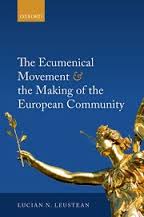
Leustean-EcumenicalTo be sure the tasks of European reconstruction and reconciliation were formidable for politicians and churchmen alike. Priority had to be given to the immense task of caring for the vast millions of bombed-out, brutalized, and displaced populations. Most churches were still tied to their own national affairs and regarded plans for European integration as lying outside their spiritual domain. However a few of the survivors of the pre-war ecumenical bodies, led by the valiant and dynamic personality of the Dutch Calvinist, Visser ‘t Hooft, General Secretary of the World Council of Churches, recognized the importance of seeking closer relations with those politicians involved in European reconstruction. The World Council, which achieved its long-delayed inauguration in 1948, almost immediately suffered a grievous, if not unexpected, blow by the rejection of its invitation to the Vatican to have Roman Catholics as full members. The initiative in European affairs was therefore left to the Anglicans, the Protestant leaders of northern Europe, and a handful of Orthodox churchmen in Eastern Europe. So too, those politicians who had expected that the legacy of unbridled nationalism under Hitler would lead to a willingness to cooperate more closely in pan-European revival were soon to be disappointed by the brusque refusal of the Soviet government to entertain any such measures for the areas of Eastern Europe under its military control. In both the political and religious fields, therefore, expectations had to be cut down, and prognoses for European integration modified, often drastically.

Leustean’s account examines the role of political and religious contacts with a direct impact on European institutions. He records how a number of Protestant churchmen saw their duty as Christians to go beyond furthering the local piety of their congregations. These men of vision believed that European cooperation was a mission for the wider Christian constituency. This witness became especially relevant in 1948, when the Berlin blockade made the threat of Soviet military power all too evident, and seemingly doomed the hopes for a peaceful cooperation throughout the continent. Leustean pays particular attention to the Ecumenical Commission on European Cooperation, founded in 1950, since some of its members went on to fulfill high administrative positions in the European Community’s structures. These included Gustav Heinemann, later President of the Federal Republic of (West) Germany, and Jean Rey, who became President of the European Commission. These men were not dreamy idealists, but practical executives, who believed that their project could and should deserve the moral guidance of the churches.

However, since most of the western European countries who founded the European Community had large Catholic populations, and since its founding leaders came from Catholic backgrounds, it was hardly surprising that relations with the Protestant ecumenists were at first marked by tensions. Later, however, after the Second Vatican Council in the 1960s, a new spirit of interdenominational cooperation was to be seen.

The European Community can be said to begin in 1950 with the plan put forward by the French Foreign Minister, Robert Schumann, for the amalgamation of industrial resources in the European Coal and Steel Community. But this initial success was overshadowed by the tensions resulting from the Cold War, by the proposals to rearm West Germans to play their part in defending their homeland, and by the reluctance of some idealists to encourage any step which would divide the nations of Western and Eastern Europe from each other. Many leading German churchmen campaigned for a unified and neutral Germany. Many British churchmen still adhered to their former attachment to the Commonwealth and were skeptical about any form of European cooperation. Many others adopted the traditional view that politics and religion should act in separate spheres. The cause of European unity therefore faced an uphill battle. The most that could be hoped for was “unity in diversity” which was finally acknowledged as the motto of the European Union in May 2000.

After the signing of the Treaty of Rome, the European Common Market among the six western European nations was founded in 1960. However the attention of the ecumenical fraternity was more attuned to the project for a pan-European Conference of European Churches, which held its first meeting in 1959. But the obvious Soviet propaganda and control of the churches in Eastern Europe meant that the CEC was a rather dubious venture. On the other hand, in the early 1960s, the British Government had a change of heart and applied to join the Common Market. But when its application was rejected by De Gaulle in 1963, this paradoxically stirred up interest among the British churches, and eventually led to a more positive approach to western European cooperation. Yet, at the same time the same French government’s refusal to accept the proposal, put forward by the Vatican, to appoint a diplomatic envoy to the European Commission in Brussels, delayed the establishment of formal relations with Europe’s largest religious community until 1970.

In the 1970s the economic successes of the Common Market were notable. With the Soviet military threat contained behind the Iron Curtain, the western European economies flourished. Living standards rose rapidly. New integrative measures were started such as the European Parliament, the adoption of a single currency, and after the dissolution of the Soviet empire, the abolition of border controls and customs offices in many parts of Europe. These developments owed little to any church initiatives, nor even to representatives of the Ecumenical Movement. As one observer commented, this lack of ecumenical mobilization was in part due to the European Community being regarded as a purely economic and political project in which religious communities could not find a theological basis for participation. Also national churches, which saw themselves as the preservers of their country’s past, were unwilling to take up the cause of others with whom they had no common heritage or language.

In fact, the Ecumenical Movement concentrated more on the personal and pastoral witness amongst the ever growing number of international bureaucrats at the European Community’s offices in Brussels. The hopes of some leading Eurocrats that the churches would take a lead in calling the young and creative forces in Europe to unite behind a common vision were never realized. British churchmen, for instance, remained skeptical about the influence of supra-national technocrats, who were not directly responsible to any national government. The ideal of political integration between different parts of Western Europe therefore remained a nonstarter, since it threatened to curtail relations with Eastern Europe or the developing world outside Europe.. As a result, no common ‘European’ consciousness appeared, transcending national loyalties.

Leustean takes his account up to 1978, but in a concluding chapter is obliged to note the dramatic changes in later years, especially after the overthrow of the Soviet empire in 1989-90. Many churchmen have since sought to engage in dialogue in order to understand the role of religion in the new Europe. Over these years countless committees, councils, conferences, and gatherings have been established or re-established with a bewildering array of alphabetical abbreviations, for which there is fortunately an appended index. But essentially the complex scale and scope of what is now the European Union defies easy or synoptic description.. It was left up to a retiring President of the European Commission, Jacques Delors, to call in 1990 for an attempt to give Europe a soul through a spiritual and intellectual debate in which the Churches should participate actively. It was a brave but mistaken view that the Churches, or other faith communities, could find enough common ground to overcome their mutual and historic differences, which are likely to remain prevailing in the foreseeable future.

Leustean’s conclusion is therefore that a fragmented, interrupted vision of Europe at both the political and religious levels, which had impacted the attempts to bring unity and integration to at least Western Europe, was the major factor why the dreams of idealists such as his hero von Trott were never realized.

Share

Review of Manfred Gailus and Clemens Vollnhals, eds, Mit Herz und Verstand—Protestantische Frauen im Widerstand gegen die NS-Rassenpolitik

Contemporary Church History Quarterly

Volume 22, Number 1 (March 2016)

Review of Manfred Gailus and Clemens Vollnhals, eds, Mit Herz und Verstand—Protestantische Frauen im Widerstand gegen die NS-Rassenpolitik (Göttingen: V&Runipress, 2013). Pp 280, with illustrations. ISBN: 9783847101734.

By Victoria J. Barnett, U. S. Holocaust Memorial Museum

The history of the Protestant women involved in resistance against the Nazi regime is well-documented, but it remains under-examined in the broader literature about the German Church Struggle and the resistance movements. Manfred Gailus, a contributing editor to this journal and co-editor of the book under review here, has devoted much of his recent work to correcting this.[1]

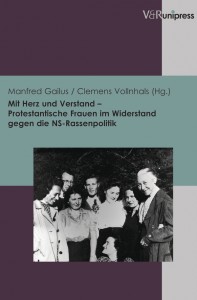
Gailus-HerzMit Herz und Verstand is one of his recent additions to the literature. In addition to the fine overview of the topic in the introduction by Gailus and co-editor Clemens Vollnhals, it consists of biographical and historical profiles of Agnes and Elisabet von Harnack, Elisabeth Abegg, Elisabeth Schmitz, Elisabeth Schiemann, Margarete Meusel, Katharina Staritz, Agnes Wendland and her daughters Ruth and Angelika, Helene Jacobs, Sophie Benfey-Kunert, Elisabeth von Thadden, and Ina Gschlössl.

Only a few of these women are recognizable names (notably Agnes von Zahn-Harnack, but usually in conjunction with her more famous father, theologian Adolf von Harnack), yet even a brief description of who they were and what they did illustrates why their stories are deserving of greater scholarly attention. In addition to achieving their doctorates, both Harnack sisters were active feminists during the 1920s. Agnes von Zahn-Harnack (who held a doctorate in Germanistics and philosophy) helped found the Deutsche Akademikerinnenbund and became the chairwoman for the Bund Deutscher Frauenvereine, and Elisabet von Harnack (who had studied political economics and church dogmatics) was a leader on women’s issues and school reform. Elisabeth Abegg was a Quaker who had worked with Friedrich Siegmund-Schultze during the 1930s and helped hide almost 80 Jews during the Nazi era (for which she has been honored by Yad Vashem). Abegg taught at the Luisenschule, a Gymnasium for young women in Berlin when Elisabeth Schmitz also taught. Schmitz of course was the author of the 1935 memorandum to Confessing Church leaders urging them to speak out in solidarity with the persecuted Jews; she subsequently resigned her teaching position in protest after the November 1938 pogroms. Elisabeth Schiemann was one of the first German women to attain a doctorate in botany and genetics, published several well-received studies and was affiliated with Friedrich-Wilhelms University and the Botanical Museum in Berlin. She joined the Confessing Church in 1934 (she was a member of the Dahlem parish) and became one of its most vocal members, writing letters to Martin Niemoeller urging him to speak out more forcefully. She personally delivered Elisabeth Schmitz’s memorandum to Karl Barth in Basel, and Franz Hildenbrandt used excerpts from a 1936 memorandum written by Schiemann in the 1937 statement on the Jews that he submitted to the 1937 Confessing synod (he acknowledged her text). While we now know that Elisabeth Schmitz was the author of the famous 1935 memorandum, Margarete Meusel (to whom it had been attributed) wrote a similar memorandum and worked throughout the Nazi era helping and hiding “non-Aryan Christians” and Jews.  Katharina Staritz, a Confessing Church theologian of Jewish descent who worked with the Grüber office, is known for her protest against the Breslau church authorities’ decision to bar people wearing the yellow star from the churches—for which she immediately lost her job. With no cover from the church, she became the target of Nazi propaganda and ended up in the Ravensbrück concentration camp. Agnes Wendland, wife of a Confessing Church pastor in Berlin, hid several Jews in their parsonage and was helped by her daughters Ruth and Angelika. Helene Jacobs was one of the few Germans to make no compromises with the regime, beginning with her refusal in 1933 to fill out the Aryan certificate for university study and ending with her participation in the Kaufmann resistance circle that forged false documents for Jews and helped them escape (Jacobs, too, spent the final war years in Nazi prisons). Sophie Benfey-Kunert was a staunch feminist who became the first woman in Hamburg to take the theological exams; she was chaplain in a women’s prison before she married Bruno Benfey. Benfey, one of the “non-Aryan” pastors in the Hannover church, became the target of Nazi propaganda and found no support from Bishop August Marahrens; the Benfeys finally emigrated to the Netherlands in 1939 and returned to Göttingen after 1945. Elisabeth von Thadden founded a small private school that continued to accept Jewish students until the regime took it over in 1941; she then became involved in various resistance activities and was arrested in early 1944. She was beheaded in the Plötzensee prison in September 1944. Ina Gschlössl, who founded the Association of Protestant Women Theologians in 1925, was fired from her teaching job as a religious educator in 1933 after making critical remarks about Hitler; she eventually worked for the Confessing Church’s Inner Mission.

The story of each woman is important in its own right, but the real value of this volume is that the essays go beyond the biographical, portraying the women in a broader historical context that records both their significant achievements before 1933 and the scandalous treatment of them after 1933, particularly within the church. It also includes the post-1945 period, which shows that their contributions were largely forgotten and dismissed.  This volume illustrates why the study of these women offers some important correctives to our general understanding of the larger issues in the German churches, the emergence and nature of different resistance movements, and the early postwar dynamics.  It is impossible to understand these women separately from the historical, social, and political context of early twentieth century Germany. They were among the first generation of women in western societies (not only in Germany) to mobilize politically, study for advanced degrees, and enter traditionally male professions. The social shifts of the Weimar years opened the way for them to enter the political sphere in Germany; almost 7 percent of the Reichstag representatives in 1926, for example, were women. Their stories show how very different the experiences of these women were from the young men in their generation. This is especially evident in the essay on Agnes von Zahn-Harnack.  During the 1920s she published and spoke widely on the women’s movement; organized German academic women and was the German delegate to the meetings in Amsterdam and Geneva of the International Federation of University Women and was elected to its board. In that international context she became one of the leading German voices on the “peace question.” The accounts in this volume of their various activities throughout the 1920s reveal a “Who’s Who” of early German feminist leaders.

Thus, although many of the women studied here sought careers or were active in the German Evangelical Church, they also shared a history of feminist and political activism in the interwar period. A number of them (both Harnack sisters, Abegg, Schmitz, Wendland, and von Thadden) had worked in Friedrich Siegmund-Schultze’s social ministry in east Berlin during the 1920s. Others were involved in early German feminist organizations like the Bund Deutscher Frauenverein (which Agnes von Zahn-Harnack led) and the religious socialist movement. In each of these three organizations, they had contact with Catholics and Jews, which was a factor in their active help for Jewish friends and colleagues after 1933.

Their interwar activities offered a different foundation in 1933 for political opposition to National Socialism. Not surprisingly, it also made the women easy targets. They were attacked not only by Nazi newspapers and party leaders, but also by male Confessing Church leaders who dismissed them. The introduction to this book opens with a vivid account of a 1937 pamphlet, Wir rufen Deutschland zu Gott, written by Otto Dibelius and Martin Niemoeller, which in addition to defending the Confessing Church attacked the feminist movement, particularly women with advanced academic degrees, criticizing them for the declining birth rate and changing social values. Although women comprised seventy to eighty percent of the Confessing Church membership in Berlin, there were no women in church governance and only one woman (Stephanie von Mackensen) attended the Barmen Synod in May 1934. The 1930s saw an ongoing battle for the right to ordination that received scant attention or support among Confessing Church leaders. (It should be noted that were a few male Confessing Church leaders who supported the women theologians’ battle for ordination; according to the women I interviewed for my book, these included Kurt Scharf, Hermann Diem, and Martin Albertz.)

The issue where the historical record of these women really casts a poor light on their male counterparts in the Confessing Church, however, is in their political clarity and their willingness to take early stands with respect to the persecution of the Jews. Agnes von Zahn-Harnack and other board members dissolved the Bund Deutsche Frauenvereine in March 1933 after being confronted with the demand to dismiss “non-Aryan” members and merge the organization with the Nazi Deutsche Frauenfront. Even more impressively, when the Frauenbund was reconstituted in 1945, women who had been Nazi party members or members of Nazi women’s’ organization were barred from membership. Despite their impressive record of political consistency, attacks on these early feminists continued into the 1980s, when they were accused of having somehow prepared the ground for the Nazi ideological precepts about women such as the “Mutterkult.”

The authors of each of these biographical essays bring different strengths and insights to the studies of these women. One of the most valuable aspects of the volume is the authors’ detailed examination of the papers and correspondence many of the women left behind. This material shows that they were critical not just of the sexism but the antisemitism within the Confessing Church. In addition to the aforementioned memoranda and protests, for example, Schmitz and Schiemann publicly criticized Walter Kunneth’s anti-Semitic attacks on Judaism They were also critical of the Confessing Church’s inherent political and theological conservatism. As the daughter of Adolf von Harnack, Agnes von Zahn-Harnack had grown up in an atmosphere of liberal, humanistic Protestantism that she feared was abandoned by the Confessing Church. Although she supported it in the Church Struggle, she criticized its conservatism, writing that “if we don’t pay attention, (the confessional front) could conjure up a new orthodoxy that would be the opposite of what we want.”

By looking at the culture and perspective of German feminism throughout this era, this volume makes an important contribution that goes beyond simply documenting the role played by these women. There continues to be a gendered division of history that runs through most of the literature on the Protestant Kirchenkampf, including the numerous books about Dietrich Bonhoeffer. (For those readers who are wondering, Bonhoeffer made no reference to the ordination debates and related feminist issues and showed no public solidarity with the Confessing Church women, despite the fact that he had taught several of them in Berlin and his close friend Elisabeth Zinn was among them.) The integration of these women’s lives into the scholarship could give us some new perspectives on the internal church debates. By portraying their political clarity and courage, particularly with regard to the persecution of Jews, this volume illustrates that there were people in the Confessing Church who stood up to the Nazi regime when it counted—many of them were women.


The views expressed in this review are those of the author and do not necessarily represent those of the United States Holocaust Memorial Museum or any other organization.

Notes:

[1] In my 2011 review in this journal of Gailus’s study of Elisabeth Schmitz (Mir aber zerriss es das Herz), I noted the three volumes of documentation that came out of a project at Göttingen University during the 1980s and 1990s, the Frauenforschungsprojekt zur Geschichte der Theologinnen. The three volumes are “Darum wag es, Schwestern…”: Zur Geschichte evangelischer Theologinnen in Deutschland (1994); Der Streit um die Frauenordination in der Bekennenden Kirche: Quellentexte zu ihrer Geschichte im Zweiten Weltkrieg (1997); Lexikon früher evangelischer Theologinnen: Biographische Skizzen (2005). Works in English that have incorporated research on these women include my For the Soul of the People (1992) and Theodore Thomas’s Women Against Hitler: Christian Resistance in the Third Reich (1995)


Share

Review of Manfred Gailus, ed., Täter und Komplizen in Theologie und Kirchen 1933-1945

Contemporary Church History Quarterly

Volume 22, Number 1 (March 2016)

Review of Manfred Gailus, ed., Täter und Komplizen in Theologie und Kirchen 1933-1945 (Göttingen: Wallstein Verlag, 2015). Pp. 260. ISBN 9783835316492.

By Kyle Jantzen, Ambrose University

Manfred Gailus’ newest contribution to the history of the German churches in the Third Reich is a collection of case studies of theologians, church leaders, and clergy whose writings or activities place them into the categories of perpetrators in or accomplices of the National Socialist regime. The various contributions are the product of a series of public lectures at the Topography of Terror in Berlin in 2013 and 2014. As such, none of the chapters in Täter und Komplizen in Theologie und Kirchen 1933-1945 represent new research. Nonetheless, the volume is more than the sum of its parts, in the way that it demonstrates the depth and breadth of the Christian support for and participation in Nazi Germany. As Gailus notes at the end of his introduction, millions of tourists come to Berlin every year, eager to see the sites of Nazi power and commemorations of Jewish suffering. When they come to the Berlin Cathedral or other historic church buildings in central Berlin, they ask questions about the role of the churches in the Third Reich. Gailus argues it is vitally important that the churches work through the issue of Christian complicity in Hitler’s Germany, in order to provide honest answers to these questions and find a healthy way forward.

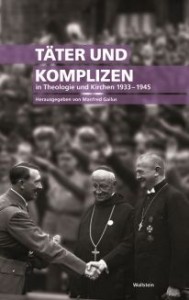
Gailus-TaeterFollowing Manfed Gailus’ introductory chapter, there are nine chapters (three by Gailus, six by a variety of other scholars) and a theological afterward by Christoph Markschies, church historian, theologian, and former president of Humboldt University. The various chapters link thematically with one another in fruitful ways. Gailus starts things off with an analysis of the Day of Potsdam (March 21, 1933), the day on which Adolf Hitler opened the German parliament in the Garrison Church which had served Prussian monarchs for two hundred years. Drawing on his work in the 2011 book Zerstrittene “Volksgemeinschaft”: Glaube, Konfession und Religion im Nationalsozialismus, Gailus describes the Day of Potsdam as a great, joyful “Yes” spoken by German Protestantism to Hitler and his National Socialism government. He describes in particular the key role played by Otto Dibelius, General Superintendent of the Kurmark and leading Protestant churchman in the region. It was Dibelius who was the main speaker at a special worship service in the Nikolaikirche in central Berlin, attended by a majority of Protestant members of parliament and Reich President Hindenburg before they made their way to Potsdam for the opening of the Reichstag. Dibelius chose Romans 8:31 as his text: “If God be for us, who can be against us.” Since this was the same text used by the imperial court preacher at the outset of the Great War in 1914, Dibelius was consciously connecting the patriotic spirit of the First World War to the Nazi seizure of power in 1933. While there were quiet notes of criticism in Dibelius’ message, none other than Hermann Goering shook his hand afterwards and declared it to be the best sermon he had ever heard (35-37).

Gailus makes a strong case for the Day of Potsdam as an important component in the revival of institutional Protestantism during the opening months of Nazi rule. Here the German Christian Movement played the leading role. One of example of this is Gailus’ description of a special “patriotic thanksgiving service” held by the Kaiser-Wilhelm-Memorial Parish on March 22. Meant to be an “ecclesiastical Potsdam,” the event depicted the German Christians as a mass movement parallel to National Socialism and celebrated the salvation of Germany from the “hell” of the godless Weimar Republic (41-42). In the end, Gailus explains the victory of the German Christians in the July 1933 church elections as the result of the fact that the majority of clergy and church people wanted this völkisch transformation, while the forces of opposition within the church were weak (46). “On the ‘Day of Postdam,’ half of society celebrated and acclaimed their ‘national awakening,’ while the other half of society was on the verge of being excluded, shackled, muzzled, and displaced” (47).

Film historian Ralf Forster follows up Gailus’ examination of the Day of Potsdam with a chapter analyzing the occasion as a propaganda event. Forster assesses the media coverage, particularly on radio and in newsreel footage. He notes the importance of the live radio broadcast of the day’s events and the many “special editions” of newspapers, some of which were printed later that same day, and were thus almost as current as the radio broadcasts. He also provides a detailed description of the newsreel footage of the Day of Potsdam, which brought the spectacle of the events at the Garrison Church to German moviegoers (57-60).

Next, editor Manfred Gailus contributes a second chapter, which shifts attention from the Day of Potsdam to the history of the takeover of Protestant church governments by the pro-Nazi German Christian Movement, especially in Berlin. German Christians united the National Socialist world view with the Christian tradition of belief, seeking to make belief in Jesus and belief in Hitler fully compatible. Gailus explains how the German Christian Movement cultivated mass ritual as its centerpiece, focusing of the Germanization of Protestant liturgy and the introduction of an ecclesiastical cult of flags (74). While the German Christians were initially successful in seizing the reigns of Protestant church governments, by 1934 they faced serious opposition, and over time they fell out of favour among the Nazi elites. This, Gailus suggests, makes it easy to believe they were insignificant. Rather, he argues they were a mass movement which dominated North Germany, Middle Germany, and East Elbian Prussia during the 1930s (78).

Horst Junginger, a professor of religious studies at Leipzig University, draws on his research on religion and antisemitism during the Nazi era to recount the career of theologian Gerhard Kittel, who joined both the German Christian Movement and the Nazi Party in 1933. Kittel’s publication The Jewish Question committed him to the antisemitic struggle against emancipation and equality for Jews in Germany and in turn elevated racial research to a central place in the University of Tübingen, making it into a “bulwark against Judaism,” as Kittel himself declared (87). As the “Jewish Question” became a subject of scientific and scholarly research, Kittel followed this agenda throughout the Third Reich, publishing articles and giving lectures as late as 1943 and 1944 for the Ministry of Propaganda and German universities. In doing so, he brought Christian anti-Judaism into the service of racial antisemitism (103-105).

Thomas Forstner, who recently published Priester in Zeiten des Umbruchs. Identität und Lebenswelt des katholischen Pfarrklerus in Oberbayern 1918 bis 1945, contributes a chapter on the phenomenon of the so-called Brown Priests. These pro-Nazi clergy were few in number compared to their Protestant counterparts—Forstner discusses fewer than 150 of them (123-124). He notes that the Roman Catholic hierarchy distanced itself from these priests, who were drawn to Nazism out of national sentiment or opportunism (not least to shed their celibacy) (129). Forstner discusses Joseph Roth and Albert Hartl as two examples of Catholic priests who engaged deeply with National Socialism.

Hansjörg Buss, author of “Entjudete” Kirche: Die Lübecker Landeskirche zwischen christlichem Antijudaismus und völkischem Antisemitismus (1918-1950), carries the Protestant story forward with an assessment of the role of Hanns Kerrl, Hitler’s Minister of Ecclesiastical Affairs, and his assistant, Hermann Muhs. He portrays Kerrl as a loyal servant, trying to accomplish the impossible task of unifying German Protestantism under church committees into order to fashion a centralized Reich Church adapted to National Socialism (148-149). This effort collapsed by 1937, and Christians like Kerrl lost favour year by year in the face of opposition from anti-Christian ideologues like Alfred Rosenberg and Martin Bormann. Kerrl’s assistant Muhs, a member of the radical Thuringian wing of the German Christian Movement, suggested “an administrative dictatorship” to “annihilate the Confessing Church” (162). This he attempted to do in part through the use of the church finance office to put serious pressure on Confessing Church pastors and parishes.

Susannah Heschel, whose book The Aryan Jesus: Christian Theologians and the Bible in Nazi Germany has received extensive attention in this journal (here, here, and here), provides a useful overview of her important work on Walter Grundmann and his Institute for the Study and Eradication of Jewish Influence on German Church Life. Through the Institute, Grundmann and others worked to develop an aryanized Christian confession for the Third Reich. Despite his leadership in such an obviously antisemitic venture, Grundmann retained his position within the Protestant church after 1945, even serving as an informer for the East German regime.

Manfred Gailus follows Susannah Heschel with a chapter on Karl Themel, Berlin pastor and race researcher. Themel was a member of the German Christian Movement, the SA, and the Nazi Party, eagerly taking up the position of “Expert for Race Research” with the Reich Interior Ministry. Working closely with the Reich Office for Geneological Research, Themel created an Office of Church Registers, Old Berlin. There they transferred the genealogical information of thousands of Berliners from these church records onto new identification cards, which were in turn used to check the Aryan ancestry of those who needed to prove their racial purity in order to take up various government positions. By 1941, Themel’s office had processed over 160,000 requests involving over 330,000 individuals, and had discovered over 2600 cases of Jewish ancestry—almost two cases per day, as Themel boasted late that year (209). Despite this direct participation in the implementation of Nazi antisemitic policy, Themel was rehabilitated by 1949, eventually taking up a pastorate in rural Brandenburg, then migrating back into archival work for the Berlin-Brandenburg church province! Upon his death, his work collecting and copying church registries in Berlin during the Third Reich was lauded as a service to the archival branch of the church (213). Not until 2002 was Themel’s work publicly denounced by church leaders (215).

Thomas Kaufmann’s chapter on influential church historian Erich Seeberg’s connections to the Nazi Party and the German Christian Movement offers another window into the ways individual theologians and church leaders navigated the Nazi era. In Seeberg’s case, his career revolved around research into transconfessional “German piety” which could be adapted easily to Nazi ideology (228). Seeberg studied Meister Eckhart and German mysticism, then applied his völkisch approach to the study of Martin Luther. Seeberg wanted to turn the Luther Renaissance into a “Luther Revolution.” This meant preaching a Luther who was “dangerous” and not “bourgeois” (229). Importantly, Seeberg also sought to recast theological education in a Nazi mold. His plans included revising theological curricula by abandoning historical-critical methodology and the study of the Hebrew language, replacing them with a “history of German piety” (241).

Finally, to complete the volume, Christoph Markschies writes on behalf of the Humboldt University Faculty of Theology, arguing that his institution still needs to engage in a thorough assessment of its activities during the Third Reich. This is a call very much in line with Gailus’ purpose for this volume, which is to demonstrate the extent to which German Protestants and (to a lesser extent) Catholics voluntarily adapted themselves to Hitler’s regime and participated in the National Socialist quest to eliminate German Jewry and thereby “purify” the German racial community. Gailus is driven by the conviction that the German churches still have much work to do in coming to terms with this history. This volume contributes substantially to his project, by compiling some of the best of current research into the German churches in the Nazi era. It also demonstrates that there is still much to do before those Berlin tourists receive proper answers to their questions about the German churches in the time of Hitler.

Share

Review of Robert Beaken, The Church of England and the Home Front 1914-1918

Contemporary Church History Quarterly

Volume 22, Number 1 (March 2016)

Review of Robert Beaken, The Church of England and the Home Front 1914-1918 (Rochester, NY: Boydell and Brewer, 2015). Pp. 272. ISBN: 9781783270514.

By John S. Conway, University of British Columbia

Colchester, fifty two miles north-east of London, has been a garrison town since the days of the Romans. During the First World War its military establishment was vastly expanded, including four major army hospitals where the casualties from the battlefields in France were treated. The impact of the war was immediate and very visible. Colchester’s Church of England parishes were quickly and significantly involved, as is described in Beaken’s insightful and well researched account of these critical years.

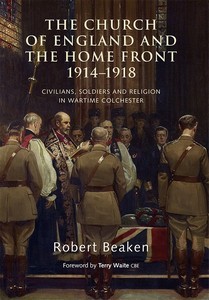
Beaken-ChurchColchester’s social elite, which was well represented in the Church of England parishes, was conservative, nationalist and hierarchical. Its members supported the British government’s decision to go to war in August 1914 for moral as well as political reasons. They joined in the widespread campaign urging young men to join the armed forces, until conscription was introduced in 1916, rendering such appeals superfluous. Thereafter the leading men set an example by supporting campaigns for contributions to the War Savings Bonds, while the church ladies were very active in ministering to the troops training in Colchester and to the wounded. Church people were assiduous in providing hospitality to the troops, and at least thirty five social clubs were established where recreational facilities and food were supplied, often at little cost. In part such provision was seen as a Christian virtue, but, as Beaken notes, in part it was inspired by the desire to keep the soldiers out of public houses, and so to keep prostitution and its attendant problems at bay.

The clergy’s position was more problematic. At first many of the younger clergy had felt drawn to join their parishioners by volunteering to serve in the ranks, which they believed would be a means of getting to know their fellow men better. But the bishops soon asserted that such notions were incompatible with their ordination vows. Instead they were to remain in their parishes where their services, because of the shortage of army chaplains and the extra requirements caused by the war, would be all the more demanding. In fact, in Colchester, both clergy and laity soon recognized the need for extra pastoral witness to the many thousands of young men passing through the garrison on their way to the western front, or to those returned to Colchester for treatment in the hospitals. They were also called to officiate at the funerals of those who died from their wounds, and to comfort their surviving families. After the initial euphoria of the early months was replaced by the grim horror of the devastating and depressing stalemate of the Flanders trench-warfare, the clergy’s often self-imposed role in support of the war effort became more dubious, and even counter-productive. Since it was they who often had to bring the dreaded news to the families of men killed in action, their pastoral skills were increasingly honed to the presence of disaster and death.

In the aftermath of the war, particularly in the 1930s, there was a widespread revulsion against all those, including a few prominent clergymen, who had so eagerly preached militant sermons in favour of the war effort. And inevitably such skepticism and resentment was turned against the religion these clergymen were upholding. The contradiction between the slaughter of so many of “the flower of the nation’s youth”, and the message of love and peace as contained in the Christian gospels was too glaring to be easily overcome. Understandably, Beaken does not try to answer the question posed by almost everyone at some point during the war: “Why does the Christian God allow such a devastating catastrophe to take place?” Instead he takes issue with some of the post-war writers, particularly those who misrepresented what actually happened and instead promoted their own interpretations for anti-war or pacifist reasons. For example, he dismisses the view that the ordinary workingman, who had volunteered for army service, had been seduced by bloodthirsty clergymen and subsequently was misled by glory-seeking and incompetent army leaders. So too the charge that the Church of England chaplains were too cowardly to go up to the front line needs to be refuted by the fact that such postings were forbidden by the military leaders. It is certainly true, as Beaken admits, that, despite the almost universal support of the war effort at the time, in later years many people came to feel that the senseless and degrading conflict in the Flanders mud had made the proclamation of the Christian gospel irrelevant. But the evidence here produced for the war-time conditions in Colchester would seem to prove the opposite. Church attendance remained almost the same throughout the war years, as did the number of confirmations. The overwhelming support given to the erection of war memorials, and the sincere participation at Armistice or Remembrance Day services for the remainder of the century and beyond, would seem to disprove the contention that the Church of England had a ‘bad’ First World War. Beaken disputes the myth that things were never the same after 1918. He points to the fact that in the vast majority of parishes the Church’s witness with its emphasis on Mattins on Sunday morning remained unchanged for a further fifty years. But he agrees that, in Colchester, as elsewhere, when the fabric if the city’s close-knit, inter-dependent society came apart, so the Church of England came to occupy a peripheral position. But this does not contradict Beaken’s central argument that the Church of England fared significantly better during the First World War than has been understood or acknowledged for much of the past century.

Share

Review of Kirsten Busch Nielsen, Ralf K. Wüstenberg, and Jens Zimmermann, eds., Dem Rad in die Speichen fallen. Das Politische in der Theologie Dietrich Bonhoeffers. A Spoke in the Wheel: The Political in the Theology of Dietrich Bonhoeffer

Contemporary Church History Quarterly

Volume 21, Number 4 (December 2015)

Review of Kirsten Busch Nielsen, Ralf K. Wüstenberg, and Jens Zimmermann, eds., Dem Rad in die Speichen fallen. Das Politische in der Theologie Dietrich Bonhoeffers. A Spoke in the Wheel: The Political in the Theology of Dietrich Bonhoeffer (Guetersloher Verlagshaus, 2014), 464 pages. ISBN: 9783579081687.

By Matthew D. Hockenos, Skidmore College

A Spoke in the Wheel: The Political in the Theology of Dietrich Bonhoeffer is a collection of thirty essays first presented as plenary lectures and papers at the XI International Bonhoeffer Congress held in Sigtuna, Sweden in June 2012. The collection is structured in three parts under the headings: Political Resistance; Christian Anthropology and the Political; and Church and Civil Society. The first part, which is most relevant to church historians, contains essays that contextualize Bonhoeffer’s political resistance to Nazism historically and theologically. The second part contains an assortment of theological essays that examine Bonhoeffer’s theology through a variety of interpretive lenses, including his understanding of prayer, grace, guilt, discipleship, redemption, reconciliation, divine mandates, and his critique of religion, among other things. The essays in the third part return to more concrete matters by examining Bonhoeffer’s understanding of the relationship between the church, civil society, and the state in the 1930s and 40s, but also in particular postwar contexts, such as South Africa and Brazil. The overall quality of the essays is exceptional and the collection should be seen as a showcase for recent research in Bonhoeffer studies.

Dem Rad in die Speichen fallen A Spoke in the Wheel vonSome of the highlights of the collection include the lead essay by Wolfgang Huber in which he provides a theological profile of Bonhoeffer’s political resistance, particularly his involvement in Hans von Dohnanyi’s conspiracy in the Abwehr. Despite the limitations placed on what Bonhoeffer could put into writing during the Third Reich, Huber believes a “theology of resistance” can be teased out of Bonhoeffer’s writing during this time. His call for the Church to take a public stand in solidarity with the Jews against the repressive state; his formulation of a confession of guilt in the name of the church; his theory of a responsible life; and his trust in God’s guidance—all indicate the rudiments of a theology of resistance, Huber believes.

Josef Außermair suggests that in addition to the texts identified by Huber that more attention needs to be paid to Bonhoeffer’s teaching at Finkenwalde to understand his political resistance. Bonhoeffer’s emphasis in his teaching on witnessing to Christ in the world, Außermair argues, was his way to prepare his students to participate in the Church Struggle and to confront the political challenges of the day. Sven-Erik Brodd and Björn Ryman both maintain that Bonhoeffer’s trips to Sweden in 1936 and 1942 played a significant role in the development of his political resistance, especially through his contact with British and Swedish members of the ecumenical movement. And Gerhard den Hertog examines how the success of Hitler’s 1940 military campaigns influenced Bonhoeffer’s reflections in Ethics and his decision to participate in the conspiracy.

Andreas Pangritz, in his examination of Bonhoeffer’s April 1933 essay, “The Church and the Jewish Question,” makes several provocative and perceptive points. First, he points out that in an earlier draft of the essay Bonoeffer had inserted the sub-heading “Ahasuerus peregrinus” or wandering Jew above the section with the offensive anti-Judaic passages that have gotten so much attention. Pangritz concludes that the sub-heading “represents authentically the main focus Bonhoeffer wanted to give to this part of the final edition [of his essay].” Second, he argues that Bonhoeffer’s association of “modern Jewish Christianity” with the alleged Jewish emphasis on a religion of law leads Bonhoeffer to refer to the Nazi-backed German Christians—and their desire to implement racial laws in the church—as guilty of Jewish Christianity. Third, he believes that Bonhoeffer’s famous phrase—best translated as “to fall within the spokes of the wheel,”—comes from the 18th-century writer Friedrich Schiller and was meant by Bonhoeffer to convey an act of “counter-revolutionary resistance” against the Nazi revolution. Pangritz maintains that Bonhoeffer’s political resistance “is aimed at defending the old order against its revolutionary transformation.” Pangritz concludes, that Bonhoeffer’s theological anti-Judaism “provides an ambiguous source for political solidarity with the Jews,” although Bonhoeffer’s rethinking of the Lutheran doctrine of two kingdoms, enables him to call for direct political against the state by the church on behalf of the Jews.

Keith Clements essay focuses on Bonhoeffer and the Bruay Conference of September 1934. Clements maintains that the Bruay report, authored by Bonhoeffer and few other Germans and British representatives from the ecumenical youth movement, should be seen as more than a simple affirmation of the Fanø conference report from the previous month. Although both Fanø and Bruay call on Christians to study the social and political questions of the day and to take action “based upon the responsibility of the church members for the social order according to the Will of God,” the Bruay report offers some eminently practical—read British—steps that can be taken by church members to “reproduce the Christian life to-day.” Thus Clements believes that Bruay created “a contextual ethic of responsibility,” which foreshadows the 1937 Oxford Conference on “Church, Community, and State” and the World Council of Churches.

Wolf Krötke and Victoria Barnett both take up the question of Bonhoeffer’s understanding of the relationship between church and state and its implications for civil society. Krötke argues that although Poles and East Germans struggling for a more democratic society in the 1970s and 1980s appropriated aspects of Bonhoeffer’s theology, his notion of the state as a divinely sanctioned order of preservation has little to offer proponents of democracy. Unlike his more conservative colleagues, Bonhoeffer saw a crucial role for the church in limiting the state’s totalitarian ambitions in Nazi Germany. His understanding of the church-state relations may have provided Bonhoeffer with the foundation for his resistance to Nazism, but the more widely accepted Lutheran understanding of the relationship between the two kingdoms also provided many of his Lutheran colleagues with a theological defense of the Nazi state and after 1945, the GDR state. Krötke concludes that democracy activists would be better off embracing Bonhoeffer’s concept of “genuine worldliness” rather than his views on the state.

Barnett understands Bonhoeffer’s views on the state similarly to Krötke but focuses her essay on Bonhoeffer’s reaction—politically and theologically—to the Nazi state’s dual suppression of the church and civil society. Especially during his time at Finkenwalde and after, Bonhoeffer reflected on the nature of the church under National Socialism—not only on the church’s role in limiting the state’s totalitarian ambitions—but also the role of the church and individual Christians in fostering a functioning civil society. After the war began and Bonhoeffer joined the Resistance he increasingly reflected on what would come after the defeat of National Socialism and what role the church would play in these changes. The church, he maintained, could no longer concern itself only with its own self-preservation—it had to become a church that demonstrated its concern for “justice among human beings.” “All Christian thinking, talking, and organizing,” Bonhoeffer wrote in 1944, “must be born anew out of prayer and action.” Barnett suggests that Bonhoeffer’s nearly twenty years of wrestling with how to understand the nature of the church and its relationship with the state and civil society culminated in some of his most provocative theological concepts such as the “world come of age” and “religionless Christianity.”

This is just a sampling of the excellent essays contained in A Spoke in the Wheel, all of which deserve a careful reading. The collection brings together for the first time a wide variety of scholarly contributions to the debate over the relationship between Bonhoeffer’s theology and his role in the Resistance.

Share

Review of John Pollard, The Papacy in the Age of Totalitarianism, 1914-1958

Contemporary Church History Quarterly

Volume 21, Number 4 (December 2015)

Review of John Pollard, The Papacy in the Age of Totalitarianism, 1914-1958 (Oxford: Oxford University Press, 2014), 560 Pp., ISBN: 9780199208562.

By Lauren Faulkner Rossi

The papacy during the first fifty years of the twentieth century is no easy subject for a historian to cover, and not merely because one of the popes is the ever-controversial Pius XII. Between 1914 and the early 1950s, the supreme leader of the global Roman Catholic Church was forced to contend with two world wars, genocide, and economic depression. Ideologies bent on achieving total control over the societies they governed, including Nazism in Germany, fascism in Italy, and communism in the Soviet Union and China, contributed to vast political and social upheaval. As John Pollard reminds us on the opening page of his book on the papacy of this era, the popes “faced challenges far greater than anything that had arisen since the Reformation of the sixteenth century or the French Revolution” two centuries later (1). This fact, coupled with the strict closure of most of the Vatican’s archival materials on the papacy of Pius XII, means that the scholarship covering the Vatican in this period is riven with division and debate, particularly during the Second World War. Pollard wades ably through this historiographical quagmire and uses sources adroitly for his own analysis. What he produces is a more balanced account of the three men who sat on the papal throne than much of what has come before.

Pollard-PapacyPollard has an imposing pedigree, which one might demand of a scholar willing to tackle such a contentious subject: he is no amateur in examining modern popes in times of conflict. He has devoted much of his professional career to the Vatican and Catholicism in Fascist Italy, and his biography of Benedict XV is one of the most significant of any language. His introduction includes several crucial definitions and a brief sketch of the papacy up to Benedict’s election in September 1914. His conclusion speaks cogently of the legacy of the period as a whole, which he refers to simply as the age of totalitarianism, and addresses its greatest legacy: bringing the divisions between Church conservatives and liberals to the fore, leading to the most radical changes in Church history at the Second Vatican Council (478).

The book proceeds in chronological fashion, beginning with the accession of Benedict XV and ending with the death of Pius XII. Each pope is fully realized as his own person, though Pollard cannot help but acknowledge the heavy threads of continuity running through Vatican politics in this era. Though Benedict is given the shortest space (only two chapters), Pollard minces no words about his significance: Benedict committed the Church to a peace-making, humanitarian role in a time of total war, and one hundred years later this remains the foundation of contemporary papal diplomacy. Whatever else might be said of Benedict – that his papal “moral neutrality” during the war was at once tenuous and dubious; his tendency towards paranoia; his unhelpful obstinacy; his lassitude in developing doctrine and liturgy – this is no small contribution to the modern papacy.

His successor was Pius XI, whose temperament was “authoritarian” (128) and who, refusing to bow to Roman custom, brought his own housekeeper with him into the papal apartment. Until nine years ago, Pius XI’s reign tended to be overshadowed by the man who worked as his secretary of state from 1930, and who himself became pope in 1939; however, the opening of the archives relating to his papacy in 2006 has allowed scholarship on “Papa Ratti” to grow. The interwar pope did not have to cope with the challenge of bloodshed in Europe, but between the advent of Fascism in Italy and Nazism in Germany, the worldwide economic depression, the outbreak of the Spanish Civil War, continual upheaval and persecution of the Church in Mexico and China, among other places, Pius XI also instituted Radio Vatican, beatified nearly five hundred people, and canonized another thirty-four (189).

Pius XI continued what Benedict had commenced with a reliance on “concordatory politics,” signing a series of important treaties in the interwar period with numerous countries that were aimed at protecting the religious rights of their Catholic citizens, notably including Italy and Germany. His papacy also heavily emphasized teaching, which is borne out by the number of public pronouncements and encyclicals he issued on subjects from Christian marriage (Casti connubii, 1930) to Soviet communism (Divini redemptoris, 1937) to the plight of the Catholic Church in Germany (Mit brennender Sorge, also 1937). His most significant challenges lay in dealing with the two totalitarian ideologies that entrenched themselves in the Soviet Union and Germany, and Pollard understandably delivers some of his sharpest criticism – of both Pius XI as well as the scholarship about him – here. He points to the obvious missed opportunity of the Vatican to have representation at the 1938 Evian Conference, when countries from across the globe met to discuss the plight of Europe’s Jews fleeing Nazism, but does not speculate about why. He acknowledges the collaborative nature of many of Pius’s encyclicals, especially the later ones, though fails to emphasize just how much of the German-language encyclical, Mit brennender Sorge, was the work of Pacelli and a handful of German bishops. (See Emma Fattorini’s excellent discussion of this encyclical in Hitler, Mussolini and the Vatican: Pope Pius XI and the Speech that was Never Made (Cambridge: Polity, 2011). Ultimately, Pollard insists, despite occasional vacillation, Pius left the papacy stronger than it had been when he began as pope, though on a basic level he remains a mysterious, somewhat elusive figure with regard to certain key issues, particularly the “modernist crisis” (289-290).

Like all scholars dealing with Pius XII, Pollard has to admit that the lack of access to key documents about his pontificate is problematic: until these archives are opened (and when this will happen has been the big question for many years now), scholars will have a difficult time contributing anything genuinely new to the debates. Pollard, though, does the historiography a clear service by summarizing the material that is available for study and by plumbing the controversies about Pius XII to provide fresh insights, especially with regards to his continuity with Pius XI. He underscores the stability within the Vatican hierarchy during the second Pius’s reign, largely due to the connections between the two Piuses – Pius XII had worked under his predecessor as secretary of state from 1930 to 1939. In fact, one argument about the papacy that Pollard makes unassailably is the importance and clout of the man in the position of secretary of state up to the outbreak of World War II. (The power of this position disintegrated somewhat when Pacelli became pope in 1939, though Pollard does not clarify specifically if this was due to the way that Pacelli ruled as pope or the personalities he chose to serve under him in that dicastery – or a combination of both.)

Pollard does not sidestep the controversy surrounding Pius XII. He states explicitly that Pius never mentioned specifically the plight of the Jews in Nazi-dominated Europe, despite the Allies urging him to do so. This was not due to lack of awareness; he estimates that the Vatican knew reasonably well about the mass murder of Jews in Eastern Europe by early 1942 at the latest (332). Rather, Pius believed he was doing as much as he could within the limits imposed on him by external circumstances. Above all – and here is where continuity shows strongly – he was committed to the policies of his predecessors, especially Benedict XV: in time of war, the Vatican had to remain neutral so as to avoid alienating segments of the Catholic population spread across the zone of conflict. To condemn the atrocities perpetrated by one side or another risked this alienation – and condemning Germany’s atrocities in particular risked isolating the sizable Catholic minority in Germany, a country dear to Pacelli’s heart (he had served as nuncio there from 1920 until he became secretary of state).

Pollard demonstrates historical sympathy in detailing the conundrum Pius XII found himself in vis-à-vis wartime atrocities, including the genocide of Europe’s Jews. Such a show of sympathy is not tantamount to an absolution, though his refusal to be more strident in his criticism will not please those ever ready to condemn the Vatican for its muteness in the face of the Holocaust. Pollard’s heaviest criticism for Pius XII – his “ugliest silence” (346-347), as he calls it – falls on the pope’s lack of reaction to the murderous campaigns of the fascist Ustasha regime in Croatia. Although the Vatican had not formally recognized an independent Croatian state when it was instituted in 1941, it declined to protest the forced conversions and ethnic cleansing that the Croats unleashed, apart from any German initiative in the area, even though Church officials had a full awareness of what was unfolding.

Moreover, of the three popes that Pollard assesses, Pius XII is not presented as the most unsympathetic towards Jews; Pius XI is. “It is impossible,” he cautions, “to understand the papacy’s relationship with the Jews of Europe in this period except within the broader context of Christian antisemitism” (472), and here he excuses none of the popes. But he singles out Pius XI as the most ambivalent towards Jews. He was continuously conflicted, showing sympathy for their plight in some circumstances but missing several opportunities to endorse a clear renunciation of antisemitism, whether found in Church liturgy or in Nazi ideology. It would take another two decades, and two more popes, before the Church finally took responsibility for its role in perpetuating antisemitism in the issuance of Nostra Aetate. Pollard categorizes this move as the papacy’s “final [divestment] of the last trace of antisemitism” (474), though one might disagree about how final it really was.

Pollard’s contribution to the subject of the popes during the age of totalitarianism has not definitively resolved any outstanding controversies and debates, but he has provided a judicious, nuanced, and well-informed examination of Benedict XV, Pius XI, and Pius XII. Expertly using a truly impressive array of materials in multiple languages, including the most recent scholarship, he grounds these popes in the contexts of both great political crisis and upheaval in Europe as well as the Church’s institutional development and growth as a political and diplomatic player. Without drawing attention away from the experience of the victims of Nazism, he quietly reminds the reader in his conclusion of the impact of communism across the world, from Asia to Europe to North America (Mexico), on Catholics and the Church: “This period of the persecution and martyrdom of Catholics must be ranked alongside those under the Roman emperors, during the Reformation and wars of religion of the sixteenth century, and in the years following the French Revolution of 1789” (460). All three popes under scrutiny made mistakes, some grievous, but their terror of widespread communist victory, which was consistently at the forefront of their thinking and behavior, perhaps makes their actions more human, and more understandable. It is to Pollard’s credit, as historian and writer, that he has made this perspective available to his readers.

Share

Review of Jacques Kornberg, The Pope’s Dilemma: Pius XII Faces Atrocities and Genocide in the Second World War

Contemporary Church History Quarterly

Volume 21, Number 4 (December 2015)

Review of Jacques Kornberg, The Pope’s Dilemma: Pius XII Faces Atrocities and Genocide in the Second World War (Toronto: University of Toronto Press, 2015), 405 Pp., ISBN 9781442628281.

By Beth A. Griech-Polelle, Pacific Lutheran University

“When Words are not matched by Actions”

“The Pope at times cannot remain silent. Governments only consider political and military issues, intentionally disregarding moral and legal issues in which, on the other hand, the Pope is primarily interested in and cannot ignore…How could the Pope, in the present circumstances, be guilty of such a serious omission as that of remaining a disinterested spectator of such heinous acts, while the entire world was waiting for his word?” (301)

These are strong words, uttered by Pope Pius XII to Dino Alfieri, the Italian Ambassador to the Holy See. Which heinous acts was the Pope willing to denounce? In this case, Alfieri had explained to Pius XII that Il Duce was displeased that in May 1940, Pius had sent a letter of commiseration to Belgium, Luxemburg, and the Netherlands upon their invasion by Nazi Germany. In The Pope’s Dilemma, Jacques Kornberg takes the reader on an odyssey to examine the reasons why Pope Pius XII might have chosen silence and inaction over outright condemnation of Nazi atrocities committed during the Second World War. Kornberg’s work represents a monumental compilation of materials, both primary and secondary sources, reflecting a lifetime of study on the role that organized religion plays in our world. Written clearly and argued persuasively, one might hope that this work would be the definitive end to the “Pius Wars,” however, one can assume that this just might engender further responses from both sides of the battle.

Kornberg-PopesKornberg takes on both sides of the Pius War, questioning the various ways in which scholars have sought to either support Pius’s reactions to the Nazi regime or have tried to find fault with Pius’s response (or lack thereof). At the book’s outset, Kornberg asks the fundamental question that has frustrated both sides of the scholarly debate: “why was the pope unable to deal with radical evil?” (3) Kornberg argues that, in his view, the papacy of Pius XII was a moral failure out of “calculated acquiescence;” meaning that the pope willingly allowed Nazi atrocities to happen “because of his own priorities and responsibilities as head of the Roman Catholic Church” (8-9). Kornberg then tracks how Pius’s reputation drastically plummeted in the 1960s, in no small part to the wildly successful play by Rolf Hochhuth, Der Stellvertreter, (The Deputy) which depicted a cold, calculating Pius who sat silent in the face of Nazi crimes for “reasons of state” (16). With this incendiary play, debates raged: was Pius complicit with the Nazi regime due to his silence or was Hochhuth’s play no more than a deeply flawed portrayal of the Pope? Kornberg takes the reader through the play, the reactions and counter-reactions to it and links this to the role of Vatican II in further sealing the demise of Pius’s reputation. A new era was opening up for the Church under the leadership of the charismatic and charming Pope John XXIII and Kornberg dryly notes that in this new climate, “it was inevitable that Pius XII’s reputation would sink like a stone” (35). At issue here was the question of mission: what was the Catholic Church’s role? Was it to serve as a voice of morality to the world, was it to concern itself primarily with pastoral care, or was it to be a mixture of both of these? Raising these questions allows Kornberg to move on to his next chapter, addressing the options of Eugenio Pacelli and his role in the drafting of the Reichskonkordat.

Kornberg takes readers through the historiography of the 1960s-1970s debate between Klaus Scholder and Konrad Repgen. Scholder denounced the role of then Cardinal Secretary of State Pacelli for sacrificing Catholic opposition to the Nazi regime in his single-minded quest for a treaty between the Holy See and the German Reich. On the other side of the debate was Konrad Repgen, who interpreted Pacelli’s actions in a much more favorable light, arguing that the Cardinal Secretary of State was attempting to keep the Catholic Church’s institutions protected in the face of a ruthless dictatorship. Kornberg neatly walks readers through the works of other prominent historians, such as Ludwig Volk, Hubert Wolf, Gerhard Besier, Martin Menke, and many more to summarize their findings that Pacelli, and his predecessor, Pope Pius XI, had both determined that the Vatican’s top priority was to find guarantees that the institutions of the Church would go on. To achieve that end, they followed the German Catholic populations’ lead, deciding to reach an accommodation with Hitler’s regime. This allowed German Catholics to believe that they could be both “good Catholics” while simultaneously behaving as “good Germans.” But, how were German Catholics to behave in the face of war?

Kornberg’s third chapter analyzes Pope Pius XII’s wartime papacy. Cardinal Pacelli was elected pope in March 1939. Two weeks later Hitler seized control of what was left of the Czech state. For the new pope, he was now face-to-face with the totalitarian aims of Hitler and Mussolini and, as war raged, how would the new pope respond? Chapter Three focuses on Pius’s interactions with some of the Catholic belligerent states- Slovakia, Croatia, France, Italy, and Hungary, with the premise that the pope was revered there and should have had some kind of palpable influence over Catholics living in these territories. What emerges, in each case, are examples of local church leaders expressing concern–or even outrage–that Catholics of “Jewish descent”(converts to Catholicism), were going to be impacted by anti-Jewish legislation and deportations. Pius XII feared moving too far ahead of local Catholic popular opinion, so he chose not to challenge Catholics, never urging them to go beyond defending narrowly defined Catholic interests. In each country Kornberg presents, Pius listened to local church leaders, thought about local Catholic consensus, and opted to not alienate Catholics and risk losing them for the Church. Reinforcing the structures of the church, providing sacramental care for local Catholics, trumped publically intervening to save the lives of persecuted minorities such as the Jews. Perhaps the most indicting of all the examples in this chapter, refers to Pius moving heaven and earth to protect Rome from destruction. While Jews of Rome were being deported, Pius spoke out eloquently against the potential destruction of the seat of Christianity. To Pius, Rome was sacred, eternal, and it was his mission to use his spiritual and moral authority to become “the Savior of the City” (121). Through his actions, Pius XII had ensured that Catholics would have access to the instruments of the sacraments, preserving the institutions of the Catholic Church all while remaining silent regarding the round ups of Jews throughout Rome.

Chapter four presents the special case of Poland, an overwhelmingly Catholic country, site of unimaginable brutality during the war- against both Catholic Poles and Jews. Surely, the pope would have an obligation to condemn Nazi aggression and the consequent victimization of the Polish population at the hands of their oppressors? Kornberg reveals, however, that the pope opted to hold back, carefully weighing his concerns. Foreign diplomats pressed the pope to utter an open, forthright condemnation of Nazi aggression against Poland, yet, when the pope did speak out, on October 20, 1939, his words were primarily a prayer for Blessed Mary’s intervention in Poland. The pope’s silence was incomprehensible to many who were suffering, but the pope maintained that German retaliation such as was being carried out in the Warthegau region of conquered Poland, kept him from saying more. Again, as in chapter three, we see the pope following the lead of local bishops, the general Catholic consensus, and opting to keep Catholic institutions functioning so as to provide pastoral care to those Catholics who desired it. The pope feared more than anything else that the Church would not be able to provide care for the souls of the people (155) and people was defined as Catholic people, not Jews.

What were the attitudes of Pius XII towards the Jews? This has been hotly contested by historians since at least 1964 when Guenter Lewy argued that traditional antisemitism precluded a true sense of moral outrage in Vatican circles. Beginning with an exploration of Pope Pius XI’s attitudes towards Jews, Kornberg unpacks many of the statements issued by Pius XI (pope from 1922-1939) and his Cardinal Secretary of State, Eugenio Pacelli. For both men, Kornberg demonstrates a strong linkage between fears of communism and Jewishness added on to the pre-existing Catholic Church beliefs in supercessionism and charges of deicide. Both men also used condemnatory language regarding modern day Jews rather than trying to emphasize to their listeners that Catholicism and Judaism had a shared heritage. At a time when Jewish lives were in extreme peril, Pope Pius XII chose to speak only in general terms of suffering where all involved in war were victims. Anti-Jewish decrees were seen as a way of protecting Christian society from the “harmful influences of the Jews” and did nothing to inspire Catholics to protest the transformation of Jews into second class citizens in whatever nations they lived. Pope Pius XII “continued to speak of the guilt of the Jews and their continued hostility to the church. In doing so he did nothing to prevent Catholics from looking upon Jewish distress with indifference, and to continue to acquiesce to the German government’s persecution of the Jews, and ultimately to the destruction of European Jewry” (184).

Because so many historians have accused Pius of silence in the face of such utter destruction, Kornberg looks to earlier popes and their responses to similar crises such as the Armenian genocide or the use of poison gas against civilians in Ethiopia. What Kornberg presents is strong evidence that Pius was one of a piece- examining the policies of Leo XIII, Benedict XV, and Pius XI reveals that each of these popes, when faced with mass atrocities, weighed the advantages and disadvantages to the Church and always chose the option that promised Catholic unity and reinforced papal authority. In one exceptional case, that of the French occupation of the Ruhr in 1923, then Pope Pius XI issued an ambiguously worded letter, which then led French Catholics to declare that they were immune to papal influence and that the French state was a sacred concept to them. In this instance, papal authority was shown to be without teeth and the limits of papal authority had been revealed. In the case of Italy’s invasion of Ethiopia and its use of mustard gas against civilians, Pius XI urged conciliation on the part of Ethiopia, recognizing that the Italian people supported the conquest and he feared a further weakening of his authority over Catholics in Fascist Italy. Towards the end of Pius XI’s life, he began to publically address the racism of the Nazi regime. In an encyclical, Mit brennender Sorge (With Deep Anxiety), in March 1937, the pope condemned the exaltation of one race over another, stressing the common humanity of all, but the true intent of the encyclical was that Pius linked Nazi racism with an effort to establish a national church based on German blood, thus supplanting the Roman Catholic Church in Germany. Racism had also by this time been uncoupled from antisemitism as Pius had argued that Catholics had a right to defend themselves against the corrupting power of secular, liberalized, emancipated Jews (226).

What then were Pius XII’s priorities? Why did he refuse to condemn Catholics who participated in atrocities or those who sat passively by the side allowing such despicable acts to be implemented? Here again, Kornberg takes the reader through the historiography of papal apologists as well as papal detractors. Did Pius XII favor Germany due to his trepidation regarding the spread of Communism? Kornberg argues effectively that, no, Pius encouraged American Catholic support of lend-lease material to the Soviet Union, that he refused to press Germany for a separate peace in the face of growing Communist power, that he engaged in an active plot to unseat Hitler from power. If Pius did not view Germany as a bulwark against Communism, was he silent about Nazi atrocities in order to preserve his role as diplomatic mediator at war’s end? Here again Kornberg argues that no, Pius XII’s diplomatic efforts to avert war ended in failure and that, following the invasion of Poland, his diplomacy was largely ignored. Another explanation offered by the pope’s defenders with regard to his silence is that he worried that if he spoke out, then worse things would happen to the victims. Kornberg examines Pius XII’s own explanations for his silence and finds that Pius cited two different reasons: as “common Father” to all Catholics on each side of the war, he thought he had to remain impartial; the second explanation, regarding potential retaliation against victims of Nazi aggression as it turns out referred to the suffering of the Polish Catholic Church and the threatened loss of sacramental life in Poland.

So, what were the pope’s priorities then? Kornberg places Pius’s top priority in his pastoral responsibilities of a universal church. His goal was to not alienate any Catholics from the Church and, hence, from potential salvation. Therefore, he concluded that he could not challenge Catholics to choose between their loyalty to the Church versus their loyalty to their State. Taking the long view of history, the Pope was envisioning a time when the war was over and Catholics from all of the warring nations would have to be reunited in the Church. Any Catholics who had participated in atrocities could receive forgiveness and salvation if they were truly repentant. Kornberg concludes that a great sacrifice was made in this decision: “Pope Pius XII looked the other way when human rights were being trampled on, and when Jews were deported to face unprecedented horrors, and continued to look the other way when Catholics participated in these crimes” (264). Religious values of the “good” trumped the moral imperative.

Finally, Kornberg brings the reader back to his opening question: why did the pope retreat before radical evil? To that, Kornberg responds with a thorough examination of Church doctrines ranging from the creation of the early Church under the Apostles, to the writings of St. Augustine, to the time of Pope Pius XII. The manuals that would have been available for Pius to consult would have been the culmination of centuries of teaching, and those manuals would have stressed that human beings are prone to sin and weakness but, through the power of the sacraments, provided by the Church, salvation was still a possibility. For Pius, as head of the Church, his primary responsibility as he saw it, was to provide access to the sacraments so that the faithful could be saved. This meant that the Pope could not overly burden the consciences of ordinary Catholics whose weak faith might result in their damnation. Weighing ‘greater evils” versus “lesser evils,” this type of casuistry led Pius XII to engage in “calculated acquiescence to mass atrocities when committed by fellow Catholics in order to hold out to them the prospect of God’s forgiveness and grace” (274).

Pius XII, at the war’s end, could feel that he had done his duty: he had preserved the institutions of the Church. Unfortunately his claims of being a moral authority who spoke truth to power and encouraged Catholics to resist evil were only words. Words not matched by actions.
Share

Review of Mark Riebling, Church of Spies: The Vatican’s Secret War against Hitler

Contemporary Church History Quarterly

Volume 21, Number 4 (December 2015)

Review of Mark Riebling, Church of Spies: The Vatican’s Secret War against Hitler (New York: Basic Books, 2015), 375 Pp. ISBN 9780465022298.

By Mark Edward Ruff, St. Louis University

That Pope Pius XII was involved in several failed plots to kill Hitler has been publicly known since the 1960s, if not since the close of the Second World War. But there have been few investigations into the actual cloak and dagger. Mark Riebling’s methodically-researched detective story, cast in the genre of a thriller, deserves widespread attention for the light that it sheds on this clandestine world of intrigue and terror in which the pontiff played a central role.

Riebling-ChurchIn the detail given to the spy rings operating out of the Vatican, Riebling’s account goes far beyond earlier accounts like those of the American scholar, Harold Deutsch. It adduces evidence from published documentary collections, state, church and intelligence archives in Britain, Germany, Poland and the United States as well as the extensive interview transcripts found in Harold Deutsch’s papers in Carlisle, Pennsylvania. In light of the fragmentary nature of the evidence and the sheer volumes of conspirators, adversaries and agendas, this research is one that only a historian of intelligence could have pulled off so compellingly. Shaping the contours of this book is Riebling’s broad range of experiences as an editor for Random House, security expert and terrorist analysis. This is simply the finest work on the subject in print.
At the heart of Riebling’s sleuthing are three plots in which Pius XII served as an intermediary between German plotters and British diplomats with whom he held midnight meetings. The Vatican, he makes clear, was one of the world’s oldest spy services. He tells how Pius XII had Guglielmo Marconi, the inventor of the radio, secretly install a secret audio recording system. Such technical expertise notwithstanding, all three plots were unsuccessful or aborted. In late 1939 and 1940, German generals were supposed to assassinate Hitler, but both they and the British got cold feet. In 1943, two bottles of cognac filled with explosives failed to detonate on board Hitler’s airplane. In 1944, Stauffenberg’s bombs only wounded Hitler. Riebling describes the unraveling of these plots and their aftermath, a gruesome litany of interrogation, torture and execution.

In many ways, however, the star of the show is not the pontiff but a Bavarian lawyer and future co-founder of the CSU, Josef Müller. Pius himself features in less than half of the chapters; it is the world of the plotters, and most notably Müller, that takes center stage. From his home in Munich, Müller was one of the masterminds, a courier bringing reports of Nazi persecution of the churches to Robert Leiber, SJ and Monsignor Ludwig Kaas, an influential German Jesuit and the former Center Party leader residing in the Vatican. At the same time, Müller, though his base in the Abwehr, the military intelligence branch of the Wehrmacht, developed strong ties to well-known plotters like Wilhelm Canaris, Alfred Delp, SJ and Hans Oster, all of whom perished following the failure of the assassination plot of July 20, 1944. True to its genre as a historical thriller, this book closes with a final revelation, how Müller, languishing in concentration camps, was given a last-minute reprieve from the gallows.

Riebling makes it clear that this is largely a Catholic story, the Protestant theologian, Dietrich Bonhoeffer serving as the lone exception. The Catholic plotters quickly discovered that they could not persuade Lutherans in the highest ranks of the army and church to go against centuries-old traditions of obedience to state authority, those anchored in Romans 13 and Luther’s doctrine of the two kingdoms. Riebling somewhat mistakenly attributes these same understandings to Calvinists, claiming that Calvin too deferred to state authority. In reality, Calvinists had historically proven to be far more inclined to resist unjust political authority under the maxim from Acts 5:29 that “we ought to obey God rather than man.” But even so, the resistance front was gradually become ecumenical, a part of cooperation that would infuse the founding of the interconfessional CDU in 1945.

What is missing from Riebling’s account is a discussion of how credible his sources are. What might the motives of the postwar storytellers have been in recounting their role in these conspiracies and their failures? Almost by definition, writing the history of such conspiracies runs up against two fundamental problems. For obvious reasons, clandestine plotters tend not to leave behind written records such as letters and diaries. They destroy them or better yet, never commit their plans to paper. Interrogation transcripts produced by their captors are typically unreliable, frequently the product of torture and deprivation. Even worse: ex-intelligence agents are often notoriously prone to exaggeration. Some seek to bolster their accomplishments post facto or settle scores with one-time rivals and adversaries. Nearly all are influenced by the political and ideological climate in which they recount their stories.

Josef Müller provides the perfect illustration of these problems. Riebling relies on his postwar memoirs published in 1975 and a series of interviews carried out by Harold Deutsch at points in the 1950s and 1960s. But how reliable this testimony compiled twenty to forty years after the events in question had taken place was remains open to question. Müller’s account has to be read through the lens of his own postwar political career, one punctuated by both triumph and defeat. After co-founding the CSU, Müller found himself under fire from the conservative integralist wing of the party led by Alois Hundhammer. His political opponents, in the grossest of ironies, denounced him as a former Nazi, forcing Müller to undergo a humiliating ordeal of denazification before a tribunal in late 1946. Müller was also forced to step down from his position as Bavarian Minister of Justice in 1952, having been accused of illegally receiving 20,000 DM from a Jewish rabbi, Philipp Auerbach. He also lost a race in 1960 to become the mayor of Munich. The extent to which these subsequent events colored his recollections is unclear. He was obviously driven by the need to exonerate Pope Pius XII from the allegations raised by Rolf Hochhuth, Saul Friedländer and others that the pontiff had refused to actively resist National Socialism. He was also influenced by prevailing currents that as late as the 1970s continued to see the men of the resistance movements as traitors. Most perplexing is that one of his handlers and co-conspirators until his arrest in early 1941, the Bavarian cathedral canon, Johnannes Neuhäusler, maintained a public silence about these plots until his death. To be sure, Riebling’s account, intended in so small measure for a popular audience, cannot delve into these puzzles in all of their complexity. Nonetheless, weaving the story of the ambiguous sources into the larger narrative would have lent the author’s larger conclusions even greater credibility.

For Riebling ultimately shows that under the guise of silence, Pope Pius XII was working to undermine National Socialism. The silence, for which he has been excoriated by many since the premiere of Hochhuth’s play in February, 1963, was in fact necessary for his covert activities. Riebling quotes what Müller told Harold Tittmann, an American diplomat to the Vatican, on June 3, 1945. “His anti-Nazi organization had always been very insistent that the Pope should refrain from making any public statement singling out the Nazis and specifically condemning them and had recommended that the Pope`s remarks should be confined to generalities only” (248). Müller added that “if the Pope had been specific, Germans would have accused him of yielding to the promptings of foreign powers and this would have made the German Catholics even more suspected than they were and would have greatly restricted their freedom of action in their work of resistance to the Nazis.”

Yet Riebling does not let Pius off the hook completely. “Judging Pius by what he did not say,” he writes, “one can only damn him.” (28). He had the duty to speak out – and on the whole did not. “During the world’s greatest moral crisis,” he notes, “its greatest moral leaders seemed at a loss for words” (28). Nor does he exonerate German Catholics. That it was the pontiff who would have to become involved in such plots speaks volumes about the fact that too few Catholics lower in the hierarchy chose a course of opposition.

Riebling’s masterful account will long remain the definitive account of the papal involvement in the conspiracies to topple Hitler. Yet it cannot remain the final work, the Vatican not yet having made fully available the papers from the wartime pontificate of Pius XII.

Share

Review of Mark R. Correll, Shepherds of the Empire: German Conservative Protestant Leadership 1888-1919

Contemporary Church History Quarterly

Volume 21, Number 3 (September 2015)

Review of Mark R. Correll, Shepherds of the Empire: German Conservative Protestant Leadership 1888-1919 (Minneapolis: Fortress Press, 2014), 283pp. ISBN: 978-1-4514-7295-0

By Matthew D. Hockenos, Skidmore College

Mark Correll’s Shepherds of Empire is a study of a particular stream of conservative Protestant theology and preaching in late nineteenth and early twentieth-century Germany. It is not, as the subtitle suggests, a book about the conservative Protestant church leadership as much as an in-depth theological study of what Correll calls “believing” Christians or Christians for whom the Scriptures remained authoritative despite the challenges of biblical criticism. In the first four chapters Correll examines how two conservative Protestant theologians, Martin Kähler (1835-1912) and Adolf Schlatter (1852-1938), and two conservative Protestant preachers, Adolf Stoecker (1835-1909) and Christoph Blumhardt (1842-1919), sought—in different ways—to make conservative theology and preaching compatible with the modern age. Kähler and Schlatter sought to create a modern conservative theology by bridging the divide between traditional Protestant doctrine and modern critical scholarship, while Stoecker and Blumhardt engaged in the social question. In two final chapters, Correll examines the theological nature of preaching in Wilhelmine Germany and during the First World War. He concludes that of the four men examined in the first four chapters only Stoecker had a significant influence on the practical Christianity of pastors in Germany. Blumhardt, Kähler, and Schlatter, however, deserve to be read, studied, and admired—not for the influence they had on practical Christianity—but for their important theological and spiritual advances in attempting to overcome the modernist-traditionalist divide that defined Protestantism in late nineteenth and early twentieth century Germany.

Correll-ShepherdsCorrell begins with the court preacher Adolf Stoecker (1835-1909), who created the church networks and organizations that provided believing theologians and church leaders with a community of likeminded churchmen in which they could expound their modern conservative responses to the crisis of Protestantism at the turn of the century. Although Adolf Stoecker is best known for popularizing political anti-Semitism, his conservative political vision of a triumphant Germany, united in thrown and altar, and fending off Germany’s multiple enemies —Austria, France, Catholics, Socialists, Liberals, as well as Jews—appealed to more than just anti-Semites. While he saw the defeat of Austria in 1866 and France in 1870 as the beginning of a great awakening in Germany, he became increasingly disappointed that the Prusso-German leaders failed to rally the growing working-class to participate in this national and Protestant awakening. In addition to founding the Christian Social Workers’ Party to harness the poor for his conservative Christian cause, another central concern of his was to combat the threat of liberal or critical theology in the church, which was gaining ground at the time. To this end he founded the “Positive Union,” an organization bringing together believing church leaders, theologians, and pastors, with the purpose of maintaining control of the key leadership positions within the church and thereby limiting the destructive influences of liberal theology on the pastorate. While the Positive Union was mostly a success, his conservative and anti-Semitic political party never gained any traction among workers. Nor did his idea to do away with the state church and found an ultra-nationalist—albeit independent of the state—Volkskirche, which would work side-by-side with the state to further the cause of a conservative Christian Germany.
Despite these two failures, Correll believes that Stoecker played a crucial role in not only organizing the believing community but in establishing “a template for a general nationalist sermon” in which “God blessed Germany in direct proportion to the obedience of the nation.” (43)

Adolf Stoecker’s brother-in law, the systematic theologian and Halle professor Martin Kähler, consciously identified with the collective of conservative or believing theologians and preachers assembled in Stoecker’s Positive Union. Like Stoecker, Kähler feared that the Bible was losing its centrality in church life and the life of the nation primarily due to the attacks by theological liberals and critical scholars. Over his lifetime Kähler sought to developed a theology that occupied a middle ground between the critical scholars for whom the Bible was just one of a number of ancient texts that needed to be scientifically studied and the conservative biblicists or fundamentalists for whom every word of the Bible emanated directly from God—the so-called doctrine of verbal inspiration. Kähler worried that this schism was tearing the Protestant church apart and weakening it ability to shepherd the German population and to ward off the challenges from Catholicism and modern Enlightenment thought.

At the center of Kähler’s theology was a defense of the Bible’s authority for Protestantism—an authority that he believed transcended human reason. But in contrast with the adherents of verbal inspiration, Kähler did not believe that the Bible was an infallible text. In fact, he valued the critical scholars’ study of the ancient languages and the history of the ancient Middle East for providing a more nuanced understanding of the history surrounding the Bible. For Kähler the authority of the Bible did not rest on its historical verifiability but in its efficacy to change lives. The purpose of the Bible was to inspire faith in God, to transform the life of the faithful, and to stimulate Christians to live an ethical life and to encourage others to do so as well.

Kähler’s junior colleague, Adolf Schlatter, took Kähler’s project to create a believing theology suitable to the modern world to a whole other level. To begin with, Schlatter’s dissertation and principal interest was in interpreting the texts of first-century Palestinian Judaism using the methodologies of historical criticism. By emphasizing Jesus’ Jewish heritage Schlatter both engaged the field of historical criticism and challenged the prevailing view of Jesus as a product of the first century Greek movements. For much of his life Schlatter found himself at the center of the modernist-traditionalist controversy because of his belief in the importance of the historical study of the Bible. Ultra conservative traditionalists viewed Schlatter with suspicion because of his openness to modern criticism. Liberals, such as von Harnack, found Schlatter’s conservative theology and support of Stoecker’s Positive Union mired in the past.

Correll argues that Schlatter was “the first Protestant believing scholar to set out to define conservative Protestantism wholly in modern terms.” (106) In contrast to many of his conservative colleagues who interpreted the Scriptures through the Reformation confessions or read the Scriptures as the unambiguous and unerring word of God, Schlatter recognized the temporal nature of Jesus’ revelation of God and asked the question, “What does the Scripture man for us?” Schlatter’s modern believing theology was built on the recognition that God’s revelation took temporal forms. This did not, however, stop him from maintaining at the same time that the Bible was the revealed word of God. God, Schlatter argued, chose to reveal himself through the historical narratives presented by the Bible’s authors. The authority of the Bible was evident to those who made the choice to accept it as the word of God.

Christians who read the Bible as the reveled word of God, Schlatter maintained, would be inspired to practice Christian ethics by their recognition of God’s gifts of love and mercy for his creation. In Schlatter’s ethics, Christians act ethically when they offer their gifts and services for the good of the whole community. Schlatter’s conservative nationalism was on display in his ethical system when he described the first and most important community in the life of a Christian as the ethnic community or Volk.

Whereas there were obvious similarities between the believing theologies and ethics of Kähler and Schlatter—not to mention their close political and organizational connections to Stoecker—it is much more of a reach to include Christoph Blumhardt, the social democratic preacher from Bad Boll, within this group. But Correll makes a convincing argument that Blumhardt “showed one extreme in the spectrum of possibility for conservative Christian thinkers at the turn of the century.” (142)

Blumhardt’s theological conservatism is certainly not hard to pin down. He seems to have had absolutely no interest in engaging seriously the critical scholarship of the time and was, in fact, an enthusiastic advocate of the miraculous events in the Bible and even the presence of miracles in the modern world. Although he had little patience for academic theology—critical or believing—his view of the Bible as the means by which the word of God come to believers was in line with Kähler and Schlatter. But for Blumhardt the Bible was not absolutely essential to faith. One could have faith in God by simply recognizing all the ways in which God intervened regularly in the world.

Blumhardt saw his primary calling as preaching the coming kingdom of God and the need for every Christian to work toward this end. In contrast to Kähler, Schlatter and particularly Stoecker, he harbored little if any nationalism and did not give Germany any particular role in the coming of the kingdom. He associated the kingdom of God with the struggle of the working class and the coming of God’s righteousness to earth. He defended his membership in the Social Democratic Party by claiming that socialists were doing more to establish God’s kingdom on earth than many Christians. He believed that Christianity and socialism were fully compatible in that they both wanted to change the world for the better. Socialists did this through their political actions and Christians did this through ethical behavior inspired by their relationship with God. Theologically it makes some sense to include Blumhardt in the same circle with Kähler, Schlatter, and Stoecker, but in all other respects they had little in common.

In Correll’s final two chapters he examines the nature of preaching in Germany from the 1880s through the First World War. These chapters are particularly useful for church historians interested in the theological and spiritual message of the Protestant pastorate to their congregations. Here Correll maintains that although theological liberalism reigned supreme in most of the university theology departments—Erlangen and Greifswald were the exceptions—the pastorate remained largely conservative, as did their sermons. Neither critical theologians nor believing theologians seemed to have had much impact on the practical Christianity of the clergy. Theology students were certainly introduced to the debates between modernists and traditionalists during their university training—and were likely to take the side of their mentor—but they made little effort to engage their congregation in the basic tenets of the debate. Instead their sermons were marked by “traditional Lutheran platitudes and nationalist enthusiasm,” associated with Stoecker. Central to most sermons in the decades leading up to the war was the simple notion that God bestowed on the German people blessings and curses in proportion to their obedience and faithfulness. During the war pastors told their congregations that God was on their side and that victory was inevitable. Correll argues that the failure of the church’s leaders and clergy to develop a more honest and critical assessment of the war and to offer a credible interpretation of Germany’s defeat and postwar plight led parishioners to leave the church in droves.

Correll’s study of the theological debates from the 1880s to 1918 is a heavy read—especially the chapters on Kähler, Schlatter, and Blumhardt—but in the end proves quite useful and enlightening. He introduces readers to the traditionalist-modernist debate that dominated German theology in the late nineteenth-century and provides an in-depth analysis of how a select group of theologians and preachers tried to address the theological crisis by incorporating some modernist elements into what was an otherwise very conservative theological and spiritual outlook. Correll is clearly disappointed that the theological innovations of Kähler and Schlatter failed to have much of an impact on the pastorate but his perceptive examination of the sermons from the time nevertheless provide the reader with a better understanding of how the German Protestant clergy utterly failed to prepare the populace for the coming century.


Share

Review of Patrick J. Houlihan, Catholicism and the Great War: Religion and Everyday Life in Germany and Austria-Hungary, 1914-1922

Contemporary Church History Quarterly

Volume 21, Number 3 (September 2015)

Review of Patrick J. Houlihan, Catholicism and the Great War: Religion and Everyday Life in Germany and Austria-Hungary, 1914-1922 (Cambridge: Cambridge University Press, 2015). Xiii + 287 Pp. ISBN: 978-1-107-03514-0.

By Kyle Jantzen, Ambrose University

Catholicism and the Great War is a transnational comparative history of everyday Catholicism. In it Patrick J. Houlihan sets out to revise the story of Roman Catholic theology and lived religion during the First World War era in both Germany (where Catholics were a minority) and Austria-Hungary (where they comprised a majority). His subjects include church leaders, military chaplains, front soldiers, women and children at home, and the papacy. And his scope is not only the war but also its immediate aftermath, which allows him to tackle the additional themes of memory and commemoration. This is an ambitious book.

Houlihan-CatholicismHoulihan’s argument is that conventional interpretations of religion in the First World War, which emphasize the secularizing effect of a shattering war experience as expressed in the voices of cultural modernists, do not capture the experiences of German and Austro-Hungarian Catholics. Rather, he asserts that Catholics adjusted to industrial warfare because their transnational faith and its practices helped them to cope relatively successfully with the upheaval and brutality of war—more successfully than Protestants, whose faith (in the case of Germany) was more closely tied to the defeated state.
The book begins with a dense introduction, demonstrating Houlihan’s remarkable historiographical knowledge. Here and throughout the book, the author interacts substantively with a wide array of scholarly literature on religion and war, the First World War, nineteenth- and twentieth-century European Catholicism, military chaplaincy, religion and nationalism, women’s experiences of war, and numerous other topics. It is indeed the strength of his work.

Methodologically, Houlihan eschews quantitative or institutional history, embracing a transnational approach to his subject, which fits well with the internationalism of Roman Catholicism and enables him to avoid the trap of viewing Christian religion only in terms of its instrumental service to national movements and state interests. He also pursues a comparative methodology, highlighting differences between the experiences of German and Austro-Hungarian Catholics, though often distinctions are blurred as examples are drawn freely from both regions. Still, it is worth noting that Houlihan finds Austro-Hungarian Catholicism to have been a vital component in maintaining imperial loyalty and social cohesion, problematizing commonly-held assumptions about the inevitable demise of the Habsburg Empire. Finally, Houlihan also attempts to incorporate elements of the history of everyday life of Central European Catholics, and to blur boundaries between battlefront and homefront, creating what he calls a “family” history of Catholicism in the First World War (16).

All of these streams of interpretation are worked out in a series of chapters on Catholicism before the war, Catholic theology during the First World War, the role of Catholic military chaplains, the experiences of Catholic soldiers, the circumstances of Catholic women and children at home, the influence of the papacy, and memory and mourning among Catholics after 1918.

Leading up to the war, Catholics in Austria-Hungary were overwhelmingly rural, living in traditional local communities of belief. At the same time, however, new imagined communities were emerging in Central Europe, thanks to the various national movements which were often connected to Catholicism. German Catholics, on the other hand, were influenced most powerfully by the legacy of the Kulturkampf, which drove Catholics into a defensive posture, as demonstrated by Catholic political and labour movements. But for most Catholics in Central Europe, the outbreak of war in 1914 was seen mainly as yet another trial to be endured, and as a threat to the coming harvest.

Once the war had begun, German and Austrian bishops were prominent public advocates of just-war theology. For German Catholic leaders, war was a patriotic test of faith. For Austro-Hungarian bishops, it was a call to defend Habsburg dynastic honour and therefore the divine order as they understood it. Military chaplains played a significant role in mediating this theology to ordinary participants, not least by praying for divine blessings on military weapons. As the war dragged on, though, public theology began to emphasize the war as a punishment for aspects of modernity that had drawn Europeans away from God and the Church. And after defeat in 1918, Catholics in former Habsburg lands found themselves reimagining themselves at the dawn of a new day of freedom and opportunity—at least those from minority groups formed into new nation states, such as Czechs, Slovaks, Croats, Poles, and Slovenes. While the “new theologies” of Max Scheler, Romano Guardini, and Karl Adam would bear fruit only later in the 1960s, other “everyday theologies” were also emerging: positively, the rise of a feminine form of Catholicism; negatively, an upsurge of Catholic antisemitism which would later help to pave the way for Hitler and the Holocaust.

Military chaplains—of which there were 1441 in the Prussian Army and 3077 among the Habsburg forces—provided pastoral care among Catholic troops. This they did more effectively in Austria-Hungary than in Germany, according to Houlihan, who uses a case study of Tyrolean Catholics to support this point. Still, all chaplains were overwhelmed by the magnitude of industrial warfare. Houlihan notes that Catholic chaplains enjoyed better reputations than their Protestant counterparts, since they tended to serve closer to the front lines. In one of the best sections in the book, Houlihan explains how chaplains used the three sacraments of communion, confession, and extreme unction to minister to their troops. On the Western Front especially, the cramped quarters of static trench lines made holding a full Mass a rare event. In the end, Houlihan argues that 1916 was a watershed year. Triumphalist “God-with-us” pronouncements gave way increasingly to private doubts about God’s support in war and public reassurances of Christian hope and perseverance in times of suffering.

Among front line soldiers, Houlihan argues that Catholic religion served them better than has often been assumed, in light of the prominent modernist literature of authors like Jaroslav Hašek, Robert Graves or Erich Maria Remarque. Rather, Catholicism was surprisingly resilient in modern conflict, as ordinary soldiers coped with their circumstances by means of a mix of transnational Church institutions, sacramental practices, correspondence with home, superstition (including amulets, talismans, and letters of protection), and popular piety focused on saintly and Marian intercession.

On “the unquiet homefront,” Catholic women and children both suffered and benefitted from the war. Wartime disrupted traditional gender roles. Though public roles for women included war relief, nursing, and industry increased markedly, Houlihan argues that Catholic women in rural Central Europe tended to embrace more conservative, traditional roles. Just as the Virgin Mary was a powerful symbol for frontline soldiers, so too was Mary was a powerful symbol for Catholic women, either in her virginity or her motherhood. Above all, the home front was a nostalgic ideal of piety and peace. Family networks provided comfort—both for soldiers at the front and their wives and family members left at home. And although the First World War opened up new public opportunities for women, Houlihan finds that most rural Catholic women remained focused on local and domestic concerns and traditional religious practices.

Stepping back from the history of everyday religion, Houlihan argues that the Holy See remained fairly impartial during the early years of the war, “nearly bankrupting itself through its devotion to its caritas network of care, especially for POWs, displaced persons, and children” (188). Pope Benedict XV forecast a bloody, brutal war, but argued that the bonds of common humanity and the institutions of the Roman Catholic Church could serve as a force for peace and unity. To that end, his Papal Peace Note of August 1917 called upon the belligerents to embrace peace and civilization. Benedict also oversaw a major revision of Canon Law (1917) designed to strengthen papal power and reinvigorate the Church. Lastly—and here Houlihan returns to his ordinary Catholics—Benedict was important as a symbol. Indeed, many ordinary Catholics wrote to him, hoping he could personally intervene on their behalf or bring peace and reconciliation to a war-torn world.

In his final chapter, Houlihan carries his examination of German and Austro-Hungarian Catholicism into the postwar era, arguing that traditional religious imagery helped Europeans make sense of the war. Themes of collective sacrifice, deference to authority, and universal suffering, grief, and consolation were manifest in monuments and commemorative services, as they had been in the Mass in Time of War. Clergy played an important pastoral role in comforting families of fallen soldiers, just as relics, votive tablets, and other physical objects of memorialization honoured the war dead.

As wide-ranging and as steeped in the secondary literature as Houlihan’s book is, it suffers from a significant lack of primary source evidence. The author acknowledges this in his preface, noting how hard it is to find archival traces of “prayers, fears, and suffering.” As a result, he asserts that his book “is a religious history that gives an impressionistic portrait” (15). It is of course true that this kind of source material is hard to come by, which is why studies of the interior lives of ordinary people are so often local or micro-historical in nature. Repeatedly, Houlihan makes large generalizations based on scant evidence, as in the case of his assertion that Catholics were worried about the impact of the outbreak of war on the coming harvest. This stands to reason, but the statement, “To many Catholics, war was another cyclical plague, redolent of the sinful human condition; it was not cause for celebration” is supported only by one memoir from a Lower Austrian domestic servant and three secondary sources (48). To give another example, a single diary from an Austrian soldier provides the supporting evidence for the conclusion that “soldiers who had to experience the daily horrors of battle often used their faith to cope” (70). Similarly, a single photo of a church service in Weimar Germany along with two references to secondary sources serves to counter the prevailing historiographical view of declining public piety after the First World War (260-261). And no explanation is provided for why a case study of Tyrol would serve to explain the relationship between military chaplains and soldiers throughout Germany and Austria-Hungary (81-82). In sum, while there is little reason to doubt that traditional Catholic religious practices persisted in rural Central Europe during and after the war, Houlihan’s wide-ranging study of this topic makes overly large claims which rest on overly thin evidentiary foundations. Simply put, it is impossible to discern whether or not the phenomena he describes are generally true for early twentieth century Catholicism in Germany and Austria-Hungary, since the his source material is drawn unsystematically from a wide array of regions and positions within Catholicism. He would be far more successful building his case through a series of studies like his useful regional analysis of German military chaplains in occupied France (Houlihan, Patrick J. “Local Catholicism as Transnational War Experience: Everyday Religious Practice in Occupied Northern France, 1914–1918.” Central European History 45, no. 2 (June 2012): 233–67), where his mastery of the secondary literature is combined with a solid and representative collection of evidence.

Share

Review of Hartmut Ludwig and Eberhard Röhm, eds., with Jörg Thierfelder, Evangelisch getauft—als “Juden” verfolgt: Theologen jüdischer Herkunft in der Zeit des Nationalsozialismus

Contemporary Church History Quarterly

Volume 21, Number 3 (September 2015)

Review of Hartmut Ludwig and Eberhard Röhm, eds., with Jörg Thierfelder, Evangelisch getauft—als “Juden” verfolgt: Theologen jüdischer Herkunft in der Zeit des Nationalsozialismus (Stuttgart: Calwer Verlag, 2014). 473 pages, with illustrations. ISBN: 9783766842992.

By Victoria J. Barnett, U. S. Holocaust Memorial Museum

The history of “non-Aryan Christians” under National Socialism has been a peripheral issue in much of the historiography and a notoriously fuzzy one even in works that focus on the German churches, reflecting the ambiguities of the category itself as well as the unpredictable fates of those who were so labelled. In Nazi Germany the term “non-Aryan” was often used interchangeably with “Jew,” yet for many Germans there was a distinction. Jews had been persecuted throughout European history, but the Emancipation laws of the nineteenth century opened the way to greater opportunity and assimilation, often but not only through conversion to Christianity.  For some, the decision to assimilate through conversion was a pragmatic one, made in the belief that it would lead to a better career and firmer standing in German society; for others, it was made for reasons of marriage or conviction. In any case, it was a double-edged sword, creating a dividing line in German society that became very evident after 1933.  Christians of Jewish ancestry did not think of themselves as Jews and were not viewed as such by religiously observant Jews, and many of these Christians shared the antisemitism of the times. After 1933, however, Nazi law designated anyone with Jewish ancestry as “non-Aryan,” blending the religious and racialized categories, and as a result many baptized Christians suddenly found themselves categorized as Judenchristen, Nichtarier, or nichtarische Christen.

Estimates of the number of people who fell into this category under Nazi law vary. This volume gives the total figure as around 400,000 (a figure that includes members of Christian churches as well as secular Germans with some Jewish ancestry). A 1945 World Council of Churches publication that quoted German governmental figures from 1933 put the number at 250,000 (and the number of religiously observant or secular Jews at 550,000), but some ecumenical leaders in the U.S. and Europe who were involved in refugee work in the 1930s gave numbers as high as one and a half million—based, I suspect, on the total numbers of refugees (not just Christians) that these organizations sought to assist.

The Nazi regime began to pass anti-Jewish laws immediately.  The two major 1933 laws—the April 1, 1933, “Law for the Restoration of the Professional Civil Service” and the September 1933 law dis-barring “non-Aryan” lawyers—had sweeping effects. In both instances, there were exemptions for Jewish veterans of the First World War as well as for people who had been practicing law or serving in the civil service as of August 1, 1914, and throughout 1933 and 1934 these laws were irregularly implemented, particularly where so-called Mischlinge, or Germans of partial Jewish ancestry, were concerned.  It wasn’t really until the 1935 Nuremberg laws that the categories and degrees of “racial Jewishness” were legally defined.

In the instance of the April 1 law there was another important exemption, elucidated in the May 6 Reichsgesetzblatt: the churches. The April 1 law essentially left the implementation of the law up to the regional and provincial church governments, and in the case of the Protestant churches, of course, the German Christian Movement was eager to introduce a church version of the Aryan paragraph throughout Germany.  Their attempts to do so sparked the widespread theological and ecclesial debate that culminated in the Protestant Kirchenkampf.  As opponents of the Aryan paragraph argued, it directly contradicted church teachings on universal salvation, baptism, conversion, and ordination.  There were of course other church teachings, such as the centrality of love for one’s neighbor, that should have led to a broader solidarity with everyone persecuted under the Nazi regime, but for the most part Protestant and Catholic churches in Germany drew a clear distinction between secular and religiously observant Jews on the one hand, and baptized Christians who fell under the Nazi racial laws on the other.  Solidarity with the former group was virtually non-existent (on the contrary, Protestant leaders like Otto Dibelius rushed to justify the Nazi anti-Jewish measures). Concerns for the latter group proved to be erratic and short-lived, as the initial controversies about the Aryan paragraph dissipated and support for those affected crumbled under internal and external pressures.

Ludwig-EvangelischEvangelisch getauft—als “Juden” verfolgt is not a comprehensive history of this topic; nonetheless it is a valuable contribution to the literature.  As its subtitle indicates, it is primarily a Gedenkbuch with brief biographies of 180 German Protestants whose lives were changed by the racial laws and the responses of their church. The editors have cast a wide net. The individuals profiled here include not only theologians and members of the Christian clergy, but individuals who were barred from studying theology before 1945 and others who, barred from other professions, decided to study theology in exile. Also included are teachers of religious education, Christians in “mixed” marriages, Austrians who came under Nazi law after 1938, and even several individuals who were Deutsche Christen or members of the Nazi party. While most of those profiled were members of the German Evangelical Church, there are also several profiles of individuals from Methodist, Baptist, and other free churches.
The editors’ introduction is an admirably clear overview of the subject, portraying the complexities of the Nazi laws and the gradual intensification of pressures on these individuals, and concluding with a brief but devastating portrait of the churches’ responses up to and after 1945. There are several very useful appendixes, including a table that locates these individuals by Landeskirche and “racial” category as defined by the 1935 Nuremberg laws, a bibliography organized by name that gives the sources for the information about each individual, and an extensive bibliography of the relevant literature. An additional appendix is a compilation of all the various measures against each individual as well as their fates and subsequent careers—a listing that gives a poignant overview of the numerous ways in which many of these people suffered. Pastors and teachers were forced into retirement, spouses were publicly humiliated, anonymous threats were sent. A number of people were betrayed by colleagues; some were sent to prisons, concentration camps, or forced labor. Some found safety for a time in one of the Confessing Church institutions.  Most of them emigrated and many—though not all—remained abroad after 1945. Those who returned encountered a mixed reception by church leaders and had to wage legal and procedural battles in some instances in order to re-enter their careers. Several people briefly returned to Germany before deciding to leave again.

The 180 biographical studies, written by a number of clergy and scholars, comprise the heart of the book. By extending their study beyond the names of the clergy already known from the literature on the Kirchenkampf, the authors and editors demonstrate the diversity of this sector of the population and have included many women in their profiles, which gives a portrait of the gendered dynamics surrounding the issue. While some of these individuals were familiar names from existing studies of the Confessing church and the Gruber office, there were a number of individuals that I hadn’t realized were affected by the racial laws and there were other names that were completely new to me.  There are a number of individuals from “brown” regional churches, and the accounts of their experiences offer important information about how the actions of church leadership in those regions affected both opposition voices and “non-Aryan” Christians.

While some of these people found refuge and solidarity in the Confessing Church, for examples, others found it lamentably passive and silent. Ernst Althausen, the Russian-born grandson of an Orthodox rabbi, worked in the interwar period with ethnic German refugees in the east, leading him to study theology in Berlin. He joined the Pastors Emergency League but complained to Martin Niemoeller that it wasn’t enough to stand up to the German Christians. Althausen worked for the Berlin Judenmission and came under pressure from the Nazi party and the church alike. After he had to wear the yellow star in 1941 his Confessing Church colleagues in Berlin stopped allowing him to hold church services and (at the age of 80), he was banned from public speaking.

The stories of “non-Aryan Christians” who were either sympathetic to Nazism or married to such people are particularly striking. Pastor Georg Börner, a supporter of the Deutsche Christen and the Nazi Party, didn’t join either organization only because his wife was one of the daughters of Kurt Eisner, the Jewish social democrat who was assassinated after leading the 1919 German revolution in Bavaria. Throughout the 1930s Börner was publicly attacked in Der Stürmer and the SS Schwarze Korps, but Nazi party members in his parish defended him, Bishop Hans Meiser stood behind him, and during the war the Bavarian governmental president issued a special order permitting him to stay in his pastorate.  His wife remained unscathed, and after 1945 the Börners remained in their parish until his retirement in 1968. One pastor who did become a member of the Deutsche Christen as well as the Nazi Party was Hellmut Fischer, who successfully hid the fact that he had a Jewish grandmother until 1938, when the Bavarian government decided to require Aryan certificates for clergy. Fischer quietly requested to be transferred to a non-pastoral position, but in December 1938 Landeskirche officials told Fischer he would have to leave the ministry.  His parish council stood up for him, declaring that he was a good pastor and “politically reliable.” The outbreak of the war resolved things: Fischer was drafted, the Landeskirche tabled the proceedings against him, and he was able to return to a parish after the war in Würzburg.

As these examples illustrate, many of these people are so interesting and surprising that readers will be tempted to do additional research (I found myself wondering, for example, where Eisner’s daughter stood politically in all this, and what happened to Eisner’s other children). The volume as a whole illustrates that those designated as “non-Aryan” Christian represented a broad spectrum of backgrounds and theological and political perspectives. As such it is a major contribution to our understanding of the complexity of the issue. The range of Germans affected by the Nazi racial laws was wide and their fates varied widely. Some people came under immediate pressure in 1933; others retained their positions until the late 1930s. Some of the people portrayed here moved toward a broader solidarity and engagement on behalf of all persecuted Jews, in contrast to the rest of their church. And, as the editors note in the introduction, the stories of these individuals attest to the widespread antisemitism not only during the Nazi era but afterward, when some of them continued to suffer under their church leadership and the antisemitism of friends and colleagues.

(The views expressed in this review are those of the author and do not necessarily represent those of the United States Holocaust Memorial Museum or any other organization.)

Share

Review of Keith Clements, Dietrich Bonhoeffer’s Ecumenical Quest

Contemporary Church History Quarterly

Volume 21, Number 3 (September 2015)

Review of Keith Clements, Dietrich Bonhoeffer’s Ecumenical Quest (Geneva: World Council of Churches Publications, 2015), 326 Pp. ISBN 978-2-8254-1656-3.

By John S. Conway, University of British Columbia

Keith Clements is a British theological scholar who served for many years as General Secretary of the Conference of European Churches, thus becoming well aware of the churches’ modern ecumenical dimensions. He has previously written a number of shorter works about Dietrich Bonhoeffer, but in this more substantial study concentrates on Bonhoeffer’s connections to and involvement with the ecumenical church bodies of the 1930s. Drawing largely on the Collected Works, now fortunately all translated into English, Clements seeks to show that this was the most continuous thread of his life and activity, but one which has been rather neglected in earlier biographies which have concentrated on Bonhoeffer’s theology or his role in the German Church Struggle.

Clements-DietrichIn fact, Bonhoeffer’s participation in ecumenical affairs started immediately after his return in September 1931 from his visit to the United States. He was sent as a German youth delegate to a meeting in Cambridge of the World Alliance for Promoting International Friendship through the Churches. This body had originally been established in 1914, but had to suspend its activities during the war, and had only been resuscitated in 1920. Its support came from influential lay and clerical leaders, particularly in the democratic countries of Western Europe and North America. They recognized the need for programs of reconciliation and peace activities in order to bind up the wounds caused by the destructive violence of the recent war. It was here that Bonhoeffer met with such leading figures as the Anglican Bishop George Bell of Chichester, with whom he was to collaborate for the next decade.In fact, Bonhoeffer made such an impact that he was forthwith appointed as an Honorary Youth Secretary and given responsibility for the World Alliance’s youth work in central Europe. This was a challenge he could hardly refuse, and one to which he brought his newly-minted skills in theological advocacy and his energetic support of the World Alliance’s aims.
As Clements makes clear, however, Bonhoeffer soon saw that the whole ecumenical endeavour was sadly lacking an adequate theology. Passing high-minded resolutions at conferences or engaging in moralistic wishful thinking about the need for peace was not enough. With all the brashness of a twenty-eight-year-old—Clements calls it boldness—Bonhoeffer set out to remedy this deficiency. At the World Alliance’s next major conference held in Denmark in 1934, he advanced the argument that what was needed was for a great ecumenical council of churches to be convened which would commit all its members to non-violence and abjure all forms of militarism. The cause of peace demanded a universal approach and was not a matter just for individuals, or even for local or national churches. In the absence of any such body, the World Alliance meeting should dare to act as that council.

It was therefore especially necessary to attack those theological ideas about “the orders of creation” which German theologians were using to justify their nationalistic sentiments. Against this, Bonhoeffer argued for an order of preservation which would obey God’s commandment to witness to truth and justice, and prepare the way for the reception of the gospel of Christ. But in fact the ecumenical community was not yet ready for this precocious and prophetic vision of Christian witness. And Bonhoeffer himself became fully occupied with the onset of the Church Struggle within Germany, following Hitler’s take-over of power in 1933. He was now taken up with combatting the eager support given to the Nazi Party, particularly by his contemporaries amongst the younger pastors who so eagerly began to spread Nazi militaristic, nationalistic and antisemitic ideas in the fallacious belief that this would bring ordinary people back to the church.

Bonhoeffer’s move to England in October 1933 brought him into more frequent contact with Bishop Bell, who indeed came to rely on Bonhoeffer’s valuable guidance about the hectic developments in the German Evangelical Church. On the other hand, Bonhoeffer was unsuccessful in persuading any of these ecumenical bodies to sever their connections with the now nazified official church structures, and to regard the Confessing Church as the only true vehicle for Christian witness in Germany. The tensions this dispute caused led to the result that no one from the German Evangelical Church was allowed to attend the significant ecumenical conferences which took place in Britain in 1937, or to participate in the discussions in 1938 which resulted in the founding of the World Council of Churches.

By this time, however, Bonhoeffer had returned to Germany to lead the Confessing Church’s seminary at Finkenwalde in the remotest part of east Pomerania. This necessarily cut down on his opportunities to be in contact with his ecumenical partners. But, as Clements points out, Bonhoeffer was insistent that “The German Church Struggle is the second great stage in the history of the ecumenical movement and will be decisive for its future. It is not an ideal which has been set up but a commandment and a promise—it is not high-handed implementation of one’s own goals that is required but obedience. The question has been posed.” But in this idealistic vision Bonhoeffer was to be disappointed.

Clements does not elucidate how far this set-back induced Bonhoeffer to be drawn increasingly into the ranks of those who now sought to oppose Nazism and Hitler by some form of resistance or revolt. But as the war clouds increasingly gathered in the late 1930s, and as the Nazi ambitions became ever clearer, the hopes of the peace party were doomed to disillusionment and frustration. To be sure, it was largely due to his ecumenical friends in the United States, such as Reinhold Niebuhr, Paul Lehmann and Henry Leiper, that Bonhoeffer was offered an escape route from the risk of being conscripted for military service by accepting offers from New York to return to the United States in the summer of 1939. Yet, shortly after his arrival, Bonhoeffer realized he had made a mistake. As he explained in the well-known letter to Niebuhr, it was not the call of family, or of his church, but of his nation which led to his decision to return to Germany:

I must live through this difficult period of our national history with the Christian people of Germany. I will have no right to participate in the reconstruction of Christian life in Germany after the war if I do not share the trials of this time with my people…. Christians in Germany will face the terrible alternative of either willing the defeat of their nation in order that Christian civilization may survive, or willing the victory of their nation and thereby destroying our civilization.

Clements rightly comments that in speaking of “Christian civilization” Bonhoeffer recognized the threat posed by the Nazis not just to Germany but to the wider Christian community. He saw himself engaged in the struggle for the widest goals of Christian witness which now required him to go back and face this ”terrible alternative”. It was all part of the costly discipleship to which he was committed.

After the outbreak of war, and his recruitment as an agent of the Military Intelligence Service, Bonhoeffer found that the hostilities virtually paralyzed the activities of the ecumenical movement and forced its supporters to find new ways of upholding their sense of community and mutuality. Clements argues that in these circumstances Bonhoeffer’s commitment to ecumenism became still more pronounced even though carried out in a conspiratorial manner. Thanks to his connections he was able to travel abroad, twice to Switzerland, where he contacted both Karl Barth and Visser’t Hooft, now the General Secretary of the World Council of Churches (in process of formation), and told them about the discussions for post-war renewal going on in the resistance circles in Germany

Bonhoeffer’s most significant journey came in April 1942 to Sigtuna, Sweden, where he met once again with Bishop Bell. Bonhoeffer’s objective was to persuade Bell to urge the British Government to make a public declaration of support for the German Resistance in the hope that any such declaration would provide evidence that, when Germany was defeated, she would not have to suffer an even more vindictive settlement than in 1919. To this end, Bonhoeffer revealed to Bell the names of the leading members of the anti-Hitler conspiracy, and eagerly looked forward to his nation’s eventual defeat, since Germany deserved punishment and ought to express repentance for the crimes committed in the nation’s name. But, in fact, when Bell fulfilled his mission on his return to London, the result was a disappointing rejection. Clements clearly admires Bonhoeffer’s dangerous venture as an example of ecumenism in practice. But other historians are more skeptical, pointing out that this plan was more the product of these churchmen’s wishful thinking than any realistic awareness of the international political scene, or the realities of choices facing the British authorities at the time.

In April 1943 Bonhoeffer was arrested and taken to Tegel prison on the outskirts of Berlin. He was never to regain his freedom. But from the letters, essays and poems smuggled out by a friendly warder, we have the evidence that his dedication to the ecumenical cause remained as before. As Clements shows, he used the opportunity to explore the dimensions of Christian discipleship in the service of the world when the church takes upon itself the needs of the world before God. We have one final glimpse of his ecumenical commitment from the day before he was murdered in April 1945. Together with a group of other notable prisoners, including a British P.O.W., Captain Payne Best, whom Bonhoeffer had discovered was acquainted with Bishop Bell, they were spending the night in a Bavarian schoolhouse. It was the Sunday after Easter, and Bonhoeffer was persuaded to hold a short service for them all. He had hardly finished when two SS policemen entered, and called out “Prisoner Bonhoeffer, come with us”. He had just time to give a message for Best to pass on to Bishop Bell. “Tell him, Bonhoeffer said, that this is the end but for me the beginning of life. With him I believe in the principle of the Universal Christian brotherhood which rises above all national interests, and that our victory is certain”. Then he was led away, taken back to Flossenbürg concentration camp, placed in front of a summary court martial, condemned to die, and on the following morning, 9 April, executed in the prison yard.

Clements’ final chapter describes the post-war reception of Bonhoeffer’s fame and ideas, beginning with the heartfelt tribute paid by Bishop Bell at a memorial service held in a large London church in July 1945, which was broadcast by the BBC’s German service and heard by members of Bonhoeffer’s family. It was the first intimation they had that he was no longer alive. It was the beginning of the process which Victoria Barnett has rightly called “the making of an ecumenical saint”, and culminated in the placing of Bonhoeffer’s statue on the front portal of Westminster Abbey in London, together with other Christian martyrs of the twentieth century. He was seen as a suffering Christian witness and defender of the faith. The emphasis was on his unconquerable piety and his unyielding trust in God.

But in fact, there were also contrasting reactions which Clements does not mention. In post-war Germany, not a few of the more conservative members of the Evangelical Church, including those in the ranks of the Confessing Church, took a much more hostile view of Bonhoeffer’s past. To many of these men, Bonhoeffer was not a Christian martyr but a national traitor. It was inconceivable to them that a pastor should have been involved in a conspiracy to assassinate the head of state, should have openly refused to pray for Germany’s military victories, or should have welcomed the prospect of his nation’s downfall and defeat. It took some twenty years before Eberhard Bethge, Bonhoeffer’s closest friend and biographer, was able to overcome these prejudices. Another and more favourable reception came in the 1950s in Britain and North America with the English translation of Letters and Papers from Prison and the revelations about Bonhoeffer’s political activism and participation in the anti-Nazi struggle. At the same time, these letters aroused a tremendous excitement, especially in the younger generation, because of the stimulating critique of existing church doctrines and the enigmatic assertions about the “world come of age”, the call for a “religion-less Christianity”, or the necessity of being “the church for others”. These were the themes which gave, and still give, Bonhoeffer an enormous appeal as a major source of inspiration and guidance.

Fortunately, in so praising Bonhoeffer’s legacy, Clements has avoided the distortions and omissions which have marked the recent American biographies by Metaxas and Marsh. Instead he points to Bonhoeffer’s posthumous appeal and influence, which have established his reputation far beyond his native German Lutheran home. Indeed, Clements can claim that in view of Bonhoeffer’s response to Nazism and the Holocaust, he has also become a significant figure for Christian-Jewish dialogue. In so doing, Bonhoeffer belongs internationally and irrevocably to the ecumenical scene. His witness to this cause remains his most lasting memorial and is one which still commands respect. We can therefore be grateful to Keith Clements for so fully and convincingly outlining Bonhoeffer’s contributions to the ecumenical world view to which he was so seriously committed and in which he believed so passionately.

Share

Review of Heike Springhart, Aufbrücke zu neuen Ufern: Der Beitrag von Religion und Kirche für Demokratisierung und Reeducation im Westen Deutschlands nach 1945

Contemporary Church History Quarterly

Volume 21, Number 3 (September 2015)

Review of Heike Springhart, Aufbrücke zu neuen Ufern: Der Beitrag von Religion und Kirche für Demokratisierung und Reeducation im Westen Deutschlands nach 1945 (Leipzig: Evangelisches Verlagsanstalt, 2008), 360 pages. ISBN: 9783374026128.

By Victoria J. Barnett, U. S. Holocaust Memorial Museum

The immediate aftermath of World War II was one of the most eventful and decisive transition periods in twentieth century history.  The Axis nations had been defeated, but there were millions of displaced persons and refugees, extensive destruction of cities and infrastructure, and a rapidly shifting postwar political landscape that eventually culminated in the formation of the Soviet bloc and NATO, the division of Germany into east and west, and the onset of the Cold War.

There was a widespread sense among the victorious Allied authorities that the postwar agenda for Germany was just as crucial as the military defeat of the Nazi regime, and that the long term stability of Europe would depend on addressing the German situation differently than the victors of the First World War had done after 1918.  Thus, the postwar policies of the British, U.S., and French occupation governments were focused not just on immediate political and military issues but on the longer-term challenge of ensuring political and civil stability, a task that included changing the political culture of Germany through re-education, denazification and various civil society programs.

This approach particularly characterized the American zone.  Whether in Roosevelt’s speeches, Hollywood newsreels, military propaganda, or publications by U.S. aid organizations, the rationale behind U.S. involvement in the war had often been articulated as a fight for American democratic ideals. Hence, a central goal of many U.S.-led postwar programs was to educate and train Germans in the practices of democracy.

Springhart-AufbruecheHeike Springhart’s Aufbrücke zu neuen Ufern is a detailed history and analysis of one such program, the partnership between the U.S. military government and German Protestant church leaders and organizations in Württemberg. Her focus is the work there of the U.S. Branch for Education and Religious Affairs (ERA) between 1946-1948, which she sets in a broader historical context by examining the individuals and organizations, both in the U.S. and in Germany, who during the war helped lay the theoretical and political foundation for the ERA’s work. There is also a concluding chapter that offers a conceptual framework for understanding the potential role of religion in post-conflict processes of democratization and social transformation, drawing on the German example as a case study.
The ERA’s agenda cannot be understood separately from the wartime “White Papers” and programs that began to address these issues before 1945. Springhart particularly examines the influence of Paul Tillich, the religious socialist German theologian who left Germany in 1933, as well as the Council for a Democratic Germany, an organization of leading German emigres and U.S. intellectuals that was founded in 1944. During the war Tillich, who was teaching at Union Theological Seminary in New York, delivered a series of radio addresses for the Voice of America directed toward “the other Germany” (Thomas Mann regularly spoke on a similar series of radio broadcasts for the BBC).  In talks that combined criticism of Nazism, praise of democracy, and an appeal to the deeper cultural and moral standards of the German people, Tillich hoped to reach not only Confessing Church members, but potential oppositional groups in the military and among intellectuals. The Council for a Democratic Germany was one of several U.S. organizations that sought to raise American awareness of “the other Germany” and draft potential approaches for democratization programs after the defeat of Nazism.

Springhart also explores some of the literature that began to shape this thinking during that war, notably the work of Talcott Parsons, a Harvard sociologist who believed that societies could be changed through “controlled institutional change,” and Richard Brickner, a New York psychiatrist who in a 1943 book (Is Germany Incurable?) argued that the positive qualities of the German psyche had to be strengthened through social and political re-education programs. As early as 1942, U.S. military and political leaders began discussing such programs as crucial tools for the democratization of postwar Germany. It was clear that the implementation and effectiveness of such programs would depend on reliable German partners, and the primary partners identified early on were German church leaders, particularly those with ties to the Confessing Church.

The ERA emerged in 1946 as a distinct division under the auspices of the Office of Military Government (OMGUS), with sub-offices focusing on Catholic, Protestant, and “Interfaith-Relations and Free Church” affairs. General Lucius Clay’s directive to ERA officials was that they offer support and guidance to German religious leaders of all faiths to strengthen the work of existing religious bodies such as church youth organizations and the social welfare programs of the Evangelical Hilfswerk. The ERA also played a key role in the development of various postwar Evangelical Church press agencies and radio broadcasting services. The Allied goal was not that the ERA actually establish and run these programs themselves, but rather help the Germans themselves to do so.  Still, over the course of time the U.S. developed a number of programs in conjunction with the ERA’s agenda, including cultural and educational exchanges that brought German clergy and academics to the United States.

In Württemberg the OMGUS staff reached out to Bishop Theophil Wurm, whom the Americans regarded as a trustworthy church leader with a strong anti-Nazi record. Wurm put them in touch with a network of church leaders and theologians that included Eberhard Müller, who founded the first Evangelical Academy in Bad Boll in 1946, and Eugen Gerstenmaier, who as a member of the Kreisau Circle had been imprisoned after July 20 and after the end of the war became director of the Evangelical Church Hilfswerk in Stuttgart.

One of the most interesting aspects of Springhart’s study is the role played by figures like Gerstenmaier, Wurm, and theologian Helmut Thielicke in the ERA’s work in Württemberg.  Wurm was nearing the end of his career (he died in 1953), but Gerstenmaier went on to political prominence as a CDU political leader, eventually serving as Bundestag president, and Thielicke became a prominent theologian. Gerstenmaier and Thielicke, both of whom traveled to the United States on governmental cultural exchange programs in the late 1940s, became conservative, pro-Western voices in the German political debates of the 1950s onward, in contrast to other Kirchenkampf veterans like Martin Niemoeller, who quickly became an outspoken critic of U.S. policies.  Their early postwar involvement in the ERA programs gives greater insight into their subsequent political perspectives as well as the internal controversies and debates within German postwar Protestantism. All three, of course, had been involved in the internal Protestant Kirchenkampf debates of the 1930s, but they had not stood on the radical Dahlemite end of the Confessing Church spectrum and there were strong tensions between them and more radical Confessing Church voices in Württemberg like Hermann Diem even before the end of the war.

Those tensions erupted in the early postwar period, particularly with respect to how the Nazi past should be addressed. Even among partners like Wurm, there was growing resentment about programs like denazification and the beginnings of the war crimes trials. Springhart’s study reveals considerable ambiguity in how ERA officials addressed the ongoing legacy of National Socialism in the churches, although the reports she cites by OMGUS officials (as well as by critical outside voices like Karl Barth) show a growing awareness that their German church partners were not as consistently anti-Nazi and pro-American as they had thought.  In addition, one of the major American church donors to ERA programs for German churches was the U.S. Missouri Synod Lutheran church, whose leaders had a good relationship to Missouri-born President Truman (Truman was Baptist). The German staff officer in the Württemberg-Baden ERA office was Karl Arndt, a Missouri Synod Lutheran accused of making antisemitic and pro-Nazi remarks; despite ongoing controversy about Arndt he retained his position and even defended the revival of a pro-Deutsche Christen group.

The ERA programs were but one part of the extensive outreach by U.S. government groups and churches in postwar Germany, but Springhart’s case study is particularly useful in its portrayal of the philosophy behind many of these initiatives, and for all the challenges they faced they did leave a permanent infrastructure of programs dedicated to broader democratic political discourse in Germany. In the decades that followed, the Evangelical publishing branches, radio and television programming, the Evangelical Academies, and other programs that emerged from the ERA’s work became defining aspects for the public voice of the Evangelical Church of Germany and, it must be added, for the emergence of a different understanding of the public responsibilities of the church from that before 1933. Although published several years ago, Aufbrücke zu neuen Ufern remains a timely and valuable study of the Branch for Education and Religious Affairs and its local impact, especially amidst the growing number of works on this critical period in German history.

(The views expressed in this review are those of the author and do not necessarily represent those of the United States Holocaust Memorial Museum or any other organization.)

Share

Review of George Faithful, Mothering the Fatherland: A Protestant Sisterhood Repents for the Holocaust

Contemporary Church History Quarterly

Volume 21, Number 3 (September 2015)

Review of George Faithful, Mothering the Fatherland: A Protestant Sisterhood Repents for the Holocaust (Oxford: Oxford University Press, 2014), xvii+270 pp.

Reviewed by Christopher J. Probst, University College at Washington University in St. Louis

This review appeared originally in Studies in Christian-Jewish Relations 10 (2015), available at http://ejournals.bc.edu/ojs/index.php/scjr/article/view/8852. It is reproduced here with permission.

Faithful-MotheringMothering the Fatherland is a focused and sympathetic study of the life and work of a unique group of women who were so haunted by the Holocaust that, in the wake of the Second World War, they formed a Protestant sisterhood focused on intercessory repentance by the “true” Christians of Germany for the sins committed by the nation during the Third Reich. It is an absorbing work of historical theology that is especially significant for the effective manner in which the author situates the theology and practice of the sisterhood in their historical and intellectual contexts and for the author’s thoughtful analysis of the theology of the sisterhood’s co-founder.

George Faithful argues that the Ecumenical Sisterhood of Mary (Ökumenische Marienschwesternschaft), which was founded in 1947 by Klara (later Mother Basilea) Schlink and Erika Madauss (later Mother Martyria), sought to prevent via intercessory prayer the judgment of God on Germany, which both believed would come unless the nation repented for its sins, chief of which was its involvement in the Holocaust. The idea that Germans, much less Protestant Germans, should repent for the Shoah, was not widely shared in the early post-war era. This fact alone makes the sisterhood a fascinating case study. That the sisterhood also exhibited affinities with elements of German Pietism and (later) with the Charismatic movement enhances the curiosity all the more.

As Faithful recognizes, many Protestants held views that were consonant with some crucial aspects of Nazi ideology, including ardent nationalism and antisemitism. During the Third Reich, a substantial, outspoken minority of Protestants avidly and openly supported the Nazis in their reprehensible goals concerning the Jewish Question. Even so, open resistance to Nazism and secret assistance for Jews living under Nazi oppression and threat of murder were found among small groups of German Protestants. The “Büro Grüber” (Grüber Office), based in Berlin, provided Jews (in­cluding Jews who converted to Christianity) who were under dire threat from the Reich with advice about emigration, finding employment abroad, social assistance, legal matters, and educational support. For example, in Württemberg (in southwest Germany), a group of pastors and parishioners sheltered at least seventeen Jew­ish refugees in sixty church parsonages in a so-called “Rectory Chain.”

Though Schlink published numerous theological works after the war, including books that emphasized the collective guilt of the German nation for the Holocaust, she does not seem to have viewed her work as part of a broader theological discussion that might have included participants in such war-time Protestant rescue groups. Despite their differences, where the Holocaust and Jewish-Christian relations is concerned, there is a congruence of views between groups such as the Büro Grüber, the Württemberg rectory chain, and the sisterhood. A comparative scholarly study of such groups would be welcome.

The most intriguing chapter of the book is titled “Schlink’s Pseudo-Judaic, Germanic Vision of Nationhood,” in which Faithful examines, among other things, Schlink’s theological outlook on peoples (Völker), in particular “Germans” and “Jews.” Faithful finds that Schlink’s views of peoples, nations, and ethnicities were derived in the main from the Hebrew Bible and from (chiefly nineteenth and twentieth century) German views of nationalism. Ironically, for Schlink, Faithful writes, “To be a Jew was to be a member of a God-ordained, uniquely blessed people whose long centuries of suffering were over. To be a German was to be a self-professed Christian and a Gentile. For Schlink, Jew and German were two mutually exclusive categories, and this, more than any of her ideas, resonated with the worldview of the German nationalists. … That Schlink so comprehensively inverted which pole was positive, elevating the Jewish people to a status above what even many German nationalists had claimed for Germany, marks her thought as definitively anti-Nazi” (p. 132). Faithful highlights here incisively some of the ironies inherent in the thought of a remarkably unique woman – a philosemitic, anti-Nazi theologian and Protestant nun.

On occasion, the main argument is hampered by assertions that are a bit too tentative. Yet, this is mitigated by succinct chapter conclusions and helpful sub-headings within chapters, both of which make the book very readable. Mothering the Fatherland will be of interest to anyone engaged in the study of the Holocaust, twentieth-century German Protestantism, Jewish-Christian relations, and, more broadly, historical theology in the modern era. Caveats aside, this work substantially deepens our knowledge of a previously unknown and fascinating corner of German Protestantism.

Share