Category Archives: News and Notes

Conference Report: “The Confessing Church’s Memorandum of May 28, 1936 and the Murder of Friedrich Weißler (1891-1937) in the Sachsenhausen Concentration Camp,” Topography of Terror

Contemporary Church History Quarterly

Volume 22, Number 4 (December 2016)

Conference Report: “The Confessing Church’s Memorandum of May 28, 1936 and the Murder of Friedrich Weißler (1891-1937) in the Sachsenhausen Concentration Camp,” Topography of Terror, Berlin, May 28, 2016

By Hansjörg Buss, Georg-August-Universität Göttingen; translated by John S. Conway, University of British Columbia

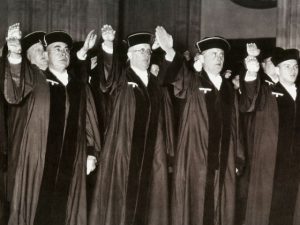
On May 28, 1936, the Second Provisional Directorate of the German Evangelical Church sent a now famous memorandum directed to Hitler personally. This protest, signed by ten members of the various wings of the Confessing Church, drew Hitler’s attention to the fact that in the fourth year of Nazi rule, the church was being repressed by the state “to a very large extent” in what seemed to be an attempt to “de-Christianize” Germany. Secondly, it refuted the Nazi interpretation of “positive Christianity” as theologically unsound. The Memorandum further attacked the Nazi ideology with its divination of “Blood “, ”Race” and “National Identity”. Above all, the authors criticized the arbitrary police measures which had undermined the rule of law, as well as leading to the erection of the system of concentration camps. The memorandum further declared that:

When the Aryan human being is glorified, God’s Word is witness to the sinfulness of all humans; when anti-Semitism, which binds him to hatred of Jews, is imposed upon the Christian framework of the National Socialist world view, then for him the Christian commandment to love one’s fellow human stands opposed to it.

This Memorandum was not without its consequences. Originally it was sent to Hitler privately without publicity, in the expectation that such a private remonstrance would lead Hitler to abandon the policies to which its authors took exception. But less than six weeks later the whole memorandum appeared in a Swiss newspaper, the Basler Nachrichten, and shortly afterwards was printed in the New York Herald Tribune. At the beginning of October the Gestapo arrested the Confessing Church’s collaborator Dr. Friedrich Weißler, who came under suspicion for having authorized the publication in Switzerland. On February 19, 1937, shortly after he had been transferred to Sachsenhausen concentration camp, he was found dead as a result of a severe bodily assault. Since then he has become regarded as the Confessing Church’s first ‘martyr’. At the same time, there can be no doubt that his murder was sparked by anti-semitism, since, although a strong supporter of the Confessing Church, Weißler came from a Jewish family. By the Nazi definition, he was counted as “fully Jewish”, and as such had already been dismissed from his post of Provincial Court judge in Magdeburg in July 1933.

To mark this Memorandum’s 80th anniversary, a lecture series was organized at the Topography of Terror Foundation by the Berlin-Brandenburg Evangelical Church in co-operation with Dr. Manfred Gailus. The title of this series was “’With Deep Concern’ over De-Christianization, Anti-Semitism and Arbitrary Breaches of Law”, and was designed to draw attention to the Confessing Church’s Memorandum and to Weißler’s fate. The high point was a public forum in which some 130 guests took part. Martin Greschat, now an emeritus professor of church history at Giessen University and author of the standard history of this Memorandum, described the origins and composition of the Memorandum in its various stages.[1] Afterwards Hansjörg Buss outlined Weißler’s biography and his role in the Memorandum’s composition and publication. In Michael Germann’s view, this was the high and catastrophic turning point in Weißler’s life. Manfred Gailus then took up the story by claiming that no evidence exists that Weißler’s murder was ‘organized’ by higher elements in the Nazi bureaucracy. One could conclude therefore that the motive for this brutal mishandling was the anti-semitic attitudes of Jew-hatred among lower echelons of the SS guards. It is possible, so Greschat suggested, that this murder stalled the launching of a full-scale trial of the Confessing Church leadership, which numerous signs suggest was being planned.

The final contribution was made by Peter Steinbach, long-time director of the German Resistance Memorial Center and emeritus professor of history at Mannheim University. His title was “Treason – Breach of Confidence – Resistance: Reflections on the Memorandum and on Friedrich Weißler”. He believes that Weißler suffered from deeply-felt feelings of isolation, like many other people who were deprived of their positions and rights during the Nazi period. This led to a total disorientation. The destruction of his bourgeois life-style, and the social exclusion which he experienced even within his church connections took an enormous toll. As a consequence he was to pay with his life for this hurtful rejection.

In conclusion, Friedrich Weißler’s grandson, Wolfgang Weißler, reflected spontaneously on how the family reacted to his fate. His grandmother had never spoken about the circumstances of his death. Only in the 1980s when this case was ‘discovered’ both in the church and society more generally was his fate also discussed in his own family circle.

Many details about the Memorandum and Weißler’s arrest still remain open. Above all, there is the question as to how this Memorandum was smuggled out to the foreign press in the summer of 1936, which was the immediate cause of Weißler’s detention. Did he give his consent to its publication? Was there any consultation with or backing from the Confessing Church leadership? (This would seem unlikely, given the speed with which these leaders dissociated themselves from his actions.) If no further sources turn up, then such questions may remain unsolved. But any such new information will not be decisive. In fact, Weißler’s murder meant that the staunchly opposing wing of the Confessing Church, known as the “Dahlemites”, could no longer have any illusions about the character of the Nazi state.

In recent years this incident has become better known both generally and in church circles. Weißler is no longer a completely unknown figure. And the keen participation in the symposium described above means that there is a continuing interest in what Gailus depicts as a modern twentieth century Passion Story. In Steinbach’s view, the whole tragedy and catastrophe of the early twentieth century in Germany is summed up in Weißler’s fate. Manfred Gailus has now completed a full biography which will appear in February 2017, and on the occasion of the eightieth anniversary of his death on February 19, 2017, a memorial service will be held on the grounds of the Sachsenhausen Camp.

Notes:

[1] Manfred Gailus, Friedrich Weißler: Ein Jurist und bekennender Christ im Widerstand gegen Hitler (forthcoming, Goettingen 2017). See also Martin Greschat, Widerspruch und Widerstand: Texte zur Denkschrift der Bekennenden Kirche an Hitler (Munich: Kaiser, 1987); Greschat, “Friedrich Weißler. Ein Jurist der Bekennenden Kirche im Widerstand gegen Hitler,” in Ursula Buettner and Martin Greschat, Die verlassenen Kinder der Kirche: Der Umgang der Kirche mit den Christen jüdischer Herkunft (Göttingen: Vandenhoeck & Ruprecht, 1998), 86-122; John S. Conway, The Nazi Persecution of the Churches 1933-1945 (London: Weidenfeld and Nicholson, 1968), 162-64.


Share

Conference Report: “Ecumenical Cooperation and World Politics”. The 2016 Kirchliche Zeitgeschichte/Contemporary Church History Conference

Contemporary Church History Quarterly

Volume 22, Number 4 (December 2016)

Conference Report: “Ecumenical Cooperation and World Politics”. The 2016 Kirchliche Zeitgeschichte/Contemporary Church History Conference, Helsinki, October 26-28, 2016

By Robert P. Ericksen

On Oct. 26-28, 2016, Professors Aila Lauha and Mikko Ketola of the Theological Faculty at the University of Helsinki hosted an international conference on the topic, “Ecumenical Cooperation and World Politics.” This conference also served as the annual meeting of Kirchliche Zeitgeschichte, with the papers to be published in that journal in 2017.

Sessions at this conference focused primarily on the twentieth century, a time when conflicts ranged from World War I and World War II to the Cold War and its occasional outbreaks of considerable violence. This also was the period in which Christian churches struggled to overcome centuries of bickering among themselves with a push toward international ecumenism. Could Christians working together reduce the scourge of war? Could ecumenical Christians help resolve the problems of racism, colonialism, or the social and cultural changes embodied in Western modernity?

These would have been very large questions to resolve in a two-day conference. Within those constraints, however, sessions probed a few specific examples within the ecumenical experience. Also, given the setting in Helsinki, there emerged a slight Nordic tilt to the proceedings, with four of the fourteen presenters describing Nordic actors within the broader ecumenical movement. One further distinction within the program bears mention. The two main days of the conference were divided between a first day focused on “Ecumenical responsibilities—dreams, utopias and realities,” and a second day on the more sobering subtheme, “Ecumenism facing the challenges of nationalism, chauvinism and extremism.”

Andrea Strübind delivered the first paper of this conference, “The International Fellowship of Reconciliation as an ecumenical and interfaith forerunner for human rights.” Two founders of the Fellowship of Reconciliation (FoR), the German pacifist Friedrich Siegmund-Schultze and the English pacifist Henry Hodgkin, met on 3 August 1914, the day before Great Britain entered World War I. These two men committed themselves to the principle that Christian nations should not turn to war against each other. Although they had little or no chance of stopping the carnage to come, they created an organization that still exists and now can be seen as a precursor of and participant in the broader ecumenical movement. Strübind focused her paper on a little-researched aspect of the FoR—its influence on the American Civil Rights Movement. As early as the1930s, the FoR began bringing Gandhi’s tactic of non-violent civil disobedience to questions of civil rights and economic rights in the United States. Bayard Ruskin, for example, a later ally of Martin Luther King, Jr, began working fulltime for the FoR in 1942 and pursued this theme. In the mid-1950s, Glenn Smiley, a Methodist pastor and a representative of the FoR, moved to Montgomery, Alabama. He and the FoR helped develop and train activists in the non-violent tactics that proved successful in the Montgomery bus boycott and then spread across the South.

Gerhard Besier followed with a paper on “80 Years WCC—Theological, Political and Societal Ambiguities.” The “ambiguities” involve the ways in which ecumenism gets caught up in issues that seem unavoidably political and/or cultural, rather than simply religious. For example, when the interwar ecumenical movement tried to deal with German Protestantism after 1933, it first tried to work with the official church leadership. Gradually, however, Barth, Bonhoeffer, and others convinced ecumenists to accept the point of view of the Confessing Church, with its rejection of radically Nazi elements within the official Protestant Church. That led to the Stuttgart Declaration of Guilt in 1945, followed by early postwar efforts to rebuild and strengthen ecumenism. Quickly, however, the Cold War impinged and once again ecumenical Christians faced political questions. John Foster Dulles, an active lay person and son of a Presbyterian minister, imagined the Federal Council of Churches (FCC, later the NCC) working within the WCC toward “a just and durable peace” in the American mold. The Czech theologian, Josef Hromadka, argued that socialism should be understood as the truly Christian stance. Some theologians in Eastern Europe both collaborated with their own regimes and critiqued the WCC as a voice for NATO. Participation by the Russian Orthodox Church established in the 1960s added further questions about the mix of politics and religion. On the one hand, one might hope that ecumenical Christendom could find a prophetic voice based upon Christian values. In the worst case, however, some might see Christian ecumenism as a theology of convenience, bent to the need for getting along.

Gerhard Ringshausen’s presentation gave a partial answer to Besier’s question. On the topic, “George Bell’s political engagement in ecumenical context,” he describes the Bishop of Chichester’s response to the “German question” before and during World War II as both theological and political. Totalitarian restraint on freedom to preach must be opposed, he said. An “ethic of peace” should include equal dignity for all. Bombing policy should make a distinction between military and civilian targets. While consistent with Christian values, these choices can also be built upon natural law. Bell gave the November Pogrom of 1938 a theological response, however, with the suggestion that non-Aryan pastors and their wives should be welcomed in England as members of the Christian community in need.

The next session grew out of a research program for PhD students directed by Aila Lauha at the University of Helsinki, “The Ecumenical Movement and Cold War Politics.” The title of this session expressed the essence of an underlying theme for ecumenism: “Can the World Council of Churches Change the World?” The conditional answer presented by products of Lauha’s program seems to be, at least in limited ways, yes. Juha Meriläinen presented on “The Reconstruction of European Churches as a WCC Programme.” War had left Europe with massive destruction. Early American attitudes exacerbated this, with, for example, a sign at a U.S. military canteen in 1945 in Berlin: “Do not feed the civilians. Put what you do not eat into the garbage can.” The Americans soon changed their minds, however, as President Truman worried about saving Europe from the USSR. One result was the Marshall Plan, which poured American aid into postwar Europe. W.A. Visser ‘t Hooft and the WCC also saw human need in postwar Europe. The WCC did its part, with a program that invested $6.2 million, a sort of counterpart to the Marshall Plan. Matti Peiponen spoke on “The Commission of the Churches on International Affairs,” judging it a success, especially in the early postwar years. It had a voice in the WCC and also in the UN. In the latter case, this commission made sure that the Universal Declaration of Human Rights included the right to freedom of thought, expression, and confession, rather than merely the “freedom to worship,” as preferred by the USSR. Antti Laine spoke on “The Programme to Combat Racism.” Here he brought the story forward by two decades, reflecting on the WCC Assembly at Uppsala in 1968, a meeting where Martin Luther King’s place on the list of speakers fell to his assassination that spring. The turbulence implicit in King’s assassination spoke to a new world, with widespread activism among young people and with questions about racism in the United States as well as other parts of the world. The WCC focus on race advocated action, not just discussion, and the action included controversial grants made to sometimes radical organizations opposed to racial injustice. These sessions on WCC programs provoked a lively discussion in the Q and A, especially involving the question of theology, which was de-emphasized (if not actually banned) at Uppsala in 1968. According to Laine, however, leaders of the WCC considered their program against racism a success, proving the Christian ecumenical movement to be a credible player amidst the widely accepted idea that racism represented an evil to be opposed.

Katharina Kunter stayed in the decade of the Uppsala Assembly for her final presentations on this first day, “Revolutionary Hopes and Global Transformations: The World Council of Churches in the 1960s.” She actually called her timeframe the “long decade” of the 1960s, beginning as early as the mid-1950s and continuing well into the 1970s. Uppsala in 1968 represented a turning point. A Theology of Liberation developed in the 1970s. White men in the WCC were replaced by increasing numbers of women and people of color. Collective human rights replaced the Western emphasis on individual human rights. The geographical locus began shifting from west to east and from north to south. Some conservatives in Europe and the United States viewed this as the end of Christianity in Christian ecumenism. Some churches withdrew their membership. Under the theme for this first day of the conference, “dreams, utopias and realities,” this stage reached by the WCC in the 1970s seemed to contain a little bit of each.

Morning sessions on the second day included papers on ecumenism in Finland presented by Aila Lauha and Mikko Ketola. Professor Lauha described the early years of the Reformation when Finland was a Swedish possession, with the Lutheran faith declared the one true faith and Catholics known primarily as opponents during times of war. Even during the nineteenth century, when Finland was a province of Russia, the legal role of the Russian Tsar did not impinge on the dominant place of Lutheranism within Finland. By the 1920s, 95 percent of Finns remained within the dominant Lutheran faith and an ecumenical group formed in 1917 primarily involved Lutherans talking with each other. With a very strong nationalism in 1920s Finland, newly granted autonomy in 1917, ecumenism was seen largely as a threat of foreign influence, and the very few Catholics in Finland were widely suspected of disloyalty. After World War II, Lutherans in Finland gradually moved toward an acceptance of ecumenism. This was based upon the development of cross-denominational theological conversations. Also, suspicions against Catholics diminished with the dramatic changes developed at the Second Vatican Council in the 1960s. A Joint Declaration on Justification in 1999 helped solidify the Finnish respect for Catholics, so that by the turn of the century a modern, multicultural acceptance of ecumenism became the norm in Finland. Mikko Ketola picked up on this story of rapprochement between Finnish Lutherans and the Catholic Church in his paper, “Finland—Ecumenical Wonderland?” He noted that a small conversation began in 1967, when representatives of the Roman Catholic and the Finnish Orthodox Churches were invited to the Finnish celebration of the 450th anniversary of the Reformation. More importantly, three Finnish Lutheran bishops made a first visit to Rome in 1985, during the papacy of John Paul II, and Finnish bishops have returned to Rome annually since. These past three decades have marked a period in which Finnish acceptance of and enthusiasm for ecumenism has increased dramatically.

Anders Jarlert began the afternoon session with “Nathan Söderblom and Nationalism—Riga, Uppsala, and Ruhr.” Many scholars view Söderblom as an internationalist, rather than a nationalist. Jarlert acknowledged that Söderblom worked for international cooperation and peace, especially in Europe, and that he was an important figure in the international ecumenical movement. However, Söderblom also had a very strong sense of his Swedish roots and a concern for the wellbeing of Sweden. Using numerous examples, Jarlert showed how these two realities can coexist in one person. Historians make a mistake when they try to find the right box into which to place a complex figure, he argued. Historical actors rarely fit so precisely into those boxes where we are tempted to place them.

The final session in this conference included three somewhat disparate topics. Aappo Laitinen spoke on “Religion and politics in Malta during the interwar years: between ‘Protestant’ Britain and the Holy See.” This story involves a complicated Catholic-Protestant clash, with a largely Catholic population on Malta, but British political control since the Napoleonic wars. Hanna-Maija Ketola spoke on “Strengthening the Alliance through Church Connections: The Church of England and the Russian Orthodox Church during WWII.” This involves a side story to the British-Soviet alliance during World War II, an unexpected alliance occasioned by Hitler’s decision to invade the USSR. A Church of England delegation visited their Russian Orthodox counterparts in 1943, hoping to use an ecumenical conversation as part of the connection that would solidify the political and military alliance of the two nations. This visit produced press reports that exaggerated the extent of religious freedom in the USSR, the sort of misunderstanding perhaps useful during the war itself, but part of the rapid separation between Russia and the West after Allied victory in 1945. Finally, Villa Jalovaara spoke on “Nordic bishops’ meetings during the Cold War.” Beginning in the 1920s, bishops from Denmark, Finland, Iceland, Norway and Sweden began meeting every third year. World War II interrupted this practice, as Danish and Norwegian bishops necessarily saw Germany as their enemy, but Finland most feared the Soviet Union. During the Cold War, these nations divided up between Norway, Denmark, and Iceland as members of NATO, with Sweden and Finland non-aligned, and with Finland maintaining a “friendly” relationship with the USSR. Although these differences of alignment made it difficult to produce joint statements, at least these bishops continued to meet regularly throughout the Cold War.

I would encourage readers interested in these topics to look for the fall edition of Kirchliche Zeitgeschichte in 2017, when refined versions of these papers will be available in print.

Share

Conference Report: “Germany and the Confessional Divide, 1871-1989,” Seminar at the Annual Meeting of the German Studies Association

Contemporary Church History Quarterly

Volume 22, Number 4 (December 2016)

Conference Report: “Germany and the Confessional Divide, 1871-1989,” Seminar at the Annual Meeting of the German Studies Association, 2016, San Diego, California

By Mark Edward Ruff, St. Louis University

On the eve of the 500th anniversary of the Lutheran Reformation, twenty-five historians and theologians gathered at the Annual Meeting of the German Studies Association from September 30 through October 2 in San Diego to examine a confessional divide between Catholicism and Protestantism characterizing the social, political and religious landscape of Germany from the Kaiserreich through German reunification in 1990.

Convened by Thomas Großbölting of the Wilhelm-Westfälische-Universität in Münster and Mark Edward Ruff of Saint Louis University, the seminar grappled with how confessional identity is created and upheld. How and why did theologians, church leaders and politicians define themselves negatively against confessional enemies? To what extent was this process of definition influenced by geography, and in particular, the degree to which their regions were confessionally homogenous or heterogeneous? How did population shifts alter processes of confessionalization? How was this process of self-definition affected by encounters with non-Christian religions, including Jews and Muslims? And finally, which voices sought to counter such confessionalization processes and what impact did they have on received identities?

The seminar began the first day by focusing on the deepening of confessional tensions in the nineteenth century. The sociologist, M. Rainer Lepsius, spoke of the concept of “socio-moral miliuex,” borrowing the concept of a “Catholic milieu” from the Catholic publicist, Carl Amery. Some of Lepsius’ disciples, in turn, referred to a “conservative Protestant milieu.” The historian, Olaf Blaschke, calls much of the nineteenth century a “second confessional era,” one marked by the intensity of passions found in the sixteenth and seventeenth centuries in the wake of the Reformation.  A participant in the seminar, Blaschke described the origins of his approach in his study with the renowned Bielefeld social historian, Hans-Ulrich Wehler. Seminar participants, examining Blaschke’s thesis as well as objections from his critics, nonetheless remained divided over whether parallels with the sixteenth and seventeenth centuries hold up for the nineteenth. All nonetheless agreed that the era represented an era of significant and troubling confessional tensions, even if some pointed out that the forces driving these tensions varied significantly between the early modern and modern eras.

On the second day, participants examined attempts to overcome these confessional tensions in the 1920s and 1930s. The Nazis had striven to create a “positive Christianity,” a recognition of how deeply these confessional fault lines cut through German society. The discussion centered on Richard Steigmann-Gall’s classic and contested monograph, The Holy Reich. Nazi Conceptions of Christianity, 1919-1945 (Cambridge: Cambridge University Press, 2004).  Participants focused less on Steigmann-Gall’s claims that the Nazis, contrary to later mythologizing, understood themselves as good Christians and acted on the basis of their Christian faith. They focused instead on Steigmann-Galls’s analysis of how the Nazis exploited the goals of “positive Christianity” in hopes of standing above the confessions and bridging the confessional divide.

Even so, and spite of attempts to put aside these confessional differences through the creation of interconfessional movements of Christian Democracy, confessional fault lines persisted through the Adenauer Era in the Federal Republic—and in some regions, even longer. Only in the German Democratic Republic did these differences recede, the region being home to only a tiny minority of Catholics and under the control of an officially atheistic regime. The third session accordingly analyzed forces that ultimately closed these confessional rifts in the second half of the twentieth century. They began with a discussion of Maria Mitchell’s seminal article in the Journal of Modern History, “Materialism and Secularism. CDU Politicians and National Socialism, 1945-1949,” (67, no. 2 (June 1995): 278-308) which showed how Catholics and Protestants found common ground in the CDU through their shared hostility to materialism. Mitchell was also present and provided an overview of her article’s genesis while she was at graduate school at Boston University. Participants also examined the second chapter of Mark Edward Ruff’s forthcoming monograph, The Battle for the Catholic Past: Germany, 1945 -1980. This chapter examined the fights over the validity of the Reichskonkordat in the postwar era that culminated in a landmark case before the Constitutional Court in June, 1956. The seminar concluded with a discussion of Thomas Mittmann’s article in Archiv für Sozialgeschichte, “Säkularisierungsvorstellungen und religiöse Identitätsstiftung im Migrationsdiskurs. Die kirchliche Wahrnehmung ‘des Islams’ in der Bundesrepublik Deutschland seit den 1960er Jahren“ (51 (2011): 267-289).

The fruitful conversations will lead to an edited volume, likely under the title, Germany and the Confessional Divide, 1871-1989. The 500th anniversary of the Lutheran Reformation provides the ideal opportunity to take stock of the Reformation legacy, not just in Germany but throughout the world.


Share

Conference Report: 14th biennial Lessons & Legacies Conference

Contemporary Church History Quarterly

Volume 22, Number 4 (December 2016)

Conference Report: 14th biennial Lessons & Legacies Conference, sponsored by the Holocaust Education Foundation at Northwestern University and Claremont McKenna College, November 3-6, 2016, Claremont, CA

By Martina Cucchiara, Bluffton University

At this year’s Lessons & Legacies Conference, a number of scholars presented on the Catholic Church in Europe under Nazism and Fascism.

On Friday, Jonathan Huener (University of Vermont) presented his study on the little-known Nonnenlager Schmückert, a labor camp for Polish nuns in the Reichsgau Wartheland. Between February 1941 and January 1945, the Gestapo, in collaboration with the Reichsstatthalter’s office of Arthur Greiser (via the Gau Self-Administration), imprisoned over six hundred nuns in the camp. In his analysis of the camp, Huener emphasized the intersections and conflicts “between ideology and economic rationality” in the Nazis’ anti-Church policies in the Warthegau. Initially, the regime’s persecution of the Polish Catholic Church, that included the dissolution of cloisters and the imprisonment of nuns, was crucial to germanization measures in the Gau. As a key symbol of “Polish national consciousness,” the Nazis viewed the destruction of the Polish Catholic Church as tantamount to the destruction of the Polish nation. Nuns in their conspicuous habits thus represented the dual threat of Catholicism and fanatical Polish nationalism and animated the Gestapo’s efforts to imprison the women in 1941. But if the initial imprisonment of nuns was driven by ideology, Huener argued that by 1942, severe labor shortages became the main impetus for the Gau administration’s renewed efforts to round up and incarcerate the remaining nuns in the Warthegau. Attempts to use nuns as forced laborers at Schmückert failed, however. Still, although most of the women were simply too ill to work, Huener concluded that the camp’s continued existence shows both the “regime’s commitment to incarcerating and exploiting its alleged enemies,” and its “obsession with Polish Catholicism as an inherently dangerous and conspiratorial locus of anti-German, Polish-national sentiment.”

On Saturday, the panel “Antisemitism and Catholicism during the Holocaust” focused on manifestations of and responses to antisemitism in the Catholic Church in Germany, France, and Italy under Nazism.

Kevin Spicer (Stonehill College) and Martina Cucchiara (Bluffton University) explored the topic through the lens Erna Becker-Kohen, a Catholic of Jewish heritage, whose writings the presenters have translated and annotated. The volume, The Evil that Surrounds Us: The Writings of Erna Becker Kohen, is forthcoming in 2017 from Indiana University Press. Overwhelmed by fear and isolation in the wake of Hitler’s rise to power in 1933, Erna converted to Catholicism in 1936. The history of Catholics of Jewish heritage primarily has been told from the perspective of the Catholic hierarchy. Focusing on the experience of one Catholic of Jewish heritage, Spicer and Cucchiara lowered their gaze to illuminate the consequences of the Catholic hierarchy’s refusal to take a clear stance on Jews, even Catholics of Jewish heritage, in Nazi Germany. Largely leaving their flock to their own devices, Church leaders did little to check the pervasive antisemitism and malice that Erna routinely encountered in Catholic parishes and women religious communities. Nonetheless, Erna, along with a small number of German Jews, did benefit from the Catholic Church’s feeble intervention on their behalf when the regime refrained from dissolving marriages between Jews and non-Jews. On account of her “privileged” marriage to a non-Jewish man, Erna therefore was exempt, for a time, from the most severe anti-Jewish decrees, including deportation. But, as Spicer and Cucchiara argued, the Church’s contribution to the protection of “privileged” Jews was incidental, as the episcopate first and foremost sought to defend its traditional right to govern marriage. The Church did not intervene when the Nazis deported Catholics of Jewish heritage or when they imprisoned the “Aryan” partners of Jews in the fall of 1944 to force them to divorce their Jewish spouses. Erna felt the full brunt of this policy of silence when the regime imprisoned her “Ayran” husband Gustav in a labor camp. Erna and her young son Silvan struggled to survive the war and the Holocaust in southern Germany and Tyrol. Gustav, too, survived but eventually succumbed to severe injuries he sustained during his time of imprisonment.

In her presentation “Catholic Antisemitism in France and Italy during the Holocaust,” Nina Valbousquet (Sciences Po Paris) also raised the issue of intermarriage, albeit in post-Fascist Italy in 1943. Following Mussolini’s fall, Father Tacchi Venturi, a member the Italian Catholic clergy, advocated for the abolition of provisions of the Fascist racial laws of 1938 that forbade intermarriages between Jews and non-Jews. At the same time, he also lobbied the Italian Ministry of the Interior to retain certain antisemitic provisions that in his estimation were consistent with Catholic traditions and principles. Valbousquet argued that Venturi’s position was representative of members of the Catholic clergy in Fascist Italy and Vichy France who disavowed Nazi antisemitism as un-Christian but continued to spread “acceptable” forms of antisemitism. In their promotion of Catholic antisemitic propaganda that conflated traditional Christian anti-Jewish prejudices with modern secular antisemitic stereotypes, the Church became complicit in legitimizing anti-Jewish laws and measures in France and Italy. From here it was but a small step for some Catholic activists during World War II to cast Fascist antisemitic laws as “a legitimate self-defense of Christian civilization” against World Jewry. At the very least, Valbousquet concluded, Catholic antisemitic propaganda contributed to widespread indifference to the suffering of Jews, and for this reason the topic deserves far greater scholarly attention that it has received so far.

Suzanne Brown-Fleming (United States Holocaust Memorial Museum) also sought answers to the Catholic Church’s apparent indifference to the persecution of Jews in the months following Hitler’s ascension to power. In particular, she examined the intersection between the Catholic Church’s response to the regime’s treatment of Jews and Catholics in 1933. Brown-Fleming argued that scholars must consider the Nazis’ treatment of Jews and Catholics together in order to gain a fuller understanding of the Church’s silence about the escalating persecution of Jews in 1933. Drawing on files from the Vatican secret archives, Brown-Fleming painted a vivid picture of discussions between the Vatican and the German episcopate on how to respond to the new regime’s persecution of Jews. In the end, Church leaders remained silent because, in the words of Cardinal Michael Faulhaber, should the Church defend Jews, “the war against the Jews would also become a war against the Catholics.” Whereas Brown-Fleming attributed the Catholic Church’s silence about Jews mainly to fears for its own flock, implicitly, she raised yet another intriguing reason for the Church’s public indifference to the suffering of Jews. It appears that upon Hitler’s ascension to power in 1933, many Catholics were not fearful but enthusiastic about the new regime. Some younger Catholics chafed against the ban on Catholic membership in the NSDAP that the Fulda Bishops’ Conference had issued in 1930. Cesare Orsenigo the Vatican nuncio in Berlin, went so far as warning the Vatican in 1933 that the Church should take care not to alienate the many “National Socialist Catholics,” lest they left the Church. Although Brown-Fleming did not explicitly make the argument, she nonetheless raised the question whether the Catholic Church remained silent about the persecution of Jews not just because they feared a war against Catholics but because they feared losing the support of large segments of Catholics whose enthusiasm for the new regime clearly outweighed their trepidations about Nazism.


Share

Conference Report: 30th Biennial Meeting of the Conference on Faith and History

Contemporary Church History Quarterly

Volume 22, Number 4 (December 2016)

Conference Report: 30th Biennial Meeting of the Conference on Faith and History, Regent University, Virginia Beach, VA, October 20-22, 2016

By Kyle Jantzen, Ambrose University

Under the title of “Marching to Zion: Judaism, Evangelicals, and Anti-Semitism,” three scholars from the Conference on Faith and History examined the relationship between American Protestant Christians, Judaism, and Antisemitism during the tumultuous twentieth century.

Daniel Hummel, Postdoctoral Fellow at the Harvard Kennedy School, presented “Rethinking Covenant, Land, and Mission: Jewish-Evangelical Dialogue after Oslo.” In it he recounted the history of Jewish-evangelical dialogue in the United States, which was first officially begun in 1969 with a highly publicized meeting between Billy Graham and the American Jewish leaders at the headquarters of the American Jewish Committee in New York City. While interreligious dialogue and politics do not always go hand-in-hand, they are inextricable in the case of Jewish-evangelical dialogue. Since the late 1960s, it has expanded into one of the most active fronts of Jewish-Christian dialogue, while at the same time American evangelical support for Israel was politicized in the Christian Zionist movement. Hummel argued that Jewish-evangelical dialogue has supplied evangelicals over the past 45 years with new ways of thinking about theological concepts of covenant, land, and mission. Through a combination of changing evangelical theology, exposure to strands of modern Jewish theology, and the very act of interreligious dialogue, new conceptualizations of covenant, land, and mission have helped legitimate Christian Zionism. In political terms, the dialogue has rationalized the Christian Zionist focus on a blessing theology rooted in Genesis 12:3. This theology argues that the Jewish people remain in covenant with God. by which the Jewish people are irrevocably granted the Land of Israel (as demarcated in the Bible), while the mission of Christians is to bear witness to this arrangement by de-prioritizing evangelism and strengthening the covenant through support for the state of Israel.

Timothy D. Padgett, who just defended his PhD from Trinity International University, gave a paper entitled “Diverse Discourse on Zion: American Evangelical Public Discussions of Zionism and the State of Israel, 1937-1973.” In it, he traced the evolution of what he argued were diverse evangelical perspectives on Zionism and the State of Israel in evangelical periodicals. Some periodicals, like Arno C. Gaebelin’s dispensationalist Our Hope, were eschatologically minded but ambivalent about Zionism and (later) the Israeli government. In contrast, the editor and writers at Christian Herald (including the pseudonymous reporter Gabriel Courier) were strongly pro-Israel but wholly uninterested in eschatology. The Reformed magazine, Southern Presbyterian Journal, though often published weekly, had precious little to say about Zionism or Israel. Most stereotypically, perhaps, the Moody Monthly was both uniformly pro-Israeli and motivated by eschatological theology. Next, the dispensationalist Presbyterian magazine Eternity combined ardent support for and harsh criticism of Israel. Finally, Christianity Today and its editor Carl Henry were quite positive about the Jewish state, but gave little expression to any theology of the end times. Overall, American evangelicals were generally pro-Israeli, though this did not seem to correlate with their level of interest in eschatological theology.

Kyle Jantzen of Ambrose University rounded out the panel, with “German Racism, American Antisemitism, and Christian Duty: U.S. Protestant Responses to the Jewish Refugee Crisis of 1938.” In it, he assessed the rhetoric employed by liberal Protestant writers and editors in Advance (Congregational), Christendom (unaffiliated), and The Churchman (Episcopalian) in responding to National Socialism, US antisemitism, the German Church Struggle, and the Jewish refugee crisis of 1938. Without doubt, these members of the Protestant church press–many of them church leaders–understood it to be their Christian duty to respond to a profound sense of crisis. Democracy, civilization, Christianity, and all religion were under attack from the forces of war, totalitarianism, racism, and paganism. These writers and editors named the evils of war and totalitarianism, in particular the threat that Hitler and Nazi Germany posed to the civilized world. They also fought against antisemitism and tried to aid Jews, though not without reviving centuries-old anti-Jewish prejudices from time to time, and also not without reframing the persecution of Jews and the Jewish refugee crisis as the persecution of Christians and Jews and the Christian and Jewish refugee crisis. In the end, the plight of the Jews was not uppermost in their minds. Most important to these liberal Protestant spokesmen was the reaffirmation that Christianity was the only force that could ultimately save their civilization, preserve democracy, and protect the world from self-destruction.

Share

Article Note: Samuel Koehne, “Were the National Socialists a Völkisch Party? Paganism, Christianity, and the Nazi Christmas”

Contemporary Church History Quarterly

Volume 22, Number 3 (September 2016)

Article Note: Samuel Koehne, “Were the National Socialists a Völkisch Party? Paganism, Christianity, and the Nazi Christmas,” Central European History 47, no. 4 (2014): 760-790.

 By Christopher Probst, Washington University in St. Louis, University College

As Kyle Jantzen noted in our most recent issue, Samuel Koehne has published over the last several years a series of articles that offer significant insights on National Socialist views of religion. This study is no exception. Koehne offers nuanced conclusions based on meticulous research. The article is especially valuable for the light it sheds on the interaction between “the völkisch world of thought,” (764) which he dubs the “strange worldview out of which Nazism emerged,” (767) and Nazi views on religion as illuminated by their celebrations of Christmas in the early years of the Weimar Republic.

Koehne’s main argument is threefold: that “the Nazis were clearly a part of the völkisch movement, that they reflected the movement’s diverse religious trends, and that there is an urgent need for historians to reconnect the Nazi Party to the milieu from which it emerged” (762-763). While major histories of the Third Reich have examined the role played by antisemitism, eugenics, and Social Darwinism in the broader völkisch subculture in which the Nazis operated, he avers, “there is a need for a deeper analysis of the intellectual roots of National Socialism with respect to its religious beliefs—and to how those beliefs connected with earlier völkisch religious trends” (763). Koehne’s emphasis on the syncretistic interaction between Nazi ideology, the völkisch milieu of the early twentieth century, and Christianity is both welcome and thoroughly elucidated here.

Koehne’s conclusions are also threefold. First, he concludes that there was no “cohesive meaning” to “positive Christianity,” a much discussed phrase used in Point 24 of the 1920 Nazi Party Program. Instead, the fact that this “positive Christian” party both promoted and reported its own Christmas celebrations as “the Germanic pagan festival of winter solstice” demonstrates both that leading Nazis (including Hitler) were not concerned about appearing as traditional Christians and that a wide array of religious views existed within the party (787). Second, he contends that “the early Nazi Party was immersed in the völkisch movement, including its pagan trends and traditions” (787). Koehne demonstrates that the party both promoted and was influenced to a significant degree by the ideas of people like Houston Stewart Chamberlain, Theodor Fritsch, and Arthur Dinter. Third, Koehne concludes both that there is no “inherent dichotomy” within the Nazi Party between its pagans and its Aryan Christians and that—because of the context and meaning poured into the terms by their Nazi adherents—references to Jesus Christ, Christianity, and the Bible do not necessarily exclude paganism (788). The picture that emerges here is one of a wide diversity of beliefs and indeed a great deal of syncretism between Christianity, Germanic paganism, and völkisch ideology.

Koehne’s study of a rather narrow topic—early Nazi views of the celebration of Christmas—offers tantalizing answers to much bigger questions, including the one posed in the article’s title. The study is extremely meticulous. The author’s nuanced conclusions are worthy of careful consideration and will no doubt propel others to plow further ground in this relatively fallow area of scholarly research.


Share

Article Note: Todd Weir, “The Christian Front against Godlessness: Anti-Secularism and the Demise of the Weimar Republic, 1928-1933”

Contemporary Church History Quarterly

Volume 22, Number 3 (September 2016)

Article Note: Todd Weir, “The Christian Front against Godlessness: Anti-Secularism and the Demise of the Weimar Republic, 1928-1933,” Past and Present 229 (Nov. 2015): 201-238.

By Heath Spencer, Seattle University

Though historians have long been attentive to the role of organized religion in the demise of the Weimar Republic, Todd Weir argues that they have failed to recognize the full significance of anti-secularism in the political developments that brought Hitler to power. In contrast, Weir sees a close relationship between campaigns against godlessness and the Nazi Party’s electoral breakthrough with conservative Protestant voters beginning in 1930.

To make his case, Weir employs M. Rainer Lepsius’ conceptual model of four “mutually hostile” social-cultural milieux (socialist, Catholic, liberal Protestant, and conservative Protestant) among which Germans had been divided since the late nineteenth century (207). The socialist milieu, represented by the Communist and Social Democratic parties in the Weimar era, was decidedly secular in comparison with the others, and its members were prominent in the German Freethought Association as well as the periodic church-leaving campaigns. From 1929 onward, the communists’ displays of anti-clericalism grew increasingly provocative as they tried to draw ardent secularists away from their more moderate social democratic rivals. Catholic and Protestant clergy and lay organizations—most often aligned with the Center Party and the German National People’s Party, respectively—responded to these threats with energetic campaigns against godlessness. Their domestic mobilization dovetailed with widespread concern over the persecution of Christians in Mexico and the USSR, leading many Christians in Germany to conclude that their “defensive campaigns against German secularists” were part of a larger “global battle with unbelief” (202).

A side effect of this escalating cultural conflict was that it further undermined the position of Heinrich Brüning of the Center Party, who was Chancellor of Germany from 1930 to 1932. Although Brüning suppressed communist freethought associations and banned a high-profile Jugendweihe (secular confirmation ceremony) that communists had planned for 2000 youth in Berlin, he was derided by conservative Catholics and Protestants for tolerating socialist freethinkers and the Center/Social Democratic coalition that governed the state of Prussia. Disappointment with the Center Party’s ‘tepid’ responses to secularism gave the National Socialists an opening to present their party as a more aggressive and effective champion in the struggle against godlessness. Their strategy seems to have been most effective among Protestants on the far right.

Weir’s article demonstrates a positive correlation—though not necessarily a causal relationship—between heightened concerns over godlessness and conservative Protestant support for the Nazis. Expressions of outrage over anti-clericalism and governments that appeared to tolerate it were certainly part of the toxic mix that undermined the Weimar Republic. However, Weir’s neglect of the liberal Protestant milieu and its role is puzzling. Members of this subculture also opposed godlessness, though many of them considered the ‘Catholicizing tendencies’ of conservative Protestants to be an equally grave threat to German culture. Consideration of this milieu would not necessarily negate Weir’s central argument, but it would provide a more nuanced representation of Christian responses to organized secularism at the end of the Weimar era.

Share

Article Note: Thomas Brodie, “The German Catholic Diaspora in the Second World War”

Contemporary Church History Quarterly

Volume 22, Number 3 (September 2016)

Article Note: Thomas Brodie, “The German Catholic Diaspora in the Second World War,” German History 33, no. 1 (March 2015): 80-99.

By Kyle Jantzen, Ambrose University

Thomas Brodie of Jesus College, Oxford, has drawn from his doctoral research on German Catholics on the home front during the Second World War to publish this interesting article about the vagaries of religious practice among Rhenish Catholics displaced by Allied bombing. He follows Catholic evacuees from the Rhineland and Westphalia to places like Thuringia, Saxony, and southern Württemberg, where they often struggled to make new homes and develop healthy spiritual practices.

The article begins with a strong historiographical section, placing the author’s research in the context of recent scholarship on the air war, evacuations, the home front, and German religious history. While many accounts have suggested that the experience of the Second World War was conducive to an upswing in religious activity and clerical influence, Brodie disagrees, arguing that scholars have taken “insufficient account of the manifold strains the conflict imposed on the Churches’ pastoral structures during this very period” (82). To the contrary, he suggests that, “It was indeed precisely from 1943 onwards, as Allied bombing of northern and western Germany intensified, that civilian evacuations increasingly disrupted established religious geographies and networks of clerical ministry in these regions” (82). In short, he suggests that the western German Catholic milieu didn’t survive displacement.

Brodie asks a series of useful questions: Were clergy able to minister to their displaced parishioners, or were evacuees essentially removed from their influence? Did evacuation to Protestant or remote Catholic regions weaken the faith of Catholics from the Catholic strongholds of the Rhineland and Westphalia? Do the experiences of Catholic evacuees tell us anything about the wider level of religious engagement in German wartime society? And how did the Catholic clergy and laity understand their experiences as evacuees? His overarching argument is that population movements were significantly disruptive to confessional life: “German society may not have been disintegrating by 1943/1944, but the measures required to maintain the national war effort were proving increasingly corrosive of traditional ‘milieu’ boundaries” (83).

In the sections that follow, Brodie draws on the reports of Rhenish clergy working with evacuees to illustrate a series of problems created by the mass evacuation of western German Catholics. For instance, often Rhenish priests simply lacked important materials for their ministry, like Bibles, catechisms, or prayer books. Moreover, they frequently wanted for the necessary means of transportation to reach widely scattered evacuees. Large parishes and poor public transportation meant that they were frequently cycling 10 to 20 km to minister to families or provide religious instruction. Then, even if they could reach their charges, clergy needed a place to meet with them. In Thuringia, for example, the Protestant church government refused to allow Catholics to use their church buildings at any time during the war. On top of that, the Gestapo often prohibited Catholics from holding religious services in schools or homes. Even when evacuees ended up in Catholic regions, however, religious practices were often so different that the Rhinelanders struggled to join in.

Compounding these problems were others. Often, clergy had no way of knowing how many Rhenish Catholics had been evacuated, where they had settled, or if they had returned home. In one case relating to the Cologne Archdiocese, out of about 250,000 evacuees, only 16,500 had registered for religious supervision in the diaspora (86).

Brodie also notes the acute shortage of Catholic clergy. In late 1943, 9 percent of German parishes lacked a priest, and the vast majority of theology students and trainee priests–at least in the Cologne area–were being called up for military duty. (This research mirrors the reality in many Protestant regions, where many clergy cared for two and three parishes during the war and administrators struggled to fill gaps.)

In Protestant regions, Catholic priests often faced confessional hostility from Protestant lay people or police. Both they and their parishioners felt this, and Rhenish clergy developed a self-understanding of working in exile. They often complained about the secularism of Protestant regions like Thuringia, and viewed their labour as a participation in the wider effort to stem the tide of godlessness in Europe. Drawing on their neo-Scholastic theology, these clergy interpreted the spiritual apathy they observed to the Reformation’s “depowering of the sacraments and the sacrifice of the cross.” The result was, as one priest put it, “the whole faith increasingly collapses” (92). In Austrian Catholic regions to which evacuees had been sent, this declining religious vitality was attributed to “enlightened Josephinism” and its modernizing effect. Everywhere, however, priests also pointed to the morally corrosive effect of the war itself, including the prevalence of adultery and marital breakup.

In the final section of his article, Brodie suggests that the weakness of Catholic evacuees’ religious practice in wartime and their observations about Protestant secularism in places like Thuringia and Saxony suggests that the narrative of a general upsurge in German religious activity on the Second World War home front may be mistaken. In fact, Brodie suggested confessional identity took a beating, with Catholics slipping into Protestant services or (more often) just going shopping or sightseeing on Sunday. In parts of Saxony, for instance, the movie theatre seems to have outdrawn the church (95). Ultimately, if many Rhenish Catholics struggled to attend church at home, how much less likely were they in the situation of displacement?

In his conclusion, Brodie reiterates his primary argument that wartime was not conducive to increasing clerical influence or religious engagement. Rather, “the experiences of the Catholic diaspora as a whole indicate that although German society was not completely atomized during 1943 and 1944, certain traditional customs and networks were fraying under the pressures of war” (98).

Share

Book Note: Ian Kershaw, To Hell and Back: Europe 1914-1949

Contemporary Church History Quarterly

Volume 22, Number 3 (September 2016)

Book Note: Ian Kershaw, To Hell and Back: Europe 1914-1949 (London: Penguin Books, 2015), Pp. 593, ISBN: 9780713990898.

By John S. Conway, University of British Columbia

Kershaw-HellDespite its theologically-sounding title, this latest work by Ian Kershaw, who is one of Britain’s most distinguished contemporary historians, is a masterly synoptic history of Europe, designed for the general reader. In this work, Kershaw expands on his previous interest in Nazi Germany to cover what he calls Europe’s “era of self-destruction,” which places Nazi Germany in its wider context of a continent-wide series of disasters in the first half of the twentieth century. Nevertheless he also includes a short but valuable section on “Christian Churches, Challenge and Continuity”, placing emphasis on the political and social developments affecting the Christian churches within the wider European setting.

Kershaw begins this section by describing how, on the outbreak of the 1914 war, both sides indulged in claims of divine approval for their nationalistic goals. These mutually contradictory and incompatible assertions did little to enhance the morale of the combatants, and in the long run discredited both their advocates and the Christian gospel of peace and brotherly love. In the aftermath, paradoxically, the churches in Britain and France led the movement against militarism and were in favour of reconciliation through such agencies as the League of Nations. But in defeated Germany, the clergy were leaders in maintaining that they should have been victorious, that their nation had been stabbed in the back by disloyal elements, particularly Jews, and that they were being humiliated by the vindictive and oppressive Treaty of Versailles. Such reactionary attitudes did much to prepare the ground for Hitler’s rise to power.

As Kershaw argues, in 1933 one wing of German Protestantism sought to bring the church up to date by jumping on the Nazi bandwagon. But this evoked a backlash from the more conservative wing known as the Confessing Church, which opposed any state interference in church affairs. However, many of these pastors had sympathy with Nazism’s political and military aims. For their part, the German Catholics invoked the aid of the Vatican in 1933, seeking a treaty or Concordat to secure their position in the new Third Reich. But, as Kershaw points out, this Concordat from the beginning was a dead letter, due to the Nazis’ dynamic ideological and nationalistic plans and the anticlerical attitudes of the party leadership. In practice, in both churches, despite attempts to oppose Nazi encroachments, there was general compliance with other spheres of government policy, including the Nazi persecution of the Jews.

The author goes on to explain that similar attitudes prevailed in other countries, such as the Nazi satellite state of Slovakia, where the president happened to be a Catholic priest. Criticisms from the pope were ignored, so that a leading Vatican official could comment in 1942: “Everyone knows that the Holy See cannot bring Hitler to heel. But who will understand that we cannot even control a priest?” In other parts of Europe, the fate of the Jews was largely greeted by churchmen with indifference. Arguments have continued ever since whether more forceful condemnations of Nazi atrocities by the churches would have saved lives, or have led to making the situation in Germany and the occupied territories even worse. In Kershaw’s view the silence of Pope Pius XII on this issue irredeemably harmed his reputation. After the Nazi regime was overthrown, little was done to regret the churches’ support for totalitarian rule or to extend sympathy to its victims. In 1945 only a few voices, such as that of Pastor Niemõller, were found to support a declaration of guilt, while too many churchmen had to come to terms with their previous support of Nazi goals.

In Kershaw’s opinion, apart from the regions that fell under Soviet domination in 1945, the wartime experiences of the churches in Europe did little to impair their standing. Soon afterwards they took energetic steps to reorganize and revitalize themselves. Significant changes would only come about in the 1960s. In his conclusion, Kershaw reverts to his theological interests by asking both about the churches’ responses to the disastrous atrocities of this half-century and about a God who could allow such evils to prevail. In his view such vital questions would only grow, not diminish, as the Second World War receded further into history.

Share

Conference Report: “Not Without the Old Testament”: The Importance of the Hebrew Bible for Christianity and Judaism, French Church of Friedrichstadt, Berlin, 8-10 December 2015

Contemporary Church History Quarterly

Volume 22, Number 3 (September 2016)

Conference Report: “Not Without the Old Testament”: The Importance of the Hebrew Bible for Christianity and Judaism, French Church of Friedrichstadt, Berlin, 8-10 December 2015

By Gerhard Naber, Nordhorn, and Oliver Arnhold, University of Bielefeld and University of Paderborn; translated by Kyle Jantzen, Ambrose University

Note: Normally Contemporary Church History Quarterly publishes historical rather than theological material. However, given the relevance of any German theological debate concerning the validity of the Old Testament to the antisemitic history of the German Christian Movement in the Nazi period, it seemed useful to publish this report from a noteworthy conference. The following account demonstrates that the conference “Not Without the Old Testament” grappled not only with contemporary theological problems, but also with the shadow of this history. Translator’s additions appear in square brackets.

Conference organizers: Protestant Academy of Berlin; Moses Mendelssohn Center for European-Jewish Studies; Moses Mendelssohn Foundation; Protestant Church of Berlin, Brandenburg, and Silesian Upper Lusatia; Church and Judaism Institute (Humboldt University).
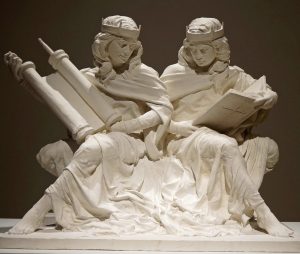
Synagoga and Ecclesia in Our Time (2015), by Joshua Koffman

Synagoga and Ecclesia in Our Time (2015), by Joshua Koffman

On the invitation to this conference and also on the huge display wall at the front side of the French Church of Friedrichstadt, we see two young women with crowns (princesses, perhaps?). They are similarly clothed, level with one another, and facing each other—each of them occupied with a scripture: the left one with a scroll, and the right one with a book marked with a cross—clearly a Torah and a Bible. What is special, however, is that neither looks (only) at her own scripture, but—in this moment—is interested in the scripture of the other.

The picture fascinates and confounds.

Such a composition is well known from medieval imagery. On almost all gothic churches we can find Ecclesia and Synagoga, an image of anti-Jewish theology with the message: Israel has been rejected; the Church has triumphed. But here, both figures are on the same level, made equal. They read their writings, but are also interested in the things that concern the other. This image of dialogue between Israel and the Church, created by Joshua Koffman, is entitled “Synagoga and Ecclesia in Our Time” (2015).

This representation symbolizes better than any other the protocol for the conference “Not Without the Old Testament.”

The background for this conference was the current, so-called “Slenczka Debate.” In 2013, the Berlin systematic theologian Dr. Notger Slenczka published a treatise in which he expressed concern that it might be time—in the intellectual tradition of Schleiermacher, Harnack, and Bultmann—to decanonize the Old Testament, i.e. perhaps to downgrade it to the status of the Apocrypha and in any case not to grant it the same status as the New Testament for Christian theology and for the Church.

This was certainly impetus enough to fundamentally reexamine the importance of the Old Testament for Christians and the Tanakh [Hebrew Bible] for Jews.

After greetings from Dr. Eva Harasta of the Protestant Academy and Dr. Julius H. Schoeps of the Moses Mendelssohn Center, the first session revolved around the question “Text and Politics.” Dr. Rolf Schieder spoke first on the theme of “The Political Responsibility of Christian Theology towards the Old Testament.” He criticized the fever of the debate, the style of the confrontation. It was important that technical questions be kept at the center. Slenczka’s thesis should therefore be taken seriously, insofar as he sees his position within the realm of Jewish-Christian dialogue. Christians should not worm their way into the covenant with Israel; they should respect the Old Testament as a record of Jewish faith. Finally, the speaker proposed a “dogmatic disarmament”—not to understand the canon as normative, but as a collection of texts for use in worship, teaching, and personal devotion. In this sense, the Old Testament is certainly part of the Christian canon.

Dr. Oliver Arnhold, Department Head for Protestant Religious Instruction in Detmold and Visiting Lecturer at the Universities of Paderborn and Bielefeld, examined aspects of the “Ecclesiastical and Theological Treatment of the Old Testament among the German Christians (DC).” Arnhold made it clear that the DC were no unified block, and provided various examples of gradations in the question of the status of the Old Testament. On the one hand, Friedrich Wienecke advocated for the maintenance of the Old Testament, while, on the other hand, Reinhold Krause called for a radical separation from the Old Testament and parts of the New Testament at the “Sport Palace Rally” [in Berlin in November 1933].

Arnhold gave a detailed outline of Walter Grundmann’s position in the “28 Theses of the DC”: The Old Testament is not of the same value as the New Testament; rather, it should serve as an example of the failure of the Jewish way (Thesis 12). The abandonment of the Jews by God resulted in the curse of God on this people—up to the present day (Thesis 13). And for his part, Siegfried Leffler, co-founder of the Thuringian Church Movement of the German Christians, wanted to replace the Old Testament with stories from German history.

A key institution for this movement was the “Institute for the Study and Eradication of Jewish Influence on German Religious Life” (“Dejudaizing Institute”), founded [by Grundmann] in 1939 in Eisenach. By 1941, Grundmann had managed to win about 180 associates for the scholarly work of the Institute, including 24 university professors from 14 Protestant theological faculties, along with ecclesiastical dignitaries and emerging scholars. These served voluntarily in working groups, research projects and publishing activities. A total of 46 research projects and workshops aimed to erase Jewish elements from theology and Church, among other things. In place of the Old Testament, personnel in the Grundmann Institute proposed the legends of German heroes and saints as the model and ideal for religious life.

“The Combination of Politics and Theology in the Controversy concerning the Old Testament: A Jewish-Civil Society Perspective”—this was the topic of the evening lecture by the Jewish Education scholar Dr. Micha Brumlik, who went into great detail about the life and thought of the theologian Emanuel Hirsch. Hirsch understood “Volk” as the concrete place, where the message of God is encountered. Thus he became a member of the German Christian Movement out of conviction, and the National Socialist Party too. In 1933 he proclaimed “a YES to the German year!” and praised Hitler “as an instrument of the Lord of all.” The Old Testament served for him as a demonstration of a false, inadequate understanding of God that should crumble. Brumlik pointed out that the line of tradition in which Slenczka stands includes not only Schleiermacher and Harnack, but also theologians like Hirsch, who fawned over National Socialism.

The second day of the conference—Wednesday, December 9, 2015—was devoted to the theme of “Text and Hermeneutic.” It was opened by Dr. Andreas Schüle, Professor of Old Testament Theology and Exegesis at the University of Leipzig, under the title “Bible Minus Old Testament: A Blind Alley.” At the outset he demonstrated that uncertainty arises if faith becomes “questionable” and people insist upon resources of certainty. The Bible is one such resource, but that idea is hard to understand outside of a worship service and outside of church. Along with Niklas Luhmann, Schüle describes the Bible as a “communications medium,” that with its diverse histories, ideas, images, and motifs can be understood in diverse ways and can withstand selective attacks. This is a very “low threshold” approach to the Bible: it is not understood as a norm; no dogmatic determinations are made; and so there is no strong awareness of a canon.

The attempt to decanonize the Old Testament or place it at the same level as the Apocrypha always results in a crisis situation: “The Old Testament will be up for debate when the gospel becomes murky.” So it is a crisis phenomenon, that we have to depart from the (seemingly!) murky in order for the (supposedly!) essentials to become clearer. The subject of the “Old Testament” has contributed to this crisis, in that it is understood essentially as a historical subject, oriented towards the past rather than the future. In this context, reference was made later in the discussion to the approaches of Frank Crüsemann und Jürgen Ebach.

The speaker listed several components of Schleiermacher’s thought which related to the Old Testament: the New Testament was the faith document of the early Christians; there were references to the Old Testament in the New Testament, but these concerned only historical aspects, not grounds of faith; the Old Testament was the legacy of a less developed religion, possessed therefore less dignity, and was perceived as somewhat alien, while the New Testament was understood to be distinct from the Old; the brilliance of the gospel was dulled by the proximity of the Old Testament.

Von Harnack took a more positive stance towards the Old Testament, particularly the Prophets. He sees in the Old Testament, however, a religion steeped in legalism and ritualism which was only broken by Christ; with Christ, the Old Testament had become irrelevant.

Gerhard von Rad thought very differently from this. For him, the Torah was not a monolithic block; rather, it witnessed to a movement “forwards,” because tradition had to be reinterpreted again and again. So also, the Jesus-event required interpretation, and this through recourse to the Old Testament, namely the Pentateuch, the Prophets, and the Wisdom Literature; this was not “e-mancipation” (leaving the Old Testament) but “mancipation” (taking the Old Testament in hand). Schüle’s closing point was that the question of Jesus Christ must once again be a component of Old Testament research. The influence of the Old Testament on the New Testament scriptures must be researched. Therefore, we can learn from Jewish biblical research.

The retired Württemberg state rabbi Dr. Joel Berger gave a lively presentation exploring “How Jews Read and Understand the Bible: An Orthodox Perspective.” Jews, as he began by asserting, do not “read” the Torah; they “study” it. Moreover, the Torah is not only “text” but also “revelation.” As he put it, “If Slenczka wants to leave us alone with the Old Testament—okay!” Scripture study is not about knowledge, but about living devotion, about imitating the saints. To learn from Abraham means to learn action.

After the Orthodox rabbi, a representative of the liberal wing of Judaism spoke: Rabbi Dr. Edward van Voolen of the Abraham Geiger College in Potsdam. His theme was “Love of Teaching: Jewish Exegesis of the Tanakh.” According to the rabbi, the Torah establishes tradition; the Torah was given to Moses, who passed it on to Joshua, who passed it on to the Elders and so on from generation to generation. Based on section Baba Mezi’a 59b of the Babylonian Talmud, van Voolen explained that the text of the Torah must be interpreted anew again and again, which represents our adulthood and with it our fundamental rejection of any dogmatism or fundamentalism. The interpretation of the Word of God is given into human hands. According to the Talmud Chagigah 3b, texts always contain several possible interpretations—even different ones. Does this lead to anarchy in exegesis? Not when the doctrine is being constantly renegotiated. Dialogue is necessary here.

The section on “Texts and Community” was opened by Dr. Alexander Deeg, Practical Theologian from Leipzig, and his paper “Hermeneutical Problems and Homiletical Opportunities: Preaching Texts from the Old Testament.” At the outset he introduced the discussion process with the compilation of a new series of pericopes. In doing so, he noted that there was great interest in including more Old Testament texts. Old Testament texts were not now perceived as foreign, but as true-to-life and of direct concern to people. In connection to this, he referred to the Protestant practice of reading daily watchwords: the nucleus of the watchwords is comprised of an Old Testament verse, to which a New Testament verse is matched. Moreover, self-selected scriptures for baptism, confirmation, and wedding ceremonies are often taken from the Old Testament. There are also countless examples of art and culture with Old Testament echoes. For instance, he found 3750 instances of biblical traces in modern lyrics alone.

One ground for this was that the Old Testament includes a wide variety of genres, and contains texts originating from an extremely long span of time and out of diverse life experiences. Exodus stories, lamentations, and biblical laws are not abstract treatises, but texts with great earthiness.

Concerning the “professorial problematization” of this enthusiasm for the Old Testament, the speaker stated that Jews are the first ones to whom these texts are addressed, and so it is easy to run the risk of monopolizing or even expropriating them. Beyond that, the choice of texts is rather selective: people choose “nice” selections and avoid “nasty” ones (displays of violence, psalms that curse). For many Christians, the Psalms constitute a natural supplement to the New Testament—baptized as quasi-Christian.

In dialogue between Jews and Christians, there must be an unlearning of the traditional Christian methods of handling the Old Testament, which rest on categories like “promise and fulfilment,” “universalist” versus “particularist,” “antithetical,” as in “christological interpretations.”

A new hermeneutic must be followed:

  1. The Old Testament is a necessary background of Christ, without which we do not know what we are talking about.
  2. The Old Testament describes a history into which we listen, in which we belong, but which, at the same time, is the history of Israel and Judaism.
  3. The Old Testament is the “No” to Jesus as the Messiah, which we have to hear and which protects us from any triumphalism.

To the last point, the texts of Israel illustrate that where there is a spillover of the promise [from Judaism to Christianity], there is also a void in the fulfillment, which makes it clear that we are both waiting, expecting—both separately and together.

From the Jewish side, Rabbi Dr. Andreas Nachama, Director of the Topography of Terror in Berlin, addressed the theme: “The Reception of the Biblical Text in the Community: Preaching on Texts from the Tanach.” His basic thesis concerning the debate at hand was that Jews can actually be, in the first instance, indifferent to the ways in which Christians see the texts of the Old Testament. Studying the Torah and the other scriptures forms the basis for the cohesion of the Jewish community. Studying the Torah means, in the first instance, that the text is carefully recited, intensively read. To understand, we have “to read not only the black of the letters, but also the white between them.” If we read the Old Testament only as a historical text, it is rather uninteresting; if, however, we read the text in such a way as to be personally involved, then the Passover story from Exodus, for example, becomes immediately existential: it is as if we ourselves are being liberated from slavery and bondage.

Jewish stories attempt to make the text come alive approximately in the manner of the Midrash. In this stream of tradition, the year 70 after that time is particularly important: the loss of the temple demands a paradigm shift. Religion can no longer be based on temple worship, priestly service, and sacrifice, but must now “work anywhere.” Out of the traditional religion of sacrifice, two new developments have emerged: Rabbinic Judaism and Christianity.

After the French Revolution, a liberal stream arose alongside the orthodox life of faith. Nachama explained the liberal approach using the example of dealing with homosexuality: the texts must be maintained, but the interpretation will change due to the fundamental changes in the cultural context, and after that the corresponding conduct will change. It is important in Jewish-Christian dialogue that Jews and Christians compare notes on their respective ways of handling the texts of the Tanakh.

The conference section “Text and Controversy” was cancelled, since the anticipated discussion participant Professor Slenczka refused to take part. In a letter to the speakers, he mentioned that the program—unlike what was previously discussed—ultimately pursued the goal of a “statement” of his position in order to arrange an “ostracism,” without him having the opportunity to adequately defend himself against “misinterpretations” and “insinuations.” He accused the Protestant Academy of “fear of debate.”

As a result, the final day—Thursday, December 10, 2015—began under the heading “Text and Jewish-Christian Dialogue,” with a presentation by Dr. Rainer Kampling, Professor of Biblical Theology at the Free University of Berlin. It was entitled, “‘For the One God is the Creator of Both’: A Roman Catholic Perspective.” Based on the document “Decretum de librissacris” from the Council of Trent (1546), the speaker explained that, without the Old Testament, not only would Christians be rid of their God, but also they would run into a linguistic homelessness in their religious existence. At the time of the Reformation, neither Protestants nor Catholics ever considered whether the Old Testament was fully valid, but rather only considered which scriptures could be taken in a more or less binding way. Thus the representative of the old belief, Eck, argued that the Maccabean Books were indeed not in the canon, but had to be believed canonically, while Luther retorted that only the canon is canonical.

On the question of the validity of the Old Testament and New Testament, the council determined that “Unus deus sit auctor” (“God alone is the author”), where “auctor” means “originator” and not “writer.” To fix the canon, the council decreed once and for all that the specified scope of the canon itself become an object of faith, and not only the content of the canon. Thus the Old Testament is in a full sense the Word of God, meaning that, in the Roman Catholic Church, no theology can modify this principle. This issue could well revolve around ways of reading.

So then the formula of the Pontifical Biblical Commission’s “The Jewish People and their Sacred Scripture in the Christian Bible” (2001): “The Jewish reading of the Bible is a possible one, in continuity with the Jewish Sacred Scriptures [from the Second Temple period].”

The closing session of the conference was comprised of a discussion round under the question “Where does Jewish-Christian dialogue stand, and where is it going?” with the participants: Bishop Markus Dröge, Professor Julius H. Schoeps, Professor Christoph Markschies, Rabbi Joel Berger, Professor Rainer Kampling und Professor Micha Brumlik, moderated by Dr. Werner Treß und Dr. Eva Harasta.

Brumlink began from the concept of “shyness with strangers” (“Fremdelns”), which—in the development of a child—is always noticeable when fears arise due to changes in the environment and the child has to form new relationships. The stranger can appear as a source of fascination or trembling.

Bishop Dröge showed—starting with the image of a pulpit with Moses as a fundamental pillar—that Judaism has a continuing importance as a sign of God’s faithfulness. Moreover, the Church must repeatedly “make clear the fundamental role of the Jewish faith for the Christian faith.”

Schoeps referred to the “Rhenish Synodal Resolution” of 1980. At that time, he was full of hope for the dawn of better times; but then the resolution was repeatedly criticized by various parties (and immediately by the Bonn and Münster theological faculties), who fundamentally rejected the resolution. For Schoeps, this aroused a skepticism over the sense of Jewish-Christian dialogue.

State Rabbi Berger was intensely critical of the behavior of specific parts of the Protestant Church (“Pietcong” [i.e. radical Pietists] in Württemberg parlance), asserting that dialogue would be used as a cover for pure Jewish mission, and that with highly questionable methods. Along the way, he called attention to the destructive activity of the so-called “Messianic Jews.”

The church historian Christoph Markschies pointed to the guilty history of theology at German universities. At the “Institutum Judaicum” [a preparatory course for Protestant theologians intending to engage in missionary work among Jews], the Old Testament was taught as a “placeholder of pre-Christian experience of God.” He expressed the wish that an information sign would be placed beside the memorial plaque for Dietrich Bonhoeffer in Berlin’s Humboldt University, which would indicate that in 1936 this university dismissed Dietrich Bonhoeffer as private docent, and moreover that the church historian Erich Seeberg energetically campaigned for the abrogation of the Old Testament and its replacement with texts from Meister Eckhart.

Professor Kampling stressed that since the [Second Vatican] Council resolution “Nostre aetate”—promulgated exactly 50 years ago and just now this day again realized through a Vatican pronouncement—it has become increasingly clear that Judaism is in salvation; Jesus as the mediator of salvation remains a mystery. “There is a thin trace of friendliness towards Jews in the history of theology!”

Overall, it was agreed that Jewish-Christian dialogue has generated many positive things. Bishop Dröge brought forth as evidence “Study in Israel” [a year-long study program for German theology students at the Hebrew University in Jerusalem], new exegesis (“Preaching Meditations in Christian-Jewish Context” [a publication from “Study in Israel”]), various meetings and significant changes in preaching and religious education. Brumlik even spoke of a “success story.”

More critically, Professor Markschies noted that the departure taken in 1980 had not been carried on decisively enough, especially in the direction of the theological education of the following generations. Many emerging theologians simply lack a solid study of the Old Testament. Correspondingly, Micha Brumlik asserted that it is necessary for more Jewish people, especially from the younger generation, to become interested in Jewish-Christian dialogue. The Reformation jubilee of 2017 would surely illustrate this—there are still aspects [of the Jewish-Christian relationship] to be negotiated that revolve around more than simply narrowly religious matters.

Finally, it must be noted that despite the refusal of Slenczka to attend the meeting, a productive exchange of views took place, in which both Jews and Christians highlighted the importance of the Old Testament. The presentations illustrated how much the question of the importance of the Old Testament relates to the very core of Christian theology. It became clear that not the detachment but the engagement with the diversity and the richness of the canon is not only theologically necessary but also illustrative of the great benefit derived for Christianity from the participation in the Hebrew Bible. Thus the title image for the conference—the sculpture “Synagoga and Ecclesia in Our Time” by Joshua Koffman—was very well chosen. The artwork illustrates how Jews and Christians can enter into a dialogue on eye level with one another on the foundation of a common collection of texts, and how the will of God can be rightly understood in their sacred scriptures.

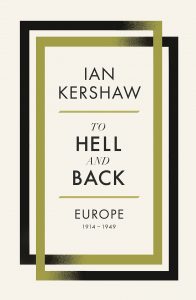
Share

Conference Report: Faith and the First World War, University of Glasgow, 21-23 July 2016

Contemporary Church History Quarterly

Volume 22, Number 3 (September 2016)

Conference Report: Faith and the First World War, University of Glasgow, 21-23 July 2016

By Geoff Jackson, Ambrose University

In late July, I had the opportunity to participate in the “Faith and the First World War” conference at the University of Glasgow. The conference explored the wide diversity and significance of religious faith for those who experienced the First World War, addressing themes such as faith in the armed forces and on the home front, religion, war resistance and the peace crusade, as well as the role of religion in remembrance.

The keynote address was delivered by Michael Snape of Durham University, a leading Anglican historian, who delivered the fascinating paper “From Flanders to Helmand: Chaplaincy, Faith and Religious Change in the British Army, 1914-2014.” While commenting on the obvious differences between the ways wars have been fought from the First World War to present-day conflicts in Afghanistan and Iraq, he argued that the role of chaplains was largely unchanged. He demonstrated convincingly that the relationship of faith to soldiers was still as important today as it was 100 years ago. This idea of faith and soldiers was the dominant theme of the conference, and ran throughout most of the presentations.

The papers covered a broad range of themes ranging from discussion of the use of the Old Testament in mobilizing Germans for the war effort to comparative studies on how the Scottish and Irish Reformed churches participated in the First World War. Gerhard Besier of the Technical University of Dresden presented on “Harmonizing Conflicting Demands and Emotions: Christian Believers during WWI.” Cyril Pearce of the University of Leeds examined Christian war resisters and their protests during the war. Pearce has mined war documents, letters, images, tribunal records and diaries to create a list of over 16,000 First World War conscientious objectors. He has also begun mapping these names, where possible, to identify communities were conscientious objection was more prevalent.

Another excellent paper was British archivist James W. Fleming’s “‘All war being contrary to the spirit and teaching of Jesus Christ I could take no part in its prosecution’: Faith and Conscientious Objection in the First World War.” Fleming analyzed conscientious objector applications–both those that were accepted and those that were denied. This could be a valuable source for those interested in studying the topic.

My (Geoff Jackson’s) paper examined the role of Canadian chaplains as part of the larger British Expeditionary Force. It examined the role of Church of England chaplains through the optics of a transnational study to demonstrate that Anglican chaplains, as part of the same religious organization, played similar but distinct roles in various national contexts. The paper argued that, depending on which national army the chaplains were working under, they had different objectives, motivations, outside influences and pressures, all of which affected the care they were able to administer to the soldiers. It generated some fascinating debate, and I also received a book from a chaplain who saw service in Afghanistan and Iraq–a really special treat.

The third day of the conference examined the role of women peace crusaders. The opening paper, “‘If Christ could be militant so could I’: Helen Crawfurd and the Women’s Peace Crusade, 1916-1918,” was delivered by activist and historian Lesley Orr, previously of the Universities of Glasgow and Edinburgh. The balance of the day was spent on a walk to commemorate the first Women’s Peace Crusade. In its original form, the first Women’s Peace Crusade marched from George Square to Glasgow Green, drawing crowds of thousands. This Crusade grew into a mass international women’s peace movement. Since early 2016 a group of amateur women historians have been discovering some of the remarkable women involved. 100 years later to the day a similar parade was held (albeit, with far fewer participants). It was a poignant walk on a fortunately sunny day.

The people and campus of the University of Glasgow were fantastic. I had the chance to explore the university and its chapel which was built in remembrance of the students who fought and died during the First World War. This conference reinvigorated my desire to research Canadian chaplains and their roles in the First World War.

Share

Film Note: Nazi Law: Legally Blind (2016)

Contemporary Church History Quarterly

Volume 22, Number 3 (September 2016)

Film Note: Nazi Law: Legally Blind (2016)

By Christopher Probst, Washington University in St. Louis, University College

Nazi-LawIn post-WWI Germany, law had been  a most respected entity, with the country thriving thanks to its most capable lawyers and judges, many of them Jewish. In 1933, no law could inhibit the Third Reich’s political and military rise to power. In a step-by-step process, the National Socialist government dismantled constitutional law, usurped justice and created a lethal totalitarian system that soon engulfed Germany and all of Europe. Redefining the nation as a pure political and biological organism, the Nazi government imposed legislation that reinforced its ideological program in all aspects of German life, with a focus on race, business, religion and medicine. Filmed at Boston College during a conference on Nazi law, as well as  in Nuremberg, Munich and Dachau, this documentary relies on the expertise of scholars from Germany, France, Israel and the US. They come from the areas of medicine, law, Jewish Studies, theology and other disciplines.

The film is co-produced by John J. Michalczyk and Susan A. Michalczyk. For more information, please see the Etoile Productions website or contact Professor John J. Michalczyk.

Share

Call for Papers: Religion and Ethno-nationalism in the Era of the World Wars

Contemporary Church History Quarterly

Volume 22, Number 3 (September 2016)

Call for Papers: Religion and Ethno-nationalism in the Era of the World Wars, May 21-23, 2017, University of Toronto

The Jack, Joseph and Morton Mandel Center for Advanced Holocaust Studies, United States Holocaust Memorial Museum and the Chancellor Rose and Ray Wolfe Chair of Holocaust Studies, University of Toronto invite scholars, including advanced graduate students, to submit applications for a symposium on religion and ethno-nationalism in the first half of the 20th century. The symposium will conduct a broad comparative and transnational examination of the intersections of religion, ethno-nationalism, fascism, antisemitism, and violence during this period. By analyzing the ways in which religious groups, institutions, and networks engaged political and social upheaval in and beyond Europe, we hope to identify broader patterns that can deepen our understanding of the dynamics shaping the roles of religious actors before and during the Holocaust.

Applicants should propose papers based on new research (including work-in-progress); submissions may focus on specific case studies or the broader themes suggested above. Papers will be pre-circulated to all participants. We especially invite applications from emerging scholars and from scholars across a range of disciplines whose work addresses a variety of geographic, religious, and linguistic traditions. Conference proceedings and papers will be in English. Travel costs, accommodations, and some meals will be covered for accepted participants.

Please submit a 1-2 page CV and a 1 page application including: a description of the proposed paper; a short explanation of the stage of your research (i.e., work-in-progress, new paper, previously published); and a brief statement on how your research and expertise might contribute to a broader discussion of the larger themes of the symposium.

Please submit applications as a single PDF to Dr. Rebecca Carter-Chand, Symposium Coordinator, at r.carter.chand@utoronto.ca by October 1, 2016. Accepted applicants will be notified by November 15, 2016.

The symposium chairs are Victoria Barnett, Director of the Programs on Ethics, Religion, and the Holocaust, United States Holocaust Memorial Museum; Doris Bergen, Chancellor Rose and Ray Wolfe Professor of Holocaust Studies, University of Toronto; and Kevin P. Spicer, C.S.C., James J. Kenneally Professor of History, Stonehill College.

Share

Article Note: Ján Liguš, “Obedience or Resistance: The Legacy of Bonhoeffer”

Contemporary Church History Quarterly

Volume 22, Number 2 (June 2016)

Article Note: Ján Liguš, “Obedience or Resistance: The Legacy of Bonhoeffer,” European Journal of Theology 24:2 (2015), 173-182.

By Heath Spencer, Seattle University

In this article, Ján Liguš offers a brief overview of Bonhoeffer’s theology with a focus on church-state relations, submission to legitimate authorities, and conditions under which Christians might practice passive disobedience or actively resist the state. Liguš notes that even before the Nazis came to power, Bonhoeffer was already exploring the boundaries of church and state and emphasizing God’s sovereignty over both. In Das Wesen der Kirche (1932), Bonhoeffer drew a distinction between the Church as a visible institution and the Kingdom of God that transcends it and “includes in itself all races, cultures [and] religions” (175). He also reflected on the limits of secular authority, asserting that “if the state prevents the proclamation of the Word of God, conflict will arise and the Church can criticise and disobey the state” (176). Similarly, in The Cost of Discipleship (1937) and Life Together (1939), Bonhoeffer stressed surrender and submission to the will of God, which might require civil disobedience but precluded rebellion. Liguš describes this position as a “pacifist theological-ethical orientation” that Bonhoeffer later gave up (178). Not until Ethics, which Bonhoeffer began writing in 1940, does Liguš find a theological-ethical justification for resistance. By that point, Bonhoeffer’s understanding of freedom and responsibility, inspired by Jesus’ voluntary acceptance of guilt due to his love for a sinful humanity, allowed him to take on the guilt of participating in a conspiracy that included an attempt to kill the head of state. Here, Liguš follows the interpretation of Larry Rasmussen’s Dietrich Bonhoeffer: Reality and Resistance.

Liguš’ aim is not only to explain what led Bonhoeffer from his earlier pacifism to participation in an assassination plot, but to identify elements in Bonhoeffer’s theology that were helpful to Eastern European Christians under communist regimes and that continue to offer hope in the present moment, when “the vast majority of people regard the church as irrelevant” (180). The article begins by comparing Bonhoeffer to reformer and martyr Jan Hus and ends with Bonhoeffer’s confidence that “the day will come” when Christians “will once more be called so to utter the word of God that the world will be changed and renewed by it” (Letters and Papers from Prison, quoted on 180).

Unfortunately, Liguš fails to integrate his assessment of Bonhoeffer’s theology with recent historical research on Bonhoeffer and the German churches during the Third Reich. The result is an oversimplification of the “church struggle” as a contest between Nazism-free orthodoxy and Nazism-infused heresy. For example, Liguš’ claim that the German churches “departed from the heritage of Martin Luther” (174) during the Nazi era fails to address the fact that many Protestant National Socialists were inspired by Luther and believed they were carrying his work forward. A more subtle version of the same argument is apparent when Liguš writes that Bonhoeffer was “initially influenced by the biblical scholar Adolf Schlatter” but “had to deal with prominent liberal theologians Adolf von Harnack and Reinhold Seeberg” (174, emphasis mine).

The article also suffers from a lack of attention to other dimensions of Bonhoeffer’s life that contributed to his uniqueness—even within the Confessing Church—as well as his decision to participate in the conspiracy. There is little discussion of the political orientation of his family (of which four members were in the resistance), the fact that he had a brother-in-law of Jewish ancestry, or the impact of his experiences living abroad. Some statements are also misleading, as when Liguš emphasizes the piety of Bonhoeffer’s mother but fails to mention that the Bonhoeffers were not a church-going family. Robert Ericksen, by way of contrast, has suggested that Bonhoeffer’s limited exposure to Christianity as a child might have been an advantage, given that so many church-going Protestants ultimately supported Hitler (see Ericksen, Complicity in the Holocaust, 112-114). Finally, there is very little attention to Bonhoeffer’s responses to (and at times neglect of) the “Jewish Question,” even though Bonhoeffer’s famous essay on this topic in 1933 considers the possibilities of criticism, amelioration, and resistance to state policy on the part of the Church.

The strength of Liguš’ article is that it takes seriously both the pacifism and the resistance of Bonhoeffer. However, the search for a second Jan Hus is best served by a close examination of Bonhoeffer in his historical context, with full awareness of its complexity and ambiguity.

Share

Article Note: Samuel Koehne, “The Racial Yardstick: ‘Ethnotheism’ and Official Nazi Views on Religion”

Contemporary Church History Quarterly

Volume 22, Number 2 (June 2016)

Article Note: Samuel Koehne, “The Racial Yardstick: ‘Ethnotheism’ and Official Nazi Views on Religion,” German Studies Review 37, no. 3 (2014): 575–596.

By Kyle Jantzen, Ambrose University

Over the past few years, Samuel Koehne of the University of Melbourne has published a series of insightful articles on National Socialist views of religion, as disseminated in various official publications. In this article, he revisits the problematic text of Article 24 in the 1920 Nazi Party Program, interpreting it in light of four other documents: the 1919 Grundsatz or Foundational Principle of the German Workers’ Party (predecessor to the 1920 Nazi Party Program), Adolf Hitler’s Mein Kampf (1925-1926), and—most importantly—Alfred Rosenberg’s 1923 and Gottfried Feder’s 1927 commentaries on the Party Program. Koehne has chosen these in part because he wants to understand what National Socialists had to say about their religious policies before they took power in 1933.

Koehne is unsatisfied with the existing conflicting interpretations of Nazi religious policy. He argues that Nazism was neither a neo-pagan religious movement, nor a political religion, nor a quasi-Christian movement. Rather, he advances “a new conceptual approach: ‘ethnotheism,’ or religion defined by race and the supposed moral or spiritual characteristics that the Nazis believed were inherent in race” (576). Ethnotheism, writes Koehne, was the unifying principle around which a wide array of religious beliefs could flourish under National Socialism. Within Article 24 of the 1920 Party Program, ethnotheism is found in the Nazi determination to oppose any kind of religious doctrine which might “endanger [the state’s] existence or offend the ethical and moral feelings of the Germanic race” (588). Importantly, Koehne argues that the subsequent sentence about the Party’s support for “positive Christianity”—normally seen as the centrepiece of Nazi religious policy—was less important. It was purposely vague, he suggests, and had no precedent or subsequent life within Nazi statements on religion. In contrast to this, the 1919 Foundational Principle of the German Worker’s Party proposed “non-interference in religious matters, except as they were matters of state or threatened the existence of the people or nation (Volk) and its ‘morality and ethics,’” as did other völkisch parties (580). This elevation of race over religion was the central principle at work, and the source of Koehne’s ethnotheism.

Koehne identifies several key Nazi ideas: that religion caused division, which would only be overcome by a common commitment to antisemitic racial nationalism, and that morality was blood bound. As Nazi ideologue Alfred Rosenberg put it, “Morality is completely racially conditioned, and not abstract Catholic, Protestant or Muslim” (582). Similarly, ideologue Gottfried Feder proclaimed that Nazism would attack any religious teachings that offended German morality (583). And Hitler wrote much the same thing in Mein Kampf, where he rejected mixing of politics and religion and argued that pious German Protestants and Catholics would be united in a joint völkisch world view and racial struggle against the Jew (585). Indeed, this “ecumenicism of National Socialism” was what accounted for the strange mixture of Norse religion and Christianity in the work of Rosenberg. Any number of religious beliefs could be practiced under the banner of antisemitism, racial morality, and the swastika, “an Aryan symbol of renewal” (587). All this is supported by Feder’s arresting assertion that Article 24 in the 1920 Party Program was “the spiritual foundation of the entire position of National Socialism towards the Jews” (588).

Koehne’s position draws on important sources and is well-argued. Moreover, it fits with other elements of Nazi ideology, such as Hitler’s assertion that the soul of a people was contained in its blood, or that Jews (with impure blood) were devoid of spiritual capacity. It also accounts for the confusing and contradictory religious statements made and religious practices supported by leading Nazis. There is good potential in Koehne’s concept of ethnotheism. We look forward to its continued development.


Share