Contemporary Church History Quarterly
Volume 32, Number 2 (Summer 2026)
Review of Marlene Pape, August Marahrens: Der erste Bischof der Landeskirche Hannovers (Vandenhoecht & Ruprecht, 2025).
By Manfred Gailus, Technische Universität Berlin, as originally published in Zeitzeichen (January 2026). Translated from the German by Lauren Faulkner Rossi, with the assistance of DEEPL.
Finally, it’s here: the thoroughly clarifying, scholarly biography of August Marahrens, the first bishop of the Hanover Regional Church. We’ve had to wait long enough for it. After 1945, Bishop Marahrens was controversial in Hanover for a long time. Now, hopefully, he is no longer so.
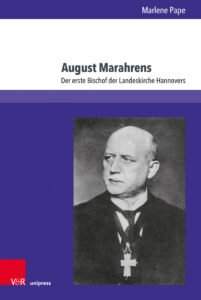 This church history dissertation, now available and supervised by Thomas Kaufmann in Göttingen, is a 500-page book that provides sufficient clarity. Marahrens, whose tenure as bishop largely coincided with the Hitler era, was an avowed Lutheran and, at the same time, a staunch National Socialist who revered and admired Hitler. He could be called a doubly-professed National Socialist Christian. Many contemporaries today believe that such a mental balancing act simply does not add up. The Hanoverian church leader Marahrens and many other renowned Protestant theologians of the Third Reich show that such dual faith was indeed possible and can even be considered a specific characteristic of the Nazi era.
Marlene Pape’s biography is the first to examine Marahrens in his entirety, including his family background, upbringing, education, and early career steps leading up to his election as bishop in 1925. The bishop painted a bleak picture of the Weimar Republic and longed for a new beginning. He saw this in the National Socialist movement, from which he hoped would bring about an end to the allegedly unbridled modernity, a return to Christianity, and a new cultural conservatism amongst Germans. He repelled the attack by the German Christians on the Hanoverian church. At the same time, he was unsurpassed by almost any other church leader in his expressions of loyalty to Hitler and National Socialism. Marahrens had the strange talent of remaining silent in the Third Reich when he should have spoken as a Christian, and speaking when he would have been better off remaining silent. His signature on the Godesberg Declaration of 1939 (here in the modified version of the “Five Principles”) initiated by Nazi Reich Church Minister Hanns Kerrl—the text affirms a commitment to the National Socialist worldview as “a völkisch-political doctrine that determines and shapes the German people. As such, it is also binding for Christian Germans” – was certainly one of his greatest sins; many more followed during the war until the bitter end in 1945.
No less shameful was the bishop’s lack of insight in the years 1945 to 1947, when he continued to hold office and believed that, apart from a few ‘mistakes,’ he had nothing to reproach himself for and could have a clear conscience. It was also regrettable that his ecclesiastical court in Hanover clung for many decades to his supposed reputation, to his Nazi-friendly performance in the Third Reich. Margot Käßmann, who served as bishop in Hanover from 1999 to 2010, could certainly have done more to shed light on this chapter of history. With this thorough biography now available, the proud defiance of Lower Saxony should be overcome.
Reading this source-based, carefully considered study is recommended especially to all pastors of the Hanover Regional Church, so that they know in what legacy they stand. But of course, the study is also recommended to anyone who wants to know how it was possible to go so badly wrong during the Hitler era while maintaining a clear Christian conscience. It is to be hoped that this important church history “from above” will soon be followed by a complementary history of the Hanover regional church “from below,” which will examine the performance of the Lower Saxony church region in its entirety at the parish level. Once this has been done, it will no longer be possible to speak of an “intact church” for Hanover from 1933 to 1945. Dietrich Bonhoeffer wanted to deny to Marahrens the label “Confessing Church” as early as 1936 after the Oeynhausen Confessional Synod: he said he had never belonged to it. Instead of speaking of “intact” for 1933 to 1945, it would probably be more appropriate to characterize the Hanover regional church as a conformist, Nazi-sympathizing church during the Third Reich.
