Contemporary Church History Quarterly
Volume 32, Number 2 (Summer 2026)
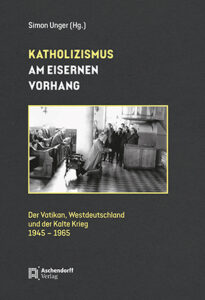
Review of Simon Unger, ed., Katholizismus am Eisernen Vorhang: Der Vatikan, Westdeutschland und der Kalte Krieg, 1945-1965. (Münster: Aschendorff Verlag, 2026). pp. 237.
By Maria D. Mitchell, Franklin & Marshall College
Edited by Simon Unger, Assistant Professor of Modern European Christianity at Princeton Theological Seminary and Principal Investigator of the research group The Global Pontificate of Pius XII at the German Historical Institute in Rome, this volume significantly enriches our understanding of the Vatican’s role in the Cold War. While the authors offer fresh information and insights – more than half the chapters showcase documents released in 2022 by the Vatican Apostolic Archive (Archivio Apostolico Vaticano, AAV) on Pius XII (1939-1958) – the book’s larger framing of conflict between conservatives and reformers paints “a differentiated picture of Catholic Church history in the postwar era” (22). With West Germany as its focus, the collection not only complements existing studies on Vatican foreign relations, but its revelations and analyses shed important light on Cold War politics.
 If Pope Pius XII looms large over any consideration of twentieth-century relations between the Vatican and Germany, Unger’s consideration of the Vatican’s role in Europe’s reconstruction, the early Cold War, and decolonization argues for a broader, if paradoxical, view of Pius XII beyond “World War Pope.” On one hand, the Vatican remained silent about the Holocaust and forged close relations with dictators such as Franciso Franco. On the other hand, Pius XII was “the first pope to speak positively about democracy, encourage the Church’s globalization, and promote processes of decolonization” (7). Apostolic Nuncio to Bavaria (1917-1920) and Germany (1920-30) before negotiating and signing, as Cardinal Secretary of State, the Reichskonkordat in 1933, Pius XII’s embrace of the Federal Republic and, in particular, West German Chancellor Konrad Adenauer’s government would inspire his nickname Papa Tedesco, the German Pope.
The Pope’s special relationship to Germany is showcased in an outstanding chapter co-authored by Maddalena Alvi and Simon Unger, “Pius XII and German Rearmament, Vatican Responses to the ‘Stalin Note’, 1951-52.” Here the authors rely on recently released AAV documents pertaining to Stalin’s 1952 proposal for a unified, neutral Germany, in particular exchanges between the American Bishop Aloysius [sic, Aloisius] Muench, Apostolic Nuncio in Bonn (1951-59), and Domenico Tardini, Pro-Secretary of State for Extraordinary Ecclesiastical Affairs in the Vatican (1952-58), respective intermediaries between Adenauer and Pope Pius XII. Mutually informed by deep-seated anti-communism and utopian visions of a unified Catholic West (Abendland), the Vatican regarded Adenauer’s Christian Democratic administration as its “closest ally in Europe” (148) while Adenauer “considered the Holy See as perhaps his closest foreign policy interlocutor” (138). Interventions with the French and American governments to coordinate opposition to Stalin’s Note were part of the Vatican’s broader anti-communist crusade and geopolitical strategy (148) that, the authors assert, culminated in West German rearmament and NATO membership. Stefan Samerski amplifies these themes, including Pope Pius XII’s strong ties to West Germany and Adenauer, in his chapter, “Neutralität oder Westorientierung? Pius XII., das politische Deutschland und der Korea-Krieg,” on the Vatican and the Korean War. In particular, Samerski highlights how the Korean War intensified the Vatican’s anti-communism while enhancing Pius XII’s foreign policy status among western governments.
If Pius XII figures prominently in this survey, he is rivaled for prominence by the American Muench. “Ein Vatikanischer ‘Vorposten’ in Nachkriegsdeutschland: Die Päpstliche Mission in Kronberg und Bischof Aloysius [sic, Aloisius] Muench 1945-1951” by Francesco Tacchi underscores Muench’s central role, as Vatican representative in occupied Germany, in facilitating communication between the Vatican, the American episcopate, U.S. military occupiers, and German Catholics, for whom Church officials served as unofficial spokesmen to the Western allies. That Tacchi describes his essay as preliminary to a projected, more comprehensive, investigation (44) sets the stage for “Der Kalte Krieg, das vatikanische Staatssekretariat und deutsche Kriegsverbrecher,” Suzanne Brown-Fleming’s investigation of the Vatican’s defense of German war criminals, including Foreign Office State Secretary (1938-1943) and Ambassador to the Holy See (1943-1945) Ernst von Weizsäcker. Brown-Fleming’s contribution, which includes long excerpts from newly released AAV documents, highlights Catholic leaders’ distrust of Jewish American occupation officials, whom they describe as driven by the “mosaic” law of “an eye for an eye” (49). In a March 1949 report titled “Activities of the Israelites (Israeliten) in Germany,” for example, Munch complains about the prominence of German Jewish refugees in the Counter Intelligence Corps and Information Control Division, suggesting it was well-known that the majority of personnel involved in postwar trials, especially in Nuremberg, were Jewish Germans [sic] returning to impose a harsh peace – not “in the spirit of reconciliation, but in the spirit of vindictiveness” (55); only a small minority, he maintained, were of “impeccable character” (55). Brown-Fleming’s portrayal of Vatican interventions on behalf of accused war criminals contrasts with that of Anna Veronica Pobbek, whose concise chapter, “Late Conversions: Requests for Pardon and Conversions to Catholicism of Nazi War Criminals,” also relies on recently released AAV documents to examine pardon requests and war criminals’ Catholic conversions. If her case study of Oswald Pohl, a prominent defendant in a Nuremberg Military Court trial, underlines his lack of remorse, Pobbek concludes that the Vatican, in order to side with the victors, was generally prudent in its interventions on behalf of accused Nazi party officials (89).
While Tacchi’s and Brown-Fleming’s contributions focus on one aspect of Muench’s postwar role, Josef Christian Schmitt and Florian Bock illuminate another in “Prälat Böhler degradieren? Eine Beschwerde des Vatikans 1956 und ihre Folgen,” in which they outline internal Church controversies involving Muench and Wilhelm Böhler, Secretary General of the Catholic School Organization of Germany and the Episcopal Central Office for Religious Schools and director of the Katholisches Büro Bonn, the German Bishops Conference’s so-called “Catholic Office.” Böhler’s prominence in postwar German Catholicism – many politicians believed he spoke for the entire Catholic Church – was facilitated by Cologne Archbishop Josef Frings, who in 1948 named Böhler his representative to the Parliamentary Council. Böhler’s special status – no other country boasted a Catholic Office in addition to an Apostolic Nuncio – raised alarm bells in the Vatican where, at the Pope’s behest, Tardini charged Muench with investigating Böhler’s position. While Muench resented Böhler for appearing to profile himself, Böhler became increasingly suspicious of Muench’s and Münster Bishop Michael Keller’s undercutting. If Schmitt and Bock risk overestimating the monolithism of Catholic Christian Democrats while understating the Catholic Church’s influence on West German politics, their depiction of the complex interactions between the Vatican and West German Church expertly illuminates papal hopes and disappointments regarding the young Federal Republic’s political and ecclesiastical structures.
In “’The Holy Warfare of Christ,’ The Vatican’s Aid to Displaced Persons and Refugees in the Aftermath of World War II,” Katarzyna Nowak relies on newly available AAV sources to offer an exceptionally well-written and researched chapter on the Vatican’s aid to displaced persons and refugees. By exploring how anticommunism and international ambitions drove the Vatican to “carve a space for papal charity in the landscape of rapidly professionalizing, secularizing, and Americanizing humanitarian relief” (91), Nowak demonstrates how the pope deployed material aid to enhance global influence, giving lie to Vatican claims of apolitical humanitarianism. To wit, the Vatican Mission in Germany initially distributed aid to all inhabitants of concentration and Displaced Person camps, including Jews, but as the Church began “downplaying war crimes and assisting Nazi criminals” (102), it prioritized German Catholics, particularly anti-communists and ethnic German expellees as recipients.
Marion Dotter’s chapter, “Zwischen Papst und Partei: Politische Strategien der Katholischen Kirche in Österreich zur Wiedererrichtung des Konkordats auf nationaler und internationaler Ebene in der Nachkriegszeit,” sheds additional light on the significance of anti-communism to postwar Catholic politics. Her analysis of the Vatican’s desire to reestablish the Austrian Concordat underscores the pope’s dual role – as spiritual leader of Catholic Europeans on the one hand and domestic political actor on the other (117). By treating the Austrian Church as a group of diverse actors with regional and national goals (111), Dotter teases out how Church officials navigated the space between domestic political opposition to the concordat and papal global priorities. (Ultimately the concordat was readopted 1957 with revisions.)
Intersections between papal and domestic politics in the Cold War also frame the book’s final chapter, “Rolf Hochhuth, The Deputy, and Cold War Tensions,” in which Mark Edward Ruff recounts the dramatic story of staging the early Federal Republic’s most controversial play, “The Deputy” by Hochhuth, in the Soviet Bloc. Penned by the self-described “lax Protestant” (195) in 1963, “The Deputy” provoked unprecedented controversy regarding the Vatican’s wartime role by accusing Pius XII of sacrificing Holocaust victims to Church wealth and power. As Hochhuth held Catholic leaders and politicians responsible for betraying Christian ideals, his charge of wartime immorality posed a broader challenge to Catholic political legitimacy. Catholic fears that Hochhuth’s attacks on the pope would feed communist propaganda proved well-founded, especially after Hochhuth – out of a combination of vanity, financial gain, and nationalist desire for German unification – permitted Soviet Bloc performances of “The Deputy.”
By integrating communist Europe into his narrative, Ruff joins Alvi and Unger in providing a broader geography for this wide-ranging survey of Vatican-German Cold War relations. The variety of approaches and topics and especially integration of AAV sources recommend this collection for all scholars, not only those of postwar Church history and Catholic politics. While the volume would have benefited from a glossary of abbreviations (including all archives and libraries) and additional copy-editing, especially of the bibliography, its intellectual quality is unimpeachable. By demonstrating the centrality of postwar Germany to Catholic history as the “culmination and testing ground for Vatican foreign relations” (8), the volume underscores the salience of religion to the early Cold War.
