Contemporary Church History Quarterly
Volume 32, Number 2 (Summer 2026)
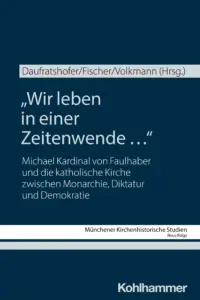
Review of Matthias Daufratshofer, Moritz Fischer, Peer Oliver Volkmann, eds. “Wir leben in einer Zeitenwende. . .“ Michael Kardinal von Faulhaber und die katholische Kirche zwischen Monarchie, Diktatur und Demokratie. Stuttgart: Kohlhammer, 2025. ISBN 978-17-045993-9.
By Martin Menke, Rivier University
This volume is the result of a conference related to the project, funded and supported by various private and church organizations, to digitize Cardinal Michael Faulhaber’s diaries and other texts, all of which are now available. In the introduction, the editors note that in the already-controversial history of the Catholic Church in interwar Germany, the assessment of Faulhaber’s life remains particularly controversial. The volume is intended to ground this debate on a more evidence-based footing. Not only is digitalization a great aid to scholars, but those preparing Faulhaber’s Nachlass also mastered the obsolete Gabelsberger shorthand that the cardinal used to record his thoughts and activities.
 The editors argue that Faulhaber’s development reflects the intellectual and practical development of conservative German Catholics in the first half of the twentieth century. At his core, Faulhaber never lost his conservative and hierarchical preference for monarchism, but adjusted pragmatically to serve the needs of the church and its faithful. In particular, the editors claim, Faulhaber’s development reflects the changing relationship between religion and politics, and between Catholicism and political ideologies, particularly National Socialism. Finally, studying Faulhaber illuminates the “theological and denominational history of the times as well as its structures and networks” (11).
Noteworthy is a brief note written by Cardinal Reinhard Marx, current archbishop of Munich and Freising, whose archives hold the Faulhaber Nachlass. “Nothing, none of that which can be found in the archival record, can do more damage to the church than the suspicion that the church would wish to conceal or omit part of the historical record. Historical research is no opponent of the church but instead is an absolutely necessary helper in the search for truth.”(20) If only all church authorities were like-minded.
In the first contribution, Hubert Wolf, professor at Münster and possibly the dean of German Catholic historians today, portrays Faulhaber’s thinking in the early Weimar Republic as reactionary. Wolf focuses on Faulhaber’s rejection of revolution and popular sovereignty at the 1922 German Catholic Assembly in Munich. Wolf notes that, while the Osservatore Romano published the archbishop’s speech on its front page, it ignored the response by Cologne Mayor Konrad Adenauer, the Assembly’s president. Similarly, Pope Pius XI congratulated Faulhaber on his firm stance consistent with the church’s antimodernism. Adenauer, of course, but also Nuncio Eugenio Pacelli disagreed. Adenauer accepted Pope Leo XIII’s theory of accidentalism, while Pacelli believed that the Weimar constitution provided the church greater autonomy than during the Wilhelmine regime. Wolf concludes that Pacelli’s later willingness to negotiate the Reich concordat may have sought to preserve that autonomy.
Matthias Daufratshofer uses the newly available records to investigate Faulhaber’s relationship with Pacelli. Faulhaber appears in Pacelli’s digitized records 315 times, mostly before Pacelli’s move to Berlin. The nuncio appears 817 times in the Faulhaber records. It appears the two consulted frequently, usually briefly. Daufratshofer disagrees with Hubert Wolf’s account of Pacelli’s assessment of the Faulhaber speech, argues there is sufficient evidence not only of personal closeness but also agreement in most political and ecclesiastical matters. Nonetheless, Daufratshofer notes that, according to Faulhaber’s records, he urged Pacelli to seek refuge in a Bavarian monastery during the revolution and, in contrast with later accounts, did not urge the nuncio to flee to Switzerland. Daufratshofer concludes that the Faulhaber Nachlass offers rich rewards for further research on Faulhaber in the Vatican archives. Perhaps alluding to the Vatican archives, Daufratshofer lauds the digitalization of archival records to render them accessible to a wider scholarly audience. He looks forward to greater assistance from AI technologies in this laborious process.
In the third essay, Olaf Blaschke argues that one needs to understand Faulhaber in the context of his fellow bishops. He notes that Antonia Leugers considers the German bishops of the time a homogeneous group because of their origins in the Wilhelmine working class. Alternatively, Anna Maria Zumholz and Michael Hirschfeld distinguish between bishops based on their responses to National Socialism. Some were more combative than others. Some, such as Berning, Faulhaber, and Gröber, were “bridge-builders” seeking to accommodate the regime, while others such as Preysing and Galen clearly distanced themselves. Blaschke agrees with Leugers that formation and attitude better explain the bishops’ behavior than do their personalities, whether brave or fearful. He argues that the bishops considered themselves to be on the defense against an increasingly secular, hostile society that persecuted Christians in both the nineteenth and twentieth centuries. The bishops perceived themselves (as a group?) as the first opponents of the National Socialist regime.
As with evidence from Bertram, Gröber, and Buchberger, Blaschke finds evidence of antisemitism in Faulhaber’s pronouncements. The archbishop argued that “Jews have always known how to help themselves.” (68) Furthermore, the Church was too busy defending itself against the regime to risk further repression, were it to protest antisemitism. Finally, the pogrom of 1938 is not mentioned in his records. Blaschke exonerates Faulhaber and his fellow bishops from the charges of racial antisemitism and condoning antisemitic violence. Antisemitism did not influence their daily thoughts and actions.
Blaschke’s most original insight concerns Faulhaber’s postwar historical revisionism. The archbishop immediately sought evidence of the regime’s persecution of the church and, in turn, of the church’s resistance. “In the post-war Catholic narrative,” however, “Jews rarely appeared as victims.” (78) Faulhaber ardently defended Germans against Allied demands, which led to criticism of the many Persilscheine he issued to exonerate individuals in their denazification proceedings. Since Hans Frank, former governor-general of occupied Poland, had returned to the church, Faulhaber intervened on his behalf in Rome. In his understanding, the new enemy arose from the East. The Soviet menace provided a rallying point for German Catholics, including archbishops.
Ultimately Blaschke agrees with Leugers that Faulhaber embodies the German bishops’ failure to oppose National Socialism. Beyond that, Blaschke’s research reveals Faulhaber’s historical revision. This tarnishes Faulhaber’s image, perhaps even more than any of his earlier resistance to democratization.
After these introductory essays, in a section entitled “Catholic Church and Democracy,” Moritz Fischer and Peer Oliver Volkmann offer the first essay, in which they discuss Faulhaber’s understanding of order, Ordnung, in relation to democracy. Currently, a civic group in Munich is seeking to rename the city’s Kardinal-von-Faulhaber-Straße because of his supposed animosity to democracy. The authors argue that 1933, 1945, or 1949 were not the deciding moments in Faulhaber’s life. Instead, the collapse of the monarchy and establishment of the republic in 1918 fundamentally violated Faulhaber’s sense of Ordnung. Faulhaber saw himself as an apolitical cleric whose only interest in politics was its relation to moral and religious order. Faulhaber blamed all of modern society’s ills on the collapse of that order. He could accommodate the republic, but not secularism and modernism, which he perceived as moral decay. For Faulhaber, the failure of the Weimar constitution to acknowledge the sovereignty of God constituted the parliamentary republic’s original sin. Thus, Faulhaber considered the appointment of Hitler as chancellor as no less legitimate than any Weimar government, especially since Hitler promised law and order. Faulhaber was blind, at least initially, to National Socialism as a force for chaos.
While Faulhaber opposed euthanasia and sterilization, he never complained publicly or privately about antisemitic persecution. He feared that the collapse of the Nazi regime would end in chaos and condemned attempts to assassinate Hitler. After the war, Faulhaber largely withdrew from politics except to oppose the settlement of Protestant refugees in Catholic areas and to promote denominational schools. Faulhaber did not comment on the Grundgesetz or the establishment of the Federal Republic. Fischer and Volkmann conclude that, indeed, Faulhaber “remained a lifelong opponent of democracy because his conception of order contradicted the fundamental principles of a pluralistic and liberal democracy.” (109)
In the next essay, Thomas Schlemmer also argues that Faulhaber withdrew from politics. He notes that the cardinal played no role in establishing the Christlich-Soziale Union (CSU) and refused to become involved in its internal factional struggles. In matters of government-church relations, Faulhaber preferred to negotiate with the executive branch but welcomed deputies who kept him abreast of events. Schlemmer’s discussion of the CSU’s internal divisions reminds the reviewer of the discord within the Center Party and the Bavarian People’s Party during the Weimar years. Similar conflicts occurred after the war within the Christian Democratic Union (CDU) between Jakob Kaiser and Konrad Adenauer. In that case, too, the bishops refused to engage in the political fray.
Each of the substantive sections of the volume ends with a commentary by a noted historian. This section on Church and democracy thus ends with a contribution by Elke Seefried. For the Weimar era, Seefried distinguishes between factions in political Catholicism. First, some supported the Weimar Republic out of democratic conviction; thenwere those who supported the republic for pragmatic reasons; and, finally, a third wing was composed of conservative monarchists. Faulhaber supported these conservatives, including Papen when he left the Center. After 1945, Faulhaber measured the legitimacy of new parties by their anti-communism. Seefried concludes that Faulhaber never took any responsibility for German democracy.
In a second section, entitled “Reordering of Conscience,” Tilman Deckers compares Faulhaber’s responses to the two world wars. Initially, Faulhaber argued that World War I was just retribution for the assassination at Sarajevo. By 1915, however, the Bishop of Speyer argued that one “could love one’s own people without hating other people. One can bless one’s nation’s labor without cursing international culture.” (159) In 1922, Faulhaber warned of the dangers of exaggerated nationalism and a resurgence of war. Four years later, he distanced himself from his wartime position, arguing that the changed nature of war had altered his views.
Faulhaber endorsed the Saar’s return to Germany as well as the 1938 Munich agreement. As late as 1940, he insisted that Catholics were obliged to remain loyal to the state. Deckers argues that Faulhaber’s minimal criticism of the wartime National Socialist regime stemmed first from his anti-communism, in which he is comparable to Galen, and then from his fear of the regime’s repression should he protest. Similarly, Faulhaber feared support for the German resistance and public criticism of the regime’s persecutions and mass murders might lead to new stab-in-the-back accusations. Deckersinsists that Faulhaber was aware of the Shoah and shared antisemitic stereotypes common among Germans at the time, which allowed him to focus on the suffering of “his” flock, German Catholics. After the war, Faulhaber denied all accusations of failing to resist the regime.
In the end, Deckers argues, Faulhaber was too careful, afraid even. Protecting Catholic institutions was his highest priority. Anything that did not affect these institutions did not merit Faulhaber’s intercession.
In an essay on Faulhaber’s postwar relations with the Allied powers and church representatives regarding surviving Jews and war criminals, Suzanne Brown-Fleming demonstrates that Faulhaber, papal emissary Aloisius Muench, and Vatican officials, including Monsignor Montini, the future Pope Paul VI, interceded on behalf of suspected, accused, and convicted German war criminals. Pope Pius XII wanted to save the souls of as many perpetrators as possible by bringing them back into the church. Germans who saw themselves as victims of Allied victors’ justice supported the Church’s efforts to intercede for war criminals sentenced to death and their families. Brown-Fleming demonstrates that church leaders in Germany and in the Vatican blamed Jewish emigres from Germany who had become U.S. citizens for the harsh treatment of Germans. Muench and Tardini criticized the influence of Jews on the U.S. occupation authorities. Brown-Fleming shows that, ultimately, the efforts of church officials in Germany and Rome had little effect on the judgments of U.S. military courts, which had recognized the severity of the crimes committed by the accused. Brown-Fleming’s essay shows that the persistence of German Catholic antisemitism after 1945 itself merits further analysis.
Andrew Beattie’s essay underscores Brown-Fleming’s argument. Beattie discusses the extra-judiciary internments of Germans by U.S. forces. He argues that Faulhaber considered the care for refugees his primary concern. He also viewed care for internees part of his care for German prisoners of war. Faulhaber’s primary interest was conversion to Catholicism. In the matter of the internees, Faulhaber was willing to cooperate with Protestant bishops. Faulhaber appealed to anyone willing to listen to his pleas to free those accused of minor crimes. Beattie shows that Faulhaber undermined his own credibility in advocating for internees. His vehement advocacy for Hans Frank, which went beyond his usual level of engagement, was unusual, as Faulhaber normally spent his energies only on more promising cases. Faulhaber valued Franks’ post-war conversion to Catholicism, which in Faulhaber’s eyes, redeemed his soul and thus merited earthly clemency. (217)
In the final essay in this section, Gerald Steinacher analyzes Faulhaber’s involvement in the trials of war criminals. Faulhaber and Pope Pius XII agreed that their first duty was their first duty was to defend those unjustly accused of war crimes”? . If the accused were Catholic, for example Slovak dictator Monsignor Tiso, Faulhaber would intervene on their behalf. Later, Faulhaber claimed to have acted unofficially on behalf of Hans Frank and others, but his contacts with U.S. authorities belied this protestation. Beginning in 1948, the Catholic Church systematically opposed further denazification and war crimes prosecutions. Beattie demonstrates that this coincided with waning Allied interest in prosecution as the Cold War began.
In his commentary on this section, Mark Edward Ruff raises important questions. Why would persecuted Church leaders advocate for their former persecutors? Why did Faulhaber and others insist on their nationalist-conservative views when these kept landing them in a dead end? While some scholars explain Faulhaber’s views as an effort to compensate for Kulturkampf-related inferiority complexes, Ruff argues Faulhaber’s nationalist enthusiasm was authentic. Ruff convincingly points to a continuity between Faulhaber’s strategy of submitting entreaties and petitions to the National Socialist regime and his efforts to influence Allied authorities. Ruff also argues that, at the time, Catholic theologians considered saving the perpetrators’ souls a priority, as the souls of the victims were already saved. This point is worth further development. Ruff ends his discussion with poignant comparisons between German Catholic conservatives of the first half of the twentieth century and evangelical Trump supporters today. They too prioritize religious and political conservative values over the constitutional order. Normally, one would avoid such contemporary references since the historian’s expertise lies in explaining the past. For this reason, historians leave the present and future to political scientists. In contrast to the late Weimar years and the National Socialist era, however, historians have learned they must also act as citizens and contribute their expertise to sustain a constitutional-democratic order. When doing so, like all scholars, historians must carefully acknowledge the limits of their knowledge and understanding.
In the third section of the volume, scholars discuss the changing nature of the Catholic understanding of the world, as embodied in its Weltanschauung. Philip Gahn argues that only after 1945 did the Catholic prioritization of the bonum commune to Christian personalism occur, which valued the individual’s right to freedom. Gahn discusses the Catholic understanding of the relationship between authority, the state, and the church as it existed before the National Socialist regime. Gahn argues that the imperative to obey legitimate authority was premised on the assumption that all legitimate authority would be Christian. Once National Socialist regime disproved that assumption, Faulhaber sought to achieve a modus vivendi with the regime to preserve as much Catholic moral influence in public life as possible. As late as his 1936 conversation with Hitler, Faulhaberreminded the Führer that the churches must defend the divine moral law.
In an essay that, at first sight, is difficult to consider in the scope of this volume for lack of context, While Anna Hultsch’s discussion of the reception of Faulhaber’s speeches in the Czech press demonstrates the popularity of Faulhaber’s anticommunism among Czech Catholics, especially those striving for a new union between Orthodox and Latin-rite Christians, it contributes less to our understanding of Faulhaber. Czechs considered Faulhaber a “good” German, while the communist parties of the Soviet Union and the Czecho-Slovak Republic demonized Faulhaber as a warmonger and fascist.
In his commentary on this section, Klaus Unterberger explains that the teaching of Pope Leo XIII influenced Faulhaber’s theological formation. God was the source of all power. Church moral teachings limited state power. Combined with his upbringing in the Wilhelmine era, Faulhaber believed state authority was legitimate as long as its actions were consistent with Christian moral teaching. Faulhaber condemned pagan and anti-Christian nationalism but considered communism a greater danger to Christianity. Scarred by the violent upheavals of 1917-1919, Faulhaber considered , feared and hated communism. After 1933, Faulhaber believed that Christian anticommunism legitimized the church’s moral authority under the new regime. Once it became clear that the regime persecuted the Christian churches as well as communists, many Christians lost faith in the regime. Unterberger’s account matches that of many German conservatives who considered government to be the guarantor of order, stability, and the free exercise of religion. Their consideration of communism as the mortal enemy of these values contributed to their willingness to cooperate with National Socialists until the anti-Christian, violent, and chaotic nature of their rule became apparent.
To this point in the volume, most essays have confirmed existing scholarship and suggested new avenues for research rather than providing new insights. The last section on the order of the sexes, however, suggests avenues of research not yet explored. Franziska Nicolay-Fischbach’s essay on Faulhaber’s vision of Catholic womanhood in the modern era raises as many questions as it answers. Faulhaber was committed to an understanding of women as wives and mothers but recognized the economic demands of modern life. He encouraged women to enter caring professions, and particularly intelligent women to study at university. Nicolay-Fischbach studies three different women who appeared in Faulhaber’s diaries. Faulhaber cherished his conversations with Elisabeth von Schmidt-Pauli, a woman with two university degrees and 150 publications to her name. On the other hand, Faulhaber often conversed with Maria Fitz. He did not respect her intelligence but appreciated her unmarried state and profound commitment to her faith. Finally, Faulhaber held confidential discussions with Zita Zehner, who grew up in the same socio-economic milieu as Faulhaber, and who, like Faulhaber, had a sibling with mental illness subject to National Socialist persecution. After the war, Zehner entered Munich politics as a morally conservative hardliner. Nicolay-Fischbach argues that Faulhaber’s expressed values do not always match his pragmatism. His view of women’s work depended on the type of work and on the individual woman’s marital status. Furthermore, Faulhaber’s respect and appreciation for women depended on their utility in increasing the church’s influence, which seems typical of his contemporaries.
The last essay, by Susanne Wanniger, reveals the Church’s deep resentment of the modern female ideal of the 1920s. Women dressed in modern 1920s fashion who attended Mass caused great concern among the archdiocesan leadership. The Church condemned women’s participation in athletic events, especially when it involved garments considered revealing at the time. Swimming and gymnastics in mixed company especially aroused the bishops’ ire. The Church, however, could not provide an alternative attractive to women. Its synods did not address the needs of women and did not include lay participation. While the essay confirms the scholarly understanding of the Church’s worries about women, it does not relate to Cardinal Faulhaber’s papers.
In Martina Steber’s commentary on this final section of the volume, she highlights how Faulhaber misinterpreted the signs of the times. Faulhaber wanted Catholic women to exemplify a traditional image of womanhood. He did not acknowledge women’s agency; instead, he expected them to fulfill an assigned role.
In a brief conclusion to the volume, Andreas Wirsching makes two important points. First, as the volume amply demonstrates, there is archival evidence to support a thorough assessment of Faulhaber. Secondly, however, his complex personalitydemands careful, nuanced, and differentiated analysis. Wirsching argues that Faulhaber can be understood only in the full context of German Catholicism in the first half of the twentieth century. He represented both traditional values that persisted long past their relevance and, occasionally, modern efforts to reconcile faith, the institutional church, and Catholic moral values with the modern world.
Each of these essays suggests new areas of research, perhaps not broad avenues, but certainly paths worth pursuing. While a comprehensive Faulhaber biography remains a scholarly desideratum, this volume paints the picture of a man of deep faith and commitment to the values of his upbringing, who nonetheless recognized the need to preserve that faith in a world increasingly alienated from his views. He preferred Ordnung over liberal democracy and the care of the soul over political considerations. To some extent, Faulhaber’s anticommunism closed his eyes to the dangers of National Socialism. Fear of government repression weighed heavily on a Catholic leader born in the Kulturkampf milieu. The volume usefully confirms much of the extant scholarship on Faulhaber. For all the work to decipher Faulhaber’s shorthand, which seems the most significant outcome of this project, the volume does not offer significantly new insights into the man. One hopes the contributors will find new ways in which to use the Faulhaber Nachlass. It would be helpful to learn more about his thoughts before and after his visit to the Berghof, his contributions to Mit brennender Sorge, or his thoughts about the Grundgesetz. Perhaps even more important would be his views on his sacerdotal and episcopal role as leader of the faithful during the many turmoils he experienced.
The scholars who contributed to this volume are all experts in their field. Most of them have previously presented their research elsewhere. New is their focus exclusively on Faulhaber. Given Faulhaber’s importance in German Catholicism from his appointment as the archbishop of Munich and Freising to his death, this volume demonstrates how much about this complex figure remains unknown and poorly understood. One hopes that the decipherment of the Gabelsberg shorthand and the completion of the digitalization project will encourage further (sustained?) scholarly inquiry. As some contributors note, however, achieving a lasting understanding of Michael Kardinal von Faulhaber will require much additional research in Franconian, Bavarian, German, Allied, and Vatican archives. Still, unlike Cardinal Preysing, whose papers burned in the bombing of Berlin, or Cardinal Bertram, whose biographers have had to visit numerous archives just to access his Nachlass, Faulhaber, like Cardinal Frings, Cardinal Gröber, and Bishop Jaeger, leaves behind a largely intact Nachlass to mine.
