Contemporary Church History Quarterly
Volume 26, Number 1/2 (June 2020)
Ordinary Men and Ordinary Bishops: The Catholic Church during the Second World War
By Olaf Blaschke, University of Münster
The following commentary examines the April 29, 2020, publication of “Deutsche Bischöfe im Weltkrieg. Wort zum Ende des Zweiten Weltkriegs vor 75 Jahren” (“German Bishops in the World War: Statement on the 75th Anniversary of the End of the Second World War”) by the German Roman Catholic Bishops Conference.
Despite rumors to the contrary, this is not the first statement by German Catholic bishops on the behavior of the shepherds in the time of National Socialism and in the Second World War. Other reflections have already been uttered several times in collective pastoral letters and those written by certain bishops or in certain statements.
In January 1945, Bishop Clemens August Graf von Galen (Münster) conceded mistakes of the hierarchy in a letter to the archbishop of Cologne, and at the same time Bishop Johannes Joseph van der Velden of Aachen admitted to the US-Psychological Warfare Division, the Church itself had failed.1 Four weeks after the total capitulation (May 8, 1945), the north-western German bishops of Cologne, Aachen, Limburg, Münster, Osnabrück, Trier, Paderborn, Fulda and Hildesheim, covering most of Germany (except the south), came together in Werl and decided to write a petition to the Military Government, to the bishops in the USA and Great Britain, and to the Pope. In this text, the bishops critically considered why they kept silent, also concerning the atrocities against Jews. Looking back, they got the impression “that it would have served our church and our people more if we had kept silent less.”2
It was a fatal event that the speech of Pius XII on June 2, 1945 – not known by the bishops meeting in Werl on June 5 – caused the bishops to change their course for the coming decades. In his address to the college of cardinals the pope praised the “great qualities of the people” in Germany, among which he had spent twelve years between 1917 and 1929, and condemned the “satanic specter raised by National Socialism,” which was persecuting the Church. “To resist such attacks millions of courageous Catholics, men and women, closed their ranks around their bishops, whose valiant and severe pronouncements never failed to resound even in these last years of war. These Catholics gathered around their priests to help them adapt their ministry to the ever-changing needs and conditions. And right up to the end they set up against the forces of impiety and pride their forces of faith, prayer and openly Catholic behavior and education.”3 This was the sentence which from now on was quoted in several pastoral letters. Backed by the authoritative voice of the pope in a context of a world condemning the Germans, the bishops felt encouraged to present themselves as victims, not as part of the system, being involved in resistance, not in collaboration, and to discard any claim of a collective guilt.4
In their first pastoral letter after the war, the Bavarian bishops referred to the pope’s speech, emphasizing that the bishops had warned against National Socialism and that the German “Volk” had suffered immensely.5
Accordingly, in the first pastoral letter of the joint German bishops of August 23, 1945, the Catholic people were praised because they had kept away from the “idolatry of brutal power.” Certainly, “terrible things” had happened before and during the war “by Germans in the occupied countries. We deeply regret it: Many Germans, even from our ranks [!], have let themselves be seduced by the wrong teachings of National Socialism and have remained indifferent to crimes against human freedom and human dignity; many of them promoted crimes through their attitude, many have become criminals themselves.” This admission of guilt is famous, but only made up 4.4 percent of the entire document. Whether “our ranks” also included the bishops is highly questionable.6 The bishops took the course of seeing themselves and the faithful as victims. The statements were shaped by dualism (Church vs. National Socialists), opposition (the Church resisted the regime), and exculpation. For years, this position remained mainstream.
The pastoral letter of the Bavarian bishops in April 1946 claimed: “We bishops have fought ‘the satanic specter of National Socialism’ [again quoting Pius XII] so decisively and suffered so much from it that we cannot be suspect that we now want to wash away all his followers of guilt and free them from punishment.” The letter was about commitment for the “political prisoners” and former party members.7
Later statements spoke more frankly: In 1976 the Common Synod of Bishoprics complained that the ecclesial community had kept silent about the murder of the Jews. After the TV series “Holocaust” had been broadcast, the Secretariat of the German Bishops Conference explained in 1979 a certain complicity, because the Church didn’t comment on the boycott, the Nuremberg race laws, or the pogroms of 1938. When the outbreak of the war commemorated its 40th anniversary in 1979, the Church acknowledged the co-responsibility of the German people, including the guilt “in the church” – but not of the Church. On the 50th anniversary of the liberation of Auschwitz, it was confirmed that “failure and guilt was common among Catholics.”
Contrasted with earlier documents, the present shepherds’ word breathes a completely different spirit. Its creation was advised by the Kommission für Zeitgeschichte and the German Commission Justitia et Pax. The document knows about the decades of apologetic tendencies in the Catholic Church and is not afraid to “name misconduct,” which however only becomes clear from the middle of the document onwards (p. 12 of 23). Despite all the well known distance to National Socialism, “the Catholic Church in Germany was part of the war society.” This is clearly stated. It was the Church, not only people in the Church.
In the controversy that has been going on for 75 years, whether the bishops have “proven themselves”8 or whether they have “failed,” this document emphasizes in a balanced way of argumentation that they were actually “complicit in the war.” Between 1933 and its last meeting in 1943, the Bishops Conference was “not up to the challenge of National Socialism.”9
The document is immune from ahistorical moralization. Rather, it recognizes the need to explain the historical circumstances: the shared belief at the time that state power came from God, the teaching of just war, nationalism, and anti-Bolshevism. Wolfgang Böckenförde identified these elements in 1961 as the interface between Catholicism and National Socialism, holding it against ecclesiastical apologetic, while now it is part of an ecclesiastical document.10
To conclude: the recent statement of the Secretariat of the German Bishops Conference corresponds to the well-established tendency of historical research to no longer search for the genocidal and war “program” of Nazi leaders in an intentionalist way, placing the guilt on a handful of “outcasts”, viewing the Germans as seduced by a brown clique. Rather, research into perpetrators (“Täterforschung”) expanded down to “ordinary men,” as Christopher Browning put it.11 Now the bishops also turn out to be “ordinary churchmen.” They no longer adorn themselves with the narrative of exculpation and dualism, sacrifice and resistance, but admit their “own entanglements” which have to be interpreted in their historical context. Even the interpretation that the war against the Soviet Union in 1941 was felt and endorsed as a “crusade” against “godless Bolshevism” can be found in this document. It gave the bishops “an additional meaning to the war.”12
What remains unclear is the choice of the date of publication, commemorating the 75th year of the liberation of the Dachau concentration-camp on April 29, 1945. Why is Dachau never mentioned in the document? 2700 clergymen, Protestant and Catholic, were imprisoned there, among them 1700 Polish priests. Many felt abandoned by their bishops, treated as disobedient, and suffered from their bishops’ de-solidarization. In 1945, the bishops told them they should not act as martyrs. Dachau is not the topic of the document, rather the 75th commemoration of the end of the Second World War nine days later. The statement explicitly marks the 8th of May as a day of liberation, but its authors chose another day to make it public. This, however, is a minor objection in the face of a document which has made great progress.
Notes:
1Vera Bücker, Die Schulddiskussion im deutschen Katholizismus nach 1945, Bochum 1989, p. 89; Wolfgang Löhr, Bischof Johannes Joseph van der Velden und die Schuldfrage nach dem Zweiten Weltkrieg, in: Kirche im Bistum Aachen, Jahrbuch 7, 2004, p. 247-257, 255, quoted in: Ulrich Helbach, Es hätte unserer Kirche und unserem Volk mehr gedient, wenn wir weniger geschwiegen hätten … Die “Schuldfrage” im Frühjahr 1945 im Lichte eines neuen Quellenfundes: Eingabe der westdeutschen Bischöfe an Papst Pius XII., in: Siegfried Schmidt (Hg.), Rheinisch – Kölnisch – Katholisch. Beiträge zur Kirchen- und Landesgeschichte, FS H. Finger, Köln 2008, p. 341-372, 344. For the context: Damian van Melis / Joachim Köhler (ed.), Siegerin in Trümmern: Die Rolle der katholischen Kirche in der deutschen Nachkriegsgesellschaft, Stuttgart 1998. Olaf Blaschke, Olaf, Die Kirchen und der Nationalsozialismus, Bonn 2019 (Stuttgart 2014), p. 231-244.
2[Probably Lorenz Jaeger], Entwurf für eine Eingabe der westdeutschen Bischöfe an Pius XII. zur Kollektivschuldfrage, Paderborn, ca. 5. 6. 1945, in: Ulrich Helbach (Bearb.), Akten deutscher Bischöfe seit 1945. Westliche Besatzungszonen 1945-1947, vol. 1, Paderborn 2012 (Veröffentlichungen der KfZG, Reihe A: Quellen, Bd. 54), p. 115-120 (EA Paderborn, NL Jaeger, Sachgruppe 1 [Rom], Hefter: Eingaben/Verfügungen). The story of this document is told by its discoverer: Helbach, Schuldfrage.
3Pius XII, Ansprache an das Kardinalskollegium, 2. 6. 1945, in: Wilhelm Jussen (ed.), Gerechtigkeit schafft Frieden, Reden und Enzykliken des Heiligen Vaters Pius XII., Hamburg 1946, p. 201-216.
4Officialla, the collective guilt was never announced. Cf. Norbert Frei, Von deutscher Erfindungskraft. Die Kollektivschuldthese in der Nachkriegszeit, in: Gary Smith (ed.), Hannah Arendt revisited. “Eichmann in Jerusalem” und die Folgen, Frankfurt 2000, p. 157-170.
5Die bayerischen Bischöfe: Erstes gemeinsames Hirtenwort nach dem Krieg, Eichstätt, June 28th 1945, in: Wolfgang Löhr (Bearb.), Dokumente deutscher Bischöfe 1945-1949, vol. 1: Hirtenbriefe und Ansprachen zu Gesellschaft und Politik 1945-1949, Würzburg 1985, S. 29-32.
6Hirtenbrief der deutschen Bischöfe, 23. 8. 1945, in: Löhr (ed.), p. 40-45.
7Die bayerischen Bischöfe: Hirtenwort über das Glaubensleben und Zeitprobleme, Eichstätt, 9. 4. 1946, in: Löhr (Bearb.), p. 99-103, 102.
8Heinz Hürten, Deutsche Katholiken 1918 bis 1945, Paderborn 1992, p. 550.
9Here, the scholarly findings of Antonia Leugers, Gegen eine Mauer bischöflichen Schweigens. Der Ausschuss für Ordensangelegenheiten und seine Widerstandskonzeption 1941 bis 1945, Frankfurt 1996, find their way into the document.
10Ernst-Wolfgang Böckenförde, Der deutsche Katholizismus im Jahre 1933. Eine kritische Betrachtung, in: Hochland 53 (1961), p. 215-239.
11Christopher Browning, Ordinary Men: Reserve Police Battalion 101 and the Final Solution in Poland, New York 1992.
12Cf. Antonia Leugers, Jesuiten in Hitlers Wehrmacht. Kriegslegitimation und Kriegserfahrung, Paderborn 2009.

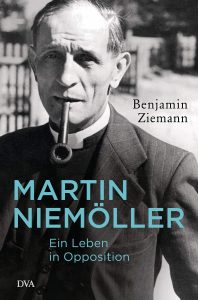 To this day, Martin Niemöller remains one of the most famous German churchmen of the twentieth century. He is regarded as an upright resistance fighter against Hitler, who testified to his stance with seven years of incarceration in concentration camps, as a preacher who admonished German “guilt” and as someone who had transformed from an imperial submarine commander of the First World War into a pacifist, who during the 1950s eloquently and powerfully opposed the Federal Republic of Germany’s Western alliance, its remilitarization, and nuclear weapons. Now, 35 years after Niemöller’s death in 1984, Benjamin Ziemann, Professor of Modern German History at the University of Sheffield and Fellow of the Royal Historical Society, cuts through the thicket of legend concerning Niemöller’s story and uncovers important strands of his life.
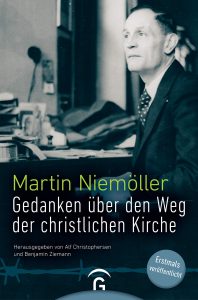 This book, edited by Alf Christophersen and Benjamin Ziemann, has given a surprising moment in Niemöller’s life its most thorough explication. It also offers readers an edited version of the handwritten manuscript Niemöller produced within a period of less than three months during his four years of solitary confinement in Sachsenhausen. His assessment of Catholicism versus Protestantism, a document which numbers over 200 pages in Niemöller’s hand, now comprises 150 printed pages in this book.
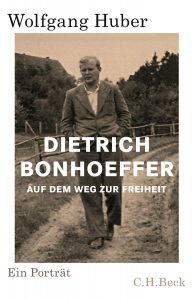 The structure of the book is not unduly distinctive, but it sets out clearly the overall argument and method. Huber’s Bonhoeffer is certainly a big and complex figure. He is also one full of contrasts and the author delights in framing and exploring them. An introductory section evokes the figure of Bonhoeffer as we might first encounter him in a variety of places, not least over the Great West Door of Westminster Abbey. There follows a section on Bonhoeffer’s background and early formation and then another three on his early work in the contexts of university and church life, the first situating him firmly in the landscapes of German thought, the second examining a theology of grace which was deeply rooted in the precepts of Lutheranism, and the third discussing the place of the Bible in a world of maturing historical criticism. Each of these sections present dualities which already defined so much in Bonhoeffer’s work (‘Individual spirituality or Society’; ‘The Church of the World or the Church of the Word’; ‘Acting justly and waiting for God’s own time’; ‘The Historical Jesus or the Jesus of Today’). The young Bonhoeffer is certainly very much at home in the intellectual landscapes of German Lutheranism but the emerging vision is an open one and there is no knowing where it will lead.
 Rebecca Scherf’s study of the German Evangelical Church’s (GEC) responses to the concentration camps is a significant new contribution to the scholarship. While her main focus concerns Protestant clergy who were sent to concentration camps (she confined her study to concentration camps, so it does not include pastors who were in prisons), she has broadened her analysis to address three points of intersection between the GEC and the concentration camp system. The first concerns the relationship between regional churches and the Protestant chaplains who served in the early camps. The second examines the official church responses when clergy were sent to camps. The third looks at the experiences of those who were imprisoned in camps by drawing on contemporary documentation and subsequent memoirs. There are several appendixes with helpful graphs illustrating the number of clergy arrests by year (1935—when there were mass arrests of Confessing pastors due to a pulpit protest—was the peak), by camp, and by regional church. While most clergy who were sent to camps were held only briefly (indicating that the Nazi state intended such arrests as a form of intimidation), the number of arrests during the war grew and fewer were released. There is also a chronologically and geographically organized list of the Protestant clergy who were imprisoned.
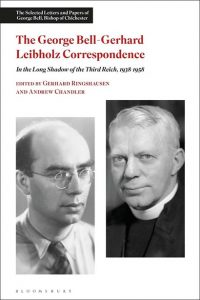 The volume opens with Bell’s September 1938 letter to Bonhoeffer assuring him of his willingness to help the Leibholzes. George Bell had been actively involved since 1933 in assisting refugees from Nazi Germany, including members of the Confessing Church who were affected by the Nazi laws. The early correspondence offers a detailed picture of the difficulties refugees faced even after they reached a safe country. They could not assume, of course, that they would remain in safety; Leibholz’s brother Hans and his wife managed to reach Holland, but committed suicide in 1940 after the German invasion. Added to this anxiety were financial concerns (Germany froze Leibholz’s assets when he fled, so they arrived in England with nothing), worries about the family they had left behind, existential concerns about employment and the future, and dealing with anti-German prejudice in England once the war began. In May 1940 Leibholz was interned as an “enemy alien” on the Isle of Man, along with a number of Confessing Church pastors and their wives. Bell managed to obtain his release in August 1940, after which the two men pursued the possibility that the Leibholzes might immigrate to the United States. With the assistance of Dietrich Bonhoeffer’s contacts in New York, Leibholz was offered and accepted an invitation to Union Theological Seminary in 1941, but by then the door had closed due to new U.S. restrictions on immigration.
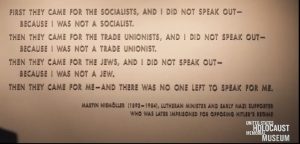 After remarking on the power, universality, and timelessness of the Niemöller quotation Brown-Fleming explained how Niemöller—though he is often held up as an opponent of Nazism—began as a supporter of the Hitler movement. Born into a monarchic, nationalist home, he served as a naval officer during the First World War and also held the typical antisemitic stereotypes of his day, seeing Jews as the Christ-killers and as outsiders in German society. Niemöller voted for the Nazis in several elections between 1924 and 1933 and read Hitler’s book, Mein Kampf. He resonated with Nazism and believed Hitler could bring God and country together into a powerful union.
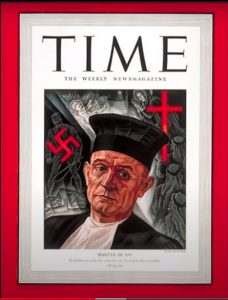 Time magazine featured Niemöller on its cover in 1940, as a symbol of the church, which it described as the sole domestic opponent to Nazism. Indeed, as Brown-Fleming explained, people from all around the world prayed for Niemöller and sent letters to him in the concentration camp.
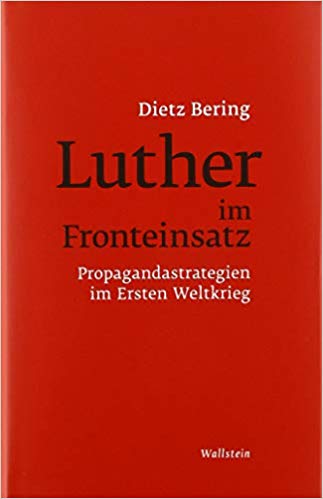 More than thirty years later, Bering is an acknowledged public intellectual whose 2010 book, Die Epoche der Intellektuellen, attracted significant attention. This newest book, about the uses and abuses of Martin Luther in World War I, does not have the cachet of a surprise discovery, but it shares with The Stigma of Names the author’s detailed attention to language – he is a linguist by training – his patience for quantitative and qualitative analyses, and a knack for moving from carefully presented evidence to bold conclusions. In this case, Bering examines a body of World War I writing in which Martin Luther features, literally counting the number of times certain words and phrases appear – “hammer”, “hero”, “manliness”, and many more – and layers his findings onto a sketch of the war as experienced by Germans. The result is an insightful elucidation of the transformation, or more aptly, weaponization, of the defiant monk and reformer into a nationalist propaganda, morale-boosting tool. As Bering shows, that process unfolded in one world war and left the Protestant reformer and his avatar primed for deployment in another.
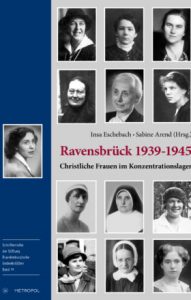 Resistance is a central theme of the book. Christian women in Ravensbrück tended to be involved in opposition within charitable associations and in education but have long been regarded as “apolitical, inconspicuous, and therefore irrelevant,” helping to explain the marginal attention paid to this persecuted group in historical scholarship (21). Most forms of resistance from Christian women entailed critical statements against the German government and expressions of solidarity with people attacked by the Nazi regime. As Manfred Gailus writes in his contribution on Protestant resistors, many religious women found themselves in a dual position of opposition: they criticized both Nazism and sexist religious conventions (206).