Category Archives: Reviews

Review of Alon Confino, A World Without Jews: The Nazi Imagination from Persecution to Genocide

Contemporary Church History Quarterly

Volume 21, Number 2 (June 2015)

Review of Alon Confino, A World Without Jews: The Nazi Imagination from Persecution to Genocide (New Haven, London: Yale University Press, 2014), 284pp. ISBN: 978-0-300-18854-7.

By Christopher Probst, Washington University in St. Louis

Review of Alon Confino, A World Without Jews: The Nazi Imagination from Persecution to Genocide (New Haven, London: Yale University Press, 2014), 284pp. ISBN: 978-0-300-18854-7.

Every so often, a work of historical scholarship appears that alters the trajectory in its field of research. Where the history of Nazi Germany and the Holocaust is concerned, Christopher Browning’s Ordinary Men: Reserve Police Battalion 101 and the Final Solution in Poland was one such work, as were Michael Burleigh and Wolfgang Wippermann’s The Racial State: Germany, 1933-1945 and Saul Friedländer’s majestic two-volume Nazi Germany and the Jews.[1] Alon Confino’s examination of “the Nazi imagination,” a thoughtful, eloquent, and provocative work of intellectual and cultural history, plows substantially new interpretive ground and may change the state of play in Holocaust studies for years to come.
Confino-WorldThe core of Confino’s argument is that Nazi antisemitism was based in fantasy, not reality. For Confino, “a key to understanding this world of anti-Semitic fantasies is no longer to account for what happened – the administrative process of extermination, the racial ideological indoctrination by the regime, and the brutalizing war – because we now have sufficiently good accounts of these historical realities.” Instead, “a key is to account for what the Nazis thought was happening, for how they imagined their world. What was this fantasy created by Nazis and other Germans during the Third Reich, and the story that went along with it, that made the persecution and extermination of the Jews justifiable, conceivable, and imaginable?” (6) The Nazi regime was trying to re-write the origins of German and European history and civilization. This main argument gives shape to the book, which Confino offers in three parts.

Part I covers the first five years of the Third Reich, from the appointment of Hitler as chancellor in January 1933 to the months leading up to the so-called Kristallnacht (“night of broken glass”) in November 1938. Here, the “common denominator” for German ideas about “the Jew” was the motif of the Jews as “creators of an evil modernity that soiled present-day Germany” (31). In Part II, Confino analyzes the attempt by the Nazi regime to eradicate the idea of the Jew as “the origins of moral past” in the period from Kristallnacht to the German invasion of the Soviet Union in late June 1941. In a chapter titled “Burning the Book of Books,” Confino poses (and answers persuasively) the question “Why did the Nazis burn the Hebrew Bible?” The chapter rightfully appears at the heart of the book, as it represents the core of Confino’s main argument. This is significant, as it moves religion, a crucial component of culture, from the margins of the historical argument closer to the center.

Part III examines the culmination of the Nazi genocide against the Jews of Europe from the onset of the Final Solution to the end of the Second World War and the Holocaust. Here, the Nazi regime attempted to expunge the idea of the Jew as “the origins of history”; they did this via mass murder, an attempt to actually remove them from history (and, perhaps – though Confino does not emphasize this – from the future).

Confino gets underneath the actions of the Nazis, offering an interpretation of what the Nazis thought was happening and what kind of world they wished to create. In so doing, he goes beyond thick description of life in the Third Reich, positing why the Nazis did what they did. Students in my courses on the history of Nazi Germany and the Holocaust often ask in understandably perplexed tones “but, why did the Nazis attempt to exterminate the Jews?” Implicit in this question is another, deeper question, one that historians are not often sufficiently poised to answer – why did Nazi hatred of Jews so consume them that they felt compelled to kill them all? Confino posits an elegant, incisive and credible answer to these questions.

Despite the originality of Confino’s conclusions, nowhere does he suggest that previous scholarship on these matters is either worthless or misguided. In fact, his work can be seen as building upon the current consensus of a “modified intentionalist” or “modified functionalist” position on the genocide against the Jews of Europe. Further, one can read Confino’s account not as a complete departure from the idea of Nazi Germany as a “racial state” but as a new direction in historical interpretation of the Shoah that perceives the pervasiveness of racial ideology in Nazi Germany as an outworking of the Nazi imagination of a world without Jews. Confino also recognizes more recent trends in Holocaust historiography, maintaining that the Holocaust “should be placed within a history of Nazi war and occupation, empire building, and comparative genocide. The Holocaust was not unique.” Even so, “it was perceived during the war as unique by Germans, Jews, and other Europeans, and if we want to understand why the Holocaust happened, we ought to explain this” (13).

In trying to build a world without Jews, so Confino, the collective Nazi imagination was immersed in irrational fantasy. “In persecuting and exterminating the Jews, Germans waged a war against an imaginary enemy that had no belligerent intentions toward Germany and possessed no army, state, or government.” (6) Confino’s work demonstrates that, while fantasies operate on a deeper (more unconscious) level than ideologies, they also have concrete expressions – including the burning of Hebrew Bibles and synagogues in November 1938, an outburst of violence that Confino does not believe can be explained by the ubiquity of racial ideology alone.

The emphasis on the irrational aspect of Nazi antisemitism is welcome. “The view of Nazi beliefs as guided by modern racial science gave Nazi anti-Semitism a rational slant, even though it was all fantasy. In fact, Nazi racial science, similar to every science, had an element of mystery, a poetic side, that the Nazis themselves were aware of” (7). Here, Confino rightly underscores the irrational and nonrational elements of Nazi thinking. Yet, in describing Nazi hatred of Jews as “all fantasy” (as he does more than once), Confino may be, on occasion, overstating this aspect of Nazi thinking (and of thinking in general).

As I have argued elsewhere, following Gavin Langmuir, irrational thought conflicts with rational empirical observation while nonrational language, which lies at the heart of religion, is the language of symbol, the kind of language found in art and affirmations of belief. Crucially for Langmuir, much of our thinking is “so ha­bitual, so much a reflex, that most of the time we are not aware of which way we are thinking.”[2] Further, Shulamit Volkov argues, “Any interpretation of reality is an independent, creative product of the human mind, and it is often all the more powerful for being partially or entirely false.”[3] Though Volkov was applying this rationale to nineteenth-century German antisemitism, it certainly applies to Nazi fantasies about purportedly “Jewish” Bolshevism, capitalism, criminality, and degeneracy. Such nuance in describing Nazi antisemitism occasionally eludes in Confino’s otherwise lucid and elegant account.

This sole caveat aside, Confino’s original and provocative interpretation gives historians and other specialists working on Nazi Germany and the Holocaust a welcome and penetrating jumping off point. It is bound to provoke discussion among historians and lay readers alike. Even more importantly, it might spur helpful new directions and methodologies in Holocaust studies.

Notes:

[1] Christopher R. Browning, Ordinary Men: Reserve Police Battalion 101 and the Final Solution in Poland (New York: Harper Perennial, 1993); Michael Burleigh and Wolfgang Wippermann, The Racial State: Germany 1933-1945 (Cambridge: Cambridge University Press, 1993); Saul Friedländer, Nazi Germany And The Jews: The Years of Persecution (New York: Harper Perennial, 1998); Saul Friedländer, Nazi Germany and the Jews, 1939-1945: The Years of Extermination (New York: Harper Perennial, 2008).

[2] Christopher J. Probst, Demonizing the Jews: Luther and the Protestant Church in Nazi Germany (Bloomington: Indiana University Press, 2012), 3–5.

[3] Ibid., 23.

Share

Review of David Nash, Christian Ideals in British Culture: Stories of Belief in the Twentieth Century

Contemporary Church History Quarterly

Volume 21, Number 2 (June 2015)

Review of David Nash, Christian Ideals in British Culture: Stories of Belief in the Twentieth Century (London: Palgrave Macmillan, 2013) ISBN 978-0-230-57265-2.

By Andrew Chandler, University of Chichester

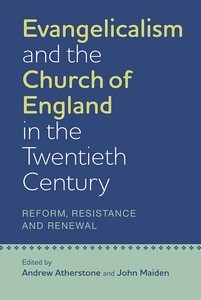
Nash-ChristianThe cover announces the character of the theme: it is the image of a stained glass window in Worcester Cathedral showing three resolute figures looking up towards the sky, intent, devout, broadly sanguine. One is a nurse and the other two are men of the Royal Navy and the Royal Air Force. The task that David Nash has set himself here is a striking one: in what kinds of narratives might the historian find the relationship between religious faith and active public life in the British twentieth century? How are we to locate the dimension of personal faith in the discussions and dramas of society at large? How are we to know when it is there – or when it is not?
Such a project, of course, requires some recasting of conventional understandings. This book is only to some extent a study of what is often now called ‘corporate’ religion. Nash knows the importance of chasing up other, less obvious paths in search of a new prospect. Above all, he looks purposefully at the sprawling realm of the Christian laity. His chapters enjoy titles like ‘Pilgrims, Seekers, Samaritans and Saviours’, and ‘Salvation, Old and New’. Two chapters explore ‘just’ and ‘unjust’ wars and ‘Loss’ and ‘Remembrance’. The material is lively and the argument vigorous and, in the best sense, provocative. Nash asks many questions which historians have often simply ignored: how did people read the Bible? What was it in their eyes to live and die ‘well’? What was it to doubt, or to be ‘saved’? There is a persistent emphasis on the Church of England which is justified at an early stage, but which still leaves some questions hanging in the air, for it is easy to claim too much for the Anglicans and expect too little of the others. There is also a fair amount of jumping about as far as dates are concerned and this might well unsettle those who look for chronological order. In one chapter the Abdication Crisis of 1938 finds itself in company with the prosecution of the Gay News for blasphemy in 1979 and the death of Princess Diana in 1997.

Yet chronology certainly does matter in this book. Nash regards the secularization debate as something tyrannous. Are so many diverse reconfigurations of faith and unfaith really amenable to one vast, unrolling trajectory of decline and extinction? ‘Secularization’ has tried to explain a great deal, no doubt, but has often only ended up distorting perspectives and getting in the way. An awareness of it has even affected the way a pessimistic Church of England, in particular, has come to understand itself. It is surely high time to claim a new freedom and to argue with quite different terms and possibilities. In short, Nash hands back the telescope that many other scholars have provided and instead picks up a kaleidoscope. The new view is fascinating, even if it is difficult quite to know what picture it presents and sort of trajectory might be at work.

This book is something better than an historical polemic and the overall effect is both alert and constructive. Perhaps best of all, it does not seek to lock the subject up inside some self-serving thesis. It frames some bold ideas and opens a variety of new doors. It invites. Does it persuade? That will depend on many things. It is surely right to suggest that later twentieth century religion came to reveal not simply a decline but a ‘diffusion of authority’ (p. 192) and to observe that this should not be seen automatically as a narrative of ‘dilution’. Scholars of secularization may well have been too ready to characterize the contemporary history of religion as a glum history of waning churches and chapels and declining weekly congregations. But secularization, however we understand it, remains difficult to repudiate because there is simply so much diverse evidence about to justify it. This is not to say that it hasn’t acquired an accumulation of questionable forms, or even become something of an ideology. Nash observes sharply that even the most adept secularization theses rather often end up preaching the end of religion and creating for themselves a kind of eschatology, a definitive ‘end time’ for religion altogether. This is plainly dubious. By contrast, Professor Nash is surely right to suggest that it is better to think cautiously and sensitively, not of cycles and grand trajectories but of patterns which might be difficult to identify with confidence. Nothing, after all, is predetermined. At the last this is both a subtle book and a hopeful one. It deserves to be read by an international audience.

Share

Review of Andrew Atherstone and John Maiden, eds., Evangelicalism and the Church of England in the Twentieth century: Reform, Resistance and Renewal

Contemporary Church History Quarterly

Volume 21, Number 2 (June 2015)

Review of Andrew Atherstone and John Maiden, eds., Evangelicalism and the Church of England in the Twentieth Century: Reform, Resistance and Renewal, Studies in Modern British Religious History, Vol. 31 (Woodbridge, UK: Boydell Press, 2014), 325 Pp. ISBN 978-1-84383-911-8.

By John S. Conway, University of British Columbia

For nearly five centuries, the Church of England has prided itself on its comprehensive character, and has refused to allow any single uniformity to be imposed on its doctrinal, liturgical or political expressions. Evangelicalism has thus remained one of the main pillars of English religious life, drawing on the legacy of the Puritans in the seventeenth century, the pietistic impetus of the Wesley brothers in the eighteenth century, and the social and missionary zeal of men like Wilberforce in the nineteenth. These collected essays, written by a group of scholars from within this tradition, now provide a survey of Evangelicalism in the twentieth century, analyzing its struggles for reform, resistance and renewal over the past hundred years. Readers should be aware that, although two of the contributors are based in the United States, apart from David Cerl Jones’ short chapter on Wales, almost no mention is made of conditions in other English-speaking countries, and no attempt is made to place English Evangelicalism in its wider setting of world Protestantism.

Atherstone-MaidenThe opening chapter, written by two Oxford scholars, examines the taxonomy of recent English Evangelicalism, describing the various strands within this spectrum of belief, which share common features in their adherence to the key truths of justification by faith alone and the supreme authority of Holy Scripture as the word of God. Nevertheless each of these strands places its emphasis on different aspects of the faith. Conservative Evangelicals stress the inerrancy of the Bible and refuse to accept the scientific evidence for evolution. More “open” Evangelicals have accepted both the modern theories about the world’s origins and many of the findings of biblical criticism, while most recently the contribution of the charismatic movement, drawn from Pentecostalism, and found in such London churches as Holy Trinity, Brompton or St Paul’s, Onslow Square, has reinvigorated and popularized Evangelicalism among young people. The rivalries—and sometimes the acerbic criticisms of these groups of each other—have meant that English evangelicalism often seems to have been in a constant process of reconfiguration.
Nevertheless, there are many signs of lively renewal, and we can be grateful to these scholars for analyzing both the successes and the failures of these movements during the course of the last century. Undoubtedly the twentieth century has been more testing for all branches of the English Church than was the nineteenth. The catastrophic effects of two world wars and the consequent loss of confidence in God’s benevolent providence eroded Christian faith in wide sections of the population, while more recently the impact of secularism, the sexual revolution, feminism, and political radicalization, have poised challenges which Evangelicals have sought to meet using the resources of their rich and vibrant traditions of personal faith. In some circumstances, Evangelicals have mobilized resistance to social changes, such as the toleration of homosexuality, but in other cases, such as the ordination of women priests and even bishops, they have welcomed the abandonment of long-standing Anglican traditions as a sign of faith-induced reform and renewal. The tension between institutional loyalty and biblical truth has been an ongoing preoccupation.

Within the Church of England’s witness, the Evangelical party has undoubtedly lost ground. For example, a hundred years ago, the usual Sunday morning worship consisted of Mattins, with a heavy emphasis on preaching, while the Holy Communion was an occasional, if prized, event. (In Queen Victoria’s court, Holy Communion was celebrated only twice a year, after considerable personal preparation). But in recent decades, the Holy Communion, along with an enhanced view of the importance of sacraments, has become the normal Sunday service, while Mattins has been relegated to a few odd Sundays in the month. So too, the Evangelical adherence to the doctrine of penal substitution has been softened, as has their resistance to the claims of Roman Catholicism. Leading Evangelicals have led the way in arguing against the kind of biblical fundamentalism or doctrinal rigidity which still prevails in some of their United States counterparts. On the other hand, Evangelicals have sought to play a more constructive role in national affairs, and have placed much more emphasis on the role of the laity in parish leadership. These signs of renewal mean that Evangelicals are no longer content to embrace the kind of reserved personal piety of their elders, but are engaged in social reforming movements of many kinds at many different levels. In the view of these authors, Evangelicalism in the Church of England is now much more diverse, no longer tied to its former rigidity of doctrine or to its defensiveness towards other branches of the church.

Subsequent chapters, written by various authors, give us brief histories of Evangelical groupings in England throughout the century, many of which demonstrated buoyant ambitions but disappointing results. The conservative wing of English Evangelicalism was successful in recruiting younger members through such organizations as the Oxford and Cambridge Inter-Collegiate Christian Unions, but its more liberal counterpart suffered from a certain diffuseness of theological proclamation and a theology which appeared to many as “vague, ephemeral and unsatisfactory”. There was a constant and recurring tension between adaptation to changing circumstances and fidelity to traditional evangelical faithfulness.

Readers unfamiliar with the details of developments in the Church of England and its Evangelical sections over the past hundred years will learn a lot. A great many names of prominent clergymen are dropped, which leads to considerable repetition in successive chapters. Fortunately the contributors avoid self-congratulatory tendencies, and adopt a suitably critical approach both to the subject and its practitioners. Their evaluations are balanced and well researched. In the latter half of the century, as John Maiden notes, younger evangelical leaders, such as John Stott of All Souls, Langham Place in central London, or Jim Packer of Larimer College, Oxford, demonstrated a greater openness to dialogue and liturgical flexibility. Packer called on evangelicals to renounce obscurantism, isolationism, pessimism and party spirit, and to adopt a warmer relationship with other branches of the church. They were horrified by the extremism of their so-called Protestant brethren in Northern Ireland. As Packer wrote in 1981, “It is a fact and a happy one, that within the past thirty years the previously felt convictional and kerygmatic gap between the more conservative evangelicals and the more conservative anglo-catholics has shrunk.” At the same time, there were also evangelicals who felt that they continued to be treated with reserve by the Church of England hierarchy, and passed over for suitable preferment. John Stott was never offered a bishopric, and Jim Packer left to join the new evangelical Regent College in Vancouver. Tom Wright, although appointed in 2003 to the prestigious See of Durham, only stayed for seven years before retreating to a much less conspicuous professorship at a Scottish university.

The final chapter, by Alister Chapman, looks at how much Evangelicals in England learned from the world in recent decades. The answer is: not much. This chapter is more introspective than outward-looking, but reveals the limited extent to which English evangelicals responded to outside influences. For example, the early Billy Graham crusades met with considerable resentment to the idea that English evangelicals had much to learn from such brash American presentations, even if well-organized. So too with the loss of the British Empire, the very considerable evangelical engagement in colonial missions faded away and was not brought back to England’s shores. Evangelicals continued to think of themselves going abroad to teach, rather than learn, so the reverse flow was minimal. Or, as in the case of evangelicals in Australia, the influence was perceptibly reactionary. To be sure, the sources of the charismatic movement among evangelicals came from abroad, but had to be suitably “anglified” by such groups as Michael Harper’s Fountain Trust before becoming popular. The original Pentecostals from the Caribbean too often found that they were rejected in local white churches, and so founded their own black assemblies. Their spiritual influence was therefore handicapped by English social conservatism. As Chapman remarks, old habits die hard. And it is doubtful that they are dead, even in this post-imperial generation.

It is a pity that no one was found to give a forecast of Evangelicalism’s place in the twenty-first century. In view of the massive changes in Britain’s social composition with the arrival of so many immigrants from Asia, Africa and the non-Protestant parts of Europe, the impact on all branches of the Church of England has to be far-reaching, and the priorities for evangelism very different. Attempts to integrate and assimilate these newcomers have found strict barriers against religious proselytism. Most of these communities have brought their own religious leaders with them, hampering social intercourse. For the first time in English history, violence and riots have broken out in English towns, spurred on by religious and racial antagonisms.

Evangelicals are therefore confronted with new and often demanding assignations. But these will have to be left for future analysis in a subsequent volume.

Share

Review of Timothy Jones, Sexual Politics in the Church of England 1857-1957

Contemporary Church History Quarterly

Volume 21, Number 2 (June 2015)

Review of Timothy Jones, Sexual Politics in the Church of England 1857-1957 (Oxford: Oxford University Press, 2013), Pp 218. ISBN 978-0-19-965510-6.

By John S. Conway, University of British Columbia

In the 1960s the Church of England suffered a striking decline in the number of supporters in many parishes across the country. Some commentators attributed this to the prevalence of science-backed secularism. Others held it was the result of the church’s uncritical support of militaristic nationalism in two world wars. But in 2000 Callum Brown advanced the controversial thesis that this decline was due to the impact of the feminist sexual revolution of those years which exploded traditional sexual morality and led to the radical challenge to the established patterns of behaviour in the church’s constituency. In particular, Brown claimed that it was women’s rejection of Victorian narratives of femininity and subordination which brought about a wholly new set of allegiances amongst church members and introduced new challenges from various women’s movements, especially those urging the right of women to be ordained to the priesthood, and even to the episcopate.

Jones-SexualTimothy Jones follows this lead by undertaking a study of the major changes in gender politics in the Church of England from the mid-nineteenth to the mid-twentieth century. He focusses on six episodes during this period which, he claims, demonstrated the often reluctant posture of the church leaders when challenged to take a stand on matters affecting gender or sexual politics. Over the course of this hundred year span, English society evolved rapidly and adopted a much more liberal stance, which was often reflected in parliamentary debates, and found its way into progressive legislation. The result was a frequent clash of interest with the more conservative and traditional sectors of opinion, including those of the Church of England. Jones begins his survey with the debates about marriage in the mid-1850s and concludes with the heated controversies about consensual homosexuality in the 1950s. Rather than indulging in detailing the reactionary attitudes of some Church of England leaders, Jones skillfully weaves into his account the variety of positions taken over the years, and displays a commendable sympathy for most of the participants in this on-going search for new understandings amongst church members about gender and sexual politics.
From the middle of the nineteenth century, the long established pattern of Anglican marriage and gender politics was disrupted by a series of secular legislative reforms, such as women’s suffrage, the official acceptance of birth control, the call for women’s equality in employment (including positions within the ordained ministry), and the pressure for more relaxed acceptance of homosexuality in later years. None of these movements originated from within the Church, but public opinion, including that of church members, was so strongly affected that the Church was obliged to recast its regulations or guidance principles in order to accommodate the changed climate. The most significant change was brought about by the suffrage movement at the turn of the century, which resulted in women being granted the vote, first in 1918 and more fully in 1928. In Jones’ view, this step radicalized Anglican discussions about gender. It brought the politics of equality into the heart of the Church’s discussions, and profoundly unsettled the balance of forces in the various parts of the community. It is not difficult to see the connection between this step and the decision of the Lambeth Conference in 1930 to amend the marriage service to stress equality between men and women, as also to accept the findings of modern medicine and to remove the previous prohibition against contraception. The arguments of the conservative opponents of such steps were usually based on either the Bible or tradition. But by the 1920s already the biblical injunctions of the New Testament were seen to be completely compatible with gender equality, while the arguments from tradition were increasingly regarded as outmoded. Women’s political emancipation was most prominent in a series of legislative changes which marked a significant cultural shift from a hierarchic to an egalitarian understanding of the sexes. Anglo-Catholics, in particular, had difficulties with such egalitarianism, since in their view, the position of a priest represented the authority of a male God and a male Christ. Both social and metaphysical order would be upset if the previous patriarchal system were overthrown.

On the other hand, Anglo-Catholics applauded the efforts of women to establish their own sisterhoods and nunneries since these reinforced the ideals of spiritualized femininity and service. Certainly the spread of such communities in the later nineteenth century provided middle-class women with much more effective and fulfilling opportunities than the life of an unmarried spinster. But the twentieth century’s opening of many more professions to women inevitably led to alternative and possibly more attractive occupations. The devotion and piety of these sisters was much praised, but did not encourage those women who might have hoped that this would lead to future ordination to the priesthood.

The campaign for the ordination of women engrossed the Church of England throughout the twentieth century, and has only now come to a completion after many adherents have abandoned their loyalty to the Church of their birth. It brought the Anglican Church to the limits of its capacity to imagine sexual equality. When it was first proposed at the 1920 Lambeth Conference, it was greeted with shock and almost universal incomprehension. In the 1920s and 1930s a series of reports struggled to find an ideological basis for such opposition, but fell back on the traditional defence that the Church was not ready for such a revolutionary move. The question was forcefully raised by the movement’s advocates as to why the priesthood merited the maintenance of the sex-bar in contrast to other professions. They never received a satisfactory answer. In 1935 the Archbishops’ Commission could still say “We believe the general mind of the Church is still in accord with the continuous tradition of a male priesthood … based on the will of God”. Such sexual double standards were naturally rejected by the supporters of women’s ordination, who argued persuasively that gender and sex were not theologically relevant to ordination. But nevertheless in this period the leading minds of the Church were unable to frame a persuasive and broadly acceptable theological argument for any change. Such a view asserted that there was a natural divinely ordained gender order which involved women’s subordination to men, though not implying women’s inferiority. Women priests were hence seen to invert a hierarchy of spiritual and domestic authority which stretched all the way to the Godhead. The male priest as symbol of religious authority had many centuries of unbroken tradition behind it, not only in the Christian version. Such considerations were only overcome after the 1960s when the impact of the so-called secular sexual revolution led to a much more open and generous realization of the contributions that women priests could offer.

Jones’ final chapter deals with the question of the Church’s attitudes towards celibacy and homosexuality. Remarkably enough, it was the Church of England which took a lead in 1952 in promoting homosexual law reform, and urging the decriminalization of homosexual acts. He argues that the Church’s negotiation of new understandings of sexual identity led to a striking level of institutional accommodation and acceptance of homosexuality. The change in the 1930s saw an abandonment of moralistic condemnation and an acceptance of medico-psychological theories about sexual preferences. In 1954 the Church of England Moral Welfare Council produced a report “The Problem of Homosexuality” which was written in almost exclusively medical terms and proved to be highly influential. Homosexuals were no longer to be regarded as perverts but to sublimate their urges into positive social roles. Nevertheless the ambiguity about the morality of homosexuality still remains widespread throughout the Church of England.

The writing of church history has traditionally focused on theological or political matters. Jones’ survey of what might be described as the undercurrent in gender and sexual politics therefore fills a vacant segment in this historiography. As of last year, 2014, with the appointment of the first female bishop, and with now a generation’s experience of women priests serving in numerous parishes across the country, we may hope that it not be long before a historian will be coming forward to comment on the repercussions of this significant change in the otherwise staid history of the Church as it approaches the five hundredth anniversary of its establishment in England.


Share

Review of Rainer Stuhlmann, Zwischen den Stühlen: Alltagsnotizen eines Christen in Israel und Palästina

Contemporary Church History Quarterly

Volume 21, Number 2 (June 2015)

Review of Rainer Stuhlmann, Zwischen den Stühlen: Alltagsnotizen eines Christen in Israel und Palästina

(Neukirchen-Vluyn: Neukirchener Verlag 2015), 155 Pp. ISBN 978-3-7615-6179-9.

By John S. Conway, University of British Columbia

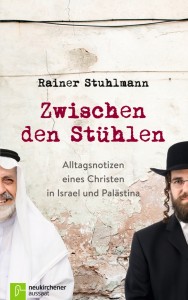
After serving for thirty years as a pastor in the Rhineland Evangelical Church, Rainer Stuhlmann is spending part of his retirement as Director of Studies at Nes Ammim, a Christian centre in northern Israel. Nes Ammim was established fifty years ago by a Dutch Reformed couple, who were convinced of the need to have a visible sign in the newly-established state of Israel of the Christian desire for reconciliation and repentance for Christian complicity in the Holocaust. They believed the best way to do this would be to follow the example of the Zionist pioneers, and build a farming community in order to contribute both practically and spiritually to building new relationships. For many years they grew roses, which were picked, packed and sent every day to the Frankfurt flower market. Some years ago, when this venture no longer proved viable, they switched to running a guest hotel, staffed mainly by young Christian volunteers from Germany, Holland and Switzerland. Pastor Stuhlmann helped to organize their free time with programs enabling them to study more of present conditions in Israel and the Palestinian West Bank. This book is essentially a record of these encounters, written as a series of snapshots from the perspective of a keenly involved observer doing what he can to enhance the growth of communal friendship and harmonious relationships.

Stuhlmann-ZwischenThe Holy Land is of course full of holy history, also of holy geography. Stuhlmann sees his job as motivating his young guests from Europe to understand the dimensions of both these features and to encourage a courageous encounter with the many history-laced dilemmas which are met in so many corners of the “promised” land. He is clearly against the kind of religious tourism which brings Christian visitors to Israel, but seeks to isolate them in the first century without ever meeting with Israel’s present-day inhabitants or their troubles. He is equally opposed to the kind of narrow eschatological proclamation of certain Christian groups, especially some American evangelicals, or to the equally one-sided Jewish extremists who wage a continual battle against their Palestinian neighbours. He is grateful for the fact that he and his younger colleagues from Germany are now looked on as representatives of the “new Germany”, and that the horrors of the Holocaust, though loudly trumpeted in state-controlled media, are not attributed to the younger generation or to him personally. Likewise he is encouraged by the friendliness of the Palestinians who see these visitors from Europe as a hopeful sign that their cause is not being forgotten by the rest of the world. And he draws hope from the fact that there are many signs of confidence building between young Jews and Arabs, not least those established at Nes Ammim itself.
Anyone visiting Israel/Palestine cannot fail to be impressed, even intimidated, by the weight of history which pervades every corner of this Holy Land. Even more forceful is the evidence on all sides of the many centuries of nation building and the equally obvious evidence of these attempts’ downfall. Stuhlmann would like to be optimistic, but is obliged to recognize that the forces of national bigotry and self-preservation have a long start. Every time he takes parties of students to Jerusalem, they are confronted with the most recent evidence of the endemic hostility between Israelis and Palestinians, namely the so-called Separation Wall around the city, which was constructed a few years ago. This was built as a barrier against terrorist attacks but has since been extended to expropriate large sections of Palestinian land holdings and vineyards, which he sees as a most brutal robbery by the Israeli state. This Wall in fact forbids the inhabitants from the Palestinian side crossing into Jerusalem without control, and hence denies the opportunity to have social contact or conversations. This is exactly the contrary to Nes Ammin, where such relationships are deliberately encouraged. It all points to the fact that, in the ancient capital, where three religions have existed in rivalry for centuries, and every stone witnesses to unresolved conflicts, the atmosphere is much sharper and confrontational than in northern Galilee. But given the escalation of conflict in all the surrounding countries, the hope that Israel will maintain a precarious peace and allow more positive steps for creative relationship between the inhabitants must be seen as an exercise in faith.

Stuhlmann is well aware that the history and the land of Israel have been and still are full of promises. Some are extravagant, some are unfulfillable, but all contain at least the hint of conflict. For this reason he avoids giving support to any of the limiting or exclusivist claims, whether political or religious, which are put forward to back one or other of the opposing sides. But to act as a reconciler, it is necessary to face both ways. Praying with the Psalmist for the peace of Jerusalem may seem a lost cause, but for Stuhlmann it is the only and most heroic stance to adopt in the midst of the present Middle Eastern strife. He places his hopes in what Nes Ammim has always done best, which is to bring together young people from both or all sides, and hope that their personal contacts will allay hostilities and rivalries, and that they will then go on to work for a resolution, or at least the alleviation of the tensions so visibly shared by the inhabitants of this Holy Land. He is sustained by the memory of how, in Germany, for forty years from 1950 onwards, two sides across the Iron Curtain adopted the same kind of biased and obstinate prejudices, and refused any kind of personal interaction across the well-defined and defended border. But then in 1989 all barriers were broken down, and humanity reigned again.

But in Israel, the separation has now lasted for fifty years. And a very deliberate policy of “Boycott, Disengagement and Sanctions” has only increased the suspicions and hostility on both sides. While there are those on the Jewish side who recognize that the occupation of the West Bank and oppression of the Palestinians is a catastrophe for their vision of Zionism, their advocacy of a two-nation solution has achieved nothing, and indeed still raises doubts about its viability. Equally there are those on the Palestinian side who refuse any contact with Jews. Stuhlmann naturally deplores such intransigence or the unwillingness to enter into dialogue even on a personal level. He realizes how difficult a task it remains to be supportive of the Palestinians without becoming an opponent of the Israelis. But he also deplores the widespread anti-Muslim and anti-Arab animosity stirred up in many western countries. Above all, he rejects the continued use of Israeli force to humiliate the Palestinian population under its control and to deny the destructive impact of their land confiscations or the malignant policies of establishing more settlements in the West Bank territories. He is convinced that such tactics seriously damage the Israeli cause, and he knows how offensive such policies are to the many Jewish friends he has found in Israel. The quest for both security for Israel and freedom for Palestine remains elusive and seemingly distressingly distant. The human toll is incalculable.

Zwischen den Stühlen is chiefly directed to his German audience in the hope of inducing a more balanced presentation of Middle Eastern politics. He cannot avoid the feeling that the widespread sympathy for the Palestinians will be interpreted, by some Jews at least, as a replay of the anti-Semitic attitudes shared by many Germans in previous decades. And the call in some western cities for a boycott of Israeli-produced goods evokes a reminder of the similar boycott organized by Josef Goebbels in April 1933. On the other hand, those Germans who loudly profess themselves to be Friends of Israel are seemingly willing to overlook the gross injustices inflicted on the Palestinian population in what they refer to as their “Nakba” or catastrophe. Similarly Stuhlmann regrets the enthusiastic support given to Israeli policies by the right-wing Evangelical Christian Zionists, eagerly awaiting the return of the Messiah. In his view, all such confrontational attitudes can only be harmful for the cause of peace. But at the same time, he greets enthusiastically all demonstrations against anti-Semitism, which must be resolutely opposed. Part of the problem is that both sides like to portray themselves as victims. Israelis harp on their status as survivors of the Holocaust of seventy years ago, and Palestinians see themselves as the victims of a hundred years of Zionist aggression. Both sides justify their defensive measures accordingly, which successfully prevent the growth of any climate of accommodation or agreement. Nevertheless Stuhlmann and his team of expatriate volunteers remain dedicated to their aim of reconciliation and mutual understanding.

Nes Ammim is situated near Acre. As a Christian centre, it stakes a claim to be a place of peaceful encounter for all faiths. But in 2013, it was itself the near-target of rockets fired from somewhere across the Lebanese border. Neither the aggressors nor the reasons for the attack were discernible. But the Israeli defence shield saved it from further damage. The paradox of being protected by the military power he has so readily criticized for its mistreatment of its Palestinian population did not escape Stuhlmann, and only heightened his awareness of the difficulties of trying to face both ways. Steering such a course in the often polarized climate in Germany makes Stuhlmann’s message of reconciliation and inter-faith dialogue even more hazardous, but equally even more necessary. He is in fact attempting to express solidarity with both Israelis and Palestinians without attempting to judge or condemn either side. This short book will undoubtedly assist those who look for the spirit of Nes Ammim to be vindicated in the troubled circumstances of the Holy Land today.


Share

Review of Hans-Joachim Döring and Michael Haspel, eds., Lothar Kreyssig und Walter Grundmann. Zwei kirchenpolitische Protagonisten des 20. Jahrhunderts in Mitteldeutschland

Contemporary Church History Quarterly

Volume 21, Number 1 (March 2015)

Review of Hans-Joachim Döring and Michael Haspel, eds., Lothar Kreyssig und Walter Grundmann. Zwei kirchenpolitische Protagonisten des 20. Jahrhunderts in Mitteldeutschland (Weimar: Wartburg Verlag, 2014). 132 Pp., ISBN 9783861602520.
By Dirk Schuster, University of Potsdam; translated by John S. Conway, University of British Columbia

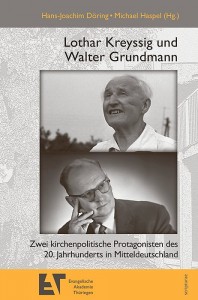
Over the past twenty-five years, an enormous amount of interest has grown about the role of German Protestantism and its representatives during the period of the Third Reich. All sorts of new findings are appearing. One of the focuses of research has been on the so-called “German Christians” and their theological conflation of Protestantism and National Socialism; another is the fact that in recent years many of the provincial churches have begun to examine their own histories. For example, a conference held in 2012 and organized by the Lothar Kreyssig Ecumenical Center and the Evangelical Academy in Thuringia discussed the role of two controversial figures whose impact could hardly have been more different, namely Lothar Kreyssig and Walter Grundmann. The former was a member of the Confessing Church, who took a stand as a judge against the Nazi euthanasia program, while the latter was the ideological leader of the “German Christians” and academic director of the notorious Institute in Eisenach dedicated to the eradication of Jewish influence from German church life. The present volume which prints some of the papers given at that conference, as well as other contributions, demonstrates very clearly the ambiguous legacy the present German Protestant churches have to deal with.

Doering-HaspelAnke Silomon’s introductory chapter provides biographical details about both men. Even though she relies on already published research, the author does give a survey of their careers, which will be of value to those readers not familiar with the subject. Both men were born during the reign of the last Kaiser, and their careers spanned the whole period up to and including the time of the German Democratic Republic, i.e. after 1949. This is followed by an article by Oliver Arnhold, who in 2010 published a comprehensive study of the “German Christians” as well as of the Eisenach Institute, which took the title of“The Institute for the Research and Removal of Jewish influence on German church life”. This contribution was drawn from a lecture Arnhold gave in 2014, which was subsequently included in this volume, and concentrated primarily on the ill-fated Institute. Hence unfortunately this means that his portrait of Walter Grundmann, who is supposed to be the main topic of this volume, is too condensed.
For his part Tobias Schüfer discusses Grundmann’s understanding of the Church and the Law. He takes the view that for Grundmann freedom and equality were to be seen as “negative qualities, urgently needing to be abandoned” (p. 68). Such a pejorative opinion is not false, but also not new. More significantly, Schüfer’s article shows, on the basis of Grundmann’s post-war writings, the lack of any admission of guilt. Even though it was already clear that Grundmann never felt any personal guilt for his activities during the Nazi period, Schüfer confirms this conclusively by examining his post-war writings and his subsequent treatment of his earlier publications.

The most interesting and rewarding article in this book is that provided by Torsten Lattki, who proves, through a detailed examination of Grundmann’s depictions of the Pharisees, both before and after 1945, that Grundmann never abandoned his anti-Jewish opinions. In all of his writings the Pharisees are seen as being the true Jews, and excerpts are produced from both pre-and post-war publications, which clearly show that Grundmann continued to hold and express his polemical opinions. To be sure, his antisemitism and his attempts to depict Jesus as “un-Jewish” were more subtly voiced in his later years of teaching in East Germany. These points have already been made in the large-scale studies by Susannah Heschel and Oliver Arnhold, but Lattki has produced the most convincing evidence that Grundmann continued to expound his antisemitic views even after the end of the Third Reich. Equally significant is Lattki’s contention that Grundmann’s works and methods of study were all part of the contemporary Zeitgeist, which found a considerable following among theologians, students, and lay people in both east and west Germany (p. 92). It will be one of the task of future researchers to establish just how influential was Grundmann’s antisemitic picture of Judaism.

The essay by Karl Wilhelm Niebuhr stands in a marked contrast to the above scholarly contributions by Schüfer and Lattki, since it is largely a repeat of an earlier article from a 2007 collection. He is trying to show that, even though Grundmann did express anti-Jewish sentiments, he was largely being misled and misused by the Nazis. Thus he seeks to prove that the Eisenach Institute was only a marginal operation, and that Grundmann and his closest colleagues were “only a relatively small minority, never taken seriously in the academic world” (p.37). This reviewer is not convinced. The evidence surely shows well enough that articles by the leading figures in this Institute were accepted by prestigious journals such as the Archiv für Religionswissenschaft or the Theologische Literaturzeitung. Grundmann’s picture of a non-Jewish Jesus or the claim that the positions of Christianity and Judaism were incompatible and contradictory found a considerable following in the academic community of the 1930s and 1940s? We have only got to think of his teacher Johannes Leipoldt or the later director of the Institute Georg Bertram to see that both the Institute, its staff and its findings were widely known. In addition we could cite the activity of the well-known scholar of Persia Hans Hermann Schaeder who quite deliberately used the Institute’s facilities in order to propagate his conclusions about the racial connections between Eastern and Western religions. His attempt to reach a wider academic community by this means, however, failed to gain much support even from the “German Christians” with whom he had little or nothing in common ideologically. Niebuhr’s contention that Grundmann never argued in the sense of a “biologically-based racism” (p. 39), but believed that the separation between Jews and Christians was due solely to religious factors, is not provable. But we have to remember that such pioneers of this kind of völkisch thinking as Houston Stewart Chamberlain saw religion as one of the central characteristics of racial identity, and equally accounted for religious differences as being derived from racial characteristics, in exactly the same way as Grundmann was later to argue. The latest research, for example by Horst Junginger, whom Niebuhr quotes in a footnote, has convincingly proved that the so-called racial antisemitism was based on religious factors. And Grundmann, like other well-known researchers in the field of religious studies, such as Karl Georg Kuhn or Carl Schneider, sought to show that Jews had singular racial characteristics which Jesus allegedly and diametrically opposed. According to Niebuhr, Grundmann never enjoyed any following among the proponents of “a biologically-based racial antisemitism.” Indeed his views were perhaps rejected by such men (p. 42). It would have been good if Niebuhr had provided some quotations to back up such risky claims. The same is true for his suggestion that Susannah Heschel’s study of Grundmann and the Eisenach Institute has now been “largely superseded”.

The second protagonist in this volume, Lothar Kreyssig, is unfortunately described in only two articles, which are not enough to do him justice. He was after all one of the most active members of the anti-Nazi opposition, whose behavior demonstrated how churchmen could have behaved differently. And he continued the same oppositional stance against the dictatorship of the German Democratic Republic after 1949. Axel Noack describes his activities in the post-1945 era, such as his leadership in founding the Aktion Sühnezeichen (a religiously motivated German Peace Corps), or his attempts to establish a collaboration between Catholics and Protestants, which ran into considerable opposition among the more rigidly-minded church authorities. Erardo C. Rautenberg presents his findings about Kreyssig’s views on legal matters during the Third Reich. Written from a juristic perspective, this is a promising subject, but could have been more fully developed.

It is a pity that Lothar Kreyssig was not given more space in this volume of collected essays instead of the superfluous pieces about Walter Grundmann which can in any case be found elsewhere. It was an opportunity missed.

Share

Review Article: The Vatican’s response to the Nazi persecution of the Jews

Contemporary Church History Quarterly

Volume 21, Number 1 (March 2015)

Review Article: The Vatican’s response to the Nazi persecution of the Jews

Susan Zuccotti, Père Marie-Benoît and Jewish Rescue: How a French Priest Together with Jewish Friends Saved Thousands during the Holocaust (Bloomington, IN: Indiana University Press, 2013). 277 Pp., ISBN 9780233008414.

Paul O’Shea, A Cross too Heavy: Eugenio Pacelli, Politics and the Jews of Europe 1917-1943 (Kenthurst, NSW: Rosenberg Publishing, 2008). 392 Pp., ISBN 9781877058714.

By John S. Conway, University of British Columbia

Two recent books have again stirred up the long-standing debate about the policies of Pope Pius XII and the Vatican in the face of the genocidal slaughter of the Jews at the hands of the Nazis during the Second World War. This controversy has now flourished for more than fifty years, and shows little sign of having reached any acceptable consensus. It has often been conducted more with political partisanship or religious loyalty than with a detailed examination of the evidence. Moreover this debate has suffered from the long delay in opening the most important sources held by the Vatican. Nevertheless most commentators express the confident hope that, when eventually the archives are revealed, their hypotheses will be found to be accurate. They therefore demonstrate a commendable integrity in allowing their findings to speak for themselves even where they differ in their interpretations. They show that there are still new aspects of the church’s rescue efforts on behalf of the persecuted Jews which deserve fuller consideration. These books will undoubtedly add to the wider corpus of scholarship which continues to be of interest to scholars of modern diplomacy and statecraft.

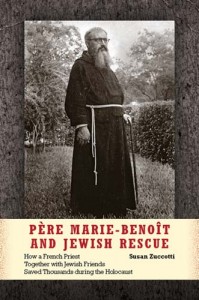
zucotti-pereSusan Zuccotti is an established American scholar who has written a number of studies of the Holocaust, particularly dealing with events in France and Italy. Her latest contribution provides us with a well-researched biography of a little-known French Capuchin friar, Fr. Marie-Benoît, who was to play a significant role in rescuing Jews first in Marseilles in 1942 and then in Rome in 1943-4. Although he was to live for several decades after the war, his exploits were only recorded in French and remained largely unnoticed in remote French archives. Zuccotti was able to interview him in 1988 shortly before he died, but he was clearly a reticent witness, and it has taken her another twenty-five years to piece together his full story and to explore the determining factors which led him to play such an active role in assisting the Jewish refugees and victims of Nazi tyranny. The result is a portrait of a valiant and courageous priest whose witness in the cause of Christian-Jewish relations deserves to be better known to an English-speaking audience. So we can be grateful to Zuccotti for this helpful addition to the debate about how much (or how little) was done by various sectors of the Catholic Church to assist the Jewish victims of Nazism.
Fr. Marie-Benoît was born the son of a country miller in that part of western France which saw violent persecution of faithful Catholics in defense of the ancient regime by agents of the Revolution in the 1790s. Zuccotti suggests that this may have been the source of his opposition to any state-directed persecution of religious minorities. In fact he wanted to join the Capuchins, a branch of the Franciscan order, but was called up in 1914 and served throughout the war at the front. Later he was called to Rome and taught at the Capuchin seminary there until 1940. He returned to France just as his nation was defeated and divided into the German-occupied north and the Vichy-led unoccupied south. It was here in Marseilles that he first became involved with helping refugees, particularly foreign-born Jews, fleeing from the Nazis. He was able to help some to escape to Switzerland or Spain, or to move to the safer area of the Italian-controlled region around Nice. He established good relations with Jewish organizers of relief efforts, and continued these after he was recalled back to Rome in early 1943. The situation grew far more perilous after Mussolini was overthrown in July 1943 and when the German army took control of Italy’s civil government in September. It was at this point that Fr. Marie-Benoît and his Jewish backers had the idea of using his presence in Rome to seek an audience with Pope Pius XII. As recorded in the printed Vatican documents, he was able to present the Pope with requests to help these foreign Jewish refugees, even though nothing came of his grander scheme to have these foreign Jews evacuated to North Africa. But, as he recorded later in his own memoirs, he successfully managed to help these stranded Jews by supplying them with forged identity documents, forged permissions to reside in Rome, and forged ration cards.

The few months between September 1943 and the liberation of Rome in June 1944 were particularly dangerous, and eventually forced Fr. Marie-Benoît himself into hiding. In October there followed the infamous round-up of the Roman Jews from Trastevere, when more than a thousand were deported to Auschwitz and only sixteen survived. As word spread through the foreign refugees’ ranks, the need for secure hiding places grew more urgent. Fr. Marie-Benoît was active in seeking assistance from various convents and monasteries, despite being warned of the danger that these institutions could well be searched by German agents.

Zuccotti deals succinctly with the question, addressed in her earlier books and articles, about the extent to which the Vatican and its officials—including the Pope—knew about these clandestine relief efforts. She concludes that the Pope and other Vatican officials were certainly aware of these developments, even if they did not know the extent or the details. She rightly denies the claims made afterwards by eager papal supporters that the Pope had issued explicit directions or had directed Vatican funds for such efforts. As Fr. Marie-Benoît himself testified, he never thought of himself as carrying out the Vatican’s instructions let alone receiving financial help. In fact the Vatican documents print some of the reservations felt towards Fr. Marie-Benoît on the grounds that his illegal activities endangered the Vatican’s carefully guarded stance of neutrality. One official who repeatedly urged him to be more prudent was recorded as being gravely disappointed by the Capuchin’s reckless readiness to engage in what he called his mission of mercy. Particularly grim was the fact that in these final weeks under German domination, several of Fr Marie-Benoît’s protégés were victims of informers, playing along with the Germans. At the same time, though, he and his partners amongst the Jewish community were aware of the broad support they enjoyed from much of the non-Jewish population. Zuccotti’s conclusion is that together they saved the lives of at least twenty-five hundred men, women and children, most of them refugees without resources in a nation controlled by Nazis determined to destroy them.

Rob Ventresca’s authoritative essay on the same subject, recently published in Studies in Christian-Jewish Relations lends support to the same conclusions. (“’The Vatican was for us like a mountain’: Reassessing the Vatican’s Role in Jewish Relief and Rescue during the Holocaust. Settled Questions and New Directions in Research,” SCJR 9, no. 1 (2014): http://ejournals.bc.edu/ojs/index.php/scjr/article/view/5601/4957). In his view the Vatican’s response to the plight of so many million Jewish victims of Nazism conformed to a familiar pattern of self-imposed restraint and self-serving resignation. While on the one hand, the Pope and his advisors consistently avoided the explicit papal condemnations being requested, yet Catholic rescuers on the ground, such as Fr. Marie-Benoît, might count on some modest measure of papal support, usually moral rather than financial. Such moves hardly amounted to a policy or a directive for Jewish rescue and could be curtailed if the results seemed to increase the likelihood of reprisals or damaging repercussions for papal diplomacy.

The limitations placed on the Vatican’s efforts to support Jewish victims of Nazism have long since been recognized. Direct protests to the German authorities were never answered. Requests to friendly governments, such as Brazil, to provide entry visas for Catholic converted Jews were ignored or only reluctantly accepted. Nevertheless the Pope’s clear preference was to continue his diplomatic representations as a means of exercising the Vatican’s leverage, limited as it might be, for the longer term issue of securing an eventual peace settlement.

It is within this envelope of diplomatic caution and restraint that the Vatican’s efforts to assist Jewish refugees, such as those supported by Fr. Marie-Benoît, have to be judged. But undoubtedly the supplies of food and other material goods given to these people were approved by the Vatican’s higher officials, and benefitted the numerous Jewish refugees hidden in Catholic institutions. But to date, no written order from the Pope has been discovered, let alone a “secret plan” as propounded recently in a journalistic account by a British writer. Yet Fr. Marie-Benoît’s activities were not prohibited by his superiors, despite the urging of certain officials to be more cautious. He emerged as the main contact with the Jewish organization DELASEM and as such paved the way for a new and much more positive relationship in the post-war years. It was in this new climate that the Vatican subsequently tried to claim that much more aid had been given, and that Fr. Marie-Benoît was supported by their instructions. This led the good friar, as Zuccotti notes, to deny any such approval or assistance. As he recorded in his memoir: “I received no mission from the Vatican, because I was unknown there…. The Vatican was for us like a mountain. We were in a hurry.” The only sum described in the Vatican published documents refers to a small amount dedicated for the support of converted Jews, but it is clear that the ingenuity of Fr. Marie-Benoît and his DELASEM colleagues enabled them to access other sources of financial support for which they did not need explicit Vatican approval. By such methods the Vatican did not appear to be engaging in questionable or possibly illegal financial activities, even if such aid was designed to assist poverty-stricken refugees.

In the post-war period, Fr. Marie-Benoit became one of the foremost champions of a new relationship between Christians and Jews. But Pius XII clearly had other priorities. It was only after two decades that these ideas found a new and much more favorable reception at the time of the Second Vatican Council, and in particular in its noteworthy statement Nostra Aetate of 1965. Fortunately Fr. Marie-Benoît was still alive at this time, and rejoiced. But there is no evidence that his war-time services played any part in the theological repudiation of Catholic antisemitism or anti-Judaism. He was never again to play any significant role even in his own Capuchin order. He died in 1991 at the age of 95.

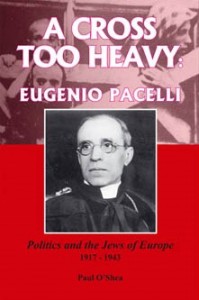
Paul O’Shea is one of the small group of Australian scholars who have become interested in the Catholic response to the traumatic events of the twentieth century, and particularly in the career of Pope Pius XII, as he sought to deal with the crises brought on by the totalitarian regimes of Europe. Like all of his predecessors, O’Shea suffers the handicap that many of the relevant documents have yet to be released from the Vatican archives, so despite his assiduous survey of Pius’ earlier life as a Vatican diplomat and later as Cardinal Secretary of State, we still have to acknowledge the tentative evaluation of all hypotheses about his war-time policies, and especially about his so-called “silence” concerning the victimization of the Jews of Europe.
O’Shea, like his fellow biographer, Robert A. Ventresca (see my review of Soldiers of Christ. The Life of Pope Pius XII in the Journal of Ecclesiastical History, 65, no. 1 (January 2014): 230-1) lays great emphasis on Eugenio Pacelli’s integration and identification with the corporate Catholic community of the later nineteenth century. But he fails to stress the fact that, under both Pope Pius IX and Pius X, the Vatican was going through a highly conservative, even reactionary, phase, as could be seen in the vicious attacks on Catholic Modernism. O’Shea believes that there can be little doubt that Pacelli was affected by the affair. “But the fact that he remained an exceptional favourite through the crisis … and continued to be promoted while others were cast aside, tells us much about his discretion, his resilience and his survival skills” (P. 144), though also about his deeply conservative mentality. The fact is that by 1914 the Vatican had reached a nadir in its theological and political influence. Its hostility to the modern world was well known. And although new Pope Benedict XV wisely decided to adopt a policy of neutral impartiality during the First World War, the Vatican was pointedly excluded from the peace process in Paris in 1919. The 1920s saw vigorous efforts to reach legally binding treaties, known as Concordats, with many of the European states in order to safeguard the Catholic Church’s interests. Pacelli was in the forefront of such attempts, which however revealed the limits, obstacles and frustrations in dealing with such powers as the Soviet Union, Germany and Italy. The experience can hardly be said to have led Pacelli to a more liberal view of his fellows. He remained convinced of the superiority of the Catholic vision and of the need for centralized control over its affairs through cautious diplomacy, which would avoid confrontation but would harness the Vatican’s limited influence at a time of turmoil.

When Pius was elected Pope in March 1939, the war clouds were ominously threatening. Pius was horrified by the idea of the blood-bath of twenty-five years earlier being repeated. The Church’s duty was to serve the cause of peace. And for his first six months, Pius engaged in a ferment of diplomatic activity to this end. In vain. By September, he was forced to recognize not only the Vatican’s impotence, but also the impossibility of calling Catholics to a higher ethos than national loyalty. He therefore retreated to the same stance of neutral impartiality as advocated by his predecessor Benedict XV. He continued to hope, or possibly to indulge his illusions, that the Vatican’s mediation would eventually be required at the point when both warring sides recognized the need to halt hostilities and seek a truce or even a peace settlement. As Europe’s most experienced diplomat, Pius believed that his services would be vital at such a moment. No steps should therefore be taken, or seen to be underway, which would prevent such an efficacious intervention from taking place. Hence the strenuous efforts to preserve the Vatican’s neutrality throughout the course of the war, especially during the traumatic years 1943 and 1944 when the Vatican was surrounded by three changes of political-military regime. Despite all the pressures and pleas on behalf of the war’s victims, including the Jews, Pius consistently believed that unwise and intemperate language would only make matters worse. In O’Shea’s view, this was a leadership of reaction.

It is clear that Pius was deeply affected by the daily reports that flowed into the Vatican about the murderous practices of the Nazis, especially against the Jews. He agonized long and fervently about what he might say or do, but was continually restrained by the fear that such action would invite reprisals which would make matters worse. In a remarkably frank letter to his friend and colleague the Bishop of Berlin in April 1943, Pius expressed both his horror and frustration. “The seemingly limitless cruelty of the war machines makes the thought of a long drawn-out period of mutual slaughter unbearable. And what we have heard, day in and day out, of atrocities that are far beyond anything which could be ascribed to the necessities of war is even more horrifying and shocking.” The frustration of not being able to decide which course of action would be less damaging to the cause of peace was an unavoidable and recurrent challenge, and lay constantly upon the Pope’s conscience. It is small wonder that he concludes his letter to the Bishop of Berlin with the words: “In constantly striving to find the right balance between the mutually contradictory claims of his pastoral office, the path ahead for the representative of Christ is becoming daily more overgrown, beset with difficulties and full of thorns” (Actes et Documents du Saint Siege, Vol. 2, document 105, letter of 30 April 1943).

But to O’Shea this conscientious and pain-ridden policy of public neutrality and personal sympathy was not enough. To be sure, he acknowledges that as the war went on, we have a profoundly moving picture of the Vicar of Christ wanting to share the sufferings of the persecuted. But in the case of the Jews O’Shea suspects that Pius was the inheritor of a long and ancient tradition of suspicion and contempt towards a religion deemed “superseded”. The Jews were thus among the “lesser victims” for whom no especially dangerous actions or pronouncements were called for. For O’Shea the turning point came in October 1943, when the Germans rounded up the Jews of Rome and transported 1000 to their deaths in Auschwitz. The fact that the Pope did not protest in clear words which could not be misunderstood was an unforgivable moral failure. He believes that Pius did not speak out because he did not want to. His actions and words up to this Nazi atrocity in October 1943 are defensible. After October 1943, they are not. For this reason O’Shea closes his narrative at this point.

Share

Review of Rebecca Ayako Bennette, Fighting for the Soul of Germany: The Catholic Struggle for Inclusion after Unification

Contemporary Church History Quarterly

Volume 21, Number 1 (March 2015)

Review of Rebecca Ayako Bennette, Fighting for the Soul of Germany: The Catholic Struggle for Inclusion after Unification (Cambridge, MA: Harvard University Press, 2012). 380 Pp., ISBN 9780674065635.

By Lauren Faulker Rossi, University of Notre Dame

Beginning in the 1990s, the history of Germany’s Catholics – and German Catholicism, by extension – enjoyed an abrupt surge of scholarly attention.  As this surge picked up speed, one German historian lamented that German Catholics had moved out of their “traditional methodological ghetto” into one of mental and cultural isolation, as scholars focused on the supposed backwardness of Catholic social, political, and economic life during the Second Reich.[1] Since Oded Heilbronner made that remark, historians have worked resolutely to qualify, revise, or alter this image of German Catholics as always a step behind their Protestant co-nationals. Rebecca Ayako Bennette’s recent monograph, Fighting for the Soul of Germany: The Catholic Struggle for Inclusion after Unification, is a strong contribution to this historiography. In it, she shows deftly that, far from being out of touch with current events or politically estranged by the events of unification, Catholics in Germany in the 1870s were fully committed to the new nation. Defying established scholarship, which has stressed that Catholics achieved a sense of Germanness only after the Kulturkampf had waned, Bennette argues that it was during the Kulturkampf that German Catholics worked hard to develop a full sense of German national identity for themselves. The significance and legacy of the Kulturkampf was not simply, and negatively, that it reinforced conflict between Catholics and Protestants in Germany, but rather that it allowed for “the management of confessional differences in the service of national integration.” (14)

bennette-fightingBennette’s book is organized in two parts. The first, consisting of five chapters, relates the familiar story of the Kulturkampf with particular attention to events that served the construction of national identity and integration. The second, more original section is composed of four thematic chapters, devoted to the examination of “significant, sustained elements in the construction of Catholic national identity” (12); these elements include gender and femininity, schools and education, and the geographies of both Germany and Europe. Based on the evidence she offers, Bennette’s conclusions are difficult to disagree with: beginning immediately after German unification, German Catholics worked actively to build a national identity, one that differed from the mainstream Protestant version of Germanness and embraced their own religious particularity. The Kulturkampf not only failed to distance Catholics from their German identity; in fact, it solidified their attachment to the new nation and convinced them that they were an integral part of it.
Bennette’s book begins with Catholic journalist Joseph Görres and the role that religion played in the nineteenth-century grossdeutsch-kleindeutsch debate that continued until unification. She then moves quickly through the wars of unification, which settled the debate in favor of the kleindeutsch option, and the opening of the Kulturkampf. At this point, she stresses, Catholics in newly unified Germany may have found themselves on the defensive against Protestant and liberal opponents in the Reichstag, but they continued to profess love and loyalty to the Kaiser and to Germany. Even at the height of the Kulturkampf, between 1873 and 1875, when they distanced themselves from the Kaiser and showed a fierce willingness to oppose the state and actively resist its policies, Catholics engaged in rhetoric that emphasized their continued commitment to the idea of national belonging. While some of this rhetoric employed antisemitic language, this “outburst” was relatively short-lived in Catholic newspapers (less than a year, according to Bennette), which quickly identified socialists as the more enduring threat to Catholic integration. As the Kulturkampf began to wind down in 1877, Center Party politicians retooled their message to the voting public, broadening their appeal beyond religious issues, inevitably leading the Center to move closer to other political parties.

The real punch of Bennette’s book is delivered in the four longer, theme-based chapters. Catholic newspapers’ attempts to bring the periphery – Catholic Germany, especially the vibrant regions of the Rhineland and Westphalia – to the center, in Berlin, and vice versa, contributed significantly to a Catholic German identity. Such activity went beyond merely contesting Berlin as the epicenter of the nation, as well, arguing that Germanness was not homogeneous but in fact regional and varied. This kind of identity set itself in opposition to the mainstream Protestant version, which emphasized militarism and masculinity. The Catholic identity, in contrast, was feminine – it was Germania herself. Catholic rhetoric on this point argued the necessity of Catholic integration into the nation in order to safeguard the national moral impulse, counterbalancing the potential “militarism and social debauchery” (120) of a Germany without Catholics. Education was another realm in which Catholics set foot, claiming that Catholic achievements in schools and scholarship were essential for the new nation. While at the primary level it continued to insist on confessional education, at the higher levels the rhetoric of Catholic newspapers sought to displace liberals as the vanguard of deutsche Wissenschaft and promoted Catholic scholarship as the true embodiment of German ideals. While Bennette cautions against accepting discourse as reality – integration of Catholics into mainstream education did not occur until the 1890s – she nonetheless shows that education was a central talking point for Catholics invested in creating a German identity. Nor did this identity limit itself to Germany; German Catholics, no less than German Protestants, identified themselves politically and morally against their non-German neighbors, especially France, Austria, and Russia. They also invested in and promoted the German idea of mission, and the spreading of German culture abroad through colonialism.

Throughout the book, Bennette is careful not to overstep her evidence. Thus, she offers many qualifiers: her primary subject is the “outlook shared by most [Catholics]”, but she acknowledges that “not all Catholics thought or acted alike regarding the nation” (5-6); in the chapter on German geography, Bennette’s analysis is centered on the Rhineland and Westphalia, following her sources’ disproportionate emphasis on “the area that appeared most easy to integrate into what their opponents envisioned as appropriately German” (13) – so, no scrutiny of Bavaria, Silesia, or Alsace-Lorraine, the other notable regions of Germany where Catholicism was dominant; as mentioned above regarding education, the distinction between what newspapers and politicians were claiming Catholic scholarship did, and what it had actually achieved, must be kept in mind. Pointing out these qualifiers is not meant as a criticism. They are examples of the meticulous attention to detail and context that Bennette has employed in her narrative. Her care in clearly defining two of her central terms – national identity (as opposed to nationalism) and integration – in the introduction is a further example.

While the chapters on gender and femininity and education are measured and insightful, the chapters dealing with geography are the most intriguing and provocative parts of Bennette’s argument. Here she lays out her case most strongly, that Catholic newspapers, periodicals, politicians, and religious leaders participated in the construction of a German Catholic identity through the reimagining of the nation’s contours, vis-à-vis both their German co-nationals and their European neighbors. Such alternative reimaginings stressed the longevity, dynamism, even modernism of the Rhineland and Westphalia, centers of industrialization and urbanization. The intrinsic Catholicity of these areas was as significant as their Germanness. Beyond Geramny’s borders, Catholics’ attachment to their German identity was reinforced by other events in the 1870s, notably the threat represented by Russia both to Germany and to the rest of Europe. In this they found common ground with German Protestants. It was up to Germany to step forward as a world leader and bulwark, to defend civilization from “‘further pan-Slavic development’” (182). This could only be done, according to Catholic rhetoric, if Germans were united. While firm Catholic backing for other national projects, including the military build-up and the maintenance of overseas colonies, gathered speed only in the 1880s, Bennette points to their roots in the first decade of German unification. It was at this time that German Catholics began to feel closer to their fellow Germans than to their cross-border co-religionists, whether in France or in Austria.

Bennette uses multiple sources, including popular novels of the time and personal correspondence, but her main source is Catholics newspapers and periodicals. This explains why so much of her investigation is taken up with rhetoric, which she also refers to as reporting. She is after the elusive and unstable “imagining” of the nation to which Benedict Anderson, among other theorists of nationalism, has referred. This is also why she offers the qualifications she does. This critic wondered if she might have done more extensive interrogation of her source base (i.e. who is running the papers, who is funding them, who is writing the articles, though she does sometimes identify the authors) as well as source reception: how widely did the main Catholic papers circulate, and what relations did they enjoy with Center politicians or with clergy? Admittedly Bennette is asking different questions, about national identity and Catholic integration, but some background on the central newspapers would be helpful. This is especially salient in light of the fact that her sources lead her to concentrate on the Rhineland and Westphalia, to the exclusion of other Catholic areas of Germany. What shall the reader assume about the reception of this rhetoric in Munich or Posen? Did Bavaria and Silesia have competing German identities in development? Bennette is silent on this note. One also wonders why the brief surge of antisemitism in the mid-1870s so quickly petered out: what doused the flames? This is especially pertinent considering that it was at this time that extremist political parties on the right began to emerge that were increasingly willing to employ such language.

Aside from these lingering questions, however, Bennette’s book proves that the molding of a German Catholic identity began earlier than scholarship has previously argued. Catholics were deeply invested in forging a national identity during the Kulturkampf years, and not even a hostile state could disrupt this commitment. Using their example, Bennette has given us an impressive and valuable testament for scholars of German Catholicism as well as nationalism more generally: she has rendered both the determination of Catholics in Germany not to capitulate to Bismarck’s anti-Catholic legislation, even as they articulated a particular German identity, as well as the powerful draw of national belonging even at a time of domestic crisis.

[1] Oded Heilbronner, “From Ghetto to Ghetto: The Place of German Catholics in Modern German Historiography,” in Journal of Modern History 72 (2000) 456-457.

Share

Review of Caroline Moorehead, Village of Secrets: Defying the Nazis in Vichy France

Contemporary Church History Quarterly

Volume 21, Number 1 (March 2015)

Review of Caroline Moorehead, Village of Secrets: Defying the Nazis in Vichy France (Toronto: Random House Canada, 2014), 374 Pp., ISBN 9780307363084.

By Stephanie Corazza, University of Toronto

Scholars of rescue during the Holocaust are very familiar with the story of Le Chambon, the French village that sheltered many Jews during the Second World War. Its success as a haven for the persecuted and its international recognition as a recipient of Yad Vashem’s title of Righteous among the Nations add to its distinction. Yet, accounts of this rescue effort are marked by inconsistent interpretations. Some suggest that individuals and families acted singly and silently to shelter Jews; others show that religious leaders directed operations and that networks funneled people into the region. Secrecy was paramount and many Jews used false identification papers; yet Le Chambon had a reputation as a safe haven and its activities were an open secret known to French and German authorities. Religion motivated the pious, mainly Protestant, rescuers, although people of different faiths were involved at all levels. These sometimes discordant claims help to explain the continued interest in the region by scholars, politicians, local memory custodians, and the descendants of rescuers and survivors.

moorehead-villagePhilosopher Philip Hallie wrote the first study of Le Chambon in 1979, and his work continues to shape the writing of this history. Using the framework of ethics, he sought to understand “how goodness happened” in Le Chambon by evaluating the behaviour of the villagers, and attributing a special role to the Protestant pastor André Trocmé. His explanation is that this was a religious community guided by a shared conscience and the principle of non-violence, so that sheltering Jews seemed “natural and necessary.”[1] The next significant contribution was Pierre Sauvage’s 1989 autobiographical documentary film Weapons of the Spirit. His interpretation aligns with Hallie’s and they share a moral tone, but the film introduced important nuances including the essential support provided by people and pastors in surrounding towns on the plateau as well as a variety of outside individuals and welfare organizations. Although Sauvage presents the rescue as a primarily Protestant endeavour, his film includes Catholic and Jewish rescuers. Following the film and a 1990 colloquium held in the town, interest in Le Chambon increased, as did dissent over what happened there and why. For instance, Hallie and Sauvage put the number of rescued Jews at several thousand, while others offer the more modest figures of 800 or 1,000. Other subjects of debate include the role of non-violence versus the presence of different forms of resistance, and the singling out of Le Chambon from the surrounding localities on the plateau. Some scholars have de-centred Le Chambon by referring to the entire region, the Plateau Vivarais-Lignon, reflecting the breadth of the rescue effort. Still, the standard view of a non-violent, Protestant rescue effort led by Pastor Trocmé in Le Chambon continues to dominate popular memory.
Caroline Moorehead’s Village of Secrets: Defying the Nazis in Vichy France claims to offer a new interpretation of the subject. Despite the title, her book accents the variety of inhabitants of the plateau who cooperated to help the refugees arriving there. She situates her narrative within the broader context of occupied France by treating French attitudes toward Jews and the Vichy regime, anti-Jewish measures including camps and deportations, self-help and rescue efforts in southern France, and French resistance. Her narrative of an increasingly persecuted Jewish population is compelling, if unsurprising to anyone familiar with this topic. Moorehead’s strength is her ability to trace individual stories throughout the entire period, weaving them into the larger historical narrative. For instance, she begins with the saga of the Polish Liwerant family in Paris, follows its two sons as they struggle to connect with each other while sheltered on the plateau, and the last we hear is of the older boy, Simon, waiting for his parents to return from the east.

Moorehead casts her work as the complete, never-been-told-before story. Certainly, she expands the standard scope of rescue in Le Chambon. Rather than rescue activities centered in one village, she shows how the surrounding areas also welcomed refugees. She insists that the rescuers were not just the descendants of the Huguenots, but rather a more diverse group of Christians that included Catholics and followers of a little-known Protestant sect called Darbyists. Most controversially, Moorehead minimizes the influence of André Trocmé by emphasizing the role of all pastors in the region and highlighting the variety of attitudes present on the plateau beyond non-violence. Her concluding explanation for the rescue includes a list of commonly cited reasons and “a felicitous combination of timing, place and people.”[2]

Although elements of Moorehead’s thesis are worth exploring – and indeed have been explored before – overall, it is weakened by problematic argumentation and a lack of methodological rigour. She seems unaware of the many discrepancies that her text generates. For instance, in order to establish her point about the diversity of religious groups involved in the rescue, she often refers to the self-effacing Protestant sects in the region, the largest of which were the Darbyists. She presents few examples, generally just referring vaguely to “Darbyists.” These were pious people, isolated from political concerns, who agreed to shelter children whom they may or may not have known to be Jewish; yet elsewhere she asserts that these same people were actively “defying the Nazis” and playing “a crucial role in the battle against Vichy for the Jews.”[3] It remains unclear just how they understood their own actions. Her claim that this modest group, too humble to seek recognition or accept the honour of Yad Vashem’s Righteous among the Nations, are among those who now feel bitterly shut out from the glory of Le Chambon, seems uncharacteristic.

Moorehead argues that faith was an important motivating factor for the rescuers, but she calls into question this point at the end of the book. Notwithstanding her insistence on a fresh interpretation, hers is a laudatory study of individuals motivated by faith to act bravely and with love, similar in tone to the early works by Hallie and Sauvage. Moorehead devotes a section to the history of the religious denominations in the area and her categorization of rescuers by faith suggests that she attributes significance to this factor. Then, in the Afterword, she adds “atheists and non-believers” to the mix of people involved in saving Jews, despite not mentioning anyone who fits those categorizations in the body of the work.  And she leaves out Jews from this concluding list, even though the book covers several key Jewish figures.

Throughout, Moorehead paints vivid tableaux of daily life on the plateau. Her descriptions of scenes and terrain, personality quirks and physical features, evoke the period, the setting, and its characters. Yet it is in these details that she undermines the value of her work. Pierre Sauvage has already pointed out egregious errors to be found throughout the book.[4] One that stuck out to me appears in a poignant scene in the chapter on internment camps: Moorehead mistakenly identifies a relief worker who encountered many desperate mothers begging her to help their children as Mary Elmes, an American Friends Service Committee representative who spent time at the internment camp at Rivesaltes. She cites the well-known memoir by Vivette Samuel as her source, but having recently consulted this text I know that it was Samuel, not Elmes, who experienced this episode.[5] Such errors will likely be visible only to those familiar with the detailed history of this period, but scholars and others will worry about how trustworthy are other details, particularly since the author is not bound to the conventions of scholarly citation.

Some interpretive points that Moorehead raises are valuable, such as her challenge to the idea of Protestant exceptionalism and the attention she calls to the shaping of the memory of Le Chambon. However, she is not the first to make these claims. In a recent article pre-dating Village of Secrets, historian Marianne Ruel Robins considers alternative explanations to the standard view of Protestant faith-based hospitality. One of her findings is that local economic patterns (that is, habits of receiving seasonal paying visitors like sickly children and tourists) make it difficult to distinguish between hosting visitors and rescuing Jews. Significantly, Robins shows that her chronological look at the reception of Jews does not contradict the thesis of a region of morally courageous inhabitants: what was primarily an economic habit “took on a different meaning” as the situation for Jews and those who helped them changed over the years of occupation.[6]

Ultimately, Moorehead’s contribution does not get us much closer to understanding the contentious history of Le Chambon, nor does it help explain any of the lingering inconsistencies in its representation, such as the degree to which the plateau was ordinary or exceptional. In her final pages Moorehead claims that it was both: the plateau was exceptional in the scale of rescue and the unity of the inhabitants, but Le Chambon and the surrounding villages were just a few of many across France that did similar rescue work. The urge to turn this historical episode into a lesson about altruism reminds us of the different ways this story is used; some prioritize the understanding of the past on its own terms, while others see its commemorative and prescriptive possibilities. Moorehead’s book does not fully satisfy the first objective, but perhaps it will serve the second by eliciting some ethical reflection amongst its readership.

The author would like to thank Doris Bergen, Stacy Hushion, Michael Marrus, and Marianne Ruel Robins.

[1] Philip Hallie, Lest Innocent Blood Be Shed: The Story of the Village of Le Chambon and How Goodness Happened There (New York: Harper Perennial, 1994), 284.

[2] Caroline Moorehead, Village of Secrets: Defying the Nazis in Vichy France (Toronto: Random House Canada, 2014), 338.

[3] Ibid, 106.

[4] See Pierre Sauvage, “Does ‘Village of Secrets’ Falsify French Rescue During the Holocaust?” Tablet Magazine Online, Oct. 31, 2014.

[5] Moorehead, 57, 352n57. Vivette Samuel worked for the Œuvre de secours aux enfants, and in 1941 and 1942 she was a resident social worker at Rivesaltes. The previous sentence, also based on information pulled from Samuel’s memoir, is about Mary Elmes smuggling children out of the camp. She continues to use this source for the following sentence, but forgets to switch the subject back to Samuel. See Vivette Samuel, Rescuing the Children, A Holocaust Memoir (Madison: The University of Wisconsin Press, 1995), 43, 78.

[6] Marianne Ruel Robins, “A Grey Site of Memory: Le Chambon-sur-Lignon and Protestant Exceptionalism on the Plateau Vivarais-Lignon,” Church History 82 (2013): 329-30. Pastor Trocmé’s wife, Magda, makes a similar point about the arrival of Jews in the region: “At first, they were paying guests in the hotels and at the farms. Later they became refugees.” See Carol Rittner and Sondra Myers, eds., The Courage to Care: Rescuers of Jews during the Holocaust (New York: New York University Press, 1986), 101.

Share

Review of James Mace Ward, Priest, Politician, Collaborator: Jozef Tiso and the Making of Fascist Slovakia

Contemporary Church History Quarterly

Volume 21, Number 1 (March 2015)

Review of James Mace Ward, Priest, Politician, Collaborator: Jozef Tiso and the Making of Fascist Slovakia (Ithaca: Cornell University Press, 2014). Xii + 362 Pp., ISBN 9780801419888.

By John S. Conway, University of British Columbia

Jozef Tiso was the only Catholic priest ever to become the head of a modern European state, namely the short-lived and ill-fated Republic of Slovakia during the turbulent and violently destructive years of the Second World War. Installed as President in 1939, he served until the final months of the war, when he was forced to flee to Germany and take refuge in a Benedictine monastery. Taken prisoner by American occupation troops, he was extradited back to Czechoslovakia, placed on trial as a war criminal, sentenced to death, and executed in April 1947. Branded as a fascist collaborator by his political enemies, he was mourned by faithful Catholics as a martyr to his faith. Fifty years later, when Slovakia regained its status as an independent country, the arguments about Tiso and his legacy still continued. We can therefore be grateful to James Ward for the first comprehensive treatment in English of this controversial figure, which most capably examines the rival views for and against this priest-politician and his convoluted policies in which religion and nationalism overlapped and often collided.

ward-priestWhen Tiso was born in 1887, Slovakia was an outlying rural part of the Hungarian kingdom, an enclave of conservative Catholicism staunchly resisting the approach of modernity, particularly in the commercial field. His education and spiritual formation as a young priest were in the highly reactionary tradition espoused by Pope Pius X. But at the same time, he welcomed the emphasis on social action, and the need for Catholics to promote a vibrant corporate life, along with engagement in corporate Catholic politics. He became the editor of a local Slovak newspaper, stressing the Catholic values of solidarity and modesty and attacking both the free-thinking Socialists and the rapacious capitalists, especially the Jews.
The downfall of the Austro-Hungarian Empire in 1918 and the revolutionary events which followed only increased Tiso’s involvement in the political affairs of his community. He especially deplored the Communist revolution in Hungary, led by Bela Kun, a Jew, which only encouraged Tiso to throw his support behind the newly created nation of Czechoslovakia, and particularly to give allegiance to the Slovak People’s Party, led by another priest, Hlinka. As Ward puts it, Tiso was reborn as a nationalist, recast as a politician and redirected onto a Czechoslovak path. But in this new nation, Catholic Slovaks found themselves as a backward minority. The Czechs were more numerous, better educated and more progressive. During the 1920s Tiso’s role was therefore one of promoting Catholic and Slovak autonomy, and resisting any lessening of Catholic influence, especially in the schools where progressives argued forcibly in favor of secularization. As the champion of a religious minority in a highly fractured multinational state, Tiso found plenty of scope for his political activism.

In the 1930s Europe was overwhelmed by political extremism, revolutionary violence and totalitarian regimes. Czechoslovakia was threatened by its rapacious neighbors, Germany, Hungary and Poland, each seeking to claim parts of its territory. When Hitler launched his campaign to regain the Sudetenland in 1938, the resulting turmoil led to a large-scale international crisis, which led in turn within a few months to the dissolution of the Czechoslovak state. This presented the opportunity for Tiso and his allies in Slovakia to advance their claim to independent sovereignty, and Tiso promoted himself first as prime minister and then as president, despite the well-publicized remonstrance of Pope Pius XII, who objected to any priest holding such a partisan political position. Tiso ignored the Vatican, and instead rallied his followers around the new opportunities now available to Slovakians.

In fact, his options were few. German predominance in central Europe was made clear when he was summoned to Berlin in March 1939. In Ward’s view these meetings were the most decisive in his life. Hitler proved to be cordial, and offered his help in advancing Slovakian nationalism under German auspices. He accepted this offer of protection even without the approval of his own legislature or executive, as the best way of heading off the Hungarian or Polish claims on Slovakian territory. But the price was to be paid later when Slovakia was drawn into the German attack on Poland, and later on the Soviet Union. This agreement also strengthened Tiso’s hand against the intrigues and rivalries of his compatriots, some of whom were more radical in pursuit of a system patterned on the Nazi example. But Tiso, as a priest, was also aware that his dream of a Catholic corporate life was threatened by the Nazis’ clear antipathy to the church in Germany. He was therefore obliged to adopt a balancing and flexible course, which enabled him to dissemble about his ultimate intentions. While voicing public admiration for Hitler’s leadership, privately he expressed misgivings. His public image as a priest hid his capacity for outflanking his opponents but earned him the respect of his compatriots. In the view of one of the German envoys, Tiso was “without doubt the craftiest, most powerful and most level-headed politician in Slovakia”. But a more critical view was taken by the newly-appointed papal Apostolic Delegate, Giuseppe Burzio, who reported to his superiors in the Vatican: “The question is how long Tiso’s political convictions and especially his conscience as a priest let him march hand in hand with his National Socialist masters”.

One aspect of his policy which was to arouse much controversy concerned his treatment of the Jewish minority. In Ward’s view, Tiso was not motivated by religious prejudice or racial paranoia, but by more pragmatic grounds. He sought to recapture the wealth which he believed Jews had extracted from the Slovak people, and was prepared to grant exemptions for those Jews considered indispensable such as doctors. In early 1941 Tiso supported measures to “Aryanize” businesses when thousands of Jewish firms were transferred to “Christian hands”. There were then squabbles over the spoils, even corruption in the bureaucracy. These steps escalated in March 1942 when the Slovaks signed an agreement with the Nazi authorities to deport young Jews to work in labour camps in German-occupied Poland. In April the first transports took several thousand Jews out of Slovakia. There is no evidence that Tiso objected to the patently cruel enforcement measures. On the other hand, protests were aroused by numerous Slovak dignitaries, including the bishops, and above all the Vatican. The Slovak representative there was summoned by the Cardinal Secretary of State himself and Slovak’s inhuman policies were soundly berated. From Bratislava the Apostolic Delegate reported that “the proposed deportation of 80,000 Jews would condemn the great majority to certain death”. But these representations were not enough to overcome Tiso’s prevarications or the radical measures implemented by his subordinates. The Vatican’s impotence aroused not merely feelings of frustration but of betrayal. As one of the senior Vatican officials commented in July 1942: “It is a great misfortune that the President of Slovakia is a priest. Everyone knows that the Holy See cannot bring Hitler to heel. But who would understand that we cannot even control a priest”. Nevertheless these cumulative protests from the Catholic bishops denouncing the inhuman deportation measures did have an effect. From mid-1942 until August 1944 deportations ceased.

By the end of 1943 it was clear that Germany was not going to win the war. Tiso tried to save his Slovak state in the face of the impending German defeat, but his record of collaboration doomed both his government and his attempt to build a Catholic political entity. The war was increasingly unpopular and Tiso’s prestige sank rapidly. In 1944 Slovakian insurgents tried to overthrow his regime, but this led to an immediate escalation of the German military presence, and the eventual suppression of the revolt. But the advance of the Red Army from the east proved unstoppable. In March 1945 Tiso’s government collapsed, and he was forced to seek refuge in a monastery in Germany. But his plea for asylum in the Vatican was refused. And in July he arrested by American occupation troops and extradited back to Slovakia in shackles. His subsequent trial as a war criminal before a court staffed by Communist or pro-Czech advocates was an opportunity to denounce him and his policies. The verdict was never in doubt. He was able to make a last appeal to his Slovak nation before he was taken to the gallows in April 1947. But with his execution, Tiso became a symbol of war-time complicity or alternatively a Slovak martyr.

Ward devotes his final chapter to describing the historiographical and political battles over Tiso’s legacy. Condemned as a clerical fascist collaborator by Czechoslovakia’s new rulers, it was left up to émigrés to celebrate him as a staunch Catholic and anti-Communist. It was only in the 1990s that a few historians in the now independent Slovakia began to seek a more balanced verdict. The first Slovakian biographer described him as a talented advocate for Slovak autonomy but found his participation in the Holocaust inexcusable. Subsequent evaluations were equally ambivalent. But with Slovakia’s admission to the European Union, and with the advocacy of Pope John Paul II, the arguments for a renewed commitment to Catholic or Christian values in Europe’s constitution echoed many of Tiso’s concerns. The battle for the soul of Europe still continues. But for many observers in the post-communist era, the Slovak hierarchy’s defense of Tiso compromised the church and dissipated the moral capital built up by years of Communist persecution. In Ward’s opinion, Tiso’s personality was constantly caught up in contradictions. His attempt to combine his loyalties to his church and his nation tore him apart but were part of his heritage from the era of the Hapsburgs. He was, in Ward’s view, a “Christian National Socialist” in whom three theologies struggled for supremacy. The first was a traditional Catholic belief in which God sets the agenda, and in which priests function as moral experts. The second was a more nationalist understanding of social values, while the third is the more current evaluation of individual human rights which sees the Holocaust as the epitome of evil and excoriates any priest or politician who collaborated in such disasters. Tiso will likely remain a figure of controversy so long as the future of central Europe and its values continue to be unresolved. But we can be grateful to J. M. Ward for his penetrating analysis and detailed exploration of his mainly Slovakian sources.


Share

Review of Hilary Earl and Karl A. Schleunes, eds., Lessons and Legacies, Volume XI: Expanding Perspectives on the Holocaust in a Changing World

Contemporary Church History Quarterly

Volume 21, Number 1 (March 2015)

Review of Hilary Earl and Karl A. Schleunes, eds., Lessons and Legacies, Volume XI: Expanding Perspectives on the Holocaust in a Changing World (Evanston, IL: Northwestern University Press, 2014). Xxii + 372 Pp., ISBN 9780810130906.

By Stacy Hushion, University of Toronto

The eleventh volume of the Lessons and Legacies series reflects on the study of the Holocaust in a shifting political, social, economic and scholarly landscape. Editors Hilary Earl and Karl A. Schleunes point out that, some seventy years after the end of World War II, fundamental issues pertaining to the origins and history of the Holocaust remain divisive. The book highlights the remarkable diversity of scholarship on the Holocaust and is instructive reading for anyone seeking to keep abreast of developments and current research in Holocaust studies.

earl-schleunesThe bookend essays by senior scholars Omer Bartov and Timothy Snyder offer both critiques of current trends in the field and directions for future research. In his introductory piece, Bartov evaluates scholarly efforts of the last decade to situate the Holocaust as part of a broader phenomenon of genocidal violence in the modern world; in other words, the Final Solution is not the genocide but a genocide among others. Bartov is unsettled by attempts to compare the Holocaust to other genocides, arguing that such comparisons often obscure the particularities of the Nazi genocide and result in the erasure of the experiences of its primary victims, European Jews. Rather than understanding the Holocaust – with its enormous arsenal of scholarship and domination of popular culture – as a barrier to the study of other genocides, Bartov invites us to conceptualize it as a singular historical example of extreme violence that can in fact enrich the field of genocide studies.
Snyder likewise addresses the place of the Holocaust in a changing world but from the vantage point of geography. Snyder encourages scholars to shift the geographical centre of Holocaust research eastwards to Poland and the Soviet Union, the central homelands of prewar Jewish life and the primary landscapes in which the Final Solution was executed. In so doing, Snyder provocatively argues that the analysis of the Holocaust would necessarily move away from a disproportionate focus on German perpetrators and German-Jewish victims, who amounted to approximately three percent of those killed. However, one wonders if a primary focus on the killing (and its geography) runs the risk of reducing the Holocaust to its final murderous stage, rather than viewing it as a much longer and larger process that began in 1933. German Jews of course suffered Nazi discrimination first and for the longest amount of time, a point highlighted by Mark Roseman’s essay in this volume. Tying the Holocaust more closely to the Nazis’ expansionist and military agenda – a relationship Snyder insists is crucial to understanding how the Germans came to control the majority of European Jews – may be one way in which to balance a focus on Jewish life and death in eastern Europe without losing sight of Jewish experiences in other parts of Europe, such as Austria and Czechoslovakia, whose Jews fell under the Nazi yoke already in 1938. In shifting the research program of Holocaust studies eastwards, scholars must also take care to not erase Jewish history from Western Europe. It may alternatively be more fruitful to investigate the political, economic, social and military-strategic dynamics between the different spaces of German-occupied Europe, rather than conceptualize them as completely disconnected.

Snyder concludes with an incitement to return Holocaust studies to its “firm foundations” – traditional subjects of study such as diplomacy, foreign policy, economics, geography and military and social history – and away from the focus on culture, representation and memory of recent years. While he astutely acknowledges that our understanding of the Holocaust can only be enriched by more knowledge about its basic geographical and chronological parameters, it is worth observing that many of the essays in the volume owe something to the “cultural turn” and were only possible due to new and non-traditional theoretical and research approaches. The essays by Regina Mühlhäuser, Pascale Bos and Robert Sommer all investigate the place of sexual violence in the Holocaust, a subject largely ignored until recently. Mühlhäuser challenges historical assumptions that Nazi racial ideology (unintentionally) “protected” Jewish women from sexual assault by German men, whereas Bos demonstrates how sexual violence against Jewish women became mythologized in postwar memory culture. Sommer’s analysis of situational homosexual relationships in the camps opens up the discussion of sexual violence to include men, although it is unclear precisely what is to be gained by comparing male and female sexual slavery and the ethics of doing so.

At the same time as scholars have addressed aspects of the Holocaust previously marginalized, they have also reopened older debates and questions. Rebecca Margolis and Toni-Lynn Frederick reconsider central films of the Holocaust canon: Allied (here Canadian) footage of the liberated concentration camps in 1945 and Claude Lanzmann’s 1985 documentary film Shoah. Both contributions demonstrate how films construct narratives of atrocity and suggest that there is still much to glean from studies of the representation and cultural transmission of Holocaust history. Margolis shows how the Canadian reels struggled to present the particularity of Jewish suffering in a national context far-removed from the actual events. Moving forward in time, Frederick recognizes the visual power of Shoah but questions the ethics of forcing survivors to relive their experiences for dramatic impact.

The impetus to reflect backwards is evident in the renaissance of the contemporary historical record. Shulamit Volkov reassesses German ideas of race in the late nineteenth and early twentieth centuries, arguing that Jews, including the philosopher Martin Buber and prominent state figures like Walter Rathenau, found essentialist notions of race useful in conceptualizing a multi-faceted Jewish identity. Volkov’s findings prompt a reconsideration of the seemingly direct line from nineteenth-century theories of race to the Holocaust; racial discourse neither necessarily nor unilaterally signified racist ideology. Robert D. Rachlin shifts the dialogue from racial to legal discourse in his chapter and offers an expansive definition of de-Judaization, arguing that it signified not only the prohibition of Jews from the legal profession but also the excision of allegedly “Jewish ideas” from German jurisprudence. The twist was that the de-Judaization of law in fact showcased the important contributions of German Jews to long-celebrated legal discourses and institutions.

The histories of everyday life, social networks and individual experience during the Holocaust are also reflected in a scholarly hearkening back to more “personal” contemporary sources, such as correspondence, personal papers and diaries. Mark Roseman’s chapter uses diaries to argue that German Jews in the 1930s were better informed and more attuned to the political, social and cultural changes uprooting their daily lives than scholars have hitherto suggested. Relying primarily on correspondence, Manfred Gailus’s essay examines the intellectual relationship between Karl Barth, Germany’s most prominent Protestant theologian, and Elizabeth Schmitz, a theologian and schoolteacher. Deeply distressed about the Nazis’ treatment of Jews, Schmitz encouraged Barth and his students to take a firm stance against Nazi actions and policies. In 1935-6, Schmitz reproached the Protestant Church for its silence on the persecution of German Jewry in a memorandum influenced by Barth’s 1934 Barmen Declaration. Though not widely circulated, Schmitz’s text became one of the most explicit protests of the situation of all non-Aryans (and not just non-Aryan Christians). Gailus illustrates how one ordinary individual could help create a space – however limited – for protest against injustice.

The volume also draws attention to some of the ways in which present-day concerns about the “uses and abuses” of the Holocaust stimulate academic inquiry. Joanna Beata Michlic analyzes the dynamic “boom of the ‘theater’ of Jewish memory” in Poland since 1989, which has yet to slow (p. 145). She aptly demonstrates the multiple representations of the Holocaust that veer from genuine commemorative efforts to superficial mea culpas in order to gain international stature to the outright whitewashing of the past. Even today, there is not yet a clear public consensus on how to remember the Holocaust in Poland. James E. McNutt’s contribution is similarly motivated by twenty-first century politics, but in the realm of religion. McNutt returns to the figure of Adolf Schlatter, a leading German Protestant theologian and professor at the University of Tübingen. A specialist in the New Testament, Schlatter argued that Jews bore responsibility for the death of Jesus Christ and thus could not be “God’s chosen people.” Though Schlatter’s argument was by no means original, his prominence and close relationships with other important religious scholars, including Gerhard Kittel, Paul Althaus and Emanuel Hirsch, helped widen his influence and spread his anti-Jewish hostility in Protestant circles after 1933. Disconcerted by the current revival of Schlatter’s scholarship by evangelical theologians, McNutt insists that Schlatter’s anti-Jewish theological legacy is not one that should be rehabilitated.

Perhaps the greatest contribution of the volume is its recognition of the growing interdisciplinarity of Holocaust studies. Tim Cole, Alberto Giordano and Waitman Wade Beorn all take seriously Snyder’s call to attend to geography. Cole and Giordano’s essay uses Geographic Information Systems (GIS) technologies to map spatial patterns of dispersed ghettoization in Hungary. Their work highlights how qualitative and quantitative approaches can be complementary and offer new insights; for example, the continued presence of non-Jews in “ghetto houses” in Budapest meant that the ghetto wall was actually often the apartment wall. Beorn’s spatial approach, prompted by his visit to Krupki in Belarus to retrace the footsteps of the town’s Jewish victims, reconsiders the relationship between the scholar and his/her place of study. Beorn argues that fieldwork – a word not often associated with the historical discipline – can illuminate how space and place shaped the experience of the Holocaust. After all, the perpetrators were the first to consider geography in assessing their actions, often connecting the level of their complicity to their physical location in relation to the killing sites.

The geography of the Holocaust has expanded in other ways too, as Wolf Gruner and Esther Webman’s essays on precedents and responses to the Holocaust outside of Europe proper demonstrate. Gruner shows that by 1933, newspapers, memoirs and books had so successfully embedded knowledge of the 1915 Armenian genocide in the German consciousness that Jews and other social commentators were able to make explicit parallels between the fate of the Armenians and the persecution of Jews under Nazism. It would be interesting to know if Hitler and the other architects of the Holocaust also reflected on the Armenian genocide in their planning. Shifting to the Middle East during the Holocaust, Webman analyzes how Egyptian intellectuals and politicians vacillated between recognition of the genocide as a human tragedy and concern about the political ramifications of Jewish immigration to Palestine. By 1945, the political approach won out, and the fate of European Jews was minimized or relativized in Egyptian public discourse.

The field of Holocaust studies is simultaneously expanding and changing. Perhaps the most jarring shift is that the age of the survivor is almost at an end. What is left when there are no survivors remaining to bear witness to the past, both in terms of public education and academic research? The essays published in this volume highlight that, in fact, there is plenty left, including innovative approaches and perspectives as well as a re-thinking of questions and sources long since worked over. The mournful end of the survivor era by no means marks the end of Holocaust studies and perhaps instead offers a new resonance to this wide-ranging and dynamic field of study.

Share

Review Article: The Vatican and the United States during the Interwar Era

Contemporary Church History Quarterly

Volume 20, Number 4 (December 2014)

Review Article: The Vatican and the United States during the Interwar Era

By John S. Conway, University of British Columbia


Luca Castagna, A Bridge across the Ocean: The United States and the Holy See Between the Two World Wars (Washington, D.C.: The Catholic University of America Press, 2014), Pp. xvii + 193, ISBN 978-0-8132-2587-0.

C. Gallacher, D. Kertzer and A. Melloni, eds., Pius XI and America (Berlin: LIT Verlag, 2012), Pp. 450, ISBN 978-3-643-90146-9.

The Vatican is the world’s oldest diplomatic entity. But in the last two centuries it was confronted with challenges and set-backs which threatened its very survival. In the mid-nineteenth century it was robbed of its long-held territories by the upstart new Kingdom of Italy and reduced to a small sliver of land in the heart of Rome. At the same time Pope Pius IX retreated into a theological obscurantism which led the church in hostility to any modern patterns of thought. The nadir of the Vatican’s diplomatic influence was, quite possibly, the era of the First World War, when a combination of intrigues by the new Italian government and the anti-Catholic obstinacy of the White Anglo-Saxon Protestant President Woodrow Wilson barred the Vatican from the Paris peace conference and the Versailles settlement which resulted. At the same time, the United States saw a resurgence of anti-Catholic nativism and the revival of the Ku Klux Klan, with its vociferous outbursts against Catholics, Jews and blacks. For its part, the Vatican was engrossed with trying to establish a set of legally-binding agreements or concordats with the numerous new states which had arisen in the wake of the war. These were supposed to secure the position of Catholic institutions and personnel, but, as the case of the German Concordat signed in 1933 was to show, the results were mixed. In fact, almost immediately protests were launched with the German Foreign Ministry about breaches of the agreement, but no satisfaction was ever given.

The situation in the United States did not improve until the election of Franklin Roosevelt in 1932. His campaign for social reform in the New Deal was widely welcomed by the under-class which included many poor, immigrants and Catholics. The Catholic social work community was particularly impressed, and indeed this move paid off handsomely politically when Roosevelt swept many states into the Democratic fold in 1936. This convergence of ideas in the New Deal and the Catholic Church’s social doctrine, as expressed by the National Catholic Welfare Conference, opened the way for a new relationship of mutual collaboration. This also resulted in an unprecedented participation of Catholics in the national sociopolitical context.

In the 1930s, the resurgence of nationalist antagonisms, especially sponsored by the totalitarian powers, was alarming to both Roosevelt and the Vatican. This alignment of views on their common need to preserve the world for peace and to prevent further conflicts brought the two diplomatic entities closer together, as was symbolized by the highly successful visit of the Cardinal Secretary of State, Pacelli, (later Pope Pius XII) to the United States in 1936. He was even invited to have a meal with the President at his summer retreat in Hyde Park, where doubtless the two men discussed the looming dangers of hostilities in international affairs.

The principal difficulty in this rapprochement arose from the fact that the United States had no diplomatic representation at the Vatican, since such an arrangement had been abandoned in 1857. Roosevelt was well aware that any attempt to persuade Congress to vote the funds necessary for the resumption of diplomatic relations with the Vatican would likely arouse waves of vehement opposition from the extreme Protestant wing, as well as from Isolationists. It would be seen as part and parcel of his attempt to draw America into the vortex of world conflict, and hence would be strenuously opposed.

Roosevelt therefore delayed any decision, which was made even more hazardous by the events in Europe in 1938, with the annexation by the Nazis of Austria, which was initially greeted with acclaim by the leading Austrian Cardinal, for which he was strongly criticized by the Vatican. Isolationists in the United States were joined by some vociferous Catholics, such as the voluble “Radio Priest” Father Charles Coughlin, whose diatribes were undoubtedly followed by many of his followers. On the other hand, the possible outbreak of hostilities in Europe added to Roosevelt’s desire to recruit the aid of the Vatican for the active pursuit of peace. The death of Pope Pius XI in February 1939 and the election of Cardinal Pacelli as the new Pope further held up this process. So it was not until December 1939, after the outbreak of war in Europe, and the conquest of the largely Catholic Poland, that Roosevelt finally turned his long-held desire into reality. He subtly hit on the expedient of not establishing a normal embassy but rather of appointing a Personal Representative of the President, who would have the status but not the title of an Ambassador. His choice fell on the wealthy industrialist Myron Taylor, a Protestant Episcopalian, who arrived in Rome in February 1940, and behaved with impeccable style and astuteness, entirely avoiding any ecclesiastical or theological matters. As such, Roosevelt now had a direct line to the Vatican and readily assented to the vigorous attempts to prevent any escalation of the war’s hostilities, particularly with Italy. Mussolini’s decision in June 1940 to ignore the appeals of Roosevelt and Pius XII and to enter the war with his Nazi partner spelled the failure of these joint efforts to reserve peace and humanity.

Castagna-bridgeCastagna’s excellently researched examination of the diplomatic archives of both the Vatican and the United States for this short period of twenty years provides a useful extension of comparative diplomatic history. He adds in various papal documents as well as notes the contributions of scholars of this subject in various languages. It is only unfortunate that the papers of Pope Pius XII are still unavailable, so that the next stage of the relationship between the Holy See and the United States, particularly where their policies diverged from 1940 onwards, remains to be told. (For these next events, see J. S. Conway, “Myron C. Taylor’s Mission to the Vatican 1940-1950,” Church History 44, no. 1 (March 1976): 1-15.) It can only be hoped that Castagna, who teaches at the University of Salerno, will be among those scholars invited to follow up this valuable study with a sequel, which could then demonstrate how, in the aftermath of 1945, this relationship actually became the bridge across the ocean of his title. The present short study must therefore be regarded as a prelude, describing the early stages of the thaw in Vatican-American relations which was only fulfilled when full diplomatic relations were finally established in 1984.
The collected essays in Pius XI and America, contributed by a variety of international scholars for a 2010 conference at Brown University, provide further evidence of the tangential and episodic relationships between the Vatican under Pope Pius XI and the United States in the 1920s and 1930s. It is striking that these scholars limit themselves entirely to the secular realm. There are no papers given on the ecclesiastical, let alone on the theological developments of those years. Instead the articles concentrate on the political and diplomatic aspects of the Vatican’s outreach and how these overlapped with certain American interests. These essays confirm Castagna’s view that relations improved only after Roosevelt’s election in 1932, when the new President believed that the Catholic social and political thought was not far removed from his idealism. So too he came to the conclusion that the Vatican shared his endeavor to maintain peace in Europe and to restrain the vainglorious ambitions of the European dictators.

Callagher-PiusIn their various explorations and elaboration of the papers from the Vatican archive, it is hardly surprising that these authors paint a favorable picture of the Vatican diplomats, especially of Cardinal Pacelli. Rob Ventresca, for example, in his survey of Pius XI, Eugenio Pacelli and the Italian Fascism, agrees with Castagna that Pacelli’s moderating influence was designed to head off any open breach with Mussolini’s aggressive tactics over Abyssinia, and to promote a negotiated settlement of the dispute. The price paid was to mute the Church’s public criticism of the morality of Mussolini’s imperial misadventures, which Ventresca suggests set a pattern to be repeated later with the even more serious breaches of the peace by Hitler. In her essay, Emma Fattorini takes a more critical attitude. She repeats the theme of her book Hitler, Mussolini and the Vatican, pointing to the profound differences of position and temperament between Pius XI and Pacelli. Fattorini clearly prefers the irrepressible intransigence of the elderly pontiff. Jacques Kornberg is even more critical, suggesting that both Pius XI and Pius XII failed to conduct themselves according to their own moral standards. The Vatican issued no outraged protests about the Nazis’ November 1938 Crystal Night pogrom because this was seen as not being a threat to Catholic interests. In Kornberg’s view, civic rights, or universal human rights, were not a matter for the papacy’s concern. On the other hand, Fr. Robert Trisco, in recounting the furor over the outspoken criticisms of Hitler and the Nazi regime made by Cardinal Mundelein of Chicago in May 1937, praises Pacelli for castigating privately the malicious invectives and disparagement perpetrated against the Holy See by the Nazi leadership. Trisco also describes the widespread support for Cardinal Mundelein given by different sections of American opinion, including President Roosevelt. Indeed Roosevelt took Mundelein’s advice about the difficult issue of how to restore diplomatic relations between the United States and the Vatican, but otherwise does not feature much in these essays. In all, there are few surprises, since many of the contributors have already had their say elsewhere. But, as Charles Gallacher remarks, there are still unanswered questions, such as why Pius XI sent Pacelli to the United States in 1936, or what topics were covered when Roosevelt and Pacelli met privately at Hyde Park.
These essays provide additional details in support of the overview given in Castagna’s book, and as such are a useful and reliable addition to our knowledge of papal diplomacy in the inter-war period.

Share

Review of J. J. Carney, Rwanda Before the Genocide: Catholic Politics and Ethnic Discourse in the Late Colonial Era

Contemporary Church History Quarterly

Volume 20, Number 4 (December 2014)

Review of J. J. Carney, Rwanda Before the Genocide: Catholic Politics and Ethnic Discourse in the Late Colonial Era (New York: Oxford University Press 2014), Xi + 343 Pp., ISBN 978-0-19-998227-1.

By Björn Krondorfer, Northern Arizona University

Much attention has been paid by contemporary church historians to questions of complicity of the German churches during the 1930s and 1940s and to theological responses to racist Nazi ideology that led to the genocidal murder of European Jews. Now J. J. Carney is shifting our focus to a similar set of questions regarding the role of the Catholic Church in Rwanda, asking how certain patterns of ethnic discourse and late-colonial missionizing efforts exacerbated the Hutu-Tutsi divide that culminated in the 100-day slaughter of an estimated 800,000 Tutsi and moderate Hutu in 1994. “One of the most Catholic countries in Africa suffered the worst genocide of the late twentieth century,” Carney writes in the opening lines of his fine study. “Christians slaughtered Christians in Christian schools and parishes” (p. 1). What accounts for the failure of the church to uphold unity among Christians? How did clergy and missionaries contribute to dividing the banyarwanda (Rwanda people) along the lines of politically contested labels of ethnicity?

carney-rwandaAfter the genocide, Cardinal Roger Etchegaray asked church leaders in Rwanda if “the blood of tribalism proved deeper than the waters of baptism”—a question that seems to speak deeply to Carney’s investigation of the role of the church. Carney quotes it both in the Introduction and the Epilogue (pp. 2, 207), though not in support of the idea of “tribalism.” On the contrary, he argues that the Hutu-Tutsi division was mobilized ideologically for defining Rwanda’s national independence from colonialism. As a historian, however, he wonders why people of the same faith ended up slaughtering each other. As a matter of fact, whereas Catholic parishes served as sanctuaries during anti-Tutsi violence in the years 1959 to 1964, this protection utterly failed in 1994, when “more Tutsi died in churches than anywhere else” (p. 197). An estimated 75,000 were slaughtered in the Kabgayi parish alone, the center of Catholic life since the early twentieth century. Throughout Rwanda, more than 200 priests and people from religious orders (mostly Tutsi) were killed, while other priests actively endorsed or supported the interahamwe militias, like diocesan priest Fr. Athanase Seromba, who burned down a church with 2,000 Tutsi inside (p. 308, n.124). How can we account for the dramatic shift from Catholic sanctuary to mortuary?
As the book’s title indicates, Carney does not focus on the1994 genocide itself but investigates Catholic Church politics in early decades, especially in the 1950s and early 1960s. Carney identifies this period as essential for setting up patterns that later get utilized and mobilized in the genocide. He carefully avoids pronouncing a sweeping judgment that either blames or exonerates the church. He also does not pursue a deterministic view of history: the patterns he identifies contributing to the increasingly hostile rift between Hutu and Tutsi do not point to a predictable (and therefore preventable) future genocidal outcome. Carney presents a nuanced picture of multifarious voices within the Catholic Church. Situated between, on the one hand, the church’s alliance with the Rwandan nobility and Tutsi elites dating back to successful early missionary efforts and, on the other hand, its growing support of social reform politics in the 1950s in favor of impoverished peasants (largely, but not exclusively Hutu), missionary and church leaders presented varying explanations for the woes plaguing Rwanda’s social and political landscape. Despite advocating unity in the church and condemning the sporadic pre-1994 violence, many of these leaders nevertheless actively participated in an ethno-political and national-reform discourse that, at least in retrospect, aggravated the conflict.

Carney suggests revising the standard explanation of the complicity of the churches. He distances himself from the more popular view of a “primordial tribal hatred between Hutu and Tutsi” ( p. 2) as well as from majority scholarly explanations that argue that colonial officials and Catholic missionaries taught Hutu and Tutsi “to see each other as separate racial groups” (p. 2). Whereas the former view has been debunked as a colonialist narrative, the latter simplifies complex historical developments and reduces the Rwandan people to puppets of colonial powers, thereby denying them active political agency. Carney also notes that current scholarship on Rwanda’s church history does not pay attention to the important decades of the 1950s and 1960s. According to Carney, the standard narrative correctly points to the missionary alliance with the Tutsi elite before the 1940s, but “then skips to the 1980s and 1990s” (p. 2), when the church had already realigned itself with the Parmehutu, the Hutu national party that assumed political power. Before the outbreak of genocide in 1994, the church had formed close ties to Hutu President Habyarimana and Hutu Archbishop Vincent Nsengiyumva.

This standard narrative, according to Carney, is present in the works of Mahmood Mamdani (When Victims Become Killers: Colonialism, Nativism, and the Genocide in Rwanda, 2001) and Timothy Longman (Christianity and Genocide in Rwanda, 2010). Carney does not dispute their observation that institutional church interests contributed to the entrenchment of ethnic labeling, but he suggests that the 1950s have been largely neglected, although they were crucial to the politicization of ethnicity. It was in the 1950s, Carney argues, that all other identities (such as clan, patron-client, religious) were “subsumed under the Hutu-Tutsi dynamic” (p. 3); it was also in the 1950s when major players in the Catholic Church and European missions shifted their sympathies to Hutu social reform ideas that advocated a “more egalitarian Rwanda society marked by social justice, democracy, and economic equality” (p. 3).

The shift of church politics from pre-1940 alliance with Tutsi elites to post-1950s Hutu sympathies (and subsequent close church-state relations to the Hutu political regime, first under President Kayibanda, then Habyarimana) deserves close attention, as Carney persuasively argues. This shift, however, seems contradictory, given the old colonial race theory as articulated in the Hamitic thesis. The Hamitic thesis perceived Tutsi as racially superior. Based on the biblical curse of Ham (Genesis 9), combined with nineteenth century race theories, European missionaries and colonial explorers considered the Tutsi as civilizers of the Bantu African population, the Hutu. Europeans felt an affinity to the Tutsi, described by some as “Caucasians under a black skin” (p. 11), ignoring the fact that social class divisions crisscrossed the Hutu-Tutsi difference (since many Tutsi belonged to the landless peasantry as well). According to the Hamitic thesis, the missionaries should have kept their loyalty with the Tutsi. But this is not what happened. Early missionaries actually poured their conversion efforts into the landless class—the disempowered, largely Hutu peasants, who, in turn, hoped that the Europeans would advocate on their behalf against their mostly Tutsi patrons. Yet, the missionaries did not succeed with their conversion program until the Tutsi king Mwami Musinga allowed them to establish missions in central Rwanda, like the above-mentioned Kabgayi. It eventually led to la tornade, a French term for mass conversions of mostly Tutsi in the 1930s, and to the establishment of Rwanda as a “Christian kingdom” in the 1940s.

The White Fathers, a French missionary order, played a crucial role in these developments. Carney’s study presents several leading figures among the White Fathers and analyzes their writings with respect to political and ethnic rhetoric. For example, Charles Lavigerie, the earlier visionary of the White Fathers in the 1880s, advocated that missionaries sent to Africa were to adopt indigenous customs and languages. His motto: “to the weak I became weak, to win over the weak” (1 Cor 9:22). Yet, Lavigerie also insisted on a model of top-down evangelization, a preference continued by Mgr. Léon Classe, another influential White Father, who therefore allied himself with the royal court of Mwami Musanga. By all accounts, this strategic choice paid off: by the 1940s, Rwanda had become a majority Catholic country.

In the 1950s, however, those sympathies began to shift toward the Hutu cause of social reform, and here the decisive role fell to White Father André Perraudin. Fearing communism and secularism more than anything, Perraudin and other White Fathers embraced Catholic social teachings (based on the 1891 encyclical Rerum Novarum) with which they sought to stem communist ideas. They advocated abolishing traditional feudal systems, like the ubuhake, in favor of Western economic and democratic policies. The ubuhake bound a landless client population to the protection of their mostly Tutsi patrons. In the early 1950s, White Fathers and Hutu leaders shared visions of a pan-ethnic, democratically reformed nation that would lead to equality among the banyarwanda and neutralize of what was feared as a godless communist revolution. Strangely—at least in retrospect—the Tutsi nationalist party UNAR (Union Nationale Rwandaise, formed in 1959), with its strong anti-colonial and anti-missionary rhetoric, was condemned as communist.

These contextualizing historical developments are covered in the first three chapters, setting the stage for the years 1956-1962, which are at the heart of Carney’s analysis. Chapter 4 looks at the period of 1956-1959, in which tensions between Hutu and Tutsi grew due to the political mobilization of ethnic divisions. Chapter 5 covers the period of 1959-1962, when the Tutsi monarchy was replaced by a democratic republic. De facto, however, this republic was a Hutu dominated one-party state, leading to the first waves of severe anti-Tutsi violence and expulsions.

In these two central chapters, Carney proves himself a prudent observer who skillfully weaves together material from an abundance of primary sources. I limit myself here to three salient points. First, Carney repeatedly refers to the role of the évolués, the indigenous African elite trained in European-style missionary schools and seminaries. The évolués are conceptually important for Carney’s study because they validate the role of indigenous Africans as major political agents (over against a simplified thesis of an all-powerful European dominance). The évolués are historically important since both Hutu and Tutsi students were groomed in the seminaries. Yet, instead of building a cohort ensuring the unity of the Christian church, they became leaders in separate and later antagonistic organizations, like the Parmehutu and UNAR. Some of the leaders became the first indigenous African priests and bishops in the then Belgian colony; other turned to secular politics. In either case, personal ties forged in the seminaries often extended into later political loyalties in church-state relations.

Second, Carney weaves into his historical analysis a comparison between two key figures, Aloys Bigirumwami, the first indigenous bishop in Belgian Africa, and André Perraudin, a Swiss White Father and Archbishop of Kabgayi from 1956 to 1989. These two men became protagonists in the church’s struggle, personifying two different perspectives as to the cause of, and remedy for, Rwanda’s increasing ethnic-sectarian discourse. Bigirumwami, from a mixed Hutu-Tutsi background, had been seen at his time as a conservative leaning bishop not swept up in the promotion of Catholic social teachings in support of the Hutu social reform movement. Instead, he incessantly cautioned “against the darker side of these movements” (p. 123), perceiving the real danger not coming from traditional feudalism or modern communism but from violence lurking in Rwanda’s growing ethnicism. Perraudin, in contrast, kept pushing the social reform agenda and aligned himself with the Hutu cause (and later with the Hutu one-party state). Though both Perraudin and Bigirumwami issued joint pastoral letters against the violence they witnessed, they had strikingly different views of the events. Perraudin kept downplaying the anti-Tutsi violence, justifying it as an understandable outburst of Hutu anger. As late as June of 1994, Perraudin, from his retirement home in Switzerland, laid blame for the genocide on the RPF, the Tutsi Rwanda Patriotic Front, that ended the genocide in July of 1994. Bigirumwami, for his part, was replaced in 1974 by Hutu bishop Vincent Nsengiyumva, who two years later became Archbishop of Kigali, with close ties to President Habyarimana’s government. Here, Carney allows himself an ethical judgment, articulating his frustration with Perraudin’s unwavering “air of self-righteousness” (pp. 200-01), while repeatedly calling Bigirumwami a lone prophetic voice. Bigirumwami, Carney laments, has been all but forgotten in the standard narrative, but he wants to rescue him from oblivion.

Third, Carney’s study teaches us to be careful about the abuse of a one-sided partisanship regarding social movements. Carney makes clear that the Hutu sympathies espoused by Perraudin and others were not rooted in liberation theology but rather in the conservative form of Rerum Novarum. He criticizes Perraudin’s church politics as a short-sighted support for the impoverished Hutu majority, falling prey to the “political instrumentalization of ethnic identities” (p. 206). Carney coins the term “analytical partisanship” to describe Perraudin’s ill-guided support of Parmehutu’s politics, preventing this churchman from naming accurately the “link between ethnicism and political violence” (p. 173).

In chapter 6, Carney presents, in quick strokes, developments after 1962, especially the escalating anti-Tutsi violence of 1963-1964 and 1973 as well as the 1972 genocide in neighboring Burundi, where a Tutsi government killed an estimated 200,000 Burundians—all leading up to the 1994 carnage. As important as these developments are, Carney makes a good choice by keeping his focus on the neglected 1950s and early 1960s—a choice partially driven by pragmatic reasons, as he explains in a footnote: the archives he consulted in Rome and Rwanda had restricted his access to materials after 1962 (p. 306, n.2).

In an eight-page epilogue, Carney ventures briefly into theological territory, drawing out some lessons for church and theology. Among others, he mentions the lack of “prophetic distance” to state power as main reason of the church’s complicity—surely a lesson learned from Bigirumwami’s lone prophetic voice; a lesson also, I might add, for many conflict zones today.

Share

Review of Dietrich von Hildebrand, My Battle Against Hitler: Faith, Truth, and Defiance in the Shadow of the Third Reich

Contemporary Church History Quarterly

Volume 20, Number 4 (December 2014)

Review of Dietrich von Hildebrand, My Battle Against Hitler: Faith, Truth, and Defiance in the Shadow of the Third Reich, Translated and Edited by John Henry Crosby with John F. Crosby (New York: Image, 2014), 341 Pp, ISBN 978-0-385-34751-8.

By Christopher S. Morrissey, Redeemer Pacific College, Trinity Western University

An earlier and shorter version of this book review was published in The B.C. Catholic (Oct 20, 2014).

When Hitler rose to power in 1933, Dietrich von Hildebrand (1889–1977) fled Germany to Austria, where in Vienna he founded and edited Der Christliche Ständestaat (The Christian Corporative State).

“That damned Hildebrand is the greatest obstacle for National Socialism in Austria. No one causes more harm,” fumed Franz von Papen, the Nazi ambassador to Austria, who proposed to Hitler a plan to assassinate Hitler’s public enemy number one. Because von Hildebrand’s anti-Nazi paper was so widely read, von Papen called him “the architect of the intellectual resistance in Austria.”

Hildebrand-battleDietrich von Hildebrand was a German Roman Catholic philosopher opposed to the Nazis from the earliest days. Ever since 1921 the Nazis had him on their blacklist. The Dietrich von Hildebrand Legacy Project, currently headquartered at the Franciscan University of Steubenville in Steubenville, Ohio, oversees the translation, publication, and promotion of von Hildebrand’s work. Despite their efforts, his work continues to be not very well known.
Thanks to their newest publication, however, that fact may be changing. My Battle Against Hitler, which is being widely disseminated by arrangement with Random House’s Image Books imprint, allows us to read for ourselves the most substantial excerpt of von Hildebrand’s heroic anti-Nazi publications ever available in English.

The book also makes a significant new contribution to the historical record because it chronicles the years from 1921 to 1938 with never before published selections from von Hildebrand’s handwritten memoirs.

“It is an immense privilege,” writes the volume’s main translator, compiler, and editor, John Henry Crosby, “to present to the world the shining witness of one man who risked everything to follow his conscience and stand in defiance of tyranny.”

Many readers will be familiar with the similarly heroic witness of Protestant pastor and theologian Dietrich Bonhoeffer. But most will have not yet heard of the Catholic von Hildebrand, despite the fact that Pope Pius XII is said to have remarked, “Von Hildebrand is the twentieth-century doctor of the Church.”

Although widely quoted and attributed to Pius XII, this remark must be considered apocryphal, since uncontestable documentary evidence for it is not available, as John Henry Crosby insisted in conversation with me. Yet von Hildebrand was a friend of Eugenio Pacelli, so the remark understandably has the ring of authenticity.

But Pius XII is not the only one to direct our attention to von Hildebrand’s historical importance. “There is but one man who can stand with Dietrich Bonhoeffer, both in intellectual brilliance and in bravery toward the Nazis; that man is Dietrich von Hildebrand,” writes Eric Metaxas, New York Times bestselling author of Bonhoeffer: Pastor, Martyr, Prophet, Spy.

In addition, the work of the Hildebrand Project also has more recent papal approval. “I am personally convinced that, when, at some time in the future, the intellectual history of the Catholic Church in the twentieth century is written, the name of Dietrich von Hildebrand will be most prominent among the figures of our time,” Pope Emeritus Benedict XVI once said, speaking as Joseph Ratzinger.

My Battle Against Hitler makes an invaluable contribution to that intellectual history. Its publication has most likely taken so long because, during the last decades of his life, von Hildebrand produced over five thousand handwritten pages of memoirs at the request of his second wife, Alice von Hildebrand, whom he married in 1959.

His first wife, Gretchen, to whom he had been married for forty-five years, had died in 1957. Being over thirty years younger than him, Alice expressed regret at having missed out on so much of Dietrich’s life. Purely out of love, he produced the handwritten pages for her, as an intimate communication of his earlier life.

These memoirs are especially interesting because of the fact that von Hildebrand never sought to promote himself by publishing his memoirs or reprinting his essays against Nazism. It is an essential mark of his character that he was not someone who thought of himself as a hero or as someone who deserved special praise.

In spite of whatever obstacles his habitual modesty may have erected to historical inquiry, thankfully with this book we can now start to review the record for ourselves. As we read his autobiographical revelations to Alice, the immediacy of his recollections transports us into the scene in a most striking way.

Targeted for assassination because of his anti-Nazi publications, eventually von Hildebrand had to flee from Vienna on March 11, 1938. He fled across Europe, from Czechoslovakia to Switzerland to France to Portugal. In 1940, he came via Brazil to New York, where he taught philosophy until 1960 at Fordham University, where he met Alice.

When von Hildebrand first spoke out in 1921 against Nazi ideas, he had been placed on the blacklist of enemies whom they would execute immediately when they came to power. On November 8, 1923, Hitler with six hundred Storm Troopers attempted to seize power in Bavaria with the Beer Hall Putsch. The next morning, after attending 7:00 a.m. morning Mass and before teaching his 9:15 a.m. class, von Hildebrand learned of the unfolding events.

With the help of a Benedictine monk who was also von Hildebrand’s confessor, arrangements were made for him to flee to safety with his wife and son. Fortunately, as the family was in flight, the Nazi putsch was meeting with failure. The Nazi threat was averted and Hitler was sentenced to five years’ imprisonment on April 1, 1924.

Yet during this time, until October 1924, Hitler worked on his infamous book, Mein Kampf, which was published in two volumes, in 1925 and 1926. It coldly outlined his racist agenda and insane political goals. Its title is usually translated as “My Struggle” but could also be rendered as “My Fight” or “My Battle.” Among the papers of von Hildebrand’s memoirs, one outline was found titled Mein Kampf Gegen Hitler, “My Battle Against Hitler.”

It was decided that this would make the best possible title for the posthumously published memoirs, although the book was originally developed by the Hildebrand Project under the working title He Dared Speak the Truth. Now published under its final title, My Battle Against Hitler chronicles the heroic struggle of one of the Catholic Church’s greatest philosophers and his fight against Hitler’s evil ideas. “It is precisely our struggle against evil that God wills, even when we suffer external defeat,” said von Hildebrand in a memorable phrase, alluding to the title of Hitler’s evil book.

“Dietrich von Hildebrand often quotes the Latin saying tua res agitur, which means ‘this concerns you,’” observes Crosby.  “He would say his battle against Hitler concerns you. Why? Because as a human person you are no less called than von Hildebrand himself was to know, to serve, and to bear witness to truth.”

Share

Review of Rudolf von Thadden, Trieglaff: Balancing Church and Politics in a Pomeranian World, 1807-1948

Contemporary Church History Quarterly

Volume 20, Number 4 (December 2014)

Review of Rudolf von Thadden, Trieglaff: Balancing Church and Politics in a Pomeranian World, 1807-1948, translated by Stephen Barlau (New York: Berghahn Books, 2013), 235 Pp., ISBN 978-0-85745-927-5.

By John S. Conway, University of British Columbia

Trieglaff is a small village in rural Pomerania, now in the north-west corner of present-day Poland. Following the Napoleonic wars, it was situated in the kingdom of Prussia and was the seat of the aristocratic family von Thadden, who for a hundred-and-fifty years used the castle and estate as their home base for very active participation in the wider spheres of church and politics. The author of this sympathetic account is a direct descendant in the fifth generation of this remarkable family. He was born and lived in Trieglaff until it was overrun by the advancing Soviet troops in March 1945, bringing to an end this era of Junker ascendancy. His narrative has been drawn from the surviving records, along with personal contacts with relations and tenants, both in Germany and the United States, to give us an attractive and instructive description of Trieglaff and its owners across the years. In contrast to many other books written by Germans exiled from their eastern homelands, Thadden avoids both nostalgia and recriminations, and instead adopts an irenic tone, seeking to stress the virtues of all those involved.

VonThaddenTrieglaffThe patriarch, Adolf von Thadden, inherited the estate after Napoleon’s defeat and was greatly influenced by the wave of pietistic fervor which swept across Germany in those years. He turned Trieglaff into a center for revivalist meetings for the whole of Pomerania. This was a strongly conservative faith which maintained an uncritical biblical fundamentalism and often expressed itself in sectarian excesses. But it sought to uphold the witness of the individual believer and to prevent the incursion of rationalist or secular ideas. In particular, the Trieglaffers resented the top-heavy controls exercised over the church by state officials, who obeyed the commands of the monarch King Frederick William III in uniting the Lutheran and Reformed adherents into one United Prussian Church. The result was a clash in the village and the secession of a group true to their former loyalties and calling themselves Old Lutherans. They even built their own church at the other end of the village which still survives today.

This determination to maintain the historic orthodoxy of their faith and to thwart all attempts at modernization for liberal or political reasons remained the hallmark of Trieglaff’s conservatism. It was to be revived again a hundred years later, after the Nazis came to power, when the so-called “German Christians” attempted to change both the doctrine and the practices of the church to accommodate Nazi ideology. The then owner Reinhold von Thadden became a leading figure in the anti-Nazi Confessing Church in the 1930s, and made Trieglaff a bastion in this cause. As a young student he had been attracted by the witness of the World Student Christian Federation and by the theological writings of Karl Barth, which he saw as a call to return to the deep roots of the Christian faith which alone could counter the current crises in the political and international arenas.

But at the same time, the whole Thadden family was imbued with the Prussian tradition of loyalty to the state. In both wars they loyally sought to enlist in the best regiments, and fully accepted Hitler’s justifications for the campaigns against the godless communists of the Soviet Union. In fact, three of the author’s elder brothers lost their lives while fighting against the Soviet troops on the eastern front.

By contrast, Reinhold’s elder sister Elisabeth demonstrated her obstinate conservatism by strongly disdaining the whole Nazi movement. In September 1943, while at a private tea party, she made some incautious remarks for which she was denounced to the Gestapo. This led to her arrest, imprisonment in Ravensbrück, and in September 1944, to her execution. This heart-wrenching news only increased the conflict of loyalties which assailed the whole Thadden family. As Reinhold later meditated, these events forced him to “consider the share contributed by our Christian conservatives, our patriotic classes to the political conceptions and the monstrous repercussions of the former regime, down to our militaristic thinking and acting, in a word, our share in the actual guilt of our people.”

As it happened, Reinhold had served as a senior officer in the German military occupation forces in Belgium and France. But when he returned to Trieglaff he was immediately arrested by the Soviet authorities and taken off to serve time in a prisoner-of-war camp in northern Archangel. Luckily he was released after several months there, and repatriated to Berlin. Only a few days later he was joined by his wife and young son Rudolf, who had been expelled from their home in Trieglaff by the newly arrived Polish authorities. The joy of being reunited was however marred by the awareness that they could never hope as a family to return to Trieglaff again.

In later years, Reinhold dedicated himself to the new venture in German Protestant life, namely the institution of biennial Church Rallies, which drew adherents from all parts of the country, including to begin with East Germans, for a week of discussions about the witness and future commitments of the church. These rallies proved to be highly popular, and indeed still continue. Reinhold’s service in this cause was marked by his determined advocacy of both repentance and reconciliation. He came to be revered as the patron of the now much humbler Protestant church, which sought out ecumenical contacts and adopted policies of social reform in deliberate repudiation of the nationalistic and militaristic attitudes of the past.

His son Rudolf, the author of this book, studied history and theology, and opted to enter academic life. He has since had a distinguished career as a professor of modern European history at Göttingen University. As this reminiscence of his family’s connection with Trieglaff shows, he also wanted to bring his father’s message of reconciliation and international friendship back to the place of his early years. But until 1978 Germans were forbidden to go back across the Oder River and revisit Pomerania. Once that restriction was lifted Rudolf found opportunities to take his wife and family to see his original home and to strike up friendships with the new occupants of the village and estate. Despite the denominational and language barriers, he succeeded in this aim, and returned on a number of occasions in later years. Largely at his initiative, and in memory of all those Germans forcibly expelled in the immediate post-war years, Rudolf arranged for a large-sized bronze plaque to be installed at the entrance of the Old Lutheran, now Catholic Church, which was unveiled in September 2002. The text of the plaque reads, in both Polish and German:

Pax vobis (Peace to you)

In memory of the many generations of German Trieglaffers who lived here and found happiness,

And with all good wishes that things might go well for those

Who make their home in Trieglaff today.

This plaque surely stands as a witness to the power of Trieglaff’s historic traditions to overcome the legacy of domination, conflict, ethnic cleansing and exile, and to build new bridges of hope for the future.

The book has been excellently translated into English by Stephen Barlau, and includes a useful glossary of terms used to describe the structures of the German Protestant Churches.


Share