
Contemporary Church History Quarterly
Volume 20, Number 3 (September 2014)
Review Essay: Interpreting Bonhoeffer, Post-Bethge
By Victoria J. Barnett, General Editor, Dietrich Bonhoeffer Works English Edition
Charles Marsh, Strange Glory: A Life of Dietrich Bonhoeffer (New York: Alfred A. Knopf, 2014). 544 pages.
Mark Thiessen Nation, Anthony G. Siegrist, and Daniel P. Umbel, Bonhoeffer the Assassin? Challenging the Myth, Recovering His Call to Peacemaking (Grand Rapids: Baker Academic Publishing, 2013). 272 pages.
Reggie L. Williams, Bonhoeffer’s Black Jesus: Harlem Renaissance Theology and an Ethic of Resistance (Waco, TX: Baylor University Press, 2014).
In 2003 the British historian Andrew Chandler (one of the contributing editors to this journal) wrote “The Quest for the Historical Bonhoeffer,” a review essay of the German Dietrich Bonhoeffer Werke (DBW) that to my mind remains the best analysis of the challenges of contemporary Bonhoeffer interpretation that has been written.[1] One of his main points was that most of the authors who have written about Bonhoeffer come from a theological or religious background and interpret him, as well as his historical context, through that perspective. The dramatic historical events of Bonhoeffer’s era and the individuals he encountered in ecumenical, political, church, and resistance circles serve primarily as the backdrop for the poignant personal and theological story that is center stage. For decades, the main source for that story has been Eberhard Bethge’s definitive biography of Bonhoeffer, but increasingly Bethge’s text is being augmented by the vast collection of documents now available in English in the Dietrich Bonhoeffer Works English Edition (DBWE) (the final index volume will be published this fall).
When I edited the new unabridged English edition of the biography about 15 years ago, I was struck by the thoroughness of Bethge’s research and by how much of it was correct. Although not a historian, Bethge went to great pains to get the history right. He himself had been part of the Confessing Church, the battles about theological education, and the resistance circles before he was conscripted into the German Wehrmacht, and he reconstructed the parts of the story that he had not personally experienced (such as Bonhoeffer’s early ecumenical period and his year of study in the U.S.) by consulting with others who had known Bonhoeffer during those periods, obtaining copies of correspondence from others and relevant documents from other archives.
There was a just-the-facts modesty in Bethge’s approach to the historical story. There were other versions of certain events, of course, and after the biography appeared there were people who disagreed with him on certain points, and there were pieces of the historical puzzle he did not have. New insights into Bonhoeffer have emerged in recent years from other historical studies that remind us that Bonhoeffer was not nearly as central or prominent as the biography made it seem. Finally, there were issues—notably the centrality of the persecution of the Jews and the churches’ reactions to this—that became dominant in the historiography only after the biography had appeared. Yet it must be said that Bethge was markedly open to all these developments, questions, and new challenges, and in later writings and lectures he began to address these issues.
Nonetheless, a Bonhoeffer mythology developed early on; in fact, it predated the publication of the biography. Particularly because of The Cost of Discipleship and the Letters and Papers from Prison, both of which were available in English by the early 1950s, Bonhoeffer was already being read as a Christian martyr by the time the biography appeared, and the historical narrative that Bethge laid out was interpreted accordingly. Bethge was as surprised by this as anyone. When he arrived in this country during the 1950s to begin writing the biography he observed that “everyone has his own Bonhoeffer,” and once the biography was published he had to spend some of his time countering popular re-interpretations of Bonhoeffer’s theology, notably those from the “death of God” movement.
The mythology remains the crux of the problem in Bonhoeffer interpretation. As Chandler noted, the common portrayal of Bonhoeffer as martyr and hero goes “hand-in-hand with a number of historical arguments about the world he inhabited.” Those historical assumptions emerged during a period in which the history of the German churches under Nazism was largely a hagiographic account. Not only was Bonhoeffer’s actual role in the Kirchenkampf, the ecumenical circles, and the resistance overemphasized, the role played by these groups were portrayed far more heroically and clear-cut than it had actually been.
In the decades since, historical research on the German churches, especially the church struggle and the Confessing Church, has given us a very different picture, and yet the popular historical picture of Bonhoeffer and his context remains frozen in time. The historiography shows, for example, that the Nazi state did not try to impose the 1933 Aryan paragraph on the churches and that the attempted nazification of the churches was carried out largely from within. The ensuing internal debates were the focus and framework for most of Bonhoeffer’s theological writings between 1933 and 1939. A side effect of these debates was pervasive caution throughout the Confessing Church about directly confronting the state. As the documents in DBWE indicate, Bonhoeffer had such moments of caution himself, even advising his seminarians in 1939 to fill out Aryan certificates if the state demanded it.
Yet the dominant narrative in most books on Bonhoeffer continues to portray the church struggle as a clear battle that the Confessing Church bravely waged against the Nazi state, rather than the reality, which was an ongoing internal series of disputes within the German Evangelical Church between German Christians, Confessing Church leaders, and so-called “neutral” church leaders. Until the 1980s the persecution and genocide of the Jews was largely ignored in historical works on the churches (and it was not a central theme in the Bethge biography), but as attention to this topic grew, it was simply assumed that concern about the Jews was Bonhoeffer’s primary motivation in opposing Nazism and that Bonhoeffer was far more outspoken on the issue than in fact was the case. That assumption ignores a number of important nuances—notably the distinctions made at the time by church leaders inside and outside Nazi Germany between secular and observant Jews and so-called “non-Aryan Christians” (i.e., Christians of Jewish ancestry who after 1933 were affected by racial laws). As a result, in much of the Bonhoeffer literature the phrase “the Jews” is uniformly applied to everyone affected by the racial laws, including those (like Franz Hildebrandt) who adamantly did not consider themselves to be Jewish.
The purpose of critically engaging such issues is not to pull Bonhoeffer off the pedestal but to understand the complexities that he himself confronted and wrote about. Chandler concluded his review essay by warning that unless the theologians learned from the historians, the DBWE volumes might themselves simply “become an imposing obstacle to a more mature and profound historical understanding of many substantial questions.”
There is now an extensive and more critical body of historical literature (much of it by the editors of this journal) on the German churches and the Holocaust, especially with regard to the Jews, that has definitively repudiated the early hagiography on this topic. There are new studies of sermons, the influence of Luther’s thought during this era, and localized studies of parishes and pastors that give a nuanced portrait of the Confessing Church. There are new theological and historical examinations of the ideological nationalism and antisemitism that shaped many Protestant, Catholic, and Orthodox leaders of the period. There are now studies that show a broader, continent-wide phenomenon in which ethnonationalist, explicitly antisemitic forms of Christianity were emerging in other parts of Europe and the Deutsche Christen were simply the German expression of this.
The documents published in DBWE are themselves another possible source of historical information about these larger events. They give a rare close-up view not just of the individuals and events in the German church struggle as it unfolded, but of the theological debates inside and outside Germany. Thus it is possible to arrive at new interpretations of Bonhoeffer’s theology from within the opus itself, and there are elements that I think Bethge himself overlooked.
This is precisely where the theologians have something to offer, and where a closer examination of Bonhoeffer’s thought would be fascinating: because Bonhoeffer, while certainly writing within the context of Nazi Germany, was addressing these larger issues. From early on—partly through his travels, his ecumenical engagement, and his exposure to a variety of cultural and theological perspectives, partly through his dialectical approach, partly through his sheer erudition—he thought in terms of the grand sweep of Christian theology and its intersection and engagement with the world. By the late 1930s he understood what was happening in Nazi Germany as part of a much larger phenomenon, theologically and historically.
The question before us is whether, with the completion of DBWE, these volumes will open the door to that new kind of theological scholarship about Bonhoeffer that seriously engages the historical challenges he faced.
As examples of the new ways in which the DBWE are being used, the three books reviewed here show both the potential for breaking new theological ground as well as some of the aforementioned historical shortcomings. The authors come from theological backgrounds. Charles Marsh is professor of religious studies at the University of Virginia and the author of Reclaiming Dietrich Bonhoeffer (1994), a study of the philosophical influences on him, as well as several books on the civil rights movement. Mark Thiessen Nation teaches at Eastern Mennonite University and has authored several works on ethics, pacifism, and the works of John Howard Yoder; Anthony Siegrist teaches at Prairie Bible College and Daniel Umbel, a graduate of Eastern Mennonite University, is a pastor. Reggie Williams teaches Christian ethics at McCormick Theological Seminary and has written a number of articles on race, ethics, black theology, and Bonhoeffer.
Each of these books marks an attempt to break new ground in very distinct genres. Marsh has written a popular biography that focuses both on conveying Bonhoeffer’s theological development as well as offering a more personal picture of him. Nation and his co-authors focus on the development of Bonhoeffer’s pacifist thought, and openly challenge Bethge’s version of Bonhoeffer’s role in the German resistance. Williams examines how Bonhoeffer’s encounter with black theology and the Harlem Renaissance during his 1930/31 study year in New York shaped his larger theological development. (Disclosure: I am personally acquainted with all three authors).
 Charles Marsh’s book is an eloquent, well-written portrayal of Bonhoeffer and his theological development from his young student days to the end of his life. Marsh offers two primary re-interpretations of Bonhoeffer’s theological development: one concerns the influence of Reinhold Niebuhr on Bonhoeffer during his year at Union as pushing Bonhoeffer to a more concrete and activist ethics once he returned to Germany. The other is an attempt to show the extent to which Bonhoeffer’s theology was influenced by Judaism, particularly the work of Martin Buber.
Both topics, of course, have implications for understanding Bonhoeffer historically. I found the Niebuhrian connection more convincing; the case for the influence of Judaism is much thinner and Marsh notably avoids the issues raised by Bonhoeffer’s 1933 essay “The Church and the Jewish Question” entirely (he refers to it obliquely while discussing the Bethel confession). Although Bonhoeffer’s postdoctoral dissertation Act and Being makes striking use of the Ich-Du distinction that Buber employed in I and Thou, the interpretation of most Bonhoeffer scholars to date has been that Bonhoeffer meant something quite different than Martin Buber–and it’s worth noting that we don’t know whether Bonhoeffer even had read the book (he didn’t own a copy and nowhere in his writings does he actually cite Buber). Because these are academic debates of little interest to general readers Marsh doesn’t develop these arguments in depth; on the other hand, precisely because he offers these as new readings of Bonhoeffer’s texts it would have been worth a footnote or two going into more detail to make his case.
Marsh’s primary aim, however, is to render a more personal portrait of Bonhoeffer. A combination of personal reserve and family considerations made Bethge remarkably circumspect about personal anecdotes, and the biography appeared before the era of tell-all biography. The only other sources for such personal glimpses have been Wolf-Dieter Zimmermann’s I knew Dietrich Bonhoeffer with its recollections by various contemporaries, Sabine Leizholz’s memoir of her family, and the published collection of Bonhoeffer’s letters to Maria von Wedemeyer, Love Letters from Cell 92, which did offer readers a completely different and often poignant glimpse of the man behind the theology. In addition to poring through the more personal letters in DBWE, Marsh went through Bethge’s personal papers that are now at the Staatsbibliothek in Berlin, and he also gives some wonderful more personalized descriptions of the very different circles in which Bonhoeffer moved.
The results are somewhat uneven, although that may be because this is such an ambitious and difficult thing to do. In rearranging the figure-ground relationship of a biography, how does one know what to emphasize, and does the selection of more personal letters obscure the broader sense of the person that can be gotten from other letters? Much of the early material Marsh cites makes Bonhoeffer seem surprisingly superficial, and yet there are other letters in DBWE (not cited) by the young Bonhoeffer that show a real gravitas, as well as a closeness and respect for his parents and his siblings that is quite moving; both those qualities seem lost here. But there are strong portrayals of his travels, particularly the trip he took through the Deep South at the end of his Union year and the impression made on him by seeing American racism.
The aspect of the book that has drawn the most attention is the portrayal of the friendship to Bethge as a homoerotic one that on Bonhoeffer’s part really was a romantic attachment. It must be said that there are a few letters in DBWE that can be read this way, and in Bethge’s papers Marsh discovered a previously unpublished letter that, in the passage that is quoted, is quite striking. Ultimately, however, such an interpretation remains speculative. The love letters to Maria von Wedemeyer do indicate a real affection and certainly a hope in the possibility of a shared future, and in one of those letters Bonhoeffer actually wrote of his earlier love for Elisabeth Zinn. The relationship (and Bethge himself) can be seen in a broader context if one realizes where Bonhoeffer stood in life at the moment Bethge arrived in Finkenwalde: increasingly marginalized in his church as well as in the ecumenical movement, under growing pressure and surveillance, and tasked with overseeing one of the five Confessing seminaries that had been created in the wake of the 1934 Dahlem synod. Bethge–a steady, unflappable person if there ever was one–came along at the right time and Bonhoeffer soon turned to him for help with running Finkenwalde and increasingly leaned on him as pressures mounted. Reading some of the correspondence, it is possible to conclude that Bonhoeffer was often a demanding friend, but most of their exchanges were intellectual and theological.
The exercise itself is an interesting one that raises broader questions about how to interpret the DBWE texts; by highlighting the more personal and informal elements of some of these documents Marsh shows us a different and in many ways more modest Bonhoeffer. The book’s real contribution may be that by illustrating the personal turning points in Bonhoeffer’s life Marsh illustrates that these were theological turning points. Those theological turning points are often overlooked by historians, and yet as Marsh notes, they were the driving impulse in some of his decisions.
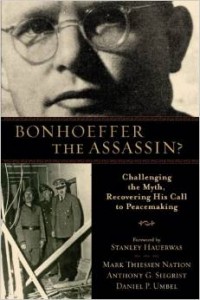 Bonhoeffer the Assassin offers a theological examination of Bonhoeffer’s writings on peace from a pacifist perspective (the authors are Anabaptists). It offers a good summary of these texts, from the early period of the 1930s through the prison period, demonstrating the strong theological continuity from his ecumenical speeches to Discipleship to Ethics that shows the centrality of a peace ethic in Bonhoeffer’s thought. The analysis and insights of these texts from a peace tradition perspective is a genuine contribution to the literature.
The more problematic section of the book is the historical section and its contention that because Bonhoeffer was a committed pacifist, he could not possibly have supported the conspiracy plans to kill Hitler and other Nazi leaders, and that his actual involvement and knowledge of such plans was peripheral. This section of the book is an attack on Bethge’s historiography. The authors claim that the “myth” of Bonhoeffer as stated in the provocative title emerged directly from Bethge’s portrayal of this period of Bonhoeffer’s life in the biography and that there is actually no evidence in the DBWE documentation to support this version. The authors argue that Bonhoeffer remained opposed to the planned murders of Adolf Hitler and leading Nazis, and that far from playing an actual role in the resistance activities, Bonhoeffer primarily served as pastoral counselor to the conspirators.
They base their argument in part on Sabine Dramm’s Dietrich Bonhoeffer and the Resistance (reviewed in this journal in 2008), but much of their methodology draws directly on the documents in DBWE—as the authors put it, by going directly to Bonhoeffer’s own words and not relying on what they describe as the secondary and erroneous account by Bethge. Dramm did something similar, it should be noted: drawing primarily on the documents in DBWE 16, she argued correctly for a more modest understanding of Bonhoeffer’s entry into and role in the July resistance circles.
Dramm’s outline of events does not contradict Bethge’s account in the biography, but Bethge did emphasize Bonhoeffer’s early knowledge of and support for the conspiracy aims, and this is one of the issues Nation and his co-authors focus on. While it is correct that Bonhoeffer did not write down information about the related discussions in the Bonhoeffer home that took place as early as 1938 (he would have been a fool to do so), there is substantial evidence to support Bethge’s version of things, both in the later accounts of people who knew Bonhoeffer and most particularly in Winfried Meyer’s recent studies of Hans von Dohnanyi and the Abwehr resistance circles, as well as in Marijke Smid’s study of Hans and Christine von Dohnanyi. By these accounts, Bonhoeffer was Dohnanyi’s most trusted confidant and was informed quite early both about the regime’s atrocities as well as the emerging plans to overthrow the regime.
Moreover there is much evidence in Bonhoeffer’s own writings that contradicts the book’s claims. Bonhoeffer did in fact speak about “tyrannicide”–in a 1935 study of the Augsburg Confession at Finkenwalde–and he also argued against a simple principled adherence to strict pacifism. Reconciling Bonhoeffer’s writings on peace with his role in the resistance is a challenge that requires an exploration of Bonhoeffer’s pacifism not only through his writings on that topic, but through his writings on ethics and the church/state relationship, with a recognition of the complexity of the circumstances he faced and the decisions he made as a result. Beginning with his deconstruction of the legitimacy of Nazi authority in 1933 and going through to his wartime writings, in fact, the church/state writings offer deep insights into Bonhoeffer’s understanding of the pacifist question.
In his July 1945 eulogy for Bonhoeffer, George Bell said that “deeply committed as he was to the plan for elimination, he was not altogether at ease as a Christian about such a solution.” Bell was in a position to know, since Bonhoeffer had given him information about the intended coup (including the plans to kill Hitler) in 1942 to convey to Anthony Eden. The second part of Bell’s sentence addresses the very dilemma that troubles the authors of this book: how did Bonhoeffer reconcile the conspiracy’s aims with Christian principles? The answer is that he didn’t, and he accepted the full responsibility demanded by such a “boundary situation.” Eberhard Bethge gave a similar reply to Bell’s when I interviewed him about this in 1985, saying that while Bonhoeffer believed that the killing of Hitler and others was necessary he deliberately refused to claim the sanction of the church for this action, saying that this was his personal choice and involved taking a certain guilt upon himself. Bethge’s version was also confirmed by Klaus Bonhoeffer’s widow Emmi when I interviewed her in 1986; she told me that the entire family was unanimous in support of the coup attempt. That might not satisfy doctrinaire thinkers, but I think it is difficult to understand Bonhoeffer fully if we insist on a version of him that ignores such contradictions and complexities.
Here there are insights to be gained from the perspective of contemporaries who were active in pacifist circles and were in fact consistent on the issue– Friedrich Siegmund-Schultze, Corder Catchpool, George Bell’s sister-in-law Laura Livingston, many of the people in the Gruber office, and Andre Trocme in Le Chambon. One of Bonhoeffer’s closest friends before Bethge came on the scene was Herbert Jehle, who strongly championed Bonhoeffer’s pacifism in postwar debates about it. So this is an especially complex area where–as with the issue of Bonhoeffer’s engagement in helping for Jews–much could still be written.
Another such area is Bonhoeffer’s encounter with the African-American church and the realities of American racism during his year in New York in 1930-31. Bonhoeffer himself acknowledged the tremendous impact of this experience, writing, “I heard the gospel preached in the Negro churches,” and taking recordings of Negro spirituals back to Germany, where he played them for the somewhat baffled Finkenwalde seminarians. Josiah Young’s 1998 book No Difference in the Fare explored this period, particularly in terms of how it shaped Bonhoeffer’s critique of Nazi ideology.
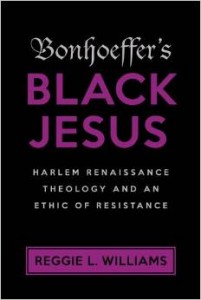 Reggie Williams’ Bonhoeffer’s Black Jesus builds on Young’s insights but breaks new ground in offering a detailed and vibrant portrait of the Harlem Renaissance that was in full blossom during Bonhoeffer’s time in New York. The course syllabi and reading lists for Bonhoeffer during this time (published in DBWE 10) show that Bonhoeffer read a number of books by black authors like Countee Cullen, and Williams talks about what it was the Bonhoeffer was actually reading, how authors like Cullen and W. E. B. Du Bois thought about racism in the broader sense, and what he would have encountered in the culture at Abyssinian Baptist Church and beyond.
William makes the case that these encounters shaped Bonhoeffer’s subsequent thought about the theological questions that were so central for him: what is church? And who is Christ today? The breakthrough sections of the book are those that explore the influence of the black theology of the day on Bonhoeffer’s notion of Stellvertretung (“vicarious representative action,” in DBWE) and his ecumenism. Williams argues that the theological insights that emerged from Bonhoeffer’s exposure to the black church shaped his further exploration of ecumenical theological identity beyond strictly European concerns and actually included some of the concerns expressed by African-American thinkers at the time.
Historically, Williams offers new information about Bonhoeffer’s seminary friend Albert Franklin Fisher, the son of a prominent Baptist minister in Birmingham who became Bonhoeffer’s guide to this new world. The book also gives an evocative description of the Harlem Renaissance in its full radicality and rawness (similar to some of Marsh’s descriptions of the south). As in each of these books, there are places here where the historical understanding of Bonhoeffer’s immediate context and the issues he confronted falls short. Williams’s use of colonialization theory in particular sometimes leads him to make sweeping claims about the German church struggle and Bonhoeffer’s theological background. The ethnocentric theology of the German Christians, while it definitely has analogies in some aspects of American racism, included a complex mix of nationalism, anti-Semitism, and certain interpretations of Lutheran tradition that led to some distinctive challenges.
The strengths of all three books rest in the theological sections: Marsh’s tracing of the different influences on Bonhoeffer’s theology and where he took them; Nation, Siegrist, and Umbel in the exploration of the development of his pacifism; Williams’ discussion of how the larger context of the Harlem renaissance inspired both Bonhoeffer’s personal spirituality and broader ecumenism.
The other strength, especially in the books by Marsh and Williams, is the vivid portrait of the worlds in which Bonhoeffer wrote and lived: the travels to Spain and Italy, the time in New York, and the theological debates that shaped Bonhoeffer and his circles. Each author has made a serious attempt to go beyond Bethge–through new information, new interpretations of the documents and the history itself, and in the case of Nation, actually challenging Bethge’s version of the history. All three draw heavily on the lesser-known material that is now available in the new DBWE edition, including material that is less familiar to English-language readers. As one of the general editors of DBWE, I welcome this as the necessary step to bring Bonhoeffer scholarship to a new level.
There is important information in each of these works for historians to consider. Nonetheless, Chandler’s warning that theologians need to consider more recent historical literature remains true; in their historical sections these books reveal the inherent limitations of constructing a historical narrative primarily from within the DBWE opus.
Notes:
[1] Published in The Journal of Ecclesiastical History (Jan 2003), 54:1, pp. 89-97.

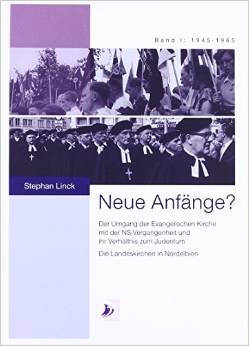
 In Neue Anfänge? Der Umgang der Evangelischen Kirche mit der NS-Vergangenheit und ihr Verhältnis zum Judentum. Die Landeskirchen in Nordelbien. Band 1: 1945-1965, Stephan Linck analyses the situation in the four Protestant churches which united in 2012 to form the Evangelical Church of North Elbia. He had earlier organized a travelling exhibition which did much to break the silence about these churches’ failures in former years. His central point is that this part of Germany had a long history of extreme nationalism, backed by Lutheran authoritarianism. This made these congregations particularly susceptible to Nazi anti-Semitic propaganda and encouraged their extremist and anti-communist attitudes, which were only reinforced in this region after 1945, when so many refugees fled to the region to escape the Russian occupation and the subsequent Communist domination of eastern Europe. These churches’ active support of the refugees’ desire to regain their homelands, in Linck’s view, only exacerbated their reactionary political attitudes and entrenched their prejudices.
 These same features were on display in the Bavarian Protestant Church, too. They are the subject of Björn Mensing’s chapter in the collection of essays edited by Antonia Leugers, entitled Zwischen Revolutionsschock und Schulddebatte. Münchner Katholizismus und Protestantismus im 20. Jahrhundert. Mensing also comments acerbically on the apologetic and self-serving accounts of Bavarian Protestantism written by survivors, which excused the early and enthusiastic support given to Adolf Hitler as stemming from a desire to prevent a victory for Communism and as a sign of the “rechristianising” of a war-torn Germany. Those few voices calling for a more critical and less self-justifying account of the Nazi years were quickly sidelined. So too those who had been involved in the 1944 plot to overthrow Hitler and had been executed as a result, such as Dietrich Bonhoeffer, were regarded by the majority of the Bavarian Protestant leaders as “traitors to the national cause”. Mensing, who is now the Pastor of the Church of Reconciliation erected in the former concentration camp at Dachau, recounts with some bitterness the opposition to the building of this chapel by the former pro-Nazi pastor of the neighboring parish, clearly backed by the majority of his parishioners. It was only after the generation of participants in the Nazi years had all passed from the scene that a more fitting recognition of the church’s failures and a new sense of repentance could be encouraged. Mensing blames the continuing influence of the conservative leadership in the Bavarian Protestant Church for the slowness with which a greater sense of repentance and reconciliation has at last been adopted. But in view of the entrenched national conservatism of most Bavarian Protestants, Mensing believes there is still a long way to go before the deficiencies of the past can be finally laid to rest.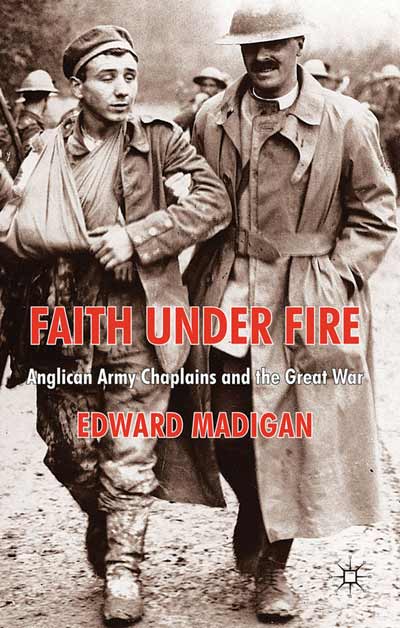
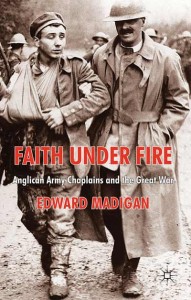 Edward Madigan’s valuable study begins with a comprehensive survey of the literature about chaplains and their war-time contributions, some written by chaplains themselves, such a Ernest Raymond’s Tell England, or the far more influential novel by Robert Graves, Goodbye to all That. Many of these books presented a largely negative picture of the war records of these chaplains, finding that they were generally not respected by either officers or men, being considered inadequate to the tasks they faced.
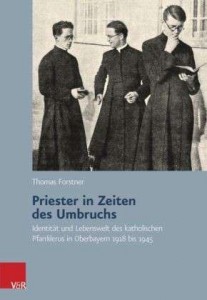 From the outset, Forstner makes it clear that his book will depart from the following works: Thomas Breuer’s Verordneter Wandel? Der Widerstreit zwischen nationalsozialistischem Herrschaftsanspruch und traditionaler Lebenswelt im Erzbistum Bamberg (Mainz: Matthias-Grünewald, 1992); Thomas Fandel’s Konfession und Nationalsozialismus: Evangelische und katholische Pfarrer in der Pfalz 1930-1939 (Paderborn: Ferdinand Schöningh, 1997); and Tobias Haaf’s Von volksverhetzenden Pfaffen und falschen Propheten: Klerus und Kirchenvolk im Bistum Würzburg in der Auseinandersetzung mit dem Nationalsozialismus (Würzburg: Ferdinand Schöningh, 2005). All of these works, he argues, centered primarily on questions relating to resistance and politics without significant consideration of priestly culture and everyday life. Forstner places my own 2004 study, Resisting the Third Reich: The Catholic Clergy in Hitler’s Berlin (DeKalb, Illinois: Northern Illinois University Press) in the same category, though he does acknowledge that my work included “some” discussion of priestly culture. By contrast to these studies, Forstner seeks to understand specifically the all-too often hermetic world of Munich’s clergy, especially their pastoral training, outlook, and practices, quite closely akin to Monika Nickel’s Habilitation, Die Passauer theologisch-praktische Monatsschrift: Ein Standesorgan des Bayerischen Klerus an der Wende vom 19. Zum 20. Jahrhundert (Passau: Dietmar Klinger, 2004), a study upon which Forstner lavishes great praise. Nickel’s work examined pastoral practice addressed in the Passau Monthly of Practical Theology.
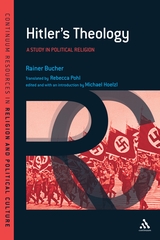 The bulk of the book, which is written in a somewhat convoluted Germanic style, but competently translated into English by Rebecca Pohl, is based on a thorough examination of all of Hitler’s surviving speeches and writings. Bucher’s main contention is that Hitler’s worldview was far more than just an ideology adopted for tactical reasons in order to gain political support. Rather, in Bucher’s view, Hitler’s ideas constituted a theology, even though it was an intellectually crude and merciless construct, and based on an abominable racism. Bucher is well aware that speaking of Hitler’s theology is provocative because it seems to associate what Christians believe with one of the worst criminals of our era. So he is careful to ensure that he cannot be accused of trying to undertake any kind of vindication. His task is therefore one of explanation rather than condemnation, let alone approbation. In this he succeeds with consummate skill.
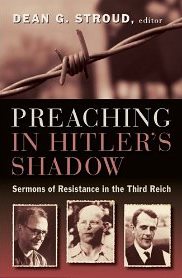 Dean Stroud’s Preaching in Hitler’s Shadow: Sermons of Resistance in the Third Reich uses a broad definition of resistance along the lines of Tec’s definition. This is problematic, because his focus is preaching in the German Confessing Church. In his 48-page introduction to the historical context, Stroud does not engage the vast literature on resistance in Germany or offer his opinion on the competing definitions of resistance by scholars such as Martin Broszat, Hans Mommsen, Peter Hoffmann, Detlev Peukert, and many others. But one can easily ascertain that he considers pastors in the Confessing Church to be a part of the Resistance, that he believes resistance among pastors was more wide spread than is acknowledged, and that he views Christianity as a radical alternative to Nazism. It is self-evident to Stroud that the thirteen sermons he includes in his book are “sermons of resistance.”
 He begins with an account of the Norwegian reception of the German Church Struggle in the pre-1940 period, since he rightly notes that both nations had Lutheranism as their official Protestant state religion and as their traditional focus of loyalty. The challenge of Nazi ideology and its attempt to corrupt Luther’s teachings was therefore immediately recognized. Hassing pays tribute to the skilful manner in which Bishop Berggrav differentiated the Norwegian understanding of Luther from that held by many theologians in Germany. He also notes the skill with which the Norwegian church leaders were able to forge an alliance amongst themselves and resolve long-held theological antagonisms, in order to oppose the invaders and their supporters in Norway.
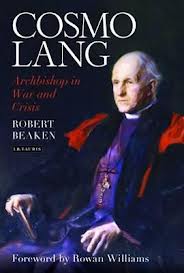 Lang was born in Scotland, the son of a distinguished Presbyterian minister. When he came to study in Oxford, he switched allegiance to a moderate high Anglicanism and opted to be ordained in the Church of England. His gifts were obvious and he quickly gained preferment. In fact, in 1890, at the age of 36, he became a suffragan or assistant bishop, and at the age of 44 was selected to be Archbishop of York, the second highest appointment in the English hierarchy. He spent twenty years there, before being moved to Canterbury in 1928. In Beaken’s view, it was hardly his fault that he was appointed to York too early and to Canterbury too late in life. He was a loner and a workaholic, and a bachelor who had difficulty in relating to others even of his own class and complexion. As a result, he never established any personal associations and had no following to uphold his legacy. This biography will, however, serve to record his achievements and gives a sympathetic analysis of Lang’s actions during the difficult and traumatic years of the 1930s.
 The tone is of course laudatory, rather than critical. But at least these papers help to set the boundaries within which Bonhoeffer scholarship can flourish today, and thus exclude some of the more exaggerated theories. For example, in recent years, Bonhoeffer has been characterized as a revolutionary, an assassin and an American Evangelical. None of these authors was invited. On the other hand, it is also clear that the theologians and the historians are not always talking on the same wave-length. The latter’s approach is empirical, concrete and historical, whereas the former seem often to engage in highly theoretical, even metaphysical interpretations, which rarely touch down on the solid earth of Nazi Germany. So this book should help to encourage some cross-fertilization in the debates about Bonhoeffer’s legacy.
 John Stott was born in 1921 in a well-to-do professional family and, as was the custom, went to one of England’s most prestigious private (i.e. “public”) schools, Rugby, where his talents led to his appointment as Head Boy. At the age of seventeen, he had a classic evangelical conversion experience and invited Jesus Christ into his life. This was largely due to the influence of an itinerant Anglican clergyman named Eric Nash, whose mission it was to attract young public school leaders and lead them to a life of Christian witness and service . Nash remained Stott’s mentor for many years and undoubtedly encouraged him to seek ordination as a Church of England priest. This decision was to be a great disappointment to Stott’s family, as was (even more so) his resolve not to be conscripted to do military service at the very moment when the Second World War broke out in 1939. Stott took advantage of the loop-hole which allowed students in training for the ministry to be exempt from military service. He was thus one of the few young men taking his war-time undergraduate degree at Trinity College, Cambridge, after which he moved on to the nearby theological college, Ridley Hall, which resolutely maintained the evangelical tradition of those martyrs burnt at the stake by Queen Mary four centuries earlier.
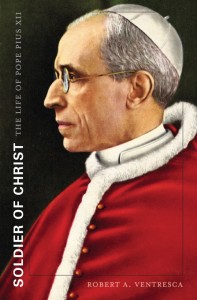 Born into the “black nobility” of Roman society, Pacelli lived a privileged life that even included a rare dispensation that enabled him to avoid the rigors of seminary life for the flexibility of home with his family. Pacelli was also not ordained with his classmates, but during a separate Mass in a private chapel. Despite such an uncommon priestly formation, Ventresca concludes that amid the changes “brought about by the fall of papal Rome in 1870, it is difficult to say whether there was anything typical about Pacelli’s clerical training in the closing decades of the nineteenth century” (p. 36). Yet, Ventresca reveals that Pacelli was exceptional. Even prior to earning a doctorate in canon law in 1904, Pacelli caught the attention of Pietro Gasparri, the secretary of the Sacred Congregation for Extraordinary Ecclesiastical Affairs, who soon became a patron and ensured a smooth transition for the young priest into Vatican bureaucracy. By 1914, the talented Pacelli had replaced Gasparri when the latter rose to become secretary of state. Three years later, Pacelli himself rose in the ranks to become papal nuncio to Bavaria. Prior to his departure for Germany, Pacelli was consecrated archbishop of Sardis by Pope Benedict XV himself.
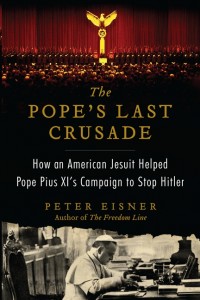 Briefly the story is as follows. Pope Pius XI (Achille Ratti) who reigned from 1922 to 1939 was increasingly alarmed and dismayed by the rise of Nazism and its flagrant and sustained attacks against both the Catholic Church and the Jews. Already in 1937, Pope Pius, after consulting the German bishops, had issued a vigorous protest in the Encyclical “Mit Brennennder Sorge”. But the results were disappointing. Hitler merely stepped up his persecution of the church, and encouraged his associates to be even more virulent in their campaigning against the Jews. But by 1938 the Pope had determined to protest again, specifically against the violent extremism in the Nazis’ racial and anti-Semitic ideology. By chance the Pope had come across a book written by LaFarge entitled Interracial Justice, which described the plight of blacks in the United States, and pleaded for the church to take a lead in combatting racism in that country. The parallels between racism in America and the dangers of anti-Semitism in Europe were easy to see.
 Unlike most of the studies of postwar Germany that focus on the origins of the Cold War and high stakes political maneuvering of the Allies, Schroeder takes a bottom-up approach that illuminates the less conspicuous reconciliation work of German groups such as the Association of the Victim of Nazism (VVN) and religiously-affiliated international groups such as International Fellowship of Reconciliation (IFOR), Moral Re-Armament (MRA), Pax Chrisiti, the International Council of Christians and Jews (ICCJ), and the World Council of Churches (WCC). His study compares and contrasts reconciliation, defined as “the establishment of peaceful – or at least non-hostile – relations between former enemies” in the four zones of occupation in the immediate postwar years and in East and West Germany after 1949.
 Thomas Grossbölting, who teaches at the University of Münster, poses these questions and puts them in the context of faith, church and religion after the catastrophe of National Socialism in Germany. This well researched study can be seen as the first up-to-date history of religion in the Federal Republic of Germany. His basic thesis is clear and hardly surprising. Anyone examining how and what Germans have believed in the past fifty years has to take note of a striking decline in the significance of religious consciousness. Although, in recent years, some observers have claimed that there has been a so-called religious revival, in fact anyone taking a longer view over the past five or six decades must conclude that a far-reaching secularization has taken place. The very idea of Heaven has been lost. As the author crucially points out in his introduction: “A Christian Germany no longer exists”. On the other hand, the elements of faith, church and religion have not disappeared from daily life in Germany. Rather they have been thinned out, pushed to the edge of society, and in many people’s lives they are completely or largely absent.