Letter from the Editors (Spring/Summer 2022)

Contemporary Church History Quarterly

Volume 28, Number 1/2 (Spring/Summer 2022)

Letter from the Editors (Spring/Summer 2022)

By Kyle Jantzen, Ambrose University

Dear Friends,

After a long hiatus, once more the editors are pleased to present a new issue of Contemporary Church History Quarterly. This issue–a combined spring/summer volume–begins with the translation and reprint of an article by Manfred Gailus reassessing the high-profile Protestant churchman Otto Dibelius.

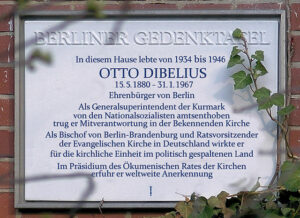
Otto Dibelius’ memorial plaque in Berlin-Lichterfelde. By OTFW, Berlin – Own work, CC BY-SA 3.0, https://commons.wikimedia.org/w/index.php?curid=5404813

Five reviews follow, including two on book-length studies by Gailus, a leading Berlin church historian. Sarah Thieme tackles Gläubige Zeiten. Religiosität im Dritten Reich while Christopher Probst assesses Gegen den Mainstream der Hitlerzeit. Der Wuppertaler Theologe Helmut Hesse (1916-1943).

On the Catholic side, Martin Menke reviews Michael Hesemann’s study, Der Papst und der Holocaust. Pius XII. und die geheimen Akten im Vatikan. Further afield, Björn Krondorfer examines Jeremy Best’s book, Heavenly Fatherland: German Missionary Culture and Globalization in the Age of Empire, while Kyle Jantzen reviews the James Strasburg study, God’s Marshall Plan: American Protestants and the Struggle for the Soul of Europe.

Three notes follow the reviews. Kyle Jantzen reports on two studies relating to Mennonites, Nazism, and the Holocaust, one a special issue of the Mennonite Central Committee journal Intersections and the other a Ben Goossen research article on Mennonite novelist and Holocaust denier Ingrid Rimland. Finally, Sarah Thieme reports on a conference devoted to Catholic historical research in Germany.

Finally, it is with sadness that I announce that long-time editor Matthew Hockenos is resigning from the CCHQ editorial team. Matthew was an important member of the group that converted the late John Conway’s newsletter into what is now Contemporary Church History Quarterly and has been an anchor on the editorial team ever since. We wish him well in his scholarly work, and look forward to reading his future publications on the German churches during and after the Hitler era.

Once again, we hope this issue of CCHQ interests and educates, and look forward to continuing to bring you news, reviews, and commentary on contemporary religious history with a focus on Germany and Europe in the twentieth and twenty-first centuries.

On behalf of the editorial team,

Kyle Jantzen, Ambrose University


Share

The Old Picture Is No Longer Valid: Why the Time Is Ripe for a Reassessment of the Ecclesiastical Figure of the Century, Otto Dibelius

Contemporary Church History Quarterly

Volume 28, Number 1/2 (Spring/Summer 2022)

The Old Picture Is No Longer Valid: Why the Time Is Ripe for a Reassessment of the Ecclesiastical Figure of the Century, Otto Dibelius

By Manfred Gailus, Technical University of Berlin; translated by Kyle Jantzen, Ambrose University

He was long regarded as the outstanding personality in the twentieth-century Protestant Church: Otto Dibelius (1880 – 1967). But what is missing is an overall picture of the leading theologian and “virtuoso power politician” and his work, especially during the National Socialist era, complains the Berlin history professor Manfred Gailus. An international Dibelius conference from October 5th to 7th (2022) in Marburg is intended to close this gap.

This article was originally published in Zeitzeichen, February 2022, p. 14-17. It is reprinted here with the kind permission of the publisher. You can view the original German article with images here.

It has grown quieter around Otto Dibelius. When the fiftieth anniversary of his death came in January 2017, few remembered him. No prominent memorial event, no scholarly conference, hardly any articles by well-known theologians or historians in newspapers or magazines. In Berlin, he was remembered in church services, but that was more of a small form – appreciation on the back burner. Perhaps the exuberant commemoration of the Reformation in 2017 also played a role: “Luther” was on everyone’s lips and drowned out the Protestant figure of the century, Dibelius. But by this time, “lower case” commemoration of the once highly revered Bishop of Berlin had long been in vogue. In 1980 things looked different. At that time, the renowned Tübingen church historian Klaus Scholder, in a highly regarded lecture in the Kaiser Wilhelm Memorial Church, spoke on the centenary of Dibelius’ birth. On the 40th anniversary of his death in 2007, the Münster theologian Albrecht Beutel gave a lecture in the Berlin Cathedral about the powerful church leader and, referring to Scholder, characterized Dibelius as a singular “Prussian church prince”.

You rarely hear such superlatives these days. The old and sometimes strongly heroic image of Dibelius is fading. It clearly doesn’t fit anymore. It is time to draw a new picture of Dibelius that meets today’s scholarly standards and integrates his drawback in addition to his undeniable skills, achievements, and merits. He will certainly remain a major figure, but he will lose some of his shine. Until now, little has been written about his aggressive war sermons from 1914 to 1918 in the relevant Dibelius literature. His leading role in the Greater Berlin regional association of the warmongering “German Fatherland Party” from 1917 to 1918 should not be ignored. Despite the important study by Hartmut Fritz (1998), his permanent agitation against the Weimar Republic as a “godless republic” has not been adequately investigated. His performance in the “Third Reich” requires considerable corrections. His attitude towards Judaism, including a consistent veritable antisemitism, was never integrated into an overall picture of this colorful Protestant personality. In short: until now the only biography has been the highly apologetic biography by Robert Stupperich (1989). The time is now ripe for a new biographical study that situates the life and work of this controversial church leader in twentieth century political and social history, assessing his modes of action from this perspective. In what follows, Dibelius’ role in the late phase of Weimar and during the Third Reich will be discussed.

Dibelius did not like the Weimar Republic and tended to vilify it as a lifeless “godless republic” out of a proud ecclesiastical attitude. A few weeks before Hitler came to power, in a lecture on the “reawakening of faith in the present”, he lamented the devastating effects of secularization, materialism, individualism, and a general decline in values​​. But he also saw light at the end of the tunnel. He pinned his hopes on the “national movement” of the moment, including the National Socialists. With its appeal to a “community of blood ” [“Blutsgemeinschaft”] and “ethno-national community” [“Volksgemeinschaft”], it rebelled against the internationalism of class struggle ideas. Their goal: a new, strong ethnic group, had not been “conceived by the sharp calculating mind of a Jew.” Rather, it came from “emotion,” “instinct,” from “impulses of the blood.” The national movement was fighting for ideals that were not conceived by man, but felt “in his blood,” precisely in what was “creatively determined” for him. Although it was not yet possible to say how the struggle within National Socialism for the religious foundations would end, one thing was certain: it was possible for a “consciously Protestant life of faith” to develop within the National Socialist movement, too.

End of the “Godless Republic”

Dibelius had high hopes for the spirit of the anti-republican opposition to Weimar, especially a strong upsurge in faith and the liquidation of an epoch of unbelief. That was his expectation. From this perspective, January 30, 1933, appeared to be a fulfillment. Joy and deep satisfaction at the end of the “Godless Republic” determined the thoughts of the acting General Superintendent of the Kurmark during the first months of Hitler’s “Cabinet of National Concentration.” Now we rule, too – something like this could be used to capture his immediate sense of that moment. The smashing of the “godless movement” took place to the applause of Protestant church leaders. The rapid increase in church membership withdrawals suddenly stopped. Religious instruction was reintroduced in the modern, secular progressive schools [Reformschulen]. “Non-Aryan” lawyers in courts were forcibly expelled by SA troops. The Easter message of the Prussian church leadership spoke of “joy at the awakening of the deepest forces of our nation.” Dibelius preached as a political theologian on the “Day of Potsdam” in a euphoric mood of optimism on the big stage. He witnessed the act of state in the Garrison Church up close and was deeply moved by the ceremonial handshake between Hindenburg and Hitler.

Dibelius also justified the April 1, 1933, boycott of Jews to other countries. In his “Wochenschau” [“Week in Review”] in the Evangelisches Sonntagsblatt [Protestant Sunday Paper] of April 9, he reaffirmed his positive attitude towards Nazi Jewish policy: the “Jewish element” (he wrote) had played a leading role in all the dark events of the last 15 years. “German national life” was endangered by the Jewish immigration from the East. Nobody could seriously object to the suppression of Jewish influence. Two things had to happen in order to solve the “Jewish question”: blocking off Jewish immigration from the East and strengthening the German way of life so that it did not succumb to a “foreign race.” In May, Dibelius expressed great joy at the National Socialist redesignation of May 1st as “National Labour Day” and praised “People’s Chancellor Hitler” and Goebbels’ “brilliant organizational talent.”

At the Kurmark Church Congress at the end of May, in the Potsdam Garrison Church, Dibelius praised the changes since January 30: the dirt had disappeared from the streets, the poisonous class hatred had been removed from the soul; children were receiving religious instruction again and adults were again returning to church. At the subsequent rally in front of Potsdam’s city palace, Dibelius allowed a prominent member of the Reich leadership of German Christians (Deutsche Christen, or DC), Pastor Friedrich Peter, to make political appeals to the Protestant youth.

The measures taken by the National Socialist state commissar August Jäger at the end of June 1933 marked a turning point: all Prussian church general superintendents were temporarily suspended, including Dibelius. After the end of Jäger’s state intervention, Dibelius was able to resume his official duties, but in fact he no longer had any administrative powers. The church elections of July 23, ordered at short notice by the state, brought a massive two-thirds-to-three-quarters majority for the DC. They now dominated the Prussian church government. In this precarious situation, Dibelius sent a pointed letter aimed at understanding to the new church leadership, which was dominated by radical German Christians. It was untenable, he complained, for a general superintendent to be considered politically unreliable in a church that had joyfully committed itself to the new state. He now wanted to clarify his “actual position.” Even as a student around 1900, he had been fighting against Judaism and social democracy. He had remained true to this attitude to this day. He referred to his sermon on the “Day of Potsdam.” In it he acknowledged a spirit that stood up for the greatness of the Fatherland with determination. After the sermon, the Prussian Prime Minister Goering had shaken his hand with warm words of thanks. Likewise, at the request of Reichsminister Goebbels, he spoke to America over the radio to defend the new state against atrocity propaganda from abroad. Although he was critical of the DC, he had always tried to establish good contacts with them. Thus he had invited Ludwig Müller – the DC’s designated candidate for Reich Bishop– to deliver the major address to the church congress in the Kurmark church province. According to Dibelius in mid-July 1933, the rhythm and goals of their work contained much that corresponded to his own style and goals. He had repeatedly asked himself whether his type of work was not so closely related to the intentions of the DC that a mutual quarrel was intolerable from a church point of view. Because of the state commissar’s intervention, he had finally had to take a stand for the church. Finally, Dibelius wanted an understanding as to how things should continue with him personally. It should not be, he said, that the agitation of a small circle could easily remove a general superintendent from office.

The DC no longer responded to this request. The powerful wave of the DC movement within Protestantism had pushed Dibelius aside. In September he received his letter of dismissal for early retirement from the future Nazi Reich Bishop Müller. Dibelius had played no part in the first steps of opposition to DC ecclesiastical dominance in 1933. Rather, that came from the opposition election list “Gospel and Church” in July and the founding phase of the Pastors’ Emergency League in September. After weeks of waiting, a solution emerged in the fall. At the request of relatives, Hermann Goering had exerted his influence over the appointment of the retired general superintendent. On December 1, 1933, Dibelius took up the post of curate in San Remo on the Italian Riviera. Ostensibly, he was looking for this opportunity to take a break from church politics and time for personal reflection.

Overall, Dibelius’ behavior in the decisive year of 1933 had proven to be hesitant, shaky, and ambivalent. When he returned to Berlin on June 3, 1934, critical decisions in the Church Struggle had been made – without him. He had not been present at the constitution of free confessional synods from the beginning of 1934, at the Ulm Day of Confession in April, or at the first Reich Confessing Synod at the end of May 1934 in Barmen. He was absent when the house of the church was ablaze, and when he returned the fronts in the Church Struggle had formed.

Man of the Middle

At the request of Kurt Scharf, Dibelius helped establish a Confessing Church (Bekennende Kirche, or BK) in the Mark Brandenburg. During the Church Struggle, he was and remained a “man of the middle,” of church-political moderation, of balance. He did not belong to the decisive wing of the Confessing Church around Martin Niemöller, Martin Albertz, Dietrich Bonhoeffer, and Karl Barth. His church-political attitude corresponded more to the accommodating course of the moderate wing represented by the three Lutheran bishops of Hanover, Bavaria, and Württemberg. He was not involved as a synodal member to the BK synods of Dahlem, Augsburg and Bad Oeynhausen. He did not sign the confidential memorandum of the second Provisional Church Leadership of the BK to Hitler at the end of May 1936, and he was rather distant towards its peace liturgy against the threat of war at the end of September 1938. Lastly, he was not one of the accused in the “examination process” (December 1941), through which the regional elite of the BK Berlin-Brandenburg were sentenced to sometimes considerable prison terms for illegal teaching and examination activities at the illegal church seminary.

Dibelius’ real problem in the “Third Reich” were the German Christians with their ethno-nationalist Christian theology and their aggressive claim on the church government. This dissent gave rise to various conflicts and personal clashes. But that was not general resistance to the Nazi regime, rather only opposition to a parallel movement to the Hitler party within Protestantism. Additionally, he criticized aspects of the Nazi worldview and Nazi religious policy, where these proclaimed anti-Christian goals. In 1937, this brought him into a legal dispute with Reich Church Minister Hanns Kerrl.

However, during the war years, Dibelius developed a certain inner distance from the regime. Kurt Gerstein’s eyewitness reports about the murder of the Jews in the East (August 1942) may have played a role in this. Dibelius maintained contacts with the church unification work of Württemberg Bishop Theophil Wurm and with the conservative Freiburg resistance group around Walter Eucken and Gerhard Ritter. But resistance against the state was not permissible for a devout Christian and avowed Lutheran, according to Romans 13 and because of the [nineteenth-century] “New Lutheran” [neulutherische] two-kingdoms doctrine. So Dibelius remained what he had always been during the “Third Reich”: a Christian-conservative churchman, a Prussian-German national Protestant, whose religious mentality had been formed by the currents prevailing in the late German Empire (Heinrich von Treitschke, Adolf Stoecker, Union of Associations of German Students). It was indelibly marked by ethno-national [völkisch] sympathies and notoriously anti-Jewish and at times antisemitic tendencies.

A thorough, up-to-date, new Dibelius biography seems urgent today—as well as a thoroughly renovated Dibelius picture as part of a contemporary ecclesiastical culture of remembrance.

Share

Review of Manfred Gailus, Gläubige Zeiten. Religiosität im Dritten Reich

Contemporary Church History Quarterly

Volume 28, Number 1/2 (Spring/Summer 2022)

Review of Manfred Gailus, Gläubige Zeiten. Religiosität im Dritten Reich (Freiburg: Herder 2021). 223 pages. ISBN 9783451033391.

By Sarah Thieme, University of Münster

With his monograph “Gläubige Zeiten”, Manfred Gailus, also one of the editors of this journal, succeeds in providing a compact synthesis of his many years of research on the history of religion during the National Socialist era and his thesis of a “religious revival” (p. 15) provides a convincing framework for his account. This well-executed study is rich in examples and quotations from contemporaneous actors that bring the story to life for the broader audience to whom he is presenting the current state of research on the “return of religiosity” (“Wiederkehr des Religiösen”) (p. 11) from 1933 to 1945. These years were marked by diverse faiths and a multitude of (often hybrid) creeds, an intensification of religious action, competition between religious actors and conflict over questions of faith.

The book is divided into four main chapters – I. Christian Denominations and Nazism; II. New Faith Movement; III. Jews, Antisemitism and “Kristallnacht”; IV. War, Christians and the Holocaust – with varying numbers of sub-chapters. Instead of an introduction, Gailus precedes the chapters with a short section entitled “Concepts, Questions, Problems” in which he introduces his topic and the central question of his study: “What did the Germans believe in during the Hitler era?” (p. 8). Given it has been shown that 95% of Germans belonged to a Christian denomination during the Nazi regime and the “astonishing mixture of individual faiths” (p. 10) and “hybride Doppelgläubigkeiten” that Gailus has identified – in particular, those blending Christian faith and Nazi confession – the study sets out to analyse the traditional Christian characteristics in relation to the reshaping and partial new imprints of religiosity that occurred during the “Third Reich” and, thereby, offer an interpretation of the Nazi era in terms of the history of religion. The author proposes that the Nazi era was a “time of faith”, “Gläubige Zeiten” with a “high conjuncture” of faith and faithfulness (p. 11). Methodologically speaking, Gailus claims to look from above, from a “bird’s eyes view” (p. 11), though it should be noted that his altitude varies significantly throughout the book. Given his own extensive research, he flies in very close to Protestantism, while remaining more distant from Catholicism, the perspective on which is primarily literature-based and, therefore, more superficial. Gailus also flies particularly close to Berlin, the geographical focus of his own research and most of the examples he cites.

The first chapter on the two main Christian denominations is particularly compelling. Gailus convincingly develops the argument that there was a significant “religious experience” (p. 15) in 1933 that can be perceived as a turning point which raised hopes for a re-Christianisation, especially within Protestantism. As evidence of this shift, the author refers to a deluge of confessional publications and the mass marriages of Berlin stormtroopers, which, by being initiated by enthusiastic Protestant pastors, demonstrates that the Nazi state welcomed such confessional commitment, at least initially. Gailus tells the story of the so-called “Church Struggle” or “Kirchenkampf” as an internal Protestant conflict between the völkisch-antisemitic religious movement “Deutsche Christen”, which dominated many regional churches, and the internal church opposition to it, the “Bekennende Kirche”. The internal tension between these groups permeated all levels of the church, creating disputes amongst church leaders and intellectuals and local disputes within the parishes. The Apostle Church in Berlin provides a particularly vivid illustration, which included blockades of the church space, fights on the pulpit and loud counter-sermons.

Using the Protestants as a starting point, Gailus evaluates the “performance” of the Catholics, whom he suggests were “less moved” (p. 23) in 1933. It is noticeable that the author analyses Catholics in a more general way and provides fewer examples of local and regional actors. He focuses primarily on the Reichskonkordat, the treaty between the Nazi government and the Vatican made in the summer of 1933 and whose observance the Church and the Nazis struggled over in the following years. To summarise, Gailus emphasises that although Catholic religiosity and Nazi faith were not mutually exclusive, in comparison to the Protestants, who he considers as fairly open to National Socialism, he considers the Catholics, overall, as more reserved and sceptical and, thus, increasingly pushed out of the public eye by the National Socialists. A stronger appreciation of the internal-Catholic plurality and diversity of forms of behaviour would have been desirable. It would also have been preferable if the developments between 1933 and the start of the war had been examined more closely. Having said that, Gailus succeeds exceedingly well in his interpretation of Protestantism, which he vividly portrays as a divided “many-voiced and dissonant choir without a conductor” (p. 37-8).

In order to do justice to the breadth of the religious field, given the great competition over questions of faith and a multitude of religious confessions that occurred at the time, the second chapter covers the new faith movements in the “Third Reich”, i.e. the völkisch movements, the so-called “God-believers”/“Gottgläubige”, and religious factions within the NSDAP.

First, he uses the example of the heterogeneous “Deutsche Glaubensbewegung” and the “Ludendorff Movement” to show the dynamics of the new-religious awakening that occurred from 1933 onwards. The churches in particular saw the “neo-pagans”, whom they overestimated, as a great threat. However, the Nazi state, which initially allowed the völkisch faith movements to continue, wanted to prevent a religious division of the “Volksgemeinschaft” and increasingly undermined the new-religious groups from 1936 onwards as the new faith was to serve National Socialism. Young, fanatical National Socialists in particular – usually SS men, party functionaries and civil servants from industrial-urban regions, often from the fringes of Protestantism – saw the NSDAP and SS as their new religious community and called themselves “Gottgläubige”. From 1936 on, they were officially recognised as a third denomination despite not having an organisational context, an explicit programme of faith or a religious practice of their own.

Within the NSDAP, Gailus considers the “Gottgläubigen” among the “ideological rigorists”, one of three distinct religious-political factions within the party, although they did not express their religious-political conflicts openly. In addition to this group, with their radical anti-church and anti-Christian attitudes, there was a large group of “Christian National Socialists” in the middle and lower levels of the party hierarchy, who desired a synthesis of beliefs, and thirdly, the “centrists” who wanted to avoid the NSDAP’s break with the large Christian portion of the population because of the power politics. Thus, the NSDAP left the solution to the religious question open. Based on the membership statistics, however, the party remained a Christian one. Nevertheless, Gailus considers the religious dimension of the Nazi movement as an expression of the religious revival, which he exemplifies, inter alia, with the so-called “Lebensfeiern”.

The third chapter is less strongly oriented towards the thesis of the “religious revival”. In this chapter, Gailus explores the perspectives of religious actors on Jewish people and their behaviour during the November pogrom of 1938. He shows how Judaism was declared “evil” by Nazi salvation beliefs and how this added a religious dimension to racist antisemitism. Following Saul Friedländer, the author puts forward the thesis of “redemptive anti-semitism” unfortunately without explaining the concept in more detail. He also elucidates how both denominations supported racist exclusion by issuing so-called “Aryan certificates”. According to the author, the churches and the new Nazi faith conformed in their “Frontstellung” – against people of Jewish faith. Due to his statement that Jews “were not an independent player in… the religious field” (p. 89), they appear merely as objects in the depiction of this chapter.

With regard to his question about the national-socialist religious foundation of antisemitism, Gailus regrettably omits the perpetrators of the violence in his examination of the actors and reactions of Christians to the so-called “Kristallnacht”. He emphasises the silence of the churches as institutions and, at the same time, shows that many Christians, especially Protestants, agreed to the racist pogrom. A small number of individual clergymen spoke out against the events publicly in sermons. However, they themselves then had to reckon with attacks and arrests, as is demonstrated through several case studies. To explain the pogrom from the point of view of Nazi believers, the author monocausally refers to an “expulsion campaign” or “Austreibungsaktion” against the “evil” (p. 110).

The fourth and final chapter, containing the most sub-chapters, focuses on the relationship between the Second World War, Christians and the Shoa. Beginning with the observation that although there was some enthusiasm and support, especially from the “Deutsche Christen”, the mood at the start of the war was less euphoric than in 1914, Gailus traces expressions of joy, for example, in field post letters. He also discusses the official change in Nazi church policy at the beginning of the war, which was, in practice, still characterised by the fact that the Church’s religious practice was restricted and even attacked. The effects of the war also increasingly restricted religious life on the “home front”. Based on recent research by, for example, Olaf Blaschke and Thomas Brodie, the author emphasises that if we move beyond the dominant narrative according to which all Catholics were victims of National Socialism and suffering because of the war, Catholic Germans also approved of and participated in the war. With regard to the development of Nazi faith over the course of the war, Gailus argues that the trend towards “de-confessionalisation” was in sharp decline, as Nazi faith could not adequately explain the mass deaths, yet, at the same time, the “post-Christian utopias” (p. 145) of some Nazi leaders became even more radicalised.

The brief sub-chapter on the Shoa explores the attitudes of Protestants and Catholics towards the Holocaust. The author stresses that only individual theologians spoke out publicly against the persecution of the Jews and that the Church institutions remained publicly silent about the Shoa despite their knowledge – mediated, for example, through Wehrmacht soldiers. Instead, the Church hierarchy chose the path of less successful petitions to Nazi leaders. Overall, Gailus emphasises that “Christian silence” (p. 160) was widespread. In addition, there had been a “de-solidarization” (p. 160) against Jewish people in the ecclesiastical sphere and “non-Aryans” were excluded from congregational life. Moreover, Protestant theologians, in particular, were actively involved in the genocide. Thus, he ultimately concludes that the Holocaust was “performed out of a Christian society” (p. 163) in which only a few protested publicly.

In sum, Manfred Gailus convincingly presents his thesis that the years from 1933 to 1945 were “faith-filled times” characterised by religious revivals of not only the two Christian denominations but also the völkisch, “gottgläubige” and Nazi believers. He conveys his argument and the current state of research vividly to a broader audience, writing in a clear and richly pictorial manner, citing numerous examples and allowing contemporary source quotations to guide the narrative, which makes the volume a pleasure to read. Source classifications, research debates and comprehensive analyses are sometimes somewhat lacking; especially with regard to the target audience, some explanations of terms (e. g. “political religion”; “redemptive anti-semitism”; …) would have been helpful. Nevertheless, the sections on Protestantism and Nazi faith, which are based on the author’s own extensive studies, are particularly convincing.

The religions studied are analysed as imagined religions, that is, they are conceptualised in terms of their discourses, confessions, church official statements and theologies. Therefore, theologians, clergy and intellectual thinkers are the main actors encountered in this volume. The level of religious practice, the performance of worship and the everyday life of the Church are not brought as clearly into view. This is regrettable, especially because in this way the lived religiosity of women could have also been taken into account more effectively. Nevertheless, and in conclusion, I unreservedly recommend this generally comprehensible overview of the history of religion during the Nazi era as an introduction to the topic and the current debates in the scholarship.

Share

Review of Michael Hesemann, Der Papst und der Holocaust: Pius XII. und die geheimen Akten im Vatikan

Contemporary Church History Quarterly

Volume 28, Number 1/2 (Spring/Summer 2022)

Review of Michael Hesemann, Der Papst und der Holocaust: Pius XII. und die geheimen Akten im Vatikan (Stuttgart: Langenmüller, 2020). 448 pages. ISBN 978-3-7844-3449-0.

By Martin Menke, Rivier University

Michael Hesemann, an independent scholar who has published several works on Pius, on Hitler’s view of religion, and on the Armenian genocide, offers a new contribution to the ongoing “Pius Wars,” the continuing scholarly debate about the degree to which Pope Pius XII opposed national socialist Antisemitism and how much he did to assist persecuted Jews. The spectrum of opinion in this debate reaches from hagiographic apologists such as Michael Feldkamp to vehement critics such as Susan Zuccotti, not to mention Ralf Hochhuth’s early attack on Pius in “The Deputy.” Hesemann makes a case for Pius’s sincere concern for Jewish suffering and his active, pragmatic support for rescue measures. He offers little new insight but amasses a large volume of evidence in the pope’s favor. This work could be a valuable contribution to the discussion, were it not for occasional disparaging comments against those with opposing viewpoints and a failure not only to make his case but engage and disprove the opposing case.

The most important contribution of Hesemann’s work is its exhaustive collection of all evidence and arguments that portray the pope’s record in a positive light. A frequently cited problem was the vague and diplomatic language used in the pope’s statements and writings; Hesemann points to contemporary sources that clearly understood the pope’s intent. Referring to Pius’ first encyclical, Summi Pontificatus, which includes a reminder about human fraternity and about the right of the victims of war and racism to human compassion, Hesemann points to the New York Times, which reported that the pope “condemned dictators, those who break international agreements, and racism.” Furthermore, the Times reported that while such a condemnation had been expected, “only few observers had expected the condemnation to be so clear and unequivocal” (104). Hesemann’s evidence suggests that Pius was not only not silent but that readers understood his guarded speech as he intended.

Beyond the question of papal ambiguity and silence, Hesemann devotes much of the work to proving that the pope was active and vocal about the holocaust. Addressing the pope’s supposed inactivity during the holocaust, Hesemann lists many instances in which the pope quietly directed that financial resources, albeit limited, be provided to help those persecuted by the National Socialists. At the same time, Hesemann shows that this aid extended beyond Catholics whom the national socialist regime considered Jewish. The examples he provides show that his assistance was reactive rather than systematic. In light of the immense need, the Vatican necessarily limited its expenditures in aid to those persecuted. Hesemann also argues that reliable information about persecutions, especially about mass murder, was challenging to obtain. According to him, Pius learned of the true extent of the genocide only after the war. (212) On the same page, however, Hesemann argues that the pope received eyewitness accounts proving the systematic nature of the murders in the East “already a few weeks before the Wannsee Conference.” (212). Thus, in January 1942, the pope knew the National Socialists were murdering according to a concrete plan. How then, as Hesemann describes a few pages later, in September 1942, could Monsignor Montini (later Pope Paul VI) have honestly told American envoy Myron Taylor that the Holy See did not possess information “confirming this grave information?” (216). To argue that the pope knew about violence, terror, and massacres, but not about the extent of the genocide seems farfetched.

Hesemann devotes an entire chapter to “the ‘wise silence’ of the pope.” (220). Pius’ silence was the result of bitter experience, claims Hesemann. Pius himself claimed that any public statements condemning Antisemitism and the holocaust were counterproductive. To each one, the national socialist regime responded with increased persecution. (208) The most robust case for reticence was the Dutch experience under occupation. Beginning in 1941, the Dutch had publicly protested against German antisemitic measures. Each time, the Germans had responded with enormous levies and additional arrests. When deportations began in 1942, the Catholic Archbishop of Utrecht ordered his protest read in all churches. (222) Within days, all Dutch Catholics whom the occupation forces considered Jewish were deported, among them Carmelite religious Edith Stein. According to the pope’s housekeeper, upon hearing the news, the pope immediately burned the draft of the public protest he had intended to make in support of the Bishop of Utrecht. German responses to Radio Vaticane’s regular reports about atrocities against Catholics led to arrests of priests, executions, and more. (231) In response to the pope’s Christmas broadcast of 1942, in which he condemned the suffering of innocents, including those persecuted based on race, the German Foreign Office threatened the pope with reprisals in Germany, should such “interference” occur again. (241). Hesemann makes a strong case that a broad, explicit public condemnation of the genocide would have wrought much suffering. However, one must ask if safeguarding the moral integrity of the Catholic Church’s leader might not have been worth the price in the scope of the crimes committed, preserving the moral integrity of the leader of the Catholic Church might not have been worth the price?

The book’s argument falters when Hesemann presents an image of Pope Pius XII as a friend of Jews, perhaps “the church leader best-disposed to Jews during his lifetime.” (61). For example, the author points to a Jewish childhood friend with whom Pius was close and whose emigration to Palestine he facilitated in 1938. More generally, Hesemann’s case for Pius’ pro-Jewish attitudes and activities during his time as nuncio in Germany relies on the testimony of Pinchas Lapide and Nahum Sokolow. Problematic are claims that Pius XII condemned the Reich pogrom of 1938 because he “must have approved and possibly even dictated himself” the Osservatore Romano’s critical response to this violent persecution. To claim that there was “no leading Catholic clergyman other than Eugenio Pacelli who opposed Hitler and National Socialism as early and as uncompromisingly” is an audacious claim. (92) Sometimes, even among the best historians, the desire for a particular “past” colors one’s work. There is no doubt that Hesemann gathered much evidence to support his case. In the cases mentioned above, the evidence presented by Hesemann broadly supports his argument. Still, a more solid foundation of evidence is needed to support some of the claims made convincingly.

The publisher’s jacket cover promises “the first publication in German of these explosive [brisant] documents.” Anyone expecting full-length explosive and previously unpublished documents will, however, be disappointed. In only two cases does Hesemann claim to offer documentary evidence he newly discovered. For example, he found a message of January 9, 1939, in which Pius, still Cardinal Secretary of State Pacelli, appealed to all leading archbishops to create structures to welcome Catholic refugees whom the Third Reich considered Jews. Pius XII claimed that about 200,000 individuals the regime considered Jewish fell into this category. Hesemann points out that this number exceeded the number of Catholics persecuted as Jews, which meant that Pius sought to create opportunities for practicing Jews. (79-80, 148)

Hesemann’s summary of post-war Jewish expressions of gratitude is exhaustive but not novel. Several significant document editions appear in the citations. However, his archival research is limited to records in the Vatican Secret Archives, specifically those of the nunciatures in Munich and Berlin and the apostolic delegation in Turkey. The documents Hesemann found in the Vatican Secret Archives generally are not new. Of the relevant scholarly literature used by Hesemann, some appeared recently, but a good number of the works are outdated. Even fifty years ago, Father Ludwig Volk, SJ, who had seen the Secret Archives, warned that this collection contained no smoking guns.

In part because Hesemann relies on questionable scholarship, his work lacks judiciousness. For example, he describes Hochhuth’s play as the result of a KGB plot (18) without mentioning that this claim stems from a largely unverifiable work by former Romanian secret police officer Ion Pacepa. Hochhuth did not need the KGB’s help writing “The Deputy.” Even were this assertion correct, it is not surprising that the Soviet bloc sought to embarrass the Vatican, nor does such a connection change the content or impact of the play. Hesemann dismisses rather than engages the work of Michael Phayer, Susan Zuccotti, and others. Accusing David Kertzer of inventing the claim that Pius XI did not want to publish an encyclical that would offend Hitler is a scholarly accusation that deserved a much more detailed explanation. In general, Hesemann undermines his work by this combination of disparaging scholars with contradictory opinions and failing to disprove their claims.

Beyond the corpus, the book includes a preface by Father Peter Gumpel, Ph.D., SJ, deeply involved in the canonization process of Pius XII. In the acknowledgments, Hesemann thanks Pope Benedict XVI for his encouragement and leading German curial officials for their help as he wrote the manuscript. While the preface and acknowledgments do not predetermine the book’s conclusions, they suggest that Hesemann would have felt the need to be all the more critical of his sources and their arguments to avoid the appearance of prejudice.

Reading the work without context, one seems to see a convincing case for an actively engaged pope, one who opposed National Socialism at every turn but whom experience had taught to be diplomatic and to act “under the radar,” without openly condemning his powerful enemies. Such a reality would have been an almost ideal papacy. This wishful thinking is not exclusive to Hesemann. It seems that, at least for now, the “Pius Wars” will continue to obstruct objective scholarship.

Share

Review of Jeremy Best, Heavenly Fatherland: German Missionary Culture in the Age of Empire

Contemporary Church History Quarterly

Volume 28, Number 1/2 (Spring/Summer 2022)

Review of Jeremy Best, Heavenly Fatherland: German Missionary Culture in the Age of Empire (University of Toronto Press, 2021). Pp. 322. ISBN: 9781487505639.

By Björn Krondorfer, Northern Arizona University

Questions around the legacy of German colonialism and how its racist ideologies and genocidal campaigns against the Maji-Maji in German East Africa (1905-1908) and the Herero in German Southwest Africa (1904-1908) influenced Nazi exterminationalist policies in World War II and the Holocaust have been debated in scholarship and public discourse for a good two decades. In the same decades, public awareness of the persistence of reflexive, uncaring repetitions of colonial patterns in postcolonial nations has steadily grown, not at least because of recent protests against vestiges of colonialism that led, to name just two examples, to the repatriation of stolen cultural artifacts from European museums and the removal of public monuments in countries like Great Britain, Germany, the Netherlands, and the United States. The presumption that Christian missionary activities were deeply embedded in the colonial enterprise, working in tandem with secular colonialist rulers, sounds like a truism today. And yet, Jeremy Best’s new book on German missionary culture questions a facile alignment of colonial economic exploitation (by secular nations states) with missionary ambitions to win souls for Christ.

Best, a historian at Iowa State University, pleads for a careful analysis of historical documentation related to German Protestant missionary activities in the nineteenth century within the context of German religious and political culture. His study of “the vast corpus of texts produced by the German missionary movement…between 1860 and the First World War” (7) arrives at the insight that relations between Protestant missionaries and German secular colonial elites were tense and fractured. They did not see eye-to-eye with regards to the purpose of establishing colonies in Africa. German Protestant missionaries aimed for a global Christian community in which the indigenous population (the colonized subject) was given some agency. They recognized the value of indigenous subjectivity that, in their imagination, would blossom economically on local levels, thus protecting them from becoming objects of brutal exploitation in the interest of European nation states, including the late colonial aspirations of the Wilhelmine Empire. What indigenous Africans were missing, according to German Protestant missionaries, was education, and that meant, of course, Christian education.

Following in the footsteps of text-centered Lutheran traditions—even if not all German missionaries were Lutherans—it may not surprise that education, learning, and reading were centerpieces for German missionary activities. They included bringing the word of God to “heathens,” translating the Bible into indigenous languages, publishing multiple mission journals, and creating the new academic discipline of Missionswissenschaft. Hence, with a tongue-in-cheek allusion to the Gospel of John, Heavenly Fatherland opens with the following lines: “In the beginning were words. Words said, words written, words read by German Protestants seeking knowledge of God, knowledge of the world, and knowledge of other people” (5). From the very first page, the reader gets prepared for an exploration of a German Sonderweg of missionary activities, a path distinct from mission aims of other colonial empires like Britain or Spain, but also distinct from German Catholic activities in German Southwest and East Africa.

The author presents his arguments in six chapters. Though he is mostly focusing on German East Africa (surrounded by British, Belgian, and Portuguese colonial territories) and on the work of the Berlin Mission, his perspective is always directed at the larger political picture. The book brings together, Best states, “religious history [and] the history of German colonialism” (18). Seamlessly woven into his overall thesis are materials from other mission societies and Hilfsvereine at home as well as larger political tensions and competitions between various actors (between European colonialists; Protestant missionaries and German colonial elites; German national politics and Protestant dreams of a global “heavenly fatherland”; German Protestants and their anti-Catholic crusade during the Kulturkampf).

Chapter 1 focuses on the development of German Protestant mission ideals that pursued not national interests but the preaching of the Gospel. Important figures like Gustav Warneck and Carl Mirbt advocated for the Gospel of Mark’s Great Commission: mission work should not create “Germans” among colonized people, but “Christians” among “heathens.” These men followed an international vision with “economically self-sufficient…colonized communities” (45) in Africa as well as aspirations for a worldwide Christian mission network. At the turn of the century and before the outbreak of World War I, a younger generation of mission leaders, like Karl Axenfeld and Julius Richter, followed, however, a new direction, pushing more forcefully to align Christian mission work with the German nation.

Chapter 2 pays attention to the importance of language and education that Protestant Germans ascribed to regarding their missionary ideals. Rather than replacing native languages and culture with those of the colonizer, Gustav Warneck understood that “Christianity [as] a foreign religion can only become indigenous…if they grasp it in their mother tongue” (68). To some extent, Warneck and others wanted a less-intrusive cultural exchange, respecting indigenous languages while organizing the newly found African-Christian communities as Volkskirchen—this very German idea that a particular church community is constituted by a particular Volk (a people/ethnos/ nationality/race). What Warneck and others did not grasp—according to Best—is that their professed global outlook nevertheless implanted particular national concepts in Africa, and thus inadvertently participated in the national colonial enterprise they resisted.

Chapter 3 examines tensions between missionary aspirations and secular state interests regarding the indigenous work force. While the state wanted cheap labor (and at best allowed for something like trade schools), the theology of missionaries aimed for a broader education to create communities for African Christians, in opposition to demands for producing “a proletariat toiling for European colonialists” (111). Chapter 4 provides a gripping analysis of the clash between three parties: secular, national imperialists focused on exploiting indigenous peoples and lands, Protestant missionaries wanting to create local indigenous Volkskirchen as Christian agrarian communities, and Catholic missionaries somewhere in between (according to Protestant polemics, the Catholic Church “satisf[ied] the needs of trading companies [and] plantation owners”; 120). The chapter briefly reviews the history of anti-Catholic sentiments in Germany and how this conflict spilled over into the African continent, with the result of Protestants and Catholics jostling over land. To that end, missions, like the Berlin Mission, acquired land as protection zones from economic exploitation. This process was, of course, just another colonial “paternalistic plan” (127) of land appropriation—albeit in the form of benign paternalism with the goal of protecting Christian-African communities.

Chapters 5 and 6 return “home” to the European continent. While Chapter 5 shows the tremendous effort of Protestant missionaries to build up support networks in German localities through presentations, exhibits, testimonies by Christianized Africans, and publications, Chapter 6 introduces the reader to the Protestant efforts of creating international Christian mission networks. It focuses on the 1910 World Missionary Conference in Edinburgh, where the German participants hoped, for good reasons, to take a leading role in future global mission outreach. Those dreams were shattered with World War I. By 1918, Germany did not only lose its colonies, it also lost its moral standing in international settings, and that included the churches. The rise of Hitler and eventually World War II and the Holocaust confirmed to the world that Germans could not be trusted.

Compared to other colonial empires (like British, Spanish, Dutch, Portuguese), German colonial rule was short-lived. It lasted for about half a century. Whatever long-term dreams national-secular elites and Protestant missionaries followed when they expanded into African territories, they all came to an abrupt end after World War I. The question remains: Were German Protestant missionaries and their theologies entangled in a racist and colonial enterprise in Africa that may have laid the foundation for the rise of racist antisemitism and the eventual genocidal campaigns in Europe after 1939? Jeremy Best’s work provides evidence that this is not the case. Generally, he sees nineteenth century German colonial history having more “in common with its contemporaneous Western empires than it does with the Third Reich” (11). Specifically, he makes us aware of significant differences between the aims of German Protestant missionaries and national interests of secular colonialists. The former resisted colonialist economic exploitation.

Nowhere does Best claim that German missionaries were free of colonialist and racist thoughts and practices; only that they “imagined racial differences differently” (10). He concludes that they “rejected the most extreme elements of racism and imperialism” (217). Best has no interest in glorifying or morally elevating German missionaries. He is fully aware that he is approaching his study through the eyes of the documentation left behind by the missionaries themselves, not through the eyes of the indigenous African population, thus privileging a European perspective. Hence, a study like this, he writes, “cannot pretend to be the whole truth of German colonialism” (218).

Framed within an awareness of the limitations of his study on colonialism and missionary activities, this is an excellent book—motivating, perhaps, someone else to write a response based on historical documentation by the indigenous population of German East and Southwest Africa, however scarce. Even when assessing some of Best’s interpretations differently, Heavenly Fatherland is an important read.

If there is any flaw (on a more formal level), then we can point to a certain kind of repetitiveness related to the author’s main thesis and sub-theses. Too often do we find central insights repeated in slightly different wordings, holding back the flow of the text and the reader’s attention when we were already prepared to move onward.

Share

Review of James D. Strasburg, God’s Marshall Plan: American Protestants and the Struggle for the Soul of Europe

Contemporary Church History Quarterly

Volume 28, Number 1/2 (Spring/Summer 2022)

Review of James D. Strasburg, God’s Marshall Plan: American Protestants and the Struggle for the Soul of Europe (New York: Oxford University Press, 2021). Pp . 313 + ix. ISBN: 9780197516447

By Kyle Jantzen, Ambrose University

In the ruins of 1945 Berlin, American Christian leader Stewart Winfield Herman, Jr., worried about the danger of Communism to Christian civilization as he and other US Protestants knew it. Just as problematic, however, was the “German Problem” they had grappled with throughout the war years: how could Germany be both the birthplace of Protestantism and the country of Nazism—home to Adolf Hitler’s racial nationalism and militarism. And where did the theological liberalism of Germany fit into the picture?

This is the starting point for James D. Strasburg’s fine study, God’s Marshall Plan: American Protestants and the Struggle for the Soul of Europe. It is the story of how, during and after the Second World War, leading US Protestants “identified Germany as the prime territory for creating a new Christian and democratic world order in the heart of Europe, one that could dispel any new totalitarian threat, whether spiritual or political” (2).

God’s Marshall Plan revolves around two groups of US Protestants. The first is the “ecumenists,” who worked through the powerful Federal Council of Churches (FCC) and were eager to develop a new “’World Christianity,’ an imagined global community that was ecumenically Protestant in its spirituality and democratically oriented in its politics” (2). Moreover, “they marshalled their spiritual and political energies to oppose any perceived ‘totalitarian’ threat to such an order—including communism and secularism, as well as Catholicism and Protestant fundamentalism—both at home and across the European continent” (3).

The second group is the “evangelicals” (often “fundamentalists” in Strasburg’s narrative), who “promoted biblical fundamentals and conversionary mission as the proper theological expression of Protestant Christianity. They also identified individual liberty, limited government, free market capitalism, and an America-first foreign policy as their nation’s proper political values” (3).

As Strasburg explains, his book “narrates the origins and history of these competing American Protestant missions to Germany and Europe.” More specifically, “it examines how ecumenical and evangelical American Protestants used the onset of two world wars and an era of reconstruction as rationale to spiritually and politically intervene in Europe” in order to develop their “respective world orders.” Beyond that, the book explains “how this spiritual struggle for Europe activated and advanced American Protestantism’s long-standing Christian nationalism—the belief that the United States was a Christian nation with an exceptional role to play in the world” (3).

As they worked for Europe’s spiritual recon­struction, both ecumenists and evangelicals drew on an American “‘conquering faith’—its spir­itual impulse to shape, lead, and transform the globe through the spread of Protestant Christianity and American democracy.” In pursuit of this aim, both groups of US Protestants “mobilized for world war and pursued strategic partnerships with federal officials, foreign policymakers, and the American military. Through these efforts, they hoped to spread dem­ocratic values and Protestant Christianity to Europe, and as such, to remake the continent in the American image” (4).

But, as Strasburg argues, the competing agendas of US Protestants in postwar Germany both grew out of and reflected religious fractures at home, as ecumenists and evangelicals struggled over “the spiritual leadership of their nation and the so-called ‘Christian West’” (4). Moreover, European Protestants had their own ideas about the spiritual and social reconstruction of war-torn Germany and Europe, the most prominent of which was a “third way” theology of peace and reconciliation independent of either superpower. This, in turn, prompted some US Protestants to rethink their own approaches to world missions and global politics in the era of the Cold War. Not surprisingly, here too ecumenists and evangelicals clashed, and so “the spiritual struggle for Europe thus left American Protestants deeply divided and at odds over their global mission. It ultimately forged competing theologies of global engagement—Christian nationalism and Christian globalism—that transformed the United States, diplomacy, and re­ligion in an era of world war and beyond” (5).

As Strasburg demonstrates throughout God’s Marshall Plan, when US Protestants grappled with rival ideologies—democratic liberal, fascist, and communist—very often,

their national and po­litical allegiances overpowered their religious commitments. In particular, such loyalties often challenged their faith’s summons to love of neighbor, re­gardless of that neighbor’s nationality, race, or politics. Christian nationalism likewise clashed with the biblical admonition to prioritize peacemaking and to seek the welfare of the wider world. Finally, it undercut the biblical man­date to hold a higher citizenship in heaven and to declare a greater devotion to a kingdom that knew no borders. (12)

One cannot read this history and not be struck by the parallels to our contemporary moment. In so many ways, the fissures Strasburg explores throughout his book remain challenges at the very heart of American Christianity today.

God’s Marshall Plan traces this story from the aftermath of the First World War through the rise of totalitarian regimes on through the Second World War and into the Cold War that followed. With respect to the book’s title, Strasburg notes:

The Marshall Plan serves as an apt metaphor for the ambitions of American Protestants in Europe. As the American govern­ment worked to remake the continent’s markets and politics, American Protestants complemented these efforts through tent revivals, theo­logical exchanges, and reconstruction programs designed to revive the continent’s soul. In effect, they worked to establish an American empire of the spirit. They hoped that exporting their faith’s values abroad and creating new ocean-spanning religious networks would provide spir­itual support for America’s new transatlantic democratic order. (18)

Strasburg develops his argument in eight chapters. The first (“Spiritual Conquest”) explores the US Protestant response to the First World War. For ecumenists like Congregational minister, relief worker, and church leader Henry Smith Leiper, the German imperialism that led to war in 1914 required the antidote of US spiritual democracy in keeping with Wilsonian internationalism. But for evangelicals like the fundamentalist Baptist pastor and anti-evolutionist William Bell Riley, the problem was not German imperialism but German theological modernism, which required the solution of a return to the Bible, Christian morality, and evangelical mission (23). Strasburg explains the competing ideas of ecumenists and evangelicals by surveying groups and individuals as diverse as the Federal Council of Churches (FCC), President Woodrow Wilson, lay evangelist and International Missionary Council leader John R. Mott, Leiper, Congregationalist minister Josiah Strong, the 1910 World Missionary Conference, German pastors Martin Niemöller and Friedrich Siegmund-Schultze, The Christian Century, theologian Reinhold Niebuhr, revivalist Billy Sunday, Riley, fundamentalist leaders French Oliver and A.C. Dixon, and The King’s Business. But if US ecumenists “outlined a mission to create a new international system rooted in Wilsonian principles,” to make Europe “more authentically Christian,” and to “promote a democratic spirit abroad” (42), conservative Protestants founded the World’s Christian Fundamentals Association to combat “the doctrinal shallowness and modernist teachings of the Federal Council and German Protestantism” (44) and supported and supported “America First” Republican Henry Cabot Lodge’s US Senate faction which fought tooth and nail against the formation of the League of Nations. Racism, anti-Catholicism, anti-socialism, and antisemitism were also features of this movement of reaction against US participation in ecumenical Christianity and internationalist politics. As Strasburg explains, in the aftermath of the First World War, US Protestants were increasingly divided about global mission—caught between Christian nationalism and Christian globalism. Despite these divisions, however, Strasburg argues that “American Protestants still generally agreed that the United States was a Christian na­tion with an exceptional role to play in the world. … American Protestants worked to reshape the world through American values and outlined a vision for global spiritual conquest” (50).

In chapters 2 to 4, Strasburg describes the growth of US Protestant engagement with Germany through the economic and political upheaval of the Weimar era (“World Chaos”) and the turmoil of Nazism and its church politics (“The Lonely Flame”), and World War II and the defeat of Nazism (“For Christ and Country”). The rise of Hitler and the Nazi movement provoked alarm among US Protestants, whether because of its totalitarianism, antisemitism, and racial nationalism (ecumenists) or because its collectivist nature seemed all too similar to “Soviet communism, planned economies, and the New Deal” (evangelicals) (52). Strasburg notes that even as modernists and fundamentalists sparred in the United States, so too pro-Nazi German Christians and their opponents in the Confessing Church entered into a church struggle in Germany. American ecumenist Protestants followed these events closely, expressing concern over the unwillingness even of Confessing Church leaders to move beyond their own conservatism, nationalism, and militarism to oppose the Nazi state itself (58).

Here Strasburg discusses the ideas and views of Leiper and Niebuhr, and recounts Bonhoeffer’s experiences in the United States and the impact of his experiences at Union Seminary and among Black Christians in New York. Bonhoeffer returned to Germany “as one of the most resolute German Protestants in his spiritual and political opposition to Hitler and the German Christian crusade” (64). Likewise, American ecumenists supported the Confessing Church at ecumenical conferences and other events, such as the 1934 Baptist World Congress held in Berlin. And Leiper wrote extensively in books and articles about the menace of Hitlerism, arguing that only the universal values of Protestant ecumenism could support the democratic order that would combat Nazism and, more broadly, secularism.

In contrast, evangelicals saw the rise of European dictators as a portent of the end times. Viewing current events through an apocalyptic lens (Daniel, Ezekiel, Revelations), these premillennial fundamentalists were on the lookout for the Antichrist, believing as they did that the world was indeed descending into the chaos of the end times. Here Gerald Winrod, Riley, J. Frank Norris, and Oswald J. Smith take centre stage, with their attacks on Soviet communism and New Deal America. Of note was Winrod’s 1935 pilgrimage to Germany, during which he revised his views of Hitler and the Nazi state, in part based on the virulent antisemitism Winrod now preached. So too Riley, who praised Hitler for rescuing “Germany from the very jaws of atheistic communism” and blamed Bolshevism on international Jewry (75). Other fundamentalists did raise concerns about Nazism and its persecution of Jews, including Baptist churchman John J. Rice. For all of these fundamentalists, however, Christian nationalism was the antidote to both foreign dictators and dangerous domestic developments in both church and state.

Meanwhile, in Berlin, the ecumenist pastor Stewart Herman shepherded the “lonely flame” of American Protestantism in Germany at the American Church. Herman studied and travelled widely in Germany, witnessing the rise of the German church struggle in the early years of the Third Reich. He also visited Jews in Germany and understood their plight clearly. While he appreciated Nazi attacks on Communism, Herman was alarmed over political developments in Hitler’s Germany, and his own involvement in American affairs in Berlin earned him the attention of the Gestapo. Herman tried to remain neutral, but the arrest of Niemöller in 1937 pushed him towards the Confessing Church, and Herman became something of a spokesman for the Confessing Church in international ecumenical meetings, which its representatives were prohibited from attending.

From 1938 onwards, Herman’s ministry took place under the shadow of the persecution of Jews. Though he did help so-called “non-Aryan” Christians, Herman harboured anti-Judaic and antisemitic sympathies and generally refused to aid Jews. Christian mission to Jews, urging them to convert, was for Herman the answer to Jewish persecution. Only when the Nazi regime began deporting Jews in 1941 was Herman moved to aid Jews, though once the United States declared war, he was interned with American Embassy staff. Strasburg uses Herman’s story and references to Leiper and Bonhoeffer to explore diverse perspectives and levels of willingness to act among ecumenical Protestants.

The entry of the United States into the war aroused ecumenical Protestants (Niebuhr, Herman—after his return from Germany—and John Foster Dulles) to declare that America needed to responsibly exercise its power, defeat “pagan” Nazism, and establish a new global Christian democratic order. Herman went so far as to join the Office of Secret Services (OSS). He also talked up the Confessing Church as an anti-Nazi opposition movement, helping create a myth that would later serve the Allied Occupation well. During the war, ecumenists began to draft plans for a democratic and Christian order in postwar Germany, and its integration into a multilateral federation of nations.

American evangelicals also supported the war, but also “advanced their commitments to conversionary mission, liberty, and unilateralism” (104). Viewing the war from a premillennialist fundamentalist perspective, Winrod and colleagues initially opposed the US entrance into the war, promoting “America First” isolationism. Other fundamentalists stressed links between Hitler, Satan, the Beast, and the Anti-Christ, and so supported the effort to defeat them and hold evil at bay. As Christian nationalists, fundamentalists conflated God and country, piety and patriotism. It was during the Second World War that the American flag found its way into many Protestant sanctuaries (124). Prayer became a weapon of war and Christian nationalist evangelism a form of mobilization, as in the case of the 1944 “Victory Rally” organized by Youth for Christ (YFC), bringing 28,000 Chicago area youth and service members together. Fundamentalists also attacked “modernism” and the Federal Council of Churches, which it accused of “theological Hitlerism” (127). Another sign of the resurgence of evangelicals was the formation of the National Association of Evangelicals (NAE) in 1942, which attempted to look forward but still opposed women’s rights and racial equality.

Chapters 5 through 8 carry the story forward, from the spiritual reconstruction of Germany (“Reviving the Heartland”) and the threat of Soviet Communism (“Battleground Europe”) to the attempt to create a new Christian world order (“God’s Marshall Plan”) and evangelistic campaigns in the time of the Cold War (“Spiritual Rearmament”). Ecumenist Protestants like Stewart Herman played an important role in postwar Germany, serving religious and political reconstruction agendas as he travelled about on behalf of the World Council of Churches, supported by the OSS and the American Military Government (AMG). With others, he hoped the German churches could serve a foundational role in the Christian and democratic renewal of Germany.

As Strasburg argues, “In occupied Germany, American ecumenists wed their ‘conquering faith’ to America’s newfound project of building the ‘American Century.’ Men like Herman and Allen and John Foster Dulles advanced religious and state interests in tandem and used their nation’s postwar primacy to build the foundations of an American-led new Christian world order” (132). They perceived an emerging “spiritual cold war against secularism and communism” and “worked to recruit German Protestants as Christian partners in their quest to establish a new democratic and Christian alliance against these perceived threats” (133). A new Reformation would transform the German churches into a democratic, voluntaristic, and activist force.

But German Protestants (including the liberated Martin Niemöller and Württemberg regional bishop Theophil Wurm) had their own ideas about the reconstruction of their church and nation, and often opposed US Protestant agendas. German and European leaders argued that they themselves needed to rebuild their churches and spiritual life. One key battle took place over the structure of the postwar German Church. Wurm and Niemöller clashed over the formation of the Evangelical Church in Germany (EKD), with Wurm’s traditional state church model winning out over Niemöller’s more ambitious congregational plan. Another contentious topic was the question of German guilt, and here Niemöller’s “Stuttgart Declaration” receives Strasburg’s attention. The author rightly notes the silence of the statement on the subject of the Jews. A third challenge was denazification, which German church leaders chafed against.

Evangelicals responded to the defeat of Germany and the rising threat of Communism with calls by young evangelists Torrey Johnson (YFC) and Billy Graham for a “spiritual invasion” of “Battleground Europe” (156). As Strasburg explains, they focused first on “occupied Germany, where they preached their conversionary gospel and commitments to freedom and free enterprise,” supported by American military chaplains and fundamentalist military officers (157). Once again, theological modernism, secularism, and the rejection of the Bible and of Jesus Christ were presented as important causes of the German catastrophe (and American worldliness), even as revival and return to Christ would restore Germany (and America).

But whether ecumenical or evangelical, US Protestants partnered with the US government (including President Harry Truman personally) and the American Military Government to oppose a rising Communist threat. German church leaders like Niemöller, Berlin Protestant Bishop Otto Dibelius and Berlin Catholic Bishop Konrad von Preysing also undertook speaking tours in the United States, praising the democracy and freedom of the USA and hoping to generate sympathy and support for Germany and its churches. Moreover, they supported the Marshall Plan to physically reconstruct Germany as a parallel force contributing to the spiritual renewal of Germany, alongside the efforts of US Protestants. As Strasburg puts it, “In an era when American capital, con­sumer goods, popular culture, and military platoons poured into Europe and began to remake the continent’s economics, society, and politics, this accompanying spiritual intervention sought to transform Europe’s soul” (185). One place these spiritual and economic plans came together was in the reconstruction of German churches, so many of which had been destroyed during the Allied bombing of Germany. Christian literature campaigns and educational projects were also important. So too were US Protestant relief efforts to gather material supplies for beleaguered Germans.

But even within the effort to rebuild Germany, Strasburg finds conflicts between ecumenists and evangelicals. The latter group criticized the World Council of Churches—Francis Schaeffer’s L’Abri project was a fundamentalist attempt response to both liberal Christianity and secular society. Evangelicals like Billy Graham also criticized the Marshall Plan itself, arguing it was “folly” and a “give-away program” rooted in “deficit spending.” Once again, big government and collectivism were the enemy. Evangelicals also rejected Truman’s Fair Deal programs, calling the proposal for national health insurance “socialized medicine” and a pathway to “societal slavery” (209).

Evangelical Protestants responded to the problems of postwar Germany most forcefully through revival meetings. In 1954, YFC evangelist Billy Graham held meetings in the former Nazi parade grounds at Nuremberg, preaching salvation through Jesus Christ. But Graham was also trying to convince Germans to support the US Cold War effort to push back Communism and protect Europe. To that end, US evangelical Protestants also strongly supported the US military. “Led by a coalition of free-enterprise businessmen, Cold War hawks, and conservative clergy, these postwar crusades rallied God-fearing Americans to defend their values of faith, freedom, and free enterprise both at home and abroad against New Deal liberalism, Soviet communism, and postwar secularization” (212). This despite the fact that many German Protestants resisted rearmament.

One intriguing element of this spiritual campaign against Communism was the Wooden Church Crusade, a plan to build 49 chapels along the line of the Iron Curtain in West Germany which gained strong support among US political and industrial leaders. By the end of 1956, 28 houses of worship had been built, including a few synagogues.

In the book’s epilogue, the author carries the story of US Protestant engagement with Germany through to the end of the Cold War. Strasburg concludes that if US evangelical Protestants were more obviously “America First” in their orientation, US ecumenical Protestants were also “quick to serve their nation’s interests and advance its global project” (238). As they tried to build a just and peaceful world order, they promoted a particularly American combination of democracy, capitalism, and Christianity abroad. And as they worked to Christianize and democratize the world, protecting it against totalitarian and secular ideologies, they did so by attempting “to rebuild Germany as the European cornerstone of an American-led Christian world order” (238). In their own way, they too supported American Christian nationalism. Thus the line between the Christian globalism of the ecumenists and the Christian nationalism of the evangelicals was in truth rather blurry. And Strasburg carries this point into today, arguing that “the challenge for many Protestant Christians in the twentieth century involved untangling their faith from the creeds of nation, race, and empire. That struggle continues to this day” (239).

In contrast to this Christian nationalism, German and European Protestant leaders espoused a Third Way in the 1960s, as men like Karl Barth and Martin Niemöller sharply critiqued elements of American capitalism, militarism, empire, and domestic social inequality. In some cases, this proved influential among US ecumenists. For example, Stewart Herman, whose ideas and work are central to Strasburg’s account, ended up denouncing antisemitism and racism, supporting refugee work, learning from liberation theology and Vatican II Catholicism, and embracing interfaith partnerships with Jews (243). To a large extent, however, US Protestants continued to struggle with racial equality, immigration, and other challenges to (white) Christian nationalism, even as they remained susceptible to the allure of political power. Strasburg’s concluding hope is that studying this history “might play a part in helping American Protestants foster and practice theologies and a style of politics that more fully reflect the ways of a border-defying faith” (252).

This is a fine work of history—deeply and widely researched and clearly argued. Strasburg’s grasp of the secondary literature on both German and especially US Protestantism is solid, and the notes are filled with references to books, articles, and speeches by Protestant leaders on both sides of the Atlantic, including the personal correspondence and papers of Henry Smith Leiper and Stewart Winfield Herman and other material drawn from church and state archives in Washington, Berlin, and Geneva, among others. With almost 50 pages of rich notes, no bibliography was included.

As for criticisms, it is not surprising that this is almost entirely the story of the men who led churches and spoke for both American and German Christianity. Women are virtually absent from this account, save for the Birmingham women who donated syrup to the German relief effort (195). Yet we know that North American women were substantially involved in relief and administrative work in the postwar era, as well as in Christian missions. Did they engage with the issues raised in God’s Marshall Plan any differently than did their male colleagues? More broadly, beyond attending conferences or rallies or subscribing to church periodicals, is there evidence to indicate how deeply engaged ordinary US Protestants were in the spiritual reconstruction of Germany? The Wooden Church Crusade is an excellent example of this. Were there others? Finally, one would wish for a little more background on some of the characters whose writings Strasburg quotes. To what extent can their ideas and statements be taken as representative of their denominations or constituencies?

Those issues aside—and some go beyond the scope of an already extensively-researched study—God’s Marshall Plan is an enlightening and challenging account of how US Protestant Christian nationalism worked itself out both abroad in postwar Germany and at home in the United States. An excellent contribution to the literature, it is also, for those with eyes to see and ears to hear, a cautionary tale.


Share

Review of Manfred Gailus, Gegen den Mainstream der Hitlerzeit – Der Wuppertaler Theologe Helmut Hesse (1916-1943)

Contemporary Church History Quarterly

Volume 28, Number 1/2 (Spring/Summer 2022)

Review of Manfred Gailus, Gegen den Mainstream der Hitlerzeit – Der Wuppertaler Theologe Helmut Hesse (1916-1943) (Bremen, Wuppertal: De Noantri, 2019). 80 pp. ISBN: 978-3-943643-11-4.

By Christopher Probst, Washington University in St. Louis, University College

The history of Nazi Germany and the Holocaust is bleak, a seemingly unrelenting litany of miseries. The Nazi regime and its collaborators murdered roughly six million Jews as well as hundreds of thousands of Sinti and Roma on the basis of their race. Gays and lesbians, Jehovah’s Witnesses, Afro-Germans, and those the regime deemed physically and/or mentally handicapped were also subjected to unspeakable cruelties. As the horrors unfolded, very few Germans raised their voices to protest the brutality. For some, this was due at least in part to fear of the dire recriminations that could result from speaking out. Others simply lacked real sympathy for Jews and others who already lived on the margins of German society. Because opposition and outright resistance to the regime were so rare, we have come to know many of the opponents and resisters by name: Sophie Scholl, Martin Niemöller, Dietrich Bonhoeffer, Claus von Stauffenberg.

Yet, over the past few decades, scholars like Eberhard Röhm and Jörg Thierfelder, Manfred Gailus, and Gerhard Lindemann – whose body of work together generally affirms the consensus view that the German Protestant Church as a whole did very little to resist Nazism or to speak out publicly on behalf of the victims of the Shoah – have published works highlighting the exploits of individual Protestants who, to use Bonhoeffer’s phrase “[fell] into the spokes of the wheel.” These courageous Protestants include not only Niemöller and Bonhoeffer, but also Elisabeth Schmitz and Katharina Staritz. In Gegen the Mainstream der Hitlerzeit, Manfred Gailus offers a concise but nuanced biography of another such lesser-known Protestant “martyr,” the Wuppertal theologian Helmut Hesse. Because we have already published excerpts of Gegen den Mainstream der Hitlerzeit here, this review will focus on some of the book’s important contributions rather than a detailed summary of its subject’s life. Even so, a sketch of his biography is in order.

Helmut Hesse was born in Elberfeld (now Wuppertal) in 1916, the youngest son of the well-known Reformed theologian Hermann Albert Hesse. Helmut had three brothers and a sister (10, 15). Beginning in 1935, he undertook theological studies, which included several stints at an illegal Confessing Church seminary in Elberfeld, the University of Halle on the Saale, a winter term at an illegal Confessing Church seminary in Berlin, and, for two semesters, under Karl Barth at Basel (17-18).

In Sunday worship services on May 23, 1943 and again on June 6, Helmut prayed for persecuted Jews, read the names of detained Christians (including Niemöller and Heinrich Grüber, leader of the “Büro Grüber,”), criticized Protestant church politics and attitudes within the Confessing Church, and called for the church to resist antisemitism (49-50). On June 8, Helmut and his father Hermann Albert, were arrested by the Wuppertal Gestapo and imprisoned in Barmen, where they languished for over five months (57). On November 14, father and son were transferred to the Dachau concentration camp. Just ten days later, Helmut, having been denied essential medications for a previously diagnosed chronic renal insufficiency, died of post angina septicemia. He was just 27 years old (62-63). Gailus’s fascinating biography paints the picture of a rather cantankerous if principled and courageous young theologian who, for his public advocacy for Jews and persecuted Christians, paid with his life.

In his June 6 sermon in Elberfeld, Hesse, who had addressed ill-treatment of Jews by “Christian peoples” in a February sermon, addressed the matter of Jews and Judaism directly. He quotes liberally a petition about the church’s position on the persecution of Jews (54). The letter had been written to Bavarian bishop Hans Meiser by Ebersbach pastor Hermann Diem and some members of the Lempp Circle, a small group of men and women committed to the theology of the Confessing Church and opposed to the policies of the “intact” Bavarian Protestant church.[1] Bishop Meiser did not make it public, but passed it on to the Württemberg Bishop Theophil Wurm, who similarly refused to publish it (54).

As recorded by the Wuppertal Gestapo, Hesse proclaimed:

As Christians, we can no longer bear the fact that the Church in Germany is silent about the persecution of the Jews. What drives us to do so is the simple commandment of Nächstenliebe (love of neighbor). The Jewish question is a Protestant question and not a political one. The Church must resist any antisemitism in the community. To the state, the Church must testify to the importance of Israel in the history of salvation and resist any attempt to destroy Judaism. Every non-Aryan, whether Jew or Christian, has fallen under the murderers in Germany today. (55).

Hesse’s stark pronouncement closely mirrors some of the language in the Munich petition.[2] Perhaps for these words more than any others, Hesse’s fate was sealed.

One is left to wonder why Hesse’s remarkable story has not been publicized more widely. Perhaps one reason lies in a scandalous affair that Gailus’s research uncovers. During a house search, the Gestapo found some private letters of Hesse’s that suggested that he had had a romantic relationship with a married woman with a school-aged child whose husband was fighting in the war (58-59). The fact that the affair with the unnamed woman took place is not in question (the Gestapo bemoaned the fact that Hesse proclaimed that “God has already forgiven him for this adultery. There is no trace of a sense of guilt ….” (59); also, Hermann Klugkist Hesse (no relation to Hermann Albert and Helmut), an Elberfeld pastor and friend of the family, tried to deal with the fallout of the Gestapo’s discovery with Elberfeld parishioners and church leadership, as well as with Helmut himself (59-60); finally, according to Klugkist Hesse, gossip about the matter had spread through the Elberfeld Reformed community and beyond (60-62)).

Yet, as seriously as the matter of adultery was regarded in such a pious Reformed community, the lack of support that Helmut apparently received from his church community while in prison and the concentration camp might be regarded as more scandalous than Helmut’s sins. So great was “the matter with Helmut,” as the affair was called, that Klugkist Hesse bitterly relays that local church leaders did not once visit Helmut during his nearly six-month ordeal, despite having visitation rights (60, 64 – 65).

In the end, due to Helmut’s physical and psychological frailty, as well as his rigid Reformed upbringing, Gailus regards Helmut Hesse as a “difficult martyr” – but a martyr nonetheless (69-70). Gailus argues that, despite his idiosyncrasies and failings, because of his incredibly courageous advocacy for Jews especially but also for his fellow travelers in the Confessing Church who had dared to speak out against the regime, Hesse merits a special place in the pantheon of Protestant “heroes and martyrs.” In fact, his name belongs with those of Dietrich Bonhoeffer, Friedrich Weißler, Elisabeth Schmitz, and Hans and Sophie Scholl (among others) (71-73). Given the case he has presented in this excellent study, it is hard to argue with this conclusion.


Notes:

[1] Wolfgang Gerlach, And the Witnesses Were Silent: The Confessing Church and the Persecution of the Jews, trans. Victoria J. Barnett (Lincoln: University of Nebraska Press, 2000), 215-216; Hermann Diem, Ja oder Nein – 50 Jahre Theologie in Kirche und Staat (Berlin: Kreuz Verlag, 1974), 130; Walter Höchstädter, “Der Lemppsche Kreis,” Evangelische Theologie 48, no. 5 (1988): 468-473.

[2] Hermann Diem, “Wider das Schweigen der Kirche zur Judenverfolgung. Offener Brief an Landesbischof D. Meiser, 1943,” (Against the Silence of the Church on the Persecution of Jews: Open Letter to Regional Bishop Dr. Meiser, 1943) in Hermann Diem and Uvo Andreas Wolf, Sine vi- sed verbo: Aufsätze, Vorträge, Voten (Munich: Chr. Kaiser, 1965), 108-111, here 108.

Share

Journal Note: MCC and National Socialism

Contemporary Church History Quarterly

Volume 28, Number 1/2 (Spring/Summer 2022)

Journal Note: MCC and National Socialism, Intersections: MCC Theory & Practice Quarterly 9, no. 4 (Fall 2021)

By Kyle Jantzen, Ambrose University

Over the past five years, much have been discussed and written about the activities and experiences of Mennonite Christians in the Holocaust. The problematization of Mennonite history and memory related to the Holocaust began with a 2017 Toronto workshop assessing the work of Gerhard Rempel and then a 2018 Conference at Bethel College. In the forefront of this debate has been Benjamin Goossen, whose book Chosen Nation: Mennonites and Germany in a Global Era, and numerous articles have highlighted the complexities of Mennonite identity and Mennonite collaboration.

More recently, scholars have begun to examine the entanglements of the Mennonite Central Committee–the church’s relief and development agency–in Nazism and the Holocaust. A November 2021 roundtable of historians discussed the MCC, refugees, and the legacies of National Socialism, and built on the fall 2021 issue of Intersections: MCC Theory & Practice Quarterly. It is that special issue of the Intersections that this note attends to. Compiled by Alain Epp Weaver, it contains twelve short articles:

  • “MCC and Nazism, 1929–1955,” by Benjamin W. Goossen (3-12)
  • “MCC and Mennonite emigration from the Soviet Union, 1920–1932,” by Esther Epp-Tiessen (13-17)
  • “Benjamin Unruh, Nazism and MCC,” by Arnold Neufeldt-Fast (17-27)
  • “MCC and Nazi impressions of Paraguay’s Mennonite colonies in the 1930s and 1940s,” by John Eicher (27-32)
  • “Between German fascism and U.S. imperialism: MCC and Paraguayan Mennonites of Fernheim during the Second World War,” by Daniel Stahl (32-35)
  • “From care to rescue: MCC in the face of the persecution of Jews in France (1939–1945),” by Stéphane Zehr (36-40)
  • “John Kroeker and the backstory to the ‘Berlin Exodus,'” by John Thiesen (40-45)
  • “Facing the future, reinterpreting the past: MCC’s solutions for successful Mennonite immigration after the Second World War,” by Erika Weidemann (45-50)
  • “Defining the deserving: MCC and Mennonite refugees from the Soviet Union after World War II,” by Aileen Friesen (50-54)
  • “National Socialism and MCC’s post-war resettlement efforts with Danziger Mennonites,” by Steven Schroeder (54-60)
  • “MCC’s resettlement of the Dutch war criminal Jacob Luitjens,” by David Barnouw (60-62)
  • “Hands under the cross: MCC and the post-war construction of German Mennonite peace identity,” by Astrid von Schlachta (63-68)

As Rick Cober Baumann, Ann Graber Herschberger, and Alain Epp Weaver note in their introduction:

Mennonite Central Committee (MCC) is a worldwide ministry of Anabaptist churches that seeks to share God’s love and compassion for all in the name of Christ by responding to basic human needs and working for peace and justice—such a mission is diametrically opposed to the racist, genocidal program of Nazism. Yet, as recent scholarship has highlighted with renewed focus, MCC’s humanitarian efforts from the late 1920s through the mid-1950s to help Mennonites from the Soviet Union migrate to the Americas were entangled with National Socialism and its legacy in multiple, complex ways. What were these entanglements? What are we to make of them? (1)

The articles that follow are short summaries of the research of scholars from Canada, the USA, Germany, France, and the Netherlands. The articles are richly illustrated and include both source citations and guides to further reading. Topics taken up in the various articles include:

  • interactions between Mennonites and the Hitler regime relating to the resettlement of refugees from the Soviet Union (which include the activities of Mennonite Nazi Benjamin Unruh),
  • pro-Nazi sentiments and ideological conflicts in the Fernheim Mennonite colony in Paraguay,
  • the observation of Nazi genocidal policies in wartime France by MCC workers, and efforts to rescue Jewish children,
  • the resettlement of displaced Mennonites–many genuine refugees but some with ties to Nazism and the Holocaust–from the Soviet Union through Germany in the aftermath of the Second World War.

This research interrogates the postwar narrative among Mennonites “of the dramatic and providential escape of desperate Mennonites in post-war Europe from the threat of deportation back to the Soviet Union and the exodus-like passage of these Mennonites through a Red Sea of danger to the promised lands of the Americas” (3). Seventy years ago, the MCC helped propagate that narrative. Now, it is promoting scholarly research that explores the much more complex reality behind that story. And the goal is not merely academic, but comes with the expectation of further response by the organization. The result is an excellent example of partnership between church organizations and scholars to pursue the truth of the past, even at the cost of soul-searching in the present and redress in the future.

Share

Article Note: Benjamin W. Goossen, “The Making of a Holocaust Denier: Ingrid Rimland, Mennonites, and Gender in White Supremacy, 1945-2000”

Contemporary Church History Quarterly

Volume 28, Number 1/2 (Spring/Summer 2022)

Article Note: Benjamin W. Goossen, “The Making of a Holocaust Denier: Ingrid Rimland, Mennonites, and Gender in White Supremacy, 1945-2000,” Antisemitism Studies 5, no. 2 (Fall 2021): 233-265.

By Kyle Jantzen, Ambrose University

Benjamin Goossen is among the most active scholars among the historians currently preoccupied with re-examining the history of Mennonite Christians and the Second World War, and especially their relationship to Nazism and the Holocaust. In his new article “The Making of a Holocaust Denier: Ingrid Rimland, Mennonites, and Gender in White Supremacy, 1945–2000,” Goossen tackles the person of Ingrid Rimland, the Mennonite novelist who became a prominent Holocaust denier in the 1990s after years of acclaim for her literary accounts of women’s suffering in the Soviet Union.

Rimland was born in 1936 into a Russian Mennonite family, which followed Hitler’s retreating armies westwards in 1943 to escape Bolshevik rule. After the war, the Mennonite Central Committee (MCC) facilitated her family’s immigration as refugees to Paraguay. As an adult, she moved to the United States and became took up writing. In her debut novel, The Wanderers: The Saga of Three Women Who Survived (1977), Rimland compared Mennonite women’s suffering to the persecution of the Jews under Nazism. She fictionalized her own experiences of displacement, flight, and emigration but was silent about the collaboration and perpetration of crimes by Mennonites in the Holocaust.

As a single mother caring for a disabled child in the 1980s, Rimland struggled to maintain her literary career. The end of the Cold War also diminished her impact, as the theme of her work–suffering under Communism–became passé. In response, she turned to antisemitic conspiracy theories, becoming intellectually, financially, and then romantically involved with the infamous Canadian neo-Nazi Ernst Zündel. Zündel was born in Germany in 1939, later immigrated to Canada, and was the subject of a serious of high-profile hate-speech trials in the 1980s and 1990s. Rimland launched the website Zundelsite.org from her home in California, in order to help Zündel spread his Holocaust denial while avoiding Canadian anti-hate laws. The site was a primary source of online Holocaust denial in the 1990s, while Rimland also sent out daily “Z-Grams” through a listserv.

Rimland also used Zundelsite.org to promote her own literary work, including her three-volume novel Lebensraum! (1988). In it she depicted Mennonites as racially pure Germans and wrote about two Mennonite settlements, one in Ukraine and one in Kansas–each threatened by Jews. The novel included a sub-plot about a global Jewish conspiracy (the “New World Order”).

Goossen sees Rimland’s life as an exemplar of how far-right extremism migrated from Hitler’s Third Reich to present-day North America. Her own turn to neo-Nazism was rooted in her long history of equating Mennonite suffering with that of the Jews in the Holocaust. “As counterintuitive as it may seem, Mennonites’ propensity to self-identify with Jews opened a path for Rimland’s racist trajectory” (236). But when a scholar suggested Canadian Mennonite views were not so different from those of Rimland, a broader controversy erupted, revealing that Canadian Mennonites had never examined the theological implications of the Holocaust for their Anabaptist theology (242).

Goossen explains Rimland’s novel The Wanderers and its appeal among Mennonite leaders, along with her slide into antisemitic conspiracy theories and Holocaust denial. He concludes that various influences played a role in her fate–her association with Ernst Zündel, to be sure, but also the background of Mennonite silence about collaboration with Hitler and her uneasy relationship with male Mennonite elites who used her depictions of female Mennonite suffering but refused to support her career.


Share

Conference Report: 35th Annual Conference of the Schwerter Arbeitskreis für Katholizismusforschung

Contemporary Church History Quarterly

Volume 28, Number 1/2 (Spring/Summer 2022)

Conference Report: 35th Annual Conference of the Schwerter Arbeitskreis für Katholizismusforschung

By Sarah Thieme, WWU University of Münster, and Martin Belz, Institute for Mainz Church History

Conference organizers: Sarah Thieme, Center for Religion and Modernity, WWU University of Münster; Martin Belz, Institute for Mainz Church History; Markus Leniger, Catholic Academy Schwerte of the Archdiocese of Paderborn

Date: 19-21 November 2021

Location: Schwerte, Germany

This conference report was first published in German at H-Soz-Kult: Tagungsbericht 35. Jahrestagung des Schwerter Arbeitskreises Katholizismusforschung. 19.11.2021–21.11.2021, Schwerte, in: H-Soz-Kult 07.02.2022, online access at: https://www.hsozkult.de/conferencereport/id/tagungsberichte-9296?title=35-jahrestagung-des-schwerter-arbeitskreises-katholizismusforschung&recno=10&q=&sort=&fq=&total=8988. We would like to thank Katharina Reuther (Münster) for assistance with the translation.

Approximately 40 scholars from the fields of church history and historiography took part in the 35th annual conference of the Schwerter Arbeitskreis für Katholizismusforschung (working group for Catholicism research, SAK). Organised by the new speakers Sarah Thieme and Martin Belz, the conference took place as always in cooperation with the Catholic Academy in Schwerte of the Archdiocese of Paderborn. The event focused on the presentation and discussion of ongoing research work on Catholicism from the nineteenth to the twenty-first century. This year’s general debate was dedicated to the topic “I was a stranger and you welcomed me” (Matthew 25:35) – Catholicism and refugees in historical and contemporary perspective.

The church historical presentation by DOMINIK HERINGER (Mainz) dealt with the Rheinischer Reformkreis in the twentieth century. Heringer located the hotspot of the circle, whose main concern was to secure a greater national independence of the German church from Rome, in the diocese of Aachen, which was newly founded in 1930. From there, the positions of the circle und its partly national socialist affinities resonated throughout Germany. As a result, church-wide battles broke out over whether and how to renew of the church. The presenter showed that Augustin Bea SJ played a leading role, one unknown until now, in monitoring the protagonists and their actions.

LEA TORWESEN (Bochum) provided an analysis of Christian-religious sites of memory. Her historiographical presentation focused on how the writing of church history had important aftereffects socially, culturally, and politically. Looking at the example of the Dortmund church Heilige Dreifaltigkeit (Holy Trinity) (1898), she elaborated on two competing stories of memory: the attribution of meaning as a community of workers in the coal and steel industry (part of industrial culture) and the currently more powerful coding as so-called BVB-founding church of those members of the youth fellowship who founded the football club Borussia Dortmund in 1909, after disagreements with the church community (part of football-fan culture). That collective memory operated selectively can also be seen in the second case study, the “Essen Catholic Day 1968,” which emerged as another site of memory because of its uniquely turbulent nature.  To this day, it is associated with protest signs, chants, and heckling. These memories erroneously made it appear that the Katholikentage (Catholic Day) were generally associated with protests. In reality, such protests did not take place in any of the other six Katholikentag-forums.

MAXIMILIAN KÜNSTER (Mainz) subsequently delivered a presentation about how Catholic seminary candidates personally experienced and interpreted the Second World War. His analysis of 867 field letters from Mainz seminarians addressed to their Head of Seminary from the battlefront, and also on other sources on teaching and studying in the years 1933-1945, allowed him to draw conclusions about how their social backgrounds and the interpretive framework they created to make sense of the war were connected.  As Künster showed, their war interpretation was influenced by the traditional socialisation in family and in seminary, as well as by youth organizations and the mindset of the NS-movement. The former became particularly clear in the reception of traditional war theology, the latter through a “communalization” (Vergemeinschaftung) of one’s own military service and the interpretation of the German-Soviet War as an “anti-Bolshevist crusade.”

SANDRA FRÜHAUF (Hamburg) presented her historical PhD project on the influence of post-conciliar priest and solidarity groups in the West German Catholic church and in the context of the transformation of society as a whole between 1965 and 1989/90. The priest and solidarity groups were established from 1968 onwards in West German dioceses to implement the reforms of the Second Vatican Council and to counteract restorative tendencies. By 1970 they were present in nearly every diocese. Initially, they were dedicated to solving inner church problems, but from 1971 onwards they turned increasingly to political and social issues. To assess which forms of protest the goals of the priest and solidarity groups – democratisation, humanisation and solidarity – could be implemented, Frühauf provided a historical conceptualization of the social movements’ own analyses, rituals and what she labelled “anti-rituals.” She provided a case study: the meeting of European priest groups in Chur, Switzerland from 5-10 July 1969 and in particular, their eucharistic celebrations.

The negotiation of gender concepts in GDR Catholicism from the late 1940s to the early 1970s is a field of research that has not yet been sufficiently explored – according to the thesis of KATHARINA ZIMMERMANN (Tübingen). In her doctoral dissertation, she accordingly investigates how Catholic citizens of the GDR experienced the tension between socialist politics and Catholic teachings on the body, gender, and sexuality in everyday practices and experiences. Zimmermann presented the research design of her work and gave first insights into her research, using examples to analyse the relevance of flight, expulsion, and (sexualised) violence after 1945, with regard to the understanding of gender in GDR Catholicism.

ALEXANDER BUERSTEDDE (Hamburg) presented his historical doctoral project on developments in the image of the priest and in the training of priests in the West German Catholic church between 1965 and 1989/90. These, he argued, could be understood as conflicts over sacrality and sacralisation in the battleground of social upheaval and post-conciliar crisis. When in the diocesan leadership of the middle 1960s the slogan was issued not to train priests for yesterday, but for tomorrow, the initial zeal for reform soon gave way to conservative attempts at containment.  A case in point was the training of pastoral assistants and priests in the archdiocese of München and Freising in the early 1970s. Once trained in the roles together, men and women were separated. Looking ahead, he referred (on the one hand) to the loss of stable practices of self-transcendence (Hans Joas) during the period under study, and (on the other hand) to successful strategies of the clerical preservation of power, despite rapidly declining birthrates. Did the end of the so-called Catholic Milieu go hand-in-hand with a farewell to the priestly ideals long associated with it?

DAVID TEMPLIN (Osnabrück) used Hamburg as an example to shed light on the Catholic Church’s mission to foreigners, which grew in number and importance in the course of labor migration into the Federal Republic from the 1960s onward. He highlighted the importance of the missions for migrants, since they not only worked to provide religious orientation but also functioned as a social “infrastructure of arrival” and as an instance of the community building through their social care. At the same time, Templin described the conflicts and negotiation processes in questions of participation, financial support, and recognition of migrant structures, which flared up in the 1970s in particular, and which made it clear that social debates about migration and integration were also taking place within the Catholic church, though articulated in a particular way.

The documentary film Friedland, about the Lower Saxon border reception camp of the same name, which was watched and discussed under the moderation of Markus Leniger, provided the topic for general debate. It addressed the relationship between Catholic believers and the institution of the Catholic church as a whole and refugees, from contemporary and historical perspectives. In a dialogue between history and social ethics, special attention was paid to the motives and (faith) convictions behind, respectively, Christian and Catholic commitment to refugees, as well as argumentation structures that underlie church attempts at integration and willingness to accept.

In the first presentation of the general debate, MARKUS STADTRECHER (Ulm) used the example of the integration of refugees and expellees after the Second World War in the diocese of Augsburg to confirm the initial thesis that Christian values represented an important motivation for a culture of welcome. In addition, however, there were strategic power interests of church leaders, who tried to use the new believers towards their efforts at re-catholisation. At the same time Stadtrecher made it clear that this migration movement was characterized by a high level of rejection on the part of the local population.

Based on the migration-friendly positions of the Church Magisterium, which ascribes extensive rights to migrants as members of the “human family”, GERHARD KRUIP (Mainz) applied John Rawls’ well-known thought experiment about the human community in its original state to the global level. Under the “veil of ignorance” those involved in the original state would decide to found states, but at the same time would advocate for the greatest possible freedom of movement and open borders. According to Kruip, the application of these “ideal theories” to current problems of migration requires the consideration of reasonableness and possible negative consequences of a brain drain for the countries of origin. In his estimation, making immigration easier is also in the well-understood self-interest of Central European countries, which are heavily influenced by the powerful demographic change.

In the subsequent discussion of both presentations, the Augsburg example could be contextualised within the framework of postwar Catholicism and society and compared with other case studies (e.g. from the diocese of Limburg). On the other hand, there was a lively exchange on Kruip’s thesis, with the focus in particular on the opportunities and limits of a policy open to immigration.

Conference Overview:

Dominik Heringer (Mainz): Hotspot Aachen – Neue Erkenntnisse zum Rheinischen Reformkreis

Lea Torwesten (Bochum): Ankerpunkte des (Glaubens-)Gedächtnisses – Christlich-religiöse Erinnerungsorte des Ruhrgebiets am Beispiel der BVB-„Gründungskirche“ (1898) und des Essener Katholikentages 1968

Maximilian Künster (Mainz): Die Feldpostbriefe der Alumnen des Mainzer Priesterseminars (1939–1945)

Sandra Frühauf (Hamburg): Abschied von „Hochwürden“. Priester- und Solidaritätsgruppen als Foren kirchlicher Selbstreflektion und klerikaler Kritik

Katharina Zimmermann (Tübingen): Gender-Konzepte zwischen Katholizismus und Sozialismus. Körper, Geschlecht und Sexualität im DDR-Katholizismus 1945–1973

Alexander Buerstedde (Hamburg): Katholisches Priesterbild und katholische Priesterausbildung in der Bundesrepublik von 1965 bis 1989/90. Ein Werkstattbericht

David Templin (Osnabrück): „Ausländermissionen“: Migration, institutionelle Einbindung und Konflikte in der Katholischen Kirche am Beispiel Hamburgs, 1960–1990

„Friedland – Der Dokumentarfilm“: Film und Diskussion, Moderation: Markus Leniger

Sarah Thieme (Münster) / Martin Belz (Mainz): Einführung in das Thema der Generaldebatte: „Ich bin ein Fremder gewesen und ihr habt mich aufgenommen“ (Mt 25,35) – Katholizismus und Geflüchtete in historischer wie gegenwärtiger Perspektive

Markus Stadtrecher (Ulm): „Brüder nehmt die Brüder mit“ – Christliche Willkommenskultur und ihre Grenzen am Beispiel der Flüchtlinge und Vertriebenen im Bistum Augsburg nach dem Zweiten Weltkrieg

Gerhard Kruip (Mainz): Gibt es ein Recht auf Einwanderung – wo doch alle Menschen Glieder der einen Menschheitsfamilie sind?


Share

Letter from the Editors (December 2021)

Contemporary Church History Quarterly

Volume 27, Number 4 (December 2021)

Letter from the Editors (December 2021)

By Kyle Jantzen, Ambrose University

Dear Friends,

As Christmas approaches and the 2021 year draws to a close, the editors of Contemporary Church History Quarterly are pleased to present a new issue of the journal. The ongoing Covid-19 pandemic has added complications to everyone’s life, it seems, one of which is to reduce the time many scholars have for research and scholarly activity. Nonetheless, we are doing our best to provide you with regular news, reviews, and commentary on contemporary religious history with a focus on Germany and Europe in the twentieth and twenty-first centuries. This quarter, there are three reviews to tell you about. Manfred Gailus reviews Robert M. Zoske’s new book, Sophie Scholl: “Es reut mich nichts.” Porträt einer Widerständigen, which explores the religious underpinnings of this famous member of The White Rose resistance group. Dirk Schuster assesses an important new regional study of the German church struggle by Ulrich Peter, entitled Lutherrose und Hakenkreuz: Die Deutschen Christen und der Bund der nationalsozialistischen Pastoren in der evangelisch-lutherischen Kirche Mecklenburgs. Schuster explains how Peter went deep into the pre-history of the German Christians in Mecklenburg, and also traced developments after 1945. Finally, Martin Menke reviews Jonas Hagedorn’s study Oswald von Nell-Breuning SJ. Aufbrüche der katholischen Soziallehrte in der Weimarer Repubik. Nell-Breuning was an important Catholic social theorist who played a significant role in the creation Quadragesimo Anno, Pope Pius XI’s social encyclical of 1931.

Potsdam Garrison Church carillon. By Bundesarchiv, Bild 170-123 / Max Baur / CC-BY-SA 3.0, CC BY-SA 3.0 de, https://commons.wikimedia.org/w/index.php?curid=5484451

Well worthy of note in this issue of CCHQ are several substantial “notes.” The first of these is provided by Phillip Oswalt of Kassel, who explains some of the recent events surrounding the reconstruction plans for the Potsdam Garrison Church, so famous for its role in the Nazi seizure of power. Oswalt and others, including CCHQ editor Manfred Gailus, are part of a group of scholars connected with the website “Lernort Garnisonkirche,” which seeks to explain the history behind the Potsdam Garrison Church and influence the reconstruction project. Next, Robert P. Ericksen explores a recent chapter on German theologian Gerhard Kittel’s time in Vienna, from 1939 to 1943, and the debates about his influence there on behalf of National Socialism. Alain Epp Weaver authors the next substantial note, which outlines recent developments in the history of the Mennonite Central Committee and its connections to antisemitism and National Socialism–connections which also influenced its refugee work in the postwar era. Finally, Martina Cucchiara and Blake McKinney offer conference reports related to two panels at this past fall’s German Studies Association annual conference: one on women, religion, and emotions in modern Germany and the other on Nazi Germany, international Protestantism, and the German churches.

On behalf of the CCHQ editorial team, let me wish you a Merry Christmas and restful 2021 holiday season, as well as a safe beginning to 2022.

Sincerely,

Kyle Jantzen, Ambrose University


Share

Review of Robert M. Zoske, Sophie Scholl: “Es reut mich nichts.” Porträt einer Widerständigen

Contemporary Church History Quarterly

Volume 27, Number 4 (December 2021)

Review of Robert M. Zoske, Sophie Scholl: “Es reut mich nichts.” Porträt einer Widerständigen (Berlin: Propyläen Verlag, 2020), 448 pages.

By Manfred Gailus, Technical University of Berlin; translated by Kyle Jantzen, Ambrose University

Several books and numerous magazine and newspaper articles appeared in 2021 on the occasion of the hundredth birthday of Sophie Scholl. She was born on 9 May 1921 in Forchtenberg (Württemberg) and was executed at the age of 21 in the Munich-Stadelheim prison on 22 February 1943, having been by sentenced to death on the same day by the National Socialist People’s Court on the charge of “preparation for high treason.” One of the most competent publications by far in this anniversary year is the great biography by the Protestant theologian and historian Robert M. Zoske. The author received his doctorate at the University of the Federal Armed Forces in Hamburg in 2014 on the basis of a study of Sophie’s brother Hans Scholl. Four years later he presented a highly acclaimed, scholarly, and critical biography of Hans Scholl, which he has recently followed up with this substantial portrait of the short life of Hans’ younger sister and fellow resister. Taken together, Zoske must undoubtedly be counted one of the best experts on the history of the Scholl siblings and the resistance group of “The White Rose.”

Zoske worked for a long time as a practicing theologian and pastor in northern Germany. For obvious reasons, he is particularly interested in religious aspects in the biography of his protagonist, so that it seems almost appropriate to speak of the book as a biography of a young Protestant who is religiously searching. Sophie Scholl came from a Christian family: her mother Lina is described as a “cheerful Pietist” and her father as a “skeptical cultural Protestant.” Nonetheless, the Scholl siblings became enthusiastic about the Hitler movement in their teenage years. For many years, Sophie Scholl was a group leader in the League of German Girls (Bund Deutscher Mädel, or BDM) in addition to her church formation.

At 55 pages, by far the most extensive chapter is “Beloved,” which is devoted to Scholl’s complicated love affair with the soldier Fritz Hartnagel, which began in 1937. In 1940 alone, the two exchanged 91 letters, which reveal deep insights into the extremely difficult, torn mental life of the 19-year-old. She never escaped an ongoing vacillation and hesitation between being in love and physical love on the one hand, and her religious, pietistic interpretation of “sex as sin” on the other. And this fluctuation was accompanied by multiple, strenuous attempts to reduce their love relationship to the “purely spiritual,” but which often failed in practice.

The reading of the Scholl siblings and their circle of friends is informative: one encounters a lot of Rilke, Hermann Hesse, and Thomas Mann. In addition, genuinely religious-Catholic literature was very popular among them: Georges Bernanos, Paul Claudel, Romano Guardini, and then also classics such as Augustine, Thomas Aquinas, and Blaise Pascal. Their reading was generally not systematic, but rather a searching reading with many interruptions and sudden breaks. Influences from Carl Muth, the editor of the Catholic magazine Hochland, could be felt here. The circle of friends had contact with him during the later Munich years, beginning in 1940-1941. This resulted in the development of a religious motivation for resistance—in a sense “with God against Hitler.” By all appearances, there was no contact between the Scholl group and the Confessing Church at all.

After graduating from high school, training as a kindergarten teacher, and performing her compulsory labor service, Sophie Scholl began studying in Munich in the summer semester of 1942. However, she was seldom seen in the lecture halls of the university. It was only towards the end of this turbulent year that she was gradually included in the resistance actions of the circle around her brother Hans and Alexander Schmorell. It was the decisive year of her political awakening, and the moment of her decisive participation in the political resistance against Hitler.

Zoske’s deserving book clears up all kinds of legends about the Scholl siblings. In the final chapter, “Nachspiel,” the author traces the genesis of the “Icon Sophie Scholl” during the post-war period. The hour of birth of this transfiguration was the “Biographische Notizen” (1950) of her sister Inge Scholl, which was published in 1955 as the book Die Weisse Rose [The White Rose]. Since then, many allegations have been corrected, and the factual knowledge of the resistance group has also increased significantly. This new biography presents the reader with a reliable picture of the life of the young Protestant martyr in the resistance against Hitler. Important documents are printed in the appendix of the book, including detailed excerpts from Sophie Scholl’s interrogation transcripts (pp. 312-348). The early, seemingly-authentic memories of her friend Susanne Hirzel from 1946 are also impressive. From this I would like to quote in conclusion: “We met at the age of 14 in the League of German Girls. She was like a fiery, wild boy, wore her straight, dark brown hair in a man’s cut and preferred to wear a blue fisherman’s shirt or her brother’s winter shirt. She was lively, bold, with a bright, clear voice, daring in our wild games and of a divine sloppiness.”

Share

Review of Ulrich Peter, Lutherrose und Hakenkreuz. Die Deutschen Christen und der Bund der nationalsozialistischen Pastoren in der evangelisch-lutherischen Kirche Mecklenburgs

Contemporary Church History Quarterly

Volume 27, Number 4 (December 2021)

Review of Ulrich Peter, Lutherrose und Hakenkreuz. Die Deutschen Christen und der Bund der nationalsozialistischen Pastoren in der evangelisch-lutherischen Kirche Mecklenburgs (Kiel: Lutherische Verlagsanstalt, 2020). 607 pages. ISBN 978-3-87503-266-6.

By Dirk Schuster, University of Vienna / Danube University Krems

Church struggle (Kirchenkampf) is a term that has shaped church historiography since the end of the Second World War. It is still partly subject to instrumentalization today: The Confessing Church (Bekennende Kirche) is characterized positively, often even as an opponent of Nazi ideology against the German Christians. For a long time, there was no further in-depth research into the German Christians beyond this assumption, because the theologically influenced church historiography preferred to turn to the supposed “heroes” of the Confessing Church for historical information. Fortunately, many research projects have emerged in the last few decades, such as the work of Robert P. Ericksen, Susannah Heschel, Doris L. Bergen, Manfred Gailus, Kyle Jantzen, and many more. These researchers have not only studied German Christians and their racist and anti-Semitic notions but have also established a completely new image of the “church struggle,” some going so far as to “deconstruct” the image of a heroic Confessing Church.

Above all, the work on the Thuringian German Christians, the dominant German-Christian movement in the “Third Reich” up to 1945 (Clemens Vollnhals), clearly shows how a large number of evangelical pastors–also far beyond Thuringia–dealt with National Socialism, perceiving it as connected to or at least instrumental in helping to build a “new Germany.” It is particularly striking, however, how many pastors–here again, beyond the Thuringian German Christians–welcomed the anti-Semitism of the National Socialists and even justified it theologically.

In the research on the German Christians, however, there has always been a blank spot that has been pointed repeatedly: whenever the Thuringian German Christians were mentioned as the most powerful group of the German Christians, one reads again and again that, in addition to the complete control of the Thuringian regional church, they could also rely on their sister organization in Mecklenburg because the German Christians also controlled that entire regional church. However, and this must be clearly stated, next to nothing was known about the conditions in Mecklenburg, the prehistory, the period between 1933 and 1945, or even the post-war history apart from individual biographical studies.

Ulrich Peter, who has been dealing with the history of the Protestant Church in Mecklenburg during the Nazi period (alongside his work on the “Religious Socialists”) for a long time, has now presented an overall study that tries to close this large gap–and does it completely. With his historiographical study, Peter provides a fundamental work that is an indispensable addition to further research on church history. Peter consults all the sources available to him: reports from various regional and national archives, papers, publications, etc.

In addition to the strictly chronological presentation of the events between 1933 and 1945 and an overview of the time after 1945 (p. 446–464), it is above all the first part of the book that, from the reviewer’s point of view, makes the developments in Mecklenburg clearly understandable. Since Peter does not begin his study with the founding of the German-Christian movement, the Bund für Deutsche Kirche or the German Christians, but with the structure and theological self-image of the regional church before the First World War, the developments of the 1920s can clearly be understood. This is, for example, the big difference between his work and Oliver Arnhold’s book on the Thuringian German Christians. Peter describes and contextualizes the prehistory on which the developments from 1933 onwards were based. For instance, in a separate subchapter, he makes it clear that long before 1933, even before 1914, anti-Semitism was virulent in the regional church. Another example is the attitude of Regional Bishop Rendtorff (also one of those alleged heroes of apologetic church historiography) and his statements in favor of National Socialism at the beginning of the 1930s.

The subsequent chapter examines in detail the disputes within the church and the increasing influence of the German Christian Church Movement (Kirchenbewegung Deutsche Christen), which ultimately found itself directly dependent on Bishop Schulz. It becomes clear that although the German Christian Church Movement increasingly dominated the regional church, they did not have an organizational or even financial basis. Fake membership numbers and disastrous financial behavior at the expense of the regional church characterized the German Christian Church Movement in Mecklenburg.

With his study, Ulrich Peter provides for the first time a detailed insight into the structure, thinking and connections of that regional church. He has completely succeeded in closing the research gap. Lutherrose und Hakenkreuz deserves to be included among the canonical works on church history during the “Third Reich” on which further research will be based.


Share

Review of Jonas Hagedorn, Oswald von Nell-Breuning: Aufbrüche der katholischen Soziallehre in der Weimarer Republik

Contemporary Church History Quarterly

Volume 27, Number 4 (December 2021)

Review of Jonas Hagedorn, Oswald von Nell-Breuning: Aufbrüche der katholischen Soziallehre in der Weimarer Republik (Paderborn: Ferdinand Schöningh, 2019). 532 pages. ISBN 978-3-657-78795-1.

By Martin Menke, Rivier University

In this meticulously detailed and well-differentiated dissertation, Jonas Hagedorn discusses the early published work of Oswald Nell-Breuning, a German Jesuit social theorist. Before engaging the substance of Hagedorn’s analysis, it is helpful to begin with the words of noted theologian Josef Mausbach, Professor at the University of Münster, who provided the first assessment of Nell-Breuning’s dissertation. Mausbach wrote, “the abstract nature and the high [intellectual] level of the work is such, that only a narrow circle of theologically interested economists and economically prepared theologians can truly access this work.” (267) One could say the same about Hagedorn’s work.

The introduction lasts the first seventy pages, and not until almost halfway through the volume does the discussion focus on Nell-Breuning. The previous pages explained the state of Christian solidarity in the 1920’s, describing Nell-Breuning’s definition of the term as post-liberal corporatist solidarity, but not fascist or reactionary. Hagedorn explains in detail the distinctions between the more romanticist-idealist Catholic thinkers in Vienna and the northern German approach to Catholic solidarity, which better reflected the economic realities of the 1920’s. Nell-Breuning was more comfortable with the “Kölner Richtlinien” of 1926, which explicitly accepted Catholic trade unions and much else in Catholic social teaching that would integrate Catholics in the broader economic and labor concerns of the times. For example, the Austrians denied any compatibility between capitalism and Christianity. At the same time, the commission established by Cardinal Schulte, Archbishop of Cologne, sought to find a way for Catholics, employers, employees, and others to function in the Weimar Republic’s economic conditions. Nell-Breuning also advocated ecclesiastical recognition of Christian trade unions and not just Catholic workers’ associations (katholische Arbeitervereine) led by priests.

Nell-Breuning, guided by fellow Jesuit Gustav Gundlach, delivered to Pope Pius XI a draft of the encyclical Quadragesimo Anno. Hagedorn, in turn, provides the reader with a detailed analysis of the divergences between Nel-Breuning’s draft and the final text. In large part, Nell-Breuning’s draft focused too much on German concerns and the conflict with the Viennese. The final draft of the encyclical guided Catholic thought on a global level, and thus different in some ways from Nell-Breuning’s draft. Nell-Breuning’s fellow Jesuit Gustav Gundlach and others also contributed to the text. Still, Nell-Breuning provided the direction and goals for Quadragesimo Anno.

Nell-Breuning’s dissertation discussed the ethics of stock market speculation. The Jesuit distinguished between speculation designed to protect against unexpected losses, which Hagedorn describes as “hedging,” and speculation out of greed. The principal distinction underlying Nell-Breuning’s thinking is between revenue sought for a moral purpose and income aimed primarily to increase wealth and possession.

Sometimes, the reader perceives that Hagedorn felt compelled to discuss Nell-Breuning’s view on almost every economic facet of Catholic social teaching. The breadth of teaching included employee-labor relations, the morality of goods pricing, the nature and limits of the welfare state, and more. Hagedorn shows how Nell-Breuning strove to balance the individual’s responsibility and the community’s solidarity. For example, Hagedorn defended the welfare state as an institution by which the community meets the needs of those who cannot afford the minimum necessary for existence through no fault of their own. However, he vehemently rejected a community that provided for all without expectation of self-reliance, which he called the Versorgungsstaat. Hagedorn insisted on prices that covered material costs and adequate wages for all employees, and a moderate reward for the employer. He rejected prices dictated purely by the market. Nell-Breuning’s understanding of appropriate and fair employer-employee relations demanded workers complete an honest day’s work, but strongly supported Christian trade unions, even over clerically led Catholic workers’ associations. Finally, Nell-Breuning’s understanding of the purpose of property, to serve the bonum commune, has become accepted in Catholic teaching. Nell-Breuning drew on the full range of papal teaching from Leo XIII onward.

One of the strengths of Hagedorn’s work is the explanation of other contemporary social justice thought, both within and outside of Catholicism. Nell-Breuning drew on Marx and other socialist thinkers without any sympathies for communism. The primary targets of his criticism, and he avoided no controversy, were Viennese and Austrian Catholic social justice theorists. Primarily, Nell-Breuning dueled with Othmar Spann and Joseph Eberle of Schönere Zukunft, but also with Anton Orel and Eugen Kogon. Nell-Breuning rejected the idealistic-romantic notions of the Viennese thinkers. His background in economics compelled him to remain rooted in practical measures to secure the ideals of Catholic social teaching. Also, he would not share the Viennese group’s rejection of capitalism and democracy.

Within a year of defending his dissertation, Nell-Breuning was asked to produce a foundational draft to form the basis of a new social encyclical. Section by section, Hagedorn meticulously analyzes the evidence of Nell-Breuning’s draft in the published version of Quadragesimo Anno, Pope Pius XI’s social encyclical of 1931. Nell-Breuning’s nuanced critique of capitalism, his ability to appreciate the strengths of the capitalist economy while seeking to correct its inequities, his appreciation for socialism’s analysis while rejecting its socio-economic prescriptions. In those interwar years, Nell-Breuning analyzed and recast the framework of Catholic social teaching. He discussed them all, and Hagedorn summarizes and analyzes the vast scope of Nell-Breuning’s comments. In the bibliography, Nell-Breuning’s works take up fifteen pages, and Hagedorn has read them all.

Hagedorn ends his analysis of Nell-Breuning’s thinking by pointing to his fundamental resistance to National Socialism. In 1933, he criticized the National Socialist falsification of corporatism. In the summer, however, Nell-Breuning proved his loyalty to the hierarchy in Germany and Rome by publishing an article welcoming the Concordat. In the article, however, Nell-Breuning carefully hid his quite incisive critique, according to Hagedorn. He cited the admonition of Saint Ambrose to Emperor Theodosius and some of the Catholic heroes of the Kulturkampf. (436) To any theologically conscious Catholic, these names sufficed to highlight Nell-Breuning’s opposition to the regime. From 1934 until 1945, Nell-Breuning published little.

There is only little to criticize in this work. One might argue that Hagedorn’s text is better used as a reference than a narrative with analysis. The details prevent any reviewer from addressing all the topics in their highly developed nuances. Furthermore, Hagedorn’s work is not for those uninitiated into Catholic social teaching or the socio-economic theory of the Weimar Republic. Finally, this work is not for those seeking a biographical analysis of Nell-Breuning, nor for those seeking a discussion of the shifts in Nell-Breuning’s thinking in the post-war period.

Share

Architectural and Website Note: “Lernort Garnisonkirche” (“Potsdam Garrison Church Site of Learning”)

Contemporary Church History Quarterly

Volume 27, Number 4 (December 2021)

Architectural and Website Note: “Lernort Garnisonkirche” (“Potsdam Garrison Church Site of Learning”)

By Philipp Oswalt, Universität Kassel; translated by Kyle Jantzen, Ambrose University

The tower of the Potsdam Garrison Church, which was badly damaged in April 1945 and demolished in 1968, has been under reconstruction since 2017 under the patronage of German Federal President Frank-Walter Steinmeier. As is customary in Germany today, this reconstruction is taking place in a photo-realistic form, i.e. its external appearance should correspond to the former photographic image. In this place, however, this is a particularly explosive idea, because the building has always been a symbol of the synthesis of state power, the military, and the Protestant church. This made it a central national symbol of Prussian-German rule by the 19th century, at the latest, and thus the church also became a central symbol for militaristic, anti-democratic, and ethno-racist circles. During the Imperial era, the colonial wars were celebrated here, including the genocide of the Hereros and Nama. During the Weimar period, right-wing groups from the Stahlhelm and the Kyffhäuserbund to the National Socialist German Workers Party (NSDAP) gathered here. After the “Day of Potsdam” on March 21, 1933, the building was an important place of tradition for the Nazi regime. Its silhouette was imprinted 75 million times together with swastikas in coins. Its carillon served as the interval signal between broadcasts on Goebbels’ Reich radio network.

It was, of all things, an increasingly right-wing extremist Bundeswehr officer with his “Potsdam Glockenspiel Tradition Society” who initiated the reconstruction project and pushed it forward for over 20 years with increasing support from Potsdam politicians. Since 2001, the Protestant Church has taken on the project and in 2008 it set up a church foundation for this purpose. An architectural break, visible from outside, was originally planned but was soon abandoned, however, under pressure from right-wing donors, even if their attempted influence on the content of church services in the planned church was rejected. Because of this dispute, the right-wing extremist circles did not hand their funds over directly to the reconstruction project, but rather donated them to other church building projects in what was once Prussia.

As a result, since that time, the Garrison Church project has been financed mainly from public funds. In addition to the theme of Christian reconciliation (“The Community of the Cross of Nails”) picked up from Coventry (UK), part of the usage concept is to create a historical site of learning. This aspiration was not fulfilled. On the contrary, so far the instigators of the reconstruction have been engaged in revising history. Until recently, they stylized the church, in which violence and war crimes have been religiously legitimized and sanctioned for centuries, as itself a victim of history. The “Call from Potsdam” on which the reconstruction project is based declares the church a victim of National Socialism, the bomber war, and the GDR dictatorship. But contrary to claims, the Garrison Church was not abused against the will of the Prussian Church on the “Day of Potsdam,” but rather it was high-ranking church representatives like General Superintendent Otto Dibelius who helped to make the symbolically important ceremony possible at this location. The bombing by the British Royal Air Force was not a symbolic act of punishment, but a military operation in support of the Red Army’s final attack on Berlin and took place because the Germans were not ready to surrender, despite their hopeless situation. The orchestrators of the reconstruction have not only falsified the historical facts for many years, but have also failed to problematize and critically research the theological tradition of national Protestantism associated with this place. This, even though völkisch, anti-democratic, nationalistic, anti-Polish, anti-French and bellicose-war-glorifying ideas have been preached here since the crushing of the 1848 Revolution, if not earlier.

The project has been controversial in Potsdam society from the beginning, but, unlike the reconstruction of the Berlin Palace, it received little national attention, despite federal funding and the patronage of the Federal President. In the summer of 2019, an array of well-known scientists, artists, architects and church representatives gathered to publish a critical open letter against the project. [1] As a result of this letter, the Potsdam carillon, which had been remade by the right-wing ex-Bundeswehr officer and his colleagues, was switched off after it had been in operation for 18 years. In September 2019, the initiators of the open letter announced the creation of a critical Garrison Church “site of learning,” in order to correct the historical image of this location—which had been sugarcoated and falsified by the advocates of rebuilding—and to explain its history.

As a first step towards a critical public view, various events were held, for example, a controversial panel discussion at the Berlin Academy of Arts in December 2019 and several lecture evenings on the history of Protestantism at the Potsdam Museum. A scholarly advisory board was founded, which advises the critical project and itself actively contributes to the content-related work of the “Lernort Garnisonkirche” website. The advisory board includes: Educational scholar Prof. Dr. Micha Brumlik, the social scientist Prof. Dr. Michael Daxner, the art historian Prof. Dr. Gabriele Dolff-Bonekämper, the historians Prof. Dr. Geoff Eley, Prof. Dr. Manfred Gailus, Dr. Matthias Grünzig, Dr. Linda von Keyserlingk-Rehbein, Dr. Annette Leo, the professor of Jewish studies Dr. Susannah Heschel, the religious scholar Prof. Dr. Horst Junginger, the theologian Prof. Dr. Andreas Pangritz, the cultural historian Dr. Agnieszka Pufelska, and the military historian Prof. Dr. Wolfram Wette. The institutional sponsor of the critical site of learning is the Martin Niemöller Foundation, in cooperation with the University of Kassel (Department of Architectural Theory and Design).

In June 2020, the internet platform http://lernort-garnisonkirche.de/ went online, and has published 60 articles about the history of the site, the reconstruction project, and the related debates. New articles are published here regularly. In September 2020, the Lernort initiative opened an exhibition at the site of the former Garrison Church. It is held in the Kunst- und Kreativhaus Rechenzentrum, in a building constructed in 1971, during the period of the GDR, which is now used as an art and creative centre. The exhibition focuses on the genesis of the reconstruction plan and the influences of right-wing radical groups on the church project. This presentation is based on several years of research in numerous archives, the explosive results of which will appear in the renowned scholarly journal Vierteljahrshefte für Zeitgeschichte (Munich) in the summer of 2022.

In 2021 the site of learning addressed the tradition of Prussian-German national Protestantism. On the basis of extensive source research of sermon texts in archives and libraries, the scholars at Lernort Garnisonkirche initiated research on individual military pastors in the Potsdam Garrison Church. In October 2021, a two-day conference with a dozen presentations on this topic took place at the Dietrich Bonhoeffer House in Berlin. The contributions from this event will be published in 2022. Also in October 2021, the Leipzig religious scholar Horst Junginger published his book on this topic: Der preußische Adler in der deutschen Herrschaftsgeschichte: Eine Vogelkunde aus religionspolitischer Sicht (“The Prussian Eagle in the History of German Rule: An Ornithology from a Religious-Political Point of View“), which critiqued the symbiotic relationship between the Protestant church and the Prussian-German state over the past three centuries.

Through the activities of the Lernort initiative, it has been possible to influence the development of the reconstruction project. This not only applies to the use of the replica carillon and its right-wing-leaning dedications of the bells. In the spring of 2020, the scholarly advisory board of the Garrison Church Foundation, i.e. the re-builders, presented a concept for a future exhibition in the new church tower, which for the first time takes up the issues raised by the Lernort scholars and comprehensively integrates them. The City of Potsdam, for its part, has initiated a process to clarify the future design of the controversial location in the area of ​​the former nave in terms of content and design. They have decided not to leave this question to the church or the church foundation alone, but to take on a central role in the matter. In the discussion and negotiations surrounding this, the Lernort Garnisonkirche has representation on the team of the Kunst- und Kreativhaus Rechenzentrum. In this respect, there is now hope that, through critical historical research and education, we will ultimately be able to deal responsibly with this site of remembrance of German and European history.

The current proposal suggests that the site of the former church nave is returned to the City of Potsdam, which intends to build a “house of democracy” there, including an assembly hall for Potsdam’s city council. The plans to demolish the neighbouring GDR-era Rechenzentrum are supposed to be cancelled; instead, the modernist building from 1971 should become part of an intentionally heterogenous architectural ensemble.


Notes:

[1] Signatories included Monica Bonvicini, Micha Brumlik, Thomas Demand, Maria Eichhorn, Hans Haacke, Katharina Hacker, Thomas Heise, Kasper König, Peter Kulka, Olaf Nicolai, Tobias Rehberger, Matthias Sauerbruch, Gregor Schneider, Friedrich Schorlemmer, Stefanie Schüler-Springorum, Klaus Staeck, Sybille Steinbacher, Robert Jan van Pelt, and Wolfram Wette.

Share