Category Archives: Reviews

Review of Mark Jantzen, Mennonite German Soldiers: Nation, Religion, and Family in the Prussian East, 1772-1880

ACCH Quarterly Vol. 18, No. 2, June 2012

Review of Mark Jantzen, Mennonite German Soldiers: Nation, Religion, and Family in the Prussian East, 1772-1880 (Notre Dame, IN: University of Notre Dame Press, 2010).

By Robert Beachy, Goucher College

Mark Jantzen’s study – titled Mennonite German Soldiers, which must sound oxymoronic to many – is a model of scrupulous, well-presented scholarship. Jantzen explains how the Prussian state succeeded over the course of a century in transforming a sect of pacifist peasants into self-conscious German nationalists. In ten chronological chapters, counting the introduction and conclusion, Jantzen demonstrates how this tortuous process was driven by “both ‘push’ and ‘pull’ factors” (p. 2). The heavy hand of the Prussian state imposed taxes for exemption from military service and at the same time restricted property ownership and other civil rights. Only the renunciation of a formal theological opposition to state-sponsored military service provided those Mennonites who remained in Germany after national unification (1871) full emancipation (p. 224). But the story, as Jantzen tells it, also sheds new light on the evolution of German nationalism and the peculiarities of German history. In that respect, his work will be as valuable, potentially, to historians of Germany as it is for students of Mennonite history.

Jantzen begins his narrative with the first partition of Poland in 1772, which added the Vistula Valley including a population of roughly 10,000 Mennonites to the territory of royal or West Prussia (p. 20). Formerly under Polish suzerainty, the Vistula communities had sought privilege and exemption from a range of local lords. Under their new Prussian overlord, however, the Mennonites faced a centralized and more uniform policy, or set of policies. At least during the reign of the irreligious Frederick the Great (1740-1786), the Vistula Mennonites were spared the worst bigotry and were able to purchase their exemption from military service with annual collective contributions of 5000 Reichsthaler (p. 30). An additional restriction imposed for their pacifism was a limitation on the acquisition of property from non-Mennonites. Already at this stage, liberal Russian policies that promised more favorable conditions lured many to emigrate to territories further east (p. 42).

The first comprehensive law, the so-called Prussian “Mennonite Edict,” was promulgated in 1789 and combined disparate regulations on exemption taxes, church taxes, and property ownership into a single policy (p. 55). This discriminatory law remained in effect until 1874. An elaboration of the 1789 edict issued in 1801 promised full emancipation for those who accepted military service. But those who continued to claim the exemption faced additional restrictions on property ownership: “only direct male descendants of current Mennonite property owners would be allowed to keep both their property and their exemption” (p. 69). Jantzen tells us that this reflected the nadir of Prussian anti-Mennonite discrimination.

The somewhat surprising result of the Napoleonic era and the Wars of Liberation was a more liberal policy towards Mennonite exceptionalism. Napoleon’s defeat of Prussia in 1806 ultimately increased militarization and an incipient German nationalism, and in 1814 Prussia introduced universal conscription. Yet soon after, in 1815, the state issued a secretive exemption – never published – that allowed Mennonites to continue to observe their pacifist beliefs. The effect of this relief was to reinforce the separate, estate-like status of the Mennonites – an odd development in the nineteenth century – and likewise strengthen their communities’ leaders, who continued to negotiate and represent their interests to the king and his ministers (pp. 93, 106).

The political differences between liberal and conservative Germans in the half century leading up to national unification (1871) was mirrored increasingly among Mennonites. The character of this division within the Mennonite community was extremely curious, however, and counterintuitive, perhaps, for a twentieth-first century observer. German liberals supported equal rights (and obligations) for religious minorities, and were therefore staunch proponents of Jewish (and Mennonite) emancipation. But since full citizenship demanded military service, according to liberals, it should be expected of all regardless of creed. In contrast, German conservatives sought to maintain traditional estate differences and had no problem with the differential treatment of religious minorities. These philosophical differences, Jantzen explains, inclined the Mennonite traditionalists who clung to their pacifism to embrace the German conservatives, while those willing to accept conscription identified with and gave political support to the liberals. For this reason, Mennonite pacifists made common cause with German conservatives while those willing to surrender their pacifism followed the liberals (p. 159).

Jantzen’s account of Mennonite acculturation also offers a valuable contribution to the broad historiography of German Central Europe. For one, the more traditional depiction of a German state riven between a monolithic Protestant majority and substantial Catholic minority is an oversimplification. Not only Germany’s tiny Jewish community but also the many smaller non-Catholic sects, such as the Mennonites, complicate the too-easy depiction of a tidy Catholic-Protestant division. Jantzen asserts that the Vistula Delta Mennonites “developed their own customized version of German national identity” by about 1880 (p. 6). A central issue in this process was the requirement of military service, a feature of citizenship and national identity that has been neglected, Jantzen suggests, in much of the literature on nationalism. As his analysis also illustrates, nationalism was never simply a state-sponsored project imposed from on high but rather a process in which individual actors and their communities participated in drawn-out negotiations with a range of cultural and state institutions (p. 9).

Share

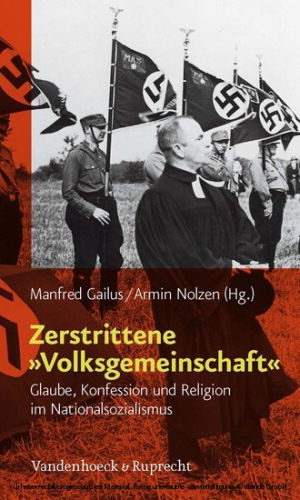
Review of Manfred Gailus and Armin Nolzen, eds., Zerstrittene “Volksgemeinschaft”: Glaube, Konfession und Religion im Nationalsozialismus

ACCH Quarterly Vol. 18, No. 1, March 2012

Review of Manfred Gailus and Armin Nolzen, eds., Zerstrittene “Volksgemeinschaft”: Glaube, Konfession und Religion im Nationalsozialismus (Göttingen: Vandenhoek & Ruprecht, 2011).

By Robert P. Ericksen, Pacific Lutheran University

“Woran glaubten die Menschen im ‘Dritten Reich?’” Gailus and Nolzen open their book with this question, arguing that it has received surprisingly little attention within the massive historiography devoted to the Nazi period. This work represents an attempt to evaluate the state of current research on Protestants and Catholics in Nazi Germany. It also includes a chapter by Merit Petersen on two smaller groups, Mormons and Jehovah’s Witnesses; a chapter by Horst Junginger on German paganism (the German Faith Movement); and a chapter by Beth Griech-Polelle on National Socialism as a “political religion.” Two themes emerge in this volume. One is a refutation of the postwar charge that the Nazi era represented a period of intense secularization. In fact, Gailus and Nolzen argue, the Nazi period was intensely religious. Along with the early postwar era, it marked a break in the twentieth-century secularization that preceded and followed this middle period of nearly three decades. Secondly, the editors argue for increased attention to religion under the Nazis, especially by scholars not defending a piece of the religious turf. Such work should acknowledge regional differences as well as the complex and overlapping varieties of religious faith to be found.

Olaf Blaschke’s contribution picks up on an issue highlighted in Doris Bergen’s Twisted Cross (Chapel Hill: University of North Carolina Press, 1996), i.e., the importance of gender in understanding the pro-Nazi “German Christians.” Blaschke begins with the nineteenth century, arguing that Protestants in Bismarck’s Germany, epitomized by Heinrich von Treitschke, considered themselves the masculine Christians, with an emphasis on courage, strength, and the use of reason. Catholics were thought to be feminine, with more emotion, more sensitivity, and more resort to the superstitious side of religious belief (38). Protestants too, however, could be considered feminized, given the “soft” side of Christian beliefs and the percentage of women in the pews. By World War I, both religious faiths worked to “masculinize” their image and their message. Bergen points out the hyper-masculine nature of “German Christian” identity. Blaschke then describes “remasculination” efforts among Catholic theologians, including their hope to save piety from its soft, feminine image and remake it into an image of courage and strength. Blaschke argues throughout that these gender issues, largely ignored by historians, should have a significant place in our understanding of religion in the modern world, especially in the hyper-masculine world espoused by Nazi ideology.

Manfred Gailus offers a chapter on Protestants in which the title, “Keine gute Performance,” quite clearly indicates the message to be found. Noting that it took several decades for a critical and honest postwar assessment to develop, he describes the first generation to write the history with these words, “Die Erlebnisgeneration selbst erinnerte sich. Und natürlich legitimierte sie sich durch die Art ihrer Erinnerung” (98). Now we know better, in Gailus’s view. “Gegen langlebige Widerstands- und Kirchenkampflegenden ist zu betonen: Es bedurfte 1933 überhaupt keines Zwangs, keines gewaltsamen Angriffs von aussen—der Protestantismus öffnete dem anschwellenden Nationalsozialismus bereitwillig, vielfach fasziniert seine Türen, um die ‘Ideen von 1933’ einströmen zu lassen” (102). As for the question of Christians and Jews, “Protestanten haben im Kontext der so genannten Judenfrage nicht nur nicht genug für die Verfolgten getan, sondern zu nicht geringen Teilen haben sie selbst aktiv verachtet, ausgegrenzt, denunziert, verfolgt. Protestantismugeschichte ist an dieser Stelle zu erheblichen Anteilen auch Täter- und Mittätergeschichte” (111). Gailus acknowledges many differences to be found throughout the regional churches in Germany. He encourages historians to fill in these regional gaps, and also to write biographies of the broad range of church figures still without serious historical treatment. He also notes that some of the intensified religious commitment in the period turned toward the political religion of Nazism, with its opposition to the Enlightenment, to the “ideas of 1789,” and to the liberalism and democracy to be found in the West. He sees the Nazi period as intensely religious, but now with a three-part competition between Protestants, Catholics, and those who made a religion of National Socialism.

The second editor of this book, Armin Nolzen, attempts in his chapter the sort of statistical analysis rarely undertaken. What percentage of Nazi leaders, functionaries, and party members belonged to the Protestant or Catholic Church? He notes the difficulty of finding statistics. For example, according to the “positive Christianity” espoused in the Party Program in 1920, no one would be expected to have a particular faith. Thus no questions about one’s religious faith appeared on the membership application. A statistical record created in 1939, however, allowed party members to check a box for religion. This shows that 70 to 75 percent of party members checked either Protestant or Catholic, with 20-25 percent checking “gottglaubig.” Protestants were over-represented in comparison to their numbers in a given region, Catholics were under-represented, and “gottgläubig” were over-represented by a factor of four to five (158-59). The latter figure reflects the attempt within the Nazi Party to discourage church membership, as well as to separate church and state. Despite this, however, up to three-quarters of party members retained contact with their church. Even in the Allgemeine SS, reputedly the most anti-Christian organization in Nazi Germany, of nearly 250,000 members in December 1938, 51 percent were Protestant and 23 percent were Catholic (171). These figures match other indicators to suggest that three of four people inside the Nazi movement resisted pressure to leave their church. Furthermore, during World War II the number of party members laid to rest in church burials increased (170). At the same time, the total number of party members incorporated more and more of the German population, increasing  from 4.8 million in 1938 to over 9 million by May 1945 (156). Finally, as Nolzen argues, an enormous number of Germans belonged  to one of the many supporting organizations of the Nazi Party, if not to the Party itself. That figure was two-thirds of all Germans in May 1939, and Nolzen claims that it grew continually during six years of war (171). This leads to his conclusion: “Die meisten Deutschen konnten jedenfalls beides mit ihrem Gewissen vereinbaren: Ihren Glauben an den ‘Führer’ und den Nationalsozialismus sowie ihren Glauben an Gott und die Zugehörigket zu einer christlichen Kirche” (172).

This book includes much more of interest, including Kevin Spicer’s assessment of the Catholic Church under Nazism and Matthew Hockenos’s description of the churches after 1945. Many readers of this journal will be familiar with their books on these subjects. Beth Griech-Polelle gives a very useful overview and analysis of “political religion” and its place in the Nazi state. Dietmar Süss writes about religion on the home front during World War II, especially as the air war brought terror to those far behind the front lines. Dagmar Pöpping writes about the role of military chaplains, especially on the brutal eastern front from 1941-45. As a whole, the book highlights our present understanding of the role of religion in Nazi Germany and it calls upon scholars to work toward filling the gaps that remain. Gailus and Nolzen show that many varying claims were made upon “Volksgemeinschaft” in Nazi Germany. That complex story continues to unfold.

Share

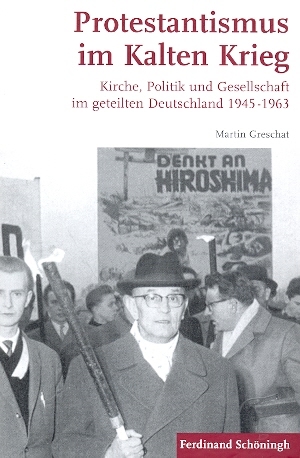
Review of Martin Greschat, Protestantismus im Kalten Krieg. Kirche, Politik und Gesellschaft im geteilten Deutschland 1945-1963

ACCH Quarterly Vol. 18, No. 1, March 2012

Review of Martin Greschat, Protestantismus im Kalten Krieg. Kirche, Politik und Gesellschaft im geteilten Deutschland 1945-1963 (Paderborn: Schöningh Verlag, 2010), 450 Pp., ISBN 978-3-506-76806-3.

By Manfred Gailus, Technische Universität, Berlin

This review was first published in theologie.geschichte – Zeitschrift für Theologie und Kulturgeschichte (Universität Saarbrücken) Band 6 (2011). Translation courtesy of John S. Conway.

This book is the first overview of the history of German Protestantism in the early post-1945 period up to the year 1963. (Why the author chose to end there is not explained). His study begins with a broad survey of international relations and personalities, such as the Great Power rivalries between the USA and the USSR, the Korean War, Stalin and his diplomacy, Konrad Adenauer and Walter Ulbricht. This makes for an extremely lengthy introduction of nearly two hundred pages before the main topic is reached. But the author sees these events, as described in his Chapter 1, as important historical preconditions for the division of Germany The second chapter describes the establishment of the two German states. On the one hand, West Germany adopted a course of integration with the West and of rearmament, despite much internal opposition. On the other hand, the German Democratic Republic under Ulbricht underwent a similar process of integration into the Soviet sphere of influence. The third chapter briefly describes the turbulent years of the 1950s with the Geneva Conference of 1955, the uprisings in the Soviet bloc in East Germany in 1953 and Hungary in 1956, the 20th Party Congress of the Soviet Communists in 1956, Khruschchev’s ultimatum over Berlin, and the Cuban crisis. Finally, in chapter 4, Greschat arrives at his main theme, namely the developments in the Protestant churches. He deals first with the situation in the German Democratic Republic, in a far too detailed and hence rather wearying fashion, in my view. He then turns to West Germany. Despite the fact that both Protestant communities were decisively in favour of upholding the notion of German national unity, they slowly drifted apart from one another. In the following chapter 5, developments in the life and witness of the Protestant churches in the 1950s are analyzed These years saw the erosion of the traditional pietistic forms of worship, heated theological debates over Rudolf Bultmann’s “demythologizing” contentions, institutional innovations such as the Church Rallies, and the notable establishment of the Evangelical Academies, which did so much to foster the Protestant churches’ life and their involvement in the wider international and ecumenical discourse of the World Council of Churches and similar bodies.

This is indeed a vast undertaking. The reader will undoubtedly gain much on these various topics. But there are problems. For one thing, the author gives us several chronological accounts, first for the international scene, then for the national political level, and thirdly for the churches’ own historical developments—and in this case, twice over, one for the west, one for the east. This leads to numerous repetitions, to frequent recapitulations of items already covered (“as already mentioned”), or to redundant digressions.

Furthermore, the author does not tackle the problematical issue of how best such a history of recent German Protestantism should be written. Since 1945, despite the strong fixation on tradition, the evident trend has been to create a constellation of about two dozen separate provincial churches, each with its own theological, ecclesial and church-political character. Greschat’s concentration on the top-level deliberations of the Evangelical Church leadership, and on the significant political disputes of two divergent groups, one around Ehlers, Dibelius and Lilje and the other around Niemoller, Heinemann and Gollwitzer, hardly does justice to the diversity of the situation. Another more serious defect is the astonishing decision to omit any discussion of Germany’s recent past, which the historian Friedrich Meinecke so rightly called “The German Catastrophe”. In fact, this was also the catastrophe of German Protestants who constituted a two-thirds majority in the “Third Reich”. Greschat’s discussion of the internal and highly divisive disputes in the post-war period are really inexplicable without reference to the Nazi period, or to the Church Struggle against Nazism. In this regard Matthew Hockenos’ A Church Divided. German Protestants confront the Nazi Past (Bloomington: Indiana University Press, 2004) is a model study. Unfortunately Greschat doesn’t even mention it.

Many sections of German Protestantism incurred a heavy burden of guilt for their highly regrettable behaviour during the Nazi period. But their stance is hardly mentioned in Greschat’s 450 pages. Likewise, no attention is given to the process of de-nazification, or what in the church was the wholly inadequate process of “self-cleansing”. Christian anti-Judaism or anti-Semitism or the Holocaust as such are not mentioned. And even the timorous Protestant attempts to begin to come to terms with a scholarly examination of the recent past, as in the Evangelical Association of Contemporary Church History after 1955, are not thoroughly discussed. The book by Bjorn Krondorfer, Katharina von Kellenbach and Norbert Reck, Mit Blick auf die Täter. Fragen an die deutsche Theologie nach 1945 (Gütersloher Verlagshaus, 2006), with its pertinent and often biting criticisms is not taken into account.

The outbreak of the Korean War, or more widely the Cold War, appears to have engrossed the attitudes of most contemporary Germans, and thus covered over that unspeakable darkness which burdened them, and in some cases still does. And so, one might suggest, it was highly convenient that the Cold War diverted attention away from those other more fateful events, about which they were unwilling to speak. But are these considerations still valid for scholarly accounts today? It is incomprehensible why this book omits mentioning the widespread silence, or more particularly the active evasiveness, the frequently well-rehearsed tissue of lies or alibis, or the habit of sweeping such unwelcome matters under the carpet, as engaged in by many Protestants.

Of course there may have been numerous understandable reasons why contemporaries in the 1950s wanted to suppress their personal pasts. But to continue suppressing such lamentable episodes in the Protestant collective past seems wholly reprehensible. Any history of German Protestantism in the 1950s needs to be written, not from the perspective of “Korea”, but from the viewpoint of the participants themselves. Herein lies what would appear to be an inexplicable omission in an otherwise significant study. As a first attempt to provide an overall account of post-war German Protestantism, this study needs to be substantially enhanced and improved.

Share

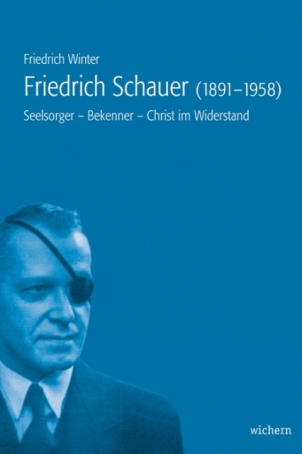
Review of Friedrich Winter, Friedrich Schauer 1891-1958. Seelsorger – Bekenner – Christ im Widerstand

ACCH Quarterly Vol. 18, No. 1, March 2012

Review of Friedrich Winter, Friedrich Schauer 1891-1958. Seelsorger – Bekenner – Christ im Widerstand (Berlin: Wichern Verlag, 2011), 215 Pp., ISBN 978-3-85981-326-8.

By John S. Conway, University of British Columbia
Friedrich Schauer was one of the cohort of German Evangelical pastors caught up in the religious, political and military disasters which engulfed Germany in the first half of the twentieth century. This short sympathetic account, written by a former church leader in Berlin, successfully describes the conflicts of loyalties in which these pastors were embroiled, and which in many cases strikingly affected their careers. Schauer was not a leading figure, but, for that reason, his biography can be seen as typical of many of his colleagues.

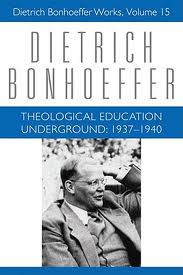
He had just completed his training when the First World War broke out. Within weeks, he was badly wounded in battle and lost the sight of his left eye. Nevertheless he was able after the war to take up parish work, first in East Prussia and then in Pomerania. Due to his conservative background and his military training, he early on opposed the more radical wing of the so-called “German Christians” who called for the adoption of Nazi ideas and practices in the church. Consequently he was a strong supporter of doctrinal orthodoxy, as expressed in the famous Barmen Declaration of 1934. But later he was disillusioned by the rigid dogmatism of those who followed Niemoeller and Bonhoeffer and refused any obedience to the established church authorities. Schauer wanted to maintain a more moderate position, rejecting extremism on either side. He became involved with the Brotherhood of Michael, a group of clergy who laid emphasis on a more liturgical church life, but avoided political engagement. One of the leading figures in this movement was Theodor Steltzer, who had been Schauer’s commanding officer in the First World War, and was to become the same in the Second.

In 1939 Schauer was again called up as a transportation officer, and served under Steltzer first in France and then for more than four years in Norway. Here he was able to establish friendly relations with some Norwegian clerics and sought to mitigate the effects of the German occupation. At this point Steltzer became increasingly critical of the Nazi leadership, and indeed became associated with the Kreisau Circle led by Graf Helmuth von Moltke. But it is not clear to what extent Schauer shared these opinions.

Following the failure of the July 20, 1944 plot, Steltzer was arrested and arraigned for high treason. (Fortunately, he survived.) Schauer, still in Oslo, must have taken all steps to destroy any evidence of his real sympathies. Only one paper survives in which he outlined his views on the future of Europe and the role of the church, along the conservative even authoritarian lines adopted by the Brotherhood of Michael. Such a stance was enough for him to be ordered dismissed from military service. But at the beginning of April 1945, instead of returning to Germany in disgrace, he fled to Sweden and sought asylum there. Luckily his friends in ecumenical circles supported him there for eighteen months until he was finally allowed to rejoin his family in West Germany.

Schauer’s post-war career was unpropitious. It seems his theological and political views found little favour in the reconstituted German Evangelical Church. Ill-health, caused by his war wounds and compounded by the loss of two of his sons on the Eastern Front in 1943, obliged him to take early retirement. He died shortly afterwards. This informative memoir is therefore rather a tragic story, but reflects the fateful experiences and the ambivalent stances of so many of these now forgotten pastors.

Share

Review of S. J. D. Green, The Passing of Protestant England: Secularisation and Social Change, c. 1920-1960

ACCH Quarterly Vol. 18, No. 1, March 2012

Review of S. J. D. Green, The Passing of Protestant England: Secularisation and Social Change, c. 1920-1960 (Cambridge: Cambridge University Press, 2011), 333 Pp., ISBN 978-0-521-83977-8.

By Andrew Chandler, George Bell Institute, University of Chichester

Very possibly what has brought many historians to consider seriously twentieth century religion is not its significance in politics, intellectual and cultural life or social existence, but the idea of its decline and even extinction. At all events, secularisation has by now become an academic realm in its own right, with its prophetic presences, its own points of reference, its particular questions (and answers) and its earnest debates about conceptual approaches and forms of analysis. Every scholar of contemporary society knows that in a western European country the statistics of adherence have crumbled, values and attitudes have altered and church buildings have emptied, shut and disappeared. Something vast has occurred—and we remain caught up in it. Whatever it may be, the term ‘secularisation’ still does very adequately in framing it.

S. J. D.Dixonis based at that most privileged of Oxbridge bastions, All Soul’s College. Certainly he works with a very well-stocked library on his doorstep: his references are copious at every turn and, although there is little archival research going on here, there is a committed and valuable exploration of published primary material. The book represents not so much a coherent argument as a succession of specific explorations of the waning of a Protestant inheritance, most of it effectively Victorian. It is a gathered contribution, a garnering of past articles published by earlier collections. But it professes an overall argument, too.

Green is cagey with his terms at the outset—he refuses to define ‘religious phenomena’, and accepts that his book is, ‘unashamedly’, a study of the specifics of denominational practice and popular belief (3). His chronological frame is chosen with a purpose and to effect: for some time scholars of secularisation have insisted that what happened after 1960 marked the crucial sea-change in the fortunes of public religion. He is firmly conscious of the difficulties in persisting in the idea of something distinctively ‘English’, but resolute in keeping out the Scots and the Welsh. Part I presents an ‘outline of the problem’ combining dense historiography with a bash at narrative; Part II picks up some case studies, inspecting the world of Dean Inge, the ‘strange death of puritan England’ and the ‘discovery of a “post-Protestant” people’ by Seebohm Rowntree; Part III adopts the pleasantly alliterative form of ‘Resistance, revival and resignation’, examining the church-state debates over the 1944 Education Act, asking if there really was much of a religious revival in the 1950s and then ‘slouching towards a secular society’ in the early 1960s. All of this is characterised by tremendous confidence, subtlety and fluency in the mobilization of terms and interpretive frameworks. Does the whole odyssey cohere? Just about, probably. Every reader will have their own questions. Is there too little sense of the deliberately constructed denominationalism on which so many Christians placed their hopes in this period? Very possibly. (Incidentally, principled Baptists might not much enjoy finding themselves a part of some conglomerate called here, a little casually, ‘theBaptistChurch’.) Might far more be said about the fate of all kinds of Christian social and educational institutions in these years? Surely. Does Dean Inge really deserve so much house space? Could there have been more about someone like Ernest Barker who wrote so thoughtfully and extensively about comparable themes? It is too easy to regret what has been left to one side—and, perhaps, irrelevant, because much of the value of the book lies in its capacity to provoke the mind to think of other avenues.

A plaudit on the cover observes the author’s pessimism while a second congratulates him for being so very ‘sensible’. Green would surely know how to value both attributes. Almost at the last gasp he writes, ‘Religion will not disappear, not even inEngland. But the social significance of religion will go on declining.’ (316) How we grasp quite what that leaves behind would make an interesting chapter in itself. At all events, it would take a rash scholar indeed to deny the force of such a judgement today.

Share

Review of Eugene J. Fisher and Leon Kleinicki, eds., The Saint for Shalom: How Pope John Paul II Transformed Catholic-Jewish Relations: The Complete Texts 1979-2005

ACCH Quarterly Vol. 18, No. 1, March 2012

Review of Eugene J. Fisher and Leon Kleinicki, eds., The Saint for Shalom: How Pope John Paul II Transformed Catholic-Jewish Relations: The Complete Texts 1979-2005. A Publication of the Anti-Defamation League (New York: Crossroad Publishing Company, 2011), 363 Pp., ISBN 0-8245-1544-7.

By John S. Conway, University of British Columbia

The striking changes in Christian-Jewish relations in recent years have been described as the most significant theological development of the past century. The abandonment of age-old Christian hostilities and prejudices and their replacement by a positive and productive dialogue between partners now marks the altered pattern of relationships. This unprecedented step has been most notably pursued by the Roman Catholic authorities, ever since the historic pronouncements of the Second Vatican Council in the early 1960s. This new stance became consolidated as part of Catholic teaching and practice particularly during the lengthy 26-year reign of Pope John Paul II (1978-2005). It is therefore a welcome step that we now have in English translation a complete edition of the texts of this Pope’s speeches and writings on the subject of Jews, Judaism and the State of Israel. (Previous but incomplete editions were issued in 1987 and 1995.)

As Eugene Fisher notes in his valuable introductory commentary, John Paul II’s views on these topics were conditioned by two seminal events of the mid-twentieth century: the Nazi mass murder of millions of Jews and the subsequent re-establishment of the State of Israel. The theological repercussions of these developments for all Christians became a constantly repeated theme of the Pope’s discourses. The re-creation of Israel in 1948 overthrew one of Christianity’s oldest slanders against the Jews, namely that they were destined to be a wandering people, exiled from their Promised Land, because of their rejection and execution of their Messiah, Jesus. The theological shock of seeing a new and vibrant Jewish state resulted in a radically altered and much more positive view which John Paul embraced throughout his reign. This was a tangible sign of the wider positive relationship with the whole Jewish people throughout the world, based on the recognition that Jews and Christians were spiritual partners. This new stance excluded all previously-held notions of Christian triumphalism, which had for so long regarded Judaism and the Old Testament as being superseded by the more enlightened Christian witness. Instead John Paul repeatedly stressed the common bonds with “our dearly beloved elder brothers”, as exemplified in his pilgrimage to Jerusalem in 2000, his visit to the Jewish memorial at Yad Vashem, and his prayer at the Western Wall, which are here reported in full.

No less urgent was the Pope’s repeated emphasis on the need to examine and rectify the calamitous indifference displayed by the Christian community when the Nazis attacked and persecuted the Jewish people. Having himself witnessed these crimes in his native Poland, John Paul could not fail to be aware of the vocal criticisms about the earlier silence of the churches and their leaders, including his own predecessors. He was therefore wholly convinced of the heavy burden of Christian guilt and of the need for gestures of repentance and solidarity. Vatican loyalties here competed with a genuine desire to express remorse and to build a new relationship through discussion and dialogue. These affirmations were to be matched by recurrent pronouncements about the need for Catholics to combat every vestige of anti-Semitism and to oppose all forms of racial intolerance. In Pope John Paul’s view, the painful legacies of earlier centuries were to be replaced by a repeated stress on the common spiritual patrimony shared by Jews and Christians.

As the documents in this collection show, Pope John Paul II’s striking and continued commitment to the cause of reconciliation has meant that these teachings have now become the new orthodoxy. It is indeed inconceivable that any future Catholic leaders could disavow John Paul’s advocacy and tireless endeavours. He has thus earned the sobriquet “The Saint for Shalom”.

Nevertheless, as Fisher admits, controversies still remain. Many Jews still have their doubts about the genuineness of this new Christian attitude after so many centuries of hostility and the world-wide phenomenon of religiously-based anti-Semitism. Many still voice criticisms about the policies of the war-time Pope Pius XII. The convoluted politics of the Middle East and the Pope’s evident sympathy for the plight of Christian Palestinians still continue to muddy the waters of Christian-Jewish relations. Yet these documents provide the evidence for John Paul’s courage in being the first Pope to profess his admiration for the Jewish people’s valiant adherence to their faith, and to affirm energetically the common commitment of both Christians and Jews to pursue justice and peace in the world.

Share

Review of Eberhard Busch, The Barmen Theses Then and Now

ACCH Quarterly Vol. 17, No. 4, December 2011

Review of Eberhard Busch, The Barmen Theses Then and Now (Grand Rapids: Eerdmans, 2010), ISBN 9780802866172.

By Matthew Hockenos, Skidmore College

Eberhard Busch, a Reformed theologian and pastor as well as a former student and assistant of Karl Barth’s, is perhaps best known in the English speaking world for his colorful biographical study of his mentor, Karl Barth: His Life from Letters and Autobiographical Texts (1976). In this text, still the best introduction to Barth’s Lebenslauf, Busch introduces Barth’s role on behalf of the Confessing Church and in particular his leading role in drafting the Theological Declaration of Barmen in May 1934. Now, in the volume under review, Busch provides a detailed analysis in just over 100 pages of each of the six Barmen theses and a brief introduction to the historical context in 1933 and 1934. The seven chapters are a revised and expanded version of the Warfield Lectures Busch gave at Princeton Theological Seminary in 2004. In addition to his close relationship with Barth, Busch has another personal connection to the Barmen Declaration—his father, a pastor, attended the Barmen meeting and voted for the declaration.

The Barmen Declaration consists of a preamble, six theses, and a conclusion. Each of the six theses begins by quoting Scripture followed by an explanation of the passage and a condemnation of error or damnatio.  The theological committee designated to draft the declaration for the Barmen synod consisted of Karl Barth, the relatively unknown Bavarian Lutheran churchman, Thomas Breit, and Hans Asmussen, a pastor and theologian from Altona near Hamburg.  Although Asmussen was a Lutheran, and after the war a rather conservative one, he was sympathetic to Barth’s theology during the church struggle. Despite the presence of two Lutherans on the theological committee, there is no question that Barth was the principal author of the declaration. According to Barth, while Breit and Asmussen took an afternoon nap he wrote the six theses. As Barth described it, “The Lutheran Church slept and the Reformed Church kept awake. …The result was that by the evening there was a text. I don’t want to boast, but it was really my text.” Although a Reformed theologian wrote the text, Busch emphasizes that not only did Lutheran and United churchmen accept it at the synod but that many of the churches within the EKD continue subscribe to it or recognize its importance.

The primary significance of the Barmen Declaration for Busch is that the Lutheran, United, and Reformed Protestant churches of Germany confessed together at Barmen that the churches had lost sight of the First Commandment when they applauded Hitler’s rise to power and the consolidation of his rule. Busch points to a veritable explosion of confessions in 1933 in which “the confession of faith in the triune God was rather glibly connected, even mixed in, with the confessional commitment to the German people and its special history, to its authoritarian form of state, its Fuehrer, and its German race.” The Barmen Declaration broke with this tendency. The preamble makes clear its purpose is to confess evangelical truths in light of the errors of the German Christians and the Reich Church government that were devastating the church.  “Its strength,” Busch writes, “is that it guides the church in a very particular situation to listen solely to the Word of God, trusting it alone, and obeying it alone.” However, the Barmen Declaration is in no way bound to the situation in which it arose; it is relevant and meaningful today to many churches outside of Germany.

In his analysis of the first thesis Busch addresses the criticism of Pinchas Lapide and Eberhard Bethge that its emphasis on Christ as the “one word of God” and as the one entryway to God and therefore salvation separates the church from the synagogue and has the potential to incite anti-Semitism. Busch respectfully disagrees. He acknowledges that the first thesis and the declaration as a whole failed to state that the church “stands and must stand in an essential bond with the Jews.” Nor did the Barmen Declaration forthrightly condemn anti-Semitism. This, however, was not because the declaration itself was anti-Jewish. In fact, its emphasis on the fundamental importance of the First Commandment “you shall have no other gods before me” and its rejection of a second source of revelation in the German Volk, undermined the anti-Semitism of the German Christians and gave the true church unlimited resources in the Scriptures to rebut anti-Semitic propaganda. If the emphasis on sola scriptura is recognized in the first thesis, “then the exclusive character of the statement that there is one Word will be understandable to Jews,” Busch believes, “as the acknowledgment of the exclusivity of the first commandment.” (32) Jesus Christ then becomes not a wall of separation but “a bridge built by God” between Christians and Jews. Busch provides plenty of evidence that this was the way Barth understood the first thesis but it seems quite likely that German Protestants, perhaps even some of those present at the synod, would have read it not only as a rejection of the German Christian heresy but also of the Jews.

Busch emphasizes the confessional unity around Barmen and its unanimous acceptance by the Lutheran, United, and Reformed churchmen present at the synod. For him the Barmen Declaration is a bridge connecting Lutheran, Reformed, and United churches.  There was, however, a group of powerful and highly respected Lutherans who believed strongly that the theological consensus reached at Barmen was an unacceptable dilution of Lutheran theology. The number of critics in fact increased when the German Christian threat diminished after 1934 and especially after 1945 when confessional unity was no longer an urgent necessity.  Some Lutherans, like the Erlangen theologian and church historian Hermann Sasse, opposed Barmen because he believed its theological content clashed with the traditional Lutheran Confessions. Sasse asserted in 1936, “He who recognizes the Theological Declaration of Barmen as a doctrinal decision has thereby surrendered the Augsburg Confession and with it the confession of the orthodox Evangelical Church.  What is pure and false doctrine, what is and is not to be preached in the Lutheran Church can only be decided by a synod which is united in the confession of Lutheran doctrine, and not an assembly at which Lutherans, Reformed, Consensus United, Pietists, and Liberals were all equal participants, as was the case in Barmen.” Others, such as Paul Althaus, a professor of systematic theology at Erlangen University, seemed more agitated by what they believed were Barmen’s political implications, particularly a curtailment of the state’s authority in thesis five.  And Bishop Hans Meiser of Bavaria exemplifies those who voted for the Barmen Declaration primarily to register their opposition to the German Christians—not because they held the declaration itself in high esteem. Fortunately, these objections and reservations did not impact the vote at the Barmen synod.

The publication of Busch’s Warfield lectures in an expanded and revised English edition provides an outstanding resource for students and scholars of the Barmen Declaration, the Confessing Church, and the Church Struggle. Nowhere have the six theses been so lucidly, insightfully, and fairly analyzed in so few pages. Busch’s astute theological analysis of Barmen is refreshingly accessible for non-theologians because he brings to it his many years of committed pastoral and ecumenical service.


Share

Review of Ulrich Bräuel und Stefan Samerski, eds., Ein Bischof vor Gericht: Der Prozeß gegen den Danziger Bischof Carl Maria Splett 1946

ACCH Quarterly Vol. 17, No. 4, December 2011

Review of Ulrich Bräuel und Stefan Samerski, eds., Ein Bischof vor Gericht: Der Prozeß gegen den Danziger Bischof Carl Maria Splett 1946 (Osnabrück: fibre Verlag, 2005), 313pp. ISBN: 3-929759-98-5.

By Diana Jane Beech, University of British Columbia

Picture the scene: It is 1933 in the Free City of Danzig (Gdańsk); a semi-autonomous city-state situated between Poland and Germany, under the special protection of the League of Nations. Life in the Free City up until now had been peaceable, with the majority of the population from Germanic heritage, yet represented abroad by Poland in an effort to ensure sufficient Polish access to the sea. For a young German Roman Catholic pastor in the Free City, a sympathetic attitude towards the Poles was indispensable, as was a knowledge of the Polish language. This was characteristic of the early career of Carl Maria Splett (1898-1964). Following his ordination into the Roman Catholic Church in 1921,  he returned to Danzig in 1924 to serve the city’s mixed German and Polish congregations.

Once the local National Socialist (Nazi) Party succeeded in taking over the government of Danzig in 1933, however, the dynamics of Splett’s ministry changed dramatically. Despite pressure from the Nazis to install their own candidate as Bishop of Danzig following Bishop Edward O’Rourke’s resignation in 1938, Carl Maria Splett was appointed to the post by Pope Pius XII. Following the annexation of Danzig to Germany in 1939, Splett was further appointed the Apostolic Administrator of the diocese of Culm. He was, thereby, firmly forced into a double-bind, in which he endeavoured to maintain friendly relations with the Poles on the one hand, and the Nazi government on the other.

Initially, Splett spurned Nazi demands and refused to prohibit the use of Polish in his diocese. Revenge murders by the Nazis of Polish-speaking pastors within Splett’s bishopric nevertheless forced him to retract his decision. He henceforth banned Polish from all churches under his jurisdiction in the spring of 1940. Under increasing pressure from the Nazi regime, Splett most controversially replaced Polish clergy with German priests, and ordered the complete removal of Polish signs and names from his diocese. In spite of all this, however, Splett is still said to have unofficially continued to support priests who continued to use the Polish language, and provided financial aid to the families of those priests arrested and murdered by the Nazis.

Splett remained in Danzig throughout the Second World War and continued to work both with and against the Nazi regime in an attempt to find his own modus vivendi to survive the war. Once Soviet troops captured the city in March 1945, Splett was arrested but released shortly afterwards. It was not until August 9, 1945, that Polish Cardinal August Hlond called for Splett’s resignation. When he refused to give up his bishopric, Polish officials arrested Splett and put him on trial for collaborating with the Nazis and oppressing the Polish people. Splett was eventually found guilty and sentenced to eight years in prison on February 1, 1946.

It is this trial which is the focus of Ulrich Bräuel and Stefan Samerski’s edited volume, Ein Bischof vor Gericht: Der Prozeß gegen den Danziger Bischof Carl Maria Splett 1946. As Bräuel and Samerski make clear in their introduction to the volume, not only has Splett’s own debatable conduct in Nazi-occupied Danzig made him one of the most disputed figures in Polish and German history, but his trial by Poland’s post-war communist regime has sparked recent debate as to whether Splett’s case was a convenient way for the communists to take up battle against the Church as a whole. In an effort to uncover whether Carl Maria Splett fell victim to the ideological agendas of two consecutive totalitarian regimes, Bräuel and Samerski have collected essays from both Polish and German academics from a wide variety of disciplines, which examine Splett’s own history, traditions, and theology. As well, his trial is analysed from both its political and legal perspectives. Even today, there are those who believe Splett acted honourably under the precarious conditions of Nazism. They refer to his trial and lengthy prison sentence in order to highlight the injustices he endured under communism. His critics on the other hand continue to view his punishment as confirming their condemnation of Splett and his anti-Polish directives during the war. It is the editors’ intention, therefore, to investigate both Splett’s actions and those of the Polish authorities that condemned him so that they can begin to reconcile the disparity of opinions that surround Splett’s life and trial.

The volume begins with a short but polemical piece by Jan Bernard Szlaga (21-24), who examines the historical legacy of Bishop Splett and firmly proclaims his belief that Splett was loyal to the Poles, yet prohibited by his powerlessness in the face of Nazi tyranny. Szlaga’s opinion piece is swiftly followed by an overview of the so-called ‘Splett debate’ in Poland by Thomas Urban (25-44), who offers a survey of the Polish reception of Splett, from his branding as a “Hitlerist” in the immediate post-war era to the steps taken towards redeeming his reputation from 1989 to the early twenty-first century.

Stefan Samerski examines the historical context surrounding Bishop Splett’s controversial behaviour during the war (45-93). He provides a comprehensive account of Splett’s formative years, his professional life in the Church, and the influences of ecclesiastical and international politics on his wartime actions. Ulrich Bräuel then provides a detailed analysis of Splett’s trial (95-143), including in his report German translations of the original Polish indictments against the bishop.

The specifically ecclesiastical influences on Splett’s life and trial are covered in the volume by both Thomas A. Amann, who writes on the aspects of ecclesiastical law that affected Splett’s case (145-169), and by Daniel Fickenscher, who provides an insight into how national languages have been traditionally used in Roman Catholic church services and confessions (172-204). Hans-Werner Rautenberg examines the problem surrounding language usage even further in his chapter on the patchwork nature of ethnicities in western Prussia and the impact that this particular mosaic of languages, cultures, and beliefs has had on Catholic liturgical practice in the area (206-246).

Since the analysis of the historical contexts surrounding Splett’s life and trial would not be complete without an appreciation of the political climate in which he was prosecuted, the volume ends with a focus on the communist Polish state, which determined Splett’s fate. Miroslaw Piotrowski’s examination of the Church and the state in Poland in the initial years after the Second World War offers a chronological account of the state’s increasing hostility against the Catholic Church (247-261). This is followed by Lukasz Kamiński’s study on propaganda trials in Poland between 1945 and 1956 (263-280), which provokes thought as to how Splett’s own case fits into the trope of such ‘show’ trials. The final word in the volume is, however, left to Stephan H. Pfürtner (281-313), who considers the case of Bishop Carl Maria Splett as a “Zeitzeugnis”, or a true product of its time. By demonstrating the fine boundaries between secular and spiritual obligations, and between duties to two distinct nationalities and cultures, Pfürtner closes the volume with the assertion that Splett’s life was ultimately shaped by his love for humanity—an expression of the love of Jesus Christ which he preached about on a daily basis.

Ein Bischof vor Gericht encourages its readers, before defending or condemning his actions, to view Carl Maria Splett as a figure firmly trapped by the  competing demands of his Catholic tradition, his almost dual nationality, and, most importantly, by the consecutive political climates of National Socialism and communism in which he strove to exist. What Bräuel and Samerski’s edited work has done, therefore, is expose the importance of thoroughly appreciating the historical contexts behind not just the lives of churchmen in Nazi-occupied territories, but also behind their post-war legacies, which may have been shaped and distorted by post-war ideologies and political agendas. All in all, this collection of essays should be praised for shedding much-needed light on the historical standing of churchmen such as Carl Maria Splett, who acted and subsequently defended their actions in the best way their historical predicaments allowed them to.


Share

Review of Daniel Heinz, ed., Freikirchen und Juden im “Dritten Reich”: Instrumentalisierte Heilsgeschichte, antisemitische Vorurteile und verdrängte Schuld

ACCH Quarterly Vol. 17, No. 4, December 2011

Review of Daniel Heinz, ed., Freikirchen und Juden im “Dritten Reich”: Instrumentalisierte Heilsgeschichte, antisemitische Vorurteile und verdrängte Schuld (Göttingen: Vandenhoeck &Ruprecht, 2011), 344pp. ISBN: 978-3-89971-690-0.

By Rebecca Carter-Chand, University of Toronto

This volume represents the first collective attempt by the German Free Churches to come to terms with the Nazi past and specifically address their relationships with Jews and Judaism. The connecting themes, presented in the subtitle, are familiar to those who study the mainline Protestant and Catholic churches in this era: manipulated theology, long-standing traditions of antisemitism, and unwillingness to admit wrongdoing in the postwar period.

As a collection of essays written by different authors, each chapter addresses an individual denomination. After an opening essay by Wolfgang Heinrichs on the Free Churches’ views on Jews in the nineteenth century, there are contributions by Claus Bernet (Quakers), Diether Götz Lichdi (Mennonites), Andreas Liese (Plymouth Brethren or Brüderbewegung), Michel Weyer (Methodists), Gottfried Sommer (Pentecostals), Andrea Stübind (Baptists), Hartmut Weyel (the Free Evangelical Association), Volker Stolle (Independent Evangelical Lutherans), Dietrich Meyer (Moravian Brethren or Brüdergemeine), and Daniel Heinz (Seventh-Day Adventists). In an appendix, Franz Graf-Stuhlhofer offers geographical breadth with a discussion of two Free Church pastors in Austria (Baptist and Methodist).

Although the scope and richness of sources varies among the essays, the exercise of placing these largely independent narratives alongside each other proves fruitful. In some cases a pattern emerges across the groups: the formation of an image of “the Jew” in the heyday of late-nineteenth-century racial antisemitism, from which essential elements were adapted by the Free Churches. In other cases it is a group’s unique characteristics that are highlighted. Regarding aid and rescue, the proverbial exception that proves the rule is most certainly the Quakers. No other group engaged in organized assistance, solidarity and protest as did the German Quakers, although Claus Bernet argues that they could not have done it without the support networks of the international Quaker community.

It is nearly impossible to draw broad conclusions about the Free Churches as a category since they come together by shared status not shared histories. Still, Daniel Heinz offers a few important observations in his forward. Because of their minority status, the Free Churches lived in the shadow of the complicated relationships between the larger churches and the Nazi state. Many of them experienced relative freedom and acceptance in the form of corporation status in the early years of dictatorship, 1933-38 (10). This is not to say that their experience under Nazism was easy, as they had their share of repression and harassment, but the temptation of legitimacy in the eyes of the state turned out to be too big to resist. For the most part, the Free Churches were not only uncritical of the political developments in their country but appreciated them (10).

Not surprisingly, the available sources are uneven. Much is written in church publications about what the clergy and academics thought about the Jews before 1933 but not so much on how they interacted with them and even less about what the laity thought and did. This situation often leads to a reliance on the earlier material. In some cases the chronology gets lost in the analysis. Most of the authors in this present volume choose to engage three topics, which could broadly be described as: what members of a particular group thought about the Jews, how they reacted to Nazi anti-Jewish policy, and what they did (or did not do) about it.

The Judenfrage was a scholarly topic with immediacy among all the Free Churches in the early twentieth century, as it was in the mainline Protestant church. Of particular value in this volume are the discussions of those groups with a strong pre-millennial eschatology that assigned a special place to the Jews in the end-times (the Pentecostals, the Adventists, and the Brethren). Not one of these groups fostered any sense of kinship with modern Jews. Instead, they rejected the theological concept of Israel’s eternal election and appropriated many of the arguments of contemporary racial antisemitism.

Although it is difficult to demonstrate that there are concrete connections between theology and behaviour, more than one author makes this case. In the context of the Free Lutherans, Volker Stolle argues their discriminative categorizations of Jews had a direct impact on their evaluation of Nazi Jewish policy, especially the Nuremberg Laws of 1935 (226). In the case of the Pentecostals, their strong pietistic tradition led them to interpret political happenings as the hand of God, with which they should not interfere (133).

The second way in which many of the authors engage the topic is to discuss how the Free Churches acted and reacted to anti-Jewish measures after 1933, such as the Nuremberg Laws and Kristallnacht. Andrea Stübind does an exceptionally good job at placing the Baptists in the wider framework of persecution of Jews in Nazi Germany. She also grapples with the particularly thorny issue of the persecution of Baptists of Jewish origin.

A common explanation among the Free Churches for their public support of the Nazi regime—either passive or active—was the fear of being shut down. Virtually every group’s leadership lived under this fear but it seems as though this argument cannot be made for the laity. Daniel Heinz points out that while most Seventh-Day Adventists “did not find the courage to swim against the storm” of anti-Jewish policy, there are several cases of Adventists who opposed the state for religious reasons: refusing to work on Sunday, refusing to give the Hitler salute, and in a few cases, refusing military duty (287). These acts of insubordination did not carry over to opposing anti-Jewish legislation. Sometimes they led to personal penalties such as fines and jail sentences but they did not cause the organization to be shut down. In a similar manner, the Quakers were openly assisting Jews and concentration camp inmates well into the 1940s, and as Claus Bernet shows, it was all done in public (64). These examples show that there was some room for protest in Germany, even in the war years.

Nearly every group has a few anecdotal accounts of people within their ranks who helped Jews in one way or another. The most important point that emerges from these ten separate groups is that outside of the Quakers, aid and rescue happened only on an individual level, not an institutional level. People helped both strangers and neighbours, devout and secular Jews, within Germany and elsewhere in Europe, but they did so on their own initiative and with their own funds. When questioned later about their motivation, they often spoke of a common humanity rather than any theological connections to Judaism, a sentiment reminiscent of the famous Protestants of Le Chambon (63).

Especially pertinent to current trends in Holocaust research is Diether Götz Lichdi’s discussion of the Mennonite connection to the Stutthof concentration camp near Danzig. Many Mennonites lived in the immediate area and benefited from prisoner labour on their farms and in their factories (72). Until 1942 there were only a few Jews among the prisoners but that changed as the ghettoes in the cities were emptied and many more prisoners were brought to Stutthof. There are numerous reports of Mennonites sneaking food and clothing to Jewish prisoners. These complicated dynamics are revealed to us today only because of the fact that the Mennonites had become a de facto ethnic group in Central Europe—in many cases it is “Mennonite-sounding names” that Lichdi uses for evidence. This characteristic puts the Mennonites in a unique position among the Free Churches, making it easier to analyze their grassroots participation in and resistance to the Holocaust.

Brief mention should be made of which Free Churches were included in this volume. Many of those that today consider themselves to be Freikirchen are included. The chapter on the Pentecostals was especially useful, as there is very little written on them elsewhere. A notable absence was the Salvation Army (Heilsarmee), which was similar to many of these other groups in size, status, and origin.

Overall, this book is indicative of the maturation of the field of German church history of the Nazi period. Its contributors bring the Free Churches into current scholarly discussions on Christian antisemitism, aid and rescue during the Holocaust, grassroots participation and postwar processes of Vergangenheitsbewältigung.


Share

Review of Margaret Ford, ed., An Evangelical Family Revealed: The Bickersteth & Monier-Williams Letters & Diaries 1880-1918

ACCH Quarterly Vol. 17, No. 4, December 2011

Review of Margaret Ford, ed., An Evangelical Family Revealed: The Bickersteth & Monier-Williams Letters & Diaries 1880-1918 (York: Ford Publishing, 2010), ISBN 9780956721808.

By John S. Conway, University of British Columbia

Ecclesiastical biographies are no longer in fashion. Especially not of Victorian worthies, already entombed in two or three volumes, replete with piety and patriotism. So Margaret Ford has some hurdles to overcome in her retelling the story of the lives of the Bickersteth and Monier-Williams families, who were staunchly evangelical Protestants, many of whose male members were ordained clergymen, and who all believed that God had granted Great Britain the responsibility of ruling over her world-wide Empire and if possible of missionizing it.

Ford brings to this task an enormous and obvious sympathy for the lives and careers of a very large, if like-minded, cast of characters from the late Victorian upper middle class. She was fortunate to find in the Bodleian a huge treasure trove of Bickersteth papers, and assiduously tracked down an equally fascinating collection of Monier-Williams records still in private hands. From these rich sources she has produced a splendidly revealing portrait of the professional and private lives of these two intertwined families which carries conviction, just because they were so representative of their class and generation.

She focuses particularly on the careers of the Reverend Sam Bickersteth, his wife Ella, nee Monier-Williams, and their six sons, all of whom were young men caught up in the excitement and catastrophe of the Great War. The climax of her account lies in the experiences, spiritual crises and subsequent adjustments they underwent between 1914 and 1918, vividly drawn from the numerous letters and records their mother Ella compiled and pasted into a War Diary, which eventually extended to nine bulky volumes.

But first Ford gives a valuable picture of the evangelical background during the earlier nineteenth century. God-fearing, earnest, enthusiastic for service to the Church and the Empire, the Bickersteths were notable in being more broad-minded than most evangelicals, always placing strong emphasis on the sacraments in their Church of England worship, and being more tolerant in their relations with members of other Christian denominations.

Sam’s father had risen to be Bishop of Exeter, and was a redoubtable father figure with sixteen children, very dedicated to propagating the evangelical witness to Christian ethics, and as yet untroubled by the kind of doubts raised by Biblical criticism or Darwinian science. These were the qualities Sam inherited as a hard-working parish priest, with no special intellectual gifts but a strong devotion to the pastoral care of his flock. His ambition to become a bishop like his father was never realised, but for twelve years he was called to serve as Vicar of Leeds, the largest parish in that city, with a huge proto-cathedral of a church, and a staff of no fewer than fourteen curates. His wife Ella was the daughter of the Oxford Professor of Sanskrit, many of whose relatives had served with distinction in India in both the civil and military services. Ella brought to her marriage a single-minded determination to ensure her boys were brought up in the Christian faith of their forebears, which she shared without reservation. Both she and Sam hoped for his preferment and were not free from the kind of social snobbery which was extremely deferential to their superiors in the aristocracy, but cut them off from associating with anyone not considered a gentleman. Such were the values they instilled in their sons.

Though not wealthy, Sam and Ella were determined, as were many others of their class, to send their sons to the best boarding schools, which were already known as the training grounds for Britain’s leading elites. So from the age of eight, these boys were sent away from home, but expected to write to their parents every Sunday. They continued this habit throughout their undergraduate days when, one after another, the boys all went up to Oxford and took over the same rooms in its most prestigious college, Christ Church. These letters were carefully preserved, and as carefully replied to, often with advice as to how the boys should behave. Private prayer should not be neglected. The Sabbath should be strictly observed. Bible reading, and personal dedication to witnessing for the faith with a concentration on each individual’s search for spiritual perfection were constant themes, in the tradition set by previous generations. Ford is clearly conscious how desperately dated such admonitions to adult undergraduates must appear today. She is critical of such values, but at no point censorious. She sees Oxford as the final stage in the casting of the mould which would be tested in the crucible of the Great War.

By 1914 the eldest son Monier had already taken holy orders and served his first curacy. The second brother Geoffrey was studying to take up an academic career. Julian had gone out to Australia as chaplain to the Church of England Grammar School in Melbourne. Similarly Burgon had responded to the call for missionary volunteers and was serving in western Canada amongst the tough work gangs building railways in distant Alberta. But when war was declared all six sons responded with patriotic fervour. Julian and Burgon returned to England as soon as possible, and were soon posted to France. Their younger brothers Morris and Ralph were also recruited as infantry officers in the trenches. Tragically, in July 1916, Morris was killed on the first day of the Battle of the Somme. It took all the family’s Christian fortitude to accept his loss, or to believe his sacrifice had not been in vain. But his death only led to a greater resolve to carry on with their evangelical mission as his legacy to them all.

In 1917 Sam moved to the easier post of being a Residentiary Canon of Canterbury Cathedral, where he ministered for another twenty years. Shortly after the war’s end, Julian was called to go back to Australia to become headmaster of a leading boys’ school, and Burgon returned to his beloved Canada. He eventually became a highly popular director of Hart House, the men’s student union of the University of Toronto, where he organized programmes to enhance the intellectual and artistic life of the students along the best Oxford lines. Both men eventually retired to Canterbury and looked after their mother who survived until she was nearly ninety-six, still secure in her fervent evangelical faith.

Several decades later, following in good Bickersteth footsteps, Sam’s grandson John became Bishop of Bath and Wells. In 1987 he organized, as his great grandfather had done, a family reunion in the Palace grounds, attended by a hundred and eighty-seven family members. No fewer than eighteen of these were ordained to the Church of England ministry. All of them, and presumably their descendants too, will now be most grateful to Margaret Ford for her captivating account of their family’s intimate hopes and fears in their daily lives during the late Victorian/early Edwardian period. Her portrait is lovingly based on extensive research into a not untypical vicarage household during those turbulent and troubled years of a century ago. And the picture she reveals of the joys and anxieties they encountered on their spiritual pilgrimage illustrates a tradition of evangelical witness and service which still has its appeal today.


Share

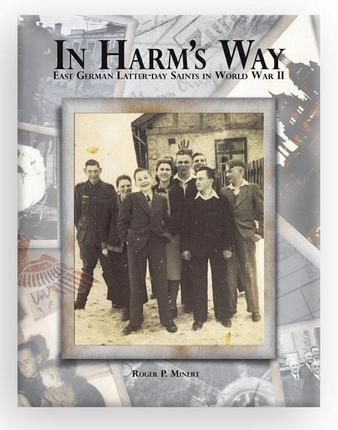
Review of Roger P. Minert, In Harm’s Way. East German Latter-day Saints in World War II

ACCH Quarterly Vol. 17, No. 4, December 2011

Review of Roger P. Minert, In Harm’s Way. East German Latter-day Saints in World War II  (Provo, Utah: Religious Studies Center, Brigham Young University, 2009) 545 pp. ISBN 878-0-8425-2746-0.

By John S. Conway, University of British Columbia

Roger Minert’s large-scale book is about one of the smaller religious communities, in East
Germany, in this case the Latter-day Saints, commonly known as Mormons. But the scope of his investigation is limited to the short period of World War II, and mainly to the crucial
period of its final catastrophic ending in 1945-6. This account thus focuses on the time before the imposition of communist rule in the German Democratic Republic, but foreshadows that much-dreaded development.

Rather than investigating the relationship of the Church to the governmental authorities, Minert’s interest is limited to describing in detail the lives of individual Mormons. He concentrates on a biographical approach, seeking to identify and record the experiences and witness of as many as possible of the ordinary members of each branch of the Church, and to draw up a complete listing of all who died during this period. To this end, he began, fifty years after these dramatic events, to interview all available surviving eyewitnesses, to locate biographies or autobiographies by or about eyewitnesses, and to study all available church records. Out of some thirteen thousand German members in 1939, he obtained interviews with five hundred survivors, who in turn also supplied first-person narratives or written stories of their own lives or those of deceased relatives.

Mormons have a strong interest in genealogy. So the records held in Salt Lake City, Utah, provide the historian with much help in linking family histories together. In addition many of the East German mission records for this period survived intact. (It is however not clear from his text why his study was limited solely to the East German Mission). The East German Mormon community, divided into districts and branches (or local parishes) was almost entirely an urban and lower-class phenomenon. These congregations contained almost no professional people. Most of the men were labourers or craftsmen. Only a few possessed their own meeting places, mostly using renting rooms in office-buildings in unremarkable parts of town. But their working-class solidarity was compounded by their loyalty to their fellow Mormons. The pattern of church organization, introduced from the United States, was largely patriarchal, while spiritual authority rested in men chosen or appointed for their dedication to the Mormon beliefs.

After all American missionaries were withdrawn in August 1939, the local branches became more dependent on each other. On the other hand, the conscription of all the younger male members into the German armed forces left many branches without leadership. In many cases, it was years before these men returned from prisoner-of-war camps. In many other cases, they never came back. Minert has successfully carried out the immense task of recording the names and biographical details of all the Saints who lost their lives during the war-time period. As well, he has interspersed narrative passages or vivid and valuable reminiscences drawn from his interviews.

Naturally the main focus is on the shattering events of 1944-5, when East Germany was assailed by the relentless bombing campaigns by the American and British air forces, and then conquered and ravaged by the invading Soviet armies. Many families were expelled from their homes, or had already fled to find refuge elsewhere. The perspective is of course that of the victims, who sustained each other by their devotion to their Mormon faith. Inevitably there is considerable repetition in these accounts, which, predictably, emphasize the sufferings endured, often heroically. The large number of surviving photographs, which Minert has reproduced, add to the immediacy of the narratives.

In his conclusion, Minert touches briefly on the vexed question of Mormon attitudes towards National Socialism. A small number, possibly five per cent, joined the Nazi Party, but the vast majority remained passive though loyal citizens. Nothing in their religious heritage led them to oppose the ruling power, or to refuse to join in its aggressive wars. Any opposition would have led to personal and collective suffering. “If there is any question of guilt on the part of the Latter-day Saints for tolerating an evil government (and in my mind there is not) they certainly paid a terrible price for their lack of action” (519).

This is church history from the pew upwards, but is outstanding as an example of meticulous
record-keeping. The surviving family members must be enormously grateful to have such a
tribute from a dedicated fellow Mormon in distant U.S.A.

Share

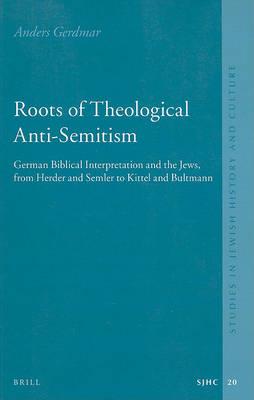
Review of Anders Gerdmar, Roots of Theological Anti-Semitism: German Biblical Interpretation and the Jews, from Herder and Semler to Kittel and Bultmann

ACCH Quarterly Vol. 17, No. 3, September 2011

Review of Anders Gerdmar, Roots of Theological Anti-Semitism: German Biblical Interpretation and the Jews, from Herder and Semler to Kittel and Bultmann. Studies in Jewish History and Culture, Vol. 20 (Leiden, Boston: Brill, 2009), 675pp. ISBN: 978-90-04-16851-0.

By Christopher Probst, Saint Louis University

Anders Gerdmar’s study of the approaches of German Protestant biblical scholars toward Jews and Judaism from 1750 to 1950 is a compelling work of biblical scholarship cum intellectual history. The author captures the ambiguity of the attitude toward Jews and Judaism of many of the exegetes discussed with Habermas’s moniker, “the Janus face of the Enlightenment.” The book is an interdisciplinary tour de force in which the author blends (often seamlessly) biblical theology, church history, and the history of antisemitism. It is an ambitious work, one that is both needed and well executed.

The book is presented in four parts bracketed by a thoughtful introduction and a thorough conclusion. Gerdmar takes a roughly chronological approach, beginning with eighteenth century Enlightenment exegetes and ending with National Socialist interpreters of Christian Scripture. Yet, each of the four sections of the book corresponds with a particular trajectory in biblical exegesis. Thus, for example, Adolf Schlatter, whose life and career reached into the National Socialist era, is included in Part II, “Salvation-Historical Exegesis and the Jews: from Tholuck to Schlatter.” At the close of his discussion of each exegete, Gerdmar provides a helpful short conclusion. Part I, “Enlightenment Exegesis and the Jews,” includes analysis of the work of Semler, Herder, Schleiermacher, F.C. Baur, and Ritschl, among others. Part II includes Delitzsch, Strack, and Schlatter. In Part III, “The Form Critics and the Jews,” Gerdmar analyzes the work of Karl Ludwig Schmidt, Martin Dibelius, and Rudolf Bultmann. Part IV, “Nazi Exegesis and the Jews,” is the longest section of the book and includes in-depth analysis of Kittel and Grundmann.

The author analyzes the work of these exegetes along three lines. First, he examines how each characterizes Jews and Judaism. Second, he frames the exegesis of each scholar within their symbolic world, that is, “the world of thoughts, values and ideologies” (9). Finally, he discusses whether each scholar’s representation of Jews and Judaism legitimized or delegitimized discriminatory attitudes and practices toward Jews. This approach in toto lends balance and perspective to the study. Gerdmar’s analysis of the characterization of Jews and Judaism of the exegetes provides for the reader the data pertaining to their theology of Jews and Judaism in the context of their biblical scholarship overall. The second aspect of the author’s approach is a crucial bridge from his characterization of the work of the exegetes to his discussion of whether their work would have legitimized or delegitimized Jews and Judaism in their historical context. The final aspect gives the author the opportunity to demonstrate the link between religious legitimation/delegitimation and social action (12).

Gerdmar explains that his idea of symbolic world essentially accords with Peter Berger’s symbolic universe. He applies this notion to the modern scholars examined in the book, noting that “since Jews and Judaism are an important part of the symbolic worlds of these scholars, either as positive or negative entities, I observe how they construct Jews and Judaism. I call this ideological construction of Jews the ‘symbolic Jew’ …” (11). Throughout the book, he demonstrates indeed that “it is possible to hold elevated views of the ‘symbolic Jew’, yet regard the ‘real Jew’ next door as a nuisance, or speak of ‘that Jew’ in a pejorative manner” (11).

When Gerdmar gets to Gerhard Kittel and Walter Grundmann, of course, the picture gets a bit grimmer than the one painted of the work of the earlier exegetes. Rather than a Janus-faced approach to Jews and Judaism, here we have German Protestant theology in the service of the Nazi racial state. The author develops a careful argument about Kittel’s evolution from a credible scholar with a complicated but not overtly antisemitic approach to Jews and Judaism to a racist theologian who publicly supported Nazi racial policies. Despite Kittel’s complexity, Gerdmar might be a bit too cautious when he discusses the Tübingen theologian’s odious 1943 article “Die Behandlung des Nichtjuden nach den Talmud” (The Treatment of Non-Jews According to the Talmud). Written for the Ministry of Propaganda’s Archiv für Judenfragen (Archive for Jewish Questions), it includes the charge, based in passages ripped out of their contexts, that the Talmud grants Jews the freedom to kill non-Jews. Gerdmar avers that Kittel “probably did not take pride in this article, since he does not include it in his own documentation of printed works in his defence” (495). While this conclusion seems too cautious, Gerdmar rightly condemns Kittel’s distorted presentation of Judaism, especially as evidenced by his writings during the Third Reich.

Gerdmar’s is a thoroughgoing scholarship; it is dense and heavily footnoted. While specialists might quibble with minor points here and there, the weight of the scholarship is as a whole very impressive. The book assumes at least a modicum of understanding of biblical scholarship. A working knowledge of biblical Greek is helpful for understanding some of the author’s arguments, but not essential for appreciating the work as a whole.

Gerdmar’s study demonstrates the need for scholars of religion, biblical scholars, and historians working on issues of theology and biblical studies to read and incorporate into their scholarship works from across the disciplines. It is a mature work, one that recognizes that the works of biblical scholars should be, indeed must be understood in their historical contexts. With his very competent handling of a vast array of historical literature covering the sociological and historical settings of biblical exegetes who lived in three successive centuries, Gerdmar sets an example for his fellow biblical scholars. Historians working in the area of Christian antisemitism or, more generally, those whose area of expertise is the history of religion, would do well to follow suit by immersing themselves in the theological literature of the subjects of their historical studies.

Eschewing easy answers and trite generalizations alike, this superb study significantly expands our previous knowledge about the outlook of German Protestant biblical scholarship on Jews and Judaism since the Enlightenment. The force of Gerdmar’s study rests in the weight of its measured and acute analysis. It is a must read for anyone interested in German Protestant biblical scholarship during the modern era, and would also be helpful for those interested in the history of antisemitism.


Share

Review of Manfred Gailus, Mir aber zerriss es das Herz. Der stille Widerstand der Elisabeth Schmitz

ACCH Quarterly Vol. 17, No. 3, September 2011

Review of Manfred Gailus, Mir aber zerriss es das Herz. Der stille Widerstand der Elisabeth Schmitz (Göttingen: Vandenhoeck & Ruprecht, 2010), ISBN: 978-3525550083.

By Victoria Barnett, United States Holocaust Memorial Museum

The individuals in Nazi Germany who acted with moral clarity, simple decency, and straightforward courage are in such short supply that they are worthy not only of honor but of serious study. As we know all too well, between 1933 and 1945 the vast majority of German citizens lived their lives in the grey zones of compromise, silence, and complicity. Those who resisted were outsiders in virtually every respect, and they remained so after 1945, when most Germans were quite uncomfortable with those in their midst who had opposed and resisted Nazism or been its victims. And by the time people became eager to uncover these stories, many of the traces had become buried.

Elisabeth Schmitz is a poignant and powerful example of one such individual. In 1999 a short study by one of her students, Dietgard Meyer, appeared as an appendix in Katharina Staritz, 1903-1953. Mit einem Exkurs Elisabeth Schmitz (Neukirchener, 1999). The 1999 essay included the startling discovery that Schmitz (not the Berlin social worker Marga Meusel) was the author of the 23-page memorandum, “Zur Lage der deutschen Nichtarier,” submitted to the September 1935 Prussian Confessing Church synod in Berlin-Steglitz. Meyer’s portrait of Schmitz proved that she had been one of the rare Germans who had consistently and at great personal cost chosen to stand by their Jewish neighbors.

As Gailus notes in this new biography, several historians were already looking more closely at the history of the memorandum; the historian Hartmut Ludwig had already confirmed that Schmitz was indeed the author. It was Gailus, however, who began to compile and document a much more comprehensive picture of Schmitz’s activities during the Third Reich and the subsequent historiography that had omitted her. The author of several fine studies on the Kirchenkampf, Gailus organized a 2007 conference in Berlin on Schmitz’s life and work; papers from this conference were published as Elisabeth Schmitz und ihre Denkschrift gegen die Judenverfolgung. Konturen einer vergessenen Biografie (1893-1977). Gailus also served as the key consultant for the film Elisabeth of Berlin produced by U. S. filmmaker Steve Martin, who produced the documentary several years ago on Robert Ericksen’s work Theologians under Hitler; both films are available from Vital Visions (www.vitalvisions.org).

Gailus has now written a biography of Schmitz that does justice both to her courage and to the troubling questions that her story raises about how historical narratives are created. Indeed, one of the most fascinating aspects of this biography is its dual narrative, which combines the story of a remarkably courageous and self-effacing woman with what Gailus calls the “Erinnerungskultur”—the culture in which the narratives of memory in postwar Germany distorted the truth and obscured those individuals who had actually spoken it during the Nazi era.

As Gailus shows us, Schmitz was an Aussenseiterin in a number of ways, both before and after 1945. She was a trained historian (she did her doctoral work under Friedrich Meinecke), Confessing Church member, and teacher at a girls’ Lyceum. Her 1935 memorandum, written shortly before the passage of the Nuremberg laws, was a painfully detailed account of what everyday life for German Jews had become and a devastating indictment of what had happened to German society. But it was directed particularly at Confessing Church leaders. “The Germans have a new god,” she wrote, “which is race.” Schmitz wrote of her hope that the Confessing Church at the Steglitz synod would speak out, “late, much too late, but nonetheless better too late than not at all … Because for the church this does not concern a tragedy that is unfolding but a sin of our people, and because we are members of this people and responsible before God for this our people, it is our sin.” She subsequently added a postscript to the memorandum after the passage of the Nuremberg laws. In addition to sending it to the synod, Schmitz personally made about 200 copies of the memorandum and circulated them among friends and people whom she hoped would have influence.

For years the author of this memorandum was believed to be Marga Meusel, a Berlin church social worker who had written another memorandum about the Confessing Church’s responsibility for its “non-Aryan” members that was submitted to the Augsburg Confessing synod in October 1934. It was, I think, an honest mistake for many of us. Copies of both documents were in the same file folder in the Günther Harder collection of Kirchenkampf documents in the Berlin Evangelische Zentralarchiv, and because Meusel’s name was written on the one memorandum (and there was no name on the other) most historians concluded that Meusel was also the author of “Zur Lage der deutschen Nichtarier” – even though a February 1947 affidavit signed by Probst Wilhelm Wibbeling had actually confirmed Schmitz as the author (a copy of the affidavit was published in Meyer’s 1999 essay). But that affidavit wasn’t in an archive, but in Schmitz’s private papers—and Schmitz, as Manfred Gailus shows, was not a self-promoter. In 1948 Wilhelm Niemoeller attributed the Steglitz memorandum to Meusel, and in the years to follow the error was repeated wherever the memo was discussed (I repeated the error in my discussion of the memorandum in For the Soul of the People).

But the story is more complicated, because as Mir aber zerriss es das Herz shows, Schmitz did far more than write the one memorandum. From the beginning to the end, she tried to help Jewish friends and colleagues and convince her church to speak out in protest. In the summer of 1933 she wrote and then met with Friedrich von Bodelschwingh, hoping to move him to speak out about the persecution of the Jews. (Her summary of his reply in an Aktennotiz in the Bethel archives begins: “For the time being, only work in silence possible.”) In the years that followed she sought out and wrote many of the leading figures in the Confessing Church—all with the hope that she could convince the Confessing Church to take a clear stand. After the November 1938 pogroms, she wrote an impassioned letter to Helmut Gollwitzer, Martin Niemoeller’s successor at the Annenkirche in Dahlem, urging him to preach openly about what had happened and to include the German Jews in the prayers of the congregation. As Wolfgang Gerlach noted in And the Witnesses were Silent, Gollwitzer’s sermon was one of the few in the aftermath of November 9, 1938, that can be considered a protest.

Then, in a remarkable act of integrity and courage, Schmitz drew the consequence that so few within the Confessing Church (or anywhere) were willing to take: she resigned her position as Studienrätin on December 31, 1938, requesting an immediate leave of absence and early retirement. “I decided to give up school service and no longer be a civil servant of a government that permitted the synagogues to be set afire,” she later wrote. In her letter to the director of the Berlin schools she told him exactly why she was doing it: “It has become increasingly doubtful to me whether I can offer instruction … in the way that the National Socialist state expects and requires of me …. I have finally come to the conviction that this is not the case.” She then quietly did volunteer work for the Confessing Church until the 1943 bombing of Berlin compelled her to return to Hanau, where she had grown up. In 1946 she returned to teaching, at a Gymnasium in Hanau.

Gailus includes several documents that give the closest glimpse of Schmitz. In addition to the text of her 1935 memorandum and the 1938 letter to Gollwitzer he has included a speech that Schmitz delivered in Hanau on September 7, 1950, at a ceremony commemorating “the victims of fascism and the war.” By 1950 German speeches on such occasions could easily slide into rationalization and alibis. Not surprisingly, Schmitz’s words summoned her audience to the responsibility of remembering and remembering accurately, not just for political reasons, but because, in her words, “otherwise we would be defrauding ourselves of our human dignity.” She concluded her remarks with references to Jochen Klepper, Hildegard Schaeder, Klaus and Dietrich Bonhoeffer—and yet said not a word about her own acts of courage and integrity.

Outside of a very small circle of acquaintances—including several Jewish colleagues whom Schmitz had helped and who wrote affidavits for her after 1945—Schmitz remained unknown and unrecognized. One reason that emerges very clearly in this biography was her modesty. The memorandum was unsigned and, with Niemoeller’s early attribution of it to Meusel, the historical record seemed to have been established. But Schmitz lived long enough that she could have corrected it (Meusel was in ill health after the war and died in 1953). And as Meyer’s 1999 essay showed, Schmitz did assemble documentation after 1945—affidavits from people she had helped as well as the affidavit from Wibbeling. She had clarified the record, at least for herself—but in the decades that followed she didn’t tell her story. Even Dietgard Meyer later told Gailus that she had never learned about the memorandum directly from Schmitz.

And no one asked her. For a very long time the women of the church struggle and resistance circles were forgotten and on the margins of the historiography. Extensive documentation emerged from the work during the 1980s of Göttingen systematic theology professor Hannelore Erhart and a group of former Confessing Church Theologinnen and doctoral students, leading to several volumes, including the 1999 one with the essay on Schmitz. My own work (For the Soul of the People, 1992) included a study of the role of women in the Confessing Church based upon of my oral histories with about 25 of the Theologinnen and women who had been in the resistance. More recently, biographies of women like Schmitz and Gertrud Staewen (Marlies Flesch-Thebesius, Zu den Aussenseitern gestellt: Die Geschichte der Gertrud Staewen, 1894-1987, 2004) have appeared.

Yet another question arises, and Gailus addresses it bluntly in this volume: why didn’t any of those who had known her and worked with her during the Nazi era come forward in the postwar era to acknowledge her courage and the role she had played? Why is it that the leading figures in the Kirchenkampf who had known her during the 1930s (Gollwitzer, Niesel, and Barth, among others)—and who eventually wrote and spoke so extensively about the events of the church struggle—failed to tell the story of Elisabeth Schmitz? The portrait of her in this biography shows a woman driven by outrage at the Nazi persecution of the Jews, someone who was active in the most prominent Confessing Church circles Berlin: in the Gossen Mission, in Dahlem, in Charlottenburg, at the Kaiser-Wilhelm-Gedächtniskirche. As yet, as Gailus notes, when Schmitz died in 1977 only seven people attended her funeral.

In any case, we now have this fine biography of Schmitz. It is among the recent German books that I wish could be published in English; it would be a strong addition to any course on the Third Reich. Her story is so compelling that I think it would find wider interest, and the chapters on Erinnerungskultur and the emergence of the historiography of the Kirchenkampf—and the emergence of her own story and the correction of the historical record—could stand alone as studies in the creation of historical narrative.


Share

Review of Martin E. Marty, Dietrich Bonhoeffer’s Letters and Papers from Prison. A biography

ACCH Quarterly Vol. 17, No. 3, September 2011

Review of Martin E. Marty, Dietrich Bonhoeffer’s Letters and Papers from Prison. A biography (Princeton University Press, 2011), 275 Pp., ISBN 978-0-691-13921-0.

By John S. Conway, University of British Columbia

Princeton University Press is to be commended for launching a new series of biographies, not of well-known authors, but of their well-known books, and also for including Dietrich Bonhoeffer’s Letters and Papers from Prison (LPP) in the first group to appear. Equally welcome is the choice as biographer of the eminent Chicago scholar Martin Marty, who has done so much to popularize religious thought in his numerous writings.

Essentially Marty gives us a well-informed survey of LPP’s reception over the past sixty-five years. He begins by describing the exceptional, almost adventitious circumstances of how the book was born. Bonhoeffer was arrested in April 1943 and placed in solitary confinement in a dank and fetid-smelling cell in Tegel Prison in Berlin. For months he suffered from being cut off from his former intellectual and pastoral activities, and from his family and fiancée. But later, thanks to a friendly prison guard, he was able to smuggle out letters, especially to his closest associate Eberhard Bethge. And then, in the period from April to August 1944, he embarked on a voyage of theological exploration, with radically challenging ideas about the future of Christian witness and the role of the church. The texts of these fragmentary letters were to form the bulk of the book at its first appearance. Although his ideas were not fully developed, it is clear that Bonhoeffer hoped they would be the basis for a future book. He therefore asked for them to be securely preserved. Bethge was then serving with the German army in Italy. But he sent the letters back to his wife in Berlin with instructions to bury them in the garden, safe from the Gestapo or air-raids. Miraculously they survived. Months later they were disinterred, and the task of deciphering Bonhoeffer’s terrible handwriting began. Thanks to Bethge’s determination, the first selection came to be published in 1951. As Marty rightly comments, “had Bethge not done his storing and editing work, the only Bonhoeffer the larger world would know was the promising theologian whose career had been cut short by the war” (39).

Bethge knew that publishing LPP was a risky business. The majority of the German Protestant clergy regarded Bonhoeffer’s participation in the plot to assassinate Hitler as a criminal dereliction of both his national and professional loyalties. Protestant clergymen could neither condone nor connive at murder, especially of the head of state. Hence the refusal by the Bishop of Munich, Hans Meiser, in early 1953 to attend a commemorative service at Flossenburg concentration camp because he saw Bonhoeffer as a political not a Christian martyr. It took many years before the climate of opinion in West Germany changed towards those who had taken part in the anti-Nazi resistance movement, and only grudgingly was this act of political witness accorded fitting recognition.

By contrast, in church circles abroad, particularly amongst supporters of the ecumenical movement such as Bishop George Bell of Chichester, Bonhoeffer’s sacrifice of his life in such a cause was early on acknowledged and acclaimed. LPP provided the evidence such supporters needed. On the other hand, the question still remains an open one whether or not the reputation of LPP was enhanced by the fact that its author died a martyr’s death.

The first translation of LPP into English was published as a slim paperback by S.C.M. Press in 1953. It received immediate praise in Britain and subsequently in North America. It came at a time when many church members were questioning their traditional orthodoxies and pietistic practices. So Bonhoeffer’s controversial and provocative ideas about “a world come of age” and the need for a “religion-less Christianity” sparked great debate. His portrayal of Jesus as “the man for others” was enormously attractive to many, but to others an exaggerated and paradoxical distortion of Christian doctrine.

In the English-speaking world, the ideas expressed in LPP gained even more notice and/or notoriety through their very wide popularization in Bishop John Robinson of Woolwich’s short book, Honest to God, which appeared in 1963. Robinson sought to show that LPP brought a message promising freedom and authenticity to a Christianity liberated from its subservience to the state and ecclesiastical tradition. Robinson’s advocacy was dynamite for a questioning church and an unstable academic community. Those seekers and devotionalists who had eagerly latched on to The Cost of Discipleship, and found inspiration and spiritual sustenance, were now jolted into a new dimension. In a world come of age, Christians were called to a much more radical obedience, both politically and socially. They were summoned to abandon the individualistic, ego-centric pursuit of personal holiness but rather to share in the sufferings of God in the world.

Robinson sought to enlist the ideas of LPP to shake up the comfortable English church establishment. But in the United States, Bonhoeffer’s radicalism was extended much further. The American theologian William Hamilton took up the non-religious interpretation of Christianity, the coming of age of the world and the need to live etsi deus non daretur, and formulated his theology for the death of God. Where Robinson sought to reform, Hamilton sought to abolish. For him Bonhoeffer was significant because he had rightly focussed on the accelerating pace of secularization, the increasing unimportance and powerlessness of religion, and the end of special privilege for religious men and religious institutions.

Such iconoclasm in pursuit of Christian atheism evoked strong responses. Hamilton was accused of distorting LPP for his own ends. But, as Marty rightly comments, Bonhoeffer did write some provocative and exploratory pages and did not live long enough to clarify and develop his concepts.

In the meanwhile, and in another quarter, Bonhoeffer’s writings were being exploited for quite different purposes. In East Berlin, in what was then the Communist-controlled German Democratic Republic, the theologians of the Humboldt University sought to use Bonhoeffer’s challenging radicalism as part of their campaign for the creation of a new Marxist-based social order. Hanfried Mueller, for example, took up Bonhoeffer’s idea of the world come of age to propagate his view that LPP envisaged a religion-less and class-less society. His advocacy for a kind of Christian utopian Marxism was aimed to build up support amongst the East German Protestant clergy for the new socialist regime in the G.D.R. Despite its brilliance, Mueller’s book found little credence. For most western critics, he distorted LPP for obvious political ends. And the whole attempt, of course, collapsed in 1989.

Such creative misuses of LPP were not destined to last. More recently, Marty notes, there has been an increasing interest in LPP among Catholic theologians, who find there an inspiring record of religious fidelity. Especially since the Second Vatican Council, many Catholics have found common fears and hopes expressed in LPP. In the drastically changed context of theology and faith, the old walls of separation have broken down, drawing both Catholics and Protestants to seek for a new ecumenically promoted agenda.

Most notable in Marty’s view is the increasing interest in Bonhoeffer among Evangelicals. Most of them, such as his recent biographer Eric Metaxas, had long favoured his earlier writings and had avoided or downplayed the radical questions posed in LPP. But here too, Marty believes, many Evangelicals are on the move from frozen positions or stereotypes. Others were attracted by the family values and social order implied in LPP.

Marty’s penultimate chapter covers the reception given to LPP in the wider world. “Who is Jesus Christ for us today?” is as captivating a question in Cape Town as it is in Korea. Even while Bonhoeffer’s reputation was still a chequered or at least an ambiguous one in his homeland, Germany, he was much more readily hailed as a prophet abroad. In South Africa, for example, the story of resistance against tyranny echoed loudly in the struggle against apartheid. LPP showed the biblical basis for identifying with the suffering and oppressed in any situation. So too in Latin America, the ideas of LPP could come to be seen as the “cusp of liberation theology” (199). But, in the course of time, there were also those liberationists and feminists who pounced on passages in LPP which they believed displayed Bonhoeffer’s paternalistic, elitist or even sexist opinions. Yet Marty is surely right to point out the dangers of anachronistic distortion. Some commentators have undoubtedly used the messages of LPP to further their own ends or to exploit Bonhoeffer’s ideology for their own purposes.

“Are we still of any use?” Marty’s final chapter discusses continuity and change in Bonhoeffer’s ideas. Many commentators, he notes, have seen a striking change between his early writings and his later prison letters. Some even, like Edwin Robertson, regard the latter as dangerous for believers, both doctrinally and morally. But Marty emphasises the continuity, especially in Bonhoeffer’s Christology. This, he claims is the connecting thread which links but also goes beyond the numerous paradoxes contained in LPP. At the same time, he asserts that it is these same intriguing reflections which have already guaranteed LPP a long life-cycle, and will undoubtedly continue to inspire and challenge both Christian and secular enquirers in the years ahead.


Share

Review of Nicolai Hannig, Die Religion der Öffentlichkeit: Kirche, Religion und Medien in der Bundesrepublik 1945- 1980

ACCH Quarterly Vol. 17, No. 3, September 2011

Review of Nicolai Hannig, Die Religion der Öffentlichkeit: Kirche, Religion und Medien in der Bundesrepublik 1945- 1980 (Göttingen: Wallstein Verlag, 2010), 454 Pp., ISBN 978-3-8353-0799-5.

By Mark Edward Ruff, Saint Louis University

Nicolai Hannig’s pioneering book, The Religion of the Public Sphere: Church, Religion and Media in the Federal Republic of Germany, 1945- 1980, helps untangle the extremely complicated relationship between the Protestant and Roman Catholic churches and the burgeoning German mass media. Strongly informed by scholarship from the last decade on the German media, Hannig’s work delicately modifies common perceptions of the media as merely a mirror of society and of journalists as individuals who simply reported on what had taken place. The mass media, he convincingly shows, consisted of individuals with the power to create discourses, alter perceptions and even shape events themselves. These television reporters and producers, journalists at newsmagazines and radio-men comprise what he calls the new “media ensemble.” Hannig pays careful attention to all three genres—television, radio and print—but especially to the writers, editors and owners of the weekly news and influential illustrated magazines like Stern, Der Spiegel, Quick, Twen, Konkret, whose names will be familiar to Americans who have spent some time in the Federal Republic.

The genius of this book lies in Hannig’s application of the fruits of ongoing media research to the major issues plaguing both major German churches in the postwar era. Accounts of the German churches had long been driven by secularization narratives bleakly positing religious decline and putting forward pictures of empty church pews. Contesting scholarship has been more apt to underscore the revitalization of religion through the emergence of nontraditional alternatives ranging from the New Age to Pentecostal and evangelical movements. Seeking neither to dispel nor confirm these competing theories, Hannig turns instead to the role of the media in creating and disseminating narratives of decline and vitality. In the 1950s, the media conjured up images of religious revival, overlooking undercurrents of decline in youth organizations and elsewhere. “The revitalization of the religious in the postwar era and the 1950s,” he states, “was in this way to a significant degree a phenomenon of the media public” (100). Television broadcasts and articles in news-magazines even proudly featured scientific experts who claimed to prove the truths of biblical stories such as Noah’s ark or to demonstrate that the Virgin Mary’s final resting place lay in Western Turkey.

But from 1958 through 1966, sooner in the print media than in television, such affirmative and faith-enhancing portraits quickly became passé. The newsmagazines, in particular, exposed a church in “crisis,” one beset by a fall-off in religiosity and acrimonious conflicts between reformers and conservatives. The amount of coverage devoted to the churches, not surprisingly, grew dramatically. The aims of such reporting, particularly from 1966 through 1972, accordingly changed. Many journalists, it seems, deliberately strove to push the church out of politics and larger society as much as possible. But from the early seventies onward, coverage dropped off markedly. The media paid increasingly less attention to the institutionalized churches. It chose instead to profile cults, sects, gurus and evangelicals, alternative forms usually far removed from church doors.

How does Hannig account for what at first glance would seem to be an increasingly negative and even acerbic coverage of the churches? Why did such increasingly dismissive and marginalizing accounts ironically find resonance at the exact moment that the Roman Catholic Churches in the wake of the landmark Second Vatican Council were consciously striving to open themselves up to the modern world? Hannig convincingly lays out the significant structural transformation in the German media landscape that began around 1958 and redrew the media map in the 1960s. As a new younger generation of editors—often men in their late twenties and early thirties—assumed new leading positions as editors by the second half of the 1950s, German journalism was suddenly catapulted from a model of consensus to one of criticism. Drawing on critical formats from the Anglo-Saxon media world, including hard-hitting roundtables, open panel discussions and investigative reporting, German journalists no longer saw it as their duty to hobnob with leading politicians but to investigate, expose, and engage a critical public. Bearing out this transformation were the manifold media “scandals” of the 1960s which put politicians on the spot, brought to light wrongdoing and uncovered tarnished pasts. At the same time, the rise of television drastically altered the media landscape. While it did not immediately displace the more established radio and print mediums, it made the traditional mediums all more likely to ratchet up criticisms in a bid for readers, listeners and relevance.

But there were additional reasons for why the mass media came to look askance at the role of the churches in society and politics. The churches had been important players in the media world from the time that the Allies reorganized the German media. Most state governments created agencies to oversee radio and eventually television broadcasting. The churches dispatched their representatives directly into these agencies, where they ensured the live broadcasts of masses and church services in an astoundingly successful at outreach to those who rarely or never attended their local parishes. It becomes clear from Hannig’s account that secular journalists (an astounding forty percent were by the 1970s formally un-churched) had been chafing at the bit. Hoping to free themselves from clerical directives, they sought greater autonomy in the media sphere.

Yet one of the most impressive features of Hannig’s book is the gentle manner in which he debunks widespread perceptions of a secular anticlerical media pitted against the religious establishment. He adeptly illustrates this significantly more complicated relationship between the new media culture and religion in the Federal Republic in his depiction of Rudolf Augstein, the hard-driving founder and legendary driving force behind the prominent newsweekly, Der Spiegel. Well-known for wielding the axe against the Roman Catholic Church in various polemics, editorials and leading articles, Augstein almost single-handedly ushered in a new era of critical religious reporting. He devoted a cover of Spiegel and fourteen ensuing pages in 1958 to the Qumrum texts discovered nearly a decade before. In marked contrast to most religious reporting from earlier in the 1950s, this Roman Catholic made no attempt to show how modern society could corroborate stories from the Bible. With characteristic lack of humility, he put his magazine forward instead as a new agent of enlightenment, claiming sensationally that there were no historically verifiable truths about Jesus. But Hannig also brings to light a less familiar side to the Spiegel editor who had become infamous in religious circles. Augstein appears here as a defender of religious orthodoxy. His reputation as a provocateur notwithstanding, Augstein openly criticized the “modern theology” of the Protestant theologian, Dorothee Sölle. He granted access to the pages of Spiegel to the Protestant theologian Walter Künneth, who argued that Christian parishes needed to draw their sustenance not from the hypotheses of theologians but from the “bread of the bible.”

Augstein’s pronouncements deftly illustrate a larger theme of this book: the manner in which media giants sought to determine the essential quality of religion—what functions it should serve and the balance between transcendence and immanence in religious teachings. For Augstein as well as for many critical intellectuals of the late 1950s and 1960s, the churches had made the mistake of extending their grasp into virtually every domain of modern life, including charity and politics. As Augstein put it in a lecture, “How I imagine Christians,” delivered before two thousand largely Protestant academics, “the churches push themselves into charity, for whose purposes they ask for ever greater sums of money from the state, into the Kindergartens, in the senior citizens’ homes and in welfare … They found academies, city missions, pay attention to what is going on in radio and television, warn about drunkenness at the steering wheel and about excessive celebration at Carnival” (348). In so doing, they had not only misused their newly gained power but had overlooked their transcendental mission of saving souls for the hereafter. The irony here should be apparent: Augstein’s assessment dovetailed with those of conservative Christians opposed to the worldly focus of religious progressives determined to reconcile religion with modernity through heightened political activism and campaigns for social justice.

Vast sections of this book spell out the manner in which the media exhumed topics in a manner often unpleasant to church leaders. Journalists had much to say about “clericalization,” “confessionalism,” confessional schools and sexuality. They criticized, they challenged and they broke taboos. Naked bodies became a regular feature of the illustrated news magazines by the 1970s. Even more instrumental was the media’s role in bringing to light the Roman Catholic church’s past during the Nazi era. Hannig argues that it was less the controversy over Rolf Hochhuth’s play, The Deputy, that marked a decisive caesura than subsequent lesser-known controversies about the tainted backgrounds of Karl Fürst zu Löwenstein, a central figure in the Zentralkomittee der Deutschen Katholiken, and Matthias Defregger, an Auxillary Bishop in the archdiocese of Munich who had been present as a Captain in the Wehrmacht at a massacre of Italian hostages in June, 1944. Once the Defregger scandal unfolded in 1969, it was clear that probing publications like Spiegel, whose own research on the topic had been voluminous, had sought to leave the moral legitimacy of the Roman Catholic Church in shreds.

Even as comprehensive a work as this could not delve into every aspect of the relationship between the German churches and the media over such a broad swath of time. Left out of this work—and left open for future researchers—are additional dimensions to the church-media relationship. In focusing on radio, television and the weekly illustrated magazines, all weighty subjects in their own right, Hannig tended, with some exceptions, to exclude the daily newspapers and wire services from his focus. Also absent, except for a few cursory pages, is the role of the Roman Catholic and Protestant media: the diocesan newspapers, the religious magazines and above all, the Katholische Nachrichtenagentur (KNA), a Catholic news service that served as a significant historical actor and interacted with the secular media in a complex and often combative manner. Each of these topics, however, could warrant its own scholarly monograph, and Hannig rightly made the decision to keep his focus limited to the secular media.

It is rare for a dissertation not only to display such scholarly command and to retain a remarkable even-handedness on charged terrain. Hannig’s book is also eminently readable, even in spite of its indebtedness to media theory and the ideas of Pierre Bourdieu. On the occasions that he lapses into jargon, he does so deliberately and almost apologetically. Through the soundness of its research and its scholarly breadth, this impressive book will easily go down as one of the most important and weighty new works in German religious history of the last decade.


Share