Contemporary Church History Quarterly
Volume 24, Number 1 (March 2018)
Review of Martin Röw, Militärseelsorge unter dem Hakenkreuz: die katholische Feldpastoral, 1939-1945 (Paderborn: Verlag Ferdinand Schöningh, 2014).
By Lauren Faulkner Rossi, Simon Fraser University
Martin Röw’s Militärseelsorge unter dem Hakenkreuz is among the newest contributions in a sudden flurry of work on chaplaincy and pastoral care during the Nazi period. Published in 2014, Röw’s text is the first rigorous, intensive analysis of the Catholic military chaplaincy during the Third Reich. At more than 450 pages, it is also the most detailed, even exhaustive. As such, Röw has provided the definitive book on this subject that is essential reading for anyone with an interest in religion in the military, pastoral care, and the world of German Catholic chaplains during the Second World War.
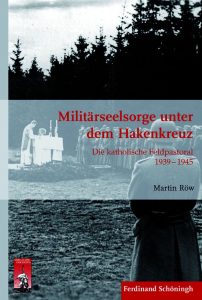 Röw’s intentions are to deliver a comprehensive structural and experiential history of Catholic military pastoral care in Germany, with a particular emphasis on providing a systematic study of chaplaincy (12). He has oriented himself solidly in the available historiography on the subject in both German and English and his archival research is impressively broad, gathering material from four archdiocesan archives (including Salzburg), eight diocesan archives (including one in Austria and one in the Netherlands), and several other state and private collections in Germany. His main source for primary documentation is the Archive of the Catholic Military Bishop, in Berlin, notably the Georg Werthmann collection. Until relatively recently, this rich compilation of chaplaincy-related material, produced by the man who served as second-in-command of the Catholic chaplaincy during the Second World War, was strikingly understudied; in the past four years, three books have appeared whose authors have extensively mined its records.[1] Röw articulates a concern with several facets of the chaplaincy’s existence, including the chaplains’ relations to military authorities, their understanding of the regime’s politics and ideology, the daily life of chaplains and their interactions with civilian populations, and their witness to war crimes. He is especially attuned to the challenges of accessing and interpreting mentality, and is determined “to drill into the mental dispositions” of chaplains wherever possible in order “to illuminate [their] self-conception and their mindset” (13). To some extent, he acknowledges the bias in and limitations of his main source, as Werthmann was the “nerve centre” of the chaplaincy (39), and his numerous judgments should not automatically be taken as balanced or neutral.
Beyond the introduction, Röw dedicates a short chapter to constructing the Catholic milieu of Germany. In passing, he recognizes the minority position that German Catholics held in a newly united German empire after 1871, but he focuses more on the impact of the First World War and the Weimar era on German Catholics, the ascent of Nazism and the relationship between the regime and the Church, and the meaning of the war’s outbreak for the German Catholic community in 1939. Much of this work is summation of earlier, mostly German historiography; because this is the backdrop to Röw’s main focus, he introduces nothing revelatory or original about the larger context of German Catholicism. The bulk of his work, nearly four hundred pages, is devoted to the Catholic chaplaincy during the war.
Röw divides his analysis of the chaplaincy into six main sections, the first two of which sketch the contours of the chaplaincy and the roles that chaplains expected themselves to fill as well as those that military officers asked them to take on. The first section considers the structures and individuals of the chaplaincy under Nazism, including general and specific chaplaincy statistics. There were “about 760” priests who served as chaplains over the course of the war, with 410 serving simultaneously at its peak, in the summer of 1942 (84). In a different section, Röw delves briefly into a quantitative social analysis of chaplains, offering statistics about regional background and generational variation; the leadership of the chaplaincy; the recruitment process and training; and the Nazi regime’s persistent, often explicit hostility towards the chaplaincy, culminating in the infamous 1942 order not to fill any vacant chaplain positions (120). The second section focuses on the context of the chaplaincy within the Wehrmacht, proclaimed at the time as “the pillar of the regime” (127). Röw depicts the military’s conceptions of pastoral care; the different kinds of relationships between chaplains and their officers, both positive and negative; the introduction of the much-detested National Socialist Leadership Officers (NSFOs) at the end of 1943; and Catholic chaplains’ interactions with their Protestant counterparts, both cooperative and competitive.
The final four sections are dedicated to the war’s impact on the chaplains and contain some of the richest material from the Werthmann collection to be introduced in one book. The third section confronts the duties of a chaplain, highlighting the divine service as “the centerpiece of pastoral care” at all times (173); Catholic chaplains’ reactions to the mandated, and controversial, nondenominational services (interkonfessionelle Gottesdienste); the significance of chaplains’ presence at the frontlines; equipment and available literature; care for the wounded, the fallen, and the imprisoned; and “deviant chaplains,” those who Werthmann labelled “weak brothers” (232).
The fourth section is Röw’s most sustained drive into the issue of mentality, considering how chaplains crafted meaning out of the war for themselves and the soldiers with whom they served, including nationalist and anti-Bolshevik impulses; displays of ambivalence, distance, and powerlessness, as well as affinity with the regime’s wartime goals; and the significant influence of a highly-developed sense of duty.
The fifth section, on communication and interactions between chaplains and their various environments, includes Röw’s scrutiny of the impact of the chaplains (and religion) on the fighting troops; their roles as guides, mentors, and helpers for soldiers in the thick of battle; the community of chaplains, however nebulous, that existed throughout the war; and their relationships with other identifiable groups, including seminarians and priests serving in the Wehrmacht (the so-called Priestersoldaten), foreign chaplains and priests, and indigenous populations.
The sixth section sees Röw endeavour to capture the kind of “everyday life in war” (“ein Alltag im Krieg”) that chaplains attempted to make for themselves, while admitting the challenges and controversy in introducing that word into the context of a war of annihilation (380-381). Thus Röw examines the typical official activities of a chaplain within his regiment or division; the peaks and ebbs of war as determined by active battle and proximity to the front; the experiences on different fronts, with a lengthy excursion into life on the Eastern Front; and their witnessing of atrocity (Röw uses the term Verbrechen for this section). This includes chaplains’ reactions to the maltreatment and murder both of Soviet POWs as well as of Jews. The almost-scant attention paid to this topic—fifteen pages—as well as Röw’s dependence on secondary sources and postwar published memoirs to flesh out the half-dozen or so eyewitness accounts that he has uncovered underscore the paucity of recorded testimony from the chaplains themselves. While many undoubtedly witnessed something, chaplains simply did not write about such things.
For scholars who have studied the Catholic chaplaincy in the Wehrmacht, Röw’s analysis does not necessarily bring anything ground-breaking to the subject of chaplains and pastoral care during the Second World War, or the hostility of the Nazi regime towards the Catholic Church in general and priests in the Wehrmacht in particular, or to the nature of the war and how devout Catholic clergy tried to makes sense of it. The identification of Bolshevism as an enemy provided a convenient overlap between Catholic and Nazi ideologies (260-270). Chaplains were dependent on good relations with the military authorities to be able to work effectively. Röw argues that “outspoken opponents of pastoral care, such as Nazi supporter General Schörner, commander of the 6th Mountain Troop Division, appear to be an exception” (145). Written or explicit criticisms of the regime or the Führer were—not surprisingly—non-existent, given the lethal reaction they would have provoked (291, 298).
The significance of Röw’s work is not its originality; it is that his study is the first methodical, systematic treatment of the chaplaincy, from the top of its hierarchy—the relatively feeble field bishop, Rarkowski, isolated from the other bishops and supported by the Nazis, alongside his field vicar-general Werthmann, judicious, active, energetic, willing to take risks (103)—to the chaplains standing next to soldiers on the field of battle. For this reason alone, the text is indispensable.
Röw’s objective is to produce a study of Catholic pastoral care during the war “in its various spheres and facets, but always viewing pastoral care as a whole” (442), and in this he has succeeded, though he has had to sacrifice depth in order to achieve breadth. The character of individual chaplains is underemphasized in favour of the institution in which they served, so that one is hard-pressed to keep track of the names (which are not always given in the footnotes). Despite the brief foray into the social and regional background of some chaplains, there is only a passing understanding of how old, or conversely how young, the chaplains tended to be, how long they had been priests when they were recruited, how their familial and regional histories moulded their pastoral behaviour in the military, or how many came from Austria or other annexed territories of the Reich. (Curiously, one of the most striking omissions in Röw’s list of archival resources is the archdiocesan archive of Munich and Freising, one of the largest archives of its kind in Germany). Werthmann is very present throughout, but remains as slippery and enigmatic as ever. Röw admits, “Whether [Werthmann’s] motto actually was, ‘good German and above all Catholic, but not and in no way National Socialist,’ as Heinrich Missalla alleges, cannot be said with certainty.” (103) Although the collection that bears his name is at last receiving the scholarly attention it has long deserved, we still await a definitive biography of its creator. One might have wished for a clearer sense, too, of change over time within the wartime chaplaincy, particularly given the turning-point of 1942, when no new chaplains were recruited.
Röw is undoubtedly correct when he claims that his work challenges the older interpretation of chaplains as unpolitical, and their military service as merely “care (Fürsorge) for men mired in the misery of war” (445). It is difficult to disagree with his conclusions about the motivation of so many chaplains, composed of an amalgam of “Catholic idealism, fueled by a specifically Catholic inferiority complex with deep historical roots, and a patriotism that convinced them that they were in no way second to non-Catholic Germans” (446). Röw is unflinching in his final assessment of the effect that chaplains had on the kind of war fought on the Eastern Front, articulating what those of us long familiar with these sources have known: their very presence encouraged soldiers to justify their behaviour as legitimate, even necessary, in an existential battle against an enemy—Bolshevism—that sought to annihilate German and Catholic culture. In this manner, priests in chaplain uniform “became, however involuntary, instruments of normalization of the war of annihilation” (448). And Röw has sifted his sources thoroughly to provide demonstrable proof of this. Although the regime worked doggedly to nullify the influence that a relatively small number of chaplains (760, says Röw, in an army in which some 18 million men served) had on the troops, the chaplains ultimately rendered a vital service in sustaining the Wehrmacht’s fighting fervor, especially on the Eastern Front.
Yet the number here might give one pause: how could so few chaplains possibly have motivated millions of men over a span of several years? They could not possibly be everywhere at once, and Werthmann, Röw’s primary resource, acknowledges that some divisions went months, or more, without access to a chaplain.[2] Does this not suggest that the chaplains inflated their own importance, precisely to justify their presence at the front, both at the time and after 1945? Undoubtedly the Priestersoldaten—more than 17,000 Catholic priests, members of religious orders (Ordensleute), and seminarians who were conscripted but did not serve in the chaplaincy—helped to fill in some gaps, though these individuals fell outside the chaplaincy and Röw accords them only a few pages.
What will really answer this question is testimony from the soldiers themselves about the impact of religion and the men who represented it: chaplains, as well as priests and other religious outside the chaplaincy wearing military uniforms. This is, admittedly, beyond Röw’s focus. His milieu is the chaplaincy, and while he begins to address the issue of reception, he does so in somewhat cursory fashion, referring to what responses to pastoral care military authorities told chaplains to expect from soldiers (326-329), and then to the perspectives of chaplains themselves (329-336). Röw does not claim to have answered all outstanding questions about the Catholic chaplaincy with this work. Indeed, he lists several areas for further research in the final pages, including theological themes in wartime sermons and other writing, comparative studies of chaplaincies in different militaries during the war, and the much-desired critical evaluation of Werthmann. But it might be time to shift focus in order to address more fully the questions that this research engenders. Perhaps we should begin to look less narrowly at the men who brought religious care to the troops, and instead scrutinize more attentively what the troops themselves did with that religious care. Röw has provided an exceptional overview of the former in the German context, and it should be considered essential reading for any scholar asking questions about religious care in the German military during the Second World War.
[1] Chronologically, Röw’s book was the first published, predating my own work by only several months. Röw was aware of my doctoral dissertation and cites this briefly in his introduction, though I was not aware of his work until it was published. While we both worked in the same archive in Berlin at roughly the same time, we never met each other. He did not have access to my book on the subject, Wehrmacht Priests (2015), prior to publishing his work. The third book is Dagmar Pöpping’s Kriegspfarrer an der Ostfront, a comparative study of the Protestant and Catholic chaplaincies, which appeared in 2017.
[2] This dearth was made even worse by the 1942 prohibition to fill vacant chaplain positions, as Röw details. See 120-122.

 In this account by the Koblenz-Landau church historian, one can not ignore the remarkably sympathetic treatment (for example, pp. 62 f., 72 ff.) of the Lutheran churches which adapted to the Nazi regime and which were skeptical or even hostile to the Barmen project from the outset. From today’s point of view, a critical church-historical assessment would seem more appropriate. Also, an up-to-date church history should leave behind terms from the time of the Church Struggle such as “intact” and “destroyed” churches. For the three large Lutheran regional churches (especially that of Hanover), with their far-reaching adjustment to the regime, the label “intact” should really be dispensed with. And for divided regional churches, such as the great Old Prussian Union Church, it would be more appropriate to speak of “self-destruction.” Although the author deals comparatively with the “Altona Confession” (1932), he deals too briefly or not at all with the 1936 memorandum of the 2nd Provisional Church Leadership (of the Confessing Church) to Hitler or the memoranda by Margarete Meusel (1935) and Elisabeth Schmitz (1935/36) on behalf of Protestant “non-Aryans” and persecuted Jews. A comparative chapter involving these and other important manifestations of the period of the Church Struggle would be well placed here.
 Lorenz’s goal is to compare New Testament passages from The Message of God with the Luther Bible, the standard translation, and the original Greek text. For this purpose, Lorenz has chosen three central terms by means of which she tries to analyze the new interpretation in The Message of God. Chapter 2 deals with the Messiah concept and the relationship between Jesus and Judaism. Chapter 3 places the concept of sacrifice at the heart of the comparison. Chapter 4 deals with the portrayal of Jesus in the New Testament traditions in comparison with Jesus’ presentation in The Message of God. The focus on concepts rather than merely on individual passages is very welcome, since, for example, in dealing with the Messiah concept, the entire Christology of The Message of God and thus of the German Christians can be derived, as Lorenz rightly states (83).
 Studdert Kennedy, or ‘Woodbine Willie’, as he was affectionately known by soldiers, has long been the most well-known of the British wartime chaplains. He has attracted the attention of scholars of various kinds for his poetry (The Unutterable Beauty, published in 1927, remains much admired in some quarters), his trenchant criticisms of the status quo, his uncompromising socialism, his pungent scepticism of authority (one of his books was simply called Lies), and his determination that the ghastliness of war must surely and eventually yield a better world. But he was also the embodiment of courage and unselfconscious sacrifice (he won the Military Cross) and his early death, exhausted, at the age of 45, presented something of the quality of a martyrdom—not so much to the powers of the age but perhaps to the whole age in which he lived. Westminster Abbey notoriously turned down the idea of hosting his funeral. One suspects that Studdert Kennedy would have been delighted by the compliment.
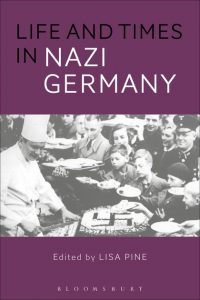 In his chapter “Protestantism in Nazi Germany: A View from the Margins,” Christopher Probst draws on church sources (newsletters, conference papers, ecclesiastical correspondence, and published works) to consider how Protestants responded to the Nazi regime and living in Nazi Germany produced profound religious divisions among Protestants. Probst begins with the issue of antisemitism, noting that “many, perhaps most, German Protestant ministers and theologians had decidedly deprecating views of Jews and Judaism,” and that most were “deeply nationalistic” (244/357). He goes on to ask three main questions: “What tack did Protestant pastors and theologians take towards the Nazi regime? How did the pressures and strictures of living in the Nazi state help to fracture the Protestant church into competing factions with distinct views on myriad issues? How did Protestant clergy and theologians confront the so-called ‘Jewish Question’?” (244/357)
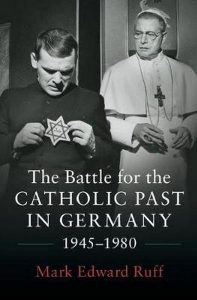 Ruff begins with the assumption that both churches, Catholic and Protestant, share a compromised history within the Nazi state. He also acknowledges that both churches from 1945 to 1949 worked to polish their reputations: “Not wishing to further damage Germany’s reputation abroad …,” both Catholics and Protestants “elevated to orthodoxy the picture of the church triumphant, of clear-headed leaders valiantly resisting and the faithful unflinchingly following” (243). Not until the 1980s did historians of the Protestant Church seriously begin to redraw this rosy picture. However, Catholic behavior came under widespread attack already in the 1950s, “Doubts about the moral fitness of Catholic bishops, Cardinal Secretary of States and pontiffs of the Nazi era were cascaded before the public. They screamed from front-page headlines, the magazine covers of the most influential newsweeklies, the glossy pages of illustrated magazines and the best-seller lists in Germany and the United States.” Why did this happen? “This has been a guiding question for this book, since by almost all objective yardsticks, the German Protestant leadership left behind a more troubling record of collaboration than their Catholic counterparts” (244).
 The book begins with two chapters offering broad surveys of early twentieth-century European culture and German war theology, respectively. Elmar Salmann’s “Der Geist der Avantgarde und der Große Krieg” covers familiar territory as it catalogs challenging and unsettling developments in modern psychology, philosophy, art, music, literature, and the natural sciences. For those contemporaries in despair over the complexity and contradictions of modern life, the Great War was a great simplifier and a welcome relief. Wolf-Friedrich Schäufele’s “Der ‘Deutsche Gott’” follows up with an overview of German war theology—also familiar terrain—but Schäufele generates new insights through his side-by-side analysis of Catholic and Protestant war theologies, his recognition of diverse perspectives among theologians of the same confession, and his cost-benefit analysis of contextual theology. In addition to those theologians of both confessions who saw the war as justified self-defense, an occasion for moral and spiritual renewal, or an experience of the sacred, Schäufele draws our attention to Protestant theologians like Reinhold Seeberg and Ferdinand Kattenbusch who believed war was a means by which God tested the ‘Geschichtsfähigkeit’ of nations, a theme that comes up again in Justus Bernhard’s chapter on Emanuel Hirsch (“’Krieg, du bist von Gott’”). Though most German war theology promoted the “civil-religious ideology of German nationalism” (73), Schäufele does not accept Karl Barth’s demand for a radical separation of theology from religious experience. As an alternative, he points to the more nuanced and critical theological engagement with wartime realities that he finds in the works of Rudolf Otto, Karl Holl, Friedrich Niebergall, and Otto Baumgarten.
 Despite the initial impression that the author’s ecclesiastical position and the book’s subtitle might suggest, Baptists, Jews, and the Holocaust is no simple glorification of Baptist-Jewish history. Rather, it is a thoroughly researched analysis of diverse Baptist responses to the plight of Jews during the Nazi era. Spitzer’s sources include a wide array of archival material: annual convention or conference books of Northern, Southern, Swedish, Regular, African American, and Seventh Day Baptists; minutes and correspondence from the Baptist World Alliance; papers from various Baptist boards, societies, and personnel; and several dozen national and regional Baptist periodicals. This is complemented by three main Jewish sources—The Jewish Chronicle, The American Hebrew, and The American Jewish Yearbook—and a solid collection of relevant secondary sources. Surveying the existing accounts of scholars like William E. Nawyn, E. Earl Joiner, and Robert W. Ross, Spitzer finds only brief, negative assessments of the two large, national, and white Baptist conventions. Omitted are the African American and the regional, state, and local facets of the history.
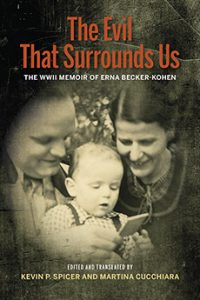 Erna’s first entry at Christmas 1937 begins with an announcement: she and her Catholic husband, Gustav, are expecting their first child in March. By this time, Hitler had been in power in Germany for four years. Erna and Gustav had married in 1931 while Erna was still Jewish and Gustav Catholic. As Spicer and Cucchiara note, the newlyweds could have had no idea then that their religious heritages would come to matter so very much to the outside world. In the early phases of Hitler’s chancellorship, Gustav continued working in an engineering company. His status as a pure Aryan accorded Erna a measure of protection. However, as the years of the Third Reich continued, Gustav and Erna would come to see that the so-called “privileged” status of their union was really no protection against an increasingly hostile German society. What adds yet another layer to this fascinating story is that Erna had converted to Roman Catholicism in 1936. She longed for community in the face of such social isolation and persecution and she took increasing solace in her Catholic faith.