Contemporary Church History Quarterly
Volume 32, Number 1 (Spring 2026)
Review of Bloch, Brandon. Reinventing Protestant Germany: Religious Nationalists and the Contest for Post-Nazi Democracy (Harvard University Press, 2025), pp. 384, ISBN: 978-0-674-29543-8.
By Björn Krondorfer, Northern Arizona University
Over the last decades, an extensive body of scholarly work and other writings have addressed the role of the German churches and German clergy during the Nazi regime as well as their efforts to reform and rebuild themselves in the decades following Germany’s defeat in 1945. As a matter of fact, Protestant Germans issued introspective, apologetic, self-exculpating and, at times, defiant public declarations and statements immediately after the war, producing a large oeuvre of historical, theological, and political writings by those who lived through the twelve-year dictatorship. These initial proclamations were followed by analytical, historical, critical, and ethical assessments by succeeding generations of scholars as well as lay people, clergy, and theologians. So much ink has been spilled on these issues that one would expect new scholarship to emerge only in areas of more limited regional interest (i.e. local networks or personal biographies) or in specialized cross-disciplinary case studies (i.e. questions of gender or comparative studies on religion and nationalism in other Nazi-occupied countries). But we might not have expected in the twenty-first century a publication to offer a fresh panoptic view on German Protestantism during and after Nazi Germany.
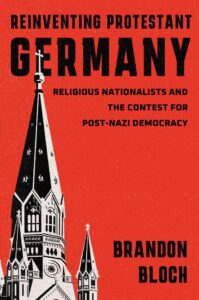 This, however, is exactly what Brandon Bloch presents in his book on Protestant Germany, a sweeping project that is part political, theological, and intellectual history and part social analysis that reassesses Protestant viewpoints and influences in postwar Germany, interspersed with occasional biographical materials on Protestant clergy and theologians as well as Protestant intellectuals and politicians. Bloch traces the wave of religious nationalism that swept up German Protestant during Hitler’s dictatorship and how the defeat of Nazi Germany required a reorientation among German Protestants which, as he convincingly argues, was both a break with the past as well as a continuation of previous Protestant mentalities. Continue reading →

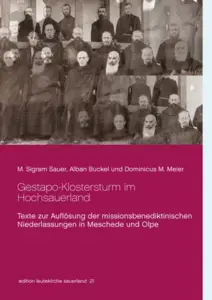 Researchers and readers new to the topic will appreciate Bürger’s two introductory chapters, in which he situates the volume within the regime’s broader campaign against religious institutions. Repressive measures included the currency and morality trials, the closure of schools and novitiates, and the compulsory use of church properties during World War II.
 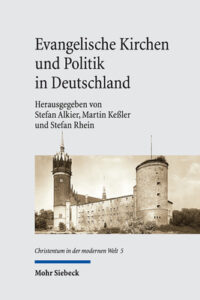 Co-editor Martin Keßler provides more detail on the concept in his individual contribution. Following Karl Mannheim, Max Weber, and most recently Dieter Henrich, the term “constellation” is to be understood as
  This book – or booklet – is the third of five publications thus far in Cambridge’s series “Elements in Modern War.” These
  This monograph advances several well-articulated claims. Its primary focus is to show that “even though Christian writers portrayed their engagement with each other as an egalitarian process, ecumenism was also deeply rooted in efforts to preserve hierarchies” (4). This study sheds light not only on the degree of interconfessional conflict and cooperation, but also on how opposition to class equality, feminism, and independence of African and Asian colonies prompted increasing ecumenical outreach. An additional thesis is that the rise of Nazism catalyzed change in confessional outlooks and caused an earlier shift toward cooperation between Catholics and Protestants than some previous histories of the subject suggest.