Contemporary Church History Quarterly
Volume 32, Number 1 (Spring 2026)
Review of Udi Greenberg, The End of Schism: Catholics, Protestants, and the Remaking of Christian Life in Europe, 1880s-1970s. Cambridge, MA and London: Harvard University Press, 2025.
By Michael E. O’Sullivan, Marist University
This thorough academic study traces the gradual decline of the antagonism between Roman Catholics and Protestants in much of modern Europe. Udi Greenberg deftly examines an array of published works by Christian theologians, economists, social theorists, sex commentators, and missionary writers from over a century of transformative change. His narrative about how interconfessionalism gradually took hold and altered European politics, culture, and law is captivating. This book contributes much to the historiography due to its engagement with so many intellectuals from several western and central European nation-states, including Germany, Austria, France, Switzerland, Belgium, and the Netherlands. Furthermore, the extended time frame of the study, its transnational focus, and the attention paid to gender, sexuality, and colonialism all add to its originality.
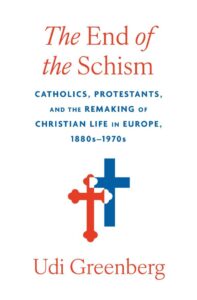 This monograph advances several well-articulated claims. Its primary focus is to show that “even though Christian writers portrayed their engagement with each other as an egalitarian process, ecumenism was also deeply rooted in efforts to preserve hierarchies” (4). This study sheds light not only on the degree of interconfessional conflict and cooperation, but also on how opposition to class equality, feminism, and independence of African and Asian colonies prompted increasing ecumenical outreach. An additional thesis is that the rise of Nazism catalyzed change in confessional outlooks and caused an earlier shift toward cooperation between Catholics and Protestants than some previous histories of the subject suggest. Continue reading
