Contemporary Church History Quarterly
Volume 32, Number 1 (Spring 2026)
Review of Patrick J. Houlihan, Religious Humanitarianism during the World Wars, 1914-1945. Cambridge Elements: Elements in Modern Wars. (Cambridge, 2024).
By Blake McKinney, Texas Baptist College at Southwestern Seminary
Wars do not consist entirely of death and destruction, but sometimes it may appear that histories written about wars do. Patrick Houlihan provides an unexpected contribution to the Cambridge Elements’ series of modern war studies which emphasizes humanitarian action rather than the era’s immense violence. Houlihan serves as Associate Professor of History at Trinity College Dublin. He is likely familiar to most CCHQ readers because of his 2015 book Catholicism and the Great War: Religion and Everyday Life in Germany and Austria-Hungary, 1914-1922 (Cambridge, 2015). His latest work, Religious Humanitarianism during the World Wars, 1914-1945, explores the reconstructive side of the human experience of war. This book is concerned with the preservation of lives and the rebuilding of societies rather than the destruction of modern warfare. Houlihan engages with the growing scholarship on humanitarianism, human rights, and transnational aid organizations. He challenges sweeping claims of twentieth-century secularization with an emphasis on the religious impulses of twentieth-century humanitarianism.
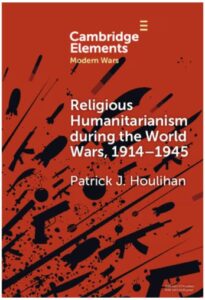 This book – or booklet – is the third of five publications thus far in Cambridge’s series “Elements in Modern War.” These Cambridge Elements volumes may be unfamiliar to some readers. Cambridge describes the Elements line as a combination of “the best features of books and journals to create a quick, concise publishing solution for researchers and readers in the fields of academic publishing and scholarly communication.” Houlihan’s contribution to the Elements in Modern War stands out as the volume that most explicitly deals with the religious aspects of the world wars era (although Jay Winter’s The Cultural History of War in the Twentieth Century and After engages aspects of religious life as well). Works in this series are intentionally short with a goal to “provide comprehensive coverage of the key topics” in various subfields. This book most certainly accomplishes this goal. Houlihan introduces his readers to religious humanitarianism during the era of the two world wars with an impressive engagement of the historical literature. Continue reading
