Category Archives: News and Notes

The German Bishops in the World War: The English Text

Contemporary Church History Quarterly

Volume 26, Number 3 (September 2020)

The German Bishops in the World War: The English Text

In the March 2020 issue of Contemporary Church History Quarterly, we featured two analyses of the German Bishops Conference statement, “Deutsche Bischöfe im Weltkrieg. Wort zum Ende des Zweiten Weltkriegs vor 75 Jahren,” by Olaf Blaschke and Mark Edward Ruff. In the meantime, the German Bishops Conference has published an official English translation of the statement, entitled The German Bishops in the World War: Statement on the end of the Second World War 75 years ago. For those who would like to read the statement in full, it is available here: https://dbk.de/fileadmin/redaktion/diverse_downloads/presse_2020/2020-04-29_DB_107_Englisch.pdf.

Share

News Note: “Campaign posters in ‘Luther country’ raise specter of anti-Semitism”

Contemporary Church History Quarterly

Volume 26, Number 1/2 (June 2020)

News Note: “Campaign posters in ‘Luther country’ raise specter of anti-Semitism”

By Christopher Probst, Washington University in St. Louis, University College

Last September, religion scholar and journalist Ken Chitwood asked me to comment on an article he was writing about the use of Martin Luther’s image and legacy in campaign posters for a far-right party, the Nationaldemokratische Partei Deutschlands (National Democratic Party of Germany, or NPD) in Thuringia. As Chitwood notes in the article, “instead of ‘Here I stand,’ the rebel monk is depicted saying, ‘I would vote NPD, I cannot do otherwise,’ alongside the party’s slogan ‘defend the homeland.’”

Together with Saxony-Anhalt, Thuringia formed the heartland of the German Protestant Reformation. Luther undertook his university studies at Erfurt and also became a monk in that city. While hiding out in Wartburg Castle in Eisenach, he accomplished one of his seminal achievements when he translated the New Testament into what became High German. In 2017, Germans commemorated the five-hundredth anniversary of the German Protestant Reformation. Luther sites across the country, including Erfurt and Eisenach, played host to numerous events celebrating the anniversary. Many Germans, and Thuringians in particular, take great pride in the place that their Heimat (homeland) played in the Reformation.

In Demonizing the Jews: Luther and the Protestant Church in Nazi Germany, I demonstrated that a large number of Protestant pastors, bishops, and theologians employed Luther’s writings about Jews and Judaism – which were littered with antisemitic and anti-Judaic rhetoric – to buttress the antisemi­tism already present in significant degrees in Protestant circles during the era of National Socialism. Some contemporary German church historians and theologians, while recognizing that Luther attacked Jews and Judaism in stark and unseemly ways, have downplayed the impact of the reformer’s Judenschriften (writings about Jews and Judaism) in subsequent German history, including the widespread apathy toward Nazi oppression and murder of Jews exhibited by many German Protestants. Others, like Hartmut Lehmann, have highlighted this darker aspect of German Protestant history in their scholarly work.

The NPD poster includes a variation on the famous phrase “Hier stehe ich, ich kann nicht anders” (Here I stand, I cannot do otherwise), which was uttered by Luther at the Diet of Worms in defense of his understanding of the Christian gospel. Yet, it also contains the slogan “Heimat verteidigen” (defend the homeland). During the Nazi boycott of Jewish businesses in April 1933, SA members stood menacingly in front of Jewish-owned storefronts holding signs that read “Deutsche! Wehrt Euch! Kauft nicht bei Juden!” (Germans! Defend yourselves! Do not buy from Jews!) The NPD posters no doubt resonate with some who both revere Luther and – unlike the great majority of Germans, including German Protestants – have no place for “foreigners” in their homeland.

The employment of Luther in NPD’s campaign did not bear fruitful results in Thuringia, as the party finished with less than 1% of the vote. Yet, in this same election, the larger far-right party, Alternative für Deutschland (Alternative for Germany, or AfD) won roughly 23% of the vote, overtaking Angela Merkel’s CDU as the second-largest party in the regional assembly. Chitwood’s article highlights the unsettling reality that, in Germany (as in the United States), xenophobia and racism, far from being relics of the past, have penetrated the body politic in ways not seen in decades.

Share

Research Note: Opening of the Vatican archives, 1939-1958 Period

Contemporary Church History Quarterly

Volume 25, Number 4 (December 2019)

Research Note: Opening of the Vatican archives, 1939-1958 Period

By Suzanne Brown-Fleming, United States Holocaust Memorial Museum*

 On March 2, 2020, one of the most important Holocaust-related archives in the world will open. I refer to the multiple archives relating to the pontificate of Pius XII (1939 to 1958, hereafter referred to as Pius XII archives). Important but incomplete documentation has been available beginning in 1965 as part of the published series Acts and Documents of the Holy See Relative to the Second World War.[1] Also already available are archives from the pontificate of Pius XI (1922-1939, since 2006) and those of the Vatican Office of Information for Prisoners of War (1939-1947, since 2004).[2]

Announced by Pope Francis on March 4, 2019 and marking 80 years since the election of Cardinal Eugenio Pacelli (Pope Pius XII) to the office of pope, the Pius XII archives will be accessible in multiple locations across Vatican City, Each archive has its own regulations, registration system, indexes, and inventories. For scholars of World War II and the Holocaust, of especial interest are the following, described in more detail by H.E. Monsignor Sergio Pagano in L’Osservatore Romano:[3]

The Roman Curia:[4] Select key archives opening in 2020

  • Vatican Apostolic Archive (former l’Archivio segreto vaticano or ASV)
  • Historical Archive of the Section of Relations with States, Secretariat of State (l’Archivio storico della Sezione dei Rapporti con gli Stati della Segreteria di Stato or AES orEE.SS.) Also called the Sacred Congregation of Extraordinary Ecclesiastical Affairs or 2nd Section of the Secretariat of State.[5]
  • Archive of the Congregation of the Doctrine of the Faith (l’Archivio storico della Congregazione per la dottrina della fede or ACDF)[6]
  • The Propaganda Fide Historical Archives of the Congregation for the Evangelization of Peoples (l’Archivio storico ‘de Propaganda Fide’ della Congregazione per l’evangelizzazione dei popoli)[7]
  • Historical Archive of the Congregation with the Oriental Churches (l’Archivio storico della Congregazione per le Chiese orientali)
  • Varied Historical Archives of Congregations, Dicasteries, Offices and Tribunals (archivi storici di congregazioni, dicasteri, uffici e tribunal)

When announcing the opening of these archives, His Holiness Pope Francis said, “the Church is not afraid of history; rather, she loves it, and would like to love it more and better, as God does! So, with the same trust of my predecessors, I open and entrust to researchers this documentary heritage.”[8] For historians of the churches during World War II, the Holocaust, and the postwar period, we are witnessing an exciting moment. Networks of scholars from Europe, Israel and the United States are already forming to be best prepared for these sizable archives and to share future findings.

[1] Actes et documents du Saint-Sìege relatifs à la seconde guerre mondiale, ed. Pierre Blet, Robert A. Graham, Angelo Martini, Burkhardt Schneider. Vatican City: Libreria Vaticana, 1965-1981, 12 vols.

[2] Inter arma caritas: l’Ufficio informazioni vaticano per i prigionieri di guerra istituito da Pio XII, 1939-1947. 2 vols.

[3] H.E. Monsignor Sergio Pagano, “Dopo un lungo e paziente lavoro di preparazione,” L’Osservatore Romano, 4 March 2019.

[4] The entire group of organized bodies and their personnel assisting the Pope in the government and ministration of the Church, i.e. the congregations, tribunals and offices.

[5] The Secretariat of State is a dicastery of the Roman Curia. From 1908-1967 it was divided into three sections: 1st Section – Ordinary Affairs, 2nd Section – Extraordinary Affairs, and 3rd Section, the Chancery of Apostolic Briefs. This set-up was reformulated in 1967 as part of Vatican II. See http://www.vatican.va/roman_curia/secretariat_state/sezione-rapporti-stati/archivio-storico/consultazione/consultazione_it.html, accessed 10/8/2019.

[6] For application process and holdings see http://www.acdf.va/content/dottrinadellafede/it/servizi/richiesta-di-accesso.html, accessed 10/8/2019. Currently, the website does not indicate a registration date for the 1939-1958 materials.

[7] For application process and holdings see http://www.archiviostoricopropaganda.va/content/archiviostoricopropagandafide/en/archivio-storico/fondi-archivistici.html, accessed 10/8/2019.

[8] Holy See Press Office, N. 190304d, Monday 04.03.2019. See https://press.vatican.va/content/salastampa/en/bollettino/pubblico/2019/03/04/190304d.html, accessed 12/28/2019.

*The views expressed are the author’s alone and do not necessarily represent those of the United States Holocaust Memorial Museum or any other organization.


Share

Conference Report: Kirchliche Zeitgeschichte Conference, Lund, Sweden, September 25-26, 2019

Contemporary Church History Quarterly

Volume 25, Number 4 (December 2019)

Conference Report: Kirchliche Zeitgeschichte Conference, Lund, Sweden, September 25-26, 2019

By Robert P. Ericksen, Pacific Lutheran University (retired)

Professor Anders Jarlert of Lund University in Sweden hosted an international conference on September 25-26, 2019, under the title, “Life-Line or Collaboration? Active contacts with churches in totalitarian societies.” This conference also served as the annual meeting of the journal, Kirchliche Zeitgeschichte, and papers will be printed in a subsequent volume of that journal. Finally, this conference occurred as Jarlert began his final year before retirement as a professor in the Lund Theological Faculty, thus marking possibly the last opportunity for Professor Jarlert, one of the longest-serving and most active members of the Kirchliche Zeitgeschichte Editorial Board, to host an annual conference of this group. The dozen presentations and subsequent conversations presented a wealth of information spread across much of the twentieth century and a broad group of nations, all on this important topic, the role and behavior of Christian churches in relationship to totalitarian societies.

All papers dealt in some fashion with an overarching question: Did various organizations and national churches outside Germany during the Nazi era and outside the Soviet Bloc during the Cold War extend important assistance, a “life-line,” to churches within those systems, or did they act as collaborators in the subversion of Christian ideals and Christian behaviors under totalitarian rule? In several instances, papers assessed the same question in terms of churches within those systems. As readers might suspect, the papers and discussion produced no clear, simple and conclusive answer to this question about assistance vs. collaboration. However, the papers at the conference shed light on a multitude of lesser known circumstances and participating nations in the mid-twentieth century, as will their future appearance in Kirchliche Zeitgeschichte.

Gerhard Besier, founding editor of Kirchliche Zeitgeschichte, opened the conference with a consideration of ongoing difficulties among Germans trying to come to a comfortable stance on Christian behavior under the Nazi state. Under the theme of “holding the line,” he noted that “people tell each other stories conducive to their purposes.” That has relevance for institutions, of course, and not just people. Besier then added that this can be difficult, especially in our modern world with its unfiltered social media adding to the mix. I will cite two examples from his presentation, the first involving the 75th anniversary of von Stauffenberg’s heroic attempt on Hitler’s life and his subsequent execution. Critics noted that von Stauffenberg had approved of National Socialism, showed no concern until his actual participation in the assassination plot, and expressed no moral reasons for his actions. Defenders of the heroic side of the story quickly responded with a claim like this, that “Klaus Schenk von Stauffenberg remains a hero and a role model,” etc. Martin Niemöller is a second example. Noting the recent biographies by Matthew Hockenos and by Benjamin Ziemann, there is a wealth of evidence both before and after 1945 that Niemöller did not always “get it right.” This includes a strongly patriotic (and militaristic) stance from his childhood, through his navy career, and in his politics up to 1933. It also includes various complicated political stances taken after 1945. Besier explored many additional complexities, including the role of Protestant pastors in the GDR. His conclusion? We are often given a narrow corridor in our lives. There is also a strong tendency to maintain the narrowness of that corridor, partially as we research and write about the past, and also as institutions try to protect the story they want told. Besier appeals for a broader opening of that conversation and a recognition of complex realities.

Many subsequent papers then illustrated the complexity to which he had alluded. For example, Valentin Jeutner of Lund described a German Protestant Church in Malmö, Sweden, serving the German population in Malmö while being administered by the German Protestant Church. Herbert Kühn, the pastor from Germany assigned in 1930, joined the NSDAP in 1935. He became an Ortsgruppenleiter among Nazis in Malmö. In 1942 he tried to volunteer for German military duty but was told his work in Malmö (on Germany’s behalf) was more important. After the war, the British produced a “list of obnoxious Germans” and urged Sweden to send them back to Germany. Kühn was sent to Lübeck. During his denazification proceedings in Germany, he lied about and hid his pro-Nazi activities, and both Martin Niemöller and Bishop Bell came to his defense. Many of the “obnoxious Germans” repatriated to Germany under British pressure simply went to Austria and then slipped back into Sweden. Kühn, however, possibly for family reasons, stayed in Germany.

Johan Sundeen of Lund then described a somewhat reverse image to Kühn, in this case, a Swedish pastor serving Swedes in Berlin, Birger Forell, As a legation pastor he had diplomatic protection, which he used in two important ways. One was to create hiding places and provide assistance to Jews in Berlin. Another was to write anonymous quarterly reports to a Swedish journal, thus telling Swedes and the outside world about horrors unfolding for Jews and other victims of the Nazi regime.

Anders Jarlert described another Swedish figure of the time, Erling Eidem, Bishop of Uppsala. He is less known than Bishop Bell of England. He is also less known than his predecessor as Bishop of Uppsala, Nathan Soderblöm, a vital figure in creating the ecumenical movement of the twentieth century and recipient of a Nobel Peace Prize. Jarlert, however, described subtle efforts by Eidem to speak to the politics of the Nazi regime and to the plight of Jews, especially with his use of a sermon text, “For I am not ashamed of the gospel of Christ: for it is the power of God unto salvation to every one that believeth, to the Jew first, and also to the Greek” (Romans 1:16, KJV). This was the text of a sermon he gave in Berlin in 1942 at the Gustavus Adolphus celebration that year. Jarlert pointed out that in German this text becomes plural, “Jews” and “Greeks,” and argued that Eidem was well aware of how powerful it would sound in Germany in 1942. Jarlert also cited other speeches and sermons with subtle political content, an emphasis in Oslo in 1940 of the close bond between Norwegians and Swedes. In both 1940 and 1943, he spoke about “our beloved Danes” while wishing God’s blessing upon them. Eidem also spoke on various occasions in Germany. Jarlert’s discussion of Eidem illustrates some of the complications implicit in this conference, suggesting that Bishop Eidem employed just enough collaboration to allow him also to give a “life-line” to his audience, whether in Norway, Denmark, or Germany itself.

Rebecca Carter-Chand, a member of our CCHQ Editorial Board, spoke at this Lund meeting, describing her work on the International Salvation Army in connection to the German Heilsarmee in the Nazi era. During World War I, the Heilsarmee had broken its connection to the international Salvation Army based in Britain. This connection was then reestablished after the war, and the Heilsarmee played a useful role during the years of need in the Weimar era. The rise of Hitler in 1933 created some talk of another break of the British connection. However, that moment passed. By October 1934, General Evangeline Booth wrote to Hitler of her “deepest appreciation” of the social improvements in Germany under his leadership. The 50th Anniversary of the Salvation Army then coincided with the 1936 Olympics in Berlin. The Kriegsruf of the Heilsarmee in September 1936 reported the good news that slums no longer existed in Germany and referenced a “Prayer for the Führer, Volk, and Vaterland, and for world peace,” while including pictures of the Nazi flag and of men in uniform. In the summer of 1939 General Evangeline Booth spoke of “bonds between us that could not be broken,” as reported in an issue of Kriegsruf that appeared in September 1939 (!). Carter-Chand noted that Heilsarmee literature at the time made no reference to the November Pogrom of 1938 or the disappearance of Jews from 1941. Furthermore, these important issues received little or no reference in early memoirs, and they remain without critical reflection today.

I encourage CCHQ readers to pay attention to the future KZG issue which will print the presentations I have mentioned, plus the balance of other conference papers as well. This will include presentations by Andrea Strübind on the relationship of Baptists to various World Federations in the Nazi era; Mikael Hermansson on “the Soviet Union in British and Swedish religious propaganda” during World War II; Erik Andersson on Axel Svensson’s “meeting with Lutheran groups in Ethiopia and Eritrea under Italian occupation;” Gerhard Ringshausen on “George Bell’s Relation to the Confessing Church and the Problem of Information;” Anna-Maija Viljanen-Pihkala on “The Finnish-Hungarian Lutheran Relationship” during the fraught years of 1956-1958; Ville Jalovaara on a “Test of religious freedom—Richard Wurmbrand’s visits to Finland in the 1970s;” and Erik Sidenvall on a 1975-1989 connection between the Växjö diocese in Sweden and the Pomeranian Church in the GDR, a well-meaning effort at peace and détente on the Swedish side that gradually lost momentum in the mid-1980s and then suffered after November 1989 with word of the Stasi connections of the Bishop of Pomerania.

As readers will note, my already rather long report will be replaced by a much more extensive version of considerable interest when the papers appear in print in 2020.

Share

Article Note: Rainer Decker, “Bischof Alois Hudal und die Judenrazzia in Rom am 16. Oktober 1943”

Contemporary Church History Quarterly

Volume 25, Number 4 (December 2019)

Article Note: Rainer Decker, “Bischof Alois Hudal und die Judenrazzia in Rom am 16. Oktober 1943,” Römische Quartalschrift für Christliche Altertumskunde und Kirchengeschichte 113:3-4 (2018), 233-255.

By Suzanne Brown-Fleming, United States Holocaust Memorial Museum*

On Saturday, October 16, 1943, SS-Hauptsturmführer Theodor Dannecker ordered the roundup of Jews in Rome, arresting 363 men and 896 women and children. On October 18, Dannecker and his men deported 1,007 of those arrested to Auschwitz. Only 19 would survive. On the day the roundup started, Vatican Secretary of State Cardinal Luigi Maglione summoned German Ambassador to the Holy See Ernst von Weizsäcker to a meeting. Maglione’s partial notes from this meeting have been available to scholars since 1975. Maglione made the plea that has become a touchstone for the so-called “Pius Wars,” telling Weizsäcker “It is painful for the Holy Father, painful beyond words that here in Rome, under the eyes of the Common Father so many people are made to suffer simply because of their particular descent.”

When pushed by Weizsäcker as to whether the Holy See would “express its disapproval” or “leave [Weizsäcker] free not to report this official conversation,” Maglione “replied that I had begged him to intervene appealing to his sentiments of humanity. I was leaving it to his judgement whether or not to mention our conversation, that had been so friendly.” Later that day, the controversial Bishop Alois Hudal,[1] Rector of the German National Church in Rome, Santa Maria dell’Anima, sent a letter to German City Commander of Rome Major General Reiner Stahel criticizing the raid. The letter reads in part, “I [Hudal] earnestly request you to order the immediate cessation of these arrests in Rome and its environs. I fear that if this is not done the pope will make a public stand against it […].”[2]

On October 17, Weizsäcker sent a telegram to the German Foreign Office “confirm[ing] the reaction of the Vatican to the removal of Jews from Rome as given by Bishop Hudal and altered Maglione’s phrase “under the eyes of the Common Father” to “under the very windows of the pope.” However, Weizsäcker did not report his meeting with Maglione. Ultimately, the Holy See did not make an official diplomatic protest.[3] Until recently, scholars have worked from various versions of and excerpts from the Hudal letter to Stahel. One version has been preserved in the Hudal papers and in the archives of the Vatican Secretariat of State. Parts of the letter were incorporated in a telegram from Stahel’s new aide, Gerhard Gumpert, to the German Foreign Office in Berlin. For decades, there has been speculation that the letter was drafted by either Weizsäcker, Gumpert, or Weizsäcker’s aide Albrecht von Kessel, and only lightly edited and signed by Hudal. The role of Eugenio Pacelli in the letter, if the pope had one at all, is contested.

Decker’s contribution to this historical question is to publish the first “exact, complete wording of the Hudal letter;” offer more clarity regarding its origin and authorship; and to problematize our conclusions about its ultimate effects (Decker, 237).[4] In this thoughtful article, Decker lays out hypotheses for the slight differences in phrasing in the various versions and the motivations Weizsäcker, Hudal, Gumpert and others might have had in choosing the excerpts, phrasing, and interpretations of the letter during and after the war. Decker also brings to the fore the potentially important role of the letter carrier, Father Pancrazio Pfeiffer, superior general of the Order of the Salvatorians and Pacelli’s personal liaison with Stahel.

Klaus Kühlwein’s recent edition Pius XII und die Deportation der Juden Roms (2019) states the claim that Eugenio Pacelli sent his nephew Carlo to Bishop Hudal to launch a protest is incorrect (Decker, 233-236). Decker is less sure, noting that some phrases in the letter were very unlikely to have been influenced by Weizsäcker, Gumpert, or Kessel. Decker finds it plausible that Pacelli asked his nephew Carlo to intervene via Hudal and Pfeiffer, both of whom had excellent relations with Stahel, and also plausible that the letter expressed Pacelli’s sentiments as Hudal understood them, even if Pacelli had not spoken with his nephew Carlo (Decker, 244). Decker also finds it plausible that the Hudal-Stahel exchange reached Heinrich Himmler, a position refuted by Zuccotti and others (Decker, 247-249). Decker acknowledges that at this time, the sources to settle this issue are not available (Decker, 249).

Ultimately, concludes Decker, Himmler’s possible receipt of the Hudal-Stahel exchange had no influence over the fate of the arrested Jews. However, the pattern of future raids for the remainder of the German occupation of Rome may have been impacted, he argues. Decker acknowledges that more work needs to be done before we can be sure (Decker, 252). Decker also provides a helpful diagram of the various available versions (253) and the full text of the letter (254-255).

Decker’s article does not change current scholarly understanding that Pope Pius XII refrained from open, public protests of the October 16th round-up “under his very windows.” Decker’s work fits with arguments that Pacelli and his aides chose back channels and unofficial messaging buried in diplomatic pleasantries. The full text of the Hudal letter is a great example of this tactic. That said, as Decker points out multiple times in his carefully crafted article, there are still missing sources that might better fill out this picture. Scholars will soon have access to the full set of materials relating to the papacy of Pius XII(1939-1958). The words exchanged within the walls of the Vatican, and directives given or not given on October 16-18, 1943, will finally become available to us.

*The views expressed are the author’s alone and do not necessarily represent those of the United States Holocaust Memorial Museum or any other organization.

Notes:

[1] See Uki Gõni, The Real Odessa: Smuggling the Nazis to Perón’s Argentina (London/New York: Granta Books, 2002) and Gerald Steinacher, Nazis on the Run: How Hitler’s Henchmen Fled Justice (Oxford University Press, 2011), among others.

[2] Stahel’s new aide, Gerhard Gumpert, forwarded the letter to the Foreign Ministry in Berlin, where a copy was preserved. See also ADSS, Vol. IX, doc. 373, p.510. Zuccotti, Under His Very Windows, 161-2 and Decker, 235.

[3] Susan Zuccotti, Under His Very Windows: The Vatican and the Holocaust in Italy (New Haven: Yale University Press, 2000), pp. 159-160, citing Actes et documents du Saint-Sìege relatifs à la seconde guerre mondiale [hereafter ADSS] ed. Pierre Blet, Robert A. Graham, Angelo Martini, Burkhardt Schneider. Vatican City: Libreria Vaticana, 1965-1981, 12 vols. Volume IX: Le Saint Siège et les victimes de la guerre, Janvier-Décembre 1943 (Città del Vaticano: Libreria Editrice Vaticana, 1975); notes of Cardinal Maglione, October 16, 1943, pp. 505-506.

[4] Decker writes, “Im Folgenden wird erstmals der genaue, vollständige Wortlaut des Hudal-Briefes veröffentlicht.”

Share

Conference Report: “Soldiers, Sex, Chaplains, and Horses: A Panel on the Wehrmacht in Honor of Gerhard L. Weinberg”

Contemporary Church History Quarterly

Volume 25, Number 4 (December 2019)

Conference Report: “Soldiers, Sex, Chaplains, and Horses: A Panel on the Wehrmacht in Honor of Gerhard L. Weinberg,” German Studies Association, Portland, OR, October 2019.

By Christina Matzen, University of Toronto

At the 2019 German Studies Association conference in Portland, OR, four scholars convened a panel in honor of esteemed military historian Gerhard Weinberg. Two of the three papers from former Weinberg students provided insights into the history of Christianity and the Second World War. Sandra Chaney’s paper, “Behind the Lines in the Ukraine and Caucasus, 1942-1943: The Wartime Diary and Photo Album of Senior Staff Veterinarian, Dr. Eugen Kohler,” offered a brief yet telling glimpse into the daily life and belief systems of Wehrmacht officials on the Eastern Front. Kohler was a devout Christian and attended worship services every Sunday while living in Donetsk. More Nazified Wehrmacht members tolerated Kohler’s religious practices and moderate political views because he was an occupation official in a specialized field. In “’For Members of the Wehrmacht Only’: Chaplains in German-Occupied Territories, 1942-1943,” Doris Bergen analyzed how military chaplains in occupied territories negotiated four key relationships: with the troops, with their superiors, with local populations, and with Germans at home. Each aspect of the chaplains’ work was enmeshed in the violent practices of occupation, including forced labor, theft, and killing. Bergen demonstrated that many of the chaplains’ duties served a dual role—providing spiritual support to individual soldiers while simultaneously performing institutional functions for the Wehrmacht. Taken together, Chaney and Bergen’s papers highlighted the fact that religion played an important role in the lives of many people across the various units of the Wehrmacht, and Christianity helped provide a sense of normalcy and relief—as well as opportunism—in the midst of war.


Share

Call for Applications: Confronting Difficult Issues around Religion and the Holocaust

Contemporary Church History Quarterly

Volume 25, Number 4 (December 2019)

Call for Applications: Confronting Difficult Issues around Religion and the Holocaust

June 15–19, 2020
Application deadline: February 14, 2020

The Programs on Ethics, Religion, and the Holocaust of the United States Holocaust Memorial Museum is pleased to announce its annual seminar for faculty and ABD doctoral candidates from all disciplines, including religious studies, history, literature, sociology, political science, gender studies, philosophy, and area studies.

This seminar will consider the complex roles of religion (specifically Judaism and Christianity) in the Holocaust by addressing five key themes: everyday religious life under persecution; religion and violence; rescue, conversion, and coercion; religious/ethnic/national identities; and religious freedom in authoritarian societies. We will examine each topic through primary sources and secondary literature related to the Holocaust as well as consider how similar issues play out in other cases of genocide or mass atrocity in order to explore how Genocide Studies might deepen our understanding of religion and the Holocaust. The seminar will emphasize practical approaches to integrating these topics in university and seminary courses, including syllabus development and discussing sensitive material in the classroom.

The seminar will be co-led by Drs. Doris Bergen and Rebecca Carter-Chand. Doris Bergen is Chancellor Rose and Ray Wolfe Professor of Holocaust Studies at the University of Toronto. She is the author or editor of five books, including War and Genocide: A Concise History of the Holocaust (3rd edition 2016); Twisted Cross: The German Christian Movement in the Third Reich (1996); and The Sword of the Lord: Military Chaplains from the First to the Twenty-First Century (2004). Rebecca Carter-Chand is the Acting Director of the Programs on Ethics, Religion, and the Holocaust at the USHMM. She is currently working on a book manuscript, “The Limits of Christian Internationalism and the Salvation Army in Germany” and is co-editing a volume with Kevin Spicer, “Christianity, Antisemitism, and Ethnonationalism in the Era of the Two World Wars.”

Application Deadline: February 14, 2020.

For more information, please go to: https://www.ushmm.org/research/opportunities-for-academics/faculty-seminars/ethics-religion-holocaust/2020-annual-seminar-on-ethics-religion-and-the-holocaust.

Share

“Victoria Barnett’s Retirement from the US Holocaust Memorial Museum”

Contemporary Church History Quarterly

Volume 25, Number 3 (September 2019)

“Victoria Barnett’s Retirement from the US Holocaust Memorial Museum”

By Robert P. Ericksen, Pacific Lutheran University (retired)

Victoria Barnett is familiar to many or most readers of CCHQ, at least partly for her position on the board of editors of this journal and as a frequent contributor, but also for the three decades in which she has been an important scholar in our field. She is far from “retirement” in any meaningful sense of the term, since she has an agenda for ongoing research and future publications. However, she retired in August from her twenty-four-year career at the United States Holocaust Memorial Museum. To honor this occasion, the Museum organized two events on August 1, 2019. The first was a public program in the Meyerhof Lecture Hall, from 2:00 to 3:30, and the second a private event primarily for Museum staff. In all cases, Vicki’s colleagues waxed enthusiastic about her insight, her skills, her contributions to Holocaust scholarship, and her career at the Museum.

I helped organize and moderated the public session on that day, a discussion under the title, “For the Soul of the People: Reflections on Interdisciplinary Approaches to Religion and the Holocaust.” The session, which can be viewed online, was introduced by Sara Bloomfield, Director of the USHMM. Speakers included Doris Bergen (Chancellor Rose and Ray Wolfe Professor of Holocaust Studies at the University of Toronto) and Susannah Heschel (Eli Black Professor of Jewish Studies at Dartmouth College), both well known to readers of this journal. Mary Boys (Vice-President of Academic Affairs and Dean at Union Theological Seminary as well as Skinner & McAlpin Professor of Practical Theology) also presented, as did Douglas Irvin-Erickson (Assistant Professor and Director of the Genocide Prevention Program in the School for Conflict Analysis and Resolution, George Mason University).

The public session began with attention to Barnett’s first book, For the Soul of the People: Protestant Protest against Hitler (Oxford U Press, 1992). With this book, she became an important member of the generation of scholars who began to modify our historical view of the Protestant Church in Nazi Germany. Rather than repeat the exaggerated defense of churches common during the first several postwar decades, she helped us see the complications within a story in which not even all members of the Confessing Church contingent among Protestants were natural opponents of the Nazi regime or its harsh policies. Both Doris Bergen and Susannah Heschel emphasized the value of Barnett’s method, the extensive interviews she did with members of the Confessing Church, and especially her focus on the stories of women. These interviews contributed a new and significant insight into the Church Struggle, especially in terms of its complexity. Barnett then indicated that she has both transcripts and tapes of those interviews, extending far beyond what she has used herself, which will soon be available in the archives of the Holocaust Museum.

Mary Boys focused on Jewish-Christian relations, which have changed so considerably in the aftermath of the Holocaust, including changes in doctrine at Vatican II and the creation of Nostra Aetate. This topic of the Jewish-Christian relationship has involved important contributions from Barnett. For example, she translated and edited the English version of Wolfgang Gerlach’s important book, And the Witnesses were Silent: The Confessing Church and the Persecution of the Jews (U of Nebraska Press, 2000). When Barnett became Director of the Program on Church Relations at the USHMM in 2004, she paid close attention to these issues, working with Jewish members of the Church Relations Committee, offering annual summer seminars for Holocaust educators, and, in 2012, leading the important move to change the name from Church Relations Committee to the Committee on Ethics, Religion and the Holocaust. She also has helped this program and this committee by adding Islam to the mix, so that now Jews, Muslims, and Christians sit on the committee and work within the program. It is also worth noting that a major focus in Barnett’s recent work involves investigations into ecumenical efforts during the 1930s in which an international group of Christian and Jewish leaders tried to investigate and mitigate the harsh measures unfolding within Germany.

Douglas Irvin-Erickson spoke about Barnett’s second major book, Bystanders: Conscience and Complicity During the Holocaust (Greenwood, 1999), another important contribution to our understanding of the ethical intricacies exposed by an event so devastating as the Holocaust. This also gave Irvin-Erickson a chance to bring Dietrich Bonhoeffer into the conversation. Barnett, of course, is a major figure in Bonhoeffer studies, especially in the project to publish the sixteen volumes of the Dietrich Bonhoeffer Works in English. She translated and edited individual volumes, and, more importantly, she served as General Editor of the entire DBWE from 2004 until the index volume was completed in 2014.

From the podium, I described Barnett as one of the most important figures in international Bonhoeffer studies. Others insisted I should have called her the most important. I do think that her recent small book, “After Ten Years”: Dietrich Bonhoeffer and Our Times (Fortress Press, 2017), based on Bonhoeffer’s Christmas 1942 letter to selected friends just months before his arrest and imprisonment, gives us a timely and important window into a crucial moment in his life and thought after ten years of living within Hitler’s Germany. I eagerly await the Bonhoeffer book I expect to appear as Barnett savors the more relaxed daily schedule that comes with retirement. Without doubt, her investment in the corpus of Bonhoeffer’s work—her role as translator and editor, her deep knowledge of the texts, her personal knowledge of many of the principals, her role in the International Bonhoeffer Society, her reviews of the books of others, and her work on churches in Nazi Germany since the late 1970s—gives us reason to look forward to the next works to spring from her laptop.

When members of the USHMM staff gathered after the public session for a retirement party, the program included comments from Sara Bloomfield, Director of the Museum, Robert Ehrenreich, Director of National Academic Programs, and Sarah Ogilvie, Chief Program Officer. The attendance at this event and the comments of these three individuals made it very clear that Barnett’s role at the Museum included not only her nurturing of a vibrant Program on Ethics, Religion and the Holocaust, but also broader contributions to the Museum. For those of us who know her primarily as a scholar in our field, we should also know that she was widely admired and very good at her day job. She made a difference in the programs of the Museum and in the way that the Museum communicates the meaning and significance of the Holocaust to the outside world.

Vicki is known to those of us associated with the CCHQ as an important scholar of churches in Nazi Germany. She is also known as an expert and very important figure in international Bonhoeffer studies. Finally, she has had a long and important career at the US Holocaust Memorial Museum. I am not sure how anyone can stand upon three such large pedestals, but she has done so with grace and impact.

Share

Article Note: Jouni Tilli, “’Deus Vult!’ The Idea of Crusading in Finnish Clerical War Rhetoric, 1941-1944”

Contemporary Church History Quarterly

Volume 25, Number 3 (September 2019)

Article Note: Jouni Tilli, “’Deus Vult!’ The Idea of Crusading in Finnish Clerical War Rhetoric, 1941-1944,” War in History 24, no 3 (2017): 363-385.

By Doris L. Bergen, University of Toronto

Jouni Tilli’s illuminating article invites readers to take a closer look at what seems an obscure topic: Finnish military chaplains in World War II, and more specifically, their rhetoric. Historians of the war and the Holocaust, if they mention Finland at all, invariably present it as exceptional. Though the Finns fought alongside Nazi Germany against the Soviet Union from 1941 to 1944, famously only eight Jews were deported from Finland to be killed, and Jewish men served in the Finnish army, some in its officer corps. This positive story, captured in the title of Hannu Rautkallio’s 1987 book, Finland and the Holocaust: The Rescue of Finland’s Jews – often described as the only English-language study of the topic – complements the so-called “separate war thesis.” That interpretation, prevalent in Finnish public discourse since the 1940s, presents Finland’s participation in the war against the Soviet Union as a Finnish-Soviet matter, occurring parallel to but not as part of the German-Soviet War. Tilli’s article counters this familiar version of events and contributes to a critical body of writing that extends back to Elina (Suominen) Sana’s 1979 book, “The Ship of Death” (in Finnish), and forward to works by Antero Holmila, Oula Silvennoinen, Tiina Kinnunen and others. Finland, it turns out, may not have been so exceptional.

Tilli’s analysis draws primarily on the sermons and writings of Finland’s Lutheran clergy during the so-called Continuation War. They uniformly preached a crusade against the Soviet Union and Communism and portrayed Germany as God’s gift to the Finnish nation, he shows. In the process, they lent religious legitimacy to violence. Their influence was considerable: 96 percent of Finns were Lutheran, and almost half of the country’s 1000 Lutheran pastors served as military chaplains, 280 of those at the front. Senior chaplain Rolf Tiivola, in a sermon to soldiers in July 1941, evoked the crusaders of the eleventh century in words that provided the title for Tilli’s article: “’God wills! God wills to make Finland great …’” Readers may be shocked, disappointed, and embarrassed by this rhetoric, reminiscent as it is of the Christian jingoism so prevalent during World War I. Similar language also occurred among the Wehrmacht chaplains, as Martin Röw has shown, although paradoxically, restrictions on “political” involvement muffled the full-throated endorsements of the Nazi German war effort that many would gladly have offered.

Finnish chaplains spoke in one voice, Tilli demonstrates, but that voice was not robotic. Indeed, their rhetoric proved to be quite supple and adaptable, and it changed with the course of events. In 1941, as the Finnish army advanced rapidly, crusading rhetoric invoked a holy war against Bolshevism, its knights clad in the armor of Christ. By late 1942, as military success gave way to setbacks and ultimately defeat, the crusade turned inward, to sermons lamenting “national sins.”

Tilli’s article was published before release in early 2019 of a report prepared by the National Archives of Finland, on “The Finnish SS-Volunteers and Atrocities 1941–1943.” Finns, it found, very likely participated in mass murder of Jews, other civilians, and prisoners of war in Ukraine and the Caucasus region. Unlike Tilli, who focused on soldiers fighting on the Finnish front, the report dealt with the 1,408 Finns in the SS Panzer Division Wiking. But those men, too, were served by chaplains: Ensio Pihkala, until his death in August 1941, then Kalervo Kurkiala. According to church historian André Swanström, Pihkala expressed horror at massacres of Jews, whereas Kurkiala had nothing but praise for the SS. One wonders whether they and the other pastors discussed by Tilli included genocide under the crusading slogan, “God wills it!”

Share

Article Note: Julio de la Cueva, “Violent Culture Wars: Religion and Revolution in Mexico, Russia and Spain in the Interwar Period”

Contemporary Church History Quarterly

Volume 25, Number 3 (September 2019)

Article Note: Julio de la Cueva, “Violent Culture Wars: Religion and Revolution in Mexico, Russia and Spain in the Interwar Period,” Journal of Contemporary History 53:3 (2018): 503-523.

By Heath Spencer, Seattle University

In this article, Julio de la Cueva explores the role of anticlericalism in early twentieth-century revolutionary movements that saw “defeat of religion…either as a necessary condition for revolution or as an equally necessary result” (503).  He describes the antireligious violence that occurred in Mexico, Russia, and Spain during this period as the most extreme manifestation of a “second Kulturkampf” inspired by the French Revolution and the subsequent culture wars of the “long nineteenth century” (504).  As was true of their counterparts in those earlier conflicts, revolutionaries of the early twentieth century believed that organized religion was an obstacle to progress and the achievement of their goals, hence the “violent culture wars” embedded in these three revolutionary struggles.

Mexican revolutionaries alternated between attempts to reform the Catholic Church and get rid of it altogether.  During the period of war and violence that began in 1910, they confiscated church property, desecrated or destroyed sacred spaces and objects, and imprisoned or expelled priests and believers who opposed them.  The Constitution of 1917 significantly curtailed the public power and legal privileges of the Church, outlawed religious orders, secularized education, and gave state governments permission to limit the number of priests within their territories.  Vigorous enforcement of these measures by President Plutarco Elías Calles (1924-1928) and his successors led to armed resistance by devout Catholics in the Cristero War, in the course of which at least 70,000 persons were killed.  The state responded with a “defanaticization” campaign and attempted to suppress Catholic worship across much of Mexico.  After nearly a decade of intermittent religious war, President Lázaro Cárdenas (1934-1940) recognized the futility of the state’s approach and allowed churches to reopen and priests and bishops to return.  “By 1938, the savage confrontation between the Revolution and the Catholic Church had come to an end in Mexico” (510).

De la Cueva identifies several notable differences between the Mexican and Russian revolutions, including a much higher death toll and a more sustained and intense campaign to eradicate religion in the latter case.  Nevertheless, the Bolsheviks’ initial moves were similar to those of Mexico’s revolutionaries.  They nationalized church lands, transferred church schools to state control, “deprived the churches of legal personality,” and waged a propaganda campaign against religious institutions and traditions (512).  Physical violence against clergy and believers increased during the civil war but subsided by the end of 1922 as the state adopted a less aggressive approach and church leaders became more submissive to the new regime.  However, this “semi-tolerance” gave way to renewed persecution under Stalin; by 1941, fewer than 1000 churches were still open (of the 60,000 that existed before the revolution) and only 5,665 priests remained (in comparison with 112,629 in 1914).  Although the Soviet state had gone a long way toward dismantling the Orthodox Church, many Soviet citizens, especially in rural communities, remained committed to Orthodox Christianity.  De la Cueva sees parallels with the Mexican case in this respect as well.

Revolutionary anticlerical violence during the Spanish Civil War (1936-1939) bore a resemblance to what occurred in these other revolutions.  As in Mexico, Spanish revolutionaries drew on older traditions of elite and popular anticlericalism dating back to the late eighteenth century.  The proclamation of the Second Republic and the Constitution of 1931 were stridently secular, calling for the separation of church and state, secular education, and the dissolution of the Jesuit Order.  A wave of anticlerical violence in that same year led to the destruction of 100 religious buildings over a period of five days, and attacks on clergy began to increase as well.  The most intense period of revolutionary anticlerical violence occurred during the civil war, in which 6,733 priests were killed (71 percent of them between July and September 1936).  However, unlike the Mexican and Russian cases, much of this violence was initiated by local actors rather than central authorities.  It came to an end in 1939 when Francisco Franco’s Nationalist forces defeated the Republican government and restored the church to a place of prominence in Spanish society.

De la Cueva notes that radical movements from the French Revolution onward have identified revolution with the suppression or destruction of religion, but he highlights the variations as well.  Attacks on church property and acts of iconoclasm were common across all three cases in this article, but only in the Soviet Union (and to a lesser extent Spain) did violence threaten to eradicate the clergy entirely.  In Mexico and the Soviet Union, the state played a central role in coordinating antireligious violence and anticlerical policies, whereas in Spain the initiative came from diverse local actors on the political left who shared a “powerful anticlerical identity” (516).  Despite Pope Pius XI’s emphasis on “atheistic communism” in his encyclical Divini Redemptoris (1937), communist ideology played only a small role in the anticlerical violence that occurred in Spain, and hardly any at all in the case of Mexico.  The encyclical correctly identified Mexico, Russia and Spain as epicenters of religious persecution but was overly simplistic in its assessment of the ideological and contextual factors that were driving it.

De la Cueva begins and ends his article with a call for additional transnational comparisons as well as the integration of “different explanatory models that have been offered of antireligious violence in each country” (503).  He hopes “to stimulate a dialogue between the histories and the historians of the early twentieth century revolutionary regimes” (523).  Contemporary church historians will also find his work helpful in terms of understanding the moral panic and political and cultural polarization that led many Christians to seek the protection of fascist and far-right regimes during the interwar period, an alternative that proved to be equally perilous for the churches and their members.


Share

Digital Humanities Highlight: American Christians, Nazi Germany, and the Holocaust in the USHMM’s Experiencing History: Holocaust Sources in Context

Contemporary Church History Quarterly

Volume 25, Number 2 (June 2019)

Digital Humanities Highlight: American Christians, Nazi Germany, and the Holocaust in the USHMM’s Experiencing History: Holocaust Sources in Context

By Rebecca Carter-Chand, United States Holocaust Memorial Museum

Experiencing History is a digital teaching and learning tool developed by the United States Holocaust Memorial Museum. Organized thematically, the tool provides carefully curated collections of primary sources intended for classroom use. Sources are contextualized with brief introductions and users can view the original sources, translations, and transcriptions.

In March 2019, Experiencing History launched a new collection, “American Christians, Nazi Germany, and the Holocaust,” which is part of the Museum’s current emphasis on Americans and the Holocaust (see also the current special exhibition, much of which can be viewed at https://www.ushmm.org/information/exhibitions/museum-exhibitions/americans-and-the-holocaust).

Developed by the USHMM’s Programs on Ethics, Religion, and the Holocaust (with helpful feedback from CCHQ Managing Editor Kyle Jantzen), the collection explores American Christians’ responses to events in Europe in the 1930s and 40s and the ways in which many Americans viewed the rise of Nazism, World War II, and news of the Holocaust through the lens of their Christian identity. The collection presents a cross-section of American Christian life, with sources by Catholics, mainline Protestants, Jehovah’s Witnesses, Seventh-Day Adventists, and Quakers, as well as ecumenical and interfaith bodies and faith-based relief organizations. Taken together, the sources point to a number of broad trends, including an early focus on the German Church Struggle (and a tendency to interpret Jewish persecution as part of a broader Nazi hostility to religion), the widespread outrage at Nazi antisemitism and violence in the wake of Kristallnacht (users can listen to a fascinating radio broadcast excerpt from Catholic University of America), and the lack of organized aid to Jewish refugees (with the exception of the American Friends Service Committee).

Several sources also illuminate the ways in which Christian leaders from both sides of the Atlantic shaped Americans’ perceptions of Nazi Germany. Protestant minister Henry Leiper is one example of an American church leader who traveled to Europe in 1932­-33 and subsequently published a personal reflection of his experience. Germans also travelled to the United States in the 1930s, sometimes with support of the German government, to shape public opinion of Nazi Germany. The collection includes a letter by an American Adventist woman who was the interpreter for one such German representative, pointing to the difficulties that Christian denominations faced in navigating international relationships with co-religionists.

More collections on topics relating to religion may be developed in the future. The Experiencing History team welcomes feedback, especially from professors who have used the tool in the classroom. The tool can be found here: https://perspectives.ushmm.org/collection/american-christians-nazi-germany-and-the-holocaust.

Share

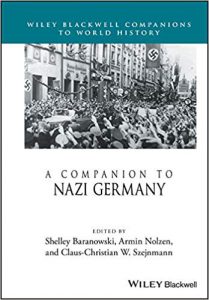
Book Note: Manfred Gailus, “Religion,” in A Companion to Nazi Germany

Contemporary Church History Quarterly

Volume 25, Number 2 (June 2019)

Book Note: Manfred Gailus, “Religion,” in A Companion to Nazi Germany, eds. Shelley Baranowski, Armin Nolzen, and Claus-Christian W. Szejnmann (Hoboken, NJ: Wiley-Blackwell, 2018). ISBN: 9781118936887.

Rebecca Carter-Chand, United States Holocaust Memorial Museum *

Like most overviews of Nazi Germany, this new anthology, published in the Wiley Blackwell Companions to World History series, includes a chapter on “religion.” The hefty 600+ page volume contains 37 chapters on a wide range of thematic topics, providing an accessible snapshot of the latest historiography on Nazi Germany and its legacy. Along with addressing enduring questions about the rise of Nazism and the nature of Nazi rule, the volume includes some intriguing chapters on the spatial turn, the history of emotions, and the study of information policies.

In just 13 pages Manfred Gailus gives an overview of the Christian churches and religious identity and practice in Germany during the 12 years of Nazi rule. Rather than placing the Kirchenkampf and an assessment of the Catholic hierarchy at the centre of this narrative, Gailus paints a picture in which several diverse religious groups quarreled and competed with each and with the state. In addition to the Deutsche Christen, the Confessing Church, and the Catholic Church, he discusses the Free Churches, other small independent religious communities (Adventists, Quakers, Jehovah’s Witnesses, etc.), and völkisch ‘new pagan’ groups (including the German Faith Movement and the Ludendorff movement). These völkisch-religious groups, whose proponents were called “German Believers,” need to be differentiated from the similarly-named “Believers in God” (a new label for those ardent Nazis who had left the church).

Gailus’ summation reveals the consensus among historians on a number of important issues that have long dominated the historiography, such as the complicity of “considerable parts of the Protestant churches” in the persecution of the Jews (337) and the importance of gender and class in understanding the German Christians and the Confessing Church. He affirms the usefulness of the concept of political religion to understand Nazism, but admits the issue will continue to be debated. Finally, he points to a few topics that are still under-researched, namely the independent smaller churches and the changes that took place during the war years.

The references, bibliography, and suggested reading list point to the most relevant scholarship in German and English.

* The views expressed are those of the author and do not necessarily represent those of the United States Holocaust Memorial Museum.

Share

Article Note: Heath Spencer, “The Thuringian Volkskirchenbund, the Nazi Revolution, and Völkisch Conceptions of Christianity”

Contemporary Church History Quarterly

Volume 25, Number 2 (June 2019)

Article Note: Heath Spencer, “The Thuringian Volkskirchenbund, the Nazi Revolution, and Völkisch Conceptions of Christianity,” Church History 87, no. 4 (December 2018): 1091-1118.

By Kyle Jantzen, Ambrose University

Recently, Heath Spencer of Seattle University has been investigating the connections and disconnections between German liberal Protestant thought and Nazi conceptions of Christianity. In this article, he tackles the question of why prominent Thuringian liberal Protestants in the Volkskirchenbund (People’s Church League) supported the pro-Nazi Deutsche Christen (German Christians) in the German church elections of July 1933. He argues that ideological affinity between the Volkskirchenbund and the German Christians was less important than pragmatic and strategic considerations, and that these liberal Protestants only supported German Christians reluctantly, once other options had been exhausted. “Their story,” Spencer writes, “illustrates one of the more complicated paths toward Christian complicity in the Third Reich” (1092).

The episode around which Spencer’s article revolves was the decision of the Volkskirchenbund—a liberal faction in the Thuringian Protestant synod—not to run their own candidates in the July 1933 church election, but rather to recommend to their members that they vote for the list of candidates put forward by the German Christian Movement, the leading pro-Nazi faction. The result was that the Volkskirchenbund disappeared from the synod and became a study group (Arbeitsgemeinschaft), while the German Christians went on to capture 46 of the 51 seats in the synod and proceeded to make Thuringia a bastion of Nazi Protestantism.

Spencer critiques the view offered by Karl Barth and promulgated by members of the theologically conservative Confessing Church that the rise of the German Christian Movement was the product of two centuries of theological modernism. Thuringian Volkskirchenbund leaders, he suggests, “did not rush into the arms of the Deutsche Christen in July 1933; anxiety and resignation were prominent alongside of cautious optimism and occasional expressions of enthusiasm” (1094).

Tracing Thuringian church politics from 1918-1933, Spencer argues that the Thuringian church constitution of 1924 gave rise to diverse church-political factions, including the Volkskirchenbund, which represented the political left, over and against the right-leaning Lutheran Christliche Volksbund (Christian People’s League) and the centrist Einigungsbund (Unification League). The Volkskirchenbund aligned itself with other German liberal Protestants who “called for democratic governance, theological pluralism, and churches that stood above political parties and narrow class interests—all key elements of the liberal Protestant Volkskirche ideal” (1098). Heinrich Weinel (professor of New Testament in Jena) was a key figure in the Volkskirchenbund, working with other liberal Protestant leaders to advocate for modern theology, innovative adult education programs, and interdenominational elementary schools to broaden the reach of liberal Protestantism (and liberal politics) in the region.

After 1924, however, both Thuringian parliamentary politics and church politics became more conservative. In the Protestant synod, the rise of leftist Religious Socialists was matched by the emergence of a new völkisch group, Bund für Deutsche Kirche (League for German Church), which began introducing “church legislation that promoted racial purity, hardline nationalism, and the removal of ‘Jewish elements’ from Christianity” (1105). Because liberals in the Volkskirchenbund promoted theological pluralism, they professed openness towards both these new groups. Indeed, Heinrich Weinel and others became increasingly engaged with the Christian-völkisch movement in Thuringia, combining “gestures of toleration, criticism of ‘excesses,’ and partial affirmation” in their responses, even proving willing to “recognize race and nation as the God-given foundations of all human life and all human love,” as Weinel put it (1106).

By the beginning of the 1930s, as the völkisch movement grew dramatically in both the Thuringian state and church, the Volkskirchenbund (now led by Hans Heyn) remained open to it as an important expression of Christianity among German people, criticizing only those aspects that liberals deemed overly divisive, including some of the anti-Jewish elements of the Bund für Deutsche Kirche.

Ultimately, though, a völkisch wing emerged within the Volkskirchenbund itself, particularly among younger members who were animated by the ways in which German racial nationalism seemed to unite society and church. By the time of the Nazi seizure of power and the 1933 church elections, four new developments pushed the Volkskirchenbund to capitulate to völkisch Protestantism: the rise of the German Christian Movement, which polled strongly in the January 1933 church elections; the frustration of Volkskirchenbund leaders over their failure to attract more younger followers; their fear that theological conservatives would seize control and make Thuringia too sectarian; and their lack of money to run a proper campaign in the July 1933 church elections (1111-1112). In the end, leaders in the Volkskirchenbund decided that the German Christians best represented the church-political goals of the Volkskirchenbund, sent around an official announcement of their support for the pro-Nazi Protestants, and effectively closed up shop on their own movement.

Spencer’s article illuminates the way theological liberals in the Volkskirchenbund—committed to pluralism and unity—brought themselves to support the German Christian Movement. They hoped to ensure that the church did not miss its chance to “to rescue an embattled and divided nation, to remedy the mistakes of the past” and “to meet the needs of the hour” (1118). “Ironically, their dream of a free, democratic, and culturally relevant Volkskirche led them to support—at least momentarily—an authoritarian group determined to impose its militant and racist ideology on the church and its members” (1118).


Share

Article Note: David A.R. Clark, “Psalm 74:8 and November 1938: Rereading Dietrich Bonhoeffer’s Kristallnacht Annotation in its Interpretive Context”

Contemporary Church History Quarterly

Volume 25, Number 2 (June 2019)

Article Note: David A.R. Clark, “Psalm 74:8 and November 1938: Rereading Dietrich Bonhoeffer’s Kristallnacht Annotation in its Interpretive Context,” Scottish Journal of Theology 71, no. 3 (2018): 253–266.

By Kyle Jantzen, Ambrose University

Dietrich Bonhoeffer’s complex relationship to Jews and Judaism continues to preoccupy both historians and theologians. To give just one example, although Bonhoeffer has been lauded for his concern for Jews and calls for ecclesiastical resistance against the state on their behalf in his famous 1933 essay, “The Church and the Jewish Question,” scholars have also criticized other aspects of that same writing, including expressions of theological anti-Judaism and Bonhoeffer’s use of “Jewish Christianity” as a term of derision for a kind of legalism practiced by the pro-Nazi German Christian Movement.

In this article, Ph.D. candidate David A.R. Clark revisits Bonhoeffer’s response to the November 1938 Kristallnacht pogrom. Clark begins by noting that Bonhoeffer had no pulpit from which to respond to the pogrom, nor did he make a public comment. Bonhoeffer did react, though, and the evidence is in the margin of his Bible, where he wrote the date of the pogrom (November 9, 1938) beside Psalm 74:8, underlined the text, “They burn all the houses of God in the land.”[1] Clark notes that Bonhoeffer friend and scholar Eberhard Bethge described this reference to a contemporary event is unique in the marginalia of Bonhoeffer’s Bible. He adds that Bonhoeffer wrote his Finkenwalde students about a week later, explaining that he had been pondering and praying about Psalm 74, Zechariah 2:8, Romans 9:4-5, and Romans 11:11-15 in the previous few days—all passages relating to God’s special relationship to the Jews.

While other scholars have noted the political importance of Bonhoeffer’s Psalm 74 marginalia, Clark aims “to examine this annotation more thoroughly in the context of Bonhoeffer’s then-burgeoning commitment to figural interpretation of the Psalter” (255).[2] By 1935 at least, he argues, Bonhoeffer was open to drawing allegorical or symbolic meanings from biblical texts, not least because of Bonhoeffer’s conviction that the whole of Scripture was a witness to Christ and also on account of his particular interest in the relationship of Christ to the Psalms.

Clark develops Bonhoeffer’s understanding of Christ in the Psalms from two of Bonhoeffer’s writings: Life Together (September/October 1938) and Prayerbook of the Bible: An Introduction to the Psalms (1940). He finds that Bonhoeffer argued that the Psalms essentially expressed the voice of Christ, and that it was most important to understand the Psalms as the prayers of the suffering and dying Christ (259). As Clark puts it, quoting Bonhoeffer, “‘No single human being can pray the psalms of lamentation out of his or her own experience.’ Rather, Bonhoeffer advocates hearing these psalms as the prayers of Christ, who ‘has known torment and pain, guilt and death more deeply than we have’” (260). Importantly, as Clark argues, Bonhoeffer then went further, “claiming additionally that the voice of Christ in psalms of suffering discloses the presence of Christ in human suffering today: ‘psalms of lament’, [Bonhoeffer] states, ‘proclaim Jesus Christ as the only help in suffering, for in Christ God is with us’” (260).

Based on this analysis of Bonhoeffer’s interest in figural interpretation, then, Clark reinterprets Bonhoeffer’s Kristallnacht annotation next to Psalm 74:8 not merely as an expression of sympathy based the similarity of contemporary and ancient cases of the abandonment of Jews, à la Eberhard Bethge, but as something more. Moving from the level of historical to christological interpretation, Clark argues “that our understanding of the Kristallnacht annotation will be enriched by attending more closely to Bonhoeffer’s figural work, which reveals the deeper theological resonance of connecting Kristallnacht with Psalm 74. As David McI. Gracie states in his brief discussion of the annotation: ‘It is important to note at the outset that Bonhoeffer taught that the psalms were to be prayed, prayed with Christ, whose prayers he believed they really were – in this case with the Christ who was being driven out of Germany when the Jews were driven out.’” (262). Clark also draws on the work of Geoffrey B. Kelly to make the point that it was as if historical distance had collapsed and Christ suffered anew in the brutalization of the German Jews.

With this Clark concludes that Bonhoeffer’s Psalm 74 annotation “entails christological presence: Bonhoeffer heard the voice of Christ praying in despair in Psalm 74:8, and – in keeping with the revelatory simultaneity of figural interpretation – he heard this voice not in the distant past of Israelite history but in the contemporary persecution of present-day Jews” (263). He closes by reminding us not to make too much of one marginal notation—it was not a public protest—but adds that it “introduces added complexities” to our understanding of Bonhoeffer’s personal solidarity with Jews (265).

Notes:

[1] Bonhoeffer also placed a vertical line and bold exclamation point alongside the following verse, Psalm 74:9, which reads: “We do not see our signs; there is no longer any prophet, and there is none among us who knows how long.” (ESV), but as Clark notes, the date of the Kristallnacht pogrom is written only beside verse 8, and specifically beside the underlined words, “They burn all the houses of God in the land,” so that we cannot be sure that the marginalia pertaining to verse 9 relate to the events of November 1938.

[2] German-Jewish literary scholar Eric Auerbach defined the term in his work Mimesis (Princeton: Princeton Univ. Press, 1968), 73: “Figural interpretation establishes a connection between two events or persons in such a way that the first signifies not only itself but also the second, while the second involves or fulfills the first.”

Share

Article Note: David A.R. Clark, “Antisemitism, Violence, and Invective against the Old Testament: Reinhold Krause’s Sportpalast Speech, 1933”

Contemporary Church History Quarterly

Volume 25, Number 2 (June 2019)

Article Note: David A.R. Clark, “Antisemitism, Violence, and Invective against the Old Testament: Reinhold Krause’s Sportpalast Speech, 1933,” Canadian-American Theological Review 7 (2018): 124-137.

By Kyle Jantzen, Ambrose University

David A.R. Clark, a PhD candidate at Wycliffe College, Toronto School of Theology, has written a compact overview and theological assessment of Reinhold Krause’s famous Sportpalast speech of November 1933, in which the Berlin leader of the German Christian Faith Movement (Glaubensbewegung Deutsche Christen) “demanded the elimination of Jewish influences from the Protestant church, calling for the deletion of Hebraisms from hymnody, the rejection of the theology of ‘rabbi Paul,’ and the erasure of the Old Testament itself. Ominously, Krause also endorsed excluding Christians of Jewish descent from the churches” (124). Drawing on the speech itself and several English-language historical analyses, Clark highlights what he calls a “conflation of hostilities” in which the “German Christian Movement targeted the Old Testament for exclusion and destruction even as Nazi leadership targeted Jews for exclusion and destruction.” He argues that “the parallels were not incidental; rather, invective against the Old Testament, in the context of Nazi Germany, yielded violent implications” (125).

Clark begins with the background to Krause’s speech, outlining the rise of the pro-Nazi and antisemitic German Christian Movement in 1932 and noting its attempt to fuse Protestant Christianity and Nazi ideology through a racialist ecclesiology in which a German national church would unite Aryan German Protestants (and Catholics) and exclude Christians of Jewish descent. Given its rapid growth through 1933, the German Christians hoped a large rally in the Berlin Sportpalast would launch a massive new propaganda campaign and prove their indispensability to the Nazi regime. On November 13, 1933, some 20,000 supporters of the German Christian Movement filled the arena, which was decorated with swastikas and other Nazi material. They came to hear a series of speakers, headlined by local high school religion teacher and German Christian leader Dr. Reinhold Krause.

Clark describes the speech itself as crude and abusive—an attack against the Old Testament and other fundamentals of Christianity derived from Jewish influences. Analyzing Krause’s “anti-Jewish and anti-Old Testament rhetoric” (127), Clark finds that Krause connected the supposed unity of the German people (Volk) under Adolf Hitler with the idea of a powerful people’s church (Volkskirche) which would mirror the Nazi state and support the remolding of Germans into National Socialists. Clark quotes some of the lowlights of the speech:

Krause denounced “rabbi Paul,” whose “scapegoat- and inferiority-theology” had led to an “un-National Socialist” desire “to cling to a kind of salvation egotism.” Similarly, Krause condemned Jewish traces in hymnody and liturgy, decrying the intrusion of Hebrew words into German worship. “We want to sing songs that are free from any Israelite-isms,” he demanded, adding: “We want to free ourselves from the language of Canaan.” … In what became a notorious section of his speech, Krause demanded “liberation from the Old Testament with its Jewish reward-and-punishment morality, with its stories of cattle-dealers and pimps” (128, 129).

Clark goes on to argue that Krause conflated invective against the Old Testament and hostility towards contemporary Jews. Even Krause he scorned elements of Judaism within German Protestantism, he also lashed out against Jews themselves, advocating the expulsion of Christians of Jewish ancestry from the church. Just as Nazis rejected purchasing goods and services from Jews, he reasoned, so too should Christians reject receiving spiritual goods from Jews—whether biblical content from ancient Jews or spiritual ministry from contemporary Jewish Christians.

As for the effect of the Sportpalast speech, Clark observes that its contents were widely reported in both the German and international press and adds that the speech was published as a pamphlet and distributed by German Christians in Berlin and beyond. But the speech was widely criticized by Protestant clergy, especially for its radical rejection of the Old Testament as Scripture. The ensuing controversy led to a mass of clerical resignations from the German Christian camp and sparked an ecclesiastical opposition movement that grew into the Confessing Church. For the German Christian base, however, Krause’s antisemitic attacks against the Bible, Jewish language, and Jewish Christians became programmatic.

Finally, Clark turns to the violent impact of the Sportpalast speech. Drawing on an incident reported in Doris Bergen’s definitive study Twisted Cross: The German Christian Movement in the Third Reich (Chapel Hill: University of North Carolina Press, 1996), in which a German Christian writer urged the burning of Jewish parts of the Bible as well as “that which threatens our people” (presumably meaning the Jews themselves), Clark notes the connection between antisemitic rhetoric within German Protestantism and the genocidal campaign of the Hitler regime.

Reflecting theologically, Clark observes that Krause’s speech involved “violent rhetoric targeting Jewish Scriptures in the context of violent rhetoric—and murderous action—targeting Jewish people” (134). Asking “how should the implications of anti-Old Testament invective be defined in the genocidal context of Nazi Germany?” (134), Clark affirms that the German Christians helped create the conditions in which genocide could occur, on the basis that they “effectively weaponized specific aspects of the Christian tradition for antisemitic purposes” (135). While Clark acknowledges that the Nazi Holocaust would have unfolded much the way it did with or without these German Christian contributions, he concludes that the German Christians “participated in the broader framework of complicity that made the destruction of Jews a conceivable and convincing option for Christian Europe” (136).

Clark’s essay won the Jack and Phyllis Middleton Memorial Award for Excellence in Bible and Theology, awarded to the best paper by a graduate student or non-tenured professor given at the interdisciplinary theology conference on “Peace and Violence in Scripture and Theology,” spon­sored by the Canadian-American Theological Association (CATA) at Wycliffe College, Toronto, Ontario, October 20, 2018.

Share