Contemporary Church History Quarterly
Volume 27, Number 2 (June 2021)
Review of Manfred Gailus and Clemens Vollnhals, eds., Christlicher Antisemitismus im 20. Jahrhundert: Der Tübinger Theologe und ‚Judenforscher‘ Gerhard Kittel (Göttingen: V & R Unipress, 2020), 276pp. ISBN: 978-3-8471-0996-9.
By Christopher Probst, Washington University in St. Louis, University College
Even those with only a cursory knowledge of the history of the churches in Nazi Germany know the name Gerhard Kittel. The Tübingen New Testament scholar is as well-known for his anti-Judaic and antisemitic rhetoric in Die Judenfrage (The Jewish Question; 1933) as he is for being the editor until 1945 of the influential Theologisches Wörterbuch zum Neuen Testament (Theological Dictionary of the New Testament). Many may not be aware, though, that in 1930 Kittel participated in the conference of a Jewish mission society the goal of which included not only Jewish mission but also Jewish-Christian dialogue (Martin Buber gave a two-hour lecture titled “The Soul of Judaism”); or that in 1942 he gave an expert opinion in the show trial of Herschel Grynszpan, the Polish Jewish teenager who fatally shot Ernst vom Rath in November 1938, an event that was used as the pretext for the Reich pogrom (Kristallnacht) that followed. This volume of essays about the theologian and ‘Judenforscher’ provides nuggets such as these and fills in some gaps in his biography and bibliography.
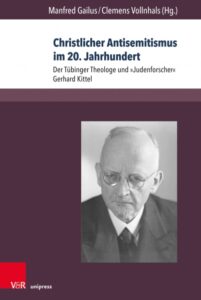 In a wide-ranging introduction, the editors skillfully contextualize the issues surrounding Protestant anti-Judaism and antisemitism during the Third Reich. Gailus and Vollnhals use the national reactions to the commemoration of the 500th anniversary of the German Protestant Reformation as a jumping off point. These 2017 commemorations included – for the first time in a Luther jubilee year – critical analysis of the reformer’s “Judenschriften,” of which the deeply anti-Judaic and antisemitic Von den Juden und ihren Lügen (On the Jews and Their Lies) stands out. Very soon after these commemorations ended, a group of historians, church historians, theologians, and religion scholars met in Dresden to assess Kittel’s biography, work, and legacy (7), which occasioned the present volume. Though Luther and Kittel lived and worked in vastly different historical contexts, their oeuvres stir similar debates about animus toward Jews and Judaism in Protestant theology and their real-world effects (8). Despite some overlap and repetition, the essays that follow address these issues in a comprehensive and satisfying fashion.
In his fascinating essay, “Schweigen und Sprechen über den ‘Fall Kittel’ nach 1945,” (Silence and Talk about the ‘Kittel Case’ after 1945), Robert Ericksen both recapitulates the development, impetus, and major conclusions of his own seminal work on Kittel, which is well-known to our readers, and reflects with noteworthy frankness and humility on his conversations and scholarly dialogue with the late Tübingen church historian Leonore Siegele-Wenschkewitz, who contributed substantial scholarly works about the relationship between Kittel, Protestant theology, National Socialism, and Judaism from the 1970s until her untimely death in 1999. Contrasting his position as an American historian in the 1970s and early 1980s with hers as a church historian in the very same theology faculty to which Kittel had belonged several decades earlier, Ericksen intones, “Now I understand that she was right when she told me that a more critical, more comprehensive account on Kittel would not have been published and would have damaged her career” (38).
Clemens Vollnhals’s chapter, titled “Nationalprotestantische Traditionen und das euphorische Aufbruchserlebnis der Kirchen im Jahr 1933” (National Protestant Traditions and the Euphoric Awakening Experience of the Churches in 1933), sets the euphoric reactions of Protestants to the ascent to power of Hitler and the Nazi regime against the backdrop of longstanding Protestant traditions, especially the “close connection between religious and national feeling, the identification of emperor, empire, and Protestantism” (46) that had infused Protestant circles since the unification of Germany in 1871 and the “traumatization” brought on by the collapse of the German Empire in the wake of the First World War (45-49). The essay provides important context for an understanding of the changes brought about in Protestant circles during this momentous and tumultuous year, changes which had important ramifications for the twelve years of Nazi rule in Germany.
Gerhard Lindemann sketches Kittel’s family origins, education, and early years as a scholar. Gerhard Kittel’s father Rudolf, one of the leading Old Testament scholars of his time, rightfully looms large in this discussion. Lindemann’s conclusions are necessarily calibrated, as Kittel’s attitude toward Jews and Judaism in his early career was deeply ambivalent. On the one hand, he utilized a wide variety of Jewish sources and could often treat them in the 1920s with a certain degree of respect. On the other hand, he could accept racist categories and employ völkisch antisemitism in his analysis of a purportedly tainted “modern Judaism” (82). The essay demonstrates (as does Vollnhals’s) the importance of viewing Kittel and Protestant theology during the Third Reich through a wider chronological lens.
After sketching German Protestantism from the Kaiserreich to the Nazi era, Horst Junginger’s essay covers Kittel’s works on Jews and Judaism during the Third Reich and his lengthy 1946 “defense” of his actions toward both Jews and the Nazi regime. Junginger pulls no punches, describing Kittel’s output from 1933 to 1945 as “Judengegnerschaft in Wort und Tat” (Antisemitism in Word and Deed) (87-96). During this period, Kittel, for example, wrote Die Judenfrage, an occasional work that reached a wide audience and which combined scholarly – if often anti-Judaic – analysis with politicized and antisemitic speech (87-90); used his scholarly reputation to become a leading light of “Judenforschung” – the politically motivated denigration of Jews and Judaism via “scholarly” means (90-92); and gave an expert opinion in the show trial of Herschel Grynszpan, in which, despite the fact that Grynszpan wasn’t especially religious, Kittel portrayed his murder of vom Rath as “the act of a Talmudic Jew controlled by international Jewry” (95).
The Theologische Worterbuch zum Neuen Testament (Theological Dictionary of the New Testament, or TDNT) has been so identified with Gerhard Kittel that the multi-volume work of biblical and theological philology is often referred to by the shorthand “Kittel.” Martin Leutzsch’s critical appraisal of the work labels its anti-Judaism and antisemitism a “Wissenschaftliche Selbstvergötzung des Christentums” (Scholarly self-idolization of Christianity). Helpfully, Leutzsch offers a detailed discussion of eighteenth- and nineteenth-century Protestant re-evaluations of Christianity as a religion eminently superior to Judaism, indeed one that is more “enlightened” in the rational, Enlightenment-era sense of that term (106-110).
Indeed, the relationship between Judaism and Christianity was marked in this era of Protestant theology by a series of newly created oppositional concepts. For example, diaspora Judaism could now be reckoned as “Spätjudentum” (late Judaism) in opposition to “Urchristentum” (early Christianity) (108-109); Judaism as a “national religion (with a national god)” v. Christianity as “universal religion” (112-113). Seen in this broader context, Leutzsch’s conclusion about the content of the TDNT (for which he offers a significant amount of evidence) is unsurprising yet nuanced. “What the reading of TDNT shows throughout is the ideological functionalization of philology and comparison of religions for the thesis of the superiority of Christianity” (118). Because of this pre-determined and “self-idolizing” approach, a fair comparison of Christianity with Judaism (or any other religion) is made impossible in the work.
Oliver Arnhold examines the connection between Kittel’s students and the “Eisenach ‘De-Judaization Institute.’” The ostensibly academic Institute for Research into and Elimination of Jewish Influence in German Church Life was a group that sought a comprehensive de-Judaization of Christianity, as demonstrated by their constant attacks against the canonicity of the Old Testament and their publication of Bibles, hymnals, and catechisms that were stripped of their Jewish elements. Arnhold reveals that a significant number of Kittel’s students (and, e.g., students of Johannes Leipoldt) who worked on TDNT were also members of the Eisenach Institute (e.g., Herbert Preisker, Rudolf Meyer, Carl Schneider, Gerhard Delling, Walter Grundmann, and Georg Bertram).
Arnhold argues that Kittel did not participate in the Eisenach Institute at least in part because he affirmed the Old Testament while Institute members largely rejected it and affirmed the “Aryan” Jesus theory. These were bridges too far, even for Kittel (131). It is also worth noting that Kittel had experienced great success as a “Judenforscher” in Walter Frank’s Nazi-approved Reichsinstitut für Geschichte des neuen Deutschlands (Reich Institute for the History of the New Germany). As the Eisenach Institute was not an officially approved institution of the Nazi State, Kittel might not have craved its imprimatur. Arnhold affirms Dirk Schuster’s interpretation – essentially, that Kittel and Grundmann affirmed a view of “the Jew” that was “allegedly” based in “race research” as well as other problematic positions and practices “in order to remove Christianity from its Jewish context and to make it compatible with the Nazi ideology” (131-132)
Lukas Bormann’s essay examines Kittel’s relationships with scholars outside of Germany and the international reception of his works, from his early career to his death in 1948. Bormann begins with an analysis of the state of the Kittel archives. Given the amount of ink that has been spilled about his life and work, it is perhaps surprising that there are significant gaps in the sources. Bormann notes, “While there are publicly accessible and archival estates for the other named personalities [Rudolf Bultmann and Martin Dibelius], there is no such estate from Kittel …” Further, archival collections at Leipzig, where Kittel taught from 1917 to 1921, and from Kohlhammer Press, which published the original German version of TDNT, were destroyed in the war (135-136).
Because of his support for the Nazi State, Kittel was able to travel more freely than, e.g., Dibelius or Bultmann. Because of these same political commitments, no British universities granted him an honorary doctorate, while they did so for Barth and Bultmann largely, so Bormann, because of British support for the Confessing Church (150). Yet, despite reservations about Kittel’s known anti-Jewish, pro-Nazi views, Bultmann’s support for TDNT lent it international credibility (151). From 1937 to 1939 especially, Kittel reached the highpoint of his international influence. Bormann avers, “He had known how to use the political and ecclesiastical conditions for himself in such a way that he was perceived and addressed at home and abroad, by friend and foe as the most influential and effective New Testament scholar in Germany” (155).
In the final essay of the volume, after summarizing the last three years of Kittel’s life, Manfred Gailus summarizes and analyzes the lengthy document “Meine Verteidigung” (My Defense; 1946), which Gailus regards as Kittel’s attempt at the justification of a “heavily compromised theologian.” Gailus presents the document in a generally nuanced fashion. Resisting the temptation to read the entire document as a cynical ploy, he notes that Kittel of course would try to defend himself – he was in a potentially dire position with “the court of public opinion” at least mixed, if not convinced of his guilt, at least about his antisemitism and collusion with regime-favored figures to advance Nazi anti-Jewish policies (172-174).
Yet, Gailus also notes Kittel’s use of self-serving language, his omissions of material from The Jewish Question that made him look guilty (in My Defense, he cites passages from the lecture version, rather than the subsequently published version, which included, e.g., citations of Hitler from Mein Kampf and Kittel’s personal embrace of an “antisemitic struggle” (175)). Kittel also tried to make his cooperation with anthropologists who really were racial “scientists” – e.g., Walter Frank, Wilhelm Grau, Eugen Fischer, Otmar von Verschuer – seem “harmless” while adopting their terminology in “numerous publications” from the late 1930s through the war (176).
In his conclusion, Gailus widens the net of culpability from Kittel to include the numerous Christians (Protestant and some Catholic) who came to his defense because of his supposedly “legitimate” anti-Judaism while affirming his self-styled “rejection” of “vulgar antisemitism.” Gailus argues that, in a certain sense, it was not only Kittel in the dock in 1948; there also was “the question of legitimacy of a Christian anti-Judaism in the early twentieth century, and its theological, moral, political and legal evaluation after Hitler and the Holocaust” (181). Such a question, so Gailus, “arguably would have overwhelmed any court to decide and … hardly seems judicial in the sense of criminal law” (181).
Though Gailus is right about the broader implications of Christian anti-Judaism in a post-Holocaust world, perhaps he has, with respect to this conclusion anyway, let Kittel – and the churches – off a bit too lightly where the preceding era is concerned. It is not as if Christian anti-Judaism (and antisemitism) had not been confronted (often with dire consequences) by, e.g. Eduard Lamparter, Dietrich Bonhoeffer, the “Büro Grüber,” and Julius von Jan in the decades leading up to and including the Shoah.
The remaining third of the book consists of some tools and sources that will be especially useful for Kittel specialists. These include the text of Kittel’s advisory opinion regarding Herschel Grynszpan, an excerpt from My Defense that deals with “the question of Kittel’s indirect complicity in the persecution of Jews,” (195-202), a thorough biographical outline of Kittel in its political and ecclesiastical context, and a comprehensive bibliography of Kittel’s works.
This excellent collection of essays both presents Kittel through a wide chronological lens and answers some very particular questions about his life and work. Taken together, the work synthesizes existing research and fills historical lacunae about one of the most controversial figures of twentieth-century German Protestantism. Students and scholars who study religion, theology, antisemitism, Jewish-Christian relations, and the Holocaust will find the volume extremely valuable; for Kittel specialists, it will be indispensable.

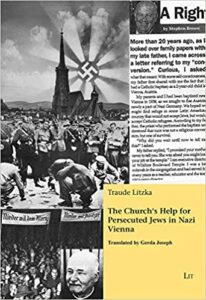 Despite the challenges of locating survivors and documents which would testify to the actions of the brave Catholic men and women engaged in rescue work, Litzka has assembled quite a roster of both individuals as well as orders of religious who decided that, despite the threat of arrest, interrogation, and imprisonment (or worse), their consciences would not allow them to remain inactive in the face of overwhelming discrimination and hardships. One such man who figures prominently throughout the book is the Jesuit priest, Ludger Born (born in Duisburg in 1897). Born was appointed as head of the “Aid Office for Non-Aryan Catholics” by Cardinal Theodor Innitzer in 1940 and for the next five years, Father Born worked assiduously to aid all those who needed help. He inherited his position from another priest, Father Georg Bichlmair, who had established the office and had staffed it primarily with dedicated women. Some of these women’s stories were later documented after the war by Father Born, providing some insight into both their identity and motivations. Out of the twenty-three employees, Father Born’s documentation focused on only five of the female workers. He attributed their dedication to their profound religiosity.
 Readers eager to expand their knowledge of World War II will appreciate details that are rarely addressed in standard histories. Reynolds, who served with the 120th Light Anti-Aircraft Regiment, describes how he experienced the elaborate preparations for the Normandy landings, including three days on board LST (Landing Ships Tank) 319. He also provides a fascinating glimpse into British interactions with locals in northern France and Belgium in the months after the breakout. For example, through a funeral he conducted for a Protestant civilian, Reynolds met and befriended a French woman, Mlle Perremond, who spoke excellent English. He subsequently learned that she and two other French women, one young, the other elderly, had helped seven downed RAF pilots escape to England.
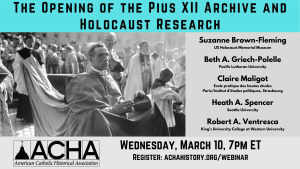 On March 10, 2021, the American Catholic Historical Association held a webinar entitled “The Opening of the Pius XI Archive and Holocaust Research.” Presenters included Suzanne Brown-Fleming, US Holocaust Memorial Museum: Beth A. Griech-Polelle, Pacific Lutheran University; Claire Maligot, Ecole pratique des hautes études, Paris, and Institut d’études politiques, Strasbourg; Heath A. Spencer, Seattle University; and Robert A. Ventresca, King’s University College at Western University.
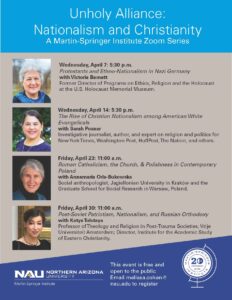 Because of the relevance of this topic—and propelled by the insurrectionist violence we witnessed at the U.S. Capitol on January 6—the Martin-Springer Institute* put together a 4-part Zoom conversation series on Christian nationalism in April 2021. Titled Unholy Alliance: Nationalism and Christianity, the series took a comparative approach by bringing in voices from different national contexts: Victoria Barnett on “Protestants and Ethno-Nationalism in Nazi Germany”; Sarah Posner on “The Rise of Christian Nationalism Among American White Evangelicals”; Annamaria Orla-Bukowska on “Roman Catholicism, the Church, and Polishness in Contemporary Poland”; and Katya Tolstaya on “Post-Soviet Patriotism, Nationalism, and Russian Orthodoxy.”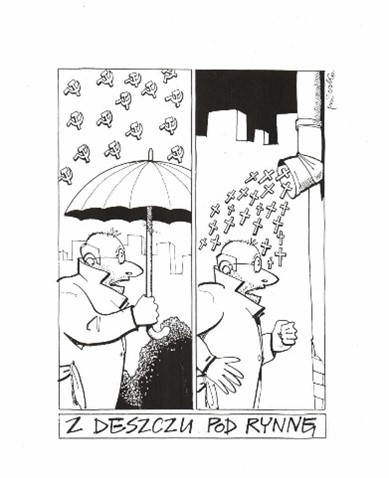
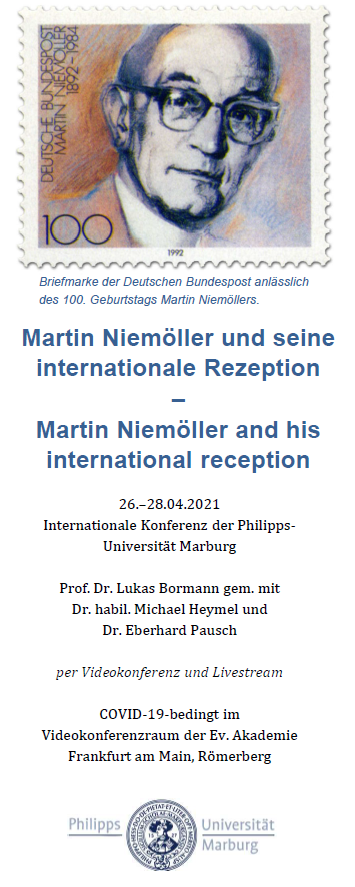 Martin Niemöller (1892-1984) is one of the most internationally known German Protestant church leaders and theologians of the 20th century. For some years he has been back in the discussion through the biographies of Heymel (2017), Hockenos (2018), Ziemann (2019) and Rognon (2020). Historian Benjamin Ziemann takes a particular position. He emphasizes Niemöller’s temporary closeness to German national (völkische) movements and problematizes his attitude toward Judaism and Jewish people, the attribution of his activities from 1933 on as resistance against the Nazi regime, his criticism of the Lutheran regional churches, and his contribution to the ecclesiastical discourse on guilt to 1948.
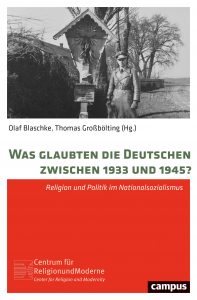 The essays in Blaschke and Großbölting’s volume continue this investigation in a similar vein by widening and deepening it. They ask: Where did the churches and National Socialism interact with each other? In what ways did they stand in each other’s way? How did they compete for members or prominence? And how did they promote each other’s particular concerns? For the editors, an apologetic and mistaken emphasis on resistance – “cross versus sword” narrative – has dominated the interpretative framework of studies on Christianity in Germany under National Socialism. By contrast, however, they view the period fluidly, recognizing that few Germans rejected Nazism entirely. They claim a closer tie between the two than previously articulated in the Gaius and Nolzen collection as well as by others. If one concludes that religion was a significant factor in German society in the 1920s and 30s, they raise the following questions: did National Socialism arise despite Christianity, as many historians have suggested, or did Nazism develop and establish itself precisely because of society’s Christian character? The essays of this volume primarily support the latter by exposing the interplay of National Socialism and Christianity in a variety of historical situations.
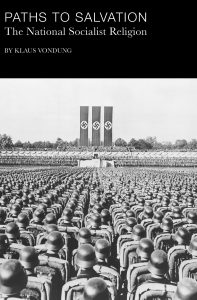 Vondung is clear from the outset that he believes central religious notions such as redemption or salvation have also formed links to very different movements across Germany’s history, from nationalist movements arising out of the Napoleonic Wars through to intellectual movements, and that National Socialism must also be considered ‘a political movement’ with ‘political goals.’ The introduction in itself explores a fascinating and diverse cast of characters, ranging from Fichte to Johst to Mirbt to Gerstenhauer, but argues a kind of coherence around the central theme of a desire for ‘redemption.’ Vondung writes extremely well, and consistently draws on a broad knowledge of German history. His larger historical perspective does sometimes mean that comparisons are drawn from examples that range from the Napoleonic wars to the Nazi state. For readers familiar with the larger history of Germany, this poses no issue, but it does assume an understanding of key historical context. Despite the fact that figures which are quoted come from different periods of time, the central desire for ‘redemption’ is argued to have been born from a ‘complex of motives’ that are summarised as ‘a combination of national frustration, fundamental unease with modernity, and the feeling that life was devoid of meaning.’ While the Introduction does not fully explain the purpose of this book, it does illustrate the overarching approach of many scholars who write in the field of ‘political religion’– that that there is either a perceived inadequacy in religion or an inefficacy of religion to fill the need for meaning in modernity (dominated by ‘rationalism and materialism’) that has led people to seek ‘a new spiritual home.’
 After the war’s end, Father Fabisiak was working as a missionary in Bolivia. There, many people expressed their curiosity about “the Phenomenon,” or, as we call it, the Holocaust. The Polish priest served as a living witness to the events his parishioners had only heard about over radio broadcasts or had read in newspapers. And many of them were skeptical: could such atrocities have truly been committed by human beings? How could something so obscene as the Holocaust have been possible? This reluctance to accept what had happened inspired Fabisiak to write down his experiences—not out of hatred for the enemy, but as a way of showing readers what human beings are capable of doing to one another. Each chapter is very brief, written like a vignette, allowing readers to move easily from one terrifying experience to the next. All of this was written with the intent of documenting the truth of Father Fabisiak’s fate when he was in the hands of the Nazis.
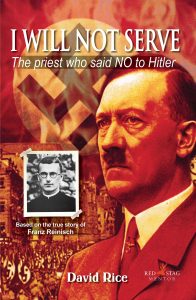 This is not a typical academic monograph. Students or scholars looking for a rigorous critical examination of Reinisch and his environment, with careful documentation of the evidence, will be disappointed. Rice’s judgment of his subject his balanced – he depicts Reinisch as a flawed human whose strength of will was extraordinary but who also clearly had his faults – but his sympathy for Reinisch is tangible. Rice does not provide consistent citations, though occasionally he will clarify a term or refer to a source for a quotation. His “source books”, listed at the end in (seemingly) random rather than alphabetical order, contain relevant scholarship on Reinisch in both English and German, but is not exhaustive on any given subject, indicates no archival research, and includes references whose impact on the text are unclear. For instance, Hans Fallada’s Alone in Berlin, Primo Levi’s If This is a Man, and Heinz Höhne’s The Order of the Death’s Head are all mentioned, but do not appear nor are they alluded to in the main text. What scholars are likely to find most problematic, though, is the style in which Rice chooses to write: in an interview with The Irish Examiner, Rice explains, “I didn’t want it to be a history book. I wanted to write it like a film script, so that you could see things happening. I couldn’t be a fly on the wall, but I tried to get inside the protagonist’s head, and I took on Joyce’s and Proust’s stream of consciousness.”