Contemporary Church History Quarterly
Volume 21, Number 4 (December 2015)
These Church Historians of Our Time: Markus Huttner, Marie-Emmanuelle Reytier, Huamin Toshiko Mackman *
By Andrew Chandler, University of Chichester
In these days of professionalism and of stolid institutions of higher education we seldom think of the work of the scholar as possessing much of the quality of a vocation. If we live and work outside the academic sphere we tend to assume that all is well within it, or at least as well there as it is anywhere else. The difficulties of finding a steady place in a world of university departments might be obvious to those who haunt its corridors, but we do not glamourize them. If the young scholar who cherishes a vision comes and goes we might enjoy them while they are here but we do not worry about them unduly when they have gone. They may not go on to quite the career they would ideally have chosen, or written the books they would have wished to write. But doesn’t that go for us all?
The modern university, like any other institution, exists to give the theme of scholarship structure and form. But the truth is often that for younger scholars academic institutions exist as a kind of intricately structured instability, in which only the powers at the top, the elect, enjoy the confidence of position and all the solidity that comes with it, while at the bottom contracts are brief, and prospects are often bleak. In such an atmosphere of benign interest and effective indifference a great deal of vital new wisdom is lost to us, and because it never has time to ripen and reveal itself we hardly know what we miss. Although they might stand to benefit so much from such labour and such insight, churches rarely view this matter as one to concern them and while money is carefully set aside for the payment of the clergy it would hardly be considered appropriate to spend it on the ambitions of a young medievalist or a historian of religious faith in the modern age. Scholars of religious history often find that they are stranded between a university world which often proceeds on the assumption that religion does not matter very much, if at all, and churches which continue to feel that the enterprise of research and critical thought is really no responsibility of theirs.
The situation, of course, varies from one country to the next. In the world of the German university it is not only the structures that look distinctive but the degrees themselves. Not yet have they shed the lengthy progress from a first doctorate to a second Habilitationsschrift. Professors do possess power and patronage matters. It is dispensed in the context of collective research projects often funded by foundations outside the university itself. This has much in common with the working of science departments in British and North American universities, though money for the Arts and Humanities is thinner and the opportunities dimmer. In North America an aspiring academic must confront all the liabilities of the ‘tenure track’ and hope that security for the longer term will come, in its time. In such a context do many young historians spend much of their energy scrambling as best they can from one position or project to another, and in Europe it is the research project, not the institution itself, which often defines the narrative. All of this makes it exceedingly difficult to enjoy much freedom in what one writes, or indeed to build a career which possesses any clear sense of direction or cumulative character. A historian of one subject will need to become the historian of another, if that is where the money is to be had. A little like the ship-builders of the industrial age whose security lasted only so long as the present ship was emerging on the slipways of a dock, they must hope that there will come another ship-building contract when the present work is done.
The German historian Markus Huttner will have known such a landscape, its opportunities and frustrations, well enough. Born in Weilheim/Oberbayern in 1961 he graduated from Friedrich-Wilhelms-Universität in Bonn in 1990. He was already conspicuous as a student and he had taken a year abroad to study at Oxford, where he was a visiting student at Christ Church. In such places a commitment to the history of National Socialism, and its convergence with Christianity in particular, had yielded a deepening awareness of the significance of these themes in the context of wider European opinion. This would define his first doctorate and his first book. In 1995 Markus Huttner published Britische Presse und nationalsozialistische Kirchenkampf and gave to scholarship an intricate survey of the British newspapers and their interpretation of what went on in the Catholic churches of Germany in the years of the Church Struggle – one of those immense monographs which have been possible for German researchers but unthinkable almost everywhere else, and which have become the speciality of the Verlag Ferdinand Schöningh. The book shows conviction not only in the choice of subject but the disavowing of some of the theoretical and methodological approaches, by then conventional in much of German scholarship, which might well have defined it. The book established a firm claim both for its subject and its author.
Although he was soon immersed in the necessities of publishing a plethora of articles for academic journals, Markus Huttner already had his sights set on a second book, and one that might reach a wider public. In 1999 he published an innovative discussion of the great matter of religion and totalitarianism as it was argued out by Christians in both Germany and Britain during the National Socialist era. This was Totalitarismus und Säkulare Religionen. Blending theoretical and biographical approaches, Markus Huttner here developed the strengths of his earlier work and drew together a striking pantheon of critics and observers, churchmen like J.H. Oldham and George Bell, intellectuals like George Orwell and Christopher Dawson, international critics like Waldemar Gurian and influential journalists like the editor Wickham Steed, the German correspondent of the Manchester Guardian, Frank Voigt and the Times correspondent, Norman Ebbutt. At the time when the book appeared a growing number of historians were beginning to write again of totalitarianism (a word which had itself passed in and out of fashion) as a ‘political religion’, and in many ways this became the premise of the book.
In the German universities the place of this work was recognised. Established historians like Thomas Brockmann, Christian Kampmann, Antje Oschmann and Franz Bosbach had come to value the achievements and the promise of this new voice. Maintaining a fruitful relationship with Oxford and the British universities, Huttner’s work was equally known to Jonathan Wright, at Christ Church itself, and, at Leicester, by Richard Bonney, who met him at a conference in 2001 and found him eager to help his own work. But it was now a question of settling to work on a Habilitationsschrift. Working under Ulrich von Hehl at the University of Leipzig, Markus Huttner began to explore the history of the German universities across the nineteenth and twentieth centuries, new work which united the intellectual and the corporate and emphasized with a new profundity the development of professionalization and the organization of disciplines. The work prospered and much of value was accomplished. But now, suddenly, time was running out. It was in Leipzig in the spring of 2005 that Markus Huttner learnt that he was seriously ill. He was killed by a brain tumour, dying in hospital on 31 May 2006.
I never met him, but with characteristic generosity he once sent me his two books and I replied, saying that I was embarrassed that I had nothing of comparable worth with which to reciprocate. After his death, in 2007 a fine anthology of Markus Huttner’s shorter writings, Gesammelte Schriften zur Zeit- und Universitätsgeschichte, was edited by Thomas Brockmann, Christof Kampmann and Antje Oschmann. The collection does well to show the character and quality, and the range, that he had by then achieved and the promise that had become its own fulfilment. Today his contribution is barely known outside his own country. One is left to acknowledge the barrier of language and the difficulties of making scholarship truly an international adventure in which the riches that may be known in one place are equally known to another.
The academic world which Markus Huttner knew bore much in common with that of Marie-Emmanuelle Reytier. Born a decade later, in 1971, she grew up in Lyon and studied History at the Jean Moulin University there, graduating in 1993. Her next step was to the University of Heidelberg where she was increasingly drawn to the history of modern Catholicism in Germany, particularly between 1848 and 1933. Like Markus Huttner, she soon looked to study abroad and an opportunity to study German Catholicism in the Kaisserreich in Oxford in 1996 proved a striking influence, as did a short visit to Vancouver for a conference of German Studies organized by John Conway. The first time that I encountered her was in a conference of the Kirchliche Zeitgeschichte journal at Strasbourg. Very much in the background and barely making her presence felt, she maintained nonetheless a palpable intensity of interest in everything and everybody there. Her work had by now garnered plaudits and accolades, but not yet a solid foundation or way ahead. It is hard not to sense that the happiness of these stipendium and conferences, and the praise that she won there, must have given her a still more vivid sense of what she wanted but could not quite secure for herself. Lyon remained her home and it was there that she completed her doctorate on the Katholikentage in the Weimar Republic.
By now Marie-Emmanuelle Reytier had come to her view herself as a historian of religion, politics and society and a scholar of comparative histories. There was a profusion of articles in journals and collections of conference proceedings of various kinds. She was as much at home with the history of German Catholicism as she was with that of French Catholicism, but she was far more interested in the realm of lay activism than the manoeuvres of ecclesiastical powers. Her work showed that she had already become an accomplished surveyor of long chronologies and broad landscapes, but she was, if anything, more drawn to intricacies of personal and collective experience. A succession of short biographical studies was published bringing a succession of neglected figures, many of them women, into the foreground of historical appreciation. But Marie-Emmanuelle Reytier already perceived that her fortunes must be, at best, precarious in the national and secular worlds which defined the outlook of the French universities. In the European faculties of that time funding could be secured for what had come to be called ‘trans-national’ and ‘trans-cultural’ research and this offered some prospect of work on projects of various kinds. Looking to secure a post-doctoral position she turned towards the history of the international women’s movement. At a workshop in Hamburg in 2005 she met the historian, Angelika Schaser. It was an important connection. Together they were able to pursue an innovative seam of research into religious conversions in the border areas of France and Germany across the nineteenth century. But the search for a university position began to look increasingly desperate and it proved impossible to develop what had been begun. There was a brief stipendium at the University of Vechta in 2006 and then at the University of Mainz in the following year. At a meeting organized by the George Bell Institute in London she said very little in formal sessions but was rich in conversation, and here she found in the Polish historian, Dorota Schreiber-Kurpiers a new and vital friendship. This yielded another brief opportunity, this time a short lectureship, from 2007-9, at the University of Opole. Together Marie-Emmanuelle Reytier and Dorota Schreiber-Kurpiers now planned an innovative project exploring the relationship between military authorities and prostitution during the First World War, a matter never before touched by scholarship in that country. I remember well the quality of near-trepidation with which they outlined this to me, and how firmly they insisted that it was surely time that such a subject must be examined (though I should add that, for my part, I needed no convincing). For Marie-Emmanuelle Reytier the position at Opole was precious, but it also brought an immense burden of teaching. There was another flurry of applications – I remember writing many references for her, often more in hope than expectation – but to no avail. When Angelika Schaser met her again in 2009 she found her almost exhausted and dispirited, but still putting a brave face on it all. The University of Hamburg remained something of an academic home for her work.
I think I have never known a scholar who was so ardent in seeking to write and publish what she had discovered in her work; always she appeared to be hunting for a home for something just finished. No other avenue opened before her. She soon became convinced that there was no future for her, and for the research in which she had come to believe, in Europe. She had some contacts in North America and believed there might be something to favour her there. Her command of English was excellent. A modest breakthrough occurred: Marie-Emmanuelle Reytier moved to Quebec and to a position at Laval University. Now she wrote a short study of the French journalist, Louise Weiss (in French, and as yet unpublished) and another, of the German politician Helene Weber (the fruit of scholarship from the Hiledegardis Association in Bonn). An article, presenting something of her earlier research on conversions in French Catholicism, was completed for the journal Kirchliche Zeitgeschichte (but not published). It was in Hamburg, shortly before Christmas in 2011, that Marie-Emmanuelle Reytier, discovered that she had developed an inoperable brain tumour. The following January treatment began in Canada, but little could be done. Friends rallied as best they could and they found her resilient, even optimistic. Far from Lyon and from the many cities which she had known so briefly, she died in hospital on 4 October 2012.
Huamin Toshiko Mackman grew up in a quite different world from that known to Markus Huttner and Marie-Emmanuelle Reytier. She was born in 1961 in Japan, to a Chinese father and a Japanese mother. Already as a child she was familiar with international travel; because her father worked for an American airline company she frequently flew alone to the United States and to Taiwan, journeys which made her family wonder if she possessed a distinctively independent and adventurous character. At elementary school she discovered the English language, often studying it late into the night and, it was feared, harming her eyesight. Much of these young years was devoted to caring for an ill mother: there was no money for university fees, but Huamin won a scholarship and duly repaid what she owed with the first job that she secured upon graduation. For a time she was employed as an interpreter by a Chinese trading company, often flying to China on business, much to the satisfaction of her father. Her parents died within weeks of each other when she was 27.
It was soon after leaving the trading company that she began to work with foreign students in Japan. She also visited Korea and began to study its language. It was striking that in the midst of such a life she should encounter the Society of Friends and herself become a Quaker. During the early 1990s she worked for the Waseda Hoshin Christian Centre in Tokyo, developing a particular commitment to Japanese-Korean relations. It was in this context that she travelled to Britain in 1996, first to study for a brief period at the Selly Oak Colleges in Birmingham, then to return there, this time to live. These early Birmingham years found her researching for a doctorate and organizing a Centre for the Study of North East Asian Missiology with Werner Ustorf. Together they edited a collective volume, Identity and Marginality: Rethinking Christianity in North East Asia (Peter Lang, 2000). She married, settled and made the city her home.
In its heyday a renowned bastion of Christian internationalism, missionary training and education, Selly Oak was in many ways an ideal place for Huamin Toshiko Mackman to flourish. But that era had now all but passed. The financial basis of the establishment was fragile and was judged by its governors to have served its purpose in the world. Negotiations were soon rumbling in the background. When Selly Oak was effectively acquired by the University of Birmingham, salaried academic staff were adopted and given a new home in the Department of Theology while a still-peripheral figure like Huamin was stranded. Whatever the rights and wrongs of it, the end of the age of Selly Oak deprived her of an important context for her work, and one to which she could have made a sustained contribution.
At this time Huamin encountered the Birmingham Quaker and Director of the Barrow Cadbury Trust, Eric Adams. The Trust had only a few years before committed generous funds to the development of a new body, the George Bell Institute, which was run from an office at the Queen’s Foundation nearby. A modest power with modest funds, the institute promptly made her a Fellow, undertook to support her research costs and made a study available to her so that she could work, translate and write as she saw fit. Here, for two years, much was achieved. Huamin published two valuable articles in the journal of the institute, Humanitas, one a discussion of Japanese Christianity and missionary controversies in the 1930s and the other on the political dilemmas of the eminent Japanese evangelist, Toyohiko Kagawa. The library at Selly Oak housed archival treasures documenting vividly the activities of international corresponding members of the World Student Christian Federation across the first half of the twentieth century. These had barely seen the light of day for decades. This was the kind of work which would have suited Huamin almost perfectly and we often discussed what we would like to do. In these conversations the name of Marie-Emmanuelle Reytier often came up. Applications for some modest finance which might make possible some new research there simply ran into the ground. Shortly afterwards the Birmingham office of the Institute had to close altogether.
Very possibly Huamin Toshiko Mackman did not view herself primarily as a scholar, though her research was meticulous, her command of languages capable and her sense of a subject was acute, creative and persuasive. But her research spoke of a profound moral engagement with contemporary issues, many of which called upon persevering, practical qualities. She was deeply involved in various works of international reconciliation and later accomplished much for the Japanese community across the Midlands. Local hospitals called upon her when they needed assistance with Japanese or Chinese patients who spoke little English. She also committed a great deal of time to contemporary issues of justice. In particular, she monitored refugee issues as they arose in Japan itself, seeking to support those who campaigned for a more liberal policy there. At heart, she was a vigorous and assiduous Christian internationalist whose work constituted a consistent challenge to those old enemies, nationalism, militarism, imperialism and indifference in their many forms. In company she was immensely kind and wonderfully thoughtful. The impression that she made on people of very different backgrounds was striking. A quiet presence in any conclave, her conversation was given wholly to things that mattered. Huamin Toshiko Mackman learnt that she had lymphatic cancer soon after the final colloquium of the George Bell Institute, in Poland in 2012. For a time there were hopes that the disease could be controlled, but it was too strong. She died in a Birmingham hospice on 17 August 2014. She left behind her husband, Steve, and a young, adopted daughter, Rose, brought to Birmingham from a Chinese orphanage only a few years before.
These three brief lives will leave few traces. Many of those who have grown familiar with the conferences and seminars of university life hardly noticed when they were among us and barely knew that they had gone. What then of the institutions of the Christian faith, as we know them in their more solid ecclesiastical forms, their national and local hierarchies and synods, their ongoing pronouncements and resolutions? Here there will be almost no acknowledgement at all, no sense of what has been lost, no sense even of what might have been learnt. Yet all three of them were still, in their own way, Doctors of the Church
* My particular thanks to Franz Bosbach, Angelika Schaser and Eric Adams.

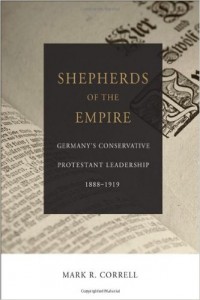 Correll begins with the court preacher Adolf Stoecker (1835-1909), who created the church networks and organizations that provided believing theologians and church leaders with a community of likeminded churchmen in which they could expound their modern conservative responses to the crisis of Protestantism at the turn of the century. Although Adolf Stoecker is best known for popularizing political anti-Semitism, his conservative political vision of a triumphant Germany, united in thrown and altar, and fending off Germany’s multiple enemies —Austria, France, Catholics, Socialists, Liberals, as well as Jews—appealed to more than just anti-Semites. While he saw the defeat of Austria in 1866 and France in 1870 as the beginning of a great awakening in Germany, he became increasingly disappointed that the Prusso-German leaders failed to rally the growing working-class to participate in this national and Protestant awakening. In addition to founding the Christian Social Workers’ Party to harness the poor for his conservative Christian cause, another central concern of his was to combat the threat of liberal or critical theology in the church, which was gaining ground at the time. To this end he founded the “Positive Union,” an organization bringing together believing church leaders, theologians, and pastors, with the purpose of maintaining control of the key leadership positions within the church and thereby limiting the destructive influences of liberal theology on the pastorate. While the Positive Union was mostly a success, his conservative and anti-Semitic political party never gained any traction among workers. Nor did his idea to do away with the state church and found an ultra-nationalist—albeit independent of the state—Volkskirche, which would work side-by-side with the state to further the cause of a conservative Christian Germany.
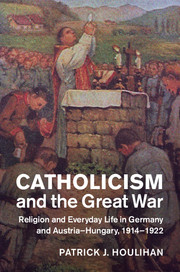 Houlihan’s argument is that conventional interpretations of religion in the First World War, which emphasize the secularizing effect of a shattering war experience as expressed in the voices of cultural modernists, do not capture the experiences of German and Austro-Hungarian Catholics. Rather, he asserts that Catholics adjusted to industrial warfare because their transnational faith and its practices helped them to cope relatively successfully with the upheaval and brutality of war—more successfully than Protestants, whose faith (in the case of Germany) was more closely tied to the defeated state.
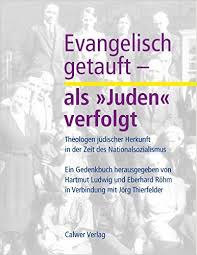 Evangelisch getauft—als “Juden” verfolgt is not a comprehensive history of this topic; nonetheless it is a valuable contribution to the literature. As its subtitle indicates, it is primarily a Gedenkbuch with brief biographies of 180 German Protestants whose lives were changed by the racial laws and the responses of their church. The editors have cast a wide net. The individuals profiled here include not only theologians and members of the Christian clergy, but individuals who were barred from studying theology before 1945 and others who, barred from other professions, decided to study theology in exile. Also included are teachers of religious education, Christians in “mixed” marriages, Austrians who came under Nazi law after 1938, and even several individuals who were Deutsche Christen or members of the Nazi party. While most of those profiled were members of the German Evangelical Church, there are also several profiles of individuals from Methodist, Baptist, and other free churches.
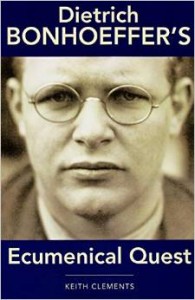 In fact, Bonhoeffer’s participation in ecumenical affairs started immediately after his return in September 1931 from his visit to the United States. He was sent as a German youth delegate to a meeting in Cambridge of the World Alliance for Promoting International Friendship through the Churches. This body had originally been established in 1914, but had to suspend its activities during the war, and had only been resuscitated in 1920. Its support came from influential lay and clerical leaders, particularly in the democratic countries of Western Europe and North America. They recognized the need for programs of reconciliation and peace activities in order to bind up the wounds caused by the destructive violence of the recent war. It was here that Bonhoeffer met with such leading figures as the Anglican Bishop George Bell of Chichester, with whom he was to collaborate for the next decade.In fact, Bonhoeffer made such an impact that he was forthwith appointed as an Honorary Youth Secretary and given responsibility for the World Alliance’s youth work in central Europe. This was a challenge he could hardly refuse, and one to which he brought his newly-minted skills in theological advocacy and his energetic support of the World Alliance’s aims.
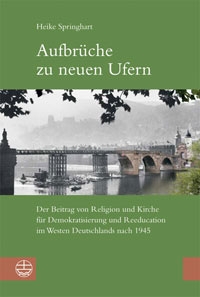 Heike Springhart’s Aufbrücke zu neuen Ufern is a detailed history and analysis of one such program, the partnership between the U.S. military government and German Protestant church leaders and organizations in Württemberg. Her focus is the work there of the U.S. Branch for Education and Religious Affairs (ERA) between 1946-1948, which she sets in a broader historical context by examining the individuals and organizations, both in the U.S. and in Germany, who during the war helped lay the theoretical and political foundation for the ERA’s work. There is also a concluding chapter that offers a conceptual framework for understanding the potential role of religion in post-conflict processes of democratization and social transformation, drawing on the German example as a case study.
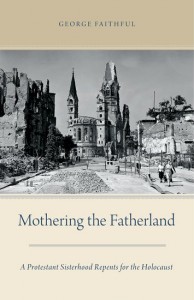 Mothering the Fatherland is a focused and sympathetic study of the life and work of a unique group of women who were so haunted by the Holocaust that, in the wake of the Second World War, they formed a Protestant sisterhood focused on intercessory repentance by the “true” Christians of Germany for the sins committed by the nation during the Third Reich. It is an absorbing work of historical theology that is especially significant for the effective manner in which the author situates the theology and practice of the sisterhood in their historical and intellectual contexts and for the author’s thoughtful analysis of the theology of the sisterhood’s co-founder.