Contemporary Church History Quarterly
Volume 32, Number 2 (Summer 2026)
Letter from the Editors (Summer 2026)
By Lauren Faulkner Rossi, Simon Fraser University
Dear Friends,
Summer greetings from a muggy, smoke-filled Vancouver. It has been a season of excitement and distraction for those of us whose eyes were drawn to the World Cup and its spectacle, but also a season of devastation, with wildfires once again dominating the news cycle for so many and upending lives and livelihoods across North America and Europe. I hope this missive reaches you safe and enjoying some respite from the intense heat that has settled over much of these continents.
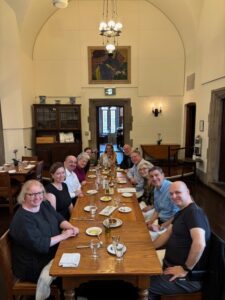
CCHQ Editors enjoying lunch with Doris Bergen and Victoria Barnett during our May board meeting. Photo courtesy Victoria Barnett.
Our summer issue comes somewhat on the slender side, but the size belies its intellectual heft. Included therein are three reviews. Maria Mitchell reviews Simon Unger’s most recent edited volume, Katholizismus am Eisernen Vorhang: Der Vatikan, Westdeutschland und der Kalte Krieg, 1945-1965 (Catholicism at the Iron Curtain: The Vatican, West Germany, and the Cold War, 1945-1965), with the many contributions of active scholars in the field exploring Vatican foreign policy and Cold War politics, with several making use of the recently-opened archives about the wartime pontificate of Pius XII. Martin Menke offers a serious critical analysis of “Wir leben in einer Zeitenwende. . .“ Michael Kardinal von Faulhaber und die katholische Kirche zwischen Monarchie, Diktatur und Demokratie, (“We Live in a Time of Change”: Michael Cardinal von Faukhaber and the Catholic Church between Monarchy, Dictatorship, and Democracy), a volume of work produced by a German conference dedicated to digitizing the Nachlass of Cardinal Archbishop Michael von Faulhaber. Continue reading

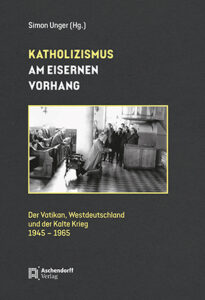 If Pope Pius XII looms large over any consideration of twentieth-century relations between the Vatican and Germany, Unger’s consideration of the Vatican’s role in Europe’s reconstruction, the early Cold War, and decolonization argues for a broader, if paradoxical, view of Pius XII beyond “World War Pope.” On one hand, the Vatican remained silent about the Holocaust and forged close relations with dictators such as Franciso Franco. On the other hand, Pius XII was “the first pope to speak positively about democracy, encourage the Church’s globalization, and promote processes of decolonization” (7). Apostolic Nuncio to Bavaria (1917-1920) and Germany (1920-30) before negotiating and signing, as Cardinal Secretary of State, the Reichskonkordat in 1933, Pius XII’s embrace of the Federal Republic and, in particular, West German Chancellor Konrad Adenauer’s government would inspire his nickname Papa Tedesco, the German Pope.
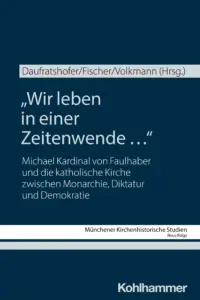 The editors argue that Faulhaber’s development reflects the intellectual and practical development of conservative German Catholics in the first half of the twentieth century. At his core, Faulhaber never lost his conservative and hierarchical preference for monarchism, but adjusted pragmatically to serve the needs of the church and its faithful. In particular, the editors claim, Faulhaber’s development reflects the changing relationship between religion and politics, and between Catholicism and political ideologies, particularly National Socialism. Finally, studying Faulhaber illuminates the “theological and denominational history of the times as well as its structures and networks” (11).
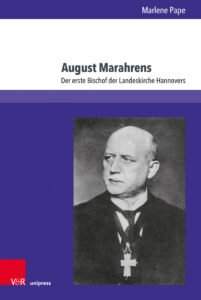 This church history dissertation, now available and supervised by Thomas Kaufmann in Göttingen, is a 500-page book that provides sufficient clarity. Marahrens, whose tenure as bishop largely coincided with the Hitler era, was an avowed Lutheran and, at the same time, a staunch National Socialist who revered and admired Hitler. He could be called a doubly-professed National Socialist Christian. Many contemporaries today believe that such a mental balancing act simply does not add up. The Hanoverian church leader Marahrens and many other renowned Protestant theologians of the Third Reich show that such dual faith was indeed possible and can even be considered a specific characteristic of the Nazi era.