Contemporary Church History Quarterly
Volume 32, Number 2 (Summer 2026)
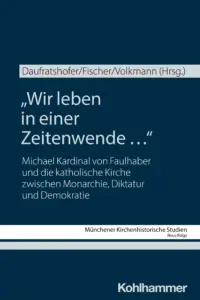
Review of Matthias Daufratshofer, Moritz Fischer, Peer Oliver Volkmann, eds. “Wir leben in einer Zeitenwende. . .“ Michael Kardinal von Faulhaber und die katholische Kirche zwischen Monarchie, Diktatur und Demokratie. Stuttgart: Kohlhammer, 2025. ISBN 978-17-045993-9.
By Martin Menke, Rivier University
This volume is the result of a conference related to the project, funded and supported by various private and church organizations, to digitize Cardinal Michael Faulhaber’s diaries and other texts, all of which are now available. In the introduction, the editors note that in the already-controversial history of the Catholic Church in interwar Germany, the assessment of Faulhaber’s life remains particularly controversial. The volume is intended to ground this debate on a more evidence-based footing. Not only is digitalization a great aid to scholars, but those preparing Faulhaber’s Nachlass also mastered the obsolete Gabelsberger shorthand that the cardinal used to record his thoughts and activities.
 The editors argue that Faulhaber’s development reflects the intellectual and practical development of conservative German Catholics in the first half of the twentieth century. At his core, Faulhaber never lost his conservative and hierarchical preference for monarchism, but adjusted pragmatically to serve the needs of the church and its faithful. In particular, the editors claim, Faulhaber’s development reflects the changing relationship between religion and politics, and between Catholicism and political ideologies, particularly National Socialism. Finally, studying Faulhaber illuminates the “theological and denominational history of the times as well as its structures and networks” (11).
