Contemporary Church History Quarterly
Volume 32, Number 2 (Summer 2026)
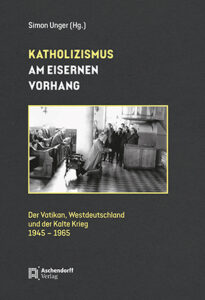
Review of Simon Unger, ed., Katholizismus am Eisernen Vorhang: Der Vatikan, Westdeutschland und der Kalte Krieg, 1945-1965. (Münster: Aschendorff Verlag, 2026). pp. 237.
By Maria D. Mitchell, Franklin & Marshall College
Edited by Simon Unger, Assistant Professor of Modern European Christianity at Princeton Theological Seminary and Principal Investigator of the research group The Global Pontificate of Pius XII at the German Historical Institute in Rome, this volume significantly enriches our understanding of the Vatican’s role in the Cold War. While the authors offer fresh information and insights – more than half the chapters showcase documents released in 2022 by the Vatican Apostolic Archive (Archivio Apostolico Vaticano, AAV) on Pius XII (1939-1958) – the book’s larger framing of conflict between conservatives and reformers paints “a differentiated picture of Catholic Church history in the postwar era” (22). With West Germany as its focus, the collection not only complements existing studies on Vatican foreign relations, but its revelations and analyses shed important light on Cold War politics.
 If Pope Pius XII looms large over any consideration of twentieth-century relations between the Vatican and Germany, Unger’s consideration of the Vatican’s role in Europe’s reconstruction, the early Cold War, and decolonization argues for a broader, if paradoxical, view of Pius XII beyond “World War Pope.” On one hand, the Vatican remained silent about the Holocaust and forged close relations with dictators such as Franciso Franco. On the other hand, Pius XII was “the first pope to speak positively about democracy, encourage the Church’s globalization, and promote processes of decolonization” (7). Apostolic Nuncio to Bavaria (1917-1920) and Germany (1920-30) before negotiating and signing, as Cardinal Secretary of State, the Reichskonkordat in 1933, Pius XII’s embrace of the Federal Republic and, in particular, West German Chancellor Konrad Adenauer’s government would inspire his nickname Papa Tedesco, the German Pope.
