Category Archives: Reviews

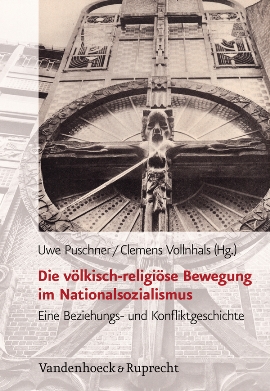
Review of Uwe Puschner and Clemens Vollnhals, eds., Die völkisch-religiöse Bewegung im Nationalsozialismus. Ein Beziehungs- und Konfliktgeschichte

ACCH Quarterly Vol. 18, No. 3, September 2012

Review of Uwe Puschner and Clemens Vollnhals, eds., Die völkisch-religiöse Bewegung im Nationalsozialismus. Ein Beziehungs- und Konfliktgeschichte. Studien des Hannah Arendt Instituts für Totalitarismusforschung, 47 (Göttingen: Vandenhoeck & Ruprecht, 2012), 592 Pp. ISBN 978-3-525-36956-8.

By John S. Conway, University of British Columbia

This collection of essays, skilfully edited by two experienced historians of Germany’s early twentieth century, plunges us at once into the turgid controversies as to whether National Socialism was a “political religion” or a “surrogate or substitute faith”, and invites us to examine the role played by a whole bunch of so-called ethno-religious associations, in order to investigate the extent to which they may have contributed to or detracted from the Nazis’ successful exercise of power from 1933 onwards.

This massive volume is divided into three sections: the völkisch-pagan movements, völkisch Christianity, and the relationship between National Socialism and these völkisch factions. All are thoroughly dissected by the contributors, not one of whom, however, would appear to have any sympathy with the people about whom he or she is writing. Many of the contributors recapitulate what they have already written at greater length, or summarize the numerous studies of earlier years. The objective of the editors would therefore seem to be not to break new ground with fresh insights but to remind us of the marginal influence of such völkisch-religious adherents and the situations of conflict into which they were drawn.

The contributors certainly do well in reminding us of the enormous variety and the frenetic activity of these groups. More particularly, they successfully evoke the kind of climate in which any number of cranks, crackpots, charlatans or opportunists appeared to flourish in the 1920s and 1930s. As Klaus Vondung points out, these groups saw themselves as the heralds of the future. They sought to elevate the cause of Germany, its race and its blood to be a focus of loyalty for the whole nation. The Nazi Party very successfully mobilized such sentiments through its efficient rallies and parades. One common thread was the idea of national rebirth or redemption, which most of these groups fostered, and which easily enough led to support of Nazism and its charismatic leader. But as several contributors rightly point out, the pervasive characteristics of these movements were all negative—anti-liberalism, anti-Semitism, anti-democratic hatreds, fanatical nationalist beliefs in the worship of Germany or the Germanic God or ethno-centrism of the worst order. Typical of those in this category was Professor Ernst Bergmann, who already in 1923 was sending urgent messages to Hitler not to water down his anti-Semitic crusade. “What is needed is the complete extermination of Jewry in Germany by fire and sword. If you, my honoured Führer, make even the slightest concession on this matter, you will have lost my allegiance.”

Manfred Gailus leads off the section on völkisch Christianity. Its principal adherents were the so-called “German Christians” whose excessive distortions of the Gospel were so ably outlined for us by Doris Bergen nearly twenty years ago. Gailus’ analysis reinforces the view that these men’s motivation was opportunistic and superficial. Many of them preached nothing more than thinly-disguised apologias for their political ambitions, clothed in the garments of Christian righteousness, or faithfulness to the German spirit. Their arsenal of nationalist heresies was all too obviously drawn from Nazi sources. Their disdain for theology or abstract theorizing was matched with fervent expressions of loyalty to the Führer with Nazi flags swirling in or above their churches. But, as Gailus notes, they never achieved the support from the Nazi hierarchy they so enthusiastically longed for, and their internal squabbles soon led to their irrelevance and eventual disappearance.

Susannah Heschel does a suitable demolition job on the notorious Institute established in Eisenach to research and remove the Jewish influence from German church life, about which she has written before, and which she places in the context of racism and Christianity. So too, Lucia Scherzberg is suitably critical of those deluded Catholics, including some prominent priests and professors, who, like their Protestant counterparts, sought to amalgamate their Catholic faith with their pro-Nazi loyalty to the Third Reich, including its virulent anti-Semitism. Their totally nebulous ideas about uniting all Germans in a German national church soon enough ran into destructive criticisms and accusations of fostering a syncretistic cult. But, in fact, these Catholic spokesmen were never disciplined—even after 1945.

Martin Leutzsch provides an interesting pathological diagnosis of the career of the Aryan Jesus between 1918 and 1945. Hitler himself in 1922 called Jesus “our great Aryan leader.” Other Nazis, such as Rosenberg and Goebbels, were quick to take up this idea. Jesus as a Nordic hero was already being voiced in the nineteenth century, but the cult gained impetus through the rapid spread of anti-Semitism in and after the first world war. Its proponents had however to contend with their counterparts in other völkisch movements who wanted to eradicate the idea of Christianity altogether and substitute a purely Germanic deity. But they had the support of no less a figure than Hanns Kerrl, from 1935 Minister of Church Affairs, in whose opinion: “ it is intolerable that German children should be taught that Jesus was a Jew. . . This is an attempt to make the Party ridiculous. True Christianity is represented in the Party and the German people are being called to this true Christianity by the Party and especially by the Führer.” In the end, the issue was too contentious, so orders were given that further discussions were to be suppressed.

Similar prohibitions on almost all these variant sects and cults were implemented in stages by the Gestapo, on Heydrich’s orders. They were suspected of threatening the Nazi Party’s totalitarian controls. A good example can be seen in the case of the Anthroposophists, whose ambivalent position in the Nazi period is here excellently described by Peter Staudenmaier. He shows that many of this sect engaged themselves eagerly in the Nazi ranks, and were then bitterly disappointed to find that the SD dismissed their support by labelling them as “purely individualistic, and their teachings incompatible with the National Socialist ideas about Race”. Similarly, in the case of Freemasonry, as Marcus Meyer explains, the Nazi hostility to a group suspected of secrecy and conspiratorial rituals was long-standing, despite the evidence that many Masons were prominent supporters of the Nazi Party. In fact, as these essays show very well, the thoroughness with which these groups were watched by the Gestapo and the ruthlessness with which they were eventually stamped out was a measure of the Nazis’ determination not to tolerate the existence of any organization which might lay claims to loyalties other than their own.

The third section of this volume covers the attitudes towards Christianity and the churches held by the Nazi leadership.. As is well known, there were numerous and conflicting views held by the Nazi hierarchy which were never resolved. Ernst Piper gives a useful summary of Alfred Rosenberg’s anti-Christian polemics, and the plans he elaborated to institute a Germanic religion of the future. Heinrich Himmler, on the other hand, had his eyes firmly on the glories of the Germanic heathen past. Wolfgang Dierker ably summarizes the findings of his recent book on the policies of the SS and its Security Service, which was responsible for most of the predatory persecution of the churches. He again makes clear that the plans of such leaders as Bormann, Heydrich, Himmler and Goebbels called for the elimination of the Christian religion which would have no place in a future Nazi state. This would have been the end-product of a fateful combination of ideological fanaticism and the exercise of an all-encompassing totalitarian power.

With the Nazi defeat such nefarious schemes came to nothing. So too did the activities of the numerous völkisch-religious cults whose wayward perversity is amply documented in this volume. We can therefore be grateful to the contributors for what can be seen as a post-mortem evaluation of this regrettable chapter of recent German history.

Share

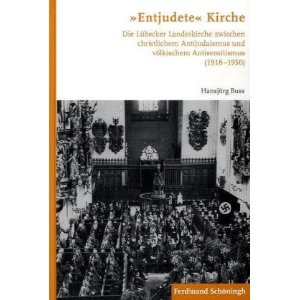
Review of Hansjörg Buss, “Entjudete” Kirche: Die Lübecker Landeskirche zwischen christlichem Antijudaismus und völkischem Antisemitismus (1918-1950)

ACCH Quarterly Vol. 18, No. 3, September 2012

Review of Hansjörg Buss, “Entjudete” Kirche: Die Lübecker Landeskirche zwischen christlichem Antijudaismus und völkischem Antisemitismus (1918-1950). (Paderborn: Ferdinand Schöningh, 2011), 559 Pp. ISBN: 978-3-506-77014-1.

By Christopher J. Probst, Saint Louis University

Hansjörg Buss’s comprehensive, fascinating study of the machinations of the Protestant church in Lübeck during the Weimar, Nazi, and immediate post-war eras is a highly original work that takes seriously predominant social, cultural, and intellectual currents over a tumultuous three-decade period of German history. With a focus on the views of Lübeck’s Protestants toward Jews and Judaism, the author manages to weave together “sacred” and “secular” threads of history in seamless and effective fashion. In the process, numerous important issues are addressed, including: the question of continuities and ruptures, the interaction between local and national issues and points of view, and the nature of anti-Jewish hostilities and how their various manifestations should be understood.

While the political ruptures of the period under study are obvious—Germany’s defeat in the First World War, the dissolution of the Kaiserreich, the collapse of the Weimar Republic, the ascent to power of Hitler and the Nazis, the collapse of the Third Reich at the end of the Second World War, the Allied occupation of Germany in the wake of the war—Buss rightly and deftly emphasizes the nationalprotestantische Mentalitäten that were consistently present during these troubled times. The divinely-sanctioned “inextricable connection” of church, Volk, and nation espoused by many Lübeck pastors during the Kaiserreich (50), a complex of ideas embraced by scores of their theological descendants during the succeeding decades, is just one example of this phenomenon. The prevalence of anti-Judaism and antisemitism among German Protestants, beginning especially with the rise to prominence of the Berlin court preacher Adolf Stoecker, is another.

One of the most significant contributions of the book is its regional focus, which, to Buss’s credit, is set firmly within the broader national context. After a prologue in which he examines the church, civil (especially bourgeois) society and nationalism during modern German history prior to 1918, he devotes significant space to each of the three most relevant timeframes (Weimar, the Third Reich, and the early post-war period). For each era, we are made intimately familiar with important areas of Lübeck society, including demographics, economics, and politics. Those seeking only a narrowly focused examination of Protestant views of Jews and Judaism from 1918-1950 will be disappointed. But, those who are patient enough to follow Buss on this thoroughly contextualized journey will be rewarded handsomely.

The ways in which Lübeck Protestants dealt with Jews and Judaism is at the heart of the book. Fearing a deeper descent into secularization and immorality—not to mention their perceived drift into irrelevance—during the Weimar era, most Lübeck Protestants, like many of their co-religionists in other parts of Germany, espoused conservative, anti-democratic, and anti-Jewish views. The outcome of the Church Struggle in Lübeck, according to Buss, was a church government take-over by “radical” German Christians. The radicals who led this regional church ardently supported the Nazi State, the National Church Movement of German Christians (NDC), and the virulently antisemitic Institute for Research into and Elimination of Jewish Influence in German Church Life (commonly called the “Eisenach Institute”).

Yet, all of this masked the fact that the Confessing Church in Lübeck, together with other Protestants who, despite their initial enthusiasm for the Hitler regime, largely rejected National Socialist incursions on Protestant autonomy (but did not openly protest anti-Jewish measures promulgated by the regime), actually represented a majority of Lübeck Protestants. As a result, from April 1937 to the end of the war, there were in Lübeck essentially two independent churches, joined only administratively (485).

On the one hand, Buss argues that a striking feature of the history of the Lübeck Church during the Nazi period was a radical antisemitism, which led under Bishop Erwin Balzer to adopt the goal of creating a “Jew-free” church to correspond to the “Jew-free” state that the Nazi Party was striving for (490). Buss suggests that this radical antisemitism was most prevalent among the leaders of the Lübeck church government.

On the other hand, however, he asserts that antisemitism and the state persecution of Jews was a non-issue in parish life. For the most part, Lübeck Protestants explicitly recognized and welcomed the state regulatory authority to limit the influence of Jews in politics, society, and culture. “There also were no reactions to the increasing restrictions on the Jewish community, to the open exclusion of Jewish Lübeckers, to the November 1938 pogrom, and finally to the beginning of the deportations.” There is simply little evidence, Buss argues, to suggest that these exclusionary policies aroused special concern among knowledgeable Protestants, even in the Confessing Church (493).

This lack of expressed concern was based at least in part on the “totalitarian” nature of the Nazi government and the “theological-ideological orientation” of the Balzer church government, both of which would have inhibited significant Protestant protest. Yet, he stresses that a lack of consciousness for the plight of Jews and Protestant “anti-Jewish resentments” (as well as some other church-political dynamics) played the greatest role.  These conclusions are nuanced, but there may be some reluctance here to attribute antisemitic attitudes to Protestants who were not aligned with the German Christians and/or the Nazis. At the national level, certainly anti-Judaism and xenophobia seem to have been more prevalent in the Confessing Church and the Protestant “middle.” Yet, antisemitic ideas can be found in those camps as well.  It is a bit surprising that such attitudes were seemingly less prevalent in Lübeck.

In the post-war era, cautious rapprochement between Protestants and Jews predominated in Lübeck, as elsewhere in Germany. Despite all that had transpired, Lübeck Protestants were not ready to welcome their Jewish neighbors with open arms. The differentiated description of events at the local level over three decades presented here helps to nuance our prior understanding of Lübeck Protestantism as a purely German Christian stronghold.

Buss’s inclusion of the experience of Lübeck Jews is commendable. Rather than a one-sided conversation featuring the dim views of Jews and Judaism purveyed by most German Protestants, Buss deals with the lived experience of Lübeck’s tiny Jewish minority during all three eras. He also consciously sets the actions and attitudes of Lübeck Protestants in their context; that is, he is careful to demonstrate the marked contrast between their often narrowly constructed abstract theological arguments about Jews and Judaism with the horrific terrestrial events being perpetrated against Jews in Europe at the same time.

This excellent study significantly broadens our previous knowledge about the Lübeck Protestant church. Buss’s judgments are measured and his analysis acute. He is also cognizant of the sensitivities involved in the issues being discussed. “Entjudete” Kirche is important reading for anyone interested in twentieth-century German Protestantism, and would be similarly useful for those interested in the history of Christian antisemitism.

Share

Review of Sascha Hinkel, Adolf Kardinal Bertram. Kirchenpolitik im Kaiserreich und in der Weimarer Republik

ACCH Quarterly Vol. 18, No. 3, September 2012

Review of Sascha Hinkel, Adolf Kardinal Bertram. Kirchenpolitik im Kaiserreich und in der Weimarer Republik. Veröffentlichungen der Kommission für Zeitgeschichte, Reihe B: Forschungen 117 (Paderborn: Ferdinand Schöningh, 2010), ISBN: 978-3-506-76871-1.

By Lauren N. Faulkner, University of Notre Dame

In his first published book based on doctoral work in Mainz, Sascha Hinkel does not set an easy task for himself. His subject is Adolf Cardinal Bertram, chairman of the Fulda Conference of Bishops from 1920 to 1945 and, as such, the most powerful Catholic bishop in Germany. Although Bertram is “among the most controversial German bishops of the 20th century” (336), he lacks a definitive, updated biography.[1] Bertram’s accommodation of the Nazi regime is notorious: “his opponents criticize him as vigorously as his proponents defend him.” (336) Rather than recounting Bertram’s well-known Nazi-era activities, Hinkel observes “a younger Bertram … who was not prejudiced by later events.” (12) The Kaiserreich and Weimar Republic are the twin epicenters of the book as Hinkel seeks to explain Bertram’s post-1933 behavior in his pre-1933 experiences. Thus, Bertram’s activities during the Third Reich are limited largely to a ten-page section at the end of the final chapter. The result is a portrait of a man who was not yet the acquiescent cardinal who kowtowed to Adolf Hitler. And though Hinkel’s biographical approach limits him to the reach of one man, there is no denying Bertram’s considerable influence in the most turbulent years of the twentieth century. His actions impacted Catholic Germans, Vatican policy, the ethnic Poles who resided in Prussian Upper Silesia before the post-WWI territorial redistributions.

In scrutinizing his experiences as bishop in Hildesheim (1906-1914) and Breslau (1914-1945) and his 1920 accession to the cardinalate and simultaneous appointment to the chair of the Fulda Conference of Bishops, rather than Bertram’s more well-known Nazi period activities, Hinkel reminds us that it is worth looking closely at an individual’s formative years in order to explain later behavior. Bertram came of age during the papacy of Leo XIII, whose Harmoniemodell, or model of harmony, served as the basis for Bertram’s own approach to church-state relations. This paradigm preached compromise because God’s authority informed all earthly governments, and that the state was God’s designated instrument for preserving social order and peace.

With this, Hinkel explains Bertram’s remarkable adaptation to regime change in Germany. From monarchy to parliamentary democracy to dictatorial regime, Bertram accommodated the successive shifts while holding strong reservations. Bertram was a classic Vernunftrepublikaner, hostile to democracy like many other Church leaders of the time but recognizing the inevitability of its coming, and he rejected much of Nazi ideology despite his endorsement of Hitler as the legitimate head of state.

Arguably the most valuable part of the book is the section detailing Bertram’s involvement in the resolution of the “Upper Silesia question.” Its story comprises more than a fifth of the book, and it is one of Bertram’s defining pre-1933 moments, showcasing his capabilities as bishop, political player, and administrator. The re-emergence of Catholic Poland necessitated the re-drawing of national and ecclesiastical borders between 1919 and 1925, which impacted the Catholic Church in Germany significantly and sparked political battles between Germans, Poles, and Vatican administrators for control of the new territories. James E. Bjork has done valuable work in this area already; Hinkel’s portrayal of Bertram adds to this, though Hinkel does not reference Bjork in his bibliography.[2]

It is difficult to get a grasp of the ethnic and national identities of the contested province of Upper Silesia: the inhabitants of the region, which had been part of Prussia since the eighteenth century, included German and Polish speakers. How many of these considered themselves Silesians (German-speaking, or Polish-speaking)? Alternately, how many classified themselves as German nationals or, after 1919, Polish nationals? Hinkel does not dwell long on these slippery distinctions. Instead, he reconstructs the events that led to the  1921 plebiscite that split Upper Silesia in two, with the eastern (mostly Polish) portion going to the Polish Silesian Voivodeship and the western (mostly German) portion remaining part of Germany.

It is in this section that Hinkel’s Bertram comes most vividly to life, as he attempted to prove himself a major player in the power contest surrounding the plebiscite. Of particular note is the relationship between Bertram and Achille Ratti, nuncio to Warsaw and later Pope Pius XI. They formed their mutual and enduring coolness toward each other here: Bertram saw Ratti’s presence as disruptive and a challenge to his own authority, and Ratti regarded Bertram as on edge, malcontent, and self-interested. Bertram’s attitude vis-à-vis the Poles was forceful, and it made him unpopular: he encouraged them to vote in elections, but he advised steadfastly that Upper Silesia remain part of Germany, and in late 1920 he forbade clergy, irrespective of nationality, to use their pulpits for political lecturing. (This did not go over well with either the German or the Polish priests.)

Hinkel has used documents from eleven archives in Germany, the Vatican, Poland and Austria, including documents recently released from the Vatican’s secret archives. He admits to having limited access to files in Wrocław (formerly Breslau) as well as in the Vatican, which has yet to release to the public much of its documentation pertaining to the Second World War. Despite these limitations, the book holds together well. Readers may be interested in the biograms at the end, comprised of a list of people in ecclesiastical and political circles whose paths crossed with Bertram, including their birth- and death-dates and their positions.[3]

Some minor editorial adjustments could have made Hinkel’s study more accessible, including a map of Upper Silesia showing shifting national and diocesan boundaries. The retention of quotations in their original language in the main body of the text will be problematic for scholars with no knowledge of Latin, French, or Italian.

There are some deeper questions for which Hinkel’s argument cannot account. The “model of harmony” does not explain well Bertram’s role in two concordat negotiations. He was a minor player in the processes that led to both the 1929 Prussian concordat and the 1933 Reichskonkordat, but both concerned him directly. No persuasive explanation is tendered for Bertram’s minimal involvement in either, beyond the observations that Bertram’s relationship with Eugenio Pacelli was distant (at the time, Pacelli was secretary of state and the overseer of both concordats), the Breslau cardinal was skeptical of a federal concordat, advocating instead for state-level concordats (he famously said, “a frame without a picture is merely ornamentation without content” – 209 fn. 412), and that he was overworked. This does not marry persuasively with Hinkel’s portrayals of Bertram as autonomous and authoritarian.

One may also quibble with the presentation of Bertram’s antisemitism, which Hinkel qualifies as “a latent existing religious anti-Judaism.” (280) The subject of Bertram’s attitude toward Jews is hardly a central tenant of the biography. Its presence towards the end of the book, and mostly confined to a footnote, reads as an aside. Yet how useful is the distinction between religious-based anti-Judaism and racist antisemitism? While certainly one cannot argue that Bertram belongs among the blatant, unapologetic antisemites of the Third Reich, he was also hardly neutral regarding the Jews. What Bertram really thought about Jews is a question Hinkel does not resolve, but one is reminded that they were not an irrelevant minority in Breslau – statistics indicate they made up as much as 4% of the population, and paid as much as 20% of the city’s taxes.[4] Two of his most damaging statements (which, Hinkel acknowledges, approximate Nazi language) describe a Jew-controlled international press, in March 1933, and refer in early 1938 to the conversion of Saint Paul as a rejection of “the errors of degenerate Jewishness [Judentum]” (280 fn 198). Susannah Heschel reminds us that words must be understood in the context of their time. In the 1930s, the German word Judentum could be used to refer both to the religion, Judaism, as well as the people who adhered it, “shifting meaning away from a theological-based polemic to a polemic against people.”[5] This important point applies to Bertram, and makes his comments about Jews more ominous than Hinkel presents them.

Finally, there is Bertram’s unwavering enthusiasm for Adolf Hitler after March 1933. Although he remained staunchly critical of its race-based world view and promotion of positive Christianity, Bertram did approve the regime’s restoration of social order, its fight against communism, and Hitler’s professed respect for the Christian churches. But this is hardly enough to explain the effusive praise that he (and the other bishops) offered after the signing of the 1933 concordat, or the personal birthday greetings he sent to Hitler every year. Why did Bertram lose no opportunity to show his loyalty to Hitler, sometimes estranging even his own colleagues in the process?

The way that Hinkel has organized his argument may be the problem here. The book focuses on the 1906-1933 period, which at the beginning of this review I describe as one of its strengths. But this periodization makes it difficult to account fully for Bertram’s behavior under the Nazi regime and his support for Hitler. Because Hinkel stops his biography in 1933, the reader is left with many questions about Bertram’s legacy in its entirety. Can the model of harmony account for Bertram’s post-1933 behavior? Upon reflection, the answer is: not persuasively. The kind of dictatorship that Hitler erected was then unprecedented, and it may be unfair to expect Bertram to recognize it for what it was, let alone repudiate it publicly. This is tantamount to asking him to break with his training and decades of Church tradition. On the other hand, his unwillingness to be critical of Hitler is rooted in more than a stubborn perception of the Nazi Party as a God-given, legitimate authority. Moreover, the model of harmony fails to suggest what course of action to take when the state ceases to compromise for the sake of social order, or attacks the institution of the Church, as Hitler’s regime did after 1933, leaving one to wonder if the “model of harmony” argument determined Hinkel’s periodization.

Despite the limitations of his central argument and the questions that remain, Hinkel’s book provides critical information about an important figure in the Catholic hierarchy in twentieth-century Germany. It is valuable to scholars studying episcopal politics and church-state relations in Germany from the Belle Epoch to the end of the Weimar Republic. It provides a new angle along which to study the impact of national and ecclesiastical border drawing on Germans, Poles, and the Vatican. Finally, it belongs to a growing body of literature that demonstrates the necessity of rethinking conventional periodizations in modern European history. The twelve-year Third Reich will always be bracketed because of the horrific devastation it spawned. But Hinkel proves that what came before 1933 is just as much worth studying on its own terms, and not simply as context for what came next.


[1] Hinkel gives a thorough overview of the literature dealing with Bertram on pages 14-27. These include works by Joachim Köhler, Bernhard Stasiewski, Werner Marschall, Antonia Leugers, August Hermann Leugers-Scherzberg, and others. Hinkel’s explanation as to why it has taken so long for scholars to engage with a study of Bertram is persuasive: the timing of his death at the end of the Second World War; the transfer of Breslau to Poland in August 1945, when it became Wrocław; the early postwar “memory literature”, which upheld Bertram as “the epitome of a lost, transfigured homeland [Heimat]” (12); and the domination of the 1933-1945 period in historiography that depicted Bertram as the compliant leader of the Catholic bishops without delving into his personality.

[2] Bjork’s book, based on his dissertation work, is Neither German Nor Pole: Catholicism and National Indifference in a Central European Borderland (Ann Arbor, MI: University of Michigan Press, 2008).

[3] My thanks to my colleague John Deak for helping me refine my understanding of the biogram, and for his helpful comments on an early draft of this review.

[4] Statistics taken from http://www.yivoencyclopedia.org/article.aspx/Silesia, accessed 12 July 2012.

[5] Susannah Heschel, “Historiography of Antisemitism versus Anti-Judaism: A Response to Robert Morgan” in Journal for the Study of the New Testament 33 (2011), 261. The article lays out an eloquent argument favoring a move away from a rigid distinction of the terms anti-Judaism and antisemitism.

Share

Review of Hanna-Maija Ketola, Relations between the Church of England and the Russian Orthodox Church during the Second World War, 1941-1945

ACCH Quarterly Vol. 18, No. 3, September 2012

Review of Hanna-Maija Ketola, Relations between the Church of England and the Russian Orthodox Church during the Second World War, 1941-1945 (Helsinki: University of Helsinki Faculty of Theology PhD thesis, 2012), 231 Pp.

By John S. Conway, University of British Columbia

It was a striking paradox that the German invasion of the Soviet Union in June 1941 led to a major change in the fortunes of the Russian Orthodox Church. The Communist dictator, Stalin, after twenty years of hostility and persecution of the church, suddenly recognized his need for popular support from church members. So he changed his policy and allowed the Russian Orthodox Church unprecedented new possibilities. Amongst the changes was the permission to enter into relations with churches abroad. One of the first with whom contact was made was the Church of England. Dr. Ketola’s valuable account of how these relations developed is drawn largely from British sources, since the Russian documents are not (yet) available. She describes the opportunities and complexities which this unprecedented encounter gave rise to, and outlines the intricate balancing act which faced the British church leaders. Political pressures to support Britain’s new-found ally competed with deep-set suspicion of Soviet Communism and all its ways. There had been virtually no contact since the Bolshevik Revolution, though considerable sympathy had been extended to the clergy and laity who had fled abroad. The Communists’ murder of the Czar and his family had appalled everyone from the royal family down to the common man. Could this crime, and the subsequent oppression of the churches now be overlooked for reasons of political expediency? The only prominent Anglican supporter of the Soviet regime was Hewlett Johnson, the Dean of Canterbury, but he was a known maverick and enjoyed no support.

In the following month, the dilemma for the Church of England’s leaders only intensified. On the one hand, they were criticized for giving moral support to a regime which still maintained anti-religious propaganda in its official ideology; on the other they were criticized for not expressing more sympathy with the Russian people in their struggle. The main difficulty lay in the fact that no one in England had accurate knowledge about church life in Russia. Wishful thinking that the Soviet anti-church policy could change was not enough. And the British Government was concerned lest admiration for the Russian people’s resistance could turn into admiration for Communism.

In 1942 the situation became more problematic when the Metropolitan Nicolai of Kiev approached the British Embassy suggesting an official exchange of visits between the churches, and bringing a gift of a newly-published and handsome book “The Truth about Religion in Russia.” This was followed by an offer to translate the book into English, and a request for a foreword by the new Archbishop of Canterbury, William Temple. The book stressed the Orthodox members’ devotion to their country and gave details of the devastation wrought by the German invaders. Shortly thereafter, 700 copies were delivered to Lambeth Palace. This resulted in a flurry of exchanges between the British Foreign Office, the Ministry of Information and various Church of England officials. But Temple declined to write anything since he could not paass over the earlier persecution of the church, nor the conduct of the Soviet occupiers in the Baltic countries. “I should either offend the Soviet authorities by what I put in, or the Continental Churches by what I left out.” It all pointed to the regrettable absence of first-hand information about the true state of the Russian Orthodox Church.

So at the end of 1942 the Church of England leaders came to the conclusion that the invitation to send a church delegation to the Soviet Union was an opportunity not to be missed. It would be politically interesting but very delicate. However much the church connection was stressed, the political overtones were inescapable. On the other hand, there had been no contact for twenty-five years. It was time to begin again. The British churchmen wanted to be the first to visit, and in return agreed to make a joint declaration against fascism. But how far was the Russian Orthodox Church eager to promote Christian brotherhood, or just to escape from the solitary confinement of so many years?

The Anglicans then chose their second highest cleric, the Archbishop of York, Cyril Garbett, to lead a small delegation. His instructions were very narrowly drawn. He should avoid any open political pronouncements. No substantial discussion of dogmatic or liturgical questions was envisaged. It was simply to be a goodwill visit without commitments. But, in order to avoid any criticism from their own members, the visit should be kept secret until the Archbishop arrived in Moscow. War-time security prompted the same caution. So in fact it was not until mid-September 1943 that Garbett and two younger clerics flew out via Gibraltar, Cairo, Tehran and Stalingrad. They arrived a few days after Stalin had unilaterally made a significant concession to the Orthodox Church by allowing the revival of the Patriarchate and the election of a new Holy Synod. This seemed a good augury for the future of the Church in Russia, and Garbett’s visit as the first foreign dignitary was most welcome. In return the British churchman gained first-hand impressions of the Russian church leaders, even though the language barrier prevented any heart-to-heart exchanges. But they gathered as much information as they could, and reciprocated with news about the Church of England. They attended several lengthy church services and were impressed bgy the piety of the worshippers. More significant issues were however skirted. Ecumenical friendship prevailed. And the delegation met briefly with the Soviet Foreign Minister, Molotov, which indicated the support given by the Soviet Government to the visit.

On his return, Garbett stressed that he had found that worship in the churches was fully allowed, and that the Russian people were now giving wholehearted support to the war effort. His impressions had been positive, and he looked forward to a return visit by the Russians to Britain. This would help to break the isolation of the Russian Church, and would enhance the prospects of future peace. But Garbett was realistic enough to acknowledge that the positive achievements of his visit were rather limited. The religious situation in Russia had improved but the state was still ”non-religious” and very many churches were still closed or secularized.

In early 1944 the idea of a return visit was taken up. But the death of Patriarch Sergii in March, the Normandy invasion in June and the sudden death of Archbishop Temple in October caused a postponement Not until June 1945 did the Russian delegation eventually arrive in Britain. By that time the European war had ended. After the defeat of Germany and the overthrow of Nazism, the need for Anglo-Soviet co-operation was no longer a top priority. At the same time, the climate of relations between the Soviet Union and its allies had grown noticeably cooler. In church circles, increasing concern, even alarm, was felt about the Soviet re-imposition of control over the Baltic countries and Poland, and to a lesser extent over Finland. The Russians had shown no willingness to join in the task of European reconstruction to which the Church of England was heavily committed. The warmth of sympathy expressed by the hosts could not obscure the fact that no substantial dogmatic or political issues were touched on. So the return visit proved to be even less of
a success that Garbett’s two years before.

Dr Ketola’s careful appraisal of the extensive documentation on this matter shows how assiduously the British officials, both governmental and ecclesiastical, took up the complex issues involved. She does not however attempt to give an overall assessment of the events she so capably describes. In fact, the verdict must be a negative one. The outbursts of sympathy for the Russian people were short-lived; the optimistic hopes that the Russian Church would gain more scope for its activities and that the Soviet state would allow more freedom for religion, were soon enough disappointed. It was to be many more years before relations between the Church of England and the Russian Orthodox Church could improve. But we can be grateful that Dr Ketola has shed such a clear light on this short and transient period of apparent reconciliation and inter-church harmony.

Share

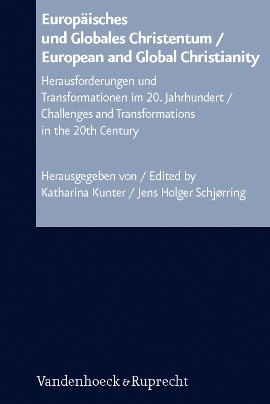
Review of Katharina Kunter and Jens Holger Schjørring, eds., Europäisches und Globales Christentum/European and Global Christianity: Herausforderungen und Transformationen im 20. Jahrhundert/Challenges and Transformations in the 20th Century

ACCH Quarterly Vol. 18, No. 3, September 2012

Review of Katharina Kunter and Jens Holger Schjørring, eds., Europäisches und Globales Christentum/European and Global Christianity: Herausforderungen und Transformationen im 20. Jahrhundert/Challenges and Transformations in the 20th Century (Göttingen: Vandenhoeck & Ruprecht, 2011), 381 Pp. ISBN-13: 978-3-525-55706-8.

By Heath A. Spencer, Seattle University

What were the most important developments in twentieth-century Christianity? If the focus is on Europe, we might emphasize secularization, declining church attendance, Christian complicity in an era of war and genocide, or the challenges faced by churches under various dictatorships. If we are more global in scope, our attention might be drawn to the peculiarity of the United States in comparison to Europe, the dramatic expansion of Christianity in the global south, the global prominence of Pentecostal-charismatic varieties of Christianity, and relations between European and non-European Christianities during a transition from colonial empires to newly independent states. All of these themes are addressed in European and Global Christianity, a collection of papers presented in Denmark in 2008 at the conference “Taking Stock of Church History in the Twentieth Century from an International Perspective.” While the book does not propose a new master narrative for the history of world Christianity, individual contributors offer an indication of themes and questions that would have to be included in such a project.

In the first section, “Transformations and Historical Turning Points in the Twentieth Century,” Hartmut Lehmann and Hugh McLeod highlight broad trends in Europe and the wider world. Both see a weakening of confessional boundaries, greater religious pluralism and a dramatic decline in church attendance to be among the most important developments in European Christianity over the course of the twentieth century. McLeod identifies the 1960s as the tipping point for this ‘decline of Christendom’ but notes that the United States diverged from the European pattern in the latter part of the century. Lehmann is more attentive to trends beyond Europe and North America, drawing attention to the surge of Pentecostal-charismatic forms of Christianity and the complexity of Christian-Muslim relations. Within Europe, he also sees positive developments such as greater international understanding and a thorough discrediting of Christian anti-Judaism.

Aud V. Tønnessen and Uffe Østergård are less interested in megatrends and international comparisons than in the reactionary or progressive tendencies in Scandinavian Christianity. Tønnessen notes the persistence of an ideology of ‘gender complementarity’, not only in early twentieth-century debates about birth control and sexual morality, but also in more recent controversies over the ordination of women and the blessing of same-sex unions. Østergård’s “Lutheranism, nationalism and the universal welfare state” challenges the conventional view that trade unions and social democratic parties deserve all the credit for the modern welfare state. Instead, he concludes that “the Danish welfare state is a result of secularized Lutheranism in national garment rather than international socialism” (93).

The second section of the book offers two articles on the world wars and their repercussions for the churches. Martin Greschat shows both change and diversity in the responses of Christians to the violence of the twentieth century. During the First World War, most churches enthusiastically endorsed the slaughter. However, in the interwar period, leaders in the ecumenical movement were promoting peace and reconciliation and challenging the absolute claims of nations and states. During the Second World War, many Christians supported their governments out of a sense of fatalism and obedience to authority, but religiously-motivated resistance was also a possibility. Unlike Greschat, Nicholas Hope tells a more uniform story of Christian capitulation to the claims of ‘the State.’ Unfortunately, he does little more than raise interesting talking points (for example, the role of the churches in what James Sheehan has called the rise of the ‘civilian state’) and then drop them without further development.

The third section of the book addresses the Protestant and Catholic churches in postwar Europe. In his comparison of East German and other Eastern European churches, Miklós Tomka demonstrates that labels like ‘conformity’ and ‘resistance’ fail to do justice to the complexity of situations faced by churches and churchgoers in east bloc countries, where it was not always easy to distinguish between hypocrisy and pragmatic survival strategies. If we imagine ‘church’ to mean the clerical hierarchy and ‘resistance’ to mean openly confronting dictatorship, then these churches were seriously compromised. On the other hand, if we focus on the congregational level and pay attention to more subtle forms of opposition, then churches appear to be among the most important sites of opposition to dictatorship in the twentieth century, particularly after 1945. Tomka’s sociological analysis is complemented by Dag Thorkildsen’s historical theology in “Unconditional Christian Loyalty towards the Rulers?” Although Luther and his early modern successors left little room for challenging the social or political status quo, Norwegian theologians of the twentieth century interpreted Romans 13 (“Everyone must submit himself to the governing authorities…”) in such a way as to justify popular sovereignty on the one hand and resistance to German occupiers and Norwegian collaborators on the other. In the study of scriptural religions, the history of interpretation is at least as important as the texts themselves, and “Norwegian history shows that Lutheranism does not necessarily have to lead to an unconditional Christian loyalty towards the rulers” (268).

Harry Oelke and Karl-Joseph Hummel offer narrower studies of the German Protestant and Catholic churches. Oelke highlights the ongoing relevance of national studies, noting that Germany’s recent past has given a particular twist to postwar debates among German Protestants over political engagement, collective guilt, and nationalism. Hummel surveys the research on the Catholic Church in Germany, much of which has focused on the Nazi era. Immediate postwar narratives of Catholic resistance and victimhood gave way in the 1960s to critical appraisals arguing that an illiberal and anti-modern Catholic hierarchy helped facilitate the Nazi ‘seizure of power.’ More recent scholarship strikes a balance, recognizing Catholic Resistenz to national socialist ideology and its totalitarian claims as well as broad areas of complicity. Hummel also explores cases where political, moral, and theological agendas have shaped and at times distorted postwar memories and representations of German Catholicism.

The articles in the final section of the book return to some of the global trends mentioned by Lehmann in the opening article. Klaus Koschorke stresses the need for a coherent narrative of World Christianity and points to promising areas for comparative study such as church independence movements in Asia and Africa, colonial-ethical discourses, and the year 1989 as a global caesura (rather than merely European). Kevin Ward and Ezra Gebremedhim follow up by highlighting the unique dynamics of African Christianities rather than presenting them as African adaptations of a ‘European’ religion. Ward argues that in Africa, religious pluralism has long been the norm, and “religion has been the midwife of modernity rather than its opponent” (303). As a result, African Christians do not feel compelled to fight the same kinds of culture wars as have Europeans and North Americans. Ezra Gebremedhim assesses progress toward independence and equality in the relationship between the Ethiopian Evangelical Church Mekane Yesus and the Church of Sweden. The nature of that equal partnership is revealed in the current dialogue between the two churches over the Church of Sweden’s decision to bless same-sex partnerships. The section ends with Viggo Mortensen’s reflections on the state of Christianity as a global religion in a pluralistic world. Mortensen identifies fundamentalism, relativism, and syncretism as threats to the integrity of Christianity, arguing that Christians must hold on to their convictions while engaging in dialogue with others in a spirit of konvivenz. Unfortunately, Mortensen’s call for konvivenz is compromised by his references to ‘Eurabia’ and ‘dhimmitude’ as well as the dubious claim that ‘Islam’ has no history of multicultural sympathy with the ‘other.’ One is left wondering what he means when he poses questions like, “What will win out: Protestantisation of religion or the islamisation of Christianity?” (368).

Overall, this book delivers what the title promises, a useful constellation of articles on European and global Christianity, covering key moments, themes, and trends over the course of the twentieth century. Chapters are in English or German, and the authors represent a variety of countries (Germany, the United Kingdom, Denmark, Norway, Sweden, and Hungary) and disciplines (church history, theology, and sociology of religion). The middle sections privilege European church history, but the others offer a range of global perspectives that suggest new ways to imagine and contextualize European developments. The individual articles are uneven in terms of quality, significance, and originality, but the collection as a whole gives evidence of the richness and diversity of twentieth-century Christianities, within and outside of Europe.

Share

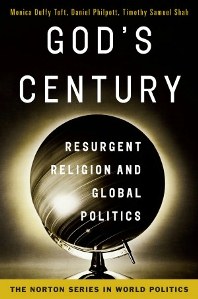
Review of Monica Duffy Toft, Daniel Philpott, Timothy Samuel Shah, God’s Century: Resurgent Religion and Global Politics

ACCH Quarterly Vol. 18, No. 3, September 2012

Review of Monica Duffy Toft, Daniel Philpott, Timothy Samuel Shah, God’s Century: Resurgent Religion and Global Politics (New York: W.W. Norton & Co., 2011), 276 Pp.

By Steven Schroeder, University of the Fraser Valley

Proponents of the secularization thesis have long-asserted that religion has been sequestered to the private realm, but the authors of God’s Century claim this view is outdated. Drawing on a plethora of events spanning the last few decades, the authors argue that “major religious actors throughout the world enjoy greater capacity for political influence today than at any time in modern history – and perhaps ever” (49). The authors set out to explain the resurgence of religiously-fuelled political action on the world stage by examining what is behind the phenomenon: the religious actors; their beliefs; and, the ramifications of actions.

Political scientists Monica Toft, Daniel Philpott, and Timothy Shah provide the necessary historical backdrop for their study, which also problematizes succinctly the oversimplified narratives that portray religion exclusively as friend, or foe, of democracy and peace. Moving on to foreground the global impact of religion in today’s world, the authors’ two central arguments are that religion has played an increasingly significant role on the world stage during the last forty years, and that this increase is due to shifts in political theology and the mutual independence of political and religious actors (9-10). They argue that the onset of religion’s resurgence in global politics began in the 1960s. Aided by modern communications, religious actors have made good use of their independence in creating “transnational civil societies,” (24) resulting in their increased strength in the political realm (81).

The measured increase in significance of political actors is based nearly exclusively on data gathered by the U.S.-based NGO Freedom House, which examined the ties between religion and democratization during the last four decades. In numerous cases involving Christianity, Islam, Buddhism, and Hinduism, the data reveals a significant relationship between religion and democratization, which the authors measure according to specific criteria (e.g., open opposition to authoritarian regimes, supporting resistance groups, brokering mediation between combatants). Generally, they determined that “the democratization role of religious actors between 1972 and 2009 was massive,” (93) due to the liberal, democratic political theology—and independent action—of the religious actors (112).

To be sure, many examples of religion fuelling terrorism and war are also found in the world during this same period. Chapters five and six deal directly with the violence inherent in various political theologies, and how certain conditions render plausible the outbreak of this religiously-inspired violence. Citing numerous cases as evidence, the authors utilize their categorical approach to conclude that religious actors are more likely to use violence to alter the status quo when they are “not privileged by the state [and hold] political theology that runs counter to the interests of the state” (132). States that privilege one religious group over others (i.e., integrated states) often witness violence and even civil war, which is evident in recent conflicts in Sudan, Chechnya, Algeria, Tajikistan, and Iraq. Radical domestic and international terrorist groups (e.g., Al Qaeda) broaden this thinking to the point that a specific state—or the world, generally—is seen as ignoring or threatening their cause. Terrorist actions result when this view is fused with a political theology that endorses violence for the “right” cause.

The authors conclude the book with two chapters that focus on religion’s positive potential to promote peace in the world, and on prescriptive measures for us to apply in light of their discoveries. Religious actors can serve and even lead the way in peacebuilding they argue, but again this depends on the actors’ political theology and their relationship to state actors, and the belligerents in the conflict. The most effective peacebuilders are religious actors who: act independent from the state and from warring factions; are popular leaders; and, hold a political theology of justice, peace, and reconciliation (206). The authors identify peaceful components in the respective religious traditions and highlight many cases of religious actors brokering peace. Here, Catholic organizations (and mainly the lay organization, Sant’Egidio) get the most attention. Additional cases involving NGOs rooted in other traditions like the Muslim-based Afghan Institute of Learning, discussed in chapter seven, would have broadened the scope and strengthened the points of this section. Nevertheless, when the essential components are present together, religious actors—at times “with fervor equal to the religiously violent” (176)—are shown to advance peace through work in mediation, transitional justice, and reconciliation.

The prescriptive conclusion first reiterates the central role of religion in contemporary politics, and then suggests ten ways to address this role. “God’s partisans are back, they are setting the political agenda, and they are not going away,” (207) say the authors, and the best way to deal with this reality is to acknowledge and embrace it, and allow for religious freedom and autonomy. Conversely, the state will encounter significant problems—even violence—if it privileges one religion and excludes others, if it represses religious actors, or, if it doesn’t take religious actors seriously. Essentially, the authors recommend that educators and government leaders inform themselves of the role of religion in local and global politics so that political actors will learn to “treat their religious citizens in a way that promotes their best civic, democratic, productive and peaceful energies” (222).

The authors have done well in highlighting numerous cases from all parts of the globe. Additional details for some cases would have rendered clarity to numerous assertions and strengthened their conclusions. The study’s categorical approach serves to illuminate general tendencies and trends, but it is insufficient for a deeper understanding of the respective cases highlighted in the book. For example, Soviet and East German church leaders are portrayed as having been completely subservient to their respective governments, but no time frame or details of the church-state relationships are provided to explain these assertions. The limitations of the study’s main approach also became evident. Partly due to the Freedom House’s categorization of Israel as a “free” nation, the authors concluded that “Judaism has lacked the demographic opportunity…to mount serious pro-democratic activism in politically volatile and dynamic parts of the world” (104). To be sure, also identified in the book is the need to address seriously the “motivations” including “sociopolitical factors” of Palestinian suicide bombers (145). The clarity of other cases presented (e.g., Iran, Mozambique, and Guatemala) was excellent, and the authors did well to maintain their necessary, though ambitious, global approach throughout the book.

God’s Century is a compelling overview of a complex phenomenon that will be of great interest to a wide readership. The book’s focal points resonate in contemporary headlines that reveal religion as a powerful force in the world, a force that shows no sign of retreat. (For example, religious actors have had some role in the events of the Arab Spring, which the book pre-dates.) The numerous ways that religion can be employed for good or ill are handled in a balanced manner and reveal what is at stake in the relationship between religious and political actors. The authors conclude that religious actors serve democratic peacebuilding best when they enjoy independence from political authorities, and hold a political theology centered on impartial, peaceful activism. Fostering these qualities in ongoing, constructive engagement between political and religious actors seems to be the best way forward for those who want to see democracy and peace furthered in the 21st century.

Share

Review Article: Academic and Ecclesiastical Complicity in the Third Reich

ACCH Quarterly Vol. 18, No. 2, June 2012

Review Article: Academic and Ecclesiastical Complicity in the Third Reich

By Victoria J. Barnett, Director of Church Relations, U. S. Holocaust Memorial Museum

Robert P. Ericksen, Complicity in the Holocaust: Churches and Universities in Nazi Germany (New York: Cambridge University Press, 2012).

Jens Gundlach, Heinz Brunotte 1896-1984: Anpassung des Evangeliums an die NS-Diktatur. Eine biographische Studie (Hannover: Lutherisches Verlagshaus, 2010).

The issue of complicity has become a major focus of Holocaust historiography in recent years, fueled by the research of historians like Christopher Browning, Robert Gellatelly, Peter Hayes and many others. While the very word “complicity” connotes a more secondary, passive role, the work of these scholars has documented the extent to which complicity was in fact an active and participatory process, particularly with regard to the persecution of the Jews. Germans from every walk of life participated in and benefited from these measures. Continue reading

Share

Review of Dietrich Bonhoeffer, Theological Education Underground: 1937-1940

ACCH Quarterly Vol. 18, No. 2, June 2012

Review of Dietrich Bonhoeffer, Theological Education Underground: 1937-1940, ed. Victoria J. Barnett, Dietrich Bonhoeffer Works, Volume 15 (Minneapolis: Fortress Press, 2012), 726 pp. ISBN 978-8006-9815-7.

By John S. Conway, University of British Columbia

In October 1937 the Gestapo ordered the closure of the Preachers Seminary for Confessing Church ordinands at Finkenwalde, which Dietrich Bonhoeffer had led for two and a half years. He now began a critical period of his life and ministry which was marked by much self-doubt and questioning about where his true discipleship lay. The letters, bible studies and essays contained in this volume give a vivid picture of his personal problems and choices, culminating in his visit to the United States in June-July 1939, but also in his well-known decision to return to Germany without delay to share his country’s fate since war looked inevitably close.

The central point of interest in this volume can be seen in the very full record of Bonhoeffer’s brief stay in New York, along with the evident disappointment of his American hosts, who thought they were offering him a valuable asylum from Europe’s turmoil. Essentially this visit revealed to Bonhoeffer the strength of his attachment to his home country and to the group of seminarians he had been training. It was this attachment which drew him back to Germany only weeks before the outbreak of hostilities. It was a decision he never regretted, even though the consequences for his career were to be so fateful. These dilemmas were to be well illustrated, particularly in the circular letters which he wrote to the now dispersed seminarians, most of whom were soon to be called up for military service, and of whom a horrendously large proportion were to lose their lives. By such means Bonhoeffer tried to maintain their theological education underground, which the Gestapo was seeking to stamp out. Despite this harassment, Bonhoeffer firmly upheld his theological stance of resolute opposition to any measures designed to enforce obedience to the Nazi ideology.

It is however notable that this concentration of effort involved a reticence about the traumatic political events of those years, from the seizure of Austria, the Munich crisis of September 1938, the notorious pogrom against Germany’s Jews in November, and the various steps which led to the outbreak of war in September 1939. It is not clear from the documents here printed whether this abstention from political comment was due to the heavy hand of Nazi intimidation and censorship, or whether Bonhoeffer was giving all his concentration to the pastoral and counselling needs of his students. He certainly undertook numerous visits to see them both before his American visit and after, until forbidden by the Gestapo to travel to Berlin and the surrounding districts of Brandenburg. Yet, as the editor of the English edition, Victoria Barnett, rightly points out, this restraint, whether self-imposed or indicative of his precarious political situation, serves as a corrective to any easy assumptions that Bonhoeffer was always in the forefront of resistance to Nazism or loudly protested its increasingly oppressive measures. For example, the only sign of his referring to the outbursts of violence against the Jews in 1938 was a reference to the biblical passages which “lead deeply into prayer.”

By the beginning of 1939, his personal dilemmas grew more acute. He could foresee that, at the age of thirty-three, he would likely be called up for military service, which he was determined to avoid. So in April he paid a quick visit to London, meeting with various leaders of the ecumenical movement, including Reinhold Niebuhr, who vigourously pressed him to return to New York and to the Union Theological Seminary so that he could undertake a number of engagements for both the church and university. Nieburhr’s advocacy pulled all the rights strings. So Bonhoeffer sailed across the Atlantic, having delegated his responsibilities at home to a chosen group of pupils.

Much of his subsequent correspondence during the crucial month of June 1939, both to his German relatives and partners, as well as to his American contacts, is by now well known and is often quoted. But the full texts show that Bonhoeffer’s rejection of the American offers was not in any way due to an aversion to the church situation in the United States. Indeed his insightful comments on the American churches during his brief stay show that he was much more appreciative of their situation than he had been during his earlier visit in 1931. The text of his thirty-page essay on “Protestantism without Reformation” commenting with remarkable perception on the state of the United States Protestant churches, which was composed during the final days of his stay, is here reprinted in full.

There is however no reason to question the version that it was the intensity of his attachment to Germany and to his coterie of friends there which drew him back, even though as he admitted: “in all my decisions, I am never completely clear about my motives. Is that a lack of clarity, inner dishonesty, or is it a sign that we are led beyond that which we can discern, or is it both?” The clearest statement of his position is contained in his letter to Reinhold Niebuhr, outlining the terrible alternatives facing Christians in Germany. “I know which of these alternatives I must choose: but I cannot make that choice in security”.

Bonhoeffer’ return to Germany was followed almost immediately by Hitler’s ruthless aggression against Poland. The efforts of church leaders, including the Pope, to prevent the outbreak of hostilities had proved fruitless. But, even thereafter, during the period of the so-called “phoney war,” several of Bonhoeffer’s close associates in the ecumenical movement still tried to find some basis on which peace might be restored. But Bonhoeffer himself no longer indulged in such illusions. Instead he was to become persuaded that the only way ahead lay in the forcible overthrow of Hitler’s regime. Needless to say, no surviving documents attest to this dramatic change from his earlier fervent advocacy of pacifism. The present volume therefore gives no hints, which are only spelled out in the subsequent and final volume dedicated to “Conspiracy and Imprisonment 1940-1945.”

Share

Review of Avraham Burg, The Holocaust Is Over. We Must Rise From Its Ashes

ACCH Quarterly Vol. 18, No. 2, June 2012

Review of Avraham Burg, The Holocaust Is Over. We Must Rise From Its Ashes. (New York: Palgrave Macmillan, 2008), 253 pp.

By John S. Conway, University of British Columbia

Twenty years ago Avraham Burg was elected to Israel’s national parliament, the Knesset, and later became its speaker. He also took a leading position with the World Zionist Federation. His father was a long-time cabinet minister under Menachem Begin. So he belonged to the Israeli establishment. But more latterly, he has renounced his political career, being convinced that Israel’s leaders have been following a dangerous and self-defeating course. Israel has for too long been captivated by the memory of the Holocaust and should now adopt a new and more liberal political stance. This book, with the provocative title The Holocaust Is Over. We Must Rise From Its Ashes. is his contribution towards this change of heart he now desires.

In Burg’s view, since more than seventy years have now passed since the catastrophic crimes of the Holocaust, Israel must now move on. He believes that the legacy of the Holocaust has been misinterpreted and manipulated. The officially-sponsored commemoration ceremonies and rituals have only served to allow Israelis to cling to the tragedies of the past, and so block the path to a more positive future. He deplores, for instance, the fact that present-day school children are escorted to Poland to visit the death camps, and are taught to believe that they are all Shoah survivors. The Holocaust, he asserts, has produced in Israel a climate of defensive aggressiveness. Israel has adopted the legacy of insecurity characteristic of trauma victims. The result is a hard-faced belligerence, not only against the Palestinians inside its borders, but against all outsiders. Israel today is a nuclear power, armed to the teeth, and has the backing of the world’s greatest power. Yet it believes it necessary to maintain a climate of hostility and isolation, upholding a militaristic society backed by all the latest weapons of mass destruction.

Israel, Burg believes, has developed muscle, not soul. Yet it remains haunted by the Shoah, which has become a stumbling block to any more positive steps for the future. As a result, Israel has followed a policy of repression of minorities at home, and of enmity towards such states as Syria, Libya and particularly at present Iran. When criticized by foreign observers, the Israeli leaders make use of the Holocaust as justification. Anyone who attacks them is seen as either an antisemite or as someone who can only imagine Jews as powerless victims. Netanyahu is only following the footsteps of many of his predecessors in demonizing Israel’s enemies, and making plentiful use of comparisons with Nazism. Begin, for example, was ready enough to compare Arafat with Hitler, and to justify Israel’s violent attack on Lebanon because “the alternative would be Treblinka, and we have decided there will be no more Treblinkas.”

Burg’s remedy is to move on, leave Auschwitz behind and learn to trust the world and humanity again. Israelis should take a wider view and universalize not nationalize the Holocaust. They should oppose human suffering in general rather than cling on to the one instance which most affected their predecessors seventy years ago. Instead of reproducing the mentality of an old, small East European Jewish town, forever persecuted, Israel should adopt the trail-blazing alternative forged by the early Zionists when they first arrived in the Middle East, redeeming the land through their hard labour and innovative social organisms.

Of course this criticism and these suggestions, coming from a prominent Israeli politician and opinion maker, aroused fierce anger in Israel’s leading circles. He challenged the core of the national identity as developed over the past sixty years. Burg was dismissed as a romantic idealist, whose utopian solutions for world peace are wildly unrealistic. Yet Burg’s optimistic hope is that Israel could become what its founders wanted – preaching and practising peace in a war-torn and strife-filled Middle East. This in his view could be the true legacy of the Holocaust.

In the wider perspective, Burg is surely right. Sooner or later the events of seventy years ago will begin to fade away. However much the memorialisation of the Holocaust is cultivated and expensively propagated amongst the Jewish population in Israel and abroad, there will come a time when the younger generation will look to other models for political guidance. The shock of the death camps, the gas chambers, the ghettos or the rampant brutality of Nazi thugs will all come to be seen as history, regrettable but over.

This translation into English from the original Hebrew is clearly aimed at the younger generation of American Jews, whom Burg believes will be the ones to give a new kind of leadership to the beleaguered Jewish community of today. American Jews are called, he claims, to take up the great spirit of universalism, once expressed by their nineteenth-century leader, Rabbi Julian Morgenstern. This would be a far more positive contribution than the continual emphasis on Holocaust disasters, so graphically rehearsed in American-made films. Modern Israel’s identity, Burg holds, should be established on foundations of optimism, faith in humans and full trust in the family of nations. The era of fearful Judaism and paranoid Zionism is over. The faith of the Jewish people in the world and in humanity must be rehabilitated. But whether this passionate plea can outweigh the present Holocaust-dominated climate of fear and repression remains to be seen.

Share

Review of Bryn Geffert, Eastern Orthodox and Anglicans: Diplomacy, Theology, and the Politics of Interwar Ecumenism

ACCH Quarterly Vol. 18, No. 2, June 2012

Review of Bryn Geffert, Eastern Orthodox and Anglicans: Diplomacy, Theology, and the Politics of Interwar Ecumenism (Notre Dame, IN: University of Notre Dame Press, 2010), 501 pp. ISBN-13: 978-0-268-02975-3.

By John S. Conway, University of British Columbia

Sixty years ago, when I was a student at Cambridge, I attended meetings of the exotically named Fellowship of St Alban and St Sergius. This organization, founded in the 1920s, was established to promote better relations between Anglicans and the Orthodox Churches of Eastern Europe. We were given a chance to meet heavily-bearded Russian clerics (in exile) or gaudily dressed Greek bishops. There was much talk about the desirability of church reunion. This was meat and drink for us members of the Student Christian Movement whose discipleship was largely based on promoting Christian unity through such bodies as the World Council of Churches. And the foreign visitors, despite their limited English, seemed glad to meet young, eager, but ecumenically naive students at Britain’s top university. But despite the high-flown rhetoric and the elaborate rituals, not much was achieved. Bryn Geffert’s excellently researched and invigoratingly written survey of these relations during the twentieth century explains why. Or rather, why not.

After the disasters of the First World War, the leadership of the Anglican Church recognized the need for spiritual rebirth. They were well aware of the damage done to Christian credibility because of the churches’ divisions. The Anglo-Catholic wing tried hard to patch over the long-standing quarrels with Rome but met only stinging rebuffs. So the Orthodox Churches looked to be more promising. In 1925 the sixteen hundredth anniversary of the Nicene Creed afforded the occasion to invite a high-ranking delegation of Orthodox clergy to come to England, where they were rapturously received. They were taken to Windsor Castle and Lambeth Palace. They met the Lord Mayor of London, and were feted at garden parties. The absence of theological discussions – and thus of theological disagreements – gave free rein to optimism about church reunion. They very much hoped that their example would draw other branches of the Christian world into the bosom of ecumenical unity. There was a great deal of wishful thinking.

For their part the Orthodox Churches, both in the Russian and Greek branches, desperately needed assistance. The 1917 Revolution had devastated the Russian Orthodox Church. Its patriarch was a prisoner of the Communists. Thousands of its priests, nuns and monks had been murdered. Its property had been confiscated. And its very survival, apart from the few clergy who had managed to escape, seemed problematical. Many of these now homeless exiles looked to the British government for both political and social relief. In Constantinople, the new Turkish government was waging a war against its Greek citizens, and expelling them en masse. Only the intervention of the British government saved the Ecumenical Patriarchate from being expelled too. Feuds amongst the Orthodox in the Middle East only added to their distress. All were in great need. Reunion, or at least closer relations with sympathetic Christian communities, offered some rays of hope.

The English response was warm-hearted and generous. The horrors of the Soviet repression evoked much sympathy. The new Patriarch in Constantinople, Meletios, seemed to be more open to Western ideas for reform. And in Jerusalem, the Orthodox Patriarch openly appealed to the newly-established British Mandate in Palestine to help him overcome his financial difficulties now that the flood of Russian pilgrims was no longer coming. Funds were raised through the Clergy and Church Aid Fund to assist the exiled communities and to sponsor a theological college in Paris. Cooperation with the YMCA and the World Student Christian Federation, which helped to promote many of the exiles’ publications, showed their strong commitment to ecumenism.

But despite all this, large segments of the Church of England remained ignorant and apathetic towards Orthodox theology or any talk of reunion. Protestant Anglicans, especially the more mission-oriented Evangelicals, were openly hostile. And when discussions turned to more substantial theological issues, the gap between the rhetoric and the reality was soon clear enough. The Orthodox leaders were themselves divided on the doctrinal questions. They had had four centuries to ask whether the Church of England was a true church, or a heretical body. Were Anglican orders valid or not? The conservatives on the whole thought the latter. They saw Westminster Abbey and St Paul’s Cathedral as strongholds of modernism and westernization, both of which were perceived as a threat to Orthodox integrity. Furthermore there were bitter disputes and heated rivalries for supremacy among the different Orthodox groups, which prevented any united, let alone ecumenical, approach.

On the other side, relations were not improved by the split in the Church of England over a new Prayer Book, which in fact was turned down by a vote in Parliament in 1927. Its defeat disillusioned many Orthodox friends and raised once again doubts about Anglican heterodoxy. Thereafter relations drifted. It became clear that agreement on such broad questions as the nature of the Church or a common confession of faith was a pipe dream. Compromise solutions seemed vague and ambivalent, and were rejected by both sides. Church reunion was no nearer. Geffert’s masterly dissection of these matters deserves close attention, showing all too clearly the thorn-filled path towards Christian unity.

For many years this unhappy situation has remained unchanged. The Fellowship of St Alban and St Sergius still exists and is even said to have a branch in the Fraser Valley in Western Canada. But polite interest in the affairs of their respective churches does not amount to any serious commitment to ecumenical unity. Geffert’s conclusion is rather damning. The schisms which plague Anglicanism have only widened theological misunderstandings, and in the revived Russia, Orthodoxy’s hostility to ecumenism is more evident than ever. As Geffert concluded, “What is abundantly clear is this: so long as neither confession can get its house in order, any dream of inter-confessional unity stands no chance at all.”

Share

Review of Mark Jantzen, Mennonite German Soldiers: Nation, Religion, and Family in the Prussian East, 1772-1880

ACCH Quarterly Vol. 18, No. 2, June 2012

Review of Mark Jantzen, Mennonite German Soldiers: Nation, Religion, and Family in the Prussian East, 1772-1880 (Notre Dame, IN: University of Notre Dame Press, 2010).

By Robert Beachy, Goucher College

Mark Jantzen’s study – titled Mennonite German Soldiers, which must sound oxymoronic to many – is a model of scrupulous, well-presented scholarship. Jantzen explains how the Prussian state succeeded over the course of a century in transforming a sect of pacifist peasants into self-conscious German nationalists. In ten chronological chapters, counting the introduction and conclusion, Jantzen demonstrates how this tortuous process was driven by “both ‘push’ and ‘pull’ factors” (p. 2). The heavy hand of the Prussian state imposed taxes for exemption from military service and at the same time restricted property ownership and other civil rights. Only the renunciation of a formal theological opposition to state-sponsored military service provided those Mennonites who remained in Germany after national unification (1871) full emancipation (p. 224). But the story, as Jantzen tells it, also sheds new light on the evolution of German nationalism and the peculiarities of German history. In that respect, his work will be as valuable, potentially, to historians of Germany as it is for students of Mennonite history.

Jantzen begins his narrative with the first partition of Poland in 1772, which added the Vistula Valley including a population of roughly 10,000 Mennonites to the territory of royal or West Prussia (p. 20). Formerly under Polish suzerainty, the Vistula communities had sought privilege and exemption from a range of local lords. Under their new Prussian overlord, however, the Mennonites faced a centralized and more uniform policy, or set of policies. At least during the reign of the irreligious Frederick the Great (1740-1786), the Vistula Mennonites were spared the worst bigotry and were able to purchase their exemption from military service with annual collective contributions of 5000 Reichsthaler (p. 30). An additional restriction imposed for their pacifism was a limitation on the acquisition of property from non-Mennonites. Already at this stage, liberal Russian policies that promised more favorable conditions lured many to emigrate to territories further east (p. 42).

The first comprehensive law, the so-called Prussian “Mennonite Edict,” was promulgated in 1789 and combined disparate regulations on exemption taxes, church taxes, and property ownership into a single policy (p. 55). This discriminatory law remained in effect until 1874. An elaboration of the 1789 edict issued in 1801 promised full emancipation for those who accepted military service. But those who continued to claim the exemption faced additional restrictions on property ownership: “only direct male descendants of current Mennonite property owners would be allowed to keep both their property and their exemption” (p. 69). Jantzen tells us that this reflected the nadir of Prussian anti-Mennonite discrimination.

The somewhat surprising result of the Napoleonic era and the Wars of Liberation was a more liberal policy towards Mennonite exceptionalism. Napoleon’s defeat of Prussia in 1806 ultimately increased militarization and an incipient German nationalism, and in 1814 Prussia introduced universal conscription. Yet soon after, in 1815, the state issued a secretive exemption – never published – that allowed Mennonites to continue to observe their pacifist beliefs. The effect of this relief was to reinforce the separate, estate-like status of the Mennonites – an odd development in the nineteenth century – and likewise strengthen their communities’ leaders, who continued to negotiate and represent their interests to the king and his ministers (pp. 93, 106).

The political differences between liberal and conservative Germans in the half century leading up to national unification (1871) was mirrored increasingly among Mennonites. The character of this division within the Mennonite community was extremely curious, however, and counterintuitive, perhaps, for a twentieth-first century observer. German liberals supported equal rights (and obligations) for religious minorities, and were therefore staunch proponents of Jewish (and Mennonite) emancipation. But since full citizenship demanded military service, according to liberals, it should be expected of all regardless of creed. In contrast, German conservatives sought to maintain traditional estate differences and had no problem with the differential treatment of religious minorities. These philosophical differences, Jantzen explains, inclined the Mennonite traditionalists who clung to their pacifism to embrace the German conservatives, while those willing to accept conscription identified with and gave political support to the liberals. For this reason, Mennonite pacifists made common cause with German conservatives while those willing to surrender their pacifism followed the liberals (p. 159).

Jantzen’s account of Mennonite acculturation also offers a valuable contribution to the broad historiography of German Central Europe. For one, the more traditional depiction of a German state riven between a monolithic Protestant majority and substantial Catholic minority is an oversimplification. Not only Germany’s tiny Jewish community but also the many smaller non-Catholic sects, such as the Mennonites, complicate the too-easy depiction of a tidy Catholic-Protestant division. Jantzen asserts that the Vistula Delta Mennonites “developed their own customized version of German national identity” by about 1880 (p. 6). A central issue in this process was the requirement of military service, a feature of citizenship and national identity that has been neglected, Jantzen suggests, in much of the literature on nationalism. As his analysis also illustrates, nationalism was never simply a state-sponsored project imposed from on high but rather a process in which individual actors and their communities participated in drawn-out negotiations with a range of cultural and state institutions (p. 9).

Share

Review of Manfred Gailus and Armin Nolzen, eds., Zerstrittene “Volksgemeinschaft”: Glaube, Konfession und Religion im Nationalsozialismus

ACCH Quarterly Vol. 18, No. 1, March 2012

Review of Manfred Gailus and Armin Nolzen, eds., Zerstrittene “Volksgemeinschaft”: Glaube, Konfession und Religion im Nationalsozialismus (Göttingen: Vandenhoek & Ruprecht, 2011).

By Robert P. Ericksen, Pacific Lutheran University

“Woran glaubten die Menschen im ‘Dritten Reich?’” Gailus and Nolzen open their book with this question, arguing that it has received surprisingly little attention within the massive historiography devoted to the Nazi period. This work represents an attempt to evaluate the state of current research on Protestants and Catholics in Nazi Germany. It also includes a chapter by Merit Petersen on two smaller groups, Mormons and Jehovah’s Witnesses; a chapter by Horst Junginger on German paganism (the German Faith Movement); and a chapter by Beth Griech-Polelle on National Socialism as a “political religion.” Two themes emerge in this volume. One is a refutation of the postwar charge that the Nazi era represented a period of intense secularization. In fact, Gailus and Nolzen argue, the Nazi period was intensely religious. Along with the early postwar era, it marked a break in the twentieth-century secularization that preceded and followed this middle period of nearly three decades. Secondly, the editors argue for increased attention to religion under the Nazis, especially by scholars not defending a piece of the religious turf. Such work should acknowledge regional differences as well as the complex and overlapping varieties of religious faith to be found.

Olaf Blaschke’s contribution picks up on an issue highlighted in Doris Bergen’s Twisted Cross (Chapel Hill: University of North Carolina Press, 1996), i.e., the importance of gender in understanding the pro-Nazi “German Christians.” Blaschke begins with the nineteenth century, arguing that Protestants in Bismarck’s Germany, epitomized by Heinrich von Treitschke, considered themselves the masculine Christians, with an emphasis on courage, strength, and the use of reason. Catholics were thought to be feminine, with more emotion, more sensitivity, and more resort to the superstitious side of religious belief (38). Protestants too, however, could be considered feminized, given the “soft” side of Christian beliefs and the percentage of women in the pews. By World War I, both religious faiths worked to “masculinize” their image and their message. Bergen points out the hyper-masculine nature of “German Christian” identity. Blaschke then describes “remasculination” efforts among Catholic theologians, including their hope to save piety from its soft, feminine image and remake it into an image of courage and strength. Blaschke argues throughout that these gender issues, largely ignored by historians, should have a significant place in our understanding of religion in the modern world, especially in the hyper-masculine world espoused by Nazi ideology.

Manfred Gailus offers a chapter on Protestants in which the title, “Keine gute Performance,” quite clearly indicates the message to be found. Noting that it took several decades for a critical and honest postwar assessment to develop, he describes the first generation to write the history with these words, “Die Erlebnisgeneration selbst erinnerte sich. Und natürlich legitimierte sie sich durch die Art ihrer Erinnerung” (98). Now we know better, in Gailus’s view. “Gegen langlebige Widerstands- und Kirchenkampflegenden ist zu betonen: Es bedurfte 1933 überhaupt keines Zwangs, keines gewaltsamen Angriffs von aussen—der Protestantismus öffnete dem anschwellenden Nationalsozialismus bereitwillig, vielfach fasziniert seine Türen, um die ‘Ideen von 1933’ einströmen zu lassen” (102). As for the question of Christians and Jews, “Protestanten haben im Kontext der so genannten Judenfrage nicht nur nicht genug für die Verfolgten getan, sondern zu nicht geringen Teilen haben sie selbst aktiv verachtet, ausgegrenzt, denunziert, verfolgt. Protestantismugeschichte ist an dieser Stelle zu erheblichen Anteilen auch Täter- und Mittätergeschichte” (111). Gailus acknowledges many differences to be found throughout the regional churches in Germany. He encourages historians to fill in these regional gaps, and also to write biographies of the broad range of church figures still without serious historical treatment. He also notes that some of the intensified religious commitment in the period turned toward the political religion of Nazism, with its opposition to the Enlightenment, to the “ideas of 1789,” and to the liberalism and democracy to be found in the West. He sees the Nazi period as intensely religious, but now with a three-part competition between Protestants, Catholics, and those who made a religion of National Socialism.

The second editor of this book, Armin Nolzen, attempts in his chapter the sort of statistical analysis rarely undertaken. What percentage of Nazi leaders, functionaries, and party members belonged to the Protestant or Catholic Church? He notes the difficulty of finding statistics. For example, according to the “positive Christianity” espoused in the Party Program in 1920, no one would be expected to have a particular faith. Thus no questions about one’s religious faith appeared on the membership application. A statistical record created in 1939, however, allowed party members to check a box for religion. This shows that 70 to 75 percent of party members checked either Protestant or Catholic, with 20-25 percent checking “gottglaubig.” Protestants were over-represented in comparison to their numbers in a given region, Catholics were under-represented, and “gottgläubig” were over-represented by a factor of four to five (158-59). The latter figure reflects the attempt within the Nazi Party to discourage church membership, as well as to separate church and state. Despite this, however, up to three-quarters of party members retained contact with their church. Even in the Allgemeine SS, reputedly the most anti-Christian organization in Nazi Germany, of nearly 250,000 members in December 1938, 51 percent were Protestant and 23 percent were Catholic (171). These figures match other indicators to suggest that three of four people inside the Nazi movement resisted pressure to leave their church. Furthermore, during World War II the number of party members laid to rest in church burials increased (170). At the same time, the total number of party members incorporated more and more of the German population, increasing  from 4.8 million in 1938 to over 9 million by May 1945 (156). Finally, as Nolzen argues, an enormous number of Germans belonged  to one of the many supporting organizations of the Nazi Party, if not to the Party itself. That figure was two-thirds of all Germans in May 1939, and Nolzen claims that it grew continually during six years of war (171). This leads to his conclusion: “Die meisten Deutschen konnten jedenfalls beides mit ihrem Gewissen vereinbaren: Ihren Glauben an den ‘Führer’ und den Nationalsozialismus sowie ihren Glauben an Gott und die Zugehörigket zu einer christlichen Kirche” (172).

This book includes much more of interest, including Kevin Spicer’s assessment of the Catholic Church under Nazism and Matthew Hockenos’s description of the churches after 1945. Many readers of this journal will be familiar with their books on these subjects. Beth Griech-Polelle gives a very useful overview and analysis of “political religion” and its place in the Nazi state. Dietmar Süss writes about religion on the home front during World War II, especially as the air war brought terror to those far behind the front lines. Dagmar Pöpping writes about the role of military chaplains, especially on the brutal eastern front from 1941-45. As a whole, the book highlights our present understanding of the role of religion in Nazi Germany and it calls upon scholars to work toward filling the gaps that remain. Gailus and Nolzen show that many varying claims were made upon “Volksgemeinschaft” in Nazi Germany. That complex story continues to unfold.

Share

Review of Martin Greschat, Protestantismus im Kalten Krieg. Kirche, Politik und Gesellschaft im geteilten Deutschland 1945-1963

ACCH Quarterly Vol. 18, No. 1, March 2012

Review of Martin Greschat, Protestantismus im Kalten Krieg. Kirche, Politik und Gesellschaft im geteilten Deutschland 1945-1963 (Paderborn: Schöningh Verlag, 2010), 450 Pp., ISBN 978-3-506-76806-3.

By Manfred Gailus, Technische Universität, Berlin

This review was first published in theologie.geschichte – Zeitschrift für Theologie und Kulturgeschichte (Universität Saarbrücken) Band 6 (2011). Translation courtesy of John S. Conway.

This book is the first overview of the history of German Protestantism in the early post-1945 period up to the year 1963. (Why the author chose to end there is not explained). His study begins with a broad survey of international relations and personalities, such as the Great Power rivalries between the USA and the USSR, the Korean War, Stalin and his diplomacy, Konrad Adenauer and Walter Ulbricht. This makes for an extremely lengthy introduction of nearly two hundred pages before the main topic is reached. But the author sees these events, as described in his Chapter 1, as important historical preconditions for the division of Germany The second chapter describes the establishment of the two German states. On the one hand, West Germany adopted a course of integration with the West and of rearmament, despite much internal opposition. On the other hand, the German Democratic Republic under Ulbricht underwent a similar process of integration into the Soviet sphere of influence. The third chapter briefly describes the turbulent years of the 1950s with the Geneva Conference of 1955, the uprisings in the Soviet bloc in East Germany in 1953 and Hungary in 1956, the 20th Party Congress of the Soviet Communists in 1956, Khruschchev’s ultimatum over Berlin, and the Cuban crisis. Finally, in chapter 4, Greschat arrives at his main theme, namely the developments in the Protestant churches. He deals first with the situation in the German Democratic Republic, in a far too detailed and hence rather wearying fashion, in my view. He then turns to West Germany. Despite the fact that both Protestant communities were decisively in favour of upholding the notion of German national unity, they slowly drifted apart from one another. In the following chapter 5, developments in the life and witness of the Protestant churches in the 1950s are analyzed These years saw the erosion of the traditional pietistic forms of worship, heated theological debates over Rudolf Bultmann’s “demythologizing” contentions, institutional innovations such as the Church Rallies, and the notable establishment of the Evangelical Academies, which did so much to foster the Protestant churches’ life and their involvement in the wider international and ecumenical discourse of the World Council of Churches and similar bodies.

This is indeed a vast undertaking. The reader will undoubtedly gain much on these various topics. But there are problems. For one thing, the author gives us several chronological accounts, first for the international scene, then for the national political level, and thirdly for the churches’ own historical developments—and in this case, twice over, one for the west, one for the east. This leads to numerous repetitions, to frequent recapitulations of items already covered (“as already mentioned”), or to redundant digressions.

Furthermore, the author does not tackle the problematical issue of how best such a history of recent German Protestantism should be written. Since 1945, despite the strong fixation on tradition, the evident trend has been to create a constellation of about two dozen separate provincial churches, each with its own theological, ecclesial and church-political character. Greschat’s concentration on the top-level deliberations of the Evangelical Church leadership, and on the significant political disputes of two divergent groups, one around Ehlers, Dibelius and Lilje and the other around Niemoller, Heinemann and Gollwitzer, hardly does justice to the diversity of the situation. Another more serious defect is the astonishing decision to omit any discussion of Germany’s recent past, which the historian Friedrich Meinecke so rightly called “The German Catastrophe”. In fact, this was also the catastrophe of German Protestants who constituted a two-thirds majority in the “Third Reich”. Greschat’s discussion of the internal and highly divisive disputes in the post-war period are really inexplicable without reference to the Nazi period, or to the Church Struggle against Nazism. In this regard Matthew Hockenos’ A Church Divided. German Protestants confront the Nazi Past (Bloomington: Indiana University Press, 2004) is a model study. Unfortunately Greschat doesn’t even mention it.

Many sections of German Protestantism incurred a heavy burden of guilt for their highly regrettable behaviour during the Nazi period. But their stance is hardly mentioned in Greschat’s 450 pages. Likewise, no attention is given to the process of de-nazification, or what in the church was the wholly inadequate process of “self-cleansing”. Christian anti-Judaism or anti-Semitism or the Holocaust as such are not mentioned. And even the timorous Protestant attempts to begin to come to terms with a scholarly examination of the recent past, as in the Evangelical Association of Contemporary Church History after 1955, are not thoroughly discussed. The book by Bjorn Krondorfer, Katharina von Kellenbach and Norbert Reck, Mit Blick auf die Täter. Fragen an die deutsche Theologie nach 1945 (Gütersloher Verlagshaus, 2006), with its pertinent and often biting criticisms is not taken into account.

The outbreak of the Korean War, or more widely the Cold War, appears to have engrossed the attitudes of most contemporary Germans, and thus covered over that unspeakable darkness which burdened them, and in some cases still does. And so, one might suggest, it was highly convenient that the Cold War diverted attention away from those other more fateful events, about which they were unwilling to speak. But are these considerations still valid for scholarly accounts today? It is incomprehensible why this book omits mentioning the widespread silence, or more particularly the active evasiveness, the frequently well-rehearsed tissue of lies or alibis, or the habit of sweeping such unwelcome matters under the carpet, as engaged in by many Protestants.

Of course there may have been numerous understandable reasons why contemporaries in the 1950s wanted to suppress their personal pasts. But to continue suppressing such lamentable episodes in the Protestant collective past seems wholly reprehensible. Any history of German Protestantism in the 1950s needs to be written, not from the perspective of “Korea”, but from the viewpoint of the participants themselves. Herein lies what would appear to be an inexplicable omission in an otherwise significant study. As a first attempt to provide an overall account of post-war German Protestantism, this study needs to be substantially enhanced and improved.

Share

Review of Friedrich Winter, Friedrich Schauer 1891-1958. Seelsorger – Bekenner – Christ im Widerstand

ACCH Quarterly Vol. 18, No. 1, March 2012

Review of Friedrich Winter, Friedrich Schauer 1891-1958. Seelsorger – Bekenner – Christ im Widerstand (Berlin: Wichern Verlag, 2011), 215 Pp., ISBN 978-3-85981-326-8.

By John S. Conway, University of British Columbia

Friedrich Schauer was one of the cohort of German Evangelical pastors caught up in the religious, political and military disasters which engulfed Germany in the first half of the twentieth century. This short sympathetic account, written by a former church leader in Berlin, successfully describes the conflicts of loyalties in which these pastors were embroiled, and which in many cases strikingly affected their careers. Schauer was not a leading figure, but, for that reason, his biography can be seen as typical of many of his colleagues.

He had just completed his training when the First World War broke out. Within weeks, he was badly wounded in battle and lost the sight of his left eye. Nevertheless he was able after the war to take up parish work, first in East Prussia and then in Pomerania. Due to his conservative background and his military training, he early on opposed the more radical wing of the so-called “German Christians” who called for the adoption of Nazi ideas and practices in the church. Consequently he was a strong supporter of doctrinal orthodoxy, as expressed in the famous Barmen Declaration of 1934. But later he was disillusioned by the rigid dogmatism of those who followed Niemoeller and Bonhoeffer and refused any obedience to the established church authorities. Schauer wanted to maintain a more moderate position, rejecting extremism on either side. He became involved with the Brotherhood of Michael, a group of clergy who laid emphasis on a more liturgical church life, but avoided political engagement. One of the leading figures in this movement was Theodor Steltzer, who had been Schauer’s commanding officer in the First World War, and was to become the same in the Second.

In 1939 Schauer was again called up as a transportation officer, and served under Steltzer first in France and then for more than four years in Norway. Here he was able to establish friendly relations with some Norwegian clerics and sought to mitigate the effects of the German occupation. At this point Steltzer became increasingly critical of the Nazi leadership, and indeed became associated with the Kreisau Circle led by Graf Helmuth von Moltke. But it is not clear to what extent Schauer shared these opinions.

Following the failure of the July 20, 1944 plot, Steltzer was arrested and arraigned for high treason. (Fortunately, he survived.) Schauer, still in Oslo, must have taken all steps to destroy any evidence of his real sympathies. Only one paper survives in which he outlined his views on the future of Europe and the role of the church, along the conservative even authoritarian lines adopted by the Brotherhood of Michael. Such a stance was enough for him to be ordered dismissed from military service. But at the beginning of April 1945, instead of returning to Germany in disgrace, he fled to Sweden and sought asylum there. Luckily his friends in ecumenical circles supported him there for eighteen months until he was finally allowed to rejoin his family in West Germany.

Schauer’s post-war career was unpropitious. It seems his theological and political views found little favour in the reconstituted German Evangelical Church. Ill-health, caused by his war wounds and compounded by the loss of two of his sons on the Eastern Front in 1943, obliged him to take early retirement. He died shortly afterwards. This informative memoir is therefore rather a tragic story, but reflects the fateful experiences and the ambivalent stances of so many of these now forgotten pastors.

Share

Review of S. J. D. Green, The Passing of Protestant England: Secularisation and Social Change, c. 1920-1960

ACCH Quarterly Vol. 18, No. 1, March 2012

Review of S. J. D. Green, The Passing of Protestant England: Secularisation and Social Change, c. 1920-1960 (Cambridge: Cambridge University Press, 2011), 333 Pp., ISBN 978-0-521-83977-8.

By Andrew Chandler, George Bell Institute, University of Chichester

Very possibly what has brought many historians to consider seriously twentieth century religion is not its significance in politics, intellectual and cultural life or social existence, but the idea of its decline and even extinction. At all events, secularisation has by now become an academic realm in its own right, with its prophetic presences, its own points of reference, its particular questions (and answers) and its earnest debates about conceptual approaches and forms of analysis. Every scholar of contemporary society knows that in a western European country the statistics of adherence have crumbled, values and attitudes have altered and church buildings have emptied, shut and disappeared. Something vast has occurred—and we remain caught up in it. Whatever it may be, the term ‘secularisation’ still does very adequately in framing it.

S. J. D.Dixonis based at that most privileged of Oxbridge bastions, All Soul’s College. Certainly he works with a very well-stocked library on his doorstep: his references are copious at every turn and, although there is little archival research going on here, there is a committed and valuable exploration of published primary material. The book represents not so much a coherent argument as a succession of specific explorations of the waning of a Protestant inheritance, most of it effectively Victorian. It is a gathered contribution, a garnering of past articles published by earlier collections. But it professes an overall argument, too.

Green is cagey with his terms at the outset—he refuses to define ‘religious phenomena’, and accepts that his book is, ‘unashamedly’, a study of the specifics of denominational practice and popular belief (3). His chronological frame is chosen with a purpose and to effect: for some time scholars of secularisation have insisted that what happened after 1960 marked the crucial sea-change in the fortunes of public religion. He is firmly conscious of the difficulties in persisting in the idea of something distinctively ‘English’, but resolute in keeping out the Scots and the Welsh. Part I presents an ‘outline of the problem’ combining dense historiography with a bash at narrative; Part II picks up some case studies, inspecting the world of Dean Inge, the ‘strange death of puritan England’ and the ‘discovery of a “post-Protestant” people’ by Seebohm Rowntree; Part III adopts the pleasantly alliterative form of ‘Resistance, revival and resignation’, examining the church-state debates over the 1944 Education Act, asking if there really was much of a religious revival in the 1950s and then ‘slouching towards a secular society’ in the early 1960s. All of this is characterised by tremendous confidence, subtlety and fluency in the mobilization of terms and interpretive frameworks. Does the whole odyssey cohere? Just about, probably. Every reader will have their own questions. Is there too little sense of the deliberately constructed denominationalism on which so many Christians placed their hopes in this period? Very possibly. (Incidentally, principled Baptists might not much enjoy finding themselves a part of some conglomerate called here, a little casually, ‘theBaptistChurch’.) Might far more be said about the fate of all kinds of Christian social and educational institutions in these years? Surely. Does Dean Inge really deserve so much house space? Could there have been more about someone like Ernest Barker who wrote so thoughtfully and extensively about comparable themes? It is too easy to regret what has been left to one side—and, perhaps, irrelevant, because much of the value of the book lies in its capacity to provoke the mind to think of other avenues.

A plaudit on the cover observes the author’s pessimism while a second congratulates him for being so very ‘sensible’. Green would surely know how to value both attributes. Almost at the last gasp he writes, ‘Religion will not disappear, not even inEngland. But the social significance of religion will go on declining.’ (316) How we grasp quite what that leaves behind would make an interesting chapter in itself. At all events, it would take a rash scholar indeed to deny the force of such a judgement today.

Share