Contemporary Church History Quarterly
Volume 30, Number 3 (Fall 2024)
Article Note: William Skiles, “Franz Hildebrandt on the BBC: Wartime Broadcasting to Nazi Germany,” Journal of Ecclesiastical History 74, no. 1 (January 2023): 90-115.
By Kyle Jantzen, Ambrose University
In this article, William Skiles analyzes thirteen wartime sermons of Franz Hildebrandt, the prominent German-Jewish pastor who emigrated to England in 1937 to minister and teach at Cambridge. As the author explains, Hildebrandt studied theology in Berlin and ministered in the Lutheran Church, working alongside Martin Niemöller in Berlin-Dahlem. Also a friend of Dietrich Bonhoeffer, Hildebrandt joined the Pastors’ Emergency League and Confessing Church, contributed substantially to the 1936 Confessing Church memorandum to Hitler, and was arrested and detained for four weeks in 1937 for illegally collecting funds for the Confessing Church. Upon his release, he moved to England. Briefly interned as an “enemy alien” in 1939, Hildebrandt ended up working for the BBC Overseas Service, writing and preaching German-language sermons as part of the secret Department of Propaganda in Enemy Countries, a section within the British Ministry of Information. Skiles explains that these sermons were part of a “white” or open propaganda campaign and “developed as a way for the British to demonstrate love and care for the spiritual needs of their brothers and sisters in Nazi Germany” (96) through the provision of German-language church services over the radio.
In his analysis, Skiles identifies various themes running through Hildebrandt’s thirteen wartime propaganda sermons broadcast into Germany by the BBC. First was the idea that British and German Christians were more unified by their shared faith than divided by national rivalries, and that this unity compelled Christians from other countries to support their German counterparts who were suffering under Nazi persecution.
Second, Hildebrandt preached against Nazism, describing it as a false ideology. In doing so, he also argued that the German churches were betraying Christ by collaborating with Nazism. Another aspect of this was Hildebrandt’s criticism of Nazi racial superiority. Only God’s grace accepted by faith would save the German people. A life of service to others would be the outcome.
Third, Skiles argues that Hildebrandt’s sermons called Germans to reassess their loyalty to Adolf Hitler and the Nazi state. Christians in Germany should honour their government leaders, but only insofar as those leaders led their people to honour God. For reasons which remain unclear, Hildebrandt seems to have preached little about the plight of the Jews, even though he was well-connected and knew about the mass murder of Jews in Europe through his work in the BBC.
There are two aspects of Hildebrandt and his propaganda sermons about which I would like to know more.
First, what role did Hildebrandt’s status as a “non-Aryan” Christian play in his work? Skiles notes that Hildebrandt was one of 117 “non-Aryan” pastors he has found within the German Protestant clergy of the 1930s[1] and adds that “National Socialist supporters in the German Churches challenged their Christian identity, imposed a Jewish identity upon them and ultimately sought their exclusion from German public life” (93). That said, though Skiles states that Hildebrandt’s Jewish ancestry played a role in his arrest, imprisonment, and exile (90-91), it would be helpful to know more about how that unfolded, since so much of Hildebrandt’s energy and passion revolved around his commitment to Scripture and doctrine and his intensive work in the Pastors’ Emergency League and Confessing Church. As Hildebrandt’s biographer Holger Roggelin put it, it was Niemöller’s arrest that confirmed Hildebrandt’s decision to leave Germany for good. Hildebrandt’s final sermon before his 1937 arrest—on the day he had planned to leave the country—was an exposition of the Acts 4 text of the arrest of the apostles for preaching about the resurrection of Jesus Christ. As he stated, the Church’s weapon was “to speak with all boldness [Christ’s] Word and the confession: There is salvation in none other!”[2] It’s not clear that his German-Jewish identity had much to do with these theological convictions, though at one point Hildebrandt did speak up against the Confessing Church’s weakness with respect to Nazi Jewish policy.[3]
Second, to what extent did the propaganda aims of the BBC shape Hildebrandt’s sermons? Skiles argues that Hildebrandt had “considerable freedom” in his radio preaching, noting that Hildebrandt was appointed to an advisory committee and asked for more sermons than he could deliver. On the other hand, though, all his sermons and prayers had to be submitted to the BBC censor for approval (100). Did he choose his own scriptural texts, or simply follow a lectionary? To what extent was he offering spiritual care, or was he more focused on subtly undermining Nazi ideology? To understand the extent to which Hildebrandt’s sermons were shaped by his own concerns, it would be helpful to have more historical background on this aspect of British wartime propaganda, and the wider role of the Sonderberichte or German news talks, which included not only Religious Broadcasts but also Talks for Workers, Naval Programmes, and Forces Programmes.[4] As Vike Martina Plock argues, the BBC European Services determined that Nazi propaganda was monochromatic—focused on the two themes of war and Hitler and directed to the collective of the German nation without distinction. “To develop effective counterpropaganda the BBC had to find ways to dissolve these crowds of synchronised automata by designing programmes that reinstated individuality and strengthened listeners’ sense of personal responsibility.”[5] Religious broadcasts were part of this initiative to target specific audiences, though there were disputes within the Ministry of Information and the Political Warfare Executive about whether exploiting religious broadcasts for political propaganda purposes would backfire. Some of the early religious broadcasts used text from Karl Barth’s books which were critical of Hitler and Nazism, and there was some question about whether Barth himself would be asked to deliver broadcasts. (He wasn’t.) BBC officials walked a fine line not only with the content of these broadcasts but also in the way they pitched them to the theologians who delivered them, suggesting that the broadcasts were primarily meant to offer messages of hope and to help ensure that there would be a remnant of faithful Christians in Germany after the end of Nazism. Eventually, as the German Religious Advisory Committee was formed (which, as Skiles notes, included Hildebrandt), Protestant broadcasts were transmitted every Wednesday morning at 10:15, beginning in November 1942. From March 1943, regular Catholic services were broadcast on Sundays and Thursdays at 10:00 am.[6]
Franz Hildebrandt is someone about whom many of us who study the history of the German Church Struggle should know more. It is surprising to me that so little has been written about him. William Skiles’ assessment of Hildebrandt’s wartime propaganda sermons hints to us of the potential for more study on this interesting figure.
Notes:
[1] For more details, see William Skiles, “Preaching to Nazi Germany: the Confessing Church on National
Socialism, the Jews, and the question of opposition,” PhD diss. (University of California, San Diego, 2016), 403-408, which includes the author’s list of the 117 pastors of Jewish descent.
[2] Holger Roggelin, Franz Hildebrandt: Ein lutherischer Dissenter im Kirchenkampf und Exil (Göttingen: Vandenhoeck & Ruprecht, 1999), 122. See also the many references to Hildebrandt’s collaboration with Bonhoeffer and Niemöller in Eberhard Bethge, Dietrich Bonhoeffer: A Biography, rev. and ed. Victoria J. Barnett (Minneapolis: Fortress Press, 2000), as well as Franz Hildebrandt, “Barmen: What to Learn and What Not to Learn,” in The Barmen Confession: Papers from the Seattle Assembly, ed. Hubert G. Locke (Lewiston/Queenston: Edwin Mellon, 1986), 285-302.
[3] Bethge, Dietrich Bonhoeffer, 488.
[4] See Vike Martina Plock, The BBC German Service during the Second World War: Broadcasting to the Enemy (Cham, Switz.: Palgrave Macmillan, 2021), especially chapter 3.
[5] Ibid., 54.
[6] Ibid., 60-62.

 Brenner first focuses on the background of the revolutionaries and their relationship to Judaism – a relationship that spanned a broad spectrum. The most influential was Kurt Eisner, who, on November 8, 1918, became minister-president of the Free State of Bavaria. Historian Sterling Fishman, whom Brenner quotes, described “the full-bearded” Eisner as speaking “like a Prussian,” sound[ing] like a socialist, and look[ing] like a Jew” (31). Eisner’s Judaism was not of particular importance to him but, at the same time, he did not bear any “feelings of hatred for his Jewish background” (32). Nevertheless, Jewish spirituality influenced Eisner through the mentorship of the Jewish scholar Hermann Cohen, whose writings emphasized a messianic theology, yearning for earth’s renewal and a heralding of God’s kingdom. The legislation he promoted, such as eight-hour workdays and women’s suffrage, concretized this spiritual hope. Eisner was unsuccessful in translating his ideas into reality and ultimately failed to win the support of the Bavarian population. For example, only one percent of Bavarian women voted for Eisner’s Independent Social Democratic Party of Germany (42). His term was brief, ending on February 21, 1919, with a bullet from the gun of Count Anton von Arco auf Valley, a rejected applicant to the antisemitic Thule Society. Though many antisemites praised the assassination, Count Arco’s act failed to gain him admittance to the Society due to his mother’s Jewish background.
 Helge-Fabien Hertz’s weighty dissertation (2021) from Kiel University, supervised by Rainer Hering (Schleswig- Holstein State Archives), Peter Graeff and Manfred Hanisch (both from Kiel University), now joins this recent research tradition. The study consists of a group biography of the 729 pastors who worked in the Schleswig-Holstein state church shortly before and during the Nazi era (1930-1945). The study is based on a broad range of sources: the clergymen’s personal files were evaluated; in addition, the author has consulted sermons and confirmation lesson plans, denazification files, the relevant state church archive files on the Kirchenkampf, documents on NSDAP membership in the Berlin Federal Archives, and a wealth of contemporary lectures, articles, letters, diaries. Hertz uses a sophisticated set of social-science methods to operationalize the exorbitant amount of data from this large group of people (quantification of “attitudes” and “actions” with the aid of indicators) and to present it using a variety of statistics, diagrams, etc. One must admit at the outset, it is not always easy to keep track of the whole given the extreme complexity of the work’s organization into “parts”, “sections”, “chapters”, and so on.
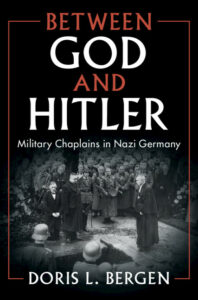 Bergen first asks what chaplains knew about the annihilation of the Jews and whether or not they sought to intervene. Working with letters individual chaplains sent to their bishops, friends, and family, official Wehrmacht reports on the chaplaincy, and more, Bergen paints an expected but devastating picture. Bergen demonstrates that the chaplains she studied were committed to their pastoral duties as they understood them. The chaplains celebrated religious services, counseled individual soldiers, and accompanied soldiers sentenced to death by a German court-martial on their final way. Before the war, Bergen shows, the chaplains continuously sought to prove their relevance to the soldiers in the field, both to prove their Germanic manliness and to prove themselves worthy of serving at the front. As Lauren Faulkner Rossi showed in her work Wehrmacht Priests: Catholicism and the War of Annihilation, the chaplains were constantly fighting efforts by the national socialist regime to curtail their activities, including the wartime decision not to replace chaplains killed or wounded in action with other chaplains and appoint Nationalsozialistische Führungsoffiziere (NSFO), national socialist leadership officers, instead. (Lauren Faulkner Rossi, Wehrmacht Priests: Catholicism and the War of Annihilation (Cambridge: Harvard University Press, 2015)). Beyond the fear of the NSFO, Bergen shows the chaplains continuously sought to prove their relevance to the soldiers in the field, both to prove their Germanic manliness and to prove themselves worthy of serving at the front.