Category Archives: Volume 31 Number 4 (Winter 2025)

Letter from the Editors (Winter 2025)

Contemporary Church History Quarterly

Volume 31, Number 4 (Winter 2025)

Letter from the Editors (Winter 2025)

By Lauren Faulkner Rossi, Simon Fraser University

Dear Friends,

Warmest Christmas greetings to our editors and readers. It has been a remarkable, productive, and very busy year for Contemporary Church History Quarterly, and I am pleased that we can once again finish on a strong note, with this final, somewhat tardy issue of the year stocked with varied contributions from several of our editors. Looking forward to 2026, I know that our journal will continue to be active and productive and, no doubt, relevant in ways both anticipated and unexpected.
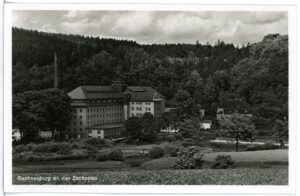
Sachsenburg Concentration Camp (1933). By Brück & Sohn Kunstverlag Meißen – Own work, CC BY-SA 3.0, https://commons.wikimedia.org/w/index.php?curid=52763635

Maria Mitchell examines Sarah Shorthall’s recent monograph about the impact of French Catholic theology on French politics in the twentieth century. She notes that Soldiers of God in a Secular World is wonderfully interdisciplinary and carefully researched, and constitutes a clear guide to complicated questions that have historical contexts but that continue to resonate, particularly about the relationship between religion and philosophy, and religious and secular thought.

Continue reading

Share

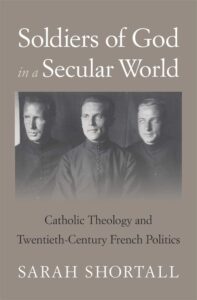
Review of Sarah Shorthall, Soldiers of God in a Secular World: Catholic Theology and Twentieth-Century French Politics

Contemporary Church History Quarterly

Volume 31, Number 4 (Winter 2025)

Review of Sarah Shorthall, Soldiers of God in a Secular World: Catholic Theology and Twentieth-Century French Politics. (Cambridge: Harvard University Press, 2021). pp. 338.

By Maria D. Mitchell, Franklin & Marshall College

Sarah Shorthall has written a sweeping, multidimensional account of the influence of French theology on twentieth- and twenty-first century European and global Catholic and policy, philosophy, and politics.  In lucid, accessible prose, Shorthall traces seemingly esoteric debates among Catholic thinkers with real-world consequences for the anti-fascist resistance, Christian Democracy, existentialism, Liberation Theology, Negritude, the Second Vatican Council, and post-structuralism.  By demonstrating religion’s ongoing significance to a dechurched Europe, this rich history punctures the false dichotomy of a secularized public sphere and religious private sphere to interrogate contemporary meanings of secularism.

Version 1.0.0

Catholicism’s fundamental challenge in the twentieth century – to define the Church’s role in a secularized public sphere – serves as a touchstone for French religious thought.  In imagining an “authentically Catholic modernity” (5), theologians, like nationalists and socialists, excavated centuries of tradition to design new forms of public Catholicism that would defy “the logic of secular political taxonomies” (134).  It was no coincidence that French theologians exercised outsized influence on European Catholicism; ironically, France’s expulsion of religious orders – the Jesuits in 1880 and Dominicans in 1903 – and the radical separation of Church and State in 1905 fostered the very conditions for theological renewal.  Providing refuge for priests from across France and abroad, the Dominican exile at Le Saulchoir in Belgium and especially the Jesuit seminary on the Channel Island Jersey offered isolation, an extensive library, and protection for young theologians from Vatican control.  Shaped by wartime “affective” bonds that facilitated intellectual daring, these seminarians-in-exile would lead a Catholic theological renewal known as the nouvelle théologie.  That they ultimately helped engineer Vatican II and inspire Popes John Paul II, Benedict XVI, and Francis more than justifies Shorthall’s detailed treatment of their writings.

Continue reading

Share

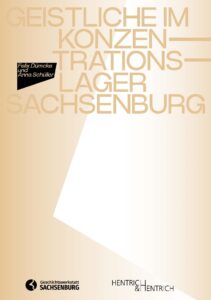
Review of Felix Dümcke and Anna Schüller, eds., Geistliche im Konzentrationslager Sachsenburg

Contemporary Church History Quarterly

Volume 31, Number 4 (Winter 2025)

Review of Felix Dümcke and Anna Schüller, eds., Geistliche im Konzentrationslager Sachsenburg. Berlin, and Leipzig: Hentrich & Hentrich, 2023.

Dirk Schuster, University of Vienna

Hardly anything has had such a lasting impact on (theological) church historiography on the churches in the Third Reich as the narratives of imprisoned clergymen. Over decades, these narratives about them have emphasized resistance, victimization, and the trope of the apologetic martyr. As is well known, clergymen were imprisoned in concentration camps for various reasons in the early years of Nazi Germany. One of these early concentration camps was the KZ Sachsenburg, in what is now the German federal state of Saxony. However, these early concentration camps differed greatly in structure and size from the later systematically planned concentration camps such as Sachsenhausen, Buchenwald and Auschwitz.

Against the backdrop of rampant right-wing extremism in Saxony, it is all the more surprising that the government of Saxony does not wanted to provide any money to renovate the remaining buildings of the Sachsenburg concentration camp for an on-site memorial.[1] Apparently, the Saxon government no longer saw the need to draw attention to the horrors of National Socialism in the early years as situated in an authentic site. Or perhaps they were simply too cowardly to face up to the anticipated outraged reactions of the far-right AfD Party (which are sure to follow) if they were to make funds available for the creation of an appropriate memorial. After all, it can’t be down to the cost amount; we are talking about just over one million missing Euros out of an estimated five million for the construction measures. Fortunately, at the end of June this year, the Saxon state government decided at the last minute to provide the missing funds after all.
Continue reading

Share

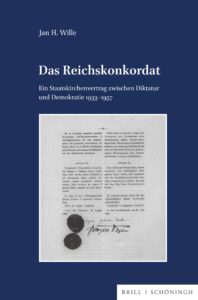
Review of Jan H. Wille, Das Reichskonkordat: Ein Staatskirchenvertrag zwischen Diktatur und Demokratie, 1933-1957

Contemporary Church History Quarterly

Volume 31, Number 4 (Winter 2025)

Review of Jan H. Wille, Das Reichskonkordat: Ein Staatskirchenvertrag zwischen Diktatur und Demokratie, 1933-1957. (Paderborn: Brill-Schöningh, 2024). Pp. 481.

By Martin Menke, Rivier University

This volume, the latest in the blaue Reihe published by the Kommission für Zeitgeschichte, is a useful reference work for those seeking to understand the long-term effects of the concordat between the German state and the Holy See, concluded in 1933 and still in effect today. That said, the volume’s five parts vary in their scholarly richness. The author, Jan H. Wille, currently serves as an associate at the Helmut Schmidt University of the Armed Forces in Hamburg.

The work under review is his revised dissertation, which the late Thomas Großbölting supervised before his untimely death. Like most German dissertations, it begins with a lengthy discussion of existing literature and investigatory approaches. The author asserts that the concordat of 1933 was one of a series of treaties negotiated between churches and the German state in the twentieth century. Generally, the concordat is not considered a Staatskirchenvertrag, as those concluded by the German government and the Protestant churches are. Most historians of the concordat consider it a diplomatic agreement between two sovereign entities.

Continue reading

Share

Article Note: García-Fernández, Mónica. “From National Catholicism to Romantic Love: The Politics of Love and Divorce in Franco’s Spain.”

Contemporary Church History Quarterly

Volume 31, Number 4 (Winter 2025)

Article Note: García-Fernández, Mónica. “From National Catholicism to Romantic Love: The Politics of Love and Divorce in Franco’s Spain.” Contemporary European History 31, no. 2 (2022): 2–14.

By Martina Cucchiara, Bluffton University

In this prize-winning article, Mónica García-Fernández examines the changing emotional regime of romantic love in marriage in the final phase of Franco’s dictatorship (1939–75). She argues that a shifting discourse on love and marriage that prized happiness and fulfillment had repercussions far beyond the private sphere. Rather, she writes, “the defense of romantic love and divorce went hand-in-hand with a demand for religious freedom, individual rights, the separation of church and state and, ultimately, democracy” (p. 2). This new discourse was so consequential because Continue reading

Share

Article Note: Ilari Taskinen, Risto Turunen, Lauri Uusitalo, and Ville Kivimäki, “Religion, Patriotism and War Experience in Digitized Wartime Letters in Finland, 1939–44”

Contemporary Church History Quarterly

Volume 31, Number 4 (Winter 2025)

Article Note: Ilari Taskinen, Risto Turunen, Lauri Uusitalo, and Ville Kivimäki, “Religion, Patriotism and War Experience in Digitized Wartime Letters in Finland, 1939–44,” Journal of Contemporary History 57 (2022): 577–96, doi: 10.1177/00220094211066006.

By Dirk Schuster, University of Vienna

In 2022, four Finnish scholars, Ilari Taskinen, Risto Turunen, Lauri Uusitalo, and Ville Kivimäki, published a truly fascinating and a forward-looking paper featuring a particularly pioneering methodological approach to analyzing historical sources in the Journal of Contemporary History 57. For their contribution, they analyzed letters written by Finnish soldiers during Finland’s three wars between 1939 and 1944, which at first glance may not sound spectacular or particularly innovative. The question of “religion, patriotism, and war experience” is equally unspectacular, to be honest. The study of religious elements in letters from and to soldiers during wartime is a common theme in academic work. Nevertheless, Taskinen and his colleagues have produced a truly promising and, above all, forward-looking contribution.

Continue reading

Share