Category Archives: News and Notes

Seminar Announcement: Moral Dilemmas and Moral Choice in the Holocaust

Contemporary Church History Quarterly

Volume 19, Number 4 (December 2013)

Seminar Announcement: Moral Dilemmas and Moral Choice in the Holocaust

United States Holocaust Memorial Museum, Center for Advanced Holocaust Studies

Program on Ethics, Religion, and the Holocaust

2013 Annual Seminar for Seminary and Religious Studies Faculty

Moral Dilemmas and Moral Choice in the Holocaust: Dietrich Bonhoeffer and Pius XII as Case Studies in Religious Leadership

 June 23-27, 2014

The Program on Ethics, Religions, and the Holocaust of the United States Holocaust Memorial Museum is pleased to announce its annual seminar for faculty from all disciplines but particularly for professors of theology, ethics, and religion at theological schools and other institutions of advanced education.  The seminar is scheduled for June 23-27, 2014.

Holocaust history provides complex, often troubling examples of the responses of religious groups, theologians, and leaders from across Europe.  As two of the most studied religious figures of this era, German Protestant theologian Dietrich Bonhoeffer and the Catholic pontiff Pope Pius XII offer significant insights into the larger theological, ecclesial, and political issues that shaped Christian reactions to National Socialism and the Holocaust. Bonhoeffer, a young Confessing Church pastor and theologian, eventually became involved in the conspiracy to overthrow the Nazi regime and was executed by the Nazis in 1945. Eugenio Pacelli was the Vatican’s secretary of state until he became Pope Pius XII in 1939. Both men have their defenders and critics, particularly with respect to their responses to the persecution of the Jews.  This seminar will explore the historical and theological complexities of their respective roles, as well as their legacies in shaping Christian understandings of the Holocaust after 1945.

The seminar will be co-taught by Victoria Barnett and Robert Ventresca.  Robert Ventresca is associate professor of history at King’s University College at Western University in London, Ontario (Canada), and the author of Soldier of Christ: The Life of Pope Pius XII (2013).  He is also the author of From Fascism to Democracy: Culture and Politics in the Italian Election of 1948 (2004) which received an honorable mention for the Canadian Historical Association’s Wallace K. Ferguson Prize.  Professor Ventresca was a founding member and inaugural Co-Chair of the former Center for Catholic-Jewish Learning at King’s University College at Western University. Victoria Barnett directs the Museum’s Programs on Ethics, Religion, and the Holocaust. She is also one of the general editors of the Dietrich Bonhoeffer Works English Edition, the translation of the complete 16-volume writings of Bonhoeffer being published by Fortress Press.  She is also the author of Bystanders: Conscience and Complicity during the Holocaust (1999) and For the Soul of the People: Protestant Protest against Hitler (1992).

Participants will also have the opportunity to learn more about Museum resources for their teaching and to consult and interact with Museum staff and visiting scholars. More information about the Museum’s programs on the history of the churches during the Holocaust can be found at www.ushmm.org/research/center/church/.

Candidates must be faculty members at accredited, degree-awarding institutions in North America.  Applications must include: (1) a curriculum vitae; (2) a statement of the candidate’s specific interest and purpose for attending the seminar; and (3) a supporting letter from a departmental chair or dean addressing the candidate’s qualifications and the institution’s potential interest in having Holocaust-related courses taught.

Admission will be decided without regard to age, gender, race, creed, or national origin. A maximum of twenty applicants will be accepted. For non-local participants, the Center will (1) reimburse the cost of direct travel to and from the participant’s home institution and Washington, DC, up to but not exceeding the amount of $500; and (2) defray the cost of lodging for the duration of the course.  Incidental, meal, and book expenses must be defrayed by the candidates or their respective institutions. All participants must attend the entire seminar.

Applications must be postmarked, emailed, or faxed no later than Monday, February 24, 2014, and sent to: Victoria Barnett, University Programs, Center for Advanced Holocaust Studies, United States Holocaust Memorial Museum, 100 Raoul Wallenberg Place, SW, Washington, DC 20024-2150 (Email: vbarnett@ushmm.org; Fax: 202-479-9726).  For questions, contact Victoria Barnett at 202-488-0469 or vbarnett@ushmm.org.  All applicants will be notified of the results of the selection process by Monday, March 24, 2014.

This seminar is made possible by the Hoffberger Family Fund and by Joseph A. and Janeal Cannon and Family.

Share

Conference Report: Reassessing Contemporary Church History, University of British Columbia, Vancouver, Canada, July 25-27, 2013

Contemporary Church History Quarterly

Volume 19, Number 3 (September 2013)

Conference Report: Reassessing Contemporary Church History, University of British Columbia, Vancouver, Canada, July 25-27, 2013

By Mark Edward Ruff, St. Louis University

This three-day conference brought twenty scholars from Canada, the United States and the Federal Republic of Germany to the campus of the University of British Columbia on the shores of Vancouver Bay to take stock of the current state of German church history in the 20th century, plot out the future direction for the new electronic journal, Contemporary Church History Quarterly and to honor the eighty-three year old Anglo-Canadian scholar and pioneer in the field, John Conway.

The keynote address from Thursday evening, “The Future of World Christianity” was delivered by Mark Noll, Professor of History at the University of Notre Dame. In his hour-long presentation, Noll contrasted the situation of Christianity in the Western and non-Western worlds for the years 1910 and 2010. Christianity has exploded numerically in Africa, Asia and Latin America, eclipsing its presence in what had at just a century earlier had been its European heartland. Noll began by highlighting the dramatic scope of recent changes. In 1970, there had been no legally open churches in China in 1970;  China may now have more active believers attending church regularly than does Europe.  Noll  argued that it was raw life-and-death struggles of poverty, disease, tribal warfare, social dislocation, and economic transformation that help explain this surge in religiosity outside of the western world.  He urged historians of Christianity to learn more about the work of African prophet-evangelists of the early 20th century like William Wadé Harris and Simon Kimbangu instead of focusing exclusively on better-known western theologians and churchmen.

Friday’s proceedings were divided into three distinct panels. The first, “The Changing Historiography of the Church Struggle, 1945 – 2013” highlighted the changing hermeneutics, value-systems, theological categories and historical methodologies that have been employed to instill meaning into the struggles of the churches against the National Socialist state. Mark Edward Ruff’s paper, “The Reception of John Conway’s, The Nazi Persecution of the Churches” analyzed why Conway’s pioneering work evoked profoundly different reactions in the English-speaking world and in the Federal Republic of Germany. In the Anglo-American world, it garnered praise; in Germany, it was largely met with criticism or indifference. Ruff argued that the very factors that ensured its mostly positive appraisals in the United States guaranteed its harvest of criticism and silence in Germany from those professional historians or churchmen charged with compiling the history of the churches under Nazi rule. Three dynamics contributed to the divided response to the work of a practicing Anglican – a confessional divide, a national divide and a methodological divide. Reflecting ongoing confessional fissures, non-Catholic politicians, churchmen, journalists, playwrights and scholars had shown a consistent willingness to enter into or launch public discussions about the Catholic past in the Third Reich, while their Roman Catholic counterparts in the press, ecclesia, intelligensia and academy rarely, if ever, spoke out openly about the Protestant past.  Negative reviews in Germany, moreover, reflected a heightened sensitivity to criticism not just from non-Catholics but from the Anglo-Saxon world, from where the majority of the non-German critical accounts of the recent past had come. And finally, Conway’s German critics assailed him for what they regarded as deficient methodologies, and in particular, his unwillingness to show the necessary empathy for his subjects and to employ what can be described as a Quellenpositivismus and refrain from making larger moral and historical judgments not born directly out of the sources he used.

Ruff’s account of the confessional dynamics in the German historical profession of the 1960s set the stage for Robert Ericksen’s paper, “Church Historians, “Profane” Historians, and our Odyssey Since Wilhelm Niemöller.” Wilhelm Niemöller was the younger brother to Martin Niemöller, an important leader of the Confessing Church during the Nazi era and a widely known prisoner of the regime after his arrest in 1937. Martin went on to serve in various church leadership positions after 1945, while Wilhelm emerged as the most important historian of the Protestant Kirchenkampf, or “Church Struggle,” in the first postwar decades. He quite consciously styled himself a “church historian,” separating himself from those historians designated “profane” in the German usage. In the 1960s he wrote, “It almost seems as if one could be satisfied with the rather shortsighted conclusion that church history and ‘profane’ history do not differ from one another.” Ericksen argued that Wilhelm Niemöller, in his effort to bring his faith to the task of writing history, distorted the history of the German Protestant Church under Hitler. He described the history of the Confessing Church, representing approximately 20% of Protestants, as if it were the history of the entire church. He also ignored those within the Confessing Church who supported Adolf Hitler and those who shared the antisemitic prejudices of the regime. Finally, Wilhelm Niemöller ignored the fact that both he and Martin had voted for the Nazi Party, and that he had joined the Party as early as 1923. Ericksen concluded by insisting that historians of churches must work as “profane” or secular historians, if they are to create a more usable and reliable history.

Manfred Gailus’ paper,  “Ist die “Aufarbeitung” der NS-Zeit beendet? Anmerkungen zur kirchlichen Erinnerungskultur seit der Wende von 1989/90,” examined how the Protestant church dealt with its own past from the Third Reich.  Focusing on the state church of Berlin-Brandenburg-schlesische-Oberlausitz (EKBO), Gailus focused on how Bishop Wolfgang Huber, one of the leaders of the Protestant church, practiced a politics of the past that can be regarded as representative for the Protestant church as a whole. In November 2002, Huber delivered a  committed and self-critical sermon for the annual  „day of repentance,“ a sermon which he dedicated to the memory of those Christians of Jewish heritage who had suffered and died in the Third Reich. This sermon can be regarded as a sign of Huber’s committed engagement with the past, one comparable with his efforts to compensate church slave laborers from the Second World War.  But his subsequent efforts to come to terms with the past began to flag almost immediately thereafter. In 2005, he chose to take up the theme of the „church and the new social movements of the 1960s and 1970s“ – and not the church struggle of the 1930s – as the major theme for the fiftieth anniversary of the „Evangelische Arbeitsgemeinschaft für Kirchliche Zeitgeschichte.“ He also stayed out of the longstanding debates about the future of the Martin-Luther-Memorial- Church in Berlin-Mariendorf, a church that had been built during the Third Reich, decorated with sundry Nazi symbols and now enjoyed the protective status as a „historical landmark.“  The church under Huber, Gailus concluded, has certainly come a long way forward in its approach to the Nazi past but still lags behind the standards set not only by professional historians but by the larger public. It remains in urgent need of powerful initiatives to kick-start its reassessment of the past.

The second panel, „Theology, Theological Changes and the Ecumenical Movement“ brought to the table the fruits of recent research. Victoria Barnett’s paper, “Track Two Diplomacy, 1933-1939: International Responses from Catholics, Jews, and Ecumenical Protestants to Events in Nazi Germany,” showed how events that unfolded in Nazi Germany and Europe between 1933 – 1939 sparked a number of significant and ongoing initiatives among international religious leaders. This was particularly true of religious bodies whose scope was international and touched on ecumenical or interfaith issues; such bodies included the Holy See in Rome, ecumenical offices in Geneva and New York, and the conferences of Christians and Jews in the UK and the United States.  Such initiatives were also driven by individual Protestants, Catholics, and Jews who were committed to fighting against National Socialism and helping its victims.  Many of these individuals, Barnett pointed out, became involved early in refugee-related issues.  Other issues of common concern included the ideological and political pressures on both Protestant and Catholic churches in Germany and the desire to prevent another European war.  After the war began, many of these same circles had contacts with different German resistance circles, and some of these leaders wrote “think pieces” on the necessary moral foundations for a postwar peace.  Although the Catholics and Protestants involved in these activities represented a distinct minority within their respective churches, an examination of their interactions, including their contacts with representatives of Jewish organizations, offers a much fuller picture of the international religious responses to Nazism and show the extent of interreligious communication even before 1939 as an attempt at “track two diplomacy.”

Matthew Hockenos’ paper “‘Blessed are the Peacemakers, for They Shall be called Sons of God’: Martin Niemöller’s Embrace of Pacifism, 1945-55”  focused on the theological transformations in the decade from 1945 to 1955 for the former Confessing Church leader and hero, Martin Niemöller. Niemöller, Hockenos showed, jettisoned the ZweiReicheLehre (Doctrine of Two Kingdoms) and championed a political role for the Church.  He abandoned German nationalism and became a leader of the ecumenical movement. He denounced war and the remilitarization of Germany and gradually came to adopt pacifism. Hockenos, however, made clear that Niemöller’s embrace of pacifism did not occur over night, as Niemöller had implied in his own account of his meeting with the German scientist Dr. Otto Hahn. It was a gradual process that one can trace from the time of his liberation to 1955. It appears to have been the result of a number of factors and events. These included including his own reflection on the destructiveness of WWII and the imminent danger that the Cold War posed to Germany, the outbreak of the Korean War, contact with ecumenical-minded church leaders abroad, and the deliberate efforts of pacifists in the United States and in Europe to convince Niemöller that the only position a true Christian could take on war was to be against because it was inimical to the message of Christ.  From 1954 on Niemöller made it his primary goal to expand the circle of pacifists person by person through education and example. Just as his pacifist colleagues had slowly reeled him in through conversations and dialogue, he traveled the globe, frequently visiting Communist nations, preaching the way of non-violence and extolling the teachings and example of Mahatma Gandhi.

Wilhelm Damberg’s paper, „Vergangenheitsbewältigung und Theologie nach dem Konzil:  J.B. Metz, die politische Theologie und die Würzburger Synode (1971-1975),” drew the attention of conference participants to a major theological paradigm shift in how the Roman Catholic Church in Germany came to terms with its past under National Socialism. Ironically, Damberg noted, this seismic shift has largely remained unknown to historians. It took place during the Würzburg Synod of 1971 to 1975, which was charged with implementing the resolutions and decrees of the Second Vatican Council in Germany. The central document for these changes was one bearing the name „Our Hope: A Commitment to Faith in our time.“ It prepared by the renowned German theologian, Johann Baptist Metz, and bore the hallmarks of Metz’s own so-called „Political Theology.“ This document met with the overwhelming approval of the synod.  Metz shaped its content around the concept of a collective „examination of conscience,“ which confessed the guilt and failure of „a sinful church“ particularly towards the Jews of the Third Reich. In the formal debates about this document, disagreements broke out about the appropriate way to understand history. Metz defended himself against criticism of his historical judgments by insisting that historical consciousness and actual reconstructions of the past remained two separate things. For the church of the present, it was the former that matter. Metz, Damberg argued, was deconstructing historical narratives that Metz himself saw as being in direct opposition to the epochal theological change of „theology after Auschwitz.“

The third panel on Friday, “Expanding the Borders: Inter and Intra-National, Interdisciplinary and Cross-Cultural Narratives” pointed out new directions for historical research. Thomas Großbölting led off with his paper„‚Kirchenkampf gibt es immer‘: Memory Politics as a Point of Reference for an inner-ecclesiastical Counter-culture.” Großbölting made his focus those moments in the 1960s and 1970s when special groups within the churches and individual Christians referred to the Nazi past.  How, he asked, did they draw connections between themselves and the church struggle from the 1930s?  He argued that the silence of the 1950s regarding the Nazi past was replaced in the second half of the 1960s by greater openness – and even bluntness. For the new social movements and special interest groups within the churches, in particular,  the politics of remembrance became a major point of orientation and mobilization. Organizations as disparate as Una voce, Unum et semper, the confessional movement “No other gospel”, the German branch of Opus Dei and “Christians for socialism” all sought to find new ways of living the personal faith and to radicalize the Christian Gospel.  For conservatives, radicalization meant bring the Christian Gospel back to its roots; for left-wingers, it meant rediscovering the communist ideals of the early church. Großbölting, in turn, showed how such groups like Catholic student parishes and Protestant confessional movements referred to the Nazi-past in general and to the Church struggle, in particular, as a way to realize these aims.  In spite of the enormous attention they found from the media at the end of the 1960s, the impact of these movements remained limited. The Protestant counter-movement took up the battle cry, “Kirche muss Kirche bleiben” –Church must remain the Church.” But even these stirring words, Großbölting concluded, never found much resonance among the ordinary members of the Protestant and the Catholic Church.

In his paper, “Conflict and Post-Conflict Representations: Autobiographical Writings of German Theologians after 1945,” Björn Krondorfer showed how the questions of gender, and male gender in particular, and of retrospective historical representatives, are central to our analyses of the postwar church. Krondorfer argued that gendered roles and identifications allowed German men in institutions like the church to adjust to a new environment after 1945. His paper critically analyzed the autobiographies of two Protestant German male theologians published after 1945, and in particular, those of  Walter Künneth ( Lebensführungen: Der Wahrheit verpflichtet; 1979) and Helmut Thielicke (Zu Gast auf einem schönen Stern; 1984.) Realizing that their autobiographical act of remembering placed them into a morally and politically charged historical context, these two theologians carefully crafted their memoirs, employing apologetic and eluding strategies when accounting for their lives during the 1930s and 1940s. The theme of “German suffering” often looms largely in these memoirs, while Jews are mostly absent; hence, the boundaries between victim and perpetrator are constantly blurred. As “helpless victims,” these men might run the risk of being effeminized, as “acting subjects” they might run the risk of being accused of moral failure. Versions of this mental split, Krondorfer argued, are to be found in almost all post-1945 autobiographies of German male theologians.

Suzanne Brown-Fleming’s paper, “Real-Time Narrative Responses to Nazism: March/ April 1933 in Germany and Rome” focused on the Catholic diplomatic response to the earliest antisemitic measures of the Nazis. On April 1, the Nazis ordered a boycott of Jewish businesses, department stores, lawyers and physicians on April 1, 1933, the first centrally directed action by the National Socialists against Jews after the Seizure of Power.  The Civil Service Law of 7 April was the first to contain the so-called “Aryan Paragraph,” stipulating that only those of Aryan descent could be employed in public service.  Brown-Fleming Using drew upon the recently-released records of the Vatican nunciature in Munich and Berlin during the tenure of Pope Pius XI. She discussed the exchanges between Pope Pius XI, then-Secretary of State Eugenio Pacelli (Pope Pius XII, 1939-1958), his diplomat in Germany, Cesare Orsenigo, German bishops, and ordinary Catholics and Jews. The elections of March 5, 1933, she argued, revealed a dissonance between the Nazi party, Catholic Center Party voters, and Catholics who hoped to find some way to be both true to their bishops and to Hitler. That dissonance, she concluded, affected the response of the Vatican Secretariat of State and German bishops to the first anti-Jewish laws in April 1933 in ways that still need to be further explored.

The third day of the conference was devoted to a discussion of the future direction of the electronic journal, Contemporary Church History Quarterly. This journal had its origins in the electronic brainchild of John Conway, what he upon his retirement from the University of British Columbia in 1995, modestly called “The Newsletter.”  This was an eclectic mixture of book reviews and notices about events dealing with contemporary international and ecumenical church history. A recipient of a Humboldt Research fellowship in 1963-4 and a founding member of the Scholars’ Conference on the German Church and the Holocaust in 1970, Conway was best known for his masterwork from 1968, The Nazi Persecution of the Churches 1933-1945, the first extensive history in English of the National Socialists’ campaign against the German churches and the responses of both the Roman Catholic and Protestant churches. He developed this free monthly electronic newsletter to provide a speedier flow of information on new publications on the history of the churches in the 20th century. Traditional quarterly journals were far too slow in informing readers of new publications and works in progress. In addition, they tended to reach only specialized academic audiences – and not the lay and religious audiences just as keenly interested in the highly charged topic of the churches’ conduct during the Nazi era such as the conduct of Pope Pius XII and the responses of the churches to the Holocaust.  Sent out by email to a list-serve of subscribers, Conway’s newsletter went by the name of the Association of Contemporary Church Historians (ACCH), or Arbeitsgemeinschaft kirchlicher Zeitgeschichtler.

In 2009, Conway turned over the helm of the Newsletter to an editorial board, which now includes sixteen theologians and historians based in Germany, Canada, the United States and the United Kingdom. The editorial board members, almost all of whom were gathered in Vancouver, discussed future directions for the journal, and in particular, how to further transatlantic cooperation. Kyle Jantzen, who almost single-handedly engineered the journal’s technical transformation from a newsletter sent out by an email list-serve to a web-based presence, gave an overview of the journal’s new features and the number of hits recent issues and articles have been receiving. Members also discussed the possibility of developing a continuously updated on-line data base that will compile the new publications in the field – journal articles, articles in edited volumes, edited volumes and monograph – from both sides of the Atlantic.

Last and most significantly, the concluding evening of the conference honored the pioneering work of John Conway, who has distinguished himself not only through his scholarly work but in his tireless efforts to bring together scholars from multiple disciplines and nations. Doris Bergen, Robert Ericksen, Steven Schroeder, Kyle Jantzen, and Gerhard Besier offered formal tributes in the course of Saturday evening.

Share

Reflections on the Indian Residential Schools and the work of the Truth and Reconciliation Commission of Canada

Contemporary Church History Quarterly

Volume 19, Number 3 (September 2013)

Reflections on the Indian Residential Schools and the work of the Truth and Reconciliation Commission of Canada

By Steven Schroeder, University of the Fraser Valley

The Truth and Reconciliation Commission of Canada (TRC) will convene in Vancouver, British Columbia for one week this month (18-21 September 2013) to hear survivors tell of their experiences in the Indian Residential Schools, and to encourage reconciliation between Indigenous and non-Indigenous peoples in Canada.[1]  The work of the TRC has exposed weighty historical problems for all Canadians, but it has also provided Canadians opportunities to re-examine their country’s colonial policies, processes of nation-building and national identity formation, and its human rights record.  For Christians, this work has evoked reason for critical reflection concerning mission work, evangelism, the role of the church in society, church-state relations, and how to best atone for past misdeeds.

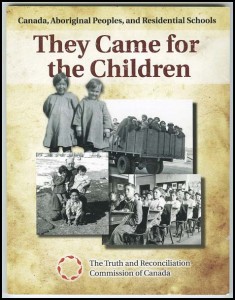
For over a hundred years (1880s-1996), the Canadian government partnered with the mainline churches — Roman Catholic, Anglican, Presbyterian, and United (and unofficially with Mennonite and Baptist organizations) – in running the Indian Residential School system.  The 140 schools that comprised the system were found in every province and territory, even the northernmost regions of the Canadian arctic.  The Indian Act, which mandated that Aboriginal children attend the schools, and court injunctions that threatened parents with arrest if they did not comply, ensured school enrollments.[2]  In all, over 150,000 Aboriginal children – beginning at the age of six – were forcibly removed from their homes to attend state-sponsored, church-run schools.  Hundreds of lawsuits stemming from abuses in the schools have led to numerous actions, including the establishment of the TRC.  The first task of the TRC was to establish and disseminate the facts regarding the school system.  The 2012 book They Came for the Children: Canada, Aboriginal Peoples, and Residential Schools is a product of the commission’s work.

TRC-ReportThe book explains how the churches in Canada began their missionary work of converting Aboriginals to Christianity and to western cultural practices long before confederation.  This foundation proved useful to Canadian government officials who found accord with the church leaders’ intent “to civilize and Christianize” Aboriginal children.[3]  Together, the government and the churches expanded the existing church education infrastructure to all of Canada with the intent to, as government officials put it, “kill the Indian in the child.” The campaign to eliminate Canada’s “Indian problem” was to be achieved through assimilation, extinguishing Aboriginal culture, and eliminating Aboriginal interest in land claims.  Although Canada’s population would be multi-racial, the success of the assimilation campaign would ensure that all Canadians were sufficiently “civilized” (i.e., westernized and Christian), thereby reducing the government’s treaty obligations considerably.[4]
The horrible accounts in the book reveal terrible abuses that the vast majority of these students experienced in the dysfunctional, ill-planned, and under-funded school system.  Students were abused emotionally, physically, and sexually, and they were punished for using their language.[5]  Tuberculosis and other serious illnesses were rampant, and the death rate was very high (at school, and after release).  For instance, during the first decade of operations at the residential school at Qu’Appelle, 174 of 344 students died from a variety of illnesses.[6]  Funding was woefully inadequate, leaving students undernourished and tasked with all sorts of labour jobs, thus sidelining school work.  The utter failure of the residential school system was obvious to all by the early 1900s, and many people – even some government officials – supported closing the schools decades prior to their actual closure.[7]

The history of the residential schools has only partly been realized by the Aboriginal community, and has been almost entirely unknown to the non-Indigenous population in Canada.  It seems that the churches and the government intended for the abuses of the failed campaign to fade away with the schools themselves.  However, the Canadian Royal Commission on Aboriginal Peoples’ 1996 report documented the suffering of the students in the residential schools, which gave rise to hundreds of legal claims aimed at the churches and the federal government.  The resulting 2007 Indian Residential Schools Settlement Agreement totaled $1.9 billion, $60 million of which was designated for the establishment and activities of the TRC.

The mandate of the TRC – to find facts and foster reconciliation – has been frustrated from the outset of its mission due to the Canadian government’s refusal to open its archives to the commission’s researchers (They Came for the Children is based mostly on published materials).[8]  Even though Prime Minister Stephen Harper gave a formal apology on behalf of the Canadian government in 2008, one has to wonder about what the apology actually addressed, and what remains overlooked.  Withholding the documents has added to past indignities, deepened the distrust between Canadians and their government, and limited the scope of reconciliatory work.  In response, Aboriginal writer Leanne Betasamosake Simpson recently called on the Canadian government to: “Honour the apology.  Release the documents.  Be on the right side of history on this one.  It’s the very, very least you can do.”[9]

The government’s resistance to full cooperation with the TRC has not kept other researchers from finding new information on human rights violations in the residential schools.  Recent research by food historian Ian Mosby has revealed that Canadian nutritionists partnered with government agencies and church personnel in conducting nutritional and pharmaceutical experiments on malnourished Aboriginal children in six residential schools.[10]  Food rations were kept low intentionally, and any useful findings were to benefit non-Indigenous Canadians (which they did).  One wonders about what other accounts exist in the archival documents that have remained under lock and key, but it appears that we may soon find out.  An Ontario court injunction of January 2013 forced the hand of the government, and in August 2013 the first researchers from the TRC gained access to the federal government’s records of the residential schools.  The research team now finds itself on a tight schedule, as the TRC’s mandate expires in mid-2014.

The residential school system is truly Canada’s national shame.  At stake is the integrity of the government, the churches, and the very fabric of Canadian society.  The government’s lack of cooperation in the fact-finding stage of the TRC’s work has impeded reconciliation.  How can Canadians address their past appropriately, when they don’t know the facts?  Without the facts, how can all Canadians work together toward a better future?  Head of the TRC, Chief Wilton Littlechild, has rightly claimed: “People just don’t know the history [of the residential schools], and once they know the history, they’ll make the connection as to why there is such a high rate of addiction, and why there is such a high rate of suicide and unemployment [in some Aboriginal communities].”[11]  Also at stake is the integrity of the churches.  Some Christian pacifists in Canada who claimed Conscientious Objector status during the Second World War, satisfied their alternative service requirement by joining the teaching staff in the racist, abusive residential schools.  This, and related accounts of Christian reasoning for complicity in the school system brings into question aspects of Christian pacifism, Christian missions, evangelism, the role of the church in society and nation building, and the relationship between church and state.  Some Christians have begun to address these issues positively, and in new ways.  During 1991-1998, all of the churches involved in the schools issued formal apologies for their respective roles in the schools, and the churches have continued to work toward reconciliation with Indigenous peoples.[12]  These efforts will be encouraged at the TRC events in Vancouver, where one will find church tents for conversation, healing, and reconciliation.

Even if Aboriginal survivors of the residential school system were left to initiate the processes of reconciliation through airing grievances, lawsuits, and court injunctions, the results of these actions have been promising.  With the TRC publicly revealing these facts and raising awareness among Canadians, Canadians now have the opportunity to respond, and to act in keeping with their long, proud history of being “peacekeepers.”  There is plenty of peacebuilding work to be done within their own communities, between peoples of diverse backgrounds, cultures, and worldviews.  To date, the response in Canadian cities to the work of the TRC has been mostly positive, evident in thousands of people attending the TRC events, including walks for reconciliation.  It would appear that the public is on board.[13]  Sustaining and growing this interest among Indigenous and non-Indigenous peoples in Canada is crucial to moving forward the reconciliatory work that is already underway.


Notes:

[1] For information on the Vancouver Truth and Reconciliation Commission events in September 2013, see: http://www.myrobust.com/websites/vancouver/index.php?p=719#.  For events at universities in the Vancouver area, see: University of the Fraser Valley: http://www.ufv.ca/indigenous/day-of-learning/  University of British Columbia: http://irsi.aboriginal.ubc.ca/  Simon Fraser University: http://www.sfu.ca/reconciliation.html

[2] Truth and Reconciliation Commission of Canada, They Came for the Children: Canada, Aboriginal Peoples, and Residential Schools.  (Winnipeg: TRC, 2012), 18.

[3] TRC, They Came for the Children, 10.

[4] TRC, They Came for the Children, 6.

[5] TRC, They Came for the Children, 1,2,10,37-45

[6] TRC, They Came for the Children, 17

[7] TRC, They Came for the Children, 17, 19.

[8] Truth and Reconciliation Commission of Canada, Interim Report (Winnipeg: TRC, 2012), 15-16.

[9] Leanne Betasamosake Simpson, “Honour the Apology,” blog entry (23 July 2013): http://leannesimpson.ca/2013/07/23/honour-the-apology/#more-866 (p.3)

[10] See Ian Mosby, “Administering Colonial Science: Nutrition Research and Human Biomedical Experimentation in Aboriginal Communities and Residential Schools, 1942-1952,” Food Deprivation and Aboriginals,” Histoire sociale/Social History, vol. XLVI, 91 (Mai/May 2013): 145-172

[11] Jamie Ross, “Littlechild: Commission will uncover the truth – Residential schools:  Head of commission says system tore apart families,” May 30th, 2011  http://media.knet.ca/node/11250

[12] See TRC, They Came for the Children, 81.  Official apologies regarding the Residential Schools were as follows: Roman Catholic Oblate (1991), Anglican Church of Canada (1993), Presbyterian Church of Canada (1994), and United Church of Canada (1998).  For publications and websites, see:   The United Church of Canada, Justice and Reconciliation: The Legacy of Indian Residential Schools and the Journey Toward Reconciliation. (United Church: 2001); Jeremy Bergen, Ecclesial Repentance: The Churches Confront their Sinful Pasts. (Continuum: 2011); Mennonite websites: http://bc.mcc.org/whatwedo/TRC; http://mcbc.ca/trc-2013/ ; Anglican website: http://www.anglican.ca/relationships/trc ; Presbyterian website: http://presbyterian.ca/healing/more/; Roman Catholic website: http://www.cccb.ca/site/eng/media-room/archives/media-releases/2008/2590-launching-of-truth-and-reconciliation-commission-an-opportunity-for-healing-and-hope

[13] Environics Research Group, 2008 National Benchmark Survey, Indian Residential Schools Resolution Canada

and the Truth and Reconciliation Commission, 2008.  This survey revealed that “Fully two-thirds (67%) of Canadians believe that individual Canadians have a role to play in efforts to bring about reconciliation in response to the legacy of the Indian residential schools system, even if they had no experience with Indian residential schools.” (29)


Share

Book Note: Vera K. Fast, ed., Companions of the Peace Diaries and Letters of Monica Storrs, 1931-1939

Contemporary Church History Quarterly

Volume 19, Number 3 (September 2013)

Book Note: Vera K. Fast, ed., Companions of the Peace Diaries and Letters of Monica Storrs, 1931-1939 (Toronto: University of Toronto Press, 1999), ISBN 0-8020-8254-8, 246 Pp.

By John S. Conway, University of British Columbia

In November 1938, one of the more remarkable responses to Hitler’s brutal pogrom against the German Jews—the Kristallnacht—came from a remote Anglican parish in distant northern British Columbia.
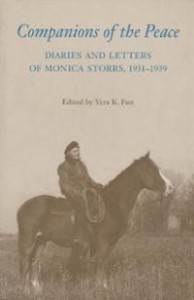
Monca Storrs, the parish worker at St Martin’s Church, Fort St. John, in the newly settled Peace River District, was so outraged that she spontaneously contacted George Bell, the Bishop of Chichester and chairman of the Church of England Committee for non-Aryan Christians, and offered to sponsor and act as guardian to two young victims, if the bishop could arrange for them to be brought to England, and if they were willing to come out and live in what she described as “the very western edge of the British Empire”.

Fast-CompanionsMonica was a cultured English gentlewoman who had volunteered in 1931 to come out to western Canada to help build up the Anglican Church amongst the isolated and often impoverished homesteaders of the Peace Dictrict. Luckily, at the end of 1938, Monica was taking a home leave, so she was able to meet the two German boys when they arrived in England on one of the “Kindertransporte” which rescued several thousand children in the few short months before the outbreak of war.
Horst, later Hugh, Schramm and Arwed, later David, Lewinski had been selected through the Society of Friends office in Berlin, where Bishop Bell’s sister-in Law, Laura Livingstone, took care of the transport and the paperwork involved. The children had to say goodbye to their parents on the Berlin railway station platform, not knowing when or if they would ever meet again. In Hugh’s case, his father was killed fighting in Russia, but his mother managed to escape to Shanghai. She and her son were later reunited when she migrated to the United States after the war was over. In David’s case, both his parents were deported to Auschwitz, where his mother died but his father survived. In 1953 David was at last able to fly over to Germany to meet his father again, after fourteen cruel years of separation.
Monica had hoped to bring the boys back with her to Canada when she returned in 1939, but bureaucracy intervened. The Canadian government was still reluctant to admit Jewish refugees, even Christian ones. On her way home, she stopped off in Ottawa to intervene personally with the immigration officials and even secured an interview with the Governor-General, Lord Tweedsmuir, to ask for his help. But it took a year before permission was granted for the boys to accompany a group of English children being evacuated to Canada. Eventually they arrived in British Columbia to be greeted most warmly by Monica and her colleagues in the community she had established as the Companions of the Peace.

This generous response undoubtedly saved the lives of these two refugee boys. But for years this international and humanitarian gesture remained unknown. This book shows us this inspiring example of one woman’s resolute service and outreach from furthest western Canada to help alleviate the terrible crimes of the Holocaust.

Share

Research Note: New Works on German Roman Catholicism Published within 2012-2013

Contemporary Church History Quarterly

Volume 19, Number 3 (September 2013)

Research Note: New Works on German Roman Catholicism Published within 2012-2013

By Kevin P. Spicer, C.S.C., Stonehill College

Keeping up with the ever-expanding literature on recent German church history remains a daunting challenge. We hope this list of newer publications on the Roman Catholic Church in Germany serves to aid CCHQ readers who research or teach in this area.

Anderson, Margaret Lavinia.  “Anatomy of an Election:  Anti-Catholicism, Antisemitism, and Social Conflict in the Era of Reichsgründung and Kulturkampf.”  In Von Freiheit, Solidarität und Subsidiarität – Staat und Gesellschaft der Moderne in Theorie und Praxis.  Festschrift für Karsten Ruppert zum 65. Geburtstag.  Edited by Markus Raasch and Tobias Hirschmüller.  Berlin:  Duncker & Humblot, 2013:  39-95.

Bankier, David, Dan Michman, and Iael Nidam-Orvieto, eds.  Pius XII and the Holocaust:  Current State of Research.  Jerusalem:  Yad Vashem, 2012.

Bennette, Rebecca Ayako.  Fighting for the Soul of Germany:  The Catholic Struggle for Inclusion after Unification.  Cambridge, MA:  Harvard University Press, 2012.

Bergen, Doris L. “Speak of the Devil:  Hubert Wolf on Pope Pius XI and the Vatican Archives” (Review Essay).  Harvard Theological Review 105 (2012): 115-121.

Beschet, Paul, SJ.  Mission in Thuringia in the Time of Nazism.  Translated by Theodore P. Fraser.  Milwaukee, WI:  Marquette University Press, 2012.

Burkard, Dominik.  Johannes Baptista Sproll:  Bischof im Widerstand.  Stuttgart:  Kohlhammer, 2013.

Cieslak, Stanislaw.  “Auf der Suche nach Versöhnung.  Kardinal Adam Kozlowieckis Erinnerungen an seine Zeit im KZ Dachau.”  Stimmen der Zeit 230 (2012): 397-408.

Connelly, John.  From Enemy to Brother:  The Revolution in Catholic Teaching on the Jews 1933-1965.  Cambridge, MA:  Harvard University Press, 2012.

Coppa, Frank J.  The Life & Pontificate of Pope Pius XII.  Between History & Controversy.  Washington, DC:  The Catholic University of America Press, 2013.

Dahlke, Benjamin.  “Zwischen Gegnerschaft und Kollaboration.  Zur Geschichte der Philosoph-Theologischen Akademie Paderborn während des Nationalsozialismus.”  Jahrbuch für mitteldeutsche Kirchen- und Ordensgeschichte  8 (2012): 49-82.

Deschner, Karlheinz.  Mit Gott und den Faschisten:  Der Vatikan im Bunde mit Mussolini, Franco, Hitler und Pavelic.  Reprint (new press).  Freiburg:  Ahriman, 2012.

Ehret, Ulrike.  Church, Nation and Race:  Catholics and Antisemitism in Germany and England, 1918-45.  Manchester:  Manchester University Press, 2012.

Eisner, Peter.  The Pope’s Last Crusade:  How and American Jesuit Helped Pope Pius XI’s Campaign to Stop Hitler.  NY:  William Morrow, 2013.

Ericksen, Robert P.  Complicity in the Holocaust.  Churches and Universities in Nazi Germany.  Cambridge:  Cambridge University Press, 2012.

Feldmann, Christian. Einen Eid auf Hitler?  Nie.  Franz Reinisch:  Ein Leben für die Menschenwürde.  Vallendar:  Patris, 2012.

Fibich, Jan Kanty.  Die Caritas im Bistum Limburg in der Zeit des „Dritten Reiches“ (1929-1946).  Mainz:  Gesellschaft für Mittelrheinische Kirchengeschichte, 2012.

Flammer, Thomas.  Nationalsozialismus und katholische Kirche im Freistaat Braunschweig 1931-1945.  Paderborn:  Ferdinand Schöningh, 2013.

Gerber, Stefan.  “Vom Barnabasbrief zum ‘Mythus des 20. Jahrhunderts’:  Philipp Haeuser (1876-1960).”  In Von Freiheit, Solidarität und Subsidiarität – Staat und Gesellschaft der Moderne in Theorie und Praxis.  Festschrift für Karsten Ruppert zum 65. Geburtstag.  Edited by Markus Raasch and Tobias Hirschmüller.  Berlin:  Duncker & Humblot, 2013:  427-448.

Goldstein, Phyllis.  A Convenient Hatred:  The History of Antisemitism.  Brookline, MA:  Facing History and Ourselves, 2012.

Helbach, Ulrich, ed.  Akten deutscher Bischöfe seit 1945.  Westliche Besatzungszonen 1945-1947.  2 Volumes.  Paderborn:  Ferdinand Schöningh, 2012.

Hesemann, Michael.  Hitlers Religion.  Reprint (new press).  Augsburg:  Sankt Ulrich, 2012.

Holzbauer, Matthias.  Der unselige Papst.  Pius XII. und seine Verstrickung in die Verbrechen des 20. Jahrhunderts … und weshalb der Vatikan ihn seligsprechen will.  Marktheidenfeld:  Das Weisse Pferd, 2012.

Houlihan, Patrick J.  “Local Catholicism as Transnational War Experience:  Everyday Religious Practice in Occupied Northern France, 1914-1918.”  Central European History  45 (2012): 233-267.

Hürten, Heinz. “50 Jahre Kommission für Zeitgeschichte:  Überlegungen zu Problemen der Katholizismusforschung.”  In Von Freiheit, Solidarität und Subsidiarität – Staat und Gesellschaft der Moderne in Theorie und Praxis.  Festschrift für Karsten Ruppert zum 65. Geburtstag.  Edited by Markus Raasch and Tobias Hirschmüller.  Berlin:  Duncker & Humblot, 2013:  753-760.

Käßmann, Margot, ed.  Gott will Taten sehen.  Christlicher Widerstand gegen Hitler.  Ein Lesebuch.   Munich:  C. H. Beck, 2013. Kidder, Annemarie S., ed.  Ultimate Price:  Testimonies of Christian who Resisted the Third Reich.  Maryknoll, NY:  Orbis Books, 2012.

Kitzmüller, Stefan.  “Der österreichische Franziskaner P. Zyrill Fischer (1892-1945).  Früher Widerstand gegen den Nationalsozialismus.”  Wissenschaft und Weisheit.   75 (2012):  80-101.

Lapomarda, Vincent A.  The Catholic Bishops of Europe and the Nazi Persections of Catholics and Jews.  Lewiston, NY:  The Edwin Mellon Press, 2012.

Lawler, Justus George.  Were the Popes Against the Jews?  Tracking the Myths, Confronting the Ideologues.  Grand Rapids, MI:  William M. Eerdmans, 2012.

Legge, Jerome S., Jr.  “Resisting a War Crimes Trial:  The Malmedy Massacre, the German Churches, and the U.S. Army Counterintelligence Corps.”  Holocaust and Genocide Studies 26 (2012): 229-260.

Loth, Wilfried.  “Der Katholizismus und die Durchsetzung der modernen Demokratie.”  In Von Freiheit, Solidarität und Subsidiarität – Staat und Gesellschaft der Moderne in Theorie und Praxis.  Festschrift für Karsten Ruppert zum 65. Geburtstag.  Edited by Markus Raasch and Tobias Hirschmüller.  Berlin:  Duncker & Humblot, 2013:  737-751.

Malak, Henryk Maria.  Shavelings in Death Camps.  A Polish Priest’s Memoir of Imprisonment by the Nazis, 1939-1945.  Translated by Bozenna J. Tucker and Thomas R. Tucker.  Jefferson, NC:  MacFarland, 2012.

Nagel, Anne C.  Hitlers Bildungsreformer.  Das Reichsministerium für Wissenschaft, Erziehung und Volksbildung 1934-1945.  Frankfurt:  Fischer, 2012.

Nirenberg, David.  Anti-Judaism:  The Western Tradition.  NY:  W.W. Norton, 2013.

Pfister, Peter, ed.  Eugenio Pacelli – Pius XII (1876-1958):  In View of Scholarship.  Translated by Christof Morrissey. Regensburg:  Scnhell und Steiner, 2012.

Porter-Szűcs, Brian.  Faith and Fatherland:  Catholicism, Modernity, and Poland.  NY:  Oxford University Press, 2012.

Recker, Klemens-August.  „Unter Preußenadler und Hakenkreuz“Katholisches Milieu zwischen Selbstbehauptung und AuflösungMünster:  Aschendorff, 2012.

Sciolino, Athony J.  The Holocaust, the Church, and the Law of Unintended ConsequencesHow Christian Anti-Judaism Spawned Nazi Anti-Semitism. A Judge’s Vedict.   Bloomington, IN:  iUniverse, 2012.

Seeger, Hans-Karl and Herman Hösken.  Dechant Josef Lodde – Coesfelds Fels in der braunen Flut.  Christliche Zivilcourage zur Zeit des Nationalsozialismus.  Berlin:  LIT, 2012.

Tec, Nechama. Resistance:  Jews and Christians Who Defied the Nazi Terror.  New York, NY:  Oxford University Press, 2013.

Thomas, Gordon.  The Pope’s Jews:  The Vatican’s Secret Plan to Save Jews from the Nazis.  NY:  Thomas Dunne Books/St. Martin’s Press, 2012.

Tomberg, Friedrich.  Das Christentum in Hitlers Weltanschauung.  Munich:  Wilhelm Fink, 2012.

Ventresca, Robert A.  Soldier of Christ:  The Life of Pope Pius XII.  Cambridge, MA:  Harvard University Press, 2013.

Verhofstadt, Dirk.  Pius XII. und die Vernichtung der Juden.  Translated by Rudy Mondelaers.  Aschaffenburg:  Alibri, 2013.

Wolf, Hubert, ed.  Eugenio Pacelli als Nuntius in Deutschland.  Forschungsperspektiven und Ansätze zu einem internationalen Vergleich.  Paderborn:  Ferdinand Schöningh, 2012.

——.  “Reichskonkordat für Ermächtigungsgesetz?  Zur Historisierung der Scholder-Repgen-Kontroverse über das Verhältnis des Vatikans zum Nationalsozialismus.” Vierteljahrshefte für Zeitgeschichte  60 (2012):  169-200.

Zedler, Jörg.  Bayern und der Vatikan.  Eine politische Biographie des letzten bayerischen Gesandten am Heiligen Stuhl Otto von Ritter (1909-1934).  Paderborn:  Ferdinand Schöningh, 2013.

Zuccotti, Susan.  Pére Marie-Benoît and Jewish Rescue:  How a French Priest Together with Jewish Friends Saved Thousands during the Holocaust.  Bloomington, IN:  Indiana University Press, 2013.


Share

Book Note: Annemarie S. Kidder, ed., Ultimate Price. Testimonies of Christians Who Resisted the Third Reich

Contemporary Church History Quarterly

Volume 19, Number 2 (June 2013)

Book Note: Annemarie S. Kidder, ed., Ultimate Price. Testimonies of Christians Who Resisted the Third Reich (Maryknoll, NY: Orbis Books, 2012), 177 Pp., ISBN 9781570759550.

By John S. Conway, University of British Columbia

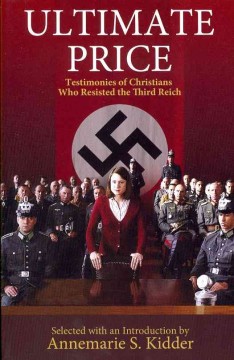
kidder-ultimateThis short selection of texts written by seven notable Germans who resisted the Nazi onslaught against their Christian faith will be a helpful introduction for beginners in this field. While the testimonies of Dietrich Bonhoeffer have been known in English translation for many years, it is good to have these brief and excellently translated extracts from the writings of lesser known figures, such as Sophie Scholl, the Munich student executed for her protests against Nazi totalitarianism, or of Jochen Klepper, the well-known novelist, who committed suicide with his Jewish wife in 1942. On the Catholic side, the Jesuit Father Alfred Delp was also executed for his involvement with the July 1944 plot to overthrow Hitler. His prison letters are, like Bonhoeffer’s, an inspiring witness to his enduring faith. Less known to English-speaking readers will be the testimony of Franz Jägerstätter, the Austrian farmer, executed for his refusal to serve in Hitler’s army, or the courageous stand of the Berlin Cathedral Provost, Bernhard Lichtenberg, who prayed publicly for the persecuted Jews and for the prisoners in concentration camps, for which he was arrested and sent to prison. The only survivor, the Jesuit Father Rupert Mayer, was already arrested in 1937 for his provocative sermons critical of the regime. His refusal to be silenced led to his being imprisoned again in 1938, and then to being placed under house arrest in a distant monastery in 1940. The common theme of all these witnesses was their determination to protest against the injustices of the Nazi regime, even though their motives for doing so varied widely. They were all well aware of their isolation in adopting such views, but were resolved to defend the integrity of their Christian beliefs. Their readiness to challenge the majority’s obeisance, gullibility or fearfulness is what makes these testimonies so compelling. This little book will undoubtedly help to uphold their memory among a wider public, in the hope that their sacrifices will resonate far beyond their own times or their original homeland.
Share

Article Note: Benjamin Pearson, “The Pluralization of Protestant Politics: Public Responsibility, Rearmament, and Division at the 1950s Kirchentage”

Contemporary Church History Quarterly

Volume 19, Number 2 (June 2013)

Article Note: Benjamin Pearson, “The Pluralization of Protestant Politics: Public Responsibility, Rearmament, and Division at the 1950s KirchentageCentral European History 43 (2010), 270-300.

By Matthew D. Hockenos, Skidmore College

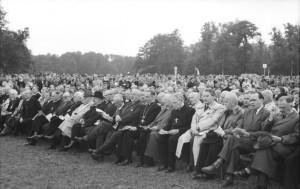
Bundesarchiv, Bild 183-25414-0111 / CC-BY-SA

Kirchentag 1954 in Leipzig. Source: Bundesarchiv, Bild 183-25414-0111 / CC-BY-SA

After WWII and twelve years of Nazi rule Catholic and Protestant church leaders in Germany agreed that at the center of Germany’s reconstruction needed to be a renewal of Christian values. They urged church members to take active, personal responsibility for political life. This was an especially strong sentiment among members of the former Confessing Church. The churches participated in the establishment of the Christian Democratic Union so that Christian values could have a more influential role in the political sphere and Reinhold von Thadden-Trieglaff founded the Kirchentag in 1949 to strengthen the faith and public responsibility of Protestant laity. Although Catholics and Protestants co-existed in the CDU it was in the late 1940s and early 1950s an uncomfortable co-existence because they differed on several issues, such as division, rearmament, and confessional schools. Adenauer’s policies challenged Christian unity. He won over Catholics and many conservative Protestants but lost the Protestant Left associated with Karl Barth, Gustav Heinemann, and Martin Niemöller. Pearson traces the manifestations of this split in the political debates that took place in the 1950s Kirchentage. The debates in the early 1950s were so caustic that “rather than promoting public responsibility and Christian unity for the transformation of German society, the churches were instead tearing themselves apart.” Eventually, however, the split among Protestants, he argues, forced the Protestant Church “to accept-even embrace-the liberal democratic value of political pluralism.” Protestants from both sides came to see political disagreement and debate as a positive sign of a working democracy.

Share

Conference Announcement: Reassessing Contemporary Church History

Contemporary Church History Quarterly

Volume 19, Number 2 (June 2013)

Conference Announcement: Reassessing Contemporary Church History, University of British Columbia, Vancouver, Canada, July 25-27, 2013

By Steven Schroeder, University of the Fraser Valley

Members of the editorial board of Contemporary Church History Quarterly are pleased to announce a conference entitled “Reassessing Contemporary Church History,” to be held at the University of British Columbia from July 25-27, 2013. The conference will serve three purposes: it will bring together members of the editorial board and a number of prominent scholars from Germany, the United States, and Canada to discuss how to expand the scope and functions of the Quarterly; it will provide a forum for the leading scholars in the field to present cutting-edge research and broaden the discipline; and it will provide an ideal setting for these scholars to honor the pioneering work of Professor John Conway, who has distinguished himself not only through his scholarly work but in his tireless efforts to bring together scholars from multiple disciplines and nations.

The conference will begin at Regent College on Thursday, July 25, with the keynote address by Professor Mark Noll, titled: “The future of World Christianity.” This lecture is open for all to attend. After two days of presentations, panel discussions, and board meetings, the conference will conclude on Saturday, July 27, with a tribute dinner to Professor John Conway, and an outing to view the magnificent fireworks display – the annual “Celebration of Light” – in the Vancouver harbor.

The conference program is as follows:

Thursday, July 25
Location: Regent College, 5800 University Boulevard, Vancouver

7:00 Keynote Address: Mark Noll, “The Future of World Christianity”

Friday, July 26
Location: Buchanan Tower, UBC (11th Floor Seminar Room)

9:00-10:45 The Changing Historiography of the “Church Struggle”, 1945 – 2013
Chair: Lauren Faulkner (University of Notre Dame, USA)
Commentator: Gerhard Besier (Technische Universität, Dresden)

1. Mark Edward Ruff (Saint Louis University, USA)- “Historiographical Battles in the 1960s after Hochhuth and the Reception of John Conway’s The Nazi Persecution of the Churches in Germany”
2. Robert Ericksen (Pacific Lutheran University, USA) – “Church Historians, Profane Historians and our Odyssey since Wilhelm Niemoeller”
3. Manfred Gailus (Technische Universität Berlin) – „Ist die “Aufarbeitung” der NS-Zeit beendet? Anmerkungen zur kirchlichen Erinnerungskultur seit der Wende von 1989/90”

11:15-1:00 Theology, Theological Changes and the Ecumenical Movement
Chair: Steven Schroeder (University of the Fraser Valley, Canada)
Commentator: Kevin Spicer (Stonehill College, USA)

1. Victoria Barnett (United States Memorial Holocaust Museum) – “Boundary Crossings: Conversations between the Ecumenical Movement and Catholic and Jewish Representatives, 1932 – 1948”
2. Matthew Hockenos (Skidmore College) – “From Nationalist to Ecumenist: The Transformation of Martin Niemöller´s Theology”
3. Wilhelm Damberg (Ruhr-Universität-Bochum) – „Vergangenheitsbewältigung und Theologie nach dem Konzil: J.B. Metz, die politische Theologie und die Wuerzburger Synode (1971-1975)“

2:00 – 4:15 Expanding the borders: Interdisciplinary and Cross-Cultural Narratives
Chair: Beth-Griech Polelle (Bowling Green State University, USA)

1. Thomas Großbölting (Westfälische-Wilhelms-Universität Münster): “Kirchenkampf gibt es immer: Erinnerungspolitik in innerkirchlichen Konflikten”
2. Kyle Jantzen (Ambrose University College, Canada) : “Other Church Struggles? Church-State Relations in Hitler’s Germany and Mobutu’s Zaire”
3. Suzanne Brown-Fleming (United States Holocaust Memorial Museum): “Catholics in the International Tracing Service: Research Opportunities”
4. Bjorn Krondorfer (Northern Arizona University): “Gender and Post-Conflict Representations: Autobiographical Writings of German Theologians after 1945”

6:00 – 9:00 Dinner Cruise: Vancouver Harbor

Saturday, July 27
Location: Regent College, (Basement, Rooms 11 &14)

9:00- 10:30 Expanding the profile of the Contemporary Church History Quarterly

11:00- 1:00 Creating a Transatlantic Database

6:00 – 9:00 Dinner and Tribute to Professor John Conway

10:00 – 11:00 Vancouver Harbor Fireworks (Celebration of Light)


Share

Conference Report: Catholicism in Germany: Contemporary History and the Present

Contemporary Church History Quarterly

Volume 19, Number 1 (March 2013)

Conference Report: Catholicism in Germany: Contemporary History and the Present (Katholizismus in Deutschland – Zeitgeschichte und Gegenwart), October 26 – 27, 2012, Katholische Akademie in Bayern

By Mark Edward Ruff, Saint Louis University, and Christoph Kösters, Kommission für Zeitgeschichte, Bonn

On September 17, 1962, a new Catholic historical association was called into existence – the Association for Contemporary History, or as it was known in German at the time, die Kommission für Zeitgeschichte bei der Katholischen Akademie in Bayern. To celebrate its fiftieth anniversary, nearly 200 researchers from various academic disciplines, journalists, clergymen, contemporaries and interested laity gathered at the birthplace of the Kommission at the Catholic Academy in Bavaria. From their meeting-place on the edge of the English Garden in Munich, they discussed its origins and steps for future research into German Catholicism.

The dozen panelists took up three major questions:  What historical context led to the founding of this historical association?  How did its subjects for research and its historical methodologies change over five decades?  What can a historical retrospective of this association tell us about future directions for research into German Catholicism?  The conference focused on three distinct eras – the Nazi era, the “long sixties,” in which scholarly work into the church’s past under National Socialism received a decisive impetus, and finally the present.  In some of its panels, scholars from the latter two eras were paired up.  Younger historians offered a look back at the debates, controversies and trends that shaped the Association’s founding and activities in the 1960s; they were immediately followed by commentaries from historians, theologians and sociologists whose work began in earnest from the late 1950s through the early1970s.  A closing podium discussion allowed the audience to pose questions directly to a group of five scholars of contemporary religion and debate the state of the field.

The founding of the Kommission für Zeitgeschichte served as the point of departure for the conference. Mark Edward Ruff (St. Louis) placed this seminal event within the context of the historical controversies over the Roman Catholic Church’s past during the Nazi era. It was the battles of the legal status of the Reichskonkordat from 1933 and the controversies over unflattering reinterpretations of the Catholic past from critics like the legal scholar and historian, Ernst-Wolfgang Böckenförde, and the American Catholic sociologist, Gordon Zahn, that helped catalyze its founding between 1959 and 1962. Ruff was followed by Hans Maier, the CSU politician and scholar, who discussed the limitations of Catholic resistance during the Third Reich.

Antonius Liedhegener (Luzern) argued that organized lay-Catholicism helped consolidate the church’s acceptance of democracy in the “long sixties.” These lay organizations accepted the increasingly pluralistic society of the Federal Republic of Germany and played a powerful role in solidifying German civil society.  Presenting an array of statistical data from public opinion polls, Liedhegener criticized those interpretations which focused on the role of protest movements in 1968 in securing support for a “second founding of the Federal Republic.” The ensuing discussion made clear that his mental shift was facilitated by new understandings of religious freedom that emerged out of the Second Vatican Council and of the new role for the “church in the world.”

In the second section, “The Future of Research into Catholicism,”  Frank Bösch (Potsdam) focused on the relationship between the media and German Catholicism.  Bösch argued that the media itself underwent a process of fundamental transformation during the long sixties. It was not an impartial commentator summarizing events as they occurred but an independent actor with its own agenda.  In providing its own interpretation of religious messages and calling for different forms of spirituality, the new media world helped pluralize the world of German Catholicism. It gave a loudspeaker to alternative voices that in the preceding decades had scarcely been heard.  Franziska Metzger (Fribourg), in turn, focused on the transformation of religious and theological semantics.

In the ensuing discussion, some in the audience questioned the extent to which transformations in religious vocabulary were specific to the domain of Catholicism: were they part of a larger societal transformation? Others were troubled by the methodologies derived from cultural history and linguistics. Is it no longer possible to speak of “Catholicism” as a coherent subject for inquiry, particularly as it became increasingly pluralized by the late 1960s and old forms of political Catholicism became a relic of the past? This discussion was intensified by Matthias Sellmann’s (Bochum) analyses of present-day Catholicism. He laid out a picture of the transformation into which the church had been forced by modern society.  Since the late 1990s, the Roman Catholic church has gone from being perceived as an “institution” with a specific religious mission to fulfill to an “organization” with no homogenous and controllable social form.

On the second day of the conference, five young scholars — Thomas Brechenmacher (Potsdam), Franziska Metzger, Ferdinand Kramer (Munich), Thomas Großbölting (Münster), Olaf Blaschke (Heidelberg) and Harry Oelke (Munich) — took to the podium to discuss perspectives for future research. They all agreed that comparative religious history that crossed denominational and national borders was necessary, so long as scholars did not lose sight of the peculiarities of Catholicism. They also called for further work into the history of gender and religion.

The conference closed with a dialogue between the two chairmen of the Kommission für Zeitgeschichte, Wilhelm Damberg (Bochum) and Michael Kißener (Mainz) over what the panels and discussions about new methodologies and research subjects could signify for the future of their institution as it enters into its next half-century of life.  Both concluded that questions about religious and ecclesiastical change from the 1960s through the 1970s will move to the center of historical research into Catholicism, the need to further pursue the history of the church and of Catholicism under the totalitarian dictatorships of the 20th century notwithstanding. Damberg and Kißener accordingly noted that questions about the Catholic milieu and its formation in the 19th century will recede in importance.  In light of these changes, they insisted that it will remain necessary for the Kommission to continue publishing the many volumes of church documents, for which it gained a strong reputation already in the late 1960s and 1970s.

Rather remarkably, there was little to hear about the Second Vatican Council itself, which began just a few weeks after the Kommission was founded in September, 1962. One might also speculate how differently the discussions and panels might have unfolded had Pope Benedict XVI announced his resignation in October 2012 rather than in February 2013. All in all, however, the conference provided a valuable opportunity to take stock of the state of the field at what seems to be a moment of transition.

Share

Conference Report: German Studies Association Conference, October 4-7, 2012, Milwaukee, Wisconsin

Contemporary Church History Quarterly

Volume 19, Number 1 (March 2013)

Conference Report: German Studies Association Conference, October 4-7, 2012, Milwaukee, Wisconsin

By Kyle Jantzen, Ambrose University College

GSAOnce again this past year, the German Studies Association conference included a number of interesting panels or papers devoted to contemporary church history.

The panel “Questioning Nazism as a ‘Political Religion'” offered new research relating to debates around the questions: was National Socialism a fundamentally anti-Christian political movement?  Was Nazism itself a political religion, a rival to traditional forms of Christianity?  Or, as Richard Steigmann-Gall has argued, was the Nazi Party led by politicians who understood themselves as Christians and even attempted to forge an unorthodox partnership with German Protestants and (to a lesser extent) German Catholics?  Three papers approached these questions from complementary directions. Beth Ann Griech-Polelle examined how Nazi ideologues viewed one of Germany’s allies, General Francisco Franco, whose collaboration with the Spanish Catholic Church inspired commentary which was sharply critical of “political Catholicism.”  Daniel A. McMillan argued that secularization constituted a significant cause of the Holocaust, in part because the concept of Nazism as a political religion helps explain why the Holocaust, more than any other genocide, was driven by ideology divorced from “practical” considerations.  Kyle Jantzen explored the efforts of a Berlin Protestant pastor to fuse Christianity and National Socialism, provoking opposition from both Nazi Party activists and leaders of the pro-Nazi German Christian movement, in the process revealing the many complexities of the relationship between National Socialism and organized religion.

In all, four members of the Contemporary Church History Quarterly editorial team presented papers in three panels scattered throughout the conference. Along with Griech-Polelle and Jantzen, mentioned above, Robert P. Ericksen presented “Antisemitism through the Lens of Denazification: Examples from Göttingen University,” as part of a panel which considered postwar assessments of pro- or anti-Nazi activities during the Third Reich. Here Ericksen continued to develop his recent research on the failings of the denazification process, highlighted by cases concerning  German academics. Finally, Steven Schroeder presented “‘The World Will Not Leave Us Alone’: Reconciliation and Peacebuilding in Germany, 1945-1949,” one of the papers in a panel on “Discourses of Victimization and Reconciliation Amid the Rubble.”

Another panel of interest was “The Work of the State and the Work of God: Religious Groups, Social Vocation, and State Violence.” Martina Cucchiara of the University of Notre Dame presented her paper, “Beyond the Concordat: Women’s Religious Negotiation of Free Spaces in Hitler’s Germany.” She discussed the notion of selective accommodation–complying with externals such as the Hitler Greeting and embracing the Nazi vision of community, nationalism, and heroism, while downplaying racial and antisemitic aspects of the regime. Stephen Morgan, also from the University of Notre Dame, contributed the paper “Between Reservation and Extermination: Rhenish Missionaries and the Herrero Genocide,” which explored the complex and compromised relationship between the German missionaries and the Herrero people. Missionaries approved of the reservation system, because it made the Christianization of the African people somewhat easier to accomplish. When the Herrero War ended this experiment, missionaries adapted to the changing conditions, but in the process lost credibility both with Europeans who found them too friendly to the Herrero and with the Herrero, who did not appreciate the missionaries’ encouragement to cease their rebellion. In the end, the missionaries were caught between their Christian interest in evangelism and the government’s interest in mobilizing colonial labour. Suzanne Brown-Fleming, another member of the Contemporary Church History Quarterly editorial team, commented ably on the papers, noting the common process of Christian adaptation to state interest and ideology and pointing out that–at some point–selective accommodation simply turns into assent.

One other paper of interest was James McNutt’s “‘They sought world domination … so he died’ Adolf Schlatter, Deicide, and Der Stürmer.” McNutt compared Streicher’s and Schlatter’s racial and theological attitudes towards Jews, noting linkages between racial hatred and religious antipathy. He argued that Schlatter was an important figure in German Protestantism, and that his social alienation of Jews contributed to their defamation as the evil other, enemies of God, and allies of Satan.

Share

New Sources on the Roman Catholic Church and the Holocaust: Summer Research Workshop for Scholars

Contemporary Church History Quarterly

Volume 19, Number 1 (March 2013)

New Sources on the Roman Catholic Church and the Holocaust: Summer Research Workshop for Scholars, August 13-24, 2012, Center for Advanced Holocaust Studies, United States Holocaust Memorial Museum, Washington, DC

By Mark Edward Ruff, Saint Louis University

This seminar held at the United States Holocaust Memorial Museum from August 13-24, 2012 brought together ten scholars and archivists from Italy, Canada, France, Israel, Poland, the United States, and the Vatican.  It was convened by Charlie Gallagher, SJ, Assistant Professor of History at Boston College, and Mara Dissegna, a postdoctoral fellow at the University of Modena.

Its keynote address, “The Tribunalization of History,” was delivered by Alberto Melloni, Professor of the History of Christianity at the University of Modena. Melloni examined how it came to be that history on this subject has so often been written in the style of “tribunalization,” or that of a judge on a tribunal.  Scholarship on the history of the Roman Catholic Church in the first half of the 20th century, he argued, has often consisted of presenting indictments,  mustering up evidence for and against the accused, delivering verdicts of guilt or innocence, imposing sentences and, even on occasion, informing the public of what form restitution should take. For Melloni, this outcome was hardly surprising.  The legwork for later scholarly analysis was often done by war crimes tribunals convened by the victorious Allies, the Israeli government and the West German government.

Since many of these, including the Nuremberg trials, the Eichmann trial of 1961, the Frankfurt war crimes trials and the trial of Klaus Barbie in 1987, occupy a permanent place in the popular imagination, those writing about the Roman Catholic past invariably fell back on courtroom semantics.  The German playwright Rolf Hochhuth, who denounced the silence of Pius XII in his play, The Deputy, had his major character voice an indictment with the emotions of a state prosecutor: “A Deputy of Christ who sees these things and nonetheless permits reasons of state to seal his lips — who wastes even one day in thought, hesitates even for an hour to lift his anguished voice in one anathema to chill the blood of every last man on earth — that Pope is … a criminal.”

For Melloni and the participants in the seminar, it became an imperative to overcome the distinct limitations to this mode of tribunalization, and most notably, its reliance on simple dichotomies of guilt and innocence. Transcending these limitations ultimately necessitates historicizing the process of tribunalization itself.  It is the historian`s duty, they concluded, to become aware of present-minded agendas that have shaped scholarship, including those of the current day. The battles over the past have shaped not just interpretative frameworks but the actual evidence itself which has been handed down to our generation of historians. In the postwar era, for instance, the actors from the years of Fascism and National Socialism compiled their documents and wrote their personal memoirs in response to allegations about the Roman Catholic Church’s complicity with extreme right-wing movements.

Seminar participants were able to demonstrate just how pervasive criticisms of the church’s conduct were already in 1945 and, in some cases, between 1933 and 1945. Archival documents and first-hand historical accounts were thus put together with this criticism in mind at the close of the war and again in the 1960s and 2000s.  The eleven volume set of papal documents commissioned by Pope Paul VI, Actes et documents du Saint-Siège relatifs à la  période de la Seconde Guerre Mondiale,  were a response to the criticisms of Rolf Hochhuth. The 2005 opening of the papers from the pontificate of Pius XI, and in the not-too-distant future papers from the pontificate of Pius XII, was the result of growing public criticisms in the late 1990s and early 2000s that took the shape of books like John Cornwall’s, Hitler’s Pope.

Participants in this seminar were also given the opportunity to draw upon photocopies and microfilm reels from the archives of the United States Holocaust Memorial Museum. These documents originally came from the Vatican Nunciatures, or Vatican embassies in Munich and Berlin, the Vatican Secretariat of State, the Affairs of the Ecclesiastical Extraordinary in Bavaria, the U.S. State Department, the British Foreign Office regarding Palestine, the Archive for the Fascist Office for Demography and Race, the Central Italian State Archives, the Swiss Police Jewish Refugee Records and the Second Vatican Council.

Though the research interests of the participants were chronologically and geographically eclectic, several recurring themes — Vatican diplomacy, clerico-Fascism and Zionism — gave the seminar a larger unity. What was the relationship of the Vatican to the Fascist regime in Italy and the National Socialist regime in Germany? To what extent did individual Roman Catholics evince attitudes and policies that diverged from positions of the official church? How did Roman Catholic attitudes towards Jews and the Zionist movement change between the 1910s and the 1960s in Italy, the United States and Germany?

The individual presentations in the seminar, in turn, addressed aspects of these questions. James Mace Ward presented an account of Reverend Josef Tiso, the enigmatic Slovak nationalist fluent in Hungarian who moved from being a nationalist priest to become a fascist leader of a European state.  Between 1923-1930, Tiso became increasingly anti-Semitic, a stance which he, however, could turn on or off depending on the needs of the moment. At the same time, Tiso was consumed with the “defense of the Church,” and his ideas were strongly rooted in Catholic social teachings.

Robert Maryks presented an account of Pietro Tacchi-Venturi, a Jesuit priest and architect of the 1929 Lateran Accords which created the Vatican. He met with Mussolini more than one hundred times.  Like Tiso, Tacchi-Venturi was a complex figure. He supported the 1938 Italian racial laws and the building of walls between Jews and Catholics. But at the same time, he tirelessly dedicated much of his energy and time to helping the victims of Mussolini’s racial laws.  He provided aid to every Jew who applied to him for assistance. He furnished passports, secured the release of Jews from concentration camps and facilitated the “Aryanization” of baptized Jews.

Charles Gallagher focused on Charles E. Coughlin, the well-known “radio priest” from Detroit who aligned himself with Fascist theories and fascist propaganda.  Gallagher aimed to modify the existing picture of the Canadian-born radio-priest which relied primarily on documents from official church archives. New documents from Jesuit and Protestant archives, Gallagher pointed out, paint a different picture. They make clear that various leaders of the Catholic church in America had concluded that he could be considered a Fascist – but they repeatedly refused to identify him as such publicly.

Mark Edward Ruff focused on the role of Johannes Neuhäusler,  the cathedral canon of the archdiocese of Munich who led an illegal courier service to the Vatican between 1933 and 1941. He supplied Eugenio Pacelli and others with documentary evidence of the Nazi state`s persecution of the Roman Catholic Church. One of Neuhäusler`s couriers, the Munich lawyer Josef Müller, also was involved in the circles in the German army plotting to overthrow Hitler. Through Müller and others, Pope Pius XII became involved in a plot to launch a coup in 1939 and early 1940.

Mara Dissegna, Adrian Ciani and Paolo Zanini focused on the question of the Vatican’s relationship to Zionism. All noted the Vatican’s strong opposition to the establishment of a Jewish homeland. A mass held in Boston to protest the creation of the Jewish state in the late 1940s, for instance, drew tens of thousands of participants. Piero Doria and Claire Maligot, finally, both examined the Second Vatican Council’s reappraisal of traditional positions towards Judaism and other world religions.


Share

Conference Report: Holocaust Scholarship: Personal Trajectories, Professional Interpretations

Contemporary Church History Quarterly

Volume 18, Number 4 (December 2012)

Conference Report: Holocaust Scholarship: Personal Trajectories, Professional Interpretations, Capetown, South Africa, 20-22 August 2012

By Doris Bergen, University of Toronto

This conference, sponsored by the Kaplan Centre for Jewish Studies and Research at the University of Cape Town in association with the South African Holocaust and Genocide Foundation, revolved around the theme, “personal trajectories, professional interpretations.” In keeping with this, the organizers – Susannah Heschel, Michael Marrus, Milton Shain, and Christopher Browning – invited participants to reflect on connections between their life experience and their scholarship. Each of the sixteen speakers tackled this challenge in a different way. The result was an intense and stimulating three days with a surprising number of presentations that addressed religion, specifically Christianity and Judaism. My report focuses on those parts of the conference most relevant to contemporary church history.

Robert Ericksen spoke most directly to the history of Christianity, in a paper titled “Pastors and Professors: Assessing Complicity and Unfolding Complexity.” Ericksen asked whether the churches and universities as a whole were complicit in Nazi crimes. “Yes,” he answered. Their praise for Hitler was genuine, he maintained; their lack of resistance was evidence of overall support; and they played a significant role by granting the regime a kind of public permission for its existence and its actions. Dietrich Bonhoeffer’s family never went to church, Ericksen noted, so “he didn’t catch that virus.” Ericksen’s presentation was not as personal as many of the others, although he began by presenting some formative moments, among them an hour-long conversation in 1989 with Emanuel Hirsch’s son. The topic: had Hirsch senior been a Nazi?

My paper was on “Protestants, Catholics, Mennonites, and Jews: Identities and Institutions in Holocaust Studies.” I used my research on the Volksdeutschen and the Wehrmacht chaplains to argue for the importance of ambiguous categories and institutional dynamics. Most relevant for our context, I analyzed how the chaplaincy served to legitimate the German war of annihilation. Rather than the familiar notions of “silent bystanders,” I showed Christians as participants – sometimes willing, sometimes reluctant – in the destruction of Jewish lives. I did not attribute these insights to the fact I am a “Mennonite farm girl from Saskatchewan” (as I was once introduced at a conference), but I did learn something about how religious institutions function from a decade at Notre Dame.

Karl Schleunes’s presentation, “Wrestling with the Holocaust,” looked back to publication in 1970 of The Twisted Road to Auschwitz. Often described as a foundational “functionalist” work, Schleuenes’s original edition did not even include the word “Holocaust.”  But it did inspire him to contemplate teaching a course on the subject, which he began to do in 1988, under the heading, “Holocaust: History and Meaning.” His religious upbringing, Schleunes told us, played a key role. He grew up a German Protestant in small-town Wisconsin, where he heard echoes of the Nazi era. The gospel accounts of the crucifixion – “May his blood be upon us and our children” – the myth of Jews as Christ-killers – these notions were deeply embedded in Christianity, Schleuenes said, not only in Luther’s “On the Jews and Their Lies,” but in the American Bible belt. When he tried to answer the question, “Why the Jews?,” he found the only way to do so was to begin with Christianity, a painful confrontation for many of his students.

But if Christian anti-Judaism were so crucial, asked Steven Aschheim, why did the Holocaust occur only in the 1940s? You can’t have continuity and uniqueness at the same time, he insisted. In his presentation, “Autobiography, Experience, and the Writing of History,” Aschheim emphasized the “massively transgressive nature of the Shoah.” It is not so much Judaism as “Jewishness” that interests him, he said, and the Germans who appealed most to him – Marx, Freud, Einstein, Kafka – were makers of modern universal thought whom he long didn’t even know were Jewish. Instead they embodied a humanizing impulse.  Aschheim, influenced by his childhood in South Africa and disillusioned with what he called the naïve Zionism of his youth, is currently writing a book on the political economy of empathy.

Antony Polonsky, who grew up just a few blocks from Aschheim, titled his talk, “From Johannesburg to Warsaw: How I Came to Write a Three-Volume History of the Jews of Poland and Russia.” Polonsky turned not to Zionism but to Communism, and he too grew disillusioned. In 1967-68 he identified with Polish students’ calls for democratic reform, and it pained him when the ANC supported the Warsaw Pact intervention in Czechoslovakia. Solidarity friends encouraged him to contact Jews in Poland, and in the 1980s he got involved in efforts to bridge the division between Jewish and Polish histories. His goal: to produce and foster scholarship that was neither sentimental nor negative.

David Cesarani gave one of the most personal presentations, under the tantalizing title, “Tony Judt and Me: Autobiographical Reflections on Writing History, the Holocaust, and Hairdressing.”  Highlighting parallels between his youth and Judt’s, Cesarani offered a glimpse into what it meant to grow up Jewish in Britain, where immigrants from many parts of the world crossed paths and where class, accent, and district of origin obstructed mobility. (Judt’s mother Stella grew up in a working-class district speaking Cockney; she was “very discreet about her Jewishness.”)

In “Holocaust and Comparative History” Steve Katz took a different approach and brought in his  personal details as jokes. (While at Cambridge Katz played cricket for his College, which made him “wicket keeper for Jesus.”) Katz’s main point was about the Holocaust’s singularity. With regard to the structure of mass murder, he contended, the Holocaust is distinct. In every other case, a central idea causes the violence but also limits it. Katz offered the example of the witch craze, which he described as rooted in Christian misogyny. But the Church found a way to domesticate the threat of women’s sexuality and offered not only Eve the seductress but also the Virgin Mary. The same is true of Christian antisemitism, Katz maintained: the Church did not murder the Jewish people; the Christian vision of Jews was dialectical. No comparable dialectic operated in the Shoah, Katz argued. For Hitler the Jewish issue was central, so every time there was a choice between the racially genocidal program and other options, the racially genocidal program won out.

In her paper, “From Lucy Dawidowicz to Timothy Snyder: Holocaust Studies Viewed from the Perspective of Jewish Studies,” Susannah Heschel provided a challenging and deeply humane perspective. She grew up among German Jewish refugees, and half her family are Hasidic rebbes. Yet her father’s friends included Christian theologians too, she noted, and he showed no bitterness or resentment. For him religion was the most important factor against racism and war. Heschel discovered the problems in Christian theology as a college student when she read Bultmann, she recalled. Protestant theologians were fascinated by racial theory and considered it modern and scientific. After the war the German Christians melted into the wider culture, and Christianity became a cover for old ideas – that the Jewish god was a violent god who commanded Jews to kill non-Jews; that Nazi obedience to authority came from Judaism.

Meanwhile, Heschel indicated, the field has its problems: Holocaust courses attract some people looking for an emotional experience, and instrumentalization of the Holocaust has become a “nightmare.” Where Dawidowicz promoted a sense of Jewish pride in being victims, Snyder’s book has a quality of ressentiment, and his explicit descriptions of horrors rob people of their humanity. For her part, Susannah said, she is returning to the sensibilities of her childhood. She misses the gentleness, piety, and holiness of the Hasidic rebbes and seeks to regain a sense of disbelief. At the same time, she concluded, yearning for religion cannot substitute for the hard work of democratic politics.

For those of us who were in South Africa for the first time, one of the most stimulating parts of the conference was the panel on “Nazism and Holocaust: Intersections with South African Experience.” Though religion was not a main focus, it came up here, too. According to David Welch, there is little evidence that Nazism had a direct influence on apartheid ideas. Certainly all of the rightist organizations were antisemitic, he observes, and the Afrikaans churches did not try to stop the Nazi virus from spreading in their communities. Still, apart from a few dissident clergy, they rejected the notion of a Nazi-style dictatorship. Milton Shain agreed that membership in South African Fascist groups was small but noted their high visibility. They exerted pressure against Jewish refugees from Germany and fueled wider attacks on Jews as promoters of miscegenation and enemies of the Afrikaner nation. When a ship with 500 Jewish refugees arrived in 1936, professors at Stellenbosch University led a protest.

An important intervention regarding Christianity came from a member of the audience, the freelance writer Claudia Braude. What about the discourse of forgiveness, she wanted to know. Hadn’t it been invoked in South Africa by people responsible for all manner of crimes, from corruption to murder, to push the burden of “reconciliation” onto the shoulders of those already victimized?  In South Africa, Braude maintained, a Christian “template of forgiveness” has reinforced a culture of impunity.

Share

Conference Report: Kirchliche Zeitgeschichte Meeting, 2012

Contemporary Church History Quarterly

Volume 18, Number 4 (December 2012)

Conference Report: Kirchliche Zeitgeschichte Meeting, Emden, Germany, November 8-10, 2012

By Robert P. Ericksen, Pacific Lutheran University

On November 8-10, 2012, a conference took place under the title, “‘Befreier der Deutschen Seele:’ Politische Inszenierung und Instrumentalisierung von Reformationsjubiläen im 20. Jahrhundert.” Several preliminaries are important. First of all, this conference served as the annual meeting of the journal, Kirchliche Zeitgeschichte, and the papers will be published next year in the journal. Andrea Strübind, a Protestant professor of church history at Oldenburg, served as a prime organizer and will edit the subsequent volume. Johanna Rahner, a professor at the Institute for Catholic Theology at the University of Kassel, co-hosted this event, bringing a strong Catholic presence to this very Protestant topic of Martin Luther and the Protestant Reformation. Finally, this conference took place in a delightful setting of historical significance. Emden, a medieval town in the northwest corner of Germany, was home to a significant Reformed presence in the 16th century. Thus we were able to meet in the Johannes a Lasco Library, an institution of 160,000 volumes, including many books from Erasmus’s library, a Bible signed by Martin Luther as a gift to one of his sons, and a letter from Jean Calvin to the congregation in Emden.

The conference itself focused on celebrations of Martin Luther’s birthday and/or the Reformation. Three speakers looked back to the 19th century. Ralf Hennings and Hans-Georg Ulrichs compared anniversaries of the Reformation celebrated in 1817 and 1917, in Oldenburg and Heideberg respectively. Frederic Hartweg spoke on the 200th anniversary of the Edict of Nantes in 1885. It was celebrated quietly in France by small groups of Huguenots, frightened by the possibility of Catholic backlash, even though Michelet, for example, called Huguenots “the best French citizens.” Bismarck also praised Huguenots and Berlin celebrated the Edict of Nantes openly in 1885. By then a mythology of Huguenots gloriously escaping France to become good Prussians had veiled a harsher history of refugee status in previous times.

The rest of the conference focused on the 20th century, plus the 500th anniversary of the Reformation forthcoming in 2017. One theme emerged in the opening lecture, given by Professor Wolfgang Thönissen of Paderborn (just before he had to leave for Rome to fulfill his role as an ex officio member of the Vatican Council). Thönissen argued that Catholics in the twentieth century have begun to see the work of Martin Luther much less in terms of a “split” in the church and much more in terms of “reform.” Vatican II, for example, looked to Luther as it worked toward reforms of its own. John Paul II and Benedict XVI both studied Luther. Catholics began to focus on things like the Augsburg Confession and the doctrine of justification by faith. Thönissen argued that Catholics and Protestants can and should celebrate the “catholicity” they hold in common: 1) Salvation by faith, 2) a church standing under the Word of God, and 3) a church requiring a certain “Ordnung.” With these things in common, both Catholics and Protestants can celebrate Luther in 2017.

Additional Catholic speakers all followed variations on this theme. For example, Professor Barbara Henze from Freiburg spoke on “Die Katholische Entdeckung Luthers im Kontext des Zweiten Vatikanischen Konzils.” After Vatican II, in 1967, Freiburg hosted a conference on Luther. Speakers at this conference compared what Luther wanted with what Vatican II wanted. One participant even suggested that Luther finally achieved his goals at Vatican II, both in taking Scripture seriously and making the church accessible, as well as in certain reforms of monastic orders. Professor Johanna Rahner continued this theme, describing developments among Catholic theologians since Vatican II. In particular, she noted the Augsburg Confession as a statement now widely accepted among Catholics, and she pointed toward an increasingly ecumenical rather than a confessional hermeneutic of the Reformation. This approach stresses complementary rather than contradictory elements in the Catholic-Protestant relationship and it accepts a plural rather than a narrowly confessional ecclesiology.

This optimistic presentation on Catholics and the Reformation raised several questions during discussion. For example, each of the Catholic presenters mentioned the work of Joseph Lortz and his twentieth-century reassessment of Luther, though mostly in passing and without going into his Nazi enthusiasm. It was then acknowledged that his appreciation of Luther might have been rooted at least somewhat in his out-sized enthusiasm for the German Volk movement. One speaker also acknowledged that she does not assign Lortz, but has her students read Protestant studies of the Reformer instead. Another issue involved the present place of Vatican II and its advocates in today’s Catholic church. The optimistically ecumenical views presented here do come up against a conservative backlash against Vatican II, in Germany as elsewhere, so that the issues are not entirely decided. However, a broad stream of appreciation for Martin Luther certainly marked the Catholic Church in the twentieth century.

A second major theme at this conference involved attention paid to Luther celebrations outside Germany. Keith Robbins, speaking on British reactions to the Reformation Jubilee of 1917, noted that a warm and collegial reaction to German celebrations could hardly be expected in that fourth year of The Great War. In that sense, his assigned topic provided almost no content. He did describe, however, close ties and cordial relations in the decade preceding World War I. A delegation of 120 Germans visited England in 1908, for example. In 1909, a British group–funded by Quakers–visited Germany and was received by the Kaiser in Berlin. In June 1914, Oxford awarded seven honorary degrees, five of them to Germans. At that time, it would not have been difficult to imagine British participation in a great Reformation Jubilee in 1917. At the outbreak of war in August, however, theologians and historians began to sharpen their sense of difference rather than commonality. Soon they were making their own hard-edged contributions to the national sense of what was wrong with the other side.

Anders Jarlert also noted, as had Keith Robbins, that his look at Reformation jubilees in Sweden during the twentieth century produced little of note. Swedes simply did not celebrate anniversaries of 1483 or 1517, as did Germans. Rather, Jarlert described a “Swedish Sonderweg.” During the 19th century, religious celebrations became bound up with Swedish nationalism. By the 20th century, this meant, for example, a 1941 celebration of the 400th anniversary of the first Swedish Bible, or a 1943 celebration of the Uppsala Synod of 1543. In the overall cause of national unity, a presence of Baptists and of Catholics in Sweden also complicated matters, so that the Lutheran presence became downplayed and compartmentalized.

My responsibility at this conference was to report on American reactions to the German celebration of Luther’s 450th birthday in November 1933. I too discovered very little to report, although Lutherans in the United States organized celebrations of their own, in some cases with thousands of participants. I broadened my approach by analyzing the response of half a dozen church newspapers to events in Germany throughout 1933. Most Lutheran weeklies, whether German, Norwegian, or Swedish in their ethnic background, indicated some attraction to Adolf Hitler and support for the changes he introduced in Germany. They liked Hitler’s attack on Bolsheviks and his campaign against vice. They often criticized the “secular press” in the United States, for its alleged exaggeration of the harshness of Nazi mistreatment of Jews. One column in the Lutheran Herald of the Norwegian Lutheran Church even exhibited its antisemitism, trying to explain the difference between “Kikes,” which it described as undesirable East-European Jews likely to be Bolsheviks, and “white Jews,” seen as more acceptable. (This did draw some critical reader response.) All of these papers, however (with the frequent exception of the Lutheran Witness of the Missouri Synod), expressed concern about political interference in the churches and criticized the excesses of the Deutsche Christen. I also read the more center-left Christian Century. In this publication, skepticism and criticism were handed out in larger portions. For example, Reinhold Niebuhr, reporting in August 1933 on his recent visit to Germany, wrote, “Evidences multiply that the German nazi effort to extirpate the Jews in Germany is proceeding with unexampled and primitive ferocity” (see “The Germans Must Be Told,” Christian Century, 9 Aug. 1933, 1014-15). He then described in detail the mistreatment of Jews, including arrests, torture, and beatings to death, asserting that only a “national neurosis” in Germany could cause Germans to complain that such reports were merely Jewish “atrocity propaganda.”

A final theme at this conference dealt with anticipation of the forthcoming 500th anniversary of the Reformation to be celebrated in 2017. Gerhard Besier placed this in the larger context of the instrumentalization of Luther. This mythology involved both nationalism and anti-Catholicism in some of its nineteenth-century manifestations, a fierce nationalism during World War I, and then a search for a new Luther myth after 1989. Besier suggested that the 2017 celebration could allow for a significant reworking and search into this tradition. Instead, however, he noted that the “Luther Decade” is now treated in FAZ on the business page. It seems to be a time for the selling of souvenirs and the sort of economic opportunities associated with hosting the Olympic Games or a World Cup. He also noted that Luther statues now available in souvenir shops have printed on the bottom, “Hier stehe ich. Ich kann nicht anders.” This is both an accurate physical statement for the object in question and. presumably, more of an ironic joke than a serious reflection on the Luther quotation.

Hartmut Lehmann also placed the present “Luther Decade” in historical context. He began by noting controversy over whether Luther actually nailed the 95 Theses to the church door in Wittenberg, or whether he merely sent them around to a few friends. We have the former story from Melanchthon, but no eyewitnesses or contemporary testimony. Luther with a hammer is a heroic figure and a builder of the Lutheran church. In the alternative image he is a reformer within the church. This works best for ecumenical purposes, including a friendlier conversation with Catholics. What about the full range of Luther, however, including his attacks on the Pope, on Erasmus, on peasants, and on Jews? Some see Luther leading to the Enlightenment, to democracy, and to pluralism. Lehmann is skeptical, arguing that we need to view him in his own time and in his full complications. If we focus instead on the Reformation rather than Luther, we still have difficult questions. Why did Luther’s followers quarrel right after his death? Why did they turn quickly toward orthodoxy, rather than a further exploration of reform? Why have Lutherans in Germany twice been ready to accept dictatorship? Why have Lutherans elsewhere, in the United States and Australia, for example, also quarreled with each other? A careful look at these issues could be a part of the Luther Decade, but it would fit less comfortably into the plans already in place. Finally, Lehmann in an afterword suggested that historians in 2017 may actually give little attention to the Luther Jubilee. In recent years, an interpretation has developed that gives the year 1517 merely one place among many in the fifteenth and sixteenth-century Renaissance that pointed toward the modern world.

This tightly-knit conference produced much to consider for those interested in contemporary church history.  It seems likely that the KZG volume which prints the papers in 2013 will be worthy of attention.

Share

Conference Report: Lessons and Legacies Conference on the Holocaust

Contemporary Church History Quarterly

Volume 18, Number 4 (December 2012)

Conference Report: Lessons and Legacies Conference on the Holocaust: “The Holocaust Today: New Directions in Research and Teaching,” November 1-4, 2012, Northwestern University.

By Lauren Faulkner, University of Notre Dame

Professor Emeritus Jacques Kornberg, from the University of Toronto, began his introduction to the panel on the German Protestant churches with the following observation: “I have been studying the Catholic Church in Germany for a long time. I’m happy to say, the Protestant churches were worse.” Kornberg drew a laugh from the sizeable audience, but it would be one of the very few moments of levity for the two panels of the conference devoted to investigating the German churches during the Third Reich.

Sponsored by the Holocaust Educational Foundation and Northwestern University, Lessons and Legacies continues to be a major conference for Holocaust scholars in North America and Europe. This year’s theme emphasized new research and teaching methods, and the scholars giving papers on the German churches set out to emphasize this in their investigations.

The panel chaired by Kornberg consisted of Robert Ericksen from Pacific Lutheran University, Christopher Probst from Saint Louis University, and Gilya Gerda Schmidt from the University of Tennessee, Knoxville. Ericksen’s paper, entitled “Antisemitism Under the Faulty Gaze of Early Postwar Germans,” took the case study of Klaus-Wilhelm Rath, professor of economics at the University of Göttingen, to complicate the current understanding of the denazification process. Using the example of Rath, who was part of the “terror group” of pro-Nazi academics at Göttingen, Ericksen outlines the process: an initial charge by the Allies led to relatively severe penalties, followed by years of appeals and a gradual softening of the penalties. Rath was dismissed summarily from his position in 1945. He lost his first appeal; second and third appeals led to his classification as a category III offender (assigned to those who had enthusiastically supported the regime). He appealed one final time, in 1950, sensing the change in mood towards denazification in West Germany, and taking advantage of the fact that denazification proceedings were now controlled by Germans. The final appeal resulted in a category IV classification, as a so-called Mitläufer, or “fellow traveler” of the regime. Rath was not satisfied – he wanted a full exoneration – but the change in status meant that he was no longer deemed an antisemitic agitator. This for a professor whose 1944 publications included a book depicting the Jews as responsible for the manipulation of the economy aimed at world domination, and who was designated in 1944 by the Nazi regime as one of the most important Nazi professors at Göttingen!

Like Ericksen, Probst presented material that comes in part from his recently published book on the demonization of Jews in Nazi Germany. Unlike Ericksen, whose focus is on members of the higher levels of the academy, Probst is interested in lower-level clergy in rural areas. In “German Protestant Attitudes Towards Jews and Judaism in Württemberg,” he explores the changes in antisemitism exhibited by Protestant pastors from the end of the Weimar Republic to the founding of the Federal Republic of Germany. This snapshot across the conventional time periods is useful in presenting threads of continuity that otherwise are more difficult to follow. Probst shows that distinctions between religious and racial antisemitism are important insofar as the former identified Jews as a religious “other” capable of redemption through conversion, while the latter employed racial or biological language to describe an irredeemable, immutable “other.” The problem he underscores in his paper is that the Lutheran pastors he examines in and around Stuttgart used both modes of expression in their discussions of Jews before, during, and after the Third Reich. These same men, who used antisemitic tropes in their lectures and sermons, ultimately became part of a “rectory chain” that hid some seventeen Jews in their parsonages between 1943 and 1945. One of his subjects, the Heimsheim pastor Heinrich Fausel, delivered a lecture on “the Jewish question” in 1934. Seeking to distance himself from biological and racial notions of Jewishness, he borrowed liberally from the Bible and the writings of Martin Luther to emphasize the failings of Jews across centuries. At the same time, he insisted that the rejection of Christ was the pivotal moment for the Jews as a Volk, and that the German Volk must defend itself against the “terrifying foreign invasion” that began in the nineteenth century, with the emancipation of the Jews. By 1943, Fausel was hiding Jews in his home. There is no evidence to indicate that he changed his mind about them, leading Probst to argue that people often behave in ways that contradict their own beliefs, and that German pastors during the Nazi period are no exception.

Schmidt’s essay, “The Dilemma of being a Good Neighbor and a Good Citizen in the Protestant Village of Süssen,” based on research for her book about rural Judaism during the Holocaust, asks the same probing questions that anchor Probst’s study. Süssen was (and continues to be) a small town not far from Stuttgart. Her subjects are civil servants, in this case the mayor, Fritz Saalmüller, and the town’s pastor, Martin Pfleiderer. Both had deep associations with Lutheranism in the area, and both were early Nazi enthusiasts. Pfleiderer later changed his mind and left both the Nazi Party in 1936, claiming he had been ignorant of the “true” ideology at play. He did not, however, mention the Jews of Süssen, who were deported and killed. Saalmüller, who became mayor in 1933, did not share Pfleiderer’s change of heart, and as mayor he was definitively antisemitic, enforcing the regime’s policies that forced Süssen’s Jews to sell their property before they were deported. Like the pastor, he was conscripted into the Wehrmacht upon the outbreak of war in 1939, but served for its duration. In 1944, he was ordered by a superior to shoot an American POW, which he did; in 1946, it was for this crime that he was arrested and sentenced to life in prison. Petitions for clemency came from all corners on his behalf, including from the bishop of Württemberg, who described Saalmüller as a “good, upstanding Christian” and loyal to his community. No mention was made of his dealings with the Langs and Ottenheimers, the Jewish families in Süssen who had been killed in the East. The postwar mayor of Süssen, August Eisele, was also not interested in pursuing these matters, and in fact for thirty years (!) suppressed Jewish reparations files submitted to him by three children of the deported Jewish families who had survived the Holocaust.

The panel analyzing the Catholic Church in Germany also treated antisemitism as its main focus. Panel members included Beth Griech-Polelle of Bowling Green State University, as chair; Martin Menke of Rivier College; Martina Cucchiara from Bluffton University; Kevin Spicer from Stonehill College; and commentator Suzanne Brown-Fleming, from the U.S. Holocaust Memorial Museum. Like those who presented on Protestantism, these scholars aimed to complicate traditional notions of Catholic antisemitism and the ways it manifested itself during the Third Reich. The panelists limited their explorations to the pre-1939 period.

Menke’s paper, “German Catholicism and Nazi Racism, 1933,” highlighted a pressing question iterated recently by Thomas Brechenmacher: where is the agency in the Catholic Church in twentieth century Germany, particularly where antisemitism is concerned? Menke considered multiple answers: the individual bishops, the bishops as a whole, the Center Party leaders, and German Catholic laity. Although he did not tender an explicit answer to this thorny question, his paper made clear that he judged all parties at least partly responsible. He related what historians now commonly accept: following the examples of their Catholic bishops, Catholics in Germany rejected Nazi racism – understood distinctly here from antisemitism – as an intrinsically un-Christian ideology. On this ground, the episcopate condemned the Nazi movement as a whole. Antisemitism, however, was a different matter: In fact, the only public figure to denounce racism and antisemitism officially was Cardinal Theodor Innitzer of Austria, who stressed Nächstenliebe vis-à-vis the Jews. (Innitzer was an active proponent of the Austrian fascist government of Dollfuß and Schuschnigg; he also endorsed the 1938 Anschluß, signing a declaration with an approving “Heil Hitler!”.) Menke is particularly hard, and justifiably so, on the bishops. They stated frequently, both during and after the Third Reich, that their priority was to defend the Church. Properly understood, this should have extended to a condemnation of any immoral action undertaken by the state. The bishops did not do this for several reasons: the Nazis did not take over the state until 1933; by that time, communism was accepted as the greater evil to be combatted; and finally, the Church treated Nazism as it did any other heresy, calling for a slow, unhurried examination. However, by the end of March 1933, when Hitler consolidated his hold on power, the bishops were ready to cooperate with his government, and set an example that permitted the acceleration of latent antisemitism among the Catholic populace.

Cucchiara’s work on Catholic nuns in Nazi Germany introduces women agents to a scene that frequently focuses on men as the exclusive subjects. In “Jewish Girls in Catholic Schools in Nazi Germany,” she studies the German-based School Sisters of Notre Dame, whose motherhouse was located in Munich until the 1950s. Their behavior between 1933 and 1938 complicates the conventional understanding of Catholic nuns as rescuers and convents as good hiding places for Jews. Cucchiara finds that convent-run schools were spaces of fusion, in which Catholicism and Nazism co-existed with the full knowledge, even open support, of the nuns. Jewish girls did experience more safety hidden in convents in comparison to other hiding places they may have discovered, but this does not follow, she argues, that Nazism failed to penetrate. The nuns in question worked to preserve their classrooms as distinctly Catholic spaces in the Third Reich. However, preservation often occurred with the least difficulty through integration with the state. As a result, they worked hard to highlight the positive, good works of Hitler and his regime, and emphasized continuity and sacrifice, bringing the regime more closely in line with their own religion. Cucchiara reports that Jewish girls remembered later that there was a remarkable absence of antisemitism exhibited by their religious caretakers, but this does not mean that the convents were hotbeds of anti-Nazi activity. Cucchiara concludes by urging historians to avoid imposing a false separation of religion, as represented by Church members and leaders, and Nazi Germany, and to treat witnesses who testify to this separation with care.

Kevin Spicer’s paper, “The German Catholic Church and the ‘Judenfrage’ in Weimar Germany” rounded out the panel, concerned explicitly with the connection between religious and racial antisemitism during the Weimar era. He identifies the dual pillars of the “Jewish question” for Catholics at that time: the theological pillar, identifying conversion as a possible remedy, and the societal pillar, lamenting and fearing the influence of Jews on German-Christian culture and society. During the years of the republic, a third pillar evolved, identifying Jews as a racial and biological enemy, though many Catholics continued to adhere to the more traditional, culture- and social-based aversion to Jews. Spicer’s most intriguing revelations involve Augustin Bea, the provincial superior of the Jesuits in Germany from 1921 to 1924. Bea was convinced that antisemitism was inextricably linked to anti-Catholicism; occasionally using anti-Jewish and antisemitic language, he and others defended Jews insofar as they, like Catholics, were a persecuted religious minority in Germany, and that the problem could be better solved by working with, not against, them. Otherwise, they would continue to pose a distinct potential danger to future German prosperity. His role in the production of Nostra Aetate at Vatican II, and his work to bring Jews and Christians into greater and more open dialogue in the post-Holocaust world, present Bea as a staunch opponent of discrimination and prejudice and a champion of ecumenism (unusual for a Catholic). However, in the early 1920s in Germany, Bea had not yet found this orientation.

It was fitting that Suzanne Brown-Fleming began her comments with Nostra Aetate, that great and necessary Church document promulgated by Pope Paul VI in 1965 as part of Vatican II. Its importance to the post-Holocaust Church is undeniable, but Brown-Fleming adeptly highlighted the individuals presented by the panel, who in the 1920s and 1930s were still mired in anti-Jewish, antisemitic ways of thinking, but who nonetheless began to grope toward reforming their interactions with their Jewish neighbours. Although Menke, Cucchiara and Spicer present historical figures who found ways to accommodate a regime that ultimately tried to solve the “Jewish problem” by physically exterminating them, the Catholic bishops, the School Sisters, and Bea never condoned the extreme racial rhetoric of Nazism. She concluded by citing one of the most significant questions that calls for further investigation, that could easily be applied to the Protestant context as well: why did some Catholics resist and other did not, and of those who resisted, what prompted them to do so?

By way of concluding this report, I want to relate an unexpected occurrence that unfolded outside of the two panels devoted to the study of the German churches, that nevertheless has a direct bearing on scholars of the German churches. Immediately preceding the panel on German Catholicism was a workshop on new cultural approaches to the Holocaust. The afternoon workshop, featuring Doris Bergen, Alon Confino, Mark Roseman, and Amos Goldberg, attracted a large audience and engendered a lively discussion, following remarks that concentrated on the role of agency and that called for the decentering of “race” from the story of the Holocaust. Religion, Christianity specifically, was identified as an element that needed to be reinserted vigorously into the narrative to make the Holocaust imaginable and representable. In the Q&A, Alan Steinweis questioned the presentation of this as innovative and “new”, pointing to Bergen and several others in the audience, including Kevin Spicer, Robert Ericksen, and Dagmar Herzog, who have contributed substantial and acclaimed works on the role of religion and the Christian churches in the Holocaust. As a spectator who had listened closely to the remarks, I found myself in agreement with Steinweis: surely those of us who work on the German churches did not produce our work in a vacuum?  Hasn’t the field of modern German history been moving for a while now towards the full integration of religious history into its narratives? The workshop is perhaps a good reminder that this integration has not yet been achieved, and that studies of the German churches, both Protestant and Catholic, must continue to present themselves as vital to the study of German society and culture as a whole, and not simply as “church history” or “religious history,” in order to explain as accurately as possible how attitudes about “otherness” can lead to persecution and genocide. In Nazi Germany, racism and Social Darwinism is part of this, but Christian belief that for centuries had depicted the Jews as “other” is just as culpable. In the wake of the turbulent exchange, as the scholars for the panel on German Catholicism settled into their seats and awaited their audience, Kevin Spicer summarized it best: “Our colleagues who don’t normally deal with the churches are discovering religion, and we’re all very excited about that.”

Share

Journal Issue: Kirchliche Zeitgeschichte

Contemporary Church History Quarterly 

Volume 18, Number 4 (December 2012)

Journal Issue: Kirchliche Zeitgeschichte, Volume 25, no. 1 (2012) “Expellees and the Church–A New Debate?”

By John S. Conway, University of British Columbia

The latest issue of Kirchliche Zeitgeschichte/Contemporary Church History, Volume 25, number 1, 2012, in which all the articles except one are in German, is entitled “Expellees and the Church – a new Debate?” In fact, the material covered deals only with one area, the territory of the re-constituted post-war Poland, and only one short time period, namely 1945-1949. At the Yalta Conference, Stalin insisted that the frontiers of Poland, both east and west, should be redrawn a hundred miles or more to the west. This settlement gave to Lithuania, Belarus and Ukraine large areas formerly Polish, while in the west the border was fixed at the Oder-Neisse rivers, so that in turn most of Silesia and Pomerania became part of the new Poland. The inhabitants were not consulted. In the east, many Polish residents faced compulsory Russification, or feared living under continuing Stalinist dictatorship, so were expelled more or less involuntarily to central or western Poland.  In the west, the German residents, approximately two million in all, were expelled, and sent westwards to German-held territory, then still under Allied military occupation. They were to be joined by another approximately two million Sudentenlanders from the Czech Republic, which was a deliberate if harsh move to prevent the possibility of a repetition of the 1938 disruptions. In all these cases, the victims sought the help of the churches, particularly the Catholic Church, to relieve their sufferings, or if possible to reverse the political decisions imposed on them. How the churches, both Polish and German, responded to these appeals is the subject of the two major contributions to this issue, one by Piotr Madajczyk on the Polish Catholic Church and the expellees from eastern Poland, and the other by Robert Zurek on the German Catholic bishops’ declarations about the compulsory expulsions of the Germans and the fateful changes in the German-Polish frontier.

The only contribution in English is by Ainslie Hepburn, of Brighton, Sussex, who provides a heart-warming description of the work for peace and reconciliation of a German-Jewish refugee, Herbert Sulzbach. He had fled to England in the 1930s but was later employed as an Interpreter Officer at a PoW camp in north England after 1945, where senior German officers were given a re-education course before they could be repatriated. His services would seem to have been wholly beneficial and much appreciated. But the argument would have been strengthened if the author had made some comparisons to similar re-education efforts, as, for instance, those at Norton Camp in Nottinghamshire, about which Jurgen Moltmann wrote so positively in his autobiography, A Broad Place.


Share