Tag Archives: Mark Edward Ruff

Article Note: Olaf Blaschke, “Geschichtsdeutung und Vergangenheitspolitik. Die Kommission für Zeitgeschichte und das Netzwerk kirchenloyaler Katholizismusforscher, 1945-2000”

ACCH Quarterly Vol. 18, No. 1, March 2012

Article Note: Olaf Blaschke, “Geschichtsdeutung und Vergangenheitspolitik. Die Kommission für Zeitgeschichte und das Netzwerk kirchenloyaler Katholizismusforscher, 1945-2000,” in Thomas Pittrof and Walter Schmitz, eds., Freie Anerkennung übergeschichtlicher Bindungen. Katholische Geschichtswahrnehmung im deutschsprachigen Raum des 20. Jahrhunderts (Freiburg: Rombach Verlag, 2009), 479-521.

By Mark Edward Ruff, Saint Louis University

In this massive forty-two page article, the German historian, Olaf Blaschke, sets his sights on the Kommission für Zeitgeschichte (Commission for Contemporary History). This Roman Catholic historical association founded in the fall of 1962 and now based in Bonn is perhaps best known in historical circles for having produced the so-called “Blue Series,” more than 175 documentary volumes and monographs on the history of German Catholicism in the nineteenth and twentieth centuries. It has served as a nexus for historical research, bringing together historians for research on many projects including many pertaining to the history of the Roman Catholic Church during the Nazi era.  The Commission has also emerged as a public relations outpost, dispatching its team of historical experts or the names of trusted colleagues to the press when pressing questions about the church’s past arrived in the headlines.

For Blaschke, the Commission provides the ideal example of a network that for decades succeeded in determining how the church’s past would be viewed. Or in his words, this is the account of “how a well positioned group stabilized a social network of support and succeeded in establishing hegemony over a specific discourse and partially maintaining this until today.” Its approach, he argues, was “apologetic.” By this term, Blaschke means that the historians writing about the church’s past during these terrible years tended to underscore the church’s positive achievements rather than to focus on its failings, omissions and missteps. They were also more likely to underscore resistance rather than collaboration and to put the church on the side of the victims and martyrs rather than the oppressors.  And hence his goal:  reconstructing the inner workings of the network at the heart of the Commission.

This task leads him to pore over lists of the Commission’s board members put together by one of the Commission’s founders, Rudolf Morsey, in 2004.  Blaschke draws three diagrams for the intervals 1965-1976, 1977-1988, and 1989-2000, showing the frequency with which network members thanked each other in the introductions and forewords to their works. He notes constants and changes over nearly fifty years. The proportion of churchmen and politicians shrank over the decades, while the ranks of professional academics, mostly but not exclusively historians, accordingly rose. Two founders remained fixtures: the historians Konrad Repgen and Rudolf Morsey, who helped direct the institute itself and oversaw many of its publications. Other men played central roles: Dieter Albrecht, Ludwig Volk, SJ, Klaus Gotto and Ulrich von Hehl. Blaschke hones in on the network’s mechanisms of exclusion. The board was the terrain of men. Only one woman took part (whom he does not name), and her role was peripheral. Voices particularly critical of the church’s past were not permitted entry. Ernst-Wolfgang Böckenförde, whose critical article about German Catholicism in 1933 published in Hochland sparked something of a firestorm, was not invited to a conference held in Würzburg in May 1961 that provided momentum for the Commission’s founding.  Indeed, he did not receive an acknowledgment of thanks in a volume from the Blue Series until 1998.

Written from the hand of an outsider, Blaschke’s analysis represents an admirable first stab into the mechanics of this network, even if an aggrieved tone reveals something of the author’s motives.  Blaschke correctly anchors the founding of this network in the political and ideological currents of the 1950s—in the spat over the validity of the Reichskonkordat which culminated in a widely-publicized and massive hearing before Germany’s Constitutional Court in June, 1956, into the rediscovery of the Nazi past from the second half of the 1950s and in attempts to overcome educational deficits amongst German Catholics.

Blaschke’s foray into the politics of history nonetheless has to rely predominantly on published sources. He repeatedly turns to Rudolf Morsey’s insider account of the Commission’s founding, the forwards to the volumes in the Blue Series and other retrospective glimpses offered by Commission members. More meticulous archival research into his topic, however, makes clear that the Commission, all outward appearances notwithstanding, was actually less homogeneous and united than portrayed here. Strategies and tactics varied. Personalities clashed. As Blaschke himself observes, founding members like Morsey and Repgen had to fight their own battles of sorts against the politicians of past and present like Heinrich Krone of the CDU in their effort to bring “truth to light.” Volk’s papers in the Jesuit Archives in Munich leave little doubt that his connections to the other Commission members were less substantial than a reading of acknowledgments might reveal. Though a tireless researcher, the more solitary Volk moved in intellectual and social circles that did not always overlap with those of other prominent members of this network.

Its many noteworthy volumes notwithstanding, the Commission also did not succeed in painting the definite discourse on the church’s role in the Third Reich—neither in the academy nor in the mainstream press. In the sweeping surveys of the Third Reich, its research was often eclipsed by the findings of church critics, its documentary editions less frequently consulted. Against the critical writings of the Hochhuths, Cornwalls and Lewys, its fervent protests had a lesser impact, undoubtedly because the mechanisms of the international press rarely intersected with this network formally anchored in the church. The mainstream news media, particularly in the Anglo-Saxon world, tended to bypass the findings of the Commission and to give print and air time instead to the exposes of church critics. Language was one obvious barrier. The works of the Commission have not been translated into English.  But the Commission’s dense monograph and documentary editions have proven nearly impossible to distill into easily digestible nuggets. In hindsight, the outcome of battles between critical sound-bytes and dense works of scholarship was never in dispute.

Further limiting the Commission’s impact on the mainstream historical profession was the fact that its members were exclusively Roman Catholic.  Most of its authors sought to write “objective” history in a Rankean sense by letting the sources speak for themselves in a strict reconstruction of the past. To no great surprise, the Commission’s publications were not absorbed into the great initial waves of social and cultural history that began sweeping through the German historical landscapes in the 1970s and 1990s respectively. By the 1990s, however, social history became part of the Commission’s corpus of literature, as evidenced by volumes produced by Antonius Liedhegener on Protestants and Catholics in Bochum and Münster or by Christoph Kösters on youth organizations in the 1920s and 1930s. These volumes, along with others from the 1990s and 2000s, were heavily informed by the model of the “Catholic milieu.”  Inspired by the work of the sociologist, M. Rainer Lepsius, this model was first used by historians to explain the history of the German Empire (1871-1914). But only in 2006 did the Commission publish its first volume of cultural history, an account of Catholic students in the postwar era by Christian Schmidtmann.

These volumes notwithstanding, many of the earlier volumes of the Commission, particularly those pertaining to the late Weimar and National Socialist eras were most likely to be cited by fellow network members. But this was true, as Blaschke notes, of the other side as well. Operating with an equal degree of methodological insularity, the advocates of social and cultural history emerging from bastions like Bielefeld preferred the output of their friends, colleagues and mentors as models of inspiration and citation. Blaschke’s essay thus opens the door for an analysis of the mechanics behind other historical networks including the Bielefelders or the Protestant Commission for the History of the Church Struggle during the Nazi Era. Were they also male-dominated? Did they foster ties to politicians and the media? And was their work an offshoot of larger ideological and political struggles?

Blaschke ultimately paints a picture of a parallel universe, even while acknowledging that the bunker mentality of the past is history. New networks like the Schwerter Arbeitskreis für Katholizismusforschung, he points out, have emerged to supplant the Commission’s research monopoly, and leaders of the Commission have joined in the discussions that they have launched.  Blaschke is right in calling for those in the field to bury the hatchets from the past. The battles from the 1950s through the 1990s need to be historicized and given their proper place in history. But will the ongoing controversies over the Roman Catholic past and the divergent moral lessons so many have drawn from these harrowing years allow this to happen?

Share

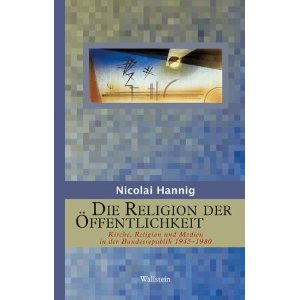
Review of Nicolai Hannig, Die Religion der Öffentlichkeit: Kirche, Religion und Medien in der Bundesrepublik 1945- 1980

ACCH Quarterly Vol. 17, No. 3, September 2011

Review of Nicolai Hannig, Die Religion der Öffentlichkeit: Kirche, Religion und Medien in der Bundesrepublik 1945- 1980 (Göttingen: Wallstein Verlag, 2010), 454 Pp., ISBN 978-3-8353-0799-5.

By Mark Edward Ruff, Saint Louis University

Nicolai Hannig’s pioneering book, The Religion of the Public Sphere: Church, Religion and Media in the Federal Republic of Germany, 1945- 1980, helps untangle the extremely complicated relationship between the Protestant and Roman Catholic churches and the burgeoning German mass media. Strongly informed by scholarship from the last decade on the German media, Hannig’s work delicately modifies common perceptions of the media as merely a mirror of society and of journalists as individuals who simply reported on what had taken place. The mass media, he convincingly shows, consisted of individuals with the power to create discourses, alter perceptions and even shape events themselves. These television reporters and producers, journalists at newsmagazines and radio-men comprise what he calls the new “media ensemble.” Hannig pays careful attention to all three genres—television, radio and print—but especially to the writers, editors and owners of the weekly news and influential illustrated magazines like Stern, Der Spiegel, Quick, Twen, Konkret, whose names will be familiar to Americans who have spent some time in the Federal Republic.

The genius of this book lies in Hannig’s application of the fruits of ongoing media research to the major issues plaguing both major German churches in the postwar era. Accounts of the German churches had long been driven by secularization narratives bleakly positing religious decline and putting forward pictures of empty church pews. Contesting scholarship has been more apt to underscore the revitalization of religion through the emergence of nontraditional alternatives ranging from the New Age to Pentecostal and evangelical movements. Seeking neither to dispel nor confirm these competing theories, Hannig turns instead to the role of the media in creating and disseminating narratives of decline and vitality. In the 1950s, the media conjured up images of religious revival, overlooking undercurrents of decline in youth organizations and elsewhere. “The revitalization of the religious in the postwar era and the 1950s,” he states, “was in this way to a significant degree a phenomenon of the media public” (100). Television broadcasts and articles in news-magazines even proudly featured scientific experts who claimed to prove the truths of biblical stories such as Noah’s ark or to demonstrate that the Virgin Mary’s final resting place lay in Western Turkey.

But from 1958 through 1966, sooner in the print media than in television, such affirmative and faith-enhancing portraits quickly became passé. The newsmagazines, in particular, exposed a church in “crisis,” one beset by a fall-off in religiosity and acrimonious conflicts between reformers and conservatives. The amount of coverage devoted to the churches, not surprisingly, grew dramatically. The aims of such reporting, particularly from 1966 through 1972, accordingly changed. Many journalists, it seems, deliberately strove to push the church out of politics and larger society as much as possible. But from the early seventies onward, coverage dropped off markedly. The media paid increasingly less attention to the institutionalized churches. It chose instead to profile cults, sects, gurus and evangelicals, alternative forms usually far removed from church doors.

How does Hannig account for what at first glance would seem to be an increasingly negative and even acerbic coverage of the churches? Why did such increasingly dismissive and marginalizing accounts ironically find resonance at the exact moment that the Roman Catholic Churches in the wake of the landmark Second Vatican Council were consciously striving to open themselves up to the modern world? Hannig convincingly lays out the significant structural transformation in the German media landscape that began around 1958 and redrew the media map in the 1960s. As a new younger generation of editors—often men in their late twenties and early thirties—assumed new leading positions as editors by the second half of the 1950s, German journalism was suddenly catapulted from a model of consensus to one of criticism. Drawing on critical formats from the Anglo-Saxon media world, including hard-hitting roundtables, open panel discussions and investigative reporting, German journalists no longer saw it as their duty to hobnob with leading politicians but to investigate, expose, and engage a critical public. Bearing out this transformation were the manifold media “scandals” of the 1960s which put politicians on the spot, brought to light wrongdoing and uncovered tarnished pasts. At the same time, the rise of television drastically altered the media landscape. While it did not immediately displace the more established radio and print mediums, it made the traditional mediums all more likely to ratchet up criticisms in a bid for readers, listeners and relevance.

But there were additional reasons for why the mass media came to look askance at the role of the churches in society and politics. The churches had been important players in the media world from the time that the Allies reorganized the German media. Most state governments created agencies to oversee radio and eventually television broadcasting. The churches dispatched their representatives directly into these agencies, where they ensured the live broadcasts of masses and church services in an astoundingly successful at outreach to those who rarely or never attended their local parishes. It becomes clear from Hannig’s account that secular journalists (an astounding forty percent were by the 1970s formally un-churched) had been chafing at the bit. Hoping to free themselves from clerical directives, they sought greater autonomy in the media sphere.

Yet one of the most impressive features of Hannig’s book is the gentle manner in which he debunks widespread perceptions of a secular anticlerical media pitted against the religious establishment. He adeptly illustrates this significantly more complicated relationship between the new media culture and religion in the Federal Republic in his depiction of Rudolf Augstein, the hard-driving founder and legendary driving force behind the prominent newsweekly, Der Spiegel. Well-known for wielding the axe against the Roman Catholic Church in various polemics, editorials and leading articles, Augstein almost single-handedly ushered in a new era of critical religious reporting. He devoted a cover of Spiegel and fourteen ensuing pages in 1958 to the Qumrum texts discovered nearly a decade before. In marked contrast to most religious reporting from earlier in the 1950s, this Roman Catholic made no attempt to show how modern society could corroborate stories from the Bible. With characteristic lack of humility, he put his magazine forward instead as a new agent of enlightenment, claiming sensationally that there were no historically verifiable truths about Jesus. But Hannig also brings to light a less familiar side to the Spiegel editor who had become infamous in religious circles. Augstein appears here as a defender of religious orthodoxy. His reputation as a provocateur notwithstanding, Augstein openly criticized the “modern theology” of the Protestant theologian, Dorothee Sölle. He granted access to the pages of Spiegel to the Protestant theologian Walter Künneth, who argued that Christian parishes needed to draw their sustenance not from the hypotheses of theologians but from the “bread of the bible.”

Augstein’s pronouncements deftly illustrate a larger theme of this book: the manner in which media giants sought to determine the essential quality of religion—what functions it should serve and the balance between transcendence and immanence in religious teachings. For Augstein as well as for many critical intellectuals of the late 1950s and 1960s, the churches had made the mistake of extending their grasp into virtually every domain of modern life, including charity and politics. As Augstein put it in a lecture, “How I imagine Christians,” delivered before two thousand largely Protestant academics, “the churches push themselves into charity, for whose purposes they ask for ever greater sums of money from the state, into the Kindergartens, in the senior citizens’ homes and in welfare … They found academies, city missions, pay attention to what is going on in radio and television, warn about drunkenness at the steering wheel and about excessive celebration at Carnival” (348). In so doing, they had not only misused their newly gained power but had overlooked their transcendental mission of saving souls for the hereafter. The irony here should be apparent: Augstein’s assessment dovetailed with those of conservative Christians opposed to the worldly focus of religious progressives determined to reconcile religion with modernity through heightened political activism and campaigns for social justice.

Vast sections of this book spell out the manner in which the media exhumed topics in a manner often unpleasant to church leaders. Journalists had much to say about “clericalization,” “confessionalism,” confessional schools and sexuality. They criticized, they challenged and they broke taboos. Naked bodies became a regular feature of the illustrated news magazines by the 1970s. Even more instrumental was the media’s role in bringing to light the Roman Catholic church’s past during the Nazi era. Hannig argues that it was less the controversy over Rolf Hochhuth’s play, The Deputy, that marked a decisive caesura than subsequent lesser-known controversies about the tainted backgrounds of Karl Fürst zu Löwenstein, a central figure in the Zentralkomittee der Deutschen Katholiken, and Matthias Defregger, an Auxillary Bishop in the archdiocese of Munich who had been present as a Captain in the Wehrmacht at a massacre of Italian hostages in June, 1944. Once the Defregger scandal unfolded in 1969, it was clear that probing publications like Spiegel, whose own research on the topic had been voluminous, had sought to leave the moral legitimacy of the Roman Catholic Church in shreds.

Even as comprehensive a work as this could not delve into every aspect of the relationship between the German churches and the media over such a broad swath of time. Left out of this work—and left open for future researchers—are additional dimensions to the church-media relationship. In focusing on radio, television and the weekly illustrated magazines, all weighty subjects in their own right, Hannig tended, with some exceptions, to exclude the daily newspapers and wire services from his focus. Also absent, except for a few cursory pages, is the role of the Roman Catholic and Protestant media: the diocesan newspapers, the religious magazines and above all, the Katholische Nachrichtenagentur (KNA), a Catholic news service that served as a significant historical actor and interacted with the secular media in a complex and often combative manner. Each of these topics, however, could warrant its own scholarly monograph, and Hannig rightly made the decision to keep his focus limited to the secular media.

It is rare for a dissertation not only to display such scholarly command and to retain a remarkable even-handedness on charged terrain. Hannig’s book is also eminently readable, even in spite of its indebtedness to media theory and the ideas of Pierre Bourdieu. On the occasions that he lapses into jargon, he does so deliberately and almost apologetically. Through the soundness of its research and its scholarly breadth, this impressive book will easily go down as one of the most important and weighty new works in German religious history of the last decade.


Share

Conference Report: “German Catholics negotiate National Socialism: Three Case Studies,” Annual Meeting of the American Historical Association, January 7, 2011

ACCH Quarterly Vol. 17, No. 1, March 2011

Conference Report: “German Catholics negotiate National Socialism: Three Case Studies,” Annual Meeting of the American Historical Association, January 7, 2011, Boston, MA.

By Mark Edward Ruff, St. Louis University

Sponsored by the American Catholic Historical Association as a contribution to its annual meeting, the panel, “German Catholics negotiate National Socialism: Three Case Studies,” put on display the work of three scholars of German Catholicism who directed their attention to the thirty-year span from 1933 through 1963. Ulrike Ehret of the University of Erlangen in Germany analyzed the attitudes of German Catholics towards the Nazi state. Kevin Spicer of Stonehill College honed in on the small number of German Catholic priests who spoke out on behalf of the beleaguered Jewish population. Mark Edward Ruff of Saint Louis University moved ahead to the postwar period to analyze the efforts of the Berlin Prelate, Walter Adolph, to commemorate the German Catholic martyrs from the Nazi era. Beth Griech-Pollele, professor at Bowling Green State University, chaired the panel.

In her paper, “Negotiating ‘Volksgemeinschaft:’ Roman Catholics and the NS-State.” Ulrike Ehret discussed how the National Socialist ideal of Volksgemeinschaft (national unity) became so persuasive to ordinary Catholics. Ehret argued that ordinary Catholics, like most Germans, nurtured and supported the idea of a revived and strengthened nation, even if it meant establishing a German nation without Jews. Drawing on her examination of government reports on public opinion as well as of petitions and denunciations addressed to the government as well as to the bishops, Ehret suggested that the Catholic bishops and clergy turned the concept of Volksgemeinschaft into a means to protect particular Roman Catholic interests and traditions. To warn their flock about divisive state politics, Catholic leaders frequently revived the memories of the nineteenth-century Kulturkampf.  Most of their protests were directed against Nazi religious policies; relatively few focused on Nazi racial policies. Yet most German Catholics, according to Ehret, insisted that the Volksgemeinschaft needed to be properly rooted in religious traditions. In popular opinion, this meant ignoring National Socialist midsummer festivals, attending mass and participating in pilgrimages in growing numbers. One needs to look at what Catholics did rather than at what they said.

Compared to Catholic anti-Semitism during Bismarck’s Kulturkampf, Catholic publications rarely reverted to anti-Jewish images. However, Catholic popular defense literature clung to traditional creeds and values of the Catholic Church. It defended biblical Jewry but failed to defend modern Jewry against contemporary anti-Semitic prejudices. Indeed, the Catholic defense was often clad in the language of the time and consequently used images of Jews that strikingly resembled those used in the Nazis’ notorious racial rhetoric. The defense drew on images of Jews as the sources behind Bolshevism, as usurers and as men and women of a different race. These were all images that may have been the essence of how Catholics viewed Jews at the time.

In his paper, “Catholic Clergy and Jews under National Socialism,” Kevin Spicer continued his examination of the relationship of Jews and Catholic priests during the Third Reich.  In particular, he examined the portrayal of Jews in priests’ sermons and public addresses.

Mark Edward Ruff’s paper, “Walter Adolph and the Construction of Catholic Martydom”  analyzed how one leading Catholic chronicler of the past constructed images of Catholic martyrdom. Between 1945 and 1965, Adolph penned more than six books that described Catholic opposition to Nazism and the suffering of Catholic victims of National Socialism, including Bernhard Lichtenberg and Erich Klausener. As the editor of the diocesan newspaper for Berlin, Das Petrusblatt, he composed and put the finishing touches on many additional commemorative articles. In addition, he spearheaded the effort to build a church to memorialize Catholic victims, Maria Regina Martyrum, which was consecrated in 1963.

Yet Adolph’s commemorative efforts were inextricably bound up with the political and ideological battles of the postwar era. His diocese straddled both the Western and Eastern zones of Berlin. From the former, he was confronted by an array of church critics who denounced Catholic resistance during the Third Reich as feeble. From the latter, he was confronted by regular articles in the Communist press that argued that the church had been in league with Fascism. These articles extolled Communist victims of the Third Reich as the sole legitimate martyrs of the past and typically couched their suffering in a quasi-religious language.  To defray the charges of Western church critics like Rolf Hochhuth, he and others claimed that Maria Regina Martyrum was the answer to Hochhuth’s play, The Deputy.

Ruff’s paper argued that Adolph’s created a hermeneutic of martyrdom that was, in fact, a combination plate. It was written in a language equal parts theological, journalistic, and political. But it also necessitated glossing over the less savory aspects of those Catholic victims of National Socialism he placed into the category of martyrs. In his profile of Erich Klausener, the leader of Catholic Action who was murdered on the night of the Röhm purge in 1934, he carefully deleted all of the sentences from the original manuscript that described Klausener’s sympathies in 1933 and 1934 for the National Socialist movement.

The comments were offered by James Bernauer, SJ, professor of philosophy at Boston College, who expounded upon the theme of martyrdom that linked the three papers. At the end of the war, he noted, Pope Pius XII spoke of the “sorrowful passion of the Church” and of the “incessant opposition maintained by the Church” in the Nazi years.  “But did the German Bishops,” he asked, “ever summon Catholics to heroic resistance?  Did the Bishops themselves ever risk real as opposed to symbolic martyrdom?” Pope John Paul II’s numerous apologies, he suggested, might be thought of as a “corrective embrace of reality for Church responsibility in what had happened to Jews, women, Protestant reformers, American Indians, the Eastern Churches and so forth.”


Share

Review of Michael Hirschfeld/Maria Anna Zumholz, eds., Oldenburgs Priester unter NS-Terror, 1932 – 1945. Herrschaftsalltag in Milieu und Diaspora

ACCH Quarterly Vol. 15, No. 2, June 2010

Review of Michael Hirschfeld/Maria Anna Zumholz, eds., Oldenburgs Priester unter NS-Terror, 1932 – 1945. Herrschaftsalltag in Milieu und Diaspora (Münster: Aschendorgg Verlag, 2006), 818 pp. ISBN: 3-402-02492-6.

By Mark Edward Ruff, Saint Louis University

This review appeared first in the Catholic Historical Review, Vol. 96 No. 1 (January 2010): 160-161, and is reprinted by kind permission of the author.

This mammoth volume details the persecution of Roman Catholic priests in Oldenburg during the years of National Socialist rule.  Containing nearly 80 separate accounts of individual priests and clergy who ran afoul of the Nazi state, this compilation is a Festschrift for Joachim Kuropka, the historian at the local University in Vechta known for his regional histories of the Oldenburg region in Northwestern Germany and his scholarship on the Cardinal of Münster, Clemens August Graf von Galen.

This dense volume centers on Oldenburg, a long, slender sliver that technically belonged to the diocese of Münster but was cut off geographically by the diocese of Osnabrück. The northern sections were part of the Catholic diaspora, an almost exclusively Protestant bastion known for his strong support for the Nazis. In contrast, the southern regions, which included the regional centers of Cloppenburg and Vechta, was home to a thriving Catholic milieu.  With than 90 percent of the population consisting of registered Catholics, the Catholic parishes there boasted thriving ancillary organizations and a dynamic parish life.

The editors, Michael Hirschfeld and Maria Anna Zumholz, leave little doubt that the strength of the Catholic milieu in these southern regions contributed to the efficacy of actions that thwarted Nazi efforts to dismantle the building blocks of this Catholic subculture. They argue that the milieu in this region did not erode. The “indicators” of religious strength – the number of priests in a region, Easter attendance, etc. – show that the milieu, in spite of significant persecution, more than held its own. Nor did clergy contribute to an attitude of uncritical obedience to the Nazi state. Instead, they were in the forefront of the resistance to Nazi ideology, seeking to counter the anti-Christian attacks launched by the Nazi ideologist, Alfred Rosenberg. As such, these priests earned the special enmity of Nazi enforcers in the Gestapo, who cracked down – sometimes methodically, sometimes sporadically – on Catholic institutions and their associates.

To be sure, this focus on persecution – the arrests, the threats, the disruptions to parish life – is an indispensable part of the story of the Catholic church under Nazi rule. For in fact, as the section on regional Nazi perpetrators in the Gestapo, party and the courts makes clear, hardliners sought to eradicate nearly all traces of religious influence on German public life.

But this is a selective lens with which to view this era, one which is by definition, incomplete. The focus on persecution necessarily precludes an analysis of accommodations to the Nazi state made by other clergy either by choice or out of necessity.  Absent are what might be termed the grey areas in the relationship between the church and National Socialism. To what extent were these priests representative of the clergy as a whole and were there areas in which they granted their approval to the other aspects of the Nazi agenda and state? The editors pay lip service to these questions, but their answers ultimately hearken back to works of earlier eras. The narratives they create are those produced already in the 1940s by chroniclers such as Johannes Neuhäusler : the patterns they use were laid out in the 1980s and 1990s in the voluminous works, Priester unter Hitlers Terror, produced by the Kommission für Zeitgeschichte in Bonn.  This is not to negate their findings but to suggest that this is but one part – and a necessary part – of a larger picture.


Share

Conference Report: Eugenio Pacelli als Nuntius in Deutschland

ACCH Quarterly Vol. 15, No. 2, June 2010

Conference Report: Eugenio Pacelli als Nuntius in Deutschland, March 24-26, 2010, Münster,Germany.

By Mark Edward Ruff, St. Louis University

The most controversial pontiff of the 20th century was the focus of a three-day symposium assembled and hosted by Professor Hubert Wolf and sponsored by the European research network, Pio XI, and the Excellence Cluster, Religion and Politics, at the University of Münster. Bringing together more than thirty researchers between March 26 and 28, this symposium honed in on Eugenio Pacelli’s years as the Nuncius in Germany between 1917 and 1929. Participants came from more than eight nations, including Italy,Germany,Poland, the Czech Republic,Israel, the United States,Austria and Switzerland. All presentations were translated simultaneously into Italian and/or German, the two official conference languages.

Keynote addresses were delivered by Romano Prodi, the former Prime Minister of Italy and current President of the European Commission and Mordechai Lewy, the Israeli ambassador to the Vatican. In very general terms, Prodi underscored the significance of the disastrous interwar years for the creation of the European Union and the importance of the European Union for the European future. Lewy, on the other hand, spoke much more critically of the conference subject. While dismissive of the epithet, “Hitler’s Pope,” Lewy spoke sharply of Pacelli’s own lack of interest in the fate of European Jews, particularly in the postwar era. The Vatican, he pointed out, was opposed to the creation of the state of Israel, regarding it as the dangerous creation of Communist and atheist forces. The curia, he added, was a bastion of anti-Semitic attitudes. Pius himself greeted the news of Israel’s creation “with mixed feelings,” and called for a “crusade of prayer” for “the sacred land.”

The centerpiece of the symposium was the formal presentation of a massive critical online edition of the approximately 7000 reports that Pacelli transmitted from Germany to the Vatican during his years as Nuncius from 1917 through 1929. Based on software  developed through the assistance of the German Historical Institutes in Rome and London, this online edition places these reports into an online databank, allowing scholars to search for documents by name, date or keyword. This software – DENQ  (Digitalle Editionen neuzeitlicher Quellen) – will allow scholars to compare drafts of Pacelli’s reports with the final versions he dispatched to Rome through multiple windows and color-coded texts.  Observing often subtle changes provide valuable glimpses into Pacelli’s thought processes. In one such report, Pacelli altered his description of Kaiser Wilhelm II from “nondeltutto equilibrato” to “nondeltutto normale.” By allowing users to open multiple windows, this software also provides user with valuable biographical information, e.g. birth and death dates, about those to whom Pacelli refers in his reports. To make optimal use of these features, users will need to use browsers based on Webkit or Gecko, including Firefox, Safari and Google Chrome. While it will ultimately take twelve years to bring this project to fruition, the project directors will not wait until then to open up this edition to scholars. Beginning with the year 1917, Pacelli’s reports will be released in regular intervals.

Following the unveiling of this online edition, three papers subsequently examined aspects of Pacelli’s tenure as nuncius.  The German scholar, Klaus Unterburger, described Pacelli’s skepticism vis-à-vis many German theologians as well as attempts to muzzle potentially critical voices. In describing Pacelli’s love for Germany, Phillip Cheneaux, Professor at the Lateran University, underscored the continuities between Pacelli’s years as Nuncios and his later pontificate. The Italian historian Emma Fattorini emphasized the wartime influence of the German Center Party politician, Matthias Erzberger, on Pacelli’s understanding of German politics. Though chronologically far removed from the interwar years, the scandals put in motion by the German playwright, Rolf Hochhuth, in the mid-1960s were at the center of Mark Edward Ruff’s presentation. Ruff focused on the missteps of Catholic defenders of Pacelli and, in particular, of the German Catholic media, whose clumsy counterattacks played into the hands of Hochhuth and his champions.

On the third day of the symposium, a panel of six scholars compared nuncios throughout Europe during the interwar era.  Thomas Brechenmacher, Professor in Potsdam, focused on Alberto Vassallo-Torregrossa (1925-1934) and the better known Cesare Orsenigo (1930-1945).  Rupert Klieber, Gianfranco Armando, Alberto Guasco, Emilia Hrabovec, Stanislaw Wilk provided respective portraits of the nuncios in Vienna, Paris, Rome, Prague and Warsaw. Of these nuncios, the most notable was Achille Ratti, Nuncio in Warsaw between 1919 and 1921 before being anointed Pope in 1922.

A final panel provided an overview of political Catholicism in the 19th and 20th centuries. Urs Altermatt, Professor in Fribourg, sketched the history political Catholicism in Switzerland, while Karsten Ruprecht laid out the trajectory of the Roman Catholic Center Party in Germany. Walter Iber summed up the history of the Christian Socialist Party in Austria: Stefano Trinchese provided the same for the Partito Popolari in Italy. Jaroslaw Sebek, finally, described the papal policies towards interwar Bohemia.

The conveners intend to publish the conference proceedings within the next year. More details will provided here at a later date.


Share

Conference Announcement: International Symposium: Pius XII as the Nuncio in Germany

ACCH Quarterly Vol. 15, No. 1, March 2010

Conference Announcement: International Symposium: Pius XII as the Nuncio in Germany, March 24-26, 2010, Münster, Germany.

By Mark Edward Ruff

The most controversial pontiff of the 20th century is serving as the subject of an international symposium sponsored by the European research network, “Pio XI” and the Excellence-Cluster, “Religion and Politics” at the University of Münster. Featuring nearly thirty speakers from a variety of nations including, Germany, the United States, Switzerland and Italy, the conference is intended to present the findings of researchers analyzing documents from the pontificate of Pius XI that were released in 2003 and 2006. According to the conference convener, Professor Hubert Wolf of the University of Münster, these documents provide a comprehensive picture of the Roman curie between 1922 and 1939 as well as new glimpses into the person and personality of Pacelli, who served as the Papal Nuncio in Germany and the Vatican Secretary of State before his appointment as Pope in 1939.  They provide the basis for a major online edition of more than 6500 documents that will be culled and edited by researchers in Münster over the next twelve years and funded by the Deutsche Forschungsgemeinschaft.

These documents shed new insights into the relations between the Roman curia and Catholic political parties across the European continent. One section of the conference will compare these relations between the Vatican and Italy, Germany, Switzerland, Bohemia and Austria. Another will compare Pacelli with other papal nuncios from the day in Poland, Czechoslovakia, Italy, France and Austria.

Saul Friedländer, a historian at the University of California, Los Angeles and the author of a book, Pius XII and the Third Reich from 1965, was to have served as the keynote speaker. Because of his recent illness, however, the keynote roles have been given to Mordechay Lewy, Israeli Ambassador to the Vatican, and Romano Prodi, former President of the European Commission and former Prime Minister of Italy.

For more information, contact Mark Ruff at ruff@slu.edu.

Share