Contemporary Church History Quarterly
Volume 23, Number 1/2 (June 2017)
Conference Report: 500 Years of Reformation: Jews and Protestants – Judaism and Protestantism, Leo Baeck Institute, Jerusalem, February 12-14, 2017
By Kyle Jantzen, Ambrose University
This year’s annual conference of the Leo Baeck Institute featured the theme of the Protestant Reformation and its impact on Jewish-Christian relations. Some 40 scholars took part in sessions that followed the evolution of Jewish-Protestant relations from the time of Luther and the Reformation era, through the Enlightenment and emergence of modernity to the cataclysm of Nazism and the Holocaust to the postwar era. Most panels were comprised of German and Israeli scholars, though a handful of North American academics were also present. Topics included Jewish perspectives on Christians and Christianity, Christian missions to Jews, conversion (in both directions), music and the arts as a sphere of Jewish-Protestant relations, and Jewish-Protestant relations during and after the Third Reich and Holocaust. The keynote speaker was Professor Susannah Heschel of Dartmouth College, who challenged the audience with a provocative lecture entitled, “Is God a Virgin? Theological Benefits and Problems in the Protestant-Jewish Relationship.”
The second last panel of the conference tackled the theme of Jewish-Protestant relations “in the shadow of racism and fascism.” Dirk Schuster of the University of Potsdam spoke on the theme “Protestantism and Racial Boundaries: Jews, ‘Aryans’ and Divine Salvation at the German Christian Church Movement.” Drawing on the history of the pro-Nazi German Christian Movement, Schuster examined the way in which race can function as an exclusive (and excluding) space, sociologically speaking, with respect to religious salvation. Race, a collection of ethno-cultural differences and an imaginary collective which draws up borders against “the other” in the process of defining a national identity.
Schuster is particularly interested in the way in which Jews were denied access to Christian community, sacraments, and salvation on account of their Jewish racial identity. This was certainly the intention of the German Christian movement, when they focused on Martin Luther as a uniquely German holy man, or Adolf Hitler as the “Führer” sent by God to Germany in its fateful hour. Similarly, the German Christian (and Nazi) loathing of “miscegenation” in not only the biological sense but also the spiritual or religious sense. Even Catholics, whom many Protestants scorned, were eligible for salvation in a way that Jews, who could not (in the German Christian mind) be Germans, were not. The irony in all of this, as Schuster noted, was that the Nazis themselves defined race based on church records–religious criteria!
Still, German Christians believed whole-heartedly in Hitler’s mission as the latest example of the revelation of God in and through German history. Under Hitler, Luther’s Reformation would be completed. All this meant that the political measures to socially and economically isolate Jews and drive them from the German Volk community were mirrored by the application of the Aryan Paragraph in the churches and the exclusion of Jews from the Christian community. Yet one problem remained: how could the German Christians isolate Judaism from Christianity? Here Schuster referred to Susannah Heschel’s book The Aryan Jesus and its account of the Grundmann Institute’s attempt to dejudaize Christianity. For Schuster, this was another way in which the German Christians attempted to create a space in which Jews would be excluded from Christian salvation.
Hansjörg Buss of Göttingen University followed, assessing “The Reception and Instrumentalization of Martin Luther’s ‘Judenschriften’ in the ‘Third Reich.'” Buss explores part of the terrain marked out by Schuster, namely, the ways in which Martin Luther’s antisemitic writings were employed by Nazi Protestants to justify their own antisemitism. National Socialist Protestants responded to those who expressed concern for Jews by reminding them that the founder of their church had advocated burning down Jewish synagogues, destroying Jewish houses, taking away Jewish prayer books, confiscating Jewish money, and forcing Jews to work. Luther, so argued National Socialist Protestants, developed a uniquely German piety that made it impossible to preach a Jewish Christianity to Protestants from the German racial community.
Buss explained that current research on Luther and the Jews emphasizes the continuity in his thinking, rather than the different consequences he proposed in That Jesus Christ was Born a Jew (1523) and On the Jews and Their Lies (1543). Beginning in the nineteenth century, however, Luther was idealized as a heroic German nationalist–by the time of the First World War, he was regularly invoked by propagandists. It was in this context that Paul Althaus described the reformer as Germany’s “secret emperor.” As antisemitism increased in the later 1800s, Luther was widely quoted, as in Theodor Fritsch’s Catechism for Antisemites (1887). In the Third Reich, Der Stürmer quoted Luther to criticize the churches for being too friendly towards Jews.
During the Nazi era, the German Christian Movement invoked Luther regularly, beginning with the first German Christian “Guidelines” of 1932, which confessed “an affirmative faith in Christ, one suited to a truly German Lutheran spirit and heroic piety.”[1] Buss explained how Luther’s 450th birthday in 1933 turned into a national festival of Protestant nationalist and Nazi ideas, an expression of a “commitment to Luther and Hitler.”
The German Christians built on this Protestant nationalism and emphasized Luther as a nordic fighter against the Jews. Buss noted that virtually all of the publications about Luther referred to the changed political situation under Hitler, and it was not uncommon for Luther’s On the Jews and Their Lies to be reprinted and distributed to German Protestants. The Confessing Church, in contrast, avoided Luther’s antisemitic writings, but consistently affirmed both the Nazi state’s authority and its antisemitic policies. As clear as the Second Provisional Church Leadership’s 1936 memo to Hitler was in its condemnation of the state’s hatred of Jews, this was an exceptional occurance. More common were statements from clergy affirming Nazi policy and even noting that Luther had advocated even harsher measures than those taken by the Nazi state of the middle 1930s.
Finally, Buss examined the November 1939 publication of Thuringian Protestant Bishop Martin Sasse, called Martin Luther and the Jews: Away With Them! In this work, Sasse celebrated the way the German people had crowned the Hitler’s divinely-sanctioned fight for the liberation of the German people by attacking the Jews on Martin Luther’s birthday (November 10). Believing that Luther was the greatest antisemite of his time, Sasse went on to ask Nazi officials whether On the Jews and Their Lies could be used as a weapon in the current struggle against the Jews. Similarly, Walter Grundmann’s Institute for the Study and Eradication of Jewish Influence on German Church Life drew on and twisted Luther’s ideas to advocate for a German racial and dejudaized Christianity. In sum, Buss demonstrates that both Christians and non-Christians used Luther’s antisemitic writings as “mental resources” (quoting Thomas Kaufmann) in support of Nazi antisemitism and the persecution of the Jews.
Kyle Jantzen of Ambrose University, Calgary, provided a North American perspective on the relationship between Jews and Protestants in his paper on “Nazi Racism, American Antisemitism, and Christian Duty: U.S. Protestant Responses to the Jewish Refugee Crisis of 1938.” Jantzen began by explaining how earlier historical accounts of U.S. Protestant responses to Hitler and his persecution of the Jews criticized Protestants for what they didn’t do, at times holding U.S. church leaders to the unrealistic expectations of stopping Hitler themselves or at least convincing the U.S. government to intervene in German domestic affairs.
Rather, Jantzen surveyed U.S. mainline Protestant church publications to discover what writers and editors, many of whom were influential church leaders, had to say about Jews and Judaism. He argued five main points: 1. that Protestant spokespersons viewed Nazism with great alarm and foreboding, sensing crisis in the air; 2. that they were primarily concerned with Nazi persecution of Christians; 3. that they also cared about the persecution of Jews; 4. that they both condemned and perpetuated forms of antisemitism in the United States; and 5. that, above all, they understood the challenge of Nazism in terms of a cosmic battle between Christianity and irreligion.
Even the staunchest mainline Protestant defenders of the Jews–men like Guy Emery Shipler of The Churchman–tended to reframe the persecution of the Jews into an attack against both Jews and Christians, or against religion in general. In part, this was a strategic move to rouse Christian support for Jewish refugees. Similarly, when W. Russell Bowie of the American Committee for Christian German Refugees solicited support, he consistently made the point that over half of the estimated 660,000 would-be refugees still in Germany and Austria were Christians, even if the Nazis defined them as racial Jews, and that the Jewish refugee crisis was very much a Christian problem.
Finally, Jantzen concluded that in 1938, in a context of German racism, American antisemitism, and a growing Jewish refugee crisis, Protestant church leaders understood their Christian duty as a call to respond to a profound sense of crisis. Democracy, civilization, Christianity, and all religion were under attack from the forces of war, totalitarianism, racism, and paganism. Clergy writing in mainline church periodicals responded by naming the evils of war and totalitarianism, in particular the threat that Hitler and Nazi Germany posed to the civilized world. They also fought against antisemitism and tried to aid Jews, though not without slipping into the language of long-standing anti-Jewish prejudices sometimes, and also not without reframing the persecution of Jews and the Jewish refugee crisis as the persecution of Christians and Jews and the Christian and Jewish refugee crisis. Most important to these church leaders, however, was the reaffirmation that Christianity was the only force that could ultimately save the world from self-destruction. Liberal Protestant writers and editors warned their readers about the forces of barbarism, totalitarianism, and war which threatened to destroy civilization, democracy, and freedom, while conservative Protestants focused more narrowly on apolitical Christian spiritual renewal and prayer as solutions for the world’s ills.
A lively discussion followed, as was the case throughout the three-day conference. Along with the host Leo Baeck Institute, the other conference sponsors included the Goethe University of Frankfurt’s Martin Buber Chair in Jewish Thought; The Hebrew University of Jerusalem; the Evangelical Church in Germany (EKD); the Minerva Institute for German History and the Stephen Roth Institute for the Study of Contemporary Antisemitism and Racism, both of Tel Aviv University; and the Center for the Study of Christianity at The Hebrew University of Jerusalem. There are plans for a publication of conference papers in the coming months.
Notes:
[1] Mary M. Solberg, A Church Undone: Documents from the German Christian Faith Movement 1932-1940 (Minneapolis: Fortress Press, 2015), p. 49.

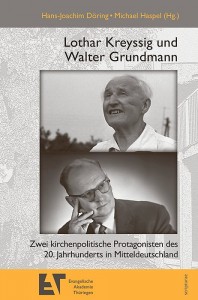 Anke Silomon’s introductory chapter provides biographical details about both men. Even though she relies on already published research, the author does give a survey of their careers, which will be of value to those readers not familiar with the subject. Both men were born during the reign of the last Kaiser, and their careers spanned the whole period up to and including the time of the German Democratic Republic, i.e. after 1949. This is followed by an article by Oliver Arnhold, who in 2010 published a comprehensive study of the “German Christians” as well as of the Eisenach Institute, which took the title of“The Institute for the Research and Removal of Jewish influence on German church life”. This contribution was drawn from a lecture Arnhold gave in 2014, which was subsequently included in this volume, and concentrated primarily on the ill-fated Institute. Hence unfortunately this means that his portrait of Walter Grundmann, who is supposed to be the main topic of this volume, is too condensed.