Contemporary Church History Quarterly
Volume 20, Number 3 (September 2014)
Review Essay: German Regional Churches Look Back on the Twentieth Century
By John S. Conway, University of British Columbia
Stephan Linck, Neue Anfänge? Der Umgang der Evangelischen Kirche mit der NS-Vergangenheit und ihr Verhältnis zum Judentum. Die Landeskirchen in Nordelbien. Band 1: 1945-1965 (Kiel: Lutherische Verlagsgesellschaft, 2013). Pp. 352. ISBN 9783875031676.
Antonia Leugers, ed., Zwischen Revolutionsschock und Schulddebatte. Münchner Katholizismus und Protestantismus im 20. Jahrhundert (Saarbrücken: universaar, 2013). Pp. 310. ISBN 9783862230594.
For the past seventy years, Germans in general, and their churches in particular, have wrestled with how to come to terms with their stances during the Nazi period, and especially with their complicity in the mass murder of their fellow citizens of Jewish origin. A no less troubling situation has been their experience in the post-war period, as the political and personal crises of the Cold War preoccupied the German people and divided them into rival political camps.
The books under review examine the record of two regional churches, the first in the area north of the River Elbe and the second in Bavaria. These are both written or compiled by younger church historians, often aghast at what they now see as the misguided attitudes of their forebears in these churches. Their objective is clearly to try to rectify, and if possible to improve, the premises for future church political and theological attitudes, especially towards Judaism.
 In Neue Anfänge? Der Umgang der Evangelischen Kirche mit der NS-Vergangenheit und ihr Verhältnis zum Judentum. Die Landeskirchen in Nordelbien. Band 1: 1945-1965, Stephan Linck analyses the situation in the four Protestant churches which united in 2012 to form the Evangelical Church of North Elbia. He had earlier organized a travelling exhibition which did much to break the silence about these churches’ failures in former years. His central point is that this part of Germany had a long history of extreme nationalism, backed by Lutheran authoritarianism. This made these congregations particularly susceptible to Nazi anti-Semitic propaganda and encouraged their extremist and anti-communist attitudes, which were only reinforced in this region after 1945, when so many refugees fled to the region to escape the Russian occupation and the subsequent Communist domination of eastern Europe. These churches’ active support of the refugees’ desire to regain their homelands, in Linck’s view, only exacerbated their reactionary political attitudes and entrenched their prejudices.
Linck’s study, of which this is only the first volume covering up to 1965, analyses the primary factors in determining the churches’ political and social stances towards their Nazi past, which can be characterized as evasion and silence. It was only in 1998 that the North Elbian Synod took the first steps to commission Linck to examine the record of their behavior before and after 1945. This was followed in 2001 by a far-reaching declaration which “recognized our errors, admitted our war guilt, opposed all forms of mission to the Jews, supported Christian-Jewish dialogue and respected the difference between us and Judaism”. Similar sentiments were written into the newly-formed united church’s 2012 constitution. But these were all belated steps taken against considerable opposition from the congregations and many of their leading members.
Linck’s aim is clearly to overcome the legacy of the past in order to combat the ultra-nationalist and xenophobic attitudes of many North Elbian Christians. He is encouraged by the evidence that these attitudes have receded since 1965, and plans to provide a further analysis in his second volume for the period up to 1989. In the major sections of this present volume, Linck describes in full detail, and with increasing exasperation, the mentalities and the policies adopted by the leaders of these churches, both clerical and lay, in the immediate post-war years. He quotes, as the basic stance taken by many pastors and their congregations, the view that “Never before has a people who have survived a lost war been so humiliated and placed in a hopeless position as we have today.” Indeed, during these traumatic years, many churchmen’s attitudes were marked by their refusal to acknowledge their complicity in Germany’s war crimes, their total lack of sympathy for the victims apart from themselves, their unwillingness to face up to the enormity of the mass murder of the Jews, or their widespread complaints about the mistreatments allegedly being imposed by the vindictive Allied occupation forces. Among the North Elbian church hierarchies, there was widespread reluctance to admit Germany’s war guilt, along with the evasion of personal responsibility and the white-washing of many leaders’ pro-Nazi activities. These were challenged by only a handful of isolated and prophetic voices. At the insistence of the Allies’ investigating commissions, all active Nazi Party members were to be dismissed from their posts. But the churches were allowed to denazify their own structures. This in fact led to a lenient and self-interested defence of those pastors who had been strident supporters of the former regime, and who were merely invited to take early retirement, lest they suffer worse penalties. In many cases these men were reinstated after a few years, apparently with the full approval of their congregations. Another problem was the widespread negative feelings towards the members of the German Resistance movement. The only pastor in the north German region who was arrested and subsequently executed by the Gestapo was regarded after the war not as a hero but as an embarrassing maverick, then forgotten. The reforming initiatives taken by other branches of the Protestant Church were either sidelined or ignored. Only in a few isolated and exceptional cases were pastors willing to take steps to encourage a spirit of reconciliation and repentance for the past.
 These same features were on display in the Bavarian Protestant Church, too. They are the subject of Björn Mensing’s chapter in the collection of essays edited by Antonia Leugers, entitled Zwischen Revolutionsschock und Schulddebatte. Münchner Katholizismus und Protestantismus im 20. Jahrhundert. Mensing also comments acerbically on the apologetic and self-serving accounts of Bavarian Protestantism written by survivors, which excused the early and enthusiastic support given to Adolf Hitler as stemming from a desire to prevent a victory for Communism and as a sign of the “rechristianising” of a war-torn Germany. Those few voices calling for a more critical and less self-justifying account of the Nazi years were quickly sidelined. So too those who had been involved in the 1944 plot to overthrow Hitler and had been executed as a result, such as Dietrich Bonhoeffer, were regarded by the majority of the Bavarian Protestant leaders as “traitors to the national cause”. Mensing, who is now the Pastor of the Church of Reconciliation erected in the former concentration camp at Dachau, recounts with some bitterness the opposition to the building of this chapel by the former pro-Nazi pastor of the neighboring parish, clearly backed by the majority of his parishioners. It was only after the generation of participants in the Nazi years had all passed from the scene that a more fitting recognition of the church’s failures and a new sense of repentance could be encouraged. Mensing blames the continuing influence of the conservative leadership in the Bavarian Protestant Church for the slowness with which a greater sense of repentance and reconciliation has at last been adopted. But in view of the entrenched national conservatism of most Bavarian Protestants, Mensing believes there is still a long way to go before the deficiencies of the past can be finally laid to rest.
Other essays in this collection deal with the experience of Catholics in Bavaria from 1919 onwards. The editor, Antonia Leugers, is a junior member of the Catholic Faculty of Theology at Tübingen University, where once Joseph Ratzinger, now Pope Benedict XVI, and the intrepid scholar Hans Kung both taught. Leugers’ own essay provides more insights about the attitudes in 1918-9 of the Cardinal Archbishop of Munich, Michael von Faulhaber, drawn from his recently opened diaries for this period. These sources confirm the already established view that Faulhaber’s deeply conservative and monarchist sympathies were shattered by the events in Munich in those revolutionary months. Not surprisingly, he saw these alarming events as a deliberate challenge to his vision of a Christian-led authority, and readily enough accepted the stereotypes of “the barbarous Bolshevik hordes” whose attempts to overthrow the existing order were at least partly inspired by the fact that many were Jewish communists inspired by the revolutionary successes in the Soviet Union. Faulhaber’s subsequent political views were, in Leugers’s opinion, largely influenced by his experiences in those traumatic days.
In a second article, Leugers follows Faulhaber’s mixed utterances during the 1920s on the subject of international peace. On the one hand he called on Catholics to support world peace efforts, but on the other he deplored the actions of the victorious allies in imposing on Germany the unjustifiably vindictive terms of the Versailles Treaty. He also took issue with the decision of the French government to station black African troops in their zone of occupation in the Rhineland, which aroused enormous hostility, and led to a campaign against the so-called “Rhineland bastards”. Such racially-based resentments only played directly into the hands of the newly-formed Nazi Party. Indeed, Adolf Hitler frequently quoted Faulhaber’s views, which probably was the basis for his later cordial meeting with the Cardinal in November 1936, when both agreed on their common hostility to Communism.
A parallel article by Axel Töllner describes the very similar reactions of the Bavarian Protestant press, which equally mourned the loss of the monarchy, deplored the moves made by the new Education Minister to sever the links with the churches and remove all church subsidies, and welcomed the forcible restoration of a conservative government in May 1919. At the same time, these press organs gave little or no support to the democratic impulses in the Weimar Republic, but clearly preferred authoritarian governance. Hence they were already susceptible to the kind of propaganda shortly to be launched by the Nazi Party in Bavaria with ever increasing success.
In a second article, Töllner describes the perverse influence during this period of Erich and Matthilde Ludendorff. Ludendorff had been one of Germany’s leading general during the war but was subsequently misled by his wife to break with his Protestant upbringing and to establish the Tannenberg League as a centre for the propagation of belief in a German God, combined with radical nationalism. Ludendorff used his considerable prestige to wage a violent anti-Christian and anti-Semitic campaign, which included the assertion that Germany’s defeat in 1918 and its subsequent enslavement had been due to an unholy alliance of Jesuits, Freemasons and Jews. Despite the similarity of views with those of the more radical Nazis, the Ludendorffs openly criticized Hitler for his “capitulation” to the Vatican in signing the 1933 Concordat. That same year, the Tanneberg League was prohibited. A reconciliation only followed when Ludendorff died in 1937 and Hitler ordered him to be given a state funeral. The churches demonstrated their loyalty to the Führer by having their buildings fly the swastika national flag. In the 1940s, the Nazis’ prohibition was thrown out and Matthilde Ludendorff resumed her sectarian campaigns. At the time of her death if 1966, her group had apparently some 400 adherents.
Thomas Forstner provides a useful overview of German Catholic attitudes since 1945 about their experiences under the Nazi regime. To begin with, their leaders depicted the Catholics as being resolutely opposed to Nazism, a view conveniently also adopted by the Western Allies. The bishops’ early pastoral letters talked of Catholics being the victims of a clique of criminals who had seized power and inflicted their anti-Christian views on the nation. Where Catholics had collaborated, this was due to their feelings of loyalty and to their innocence in political affairs. Any accusation of collective guilt had therefore to be rejected. Such an idealization of the recent past left no room for a more critical examination of Catholic complicity in the Nazis’ crimes, and so it was passed over in silence. It also gave opportunities for favourable treatment of former Nazis, especially if they rejoined the Catholic ranks. Priests only too readily provided letters of exculpation, which then served to consolidate the conservative forces dedicated to averting the dangers of communism or socialism in post-war Germany. The victims of Nazi crimes and injustices were largely forgotten or ignored.
This favourable view of the Catholic Church’s record during the Nazi years was later supported by the large-scale academic productions of the Catholic Commission for Contemporary History. In the 1960s, however, such apologetic accounts were challenged, most strikingly by the 1963 production of Rolf Hochhuth’s play The Deputy, which accused the then Pope Pius XII and by implication the entire Catholic hierarchy of failing to stand by the Nazis’ victims, and of being interested solely in preserving the church’s own institutional life. Such protests were frequently regarded by leading Catholics as designed to weaken the political hold of conservative Catholicism, as established since 1949 under the Catholic Chancellor Konrad Adenauer. Left-wing Catholics in West Germany had continually to contend with accusations that they were sympathetic to the Communists in East Germany. The collapse of the latter regime in 1989 was taken as an indication of the correctness and validity of conservative and nationalistic Catholicism.
In the most recent years, in Forstner’s view, there has been a tendency to compensate for the lack of support for the Jews during the Holocaust by stressing the religious commemoration of Catholic converts such as Edith Stein, murdered in Auschwitz in 1942 and declared a saint nearly sixty years later. Similar attempts to canonize Pope Pius XII have so far not succeeded. In Forstner’s opinion, such encouragement of martyrology rather than accurate history-writing is a mistake and will not increase the credibility or reputation of the Catholic Church in a now largely secularized world.

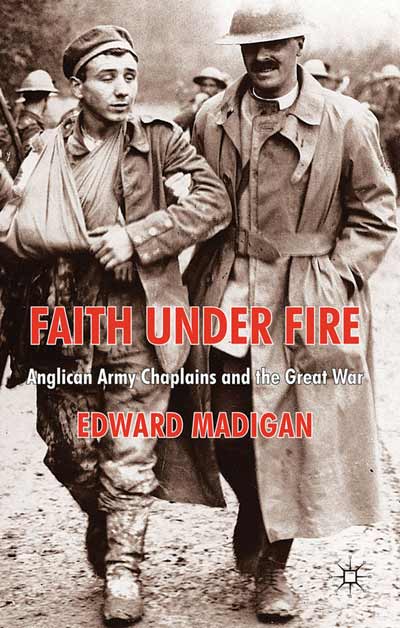
 Edward Madigan’s valuable study begins with a comprehensive survey of the literature about chaplains and their war-time contributions, some written by chaplains themselves, such a Ernest Raymond’s Tell England, or the far more influential novel by Robert Graves, Goodbye to all That. Many of these books presented a largely negative picture of the war records of these chaplains, finding that they were generally not respected by either officers or men, being considered inadequate to the tasks they faced.
 From the outset, Forstner makes it clear that his book will depart from the following works: Thomas Breuer’s Verordneter Wandel? Der Widerstreit zwischen nationalsozialistischem Herrschaftsanspruch und traditionaler Lebenswelt im Erzbistum Bamberg (Mainz: Matthias-Grünewald, 1992); Thomas Fandel’s Konfession und Nationalsozialismus: Evangelische und katholische Pfarrer in der Pfalz 1930-1939 (Paderborn: Ferdinand Schöningh, 1997); and Tobias Haaf’s Von volksverhetzenden Pfaffen und falschen Propheten: Klerus und Kirchenvolk im Bistum Würzburg in der Auseinandersetzung mit dem Nationalsozialismus (Würzburg: Ferdinand Schöningh, 2005). All of these works, he argues, centered primarily on questions relating to resistance and politics without significant consideration of priestly culture and everyday life. Forstner places my own 2004 study, Resisting the Third Reich: The Catholic Clergy in Hitler’s Berlin (DeKalb, Illinois: Northern Illinois University Press) in the same category, though he does acknowledge that my work included “some” discussion of priestly culture. By contrast to these studies, Forstner seeks to understand specifically the all-too often hermetic world of Munich’s clergy, especially their pastoral training, outlook, and practices, quite closely akin to Monika Nickel’s Habilitation, Die Passauer theologisch-praktische Monatsschrift: Ein Standesorgan des Bayerischen Klerus an der Wende vom 19. Zum 20. Jahrhundert (Passau: Dietmar Klinger, 2004), a study upon which Forstner lavishes great praise. Nickel’s work examined pastoral practice addressed in the Passau Monthly of Practical Theology.
 The bulk of the book, which is written in a somewhat convoluted Germanic style, but competently translated into English by Rebecca Pohl, is based on a thorough examination of all of Hitler’s surviving speeches and writings. Bucher’s main contention is that Hitler’s worldview was far more than just an ideology adopted for tactical reasons in order to gain political support. Rather, in Bucher’s view, Hitler’s ideas constituted a theology, even though it was an intellectually crude and merciless construct, and based on an abominable racism. Bucher is well aware that speaking of Hitler’s theology is provocative because it seems to associate what Christians believe with one of the worst criminals of our era. So he is careful to ensure that he cannot be accused of trying to undertake any kind of vindication. His task is therefore one of explanation rather than condemnation, let alone approbation. In this he succeeds with consummate skill.
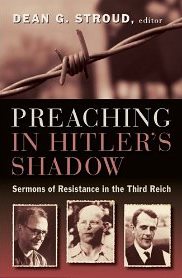 Dean Stroud’s Preaching in Hitler’s Shadow: Sermons of Resistance in the Third Reich uses a broad definition of resistance along the lines of Tec’s definition. This is problematic, because his focus is preaching in the German Confessing Church. In his 48-page introduction to the historical context, Stroud does not engage the vast literature on resistance in Germany or offer his opinion on the competing definitions of resistance by scholars such as Martin Broszat, Hans Mommsen, Peter Hoffmann, Detlev Peukert, and many others. But one can easily ascertain that he considers pastors in the Confessing Church to be a part of the Resistance, that he believes resistance among pastors was more wide spread than is acknowledged, and that he views Christianity as a radical alternative to Nazism. It is self-evident to Stroud that the thirteen sermons he includes in his book are “sermons of resistance.”
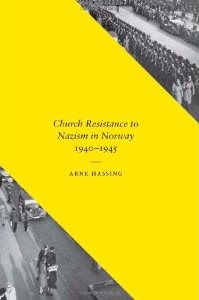 He begins with an account of the Norwegian reception of the German Church Struggle in the pre-1940 period, since he rightly notes that both nations had Lutheranism as their official Protestant state religion and as their traditional focus of loyalty. The challenge of Nazi ideology and its attempt to corrupt Luther’s teachings was therefore immediately recognized. Hassing pays tribute to the skilful manner in which Bishop Berggrav differentiated the Norwegian understanding of Luther from that held by many theologians in Germany. He also notes the skill with which the Norwegian church leaders were able to forge an alliance amongst themselves and resolve long-held theological antagonisms, in order to oppose the invaders and their supporters in Norway.
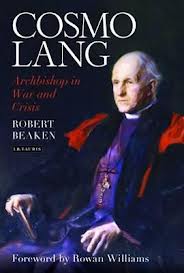 Lang was born in Scotland, the son of a distinguished Presbyterian minister. When he came to study in Oxford, he switched allegiance to a moderate high Anglicanism and opted to be ordained in the Church of England. His gifts were obvious and he quickly gained preferment. In fact, in 1890, at the age of 36, he became a suffragan or assistant bishop, and at the age of 44 was selected to be Archbishop of York, the second highest appointment in the English hierarchy. He spent twenty years there, before being moved to Canterbury in 1928. In Beaken’s view, it was hardly his fault that he was appointed to York too early and to Canterbury too late in life. He was a loner and a workaholic, and a bachelor who had difficulty in relating to others even of his own class and complexion. As a result, he never established any personal associations and had no following to uphold his legacy. This biography will, however, serve to record his achievements and gives a sympathetic analysis of Lang’s actions during the difficult and traumatic years of the 1930s.