Contemporary Church History Quarterly
Volume 30, Number 4 (Winter 2024)
Review Article: Tim Lorentzen, Bonhoeffers Widerstand im Gedächtnis der Nachwelt. (Paderborn: Brill Schöningh, 2023). Illustrations. ISBN 978-3-506-70473-3.
By Victoria J. Barnett, General Editor, Dietrich Bonhoeffer Works English edition, and former director, Programs on Ethics, Religion, and the Holocaust, U. S. Holocaust Memorial Museum.[i]
This fall a new film about the German theologian/resistance figure Dietrich Bonhoeffer has revived debates among Christians about his legacy and its relevance for contemporary issues. The film, Bonhoeffer: Pastor. Spy. Assassin, provoked protests (in which I was involved) from German and North American scholars in the Bonhoeffer Society and eighty-six members of the extended Bonhoeffer family, as well as disclaimers about the film’s marketing by the German actors and the film’s director. Like most films on Bonhoeffer, the new production plays fast and loose with the historical facts. Readers of this journal will be surprised, for example, to see Martin Niemoeller preaching a rousing sermon in defense of German Jews after Kristallnacht and Winston Churchill appreciatively reading excerpts from Bonhoeffer’s 1933 essay, “The Church and the Jewish Question.” Most protests focused on the film’s portrayal of Bonhoeffer’s resistance as a militant embrace of violence in the name of a just cause: a stunning misrepresentation of Bonhoeffer’s theology and, at a time of rising political violence and Christian Nationalism in the United States, a potentially dangerous one.
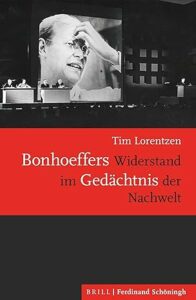 But as Tim Lorentzen’s new book illustrates, it is hardly the first time that interpretations of Bonhoeffer have been based on his ties to the German resistance. Lorentzen, Professor of Early Modern Church History at Kiel University, traces the chronology of German cultural narratives about Bonhoeffer’s resistance, and their intersections with German Protestant memorialization, from 1945 to 2006. His focus on resistance (rather than German historiography about Nazism, the Holocaust, the Protestant Kirchenkampf, or Bonhoeffer’s theological writings) is a narrow lens through which to understand Bonhoeffer, but it raises interesting and provocative questions. As historians know, Bonhoeffer was a minor figure in the resistance circles—and yet this very aspect of his life has become central in the narratives about him. Would Bonhoeffer’s theology be as well-known and widely read today if this were not the case? Has the emphasis on resistance led to the historical distortions one finds in many works on Bonhoeffer? Conversely, does it offer insights we might not otherwise have into his theology and his life?
In his introduction, Lorentzen argues that despite the growing body of scholarship on memorialization and memory cultures (especially with respect to the history of Nazi Germany and the Holocaust), there has not yet been a work focusing on church memory culture, where Bonhoeffer has achieved unusually central and symbolic status (and not just in Germany). This is especially important between 1948 and 1989, when parallel memory cultures about the Nazi era emerged in the German Democratic Republic in the east and the Federal Republic in the west.
The process began even before all the family members had received confirmation of his death and the deaths of his brother Klaus and two brothers-in-law. In May 1945, the ecumenical press office in Geneva issued a press release about his death. The report was sent to Reinhold Niebuhr in the United States, and on June 15 Niebuhr’s tribute, “The Death of a Martyr,” was published in the U.S. biweekly magazine Christianity and Crisis. In July 1945 Bishop George Bell presided over a memorial service in London’s Holy Trinity Church, broadcast by the BBC, in which he praised Bonhoeffer and the other executed resistance figures as examples of “the other Germany” that he had championed throughout the war. One week later, Confessing Church veterans held their first postwar synod in Spandau, where Probst Hans Böhm expressed his hope that Bell’s service in London could renew the bond between British and German churches; Bonhoeffer was similarly honored at the Treysa synod in August 1945. In early October, George Bell published an account of his last conversation with Bonhoeffer in Sigtuna, Sweden, in May 1942, when Bonhoeffer had told him that God would punish Germany for its guilt and that resistance was “an act of repentance.” Weeks later in Stuttgart, German church leaders met with ecumenical leaders, including Willem Visser ‘t Hooft (who was familiar with Bell’s article), and wrote the Stuttgart Declaration of Guilt. Lorentzen argues that Bell’s account influenced the wording of the Stuttgart Declaration in October 1945. That same month, George Bell visited Germany and met with Eberhard Bethge, who had compiled excerpts of various Bonhoeffer texts. In December 1945, the World Council of Churches published these texts in a short paperback titled Zeugnis eines Boten.
By the end of 1945, then, Bonhoeffer was recognized internationally as both Christian martyr and political resister. His story had become a cornerstone of the revived relationship between the German Protestant churches and their international partners, but this meant something very different on either side of the border. Inside Germany, tensions were already developing between Bonhoeffer’s closest allies and the official postwar church. Bethge in particular viewed Bonhoeffer’s resistance and death as an implicit accusation against those who had collaborated and compromised. In contrast, some postwar German church leaders found it a useful alibi as they reconstituted the Protestant Church and navigated their relationship with the Allied occupation government. They embraced Bonhoeffer’s martyrdom and resistance as exemplary of the Protestant Church’s courage under the Nazi regime (a deceptive move that obscured the complicity of the churches and, in many cases, their own).
As Lorentzen astutely observes, the memorialization of Bonhoeffer was a public process from the very beginning of the postwar era: “there was not a single moment when it was confined to being a family affair.” [13] This is worth pondering in terms of what it meant for Eberhard Bethge, who in the summer of 1945 was helping a traumatized family that had just lost four family members to Nazi violence and assisting the survivors of several other resistance families. In his Bonhoeffer biography and elsewhere, Bethge later contended that Bonhoeffer’s significance was quickly marginalized in the postwar Protestant Church and that he was dismissed by figures like Bishop Meiser as a “political” martyr, not a religious one. Lorentzen makes a convincing case that this was untrue (and one of the features of this book is that he pushes back against Bethge’s version of some things)—although, I would add, Lorentzen’s narrow focus omits a closer look at the broader early postwar disputes among Protestants who had been involved in the Kirchenkampf (which was the background for many of Bethge’s battles).
In any case, Bethge was central to the elevation of Bonhoeffer’s story. In spring 1946 he published some of Bonhoeffer’s poetry in Unterwegs, an occasional publication by Bonhoeffer’s former students; the poems also appeared in other publications, including the international newsletter of the Fellowship of Reconciliation. Each publication put a different spin on the texts—the Berlin newspaper Neue Zeit published the poem “Night Voices in Tegel,” for example, without mentioning that Bonhoeffer was a theologian. In February 1946, on the 40th anniversary of Bonhoeffer’s birth, Bethge published an article in Neue Zeit, George Bell wrote a two-part article on the German resistance for the New York Herald Tribune, and Reinhold Niebuhr published a piece in the Union Seminary Quarterly Review about Bonhoeffer’s resistance. Bonhoeffer’s martyrdom was now firmly interwoven into German Protestant postwar ties to foreign churches, and there was international fascination with his story.
All of this influenced early perspectives on the Kirchenkampf and the German resistance. Lorentzen argues that many theologians and church leaders already understood the broader German resistance in the context of Bonhoeffer (not the other way around), leading to an early “sanctification” of the July 20 conspirators and an emphasis on Christian resistance against Nazism. This was also possible, I would add, because in the 1930s much of the international reaction to the Kirchenkampf had focused on the “Nazi persecution of Christians.” Martin Niemoeller’s trial and imprisonment became an international cause célèbre (in December 1940, Time Magazine put him on the cover as the “Martyr of 1940”). Although Lorentzen doesn’t delve into those precedents, his analysis helps to explain how the Bonhoeffer legacy dovetailed with early postwar portrayals of Confessing Church heroism. In his lectures and essays in the late 1940s, Bethge offered a similar framing of the resistance. In 1951 the first German edition of the prison letters, Widerstand und Ergebung, was published (the English publication of Letters and Papers appeared in 1953).
By then, Bonhoeffer’s status as a martyr was well established. A new phase began in which his legacy was incorporated into other postwar political narratives in the new German Federal Republic. There were two major processes between 1946 and 1961 (which Lorentzen describes as the “martyrization” phase). First, Bonhoeffer’s status as “martyr” and resistance figure gave him a broader political symbolic value. Secondly, however, postwar Germany was already moving on to the burning political issues of the 1950s. Church and civil commemorations of events like the July 20 bomb plot continued, but surviving figures from the Kirchenkampf—people like Martin Niemoeller, Otto Dibelius, Eugen Gerstenmaier, and Theodor Heckel—were now focused on issues like the Cold War and German rearmament. Gerstenmaier and Heckel (former nemeses of Bonhoeffer with whom Bethge continued to do battle) had moved into the political sphere.
The first histories of the Kirchenkampf were also written during this period; Wilhelm Niemoeller’s Die Evangelische Kirche im Dritten Reich appeared in 1956. Survivors of the July 20 circles and other groups that had been persecuted and imprisoned under the Nazi regime founded their own organizations and began holding their own commemorations. Bethge was increasingly uncomfortable with Bonhoeffer’s inclusion in the celebration of “Heldentod” (the deaths of heroes). In 1960 a two-volume set titled Das Gewissen Steht Auf and Das Gewissen Entscheidet was published (the second volume had a foreword by Willy Brandt). The books profiled individual resistance figures from the July 20 group, the Protestant and Catholic churches, all the executed members of the Bonhoeffer family, and many other resisters.
Certain events (notably the mid-1950s trials of Walter Huppenkothen, who had overseen the trials and executions of Bonhoeffer, Canaris, and other conspirators in Flossenbürg) brought Bonhoeffer’s name back into the public eye, revealing ongoing postwar divisions about the resistance. Public reaction to these trials showed that Germans were still divided in their opinions about the July 20 group, with almost half of those polled (as well as some still-some prominent apologists for the Nazi regime) condemning the conspirators as “traitors.” Huppenkothen and his co-defendants were eventually sentenced to the time they had already served in prison.
But here, Lorentzen argues, public statements from Bonhoeffer’s sole surviving brother Karl-Friedrich, survivors of the conspiracy, and Protestant theologians altered public discussion of the trials and led to a “lasting shift” in how Germans thought about the resistance. The theological memorandum and testimony from former Confessing pastor and theologian Han Joachim Iwand, in which he explained the theological foundation for resistance and even declared that the churches should have resisted in 1933, had a profound impact that extended beyond the trial. (I should add, however, that these battles continued for several decades. In 1976 Eberhard Bethge and Gerhard Leibholz won a defamation suit against a right-wing propagandist on behalf of the Bonhoeffer family).
Although Lorentzen doesn’t mention it, the Huppenkothen trial had another impact on postwar politics and international relations. A 38-minute excerpt from the trial was filmed and distributed by the West German Government Office of Political Education (the USHMM in Washington, DC, has a copy). The film clip (which opens with photographs of Bonhoeffer, Oster, Dohnanyi, and Canaris) was produced at the very moment when the Adenauer government sought to reestablish the West German military. By honoring the German conspirators who died for their resistance to National Socialism (especially Oster and Canaris, who had been leading military figures) and showing a public democratic trial of former Nazis, the clip was intended in part, I suspect, to reassure western allies at a time when German rearmament was still controversial.
It was still the era of Bonhoeffer’s “martyrization”, but his story was now firmly embedded in the historical complexities of the post-Nazi era. Perhaps not coincidentally, this was the period during which Eberhard Bethge left Germany to serve a church in London in 1953 and then came to Harvard in 1957 to begin writing the biography, where he famously observed how in the United States, ”Everyone here has his own Bonhoeffer.” In the United States, too, Bonhoeffer was already well-known as a martyr, and over the ensuring decades (to the present moment, I would argue) there are multiple and very different American spins on that story.
In 1961, the Berlin Wall was built. Divided Germany became ground zero for many international political battles. Lorentzen describes the years between 1961 and 1989 (when the Berlin Wall came down) as the era of the “politicization” of Bonhoeffer’s memory. He continued to play a morally symbolic role for German Protestants on both sides of the border, but increasingly on behalf of very different political causes. During the same years, the first postwar generation of Germans reached adulthood and began to critically challenge early hagiographies. There was a growing focus on the Nazi persecution of the Jews and the churches’ complicity with the Nazi regime. Rolf Hochuth’s critical play, Der Stellvertreter, about the role of Pope Pius XII during the Holocaust, premiered in 1963. It was also during this period that Wolfgang Gerlach wrote his And the Witnesses Were Silent: The Confessing Church and the Jews (although it was not published in Germany until 1987).
Bonhoeffer acquired a new symbolic status as a politically critical theologian who was embraced by younger theologians. His resistance against Nazism represented a critique of church leaders who had made compromises with the Deutsche Christen and the Nazis. It also offered the basis for postwar activism on other issues: his pacifism, for example, became a rallying cry for anti-nuclear groups. His postwar relevance was amplified by the 1967 publication of Bethge’s massive Bonhoeffer biography (an abridged English translation was published in 1970). Bethge’s narrative encompassed the story of the German churches and the Kirchenkampf, the role played by theologians like Karl Barth, and the German resistance, but with Bonhoeffer at the heart of every story. The biography was also Bethge’s first systematic attempt to explain Bonhoeffer’s theological journey, especially his vision for the future of the Protestant Church.
This intersected with a growing number of international church conversations in the 1960s, 1970s, and 1980s. In the German Democratic Republic, the head of the Protestant Church was Albrecht Schönherr, who had been one of Bonhoeffer’s seminarians in Finkenwalde. Schönherr took Bonhoeffer’s understanding of “the church for others” as the model for what he wanted the “church in socialism” to be. During this same period, the international Bonhoeffer Society was founded, bringing together theologians and clergy from around the world. Its first meeting was in 1976 in Geneva, underscoring Bonhoeffer’s role (and ongoing relevance) in the ecumenical movement. Bonhoeffer’s story had become seminal to Christian memory culture on a global scale, from South Africa to the United State to Asia. His theology and his life story resonated in very different churches and political circumstances.
Bethge was a singular and influential force in these developments, internationally and increasingly in terms of the publication of Bonhoeffer’s writings . During this period the German publication of the seventeen-volume Bonhoeffer Werke began, with Bethge’s involvement. He was also influential in the German church, where he often invoked Bonhoeffer’s legacy. From 1961 to 1975 he was director of the Pastoral College in the Rhineland, and in 1981 he was instrumental in shaping the Rhineland Synod’s declaration on Christian-Jewish relations, making the Rhineland church the first German Landeskirche to acknowledge the validity of Judaism.
“Politicization” is too narrow a term for some of this, but Lorentzen skillfully illustrates how Bonhoeffer’s memory remained central in shaping the German churches’ public positions during this period. During these years (especially in the 1980s, after the nationwide television broadcast of the American docudrama Holocaust), numerous localized memorials and exhibitions about the Nazi persecution of the Jews began to appear. There were also new memorials to Bonhoeffer, and hundreds of churches, schools, and streets were named after him. One of the most striking examples of this “politicization” is the Bonhoeffer statue in an outside corner of the Petrikirche in Hamburg, at the site of a protest against atomic weapons by a Tübingen teacher, Hartmut Gründler, who burned himself to death there in 1977. The site soon became a shrine for environmental activists, who covered it with flowers and marked it with a series of memorial plaques intended both to honor Gründler as well as to inspire others to protest. The ongoing protests and demonstrations inspired a deep debate within the church and in the wider public. This ended when Axel Springer, the conservative publisher of Germany’s largest tabloid, gave the money for a Bonhoeffer statue on that very spot. There it stands to the present day: an ironic “memorial” that is simultaneously an erasure (there are two images of the statue in the book’s appendix of illustrations).
It is a useful reminder that memorial culture invariably elevates certain themes and obscures others. Drawing on German bishop Wolfgang Huber’s description of Bonhoeffer as a “Protestant saint,” Lorentzen describes the third phase, from 1990-2006, as a period of “sanctification.” There were a growing number of pilgrimages, especially from other countries, to Flossenbürg, Finkenwalde, the resistance memorial sites in Berlin, and of course the Bonhoeffer Haus (where the family had lived) in Charlottenburg. Bonhoeffer’s writings and history were regularly invoked by churches and in the ecumenical movement. Even Catholic countries and shrines have honored Bonhoeffer alongside Catholic victims of Nazism like Alfred Delp and Bernard Lichtenberg. In the appendix of illustrations, Lorentzen includes photographs of many memorials to Bonhoeffer, including some there were unfamiliar to me. The most famous memorial of course is the statues of ten “modern martyrs” at the West Entrance to Westminster Abbey, unveiled in 1998. There, Bonhoeffer stands alongside figures from around the world, including Maximilian Kolbe, Martin Luther King, Jr., and Oscar Romero. But there is also an icon in the Church of San Bartolomeo in Rome (where Bonhoeffer is pictured with Catholic Bishop of Münster Clemens Graf von Galen, Bernard Lichtenberg, and Friedrich Weissler), and the Romanian Orthodox Cathedral in Nuremberg, which features Bonhoeffer together with Catholic and Protestant saints through the centuries.
The final chapter explores the significance of “Christian resistance” in church memorial culture and the inherent tensions between religious and cultural interpretations of memory. In many ways, memorialization “domesticates” resistance figures; the Petrikirche memorial statue is certainly a striking example of that. Bonhoeffer is an interesting figure in this regard because he continues to be claimed by very different kinds of Christian groups (especially in the United States). It is almost as if the status of “resister” has lifted him above theological and political divisions that might otherwise prevent people from claiming him. In the process, what scholar Stephen Haynes once called the “Bonhoeffer Phenomenon,”[ii] leads to misinterpretations of his theological writings and his historical role.
Lorentzen’s book masterfully illustrates the process by which Bonhoeffer acquired an “über-historical” status soon after the war. To this day, many books and films about him are symbolic and very selective histories of heroism and martyrdom, not actual studies of the man and his times. Not surprisingly, this also means that they are riddled with false historical claims, not just with respect to the resistance but in terms of his significance in the Kirchenkampf. Lorentzen’s book helps us understand how this happened. For that reason alone, the book is a major achievement that any student or scholar of Bonhoeffer who is writing reception history or looking at Bonhoeffer’s impact in postwar Germany should read. By focusing specifically on the issue of resistance, this book offers a fascinating analysis of how, in east and west, postwar Germany wrestled with the intersections of resistance and martyrdom over six decades. It also offers some new insights into the theological literature on Bonhoeffer, much of which has been shaped by legends of his centrality in the resistance.
At the same time, however, this work parallels (but does not discuss at any length) the changes in historical narratives about the German Kirchenkampf, the German scholarship on Nazi Germany and the Holocaust, the different phases of political memorialization and commemoration and specific debates around the Historikerstreit, and the more critical studies of the Wehrmacht and resistance circles. It would naturally be impossible to include all these other influences on the Bonhoeffer narrative and still have a coherent book, but this does skew his account of some developments.
There is one issue in particular that I wish he had addressed in greater depth: how German political and church memory cultures in these postwar decades addressed the Nazi persecution of the Jews and the Holocaust. I suspect this is partly because this remains a significant gap in the Bonhoeffer literature—which tells us something about the symbolic and ahistorical nature of many books on him. But over the decades there was growing discussion of the Holocaust in the German churches, in the various Kirchentags, and among theologians like Dorothee Soelle—and it certainly became central to the public discourse after 1979. I was surprised, for example, that he didn’t discuss Tetyana Pavlush’s 2015 Kirche nach Auschwitz zwischen Theologie und Vergangenheitspolitik,[iii] which traces these discussions in both Germanys (and she includes some analysis of Bonhoeffer’s impact).
Nonetheless, Lorentzen’s book stands on its own merits. This is an important work that led me to rethink some of my own assumptions. While not about reception history per se, it is a masterful study of the myriad political influences that shape the construction and revision of biographical and theological narratives over time. Along the way, Lorentzen offers some fascinating glimpses into the postwar telling of the Bonhoeffer story in Germany.
Notes:
[i] The views expressed in this essay are the author’s own.
[ii] Haynes, The Bonhoeffer Phenomenon: Portraits of a Protestant Saint (2004); Lorentzen mentions Haynes’ work (including his other The Bonhoeffer Legacy: Post-Holocaust Perspectives (2006).
[iii] Reviewed in this journal in 2016: https://contemporarychurchhistory.org/2016/06/review-of-tetyana-pavlush-kirche-nach-auschwitz-zwischen-theologie-und-vergangenheitspolitik/

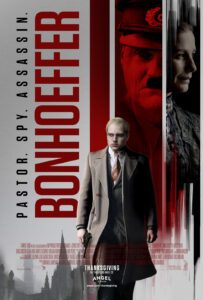 The film, which is beautifully shot and scored, but at times laden with clunky dialogue, begins with a glimpse into the domestic life of the Bonhoeffer family (warm and loving, and also tranquil until Dietrich’s beloved older brother Walter is killed in the Great War). Yet it largely focuses on Bonhoeffer’s involvement in a plot to assassinate Adolf Hitler, who became chancellor of Germany in 1933. The film flashes back and forth, from Bonhoeffer’s imprisonments in Buchenwald and Flossenbürg to the years preceding the war. It tells the tale of a young theologian whose participation in the 1944 plot to assassinate the Führer and overthrow the Nazi regime seems nearly inevitable. The flashbacks often muddle both the chronology and the film’s interpretation of Bonhoeffer’s de-contextualized words.
 Breger rightly notes that following World War II, neutrality had a negative connotation and was often seen as a form of collaboration with the Nazis. Countries like Switzerland, and to some extent Sweden, did not emerge from the war with their reputations fully intact. Consequently, for many years, Vatican neutrality has received little attention in academic literature. This volume, which spans from 1870 to 2020, helps to close that gap by examining various aspects of the Vatican’s neutrality over these 150 years. However, the main focus is on the Vatican’s neutrality as defined in the Lateran Pacts of 1929, which also established the city-state. Breger states the goal of the project thus: “This book will consider the interplay between two normatively disparate subjects – the concept of neutrality in international law and the concept of the Vatican as a neutral actor in international relations” (Breger xii). This review will provide a general overview of the volume, highlighting a selection of the thirteen essays rather than examining each one in detail. I will focus primarily on essays that fall more closely in my own research purview, which deals with Fascism, WWII and the immediate postwar years.
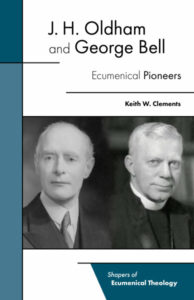 Christian internationalism has yet to find a secure place in the various histories of twentieth-century churches. Very largely this is due to a persistent emphasis on national categories and narratives, but denominational perspectives have also fashioned a great deal of what we expect to find in the foreground. All too often, Bell and Oldham may be observed, usually dutifully and briefly, hovering in the background of anything other than ecumenical surveys. In the final volume of the recent Oxford History of Anglicanism (OUP, 2019), Bell flits about here and there, but there is no very confident sense of where to put him for very long. Meanwhile, Oldham, the United Free Church layman, has almost vanished from ecclesiastical memory altogether. This is an authentic tragedy because it indicates how horizons have contracted across the western Protestant churches in the half-century since their deaths.
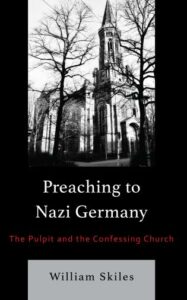 After setting his agenda in the introductory chapter, Skiles outlines in Chapter 2 the religious conflicts under National Socialism, and more specifically, the division in German Protestantism between the German Christian movement, which sought to align Protestant theology and praxis with Nazi ideology, and the Confessing Church. For Skiles, at the foundation of that conflict was “a profound disagreement about the nature of divine revelation,” (p. 28) with the German Christians claiming to find divine revelation in history, national identity, and racial “science.” By contrast, the Confessing Church, in the spirit of the Reformation, held to the doctrine that knowledge of God is to be found in scripture alone. This chapter provides important context as it guides the reader through some of the early milestones in the regime’s conflict with the Confessing Church: the controversy over the “Aryan Paragraph” of 1933, which excluded clergy of alleged Jewish heritage from the pastorate; the subsequent formation of the Pastors’ Emergency League, which formed the basis for the Confessing Church; and the issuing of the Barmen Declaration in 1934. Skiles also effectively challenges in this chapter two common and simplified interpretations: that the Confessing Church was an anti-Nazi resistance group, and that the Confessing Church’s conflict with the regime was essentially about ecclesiastical freedom.
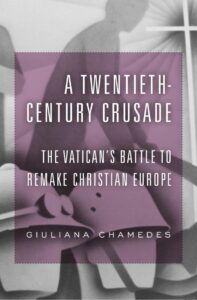 Chamedes summarizes the existing scholarship concerning the Church’s fight against communism and its willingness to collaborate with fascism. However, her insights about the fear of Western liberalism and materialism are novel and worth exploring further. For example, she cites Vatican archival records in which editor of the Code of Canon Law Eugenio Pacelli, future nuncio to Germany, Cardinal Secretary of State, and Pope, stated his fear that the U.S. entry into World War I was part of the campaign to secularize Europe. [2] The author argues that the Church perceived President Woodrow Wilson as determined to destroy the Church. As Chamades shows, the Church’s fear of liberalism lasted well beyond World War II. After World War I, the Church saw itself engaged in an existential struggle with liberalism, which explains its willingness to work with fascist regimes that opposed both liberalism as well as socialism.
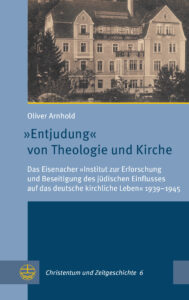 Ten years later, Arnhold has published a condensed version of his doctoral thesis. In 245 pages, he tells the history of the establishment of the largest research institute in the Third Reich that dealt with the so-called “Jewish question”. Promoted by the Thuringian German Christian Church Movement (Kirchenbewegung Deutsche Christen), the institute was opened at Wartburg Castle in Eisenach – one of the most important places for Protestants –in May 1939 with the intention of tracing and eliminating all Jewish influences within (Protestant) Christianity. The aim was to prove – on its own initiative, without state influence, supported by various Protestant regional churches and with the collaboration of renowned professors – that Jesus of Nazareth, and with him Christianity as a whole, had always stood in extreme contrast to Judaism. Jews, however, had distorted the true message of Jesus, which the Eisenach Institute was to bring to light again. Accordingly, some of the staff also saw themselves as completing Luther’s Reformation. Luther had liberated Christianity from the papacy in the sixteenth century. Now, under the rule of the “God-sent Führer” Adolf Hitler, the time had come to accomplish in full Luther’s Reformation and remove all alleged Jewish influences from Christianity. The message of Jesus and, indeed, his entire person were to be “de-Judaized” (entjudet) – nothing more and nothing less.
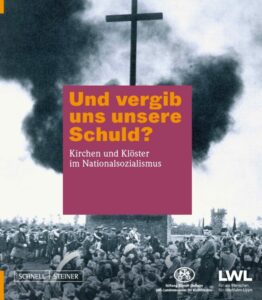 The exhibition is well-crafted, offering a thorough and balanced introduction to the history of the Christian churches under National Socialism. At its entrance, a placard lists the curators under the leadership of the Stiftung Kloster Dalheim’s director, Ingo Grabowsky, and the scholarly advisors, Oliver Arnhold of the University of Paderborn; Olaf Blaschke and Hubert Wolf of the University of Münster; Gisela Fleckenstein and Hermann Großevollmer of the Paderborn Archdiocese’s Commission for Contemporary History; Kirsten John-Stucke of the Büren-Wewelsburg District Museum; and Kathrin Pieren of the Westfalen Jewish Museum. As our readers know, Blaschke and Wolf have written extensively about the churches under Nazism. The placard also contains an impressive and extensive list of archives, museums, and libraries, encompassing cities, towns, and institutions across Germany that contributed to the exhibit. Interestingly, there is no mention of Bonn’s influential Commission for Contemporary History or the participation of any of its academic board members.
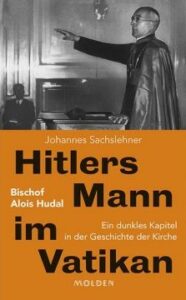 Sachslehner’s emphasis on Hudal’s early ambition, constant desire for recognition, and embarrassment over his heritage helps to explain both his career as well as his extreme commitment to German nationalism. Hudal’s contemporaries soon recognized his ambitions and accused him of sycophancy. Sachslehner suggests that this need for recognition contributed to Hudal’s völkisch and pro-National Socialist positions as well as his later commitment to a free Austria, even as he helped hunted war criminals to escape. Hudal grew up near Graz. Proving himself intelligent, he won scholarships to obtain a Catholic education, leading to his ordination in 1908 and to a doctoral degree in Old Testament Scripture in 1911. In 1914, the bishop of Graz sent Hudal to the Anima in Rome to continue his studies. Such appointments were considered a stepping stone to higher office in the Austrian church. Hudal helped to ensure that the leadership of the parish and the institute remained in Austrian hands despite German diplomatic efforts to change that. At the time, Hudal believed his only suitable further promotion was to the episcopal seat at Graz, whereas his bishop believed a university post in Graz was a sufficiently dignified position.
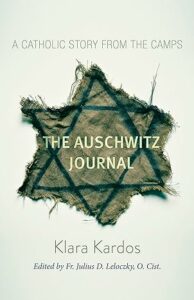 Much like Viktor Frankl’s Man’s Search for Meaning, in which Frankl made a conscious decision to fight to retain his humanity against all odds, Klara Kardos’ story features a similar decision. In Kardos’ case, though, her prayer life and her way of framing her persecution allowed her to detach herself from the day-to-day horrors she was experiencing. When Kardos was deported from the Szeged ghetto to Auschwitz, her spiritual director (a priest not named in full in the account) wrote of her walking to the deportation train as a “deportee of heroic spirit… with a triumphant smile on her face for the road of sufferings. Will she ever return to Szeged? Only God can say. We can only hope. But her heroic spirit that was shining from her soul showed the world that the soul, even in a body trampled underfoot, in the midst of ignominy, can be victorious over her oppressors…” (42). Kardos humbly remarks that the priest’s words were very idealistic, but she also confirms that the essence of his words describing her departure were true.