Contemporary Church History Quarterly
Volume 31, Number 4 (Winter 2025)
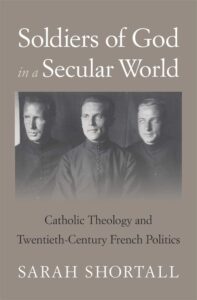
Review of Sarah Shorthall, Soldiers of God in a Secular World: Catholic Theology and Twentieth-Century French Politics. (Cambridge: Harvard University Press, 2021). pp. 338.
By Maria D. Mitchell, Franklin & Marshall College
Sarah Shorthall has written a sweeping, multidimensional account of the influence of French theology on twentieth- and twenty-first century European and global Catholic and policy, philosophy, and politics. In lucid, accessible prose, Shorthall traces seemingly esoteric debates among Catholic thinkers with real-world consequences for the anti-fascist resistance, Christian Democracy, existentialism, Liberation Theology, Negritude, the Second Vatican Council, and post-structuralism. By demonstrating religion’s ongoing significance to a dechurched Europe, this rich history punctures the false dichotomy of a secularized public sphere and religious private sphere to interrogate contemporary meanings of secularism.
Version 1.0.0
Catholicism’s fundamental challenge in the twentieth century – to define the Church’s role in a secularized public sphere – serves as a touchstone for French religious thought. In imagining an “authentically Catholic modernity” (5), theologians, like nationalists and socialists, excavated centuries of tradition to design new forms of public Catholicism that would defy “the logic of secular political taxonomies” (134). It was no coincidence that French theologians exercised outsized influence on European Catholicism; ironically, France’s expulsion of religious orders – the Jesuits in 1880 and Dominicans in 1903 – and the radical separation of Church and State in 1905 fostered the very conditions for theological renewal. Providing refuge for priests from across France and abroad, the Dominican exile at Le Saulchoir in Belgium and especially the Jesuit seminary on the Channel Island Jersey offered isolation, an extensive library, and protection for young theologians from Vatican control. Shaped by wartime “affective” bonds that facilitated intellectual daring, these seminarians-in-exile would lead a Catholic theological renewal known as the nouvelle théologie. That they ultimately helped engineer Vatican II and inspire Popes John Paul II, Benedict XVI, and Francis more than justifies Shorthall’s detailed treatment of their writings.
The nouvelle théologie emerged in the wake of the Modernist Crisis, a pre-World War I series of ecclesiastical battles resolved by papal sanctions on critics of neo-scholasticism, the reigning theology since Leo XIII’s revival of Thomas Aquinas’ teachings. Galvanized by their war experiences to adapt Catholicism to the postwar world, veterans led by Jesuit Henri de Lubac opposed the Thomist distinction between secular and religious affairs to advocate for an activist Church in the temporal order. After the 1926 papal condemnation of Action française ended dreams of restoring a confessional state, these nouveaux théologiens filled a vacuum in Catholic thought by framing the separation of Church and State as an opportunity to reclaim early Christianity’s opposition to secular power.
The relationship of the Church to the secular world was of more than theological consequence. In contrast to future Ambassador to the Vatican Jacques Maritain, who drew on the Thomist distinction between secular and religious affairs to justify support for Action française, the nouveaux théologiens would refuse collaboration with a Third Reich hostile to Christianity. Framing their rejection of Vichy as “counter-political” “spiritual resistance,” de Lubac and fellow Jesuits published the underground ecumenical journal, Témoignage chrétien, anonymously between 1941 and 1944. Censored by both Vichy and clerical officials, these new theologians would reject Nazi antisemitism as an attack on Christianity and prefigure Christian Democratic anti-totalitarianism by ascribing fascism to communism and liberalism. In refuting liberalism, they also forged their distinctive approach to personalism, the theory of the inherent dignity of the individual and bedrock of postwar Christian Democracy most closely associated with Maritain. Distinct from Maritain’s reliance on subsidiarity embedded in the Thomist separation of spheres, the nouvelle théologie proposed an ecclesiastical personalism whereby the “person at the heart of their vision was a collective rather than an individual one: the Church, conceived as the mystical body of Christ” (67).
Having provoked clerical authorities with their anti-fascist resistance, the nouveaux théologiens courted controversy in the postwar era for their openness to modern philosophy, particularly existentialism. In 1950, as Pope Pius XII condemned the nouvelle théologie in his encyclical Humani Generis of the same year, de Lubac would find himself in exile, stripped of his teaching and editorial positions, his theological works banned. Having spent the war years promoting a “missionary” Church, humanist socialism, the worker-priests movement, anti-imperialism, and nuclear disarmament, Dominican new theologians Marie-Dominique Chenu and Yves Congar would suffer a similar fate to de Lubac. (In response to his punishment, “Congar apparently urinated on the outer wall of the Holy Office during a visit to Rome” [230].) Despite – or perhaps due to – the Vatican’s best efforts, the new theology continued to exercise considerable influence, including on Africans, Asians, and Latin Americans studying in France, among them future Negritude leader Léopold Ségar Senghor and the founders of Liberation Theology.
Of arguably the greatest consequence for postwar Catholicism, the nouvelle théologie spread through Germany, Switzerland, the Netherlands, Belgium, and Luxembourg to guide European theology students, a number of whom, including future popes, were instrumental at the Second Vatican Council. The “resurrection” (221) of the nouvelle théologie began in 1958 with the papacy of John XXIII, a former nuncio to France and admirer of de Lubac’s ressourcement project to reclaim early Christian sources. De Lubac, Chenu, and especially Congar would play determinant roles in drafting and rewriting the Council’s final doctrinal pronouncements and constitutions. Inconceivable just a decade before, the nouvelle théologie‘s support for ecumenicism and understanding of the Church as historically contingent made possible the Vatican’s revolutionary reappraisals of Judaism and religious liberty.
In sanctioning the nouveaux théologiens for engaging with secular thinkers, Pius XII identified a striking feature of twentieth-century Catholic theology – its proximity to and interplay with contemporary philosophy and thought. If Hegel enjoyed a postwar renaissance in large part due to Catholic thinkers, Christian existentialism emerged, in the view of Jesuit new theologian Jean Daniélou, as “one of the two dominant strands of [postwar] Catholic thought” (184). In her evocative epilogue surveying the new theologians’ impact on contemporary thought, Shorthall identifies the influence of the nouvelle théologie on, among others, Radical Orthodoxy proponents John Milbank and William Cavanaugh, Charles Taylor and contemporary philosophy’s “philosophical turn,” and Wendy Brown’s and Talal Asad’s biopolitical criticism of human rights. Significantly, Shorthall sees de Lubac’s rejection of the distinction between the natural and supernatural ends of life as fundamental to Asad’s groundbreaking work on secularism.
Richly sourced and carefully argued, Soldiers of God in a Secular World models a creative yet rigorous approach to intellectual history, even as, in a reflection of methodological diversity, social and cultural historians may long for broader historical context. It is difficult, for example, not to read the rebelliousness of young exilic theologians, who mockingly rejected their teachers’ rigidity and traditionalism, through the lens of the larger post-World War I generational revolt. And while Shorthall adroitly links the theologians’ deep friendships to their war experiences, readers may wonder how those relationships evolved, not least during years of Vatican persecution. Gender remains largely unthematized, especially in discussions of Catholic Action, personalism, and the “spiritual resistance,” where significant female participation in the Témoignage chrétien and interconfessional rescue operation Amitié chretiénne (125) alone recommends extended analysis. That the Dominican new theologians’ support for workers’ rights, nuclear disarmament, and anti-colonialism excludes gender equality suggests the value of investigating the nouvelle théologie‘s relationship to postwar Europe’s social revolutions. Finally, Catholic cooperation with Protestants, isolated examples of which appear throughout the text, raises the profile of interconfessionalism, particularly in light of the Vatican II Decree on Ecumenicism. (Unsurprisingly, Udi Greenberg draws extensively on Shorthall’s work in his recent history of twentieth-century ecumenicism.) As Catholic theology transformed the non-theological world, pushing the inverse beyond adumbration would have deepened the author’s argumentation.
Sarah Shorthall has nonetheless produced an impressive book with notable interdisciplinary appeal. Those focused on Catholic thought and politics will appreciate her clear guide to complex theological debates, and all readers should take seriously the lineage of Vatican II doctrines in light of Catholicism’s global reach and meaning. Of broadest import are the questions Shorthall poses about relationships between theology and philosophy and between religious and secular thought. If the debates that consumed twentieth-century Catholic theologians determined and were shaped by European thought, and contemporary philosophy remains imprinted by the nouvelle théologie, where does the purported boundary between theology and philosophy lie? What are the larger implications of distinguishing between secular and Catholic thought? By foregrounding these fundamental inquiries, Shorthall has made a significant contribution to our understanding of twentieth-century European history.
