Contemporary Church History Quarterly
Volume 31, Number 4 (Winter 2025)
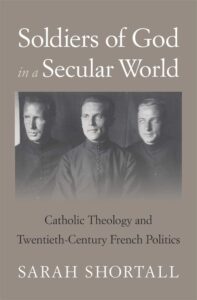
Review of Sarah Shorthall, Soldiers of God in a Secular World: Catholic Theology and Twentieth-Century French Politics. (Cambridge: Harvard University Press, 2021). pp. 338.
By Maria D. Mitchell, Franklin & Marshall College
Sarah Shorthall has written a sweeping, multidimensional account of the influence of French theology on twentieth- and twenty-first century European and global Catholic and policy, philosophy, and politics. In lucid, accessible prose, Shorthall traces seemingly esoteric debates among Catholic thinkers with real-world consequences for the anti-fascist resistance, Christian Democracy, existentialism, Liberation Theology, Negritude, the Second Vatican Council, and post-structuralism. By demonstrating religion’s ongoing significance to a dechurched Europe, this rich history punctures the false dichotomy of a secularized public sphere and religious private sphere to interrogate contemporary meanings of secularism.
Version 1.0.0
Catholicism’s fundamental challenge in the twentieth century – to define the Church’s role in a secularized public sphere – serves as a touchstone for French religious thought. In imagining an “authentically Catholic modernity” (5), theologians, like nationalists and socialists, excavated centuries of tradition to design new forms of public Catholicism that would defy “the logic of secular political taxonomies” (134). It was no coincidence that French theologians exercised outsized influence on European Catholicism; ironically, France’s expulsion of religious orders – the Jesuits in 1880 and Dominicans in 1903 – and the radical separation of Church and State in 1905 fostered the very conditions for theological renewal. Providing refuge for priests from across France and abroad, the Dominican exile at Le Saulchoir in Belgium and especially the Jesuit seminary on the Channel Island Jersey offered isolation, an extensive library, and protection for young theologians from Vatican control. Shaped by wartime “affective” bonds that facilitated intellectual daring, these seminarians-in-exile would lead a Catholic theological renewal known as the nouvelle théologie. That they ultimately helped engineer Vatican II and inspire Popes John Paul II, Benedict XVI, and Francis more than justifies Shorthall’s detailed treatment of their writings.
