Contemporary Church History Quarterly
Volume 31, Number 4 (Winter 2025)
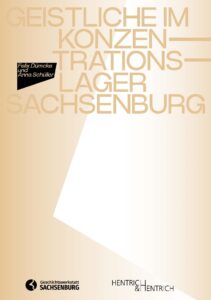
Review of Felix Dümcke and Anna Schüller, eds., Geistliche im Konzentrationslager Sachsenburg. Berlin, and Leipzig: Hentrich & Hentrich, 2023.
Dirk Schuster, University of Vienna
Hardly anything has had such a lasting impact on (theological) church historiography on the churches in the Third Reich as the narratives of imprisoned clergymen. Over decades, these narratives about them have emphasized resistance, victimization, and the trope of the apologetic martyr. As is well known, clergymen were imprisoned in concentration camps for various reasons in the early years of Nazi Germany. One of these early concentration camps was the KZ Sachsenburg, in what is now the German federal state of Saxony. However, these early concentration camps differed greatly in structure and size from the later systematically planned concentration camps such as Sachsenhausen, Buchenwald and Auschwitz.
 Against the backdrop of rampant right-wing extremism in Saxony, it is all the more surprising that the government of Saxony does not wanted to provide any money to renovate the remaining buildings of the Sachsenburg concentration camp for an on-site memorial.[1] Apparently, the Saxon government no longer saw the need to draw attention to the horrors of National Socialism in the early years as situated in an authentic site. Or perhaps they were simply too cowardly to face up to the anticipated outraged reactions of the far-right AfD Party (which are sure to follow) if they were to make funds available for the creation of an appropriate memorial. After all, it can’t be down to the cost amount; we are talking about just over one million missing Euros out of an estimated five million for the construction measures. Fortunately, at the end of June this year, the Saxon state government decided at the last minute to provide the missing funds after all.
It is therefore all the more pleasing that PhD student Felix Dümcke and high school teacher Anna Schüller—since August 2025 Schüller is also coordinator of the Leipzig democracy project Erich-Zeigner Haus—have contributed to the history of this early concentration camp with their anthology, for which they were able to attract renowned academics such as Rebecca Scherf, Manfred Gailus, Oliver Arnhold, and Olaf Blaschke, each with their own papers. The reason for this book and its special focus is that, compared to other concentration camps (especially during the first years of the Third Reich), a relatively large number of clergymen were in “protective custody” (Schutzhaft) at the Sachsenburg concentration camp: eighteen Protestant pastors, three Protestant vicars and two Catholic priests. With their book, Dümcke and Schüller want to shed more light on a marginalized group among the prisoners, as up to now the political prisoners (communists, trade unionists and social democrats) have been dealt with almost exclusively.
The biographies of the clergymen are reproduced in around one hundred pages, followed by interviews with family members and their perspectives on this part of their own family history. Anna Schüller herself has written an extremely informative paper that summarizes the history of the clergymen in the camp in a condensed form. Their arrest and imprisonment in the spring of 1935 was a reaction by the Saxon Gauleiter Martin Mutschmann (1879–1947) to the pulpit proclamation by Saxon pastors against the German Faith Movement (Deutsche Glaubensbewegung) initiated by Jakob Wilhelm Hauer. However, local conflicts were also the reason for the imprisonment of some clergymen. The Protestant clergymen had their hair shorn in the concentration camp, and they had to wear prisoner’s clothing and perform hard physical labor in the quarry or in road construction. Interestingly, none of this was applied to the two Catholic priests: they were able to continue wearing their clerical uniforms and were also exempt from forced labor.
The fact that the clergy only remained in “protective custody” for a relatively short time was due to national and international pressure: religious representatives from the USA and the Netherlands visited the prisoners and the international press reported extensively on their fate. Signatures were also collected in Germany calling for their release, pastors expressed their solidarity and intercessions were held. The actual reason for the relatively quick release of all the clergymen still imprisoned on June 4, 1935, was the negotiations between Britain and Nazi Germany over the so-called Naval Agreement: international church representatives exerted pressure on politicians in England, so that Reich Interior Minister Wilhelm Frick felt compelled to enforce the release of the clergymen against the wishes of Gauleiter Mutschmann so as not to jeopardize the naval agreement negotiations. This clearly shows that it was quite possible to stand up for concentration camp inmates within the Third Reich and that there was also enough leverage at the foreign policy level to force the Nazi leadership to make concessions.
In their paper, Mike Schmeitzner and Swen Steinberg analyze the reporting, especially abroad, on the imprisonment and release of the clerics. This contribution also clearly shows that it was possible to exert influence on political decisions through media pressure. In the end, Gauleiter Mutschmann was forced to abandon his aggressive stance towards representatives of the Confessing Church, as he had to submit to the instructions of Reich Interior Minister Frick.
The aforementioned Scherf, Gailus, Arnhold and Blaschke round out the anthology with historical classifications, enabling even readers who are not familiar with all the details to place the subject of the anthology in its historical and church-political context. The statistics that Scherf mentions in her contribution are remarkable: during the Third Reich, a total of seventy-one Protestant clergymen were imprisoned in concentration camps (243). If one recalls how many books have been written (and are still being written) about the persecution of church representatives since 1945, an extreme one-sidedness of church historiography becomes apparent. Between 1933 and 1937, 368 named Jehovah’s Witnesses were imprisoned in Sachsenburg concentration camp alone. It is time that this group of victims also received the same attention from researchers as those seventy-one clergymen have received for the past eighty years.
However, this should in no way relativize the importance of this anthology. This book gives voices and faces to a small number of the prisoners of the Sachsenburg concentration camp and offers an excellent insight into the religious and power politics of the Third Reich on a regional level. In addition—and this should also be expressly emphasized—this volume impresses with its graphic design. Conclusion: very readable and informative!
Notes:
[1] https://www.frankenberg-sachsen.de/Bildung-Kultur/gedenkstaettesachsenburg/
