Contemporary Church History Quarterly
Volume 31, Number 4 (Winter 2025)
Letter from the Editors (Winter 2025)
By Lauren Faulkner Rossi, Simon Fraser University
Dear Friends,
Warmest Christmas greetings to our editors and readers. It has been a remarkable, productive, and very busy year for Contemporary Church History Quarterly, and I am pleased that we can once again finish on a strong note, with this final, somewhat tardy issue of the year stocked with varied contributions from several of our editors. Looking forward to 2026, I know that our journal will continue to be active and productive and, no doubt, relevant in ways both anticipated and unexpected.
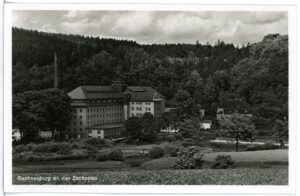
Sachsenburg Concentration Camp (1933). By Brück & Sohn Kunstverlag Meißen – Own work, CC BY-SA 3.0, https://commons.wikimedia.org/w/index.php?curid=52763635
Maria Mitchell examines Sarah Shorthall’s recent monograph about the impact of French Catholic theology on French politics in the twentieth century. She notes that Soldiers of God in a Secular World is wonderfully interdisciplinary and carefully researched, and constitutes a clear guide to complicated questions that have historical contexts but that continue to resonate, particularly about the relationship between religion and philosophy, and religious and secular thought.
Martina Cucchiara takes on a prize-winning article written by Mónica García-Fernández published some three years ago in Contemporary European History, about emotions and love in Francoist Spain. García-Fernández explores the role of the Catholic Church as the enabler of Franco’s regime, and argues that ultimately such questions about marriage and divorce, particularly after the Second Vatican Council, concerned religious freedom, human rights, and democracy.
Martin Menke’s review of Jan Wille’s 2024 study of the Reichskonkordat details the significance of this most recent foray into the history and continued relevance of the 1933 concordat between the German state and the Vatican. A reworking of his doctoral dissertation, Wille’s contribution to the Kommission für Zeitgeschichte’s Blaue Reihe is useful in the attention it gives to the concordat’s utility after 1945, in particular the various political powers operating in defeated Germany and their different views on what the concordat could provide for them. Menke’s second contribution to this issue features a film review, though unfortunately not a film that he feels comfortable in recommending. He spares little criticism for Escape from Germany, a recent, rather fanciful treatment of American Mormon missionaries fleeing from Nazi Germany in 1939, which he notes bears almost no resemblance to the actual historical narrative.
Dirk Schuster also gives us two contributions for this issue. His first review focuses on Felix Dümcke and Anna Schüller’s edited volume about the Sachsenburg concentration camp, in Saxony. Featuring articles from major scholars such as Olaf Blaschke, Rebecca Scherf, and CCHQ’s own Manfred Gailus, Dümcke and Schüller’s anthology highlights the high number of imprisoned clergymen in the camp, and pursues questions about the religious and political dynamics on a regional level within the Third Reich. Schuster’s second piece is an article note about an innovative digitization project involving wartime letters written in Finland between 1939 and 1944 (a period in which Finland fought three separate wars). Schuster’s enthusiasm for the technology employed by the War Letter Collection of the Tampere University Folklife Archives – the article’s four authors highlight a computer application’s ability to scan handwriting for key terms – is discernable and timely, as he raises questions about the ever-evolving use of technology in academic research and writing, especially the advent and growth of AI. He sounds an optimistic note, echoing the Finnish scholars he’s writing about, when he insists that using such technology is not a replacement for more traditional methods of research, but an expansion of our abilities to work through and organize our sources.
As ever, I invite you, the reader, to let us know about any major conferences, exhibitions, websites, or films that we should know about to review, by contacting me directly.
On behalf of my associate editors and the editorial board, I wish you all a Christmas season and new year full of peace and blessings both large and small,
Lauren Faulkner Rossi,
Simon Fraser University
